


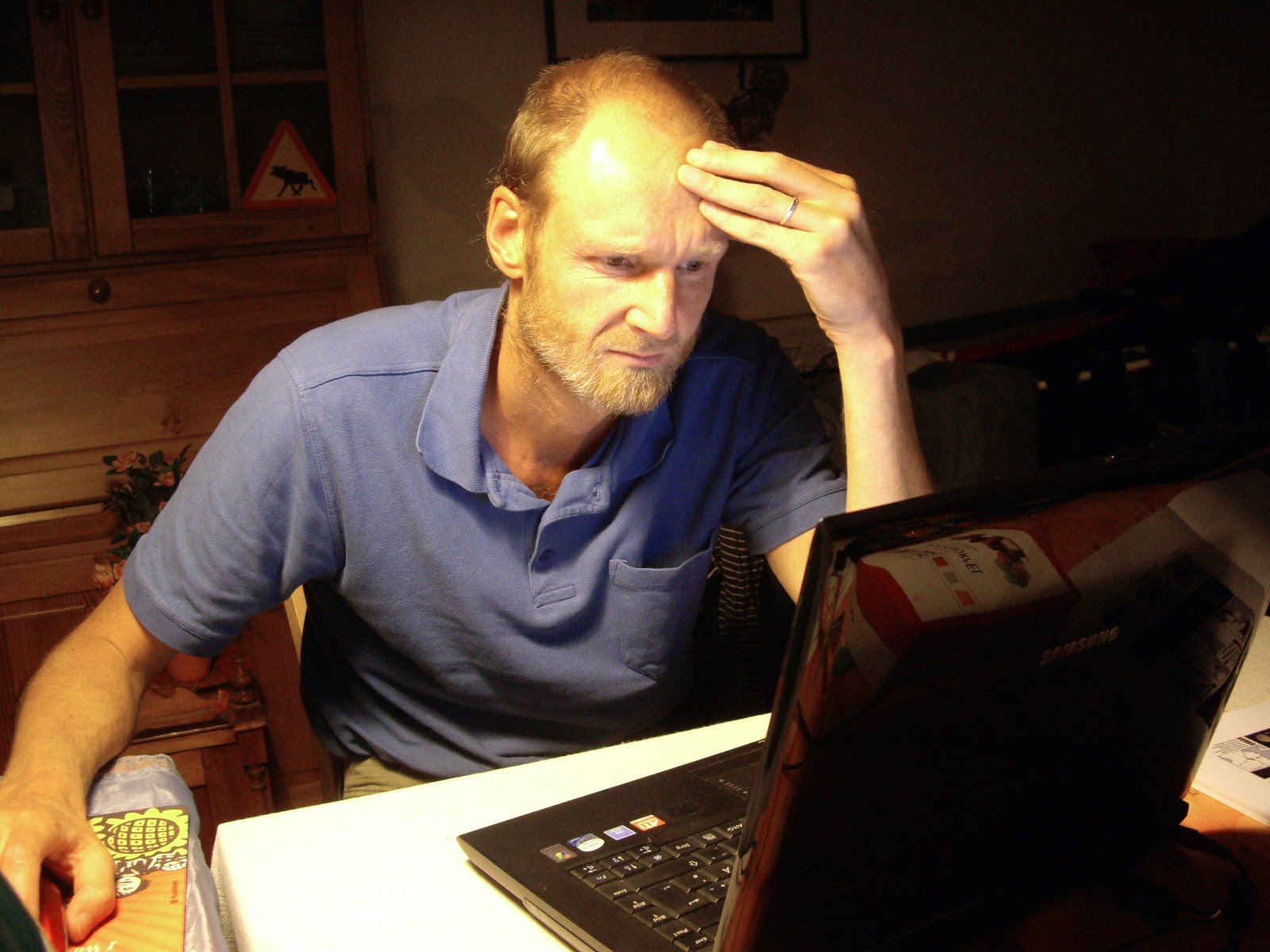
 This week, we feature one of our colleagues from “across the pond,” as we like to say. Meet Dr. Francisco Welter-Schultes, whose many accomplishments include studying mollusks at the University of Goettingen, initiating and running the AnimalBase project, and, last but certainly not least, participating in the BHL-Europe project!
What is your title, institutional affiliation, and area of interest?
I am a biologist interested in terrestrial molluscs of Europe, working in or affiliated to the University of Goettingen, Germany (I have a small office there and sometimes I am also paid…). Like many researchers in the field of taxonomy and species identification, I had to collect a lot of literature to get to know what many others did before I came in. In passing by I became skilled in writing bibliographies and finding literature. In 2003 I initiated the AnimalBase project to scan literature (from Goettingen Library resources) and create a database to link zoological names with their original descriptions.
How long have you been in your field of study?
First systematic fieldwork in 1985; scientifically since 1990.
When did you first discover BHL?
Must have been in 2005 or 2006. It was part of my job to check if literature was already online somewhere else so that we would not need to scan it in the AnimalBase project. I guess I must have been one of the first regular users of BHL.
What is your opinion of BHL and how has it impacted your research?
My mollusc research became much faster and more efficient since I have been able to check sources online. Not only BHL, also Google Books and other providers, and of course sources provided by BHL-Europe consortium members including our own content (Goettingen), which we hope will some day be accessible in one big portal. Before 2005 I had to go to the library and order book by book, implying delays of several days between research actions. Today this goes much faster. About 70% of the sources I currently need to verify in my mollusc research are BHL sources. I use Google Books only if BHL does not have the title (or if the title does not show up in my BHL search).
How often do you use BHL?
Practically every day of work.
How do you usually use BHL (read the titles online/download whole PDFs/Select Pages to Download for a custom PDF/etc.)?
I usually read the titles online. I usually know exactly what I am looking for. In most cases it’s only checking one or two pages in a title (I know exactly which ones) and then closing the site. The BHL website does not work well on my notebook, and the PDF download function does not work.
What are your favorite features/services on BHL?
A very good default search function – very efficient; I really like it. Page level scrollbox in the online viewer, very useful. Makes my work really quick. I provide links to BHL resources from the AnimalBase website and appreciate that BHL links to items have been stable from the beginning on. I also appreciate very much that BHL is very rarely offline!
If you could change one thing about BHL, what would it be, or what developmental aspect would you like the BHL team to focus on next?
- Improving bibliography metadata (journal volume numbers and years) and most important: page-level metadata. Missing plate numbers and Roman pages in the page-level metadata are a big problem. The page-level scrollbox is very important for my work.
- Online book viewer should be faster; black and white text pages should be shown instead of brown on tan.
- “Scanning more pages” is too easily said, and such a suggestion would not be a good guide for you. “Filling the gaps in serial runs” would be a more useful approach. Actually this is the contrary of “scanning more pages” because identifying gaps in serial runs and scanning single journal volumes is much more expensive than simple and brainless mass digitisation.
If you had to choose one title/item in BHL that has most impacted your research, or one item that you prefer above any other in BHL, what would it be and why?
There are some titles that I consult repeatedly, which are simply the important monographs of European terrestrial Malacology of the late 1880s (Westerlund 1884-1890 and Pfeiffer’s Monographia Heliceorum 1848-1877). Boring for the non-insider. From my experience in researching rare titles I have occasionally found really rare titles in BHL, about which I was very surprised and happy! They were titles I had found to exist only in very few libraries in the world, and I had not suspected BHL had them. These were real BHL highlights.
Thank you, Dr. Welter-Schultes, for giving us a brief glimpse into your life, work, and relationship with BHL! Improving our page-level metadata is certainly a priority for us, and, slowly but surely, we are making our way through the millions of pages in our collection. If there are specific titles for which you’d like to see the pagination improved, please let us know via our Feedback Form! Similarly, as we work to fill gaps in our collection, if there are any specific volumes from specific titles that you’d like us to add, please don’t hesitate to let us know as well.
To learn more about Dr. Welter-Schultes, visit his website. Be sure to check out the BHL-Europe website as well! We look forward to future collaborations and the opportunity to share our resources with our friends on the continent and around the world!
