
This week for our book of the week, we feature a title that Charles Darwin himself called “one of the great monuments of science in the 19th century.” The book? Voyage dans l’Amérique Méridionale(1835-47), by Alcide Dessalines d’Orbigny. The work chronicles d’Orbigny’s travels to South America for the Paris Museum from 1826-1833. As a result of this voyage, d’Orbigny returned to Paris with more than 10,000 natural history specimens.
Alcide d’Orbigny was a French naturalist born in 1802 that studied a variety of fields including zoology, paleontology, geology, archaeology, and anthropology. He was born to a ship’s physician and naturalist, which made his choice of occupation a natural one. When his family moved to La Rochelle in 1820, d’Orbigny’s interest in natural history was nourished as he began to study the marine fauna in that area. Shortly thereafter he moved to Paris, where he closely studied the work of Georges Cuvier.
d’Orbigny’s mission to South America included visits to Brazil, Argentina, Paraguay, Chile, Bolivia, and Peru. d’Orbigny described some of the 10,000 specimens he collected in our book of the week, Voyage dans l’Amérique Méridionale, which was published in 90 fascicles. As mentioned, Darwin highly praised the work, and d’Orbigny even named select species after him. For instance, the common name of Rhea pennata is Darwin’s Rhea.
After 1840, d’Orbigny focused his attention on fossils, publishing two important titles on the subject between 1840 and 1850. In 1853, he became a professor of paleontology at the Muséum National d’Histoire Naturelle in Paris. The position of Chair of Paleontology was created especially for him, and his geological timescales and strata are still used today as chronostratigraphic reference.
For our post, we’re featuring some of the species that d’Orbigny described as a result of his voyage to South America, particularly those contained in v.9 of the title. You can see all of the images from this volume on our Flickr site, and be sure to check out a few of the other volumes from the title that we have in BHL.
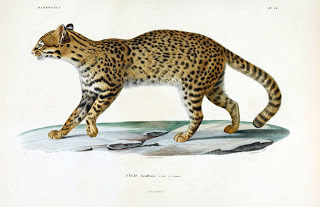 Geoffroy’s Cat Leopardus geoffroyi: A wild cat found in Southern and Central South America that is about the size of a domestic house cat. While fairly abundant, issues over land-use changes in its habitat, as well as intense international fur trade in the 1960s-80s, results in this species being listed as “Near Threatened” by the IUCN.
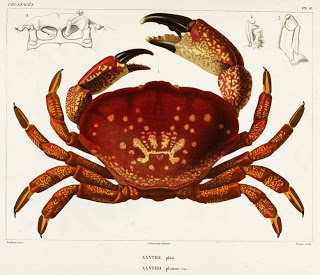 Xantho planus: A crab species of the family Xanthidae, the largest crab family in terms of species richness, with 572 species and 133 genera. Species of Xanthidae are commonly called mud crabs, pebble crabs or rubble crabs. They are poisonous, containing a toxin, similar to that produced by puffer fish, for which there is no antidote and which is not destroyed by cooking.
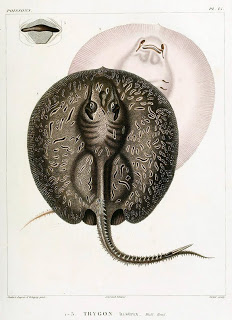 Porcupine River Stingray Potamotrygon hystrix: This species is found within marshy, freshwater zones of the Paraná-Paraguay River basin. When it remains perfectly immobile, partially covered by sand, and exercising homochromy (a process of protective coloration that allows the animal to blend into its environment), this species is practically undetectable to the eye. Its tail contains 1 or more spines, which are covered in a toxic mucus that inflicts painful wounds.
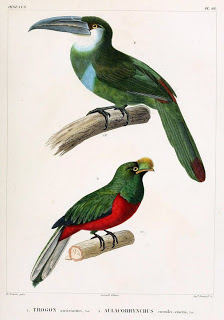 Blue-banded Toucanet Aulacorhynchus coeruleicinctis – Top Figure: This species of Toucanet lives in Bolivia and Peru. Members of the Toucan family, Toucanets are near-passerine or high land-birds, meaning that they are arboreal birds believed to be related to true passerines. Passerines, which are of the order Passeriformes, include more than half of all bird species, with over 5,000 identified species. This is approximately twice as many species as that contained in the largest mammal order, Rodentia, and, with over 110 families, it has the second most families of any order of vertebrates, after Perciformes (bony fish).