
Biodiversity Heritage Library - Program news and collection highlights from BHL
  • Home
  • News
  • Featured Books
    • All Featured Books
    • Book of the Month Series
    • BHL at 20
  • User Stories
  • Campaigns
    • Fossil Stories
    • Garden Stories
    • Monsters Are Real
    • Page Frights
    • Her Natural History
    • Earth Optimism 2020
  • Tech Blog
  • Visit BHL
Home
News
Featured Books
    All Featured Books
    Book of the Month Series
    BHL at 20
User Stories
Campaigns
    Fossil Stories
    Garden Stories
    Monsters Are Real
    Page Frights
    Her Natural History
    Earth Optimism 2020
Tech Blog
Visit BHL
  • Home
  • News
  • Featured Books
    • All Featured Books
    • Book of the Month Series
    • BHL at 20
  • User Stories
  • Campaigns
    • Fossil Stories
    • Garden Stories
    • Monsters Are Real
    • Page Frights
    • Her Natural History
    • Earth Optimism 2020
  • Tech Blog
  • Visit BHL
Biodiversity Heritage Library - Program news and collection highlights from BHL
Blog Reel, User Stories

BHL and Our Users: Gil Taylor

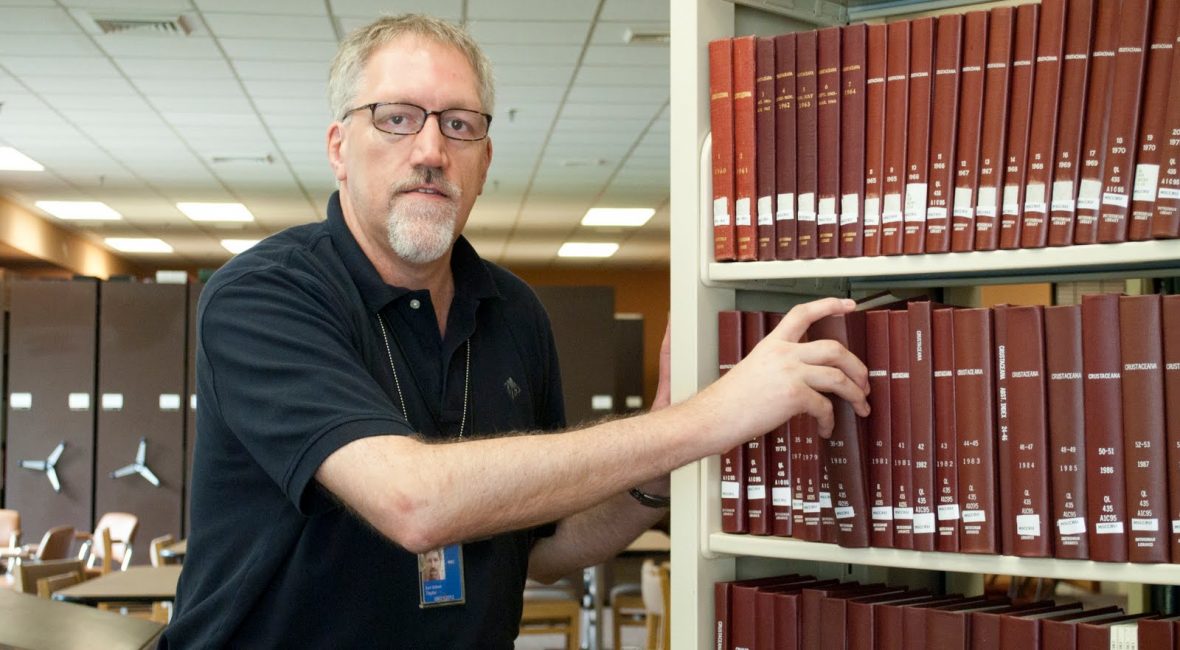
View Full Size ImageEver wondered how BHL decides what to scan? There are a variety of avenues that staff use to select titles for digitization, including scan requests submitted by users, BHL member publications and subject strengths, botany and zoology priority titles, in-copyright titles for which BHL has received permission to scan, and titles identified by BHL staff members as important biodiversity works. To accomplish the latter, the librarians at various BHL institutions play a key role. Their expertise and interaction with library patrons ideally situates them to inform collection development for the BHL project.

This week, we feature one of these individuals, Gil Taylor, librarian at the Smithsonian Institution Libraries. He regularly uses day-to-day work within the library and conversations with patrons to suggest important works for BHL to digitize, and his enthusiasm for and promotion of the project ensures that anyone coming into contact with the Smithsonian Libraries is made aware of the wealth of information available within the BHL collection.

What is your title and institutional affiliation?

I’m assistant department head at the Smithsonian’s National Museum of Natural History’s Natural and Physical Sciences department. Recently I have been overseeing the Entomology and Invertebrate Zoology (IZ) libraries at the NMNH, along with Museum Support Center Library, in Suitland, MD. I have been at the SIL since 1990.

How long have you been working in a library environment?

Nearly 30 years. Before coming to SIL, I worked full time in a number of libraries and technical services at the University of Maryland, College Park, where I also received my MLS in 1989. I came aboard in the library world just as the OPAC was superseding the card catalog, and to me it was particularly interesting, especially as you could access the catalog remotely. I felt like I was cutting-edge back in the 1980’s as I was the only one in my library school cataloging class who typed up sample cards using an Apple II and a dot matrix printer instead of using a typewriter.

When did you first discover BHL?

I feel as if I witnessed its birth, as it grew out of SIL’s Biologia Centrali -Americana project.

What is your current level of involvement in BHL?

I serve on SIL’s BHL Task Force and try to identify needs BHL can fill for our researchers. I was very happy to be on board with BHL as the Entomology and IZ Libraries here were among the first SIL libraries to be “harvested” for BHL. But, I primarily I see myself as a BHL evangelist, taking every opportunity to expound on what a great, quality non-profit effort It is. I believe it’s utterly central to the librarian ethos to make every effort to share the knowledge you’re charged with curating.

What is your opinion of BHL and what impact has it had on your duties as a librarian?

From a front-line reference librarian perspective, it has been a real boon. Our staff members sometimes take particular delight in responding to ILL queries for our materials by pointing to their availability in BHL. Not having to painstakingly copy materials, sometimes from old volumes with fragile bindings, is a huge time-saver.

How often do you use BHL?

When doing reference work, almost every day.

What has been the reaction of your patrons to BHL?

I remember the initial skepticism from staff and users that the image quality of scans would not be good enough for serious taxonomic identification work. When users know they have access to original scans in a very lossless format, I have rarely come across a patron who was dissatisfied with what they have downloaded from BHL. For older curators and volunteers, their first time in utilizing BHL can seem almost magical in its instant gratification.

What services/features do you like most about BHL and which do you most like to point out to your patrons? Which services/features are your patrons most excited about/use the most often?

There is no one specific feature that I point out routinely, but I emphasize to patrons that because BHL is nearly a grass-roots effort, all suggestions and feedback for its improvement are taken seriously and can really make a difference. We can clearly see this, for example, as BHL continually tweaks its UI. Compare this to attempting to get the attention of a vast information services conglomerate.

If you could change one thing about BHL, what would it be, or what developmental aspect would you like the BHL team to focus on next?

I think some work needs to be done on correcting OCR, as this can be a problem when exporting content to mobile platforms. One researcher here recently inquired about how to access BHL content on an iPad while he is in a deep-sea submersible.

I think I (and others) would like to have the ability to upload a list of citations from a researcher and have BHL automatically link to corresponding content. This seems almost like a science fiction fantasy for a librarian, but I think it is within the reach of developers.

The BLE virtual exhibition of BHL content that BHL-Europe is experimenting with seems like a terrific way to package and serve content in literally spicy, creative ways. This is the customized library subject guide of the future.

As I also answer or direct public e-mail queries at SIL, I see a lot of requests for images. Further indexing of images through pattern recognition, etc. could dramatically widen the BHL’s audience.

Is there a specific item on BHL that is most often requested by your patrons/that you use more than any other to fulfill ILL requests?

For the public, but also from SI researchers, the mostly 19th century, legacy Smithsonian-published materials (annual reports/bulletins of the USNM, Bureau of Ethnology, etc.) are particularly popular.

Thank you, Gil, for all the work you do for BHL and for the critical contributions you make to the development and dissemination of the project. And we send a special thanks to all our librarian colleagues who make BHL run like such a well-oiled machine!

December 20, 2011by ulib-libraryjobs

Help Support BHL

BHL's existence depends on the financial support of its patrons. Help us keep this free resource alive!

search

About BHL

The Biodiversity Heritage Library (BHL) is the world’s largest open access digital library for biodiversity literature and archives. BHL operates as a worldwide consortium of natural history, botanical, research, and national libraries working together to digitize the natural history literature held in their collections and make it freely available for open access as part of a global “biodiversity community.”

Join Our Mailing List

Sign up to receive the latest news, content highlights, and promotions.

Subscribe Now

Subscribe to Blog via Email

Enter your email address to subscribe to this blog and receive notifications of new posts by email.

Join 319 other subscribers

Subscribe to Blog Via RSS

Subscribe to the blog RSS feed to stay up-to-date on all the latest BHL posts.

Access RSS Feed

Inspiring Discovery through Free Access to Biodiversity Knowledge.

The Biodiversity Heritage Library makes it easier than ever for you to access the information you need to study and explore life on Earth…for free, anytime, anywhere.


64+ Million Pages of
Biodiversity Literature Online.

EXPLORE

Tools and Services
to Transform Research.

EXPLORE

300,000+
Illustrations on Flickr.

EXPLORE

ABOUT | HARMFUL CONTENT | PRIVACY | SITE MAP | TERMS OF USE