

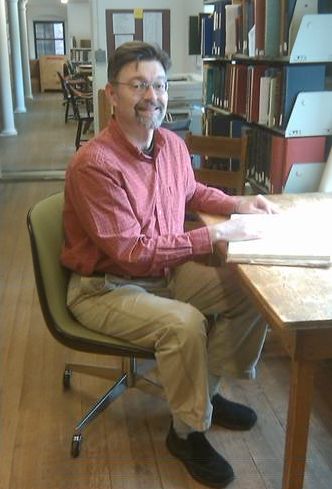

I am a Metadata Librarian for the Biodiversity Heritage Library based at the Ernst Mayr Library, Museum of Comparative Zoology, Harvard University. Under the auspices of Harvard librarians Connie Rinaldo and Joe DeVeer, I am responsible for complex cataloging of the MCZ Library’s significant natural history literature collection within Harvard’s integrated library system (known as HOLLIS) in order to provide precise bibliographic records that are imported to the BHL portal via XML pages. In order to accomplish this and to facilitate comprehensive intellectual access, I enhance minimal-level records to provide in-depth bibliographic descriptions, as well as name, series and subject authority control according to international, national and local Harvard standards. I also resolve problems of incorrect, incomplete or conflicting bibliographic and authority data in order to facilitate navigability to content in HOLLIS and the BHL portal.
I see my job as a blend of “old” and “new” librarianship skills – I catalog in MARC, but I help facilitate knowledge accessibility for the Harvard community through HOLLIS and for the BHL community through the BHL portal, although all communities can partake of each other’s public finding aids. My goals are to improve ease of access for all biodiversity and natural history researchers through the promotion of accurate and complete digital catalog records. The BHL taxonomy provides important search capability, but providing subject access and links to BHL records through HOLLIS provides another avenue for search means and provides facilitation for improved research use. This access is influenced by information organization and cataloging relationships, which I endeavor to provide.
For various reasons, quite a few bibliographic records in HOLLIS have not been upgraded to local, national or international standards. The Harvard libraries’ 19th and 20th century card catalog records were retrospectively converted into digital online catalog records during the 1990s, but considering there are over 13 million entries within HOLLIS, many of these records contained less-than-full information, what are colloquially known as core-level or “stub” records. These records were always meant to be temporary at best – just a placeholder where a record might contain a main entry and title, and a holding location, but very little else.
One example of this is shown here, a two-volume text and atlas set of the paleontologist Fridolin von Sandberger’s work, Die Land-und Süsswasser-Conchylien der Vorwelt, published in 1875:
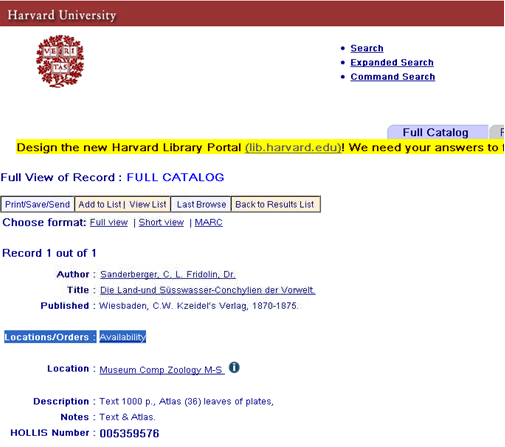
This record exhibits very basic and incomplete information; there is author, title and publisher information, a physical description in terms of number of pages, a perfunctory general note, the HOLLIS record number, and the holding location here at the Ernst Mayr Library. All well and good, but obviously this record has a few problems. Besides the need to link the entry to its corresponding BHL record, there are no subject headings, there is a bibliography and index that needs to be noted, punctuation and physical descriptors need to be upgraded to contemporary cataloging rule standards (i.e., Anglo-American Cataloging Rules, 2nd ed., etc.), and most egregiously, the author’s name is misspelled!
To rectify these problems, I employed a few steps. I first checked OCLC (Online Computer Library Center) through its Connexion program to see if there were more complete records held by other reputable repositories. In this case there was a good one, so I overlaid the new record via a Z39.50 protocol over the original incomplete record in HOLLIS. I then compared the bibliographic information with the scanned BHL version of the book; if necessary, I sometimes consult the physical copy from our Library stacks. I then made necessary changes to the record to reflect the Library’s holding. I also consulted the Library of Congress Name Authorities to check the authorized heading for Dr. von Sandberger’s name. Finally, I attached a holdings record link to the corresponding BHL record, making it quick and easy for researchers to go straight to the digital copy and begin reading. The final markup in HOLLIS now looks like this:
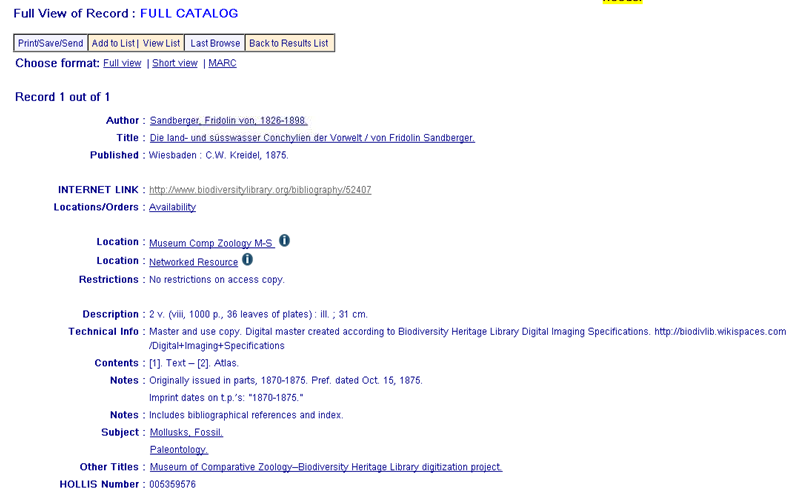
Note there is a properly-spelled author with his birth and death dates, a more complete physical description of the volumes, subject access, and an internet link to the BHL record. In addition, the BHL record now looks like this:
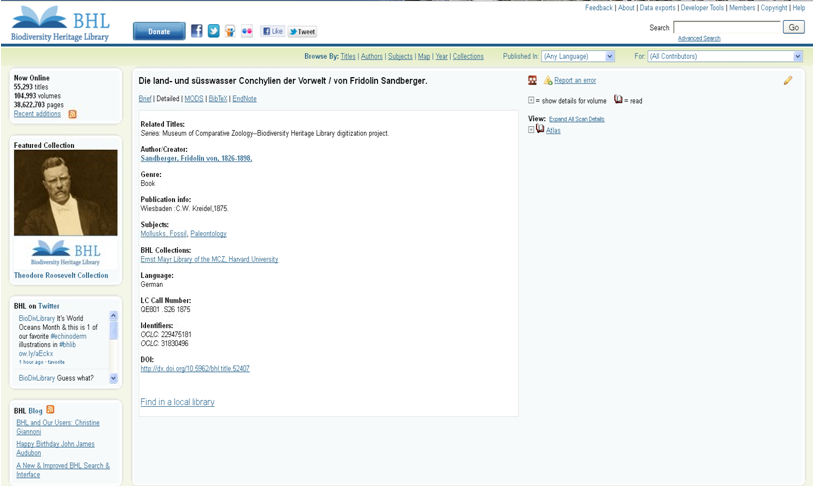
One note about the subjects, of which there are only a couple and they seem very broad: in a comprehensive work such as this, the taxonomy for subject headings would be very extensive, and a massive bibliographic record would result. I don’t claim to be a biological taxonomist, and am thankful for BHL’s uBio taxonomic name server that makes searches easier within the digitized texts for specific species or genera. Therefore, with the help of Library of Congress MARC 21 authorities, I chose “Mollusks, Fossil” and “Paleontology” as subject terms that would most accurately describe the work. In other cases, for a work that covers a more specific species, geographic area or geological epoch, I would include species, geographical or chronological subject terms, if possible.
Another aspect of my job is paginating Harvard’s holdings on the public portal consistent with BHL standards. Gilbert Borrego and JJ Ford have already enlightened us on the importance of the BHL pagination through previous blog posts, so I won’t describe the process as it would be redundant. However, my intent is to help direct researchers to the materials they need in the most efficacious manner, and streamline the navigability of the online texts and illustrations held by the Ernst Mayr Library that are in the BHL portal. With the outstanding assistance of our colleagues JJ, Katie Mullen and Gwen Henry, most of Harvard’s serial holdings on BHL have been thoroughly paginated. Pagination continues on monographic titles that the Library has prioritized and our faithful users have suggested. As Gilbert noted, we’re looking for ways to accurately automate the pagination procedure, but right now it’s still a manual method. But, hopefully, even with over 38 million pages and counting, everyone will eventually get a fully-paginated BHL.
I have a varied professional background and my earlier careers included having worked as assistants in fields such as environmental law and bookselling. However, since I earned my MSLIS from Simmons College in Boston, I have been fortunate to have worked on a number of different archival and metadata projects at such diverse places as the Metropolitan Museum of Art and the Doris Duke Foundation at Duke Farms, New Jersey. I have been at Harvard since 2006 where my initial position was as a project cataloger in the Fine Arts Library.
I have been working on the BHL project since February 2010. I truly feel privileged to be part of the BHL team, and this is one of the most satisfying and gratifying positions I have ever had in my career. I am working with a great group of intelligent, talented, hard-working and dedicated colleagues, not only at Harvard, but within all the partner institutions, and it has been very rewarding. We have also been privileged to have some great and positive feedback by our researchers, who continually help us with suggestions of titles that have yet to be scanned or suggest ways to provide better access and information online. I am very proud to be working on this project and believe that such a significant resource will continue to be sustained and be kept strong for future biodiversity researchers.
