

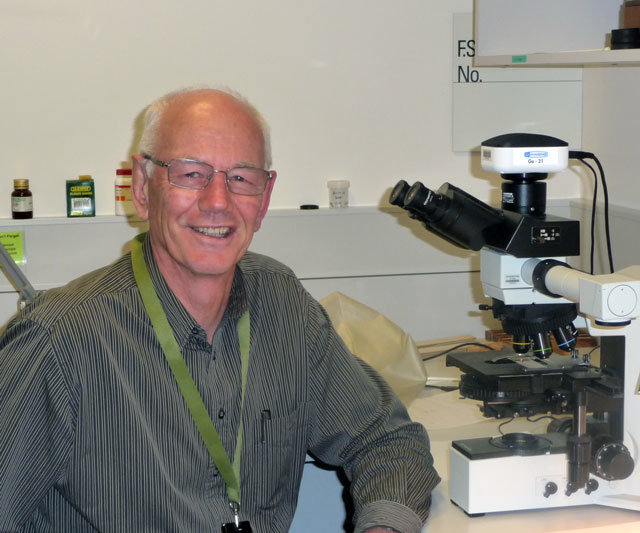

As you probably know, BHL is a global initiative, with project nodes on every continent in the world except Antarctica. As a global effort, we think it’s important to highlight our user communities around the world. This week, we’ve collaborated with our friends at BHL-Australia to feature Dr. Gary Poore, an avid BHL user from “Down Under.”
Dr. Gary Poore is based at Museum Victoria in Melbourne, Australia. As the curator of the museum’s crustacean collection he has been researching the diversity of marine crustaceans for more than 30 years. He has been responsible for the naming of almost 400 new species over the course of his career and is renowned as a world expert on isopod and decapod crustaceans. Although he’s recently retired from his position at Museum Victoria, he is now a Curator Emeritus and still heavily involved in research and in the global crustacean taxonomic community.
He first learned about BHL when he toured the Internet Archive offices in San Francisco while a member of one of the Census of Marine Life steering committees.
As a taxonomist, Gary’s work requires that he regularly delve into the historical literature to ensure that any new species he might be describing has not been previously named, and that current nomenclature accords with the conventions of the International Code of Zoological Nomenclature. (It is surprising how much does not, he says). This involves searching potentially hundreds of documents dating back to 1758, the publication date of Carl Linnaeus’s Systema Natura, the starting point of our modern nomenclatural conventions.
To find and read the historical literature, Gary uses the BHL because it is always conveniently at his fingertips.
“This saves me so much time”, he says. “Without it, I would have to go through library catalogues, and if our library didn’t have an article, I’d waste days or weeks waiting for inter-library loans.”
Recently, Gary was asked by the Australian Faunal Directory to catalogue the species of Australian Pentastomida, or tongue worms, respiratory parasites of mammals, reptiles and birds. He was then encouraged to go on to publish a list of all the world’s 124 species. This required Gary to delve into the literature back to the earliest mention of each family, genus and species and having to call on some detective skills as he traced the names from contemporary literature back to their first publication.
During the course of his investigations, he discovered many anomalies and errors in the names of species and their attribution. For example, the name widely used name Pentastomida itself was widely attributed to Diesing, 1836, but the word did not appear in the literature until 1905. This and other nomenclatural and taxonomic projects in which Gary is involved would not have been feasible without access to the resources in the Biodiversity Heritage Library.
Another feature of the BHL that Gary likes is the ability to create personalised portable electronic libraries of extracts from numerous journals using the PDF tools linked to bibliographic software. These complement, and even go some way to replacing, the huge collection of paper article extracts that line the walls of the Marine Invertebrates lab at Museum Victoria.
“The BHL is a great resource for the researcher working in taxonomy”, says Gary. “It provides easy access to the historical literature, right back to Linnaeus and beyond”.
