Approach Nature anew, as a child might.
Royal Dixon, the author of this week’s book of the week, The Human Side of Birds (1917), had an eclectic background. His formal credentials included botanist at the Chicago Field Museum, ornithologist, lecturer for the NY Board of Education, science journalist and author of several books– all of which sought to put a human face on nature. He was also a dancer, thespian, political writer and founder of the First Animal Church in America.
One might ask why was this man was so intent on humanizing plants, animals, trees and birds? Dixon, it seems, was concerned with modern society and its growing inability to relate to nature. To appreciate it. To see it. And most importantly to preserve it. He saw the good in the formal sciences yet, believed in some ways that taxonomy, in particular, barred non-experts from participating in the deeply human act of naming and organizing Nature’s Kingdom. His mission was simple: bring Nature to the people. Show them how similar every creature on this planet is to us and how we are all connected to each other on the most basic and profound levels.
Besides authoring several books, Dixon’s chosen platform from which to disseminate his message was guffawed at by most in his time. He became founder and leader of the First Church for Animal Rights, which met weekly and promoted the idea that “every creature had the inalienable right to life, liberty and the pursuit of happiness.” Although the church is now defunct, or at least seems to be since there isn’t a digital whisper of such an organization to be found out in cyberspace, we here at BHL are entirely sympathetic to Dixon’s cause! He was a man who had a formal science background yet, his efforts were wholly aimed at the general public. He realized that in order to reach people and get them to care about Nature we need to change the hearts and minds of those who believe in the stereotype that taxonomy is just a dry, stodgy, and inaccessible science concerned with mindless minutiae and doomed to endless arguments between warring factions of men who seemed partial to fabric combinations consisting only of houndstooth, tweed, or corduroy.
In his forward Dixon states his purpose simply: “to reject the limitations of unsympathetic research, and to endeavor to see beyond formal classifications, and to understand the spirit, emotions and impulses in the lives of our feathered friends of the air.” Is this not the true reason behind all this binomial naming business? Author Carol Kaesuk Yoon seems to think so in her prize winning book on taxonomy: Naming Nature. Moreover she makes the case that those of our ancestors who were not taxonomists, or folk taxonomists more precisely, did not survive. Therefore, we are all descendents of taxonomists because those who could not name, order and understand nature were unable to discern a poisonous plant from a one that was edible, or which herbal remedy could cure their sick child’s fever. They knew to avoid eating the sacred bird of the neighboring tribe lest they’d like to find their head on a stake in the morning! Our non-taxonomist ancestors were “naturally deselected.” Taxonomy is an ancient science deeply embedded into the human experience, past and present. It was and still is vital to human existence and it belongs to everyone.
So let us humor Dixon: How can he show us that birds are just like US?
Dixon’s theater background helped him understand storytelling and the human archetypes that we identify with. Therefore, his book is divided into 14 chapters; each assigned a human archetype such as the “Athlete”, the “Artist”, the “Dancer,” and it is under these human classifications that Dixon seeks to place birds:
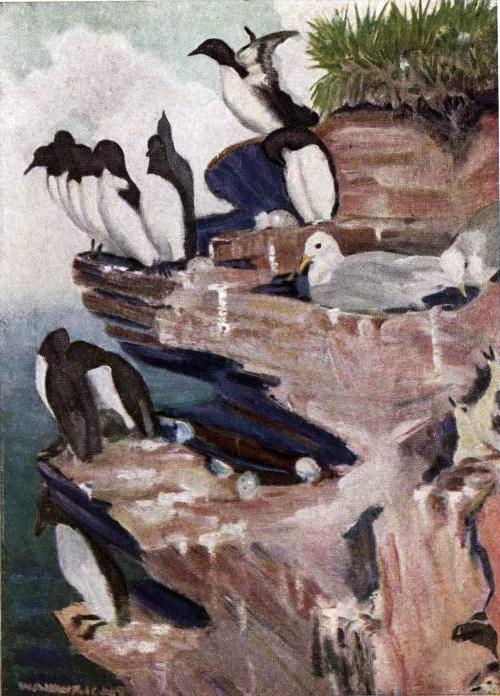 |
| The urbane Penguin’s apartment houses are nestled in cliff cities. |
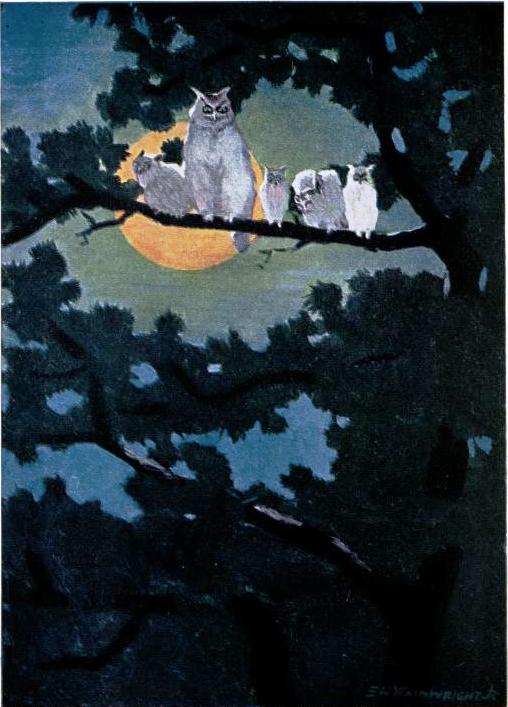 |
| The Wise Mother: ‘Gather ’round young ones, let mother impart her wisdom with a story |
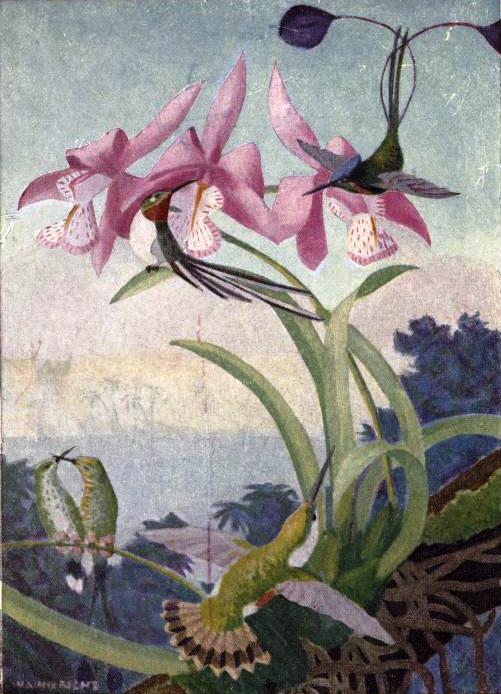 |
| The aesthetic sense of the artistic hummingbird whose nests are wonders of delicacy and beauty |
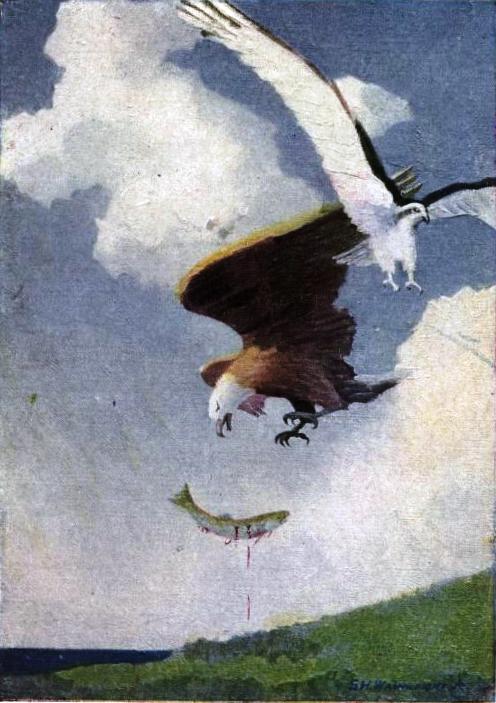 |
| The thieving Osprey rarely fishes for himself preferring to rob others of their work. Human-like? |
So today, let’s look at Nature through Dixon’s eyes: awake, appreciative, anew, as a child might. We leave you with a quote to contemplate:
“If I name every bird in my walk, describe its colour and ways, . . . give a lot of facts and details about the bird, it is doubtful if my reader is interested. But if I relate the bird in some way to human life, to my own life; show what it is to me and what it is in the landscape and season, then do I give my reader a live bird and not a labeled specimen.”
– John Burroughs, American Naturalist and Conservationist
We would like to thank America Museum of Natural History, NY (AMNH) for digitizing this work. Incidentally, the 34 photos in Dixon’s book also come from AMNH. Bravo to the staff there for assisting in the creation and rebirth of this work. We know Dixon would be doubly pleased.
Other work’s by Dixon available on the Biodiversity Heritage Library
The Human Side of Plants (1914)
The Human Side of Trees (1917)
The Human Side of Animals (1918)