As part of BHL’s Winter Appeal, we’re highlighting some of the amazing species that are especially well-adapted to cold, wintery climes as well as those that often come to mind as we celebrate the winter holidays. Last week we featured Ursus maritimus, the magnificent apex predator of the Arctic commonly known as the polar bear. This week, we turn our eyes again to the North Pole to shine the spotlight on a well-known celebrity of the giving season!
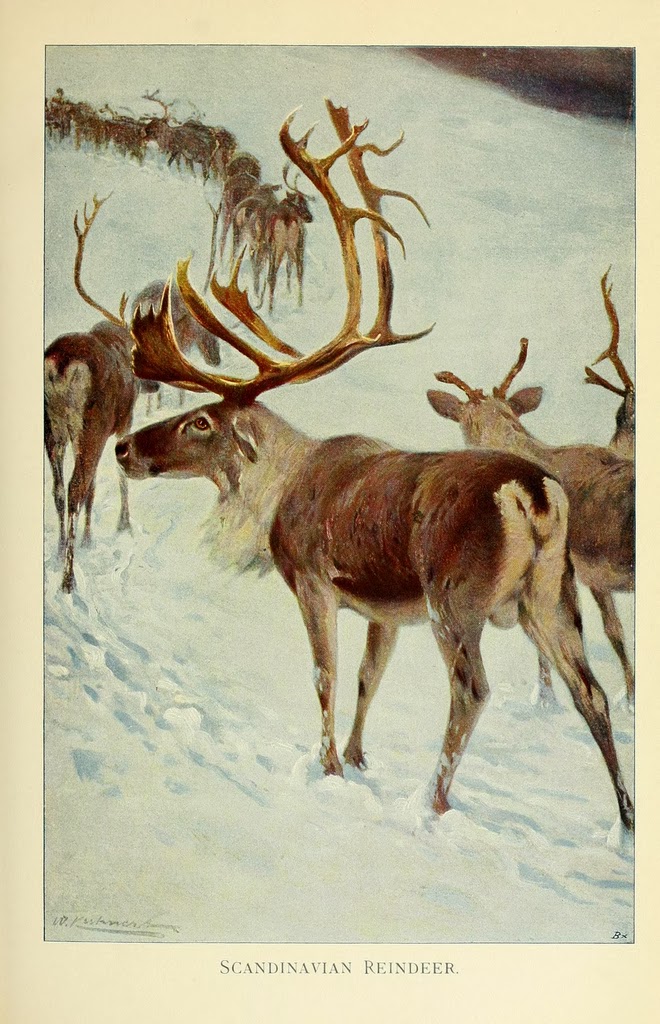 |
| Wild Life of the World: A Descriptive Survey of the Geographical Distribution of Animals. London, F Warne and Co, 1916. http://biodiversitylibrary.org/page/21738521 #page/455/mode/1up |
Rangifer tarandus
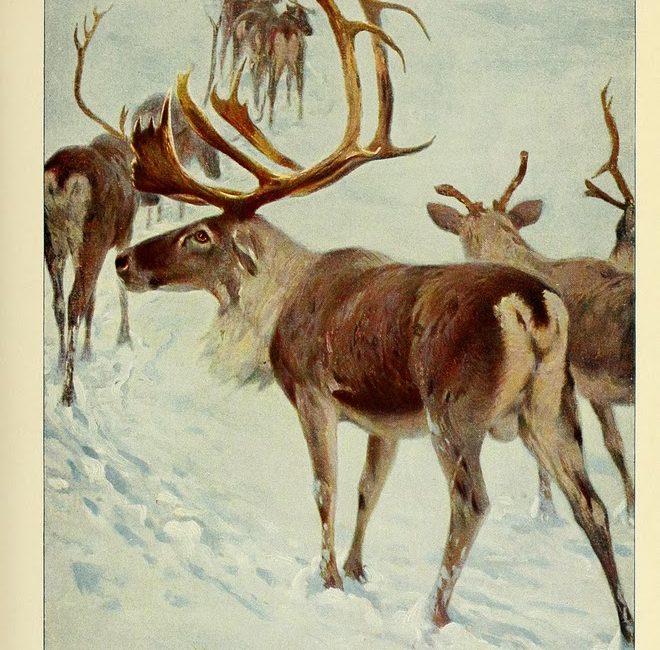
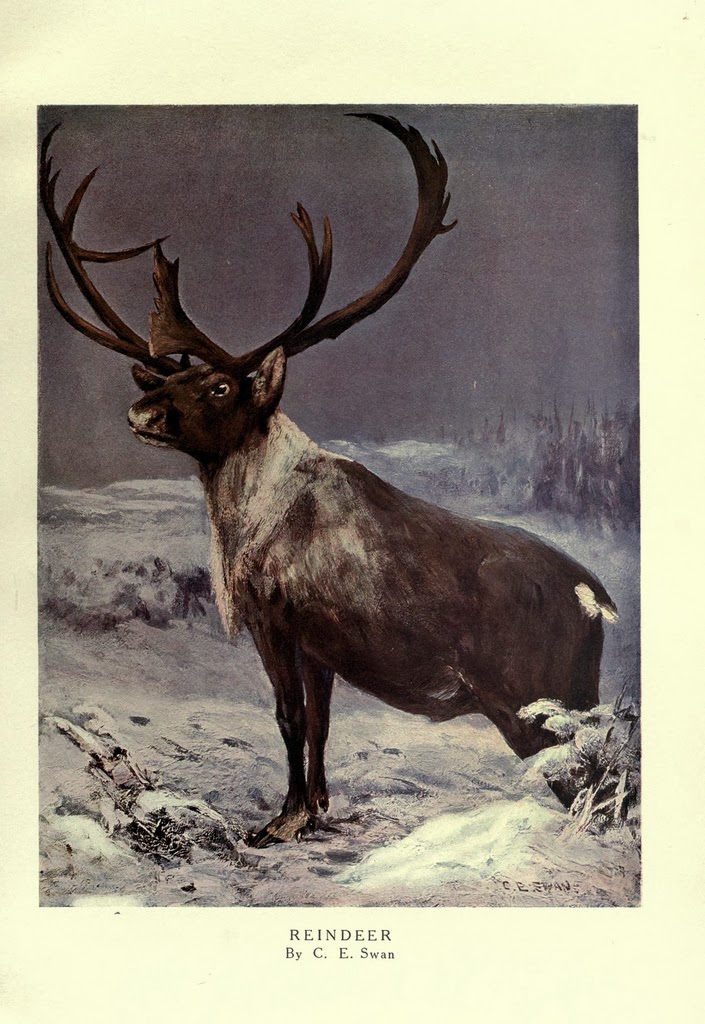
As the holiday season goes into full swing, the festive days of late December bring a dazzling array of familiar images–shiny packages with ribbons and bows, snowy rooftops and fir trees, and of course the ubiquitous Rangifer tarandus. Whether pulling sleighs or playing games, these antlered animals feature prominently in decorations throughout the holiday season. If you’ve ever watched the holiday cartoons broadcast at this time of year, you could be forgiven for thinking that reindeer are an especially uniform species, intolerant of differences. But what of reality? As it turns out, in real life reindeer exhibit a remarkable range of diversity.
Distinguishing them from other deer, reindeer are the only species in which both the male and female grow antlers. Within the species, reindeer display notable variations in size, shape and color. According to The Animals of World: Brehm’s Life of Animals (1895) a comparison of tame and wild reindeer would reveal such differences just in the size and shape of the hooves that one could easily see how they might be considered belonging to separate species. Antler size and fur coloration are also known to vary in the different regions of the reindeer’s circumpolar habitat. Even within individuals, coloration changes with the seasons, bringing on a more greyish-white hue for the snowy winter months.
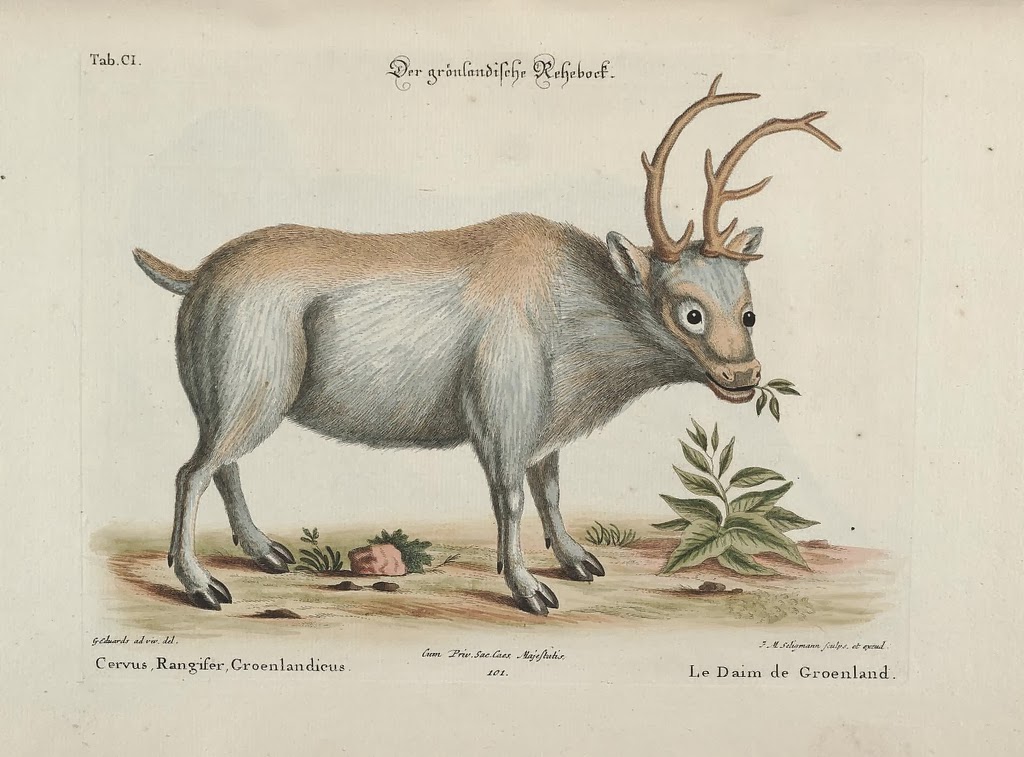 |
| Verzameling van uilandsche en zeldzaame vogelen. Amsterdam, J.C. Sepp, 1772-1781. http://biodiversitylibrary.org/page/11267501#page/199/mode/1up |
But sometimes the differences are significant enough to denote a classifiable distinction and today taxonomists recognize several subspecies of reindeer. For example, Rangifer tarandus groenlandicus, shown above, occurs primarily in Greenland. Even for those of us not well-versed in scientific names, this shouldn’t be surprising with the obvious phonetic similarity between groenlandicus and Greenland. What many of us will find surprising, though, is that the common name of this subspecies is the “barren-ground caribou” meaning that, yes, caribou are subspecies of reindeer! Who knew? (Well, undoubtedly some of you did but for those of us more familiar with the animated variety, let us not be ashamed to admit we are duly surprised!)
Other subspecies include the Dawson’s caribou (Rangifer tarandus dawsoni) which once roamed the Queen Charlotte Islands of British Columbia and is now presumed extinct. While some information can still be derived from the DNA extracted from bones, fur and other remains of Dawson’s caribou and other extinct species, the vast majority of scientific knowledge on their appearance and behavior is locked in rare or hard to find literature.
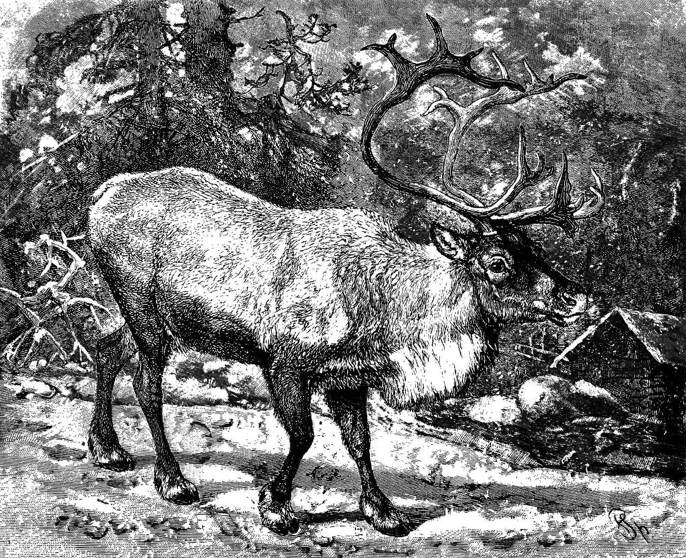 |
| The animals of the world. Brehm’s life of animals. Chicago, A. N. Marquis, 1895. http://www.biodiversitylibrary.org/page/37569440 #page/540/mode/1up |
Habitat destruction, hunting and predators continue to present threats to wild caribou and reindeer. In 1983, the US Fish and Wildlife Service listed the subspecies Rangifer tarandus caribou as endangered and advocated to protect its habitat. Even at the turn of the century, reports of diminishing populations of one of the largest subspecies, Rangifer tarandus fennicus or Finland reindeer, were common. In one of several such reports, cited in Extinct and vanishing mammals of the Old World (1945), the author laments, “The Finland reindeer is thus very nearly exterminated in the greatest part of its former habitat and it looks almost as a bitter irony of fate that it should not be recognized and discerned as a separate race before it was in so imminent danger of becoming entirely extinct…”
While we can’t bring the species and subspecies that have gone extinct, we can preserve our knowledge of them to help avoid future extinctions. By making this knowledge widely available, we can become better stewards to those species that are still here and especially to those recovering from diminished populations.
The BHL currently provides access to over 42 million pages and over 87,000 images and is changing the face of research methodology. Scientists around the world are using BHL to identify and classify species, facilitate further scientific research, and support conservation efforts to help prevent future extinctions. The ongoing growth of BHL is supported in part by our dedicated patrons whose gifts support the digitization of additional literature, technical development of the program, and improvement of data curation. We hope you’ll take a moment to review how your donation can be put to work and will consider supporting BHL this holiday season!
 |
| The wild beasts of the world. London, T.C & E.C. Jack, 1909 http://biodiversitylibrary.org/page/19080406#page/157/mode/1up |
Thank you and Happy Holidays!