

Over the past few months, I’ve been working as the Biodiversity Heritage Library Flickr Content Volunteer. As someone who really values the cross-section between art and science, it’s a fascinating task. The Flickr page is full of beautiful images of flowers, birds, and butterflies. However, have you ever considered the beauty in rocks and bones?
Most of the items I’ve been adding to the BHL Flickr page were published in The Quarterly Journal of the Geological Society of London, a 19th century journal with articles on geology, paleontology, and paleobotany. I’m sure any geologist would say I’m late to the party, but I was pleasantly surprised by the various diagrams and illustrations in this Victorian journal. Below I highlight a few of the most interesting, surprising, and just plain beautiful images I’ve come across so far.
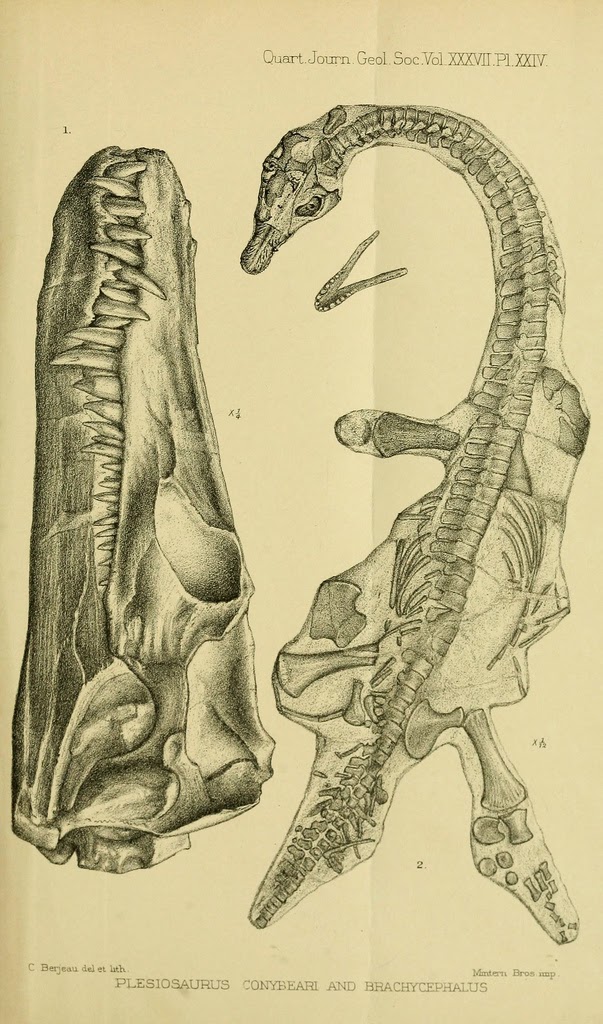 |
| Plesiosaurus conybeari and brachycephalus. Volume 37 (1881). |
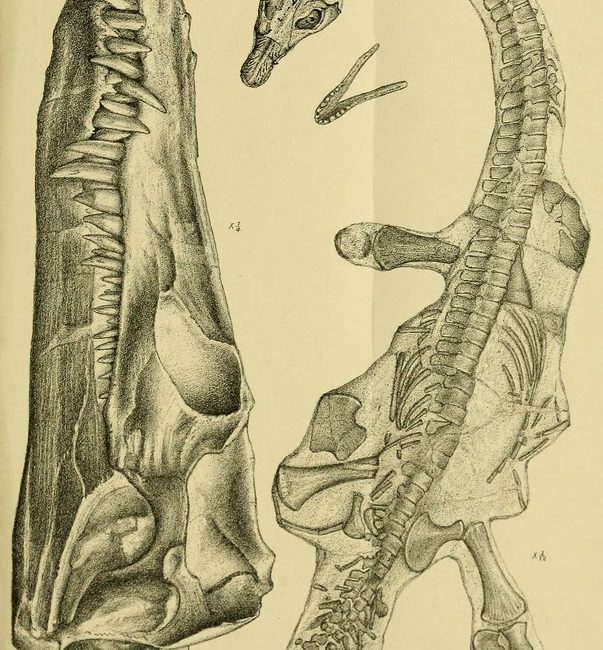
From what I’ve observed, there are two camps when it comes to skulls and bones: those who find them fascinating, and those you find them morbid. I absolutely fall in the first camp, finding it interesting to see how different bodies are structured and fit together. If the remains are that of a species we’ll never have the chance to see, even more so, making these plesiosaur fossils of particular interest. It’s mind-boggling to imagine these reptiles of the early Jurassic era swimming about. Among Nessie believers there’s a theory that the Loch Ness monster is a member of the Plesiosauria order which managed to avoid extinction. With that long neck and those paddle-like limbs, I can definitely see why.
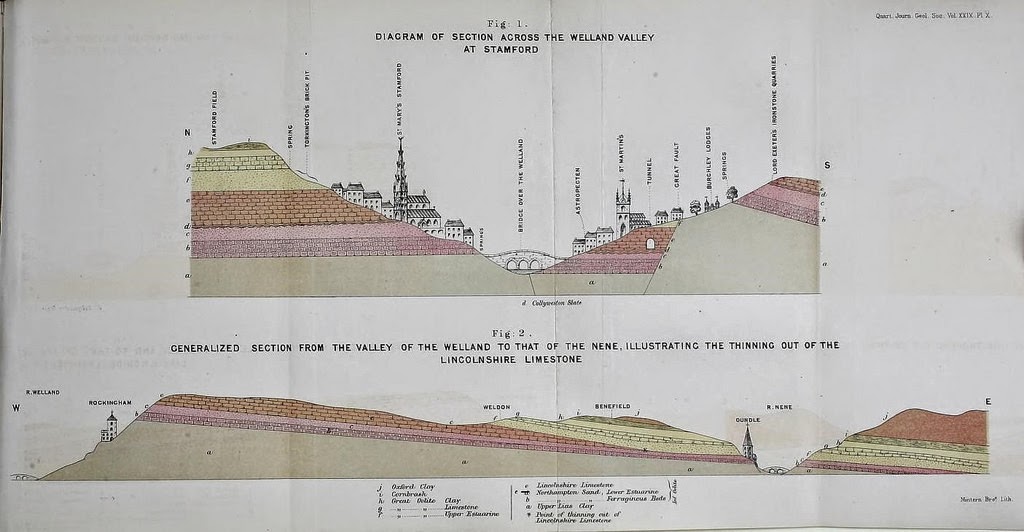 |
| Cross section of the Welland Valley. Volume 29 (1873). |
This image is an interesting representation of the different layers of clay, sand, and limestone in the Welland Valley of eastern England. The two views offer a look into where researchers observed hundreds of different sand fossils, such as Teleosaurus teeth and cephalopods in the Lincolnshire Limestone. However, that’s not the only reason it caught my attention. It’s on this list because—with a bit more hatching—this could easily be mistaken for the beginning of an Edward Gorey – Dr. Seuss collaboration. I didn’t expect whimsy from a Victorian geology journal, but I sure found it.
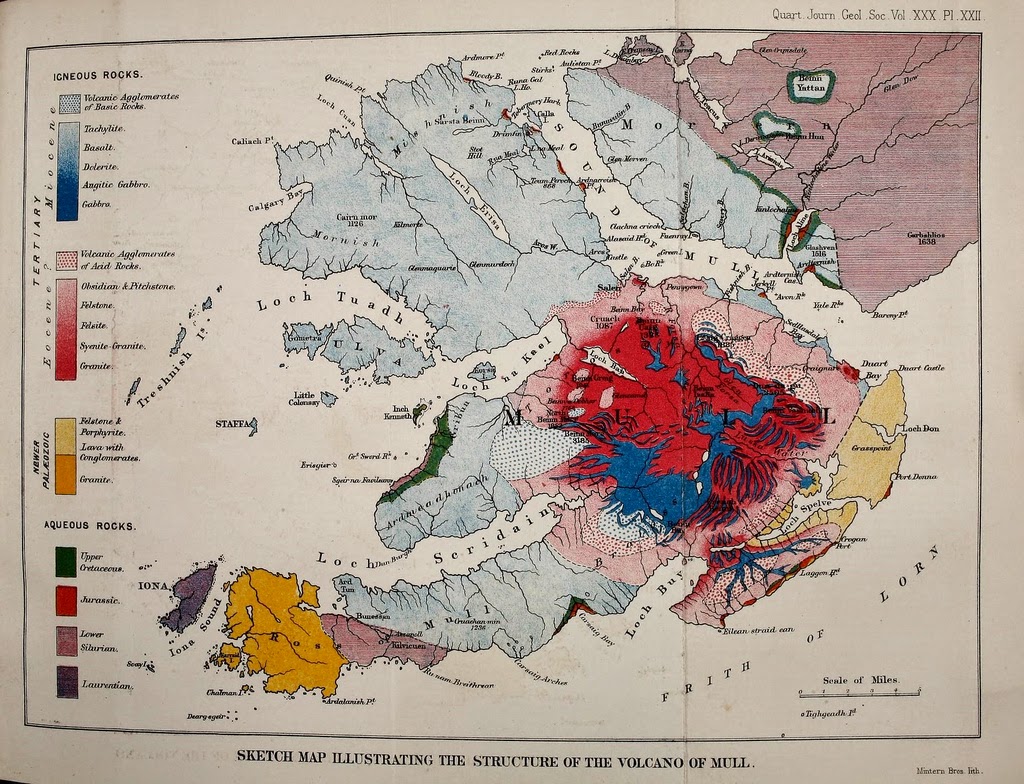 |
| Map illustrating the structure of the volcano of Mull. Volume 30 (1874). |
The colors in this map of the Isle of Mull, Scotland are so incredibly vibrant even 140 years later. Not only beautiful, it’s very informative, highlighting the locations of various igneous and aqueous rocks in the area. It even helped me realized that “loch” not only means “lake” but also “inlet.” Lessons in geology and Gaelic all in one place!
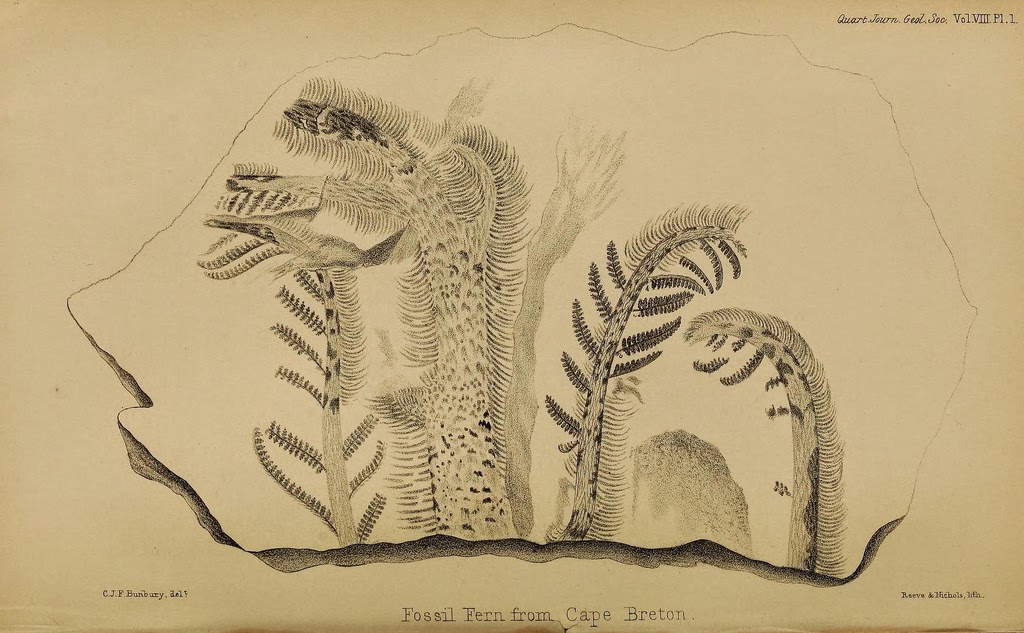 |
| Fossil Fern from Cape Breton. From Volume 18 (1852). |
Sometimes it feels like ferns don’t get the same praise and attention as flowering plants. That’s hard to believe after seeing this beautiful depiction of fossil ferns found near the coal mines of Sydney, Nova Scotia. The most remarkable aspect of the image may just be the article it accompanies. It’s a fascinating read offering a glimpse into the thought process behind identifying the “uncommonly interesting species” seen here.
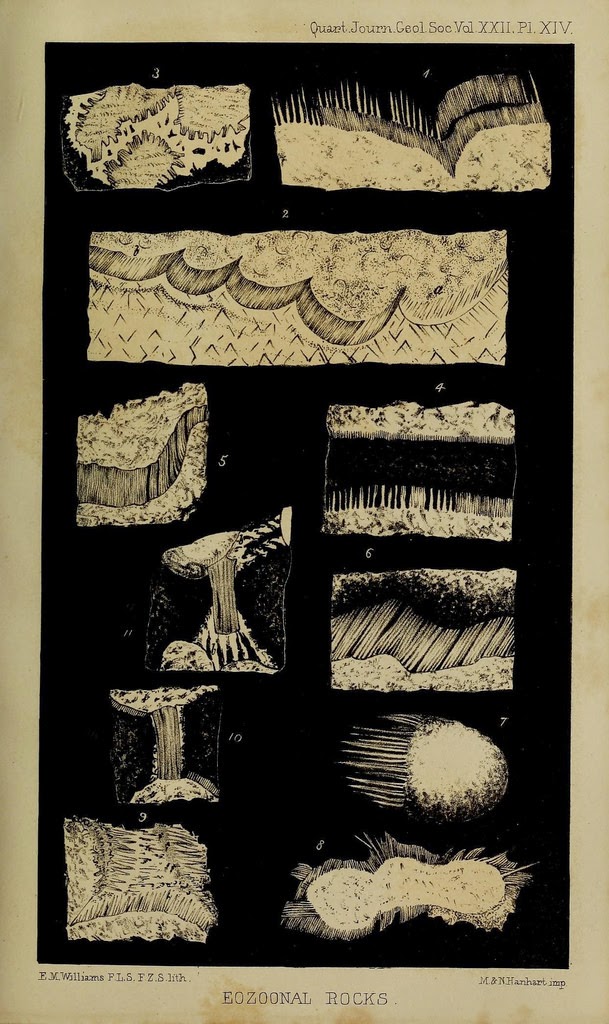 |
| Eozoonal rocks. Volume 22 (1866). |
This plate illustrating the inorganic nature of eozoonal rocks just might be my favorite of the bunch. It looks like a page from a comic book set in space or a post-apocalyptic Earth. In fact, Figure 2 looks like it came straight from the background of Pat Aulisio’s Bowman comics. I can definitely imagine this one hanging next to the artwork I already own. In fact, I just may do that! Many of the images in BHL’s Flickr stream are in the public domain and have been made available using a Creative Commons Attribution CC-BY License. Images which may still be in copyright (generally those published after 1922) have been assigned a Creative Commons non-commerical license meaning users are free to repurpose for non-commercial use.
The Quarterly Journal of the Geological Society of London has been quite the surprise. There are several more volumes to go through, so I can only imagine the surprises will keep coming. In the mean time, it looks like I need to buy a frame that can do justice to eozoonal rocks.
Check out an older post to read about my previous internship with the BHL and how I’ve used BHL images in the past.
