

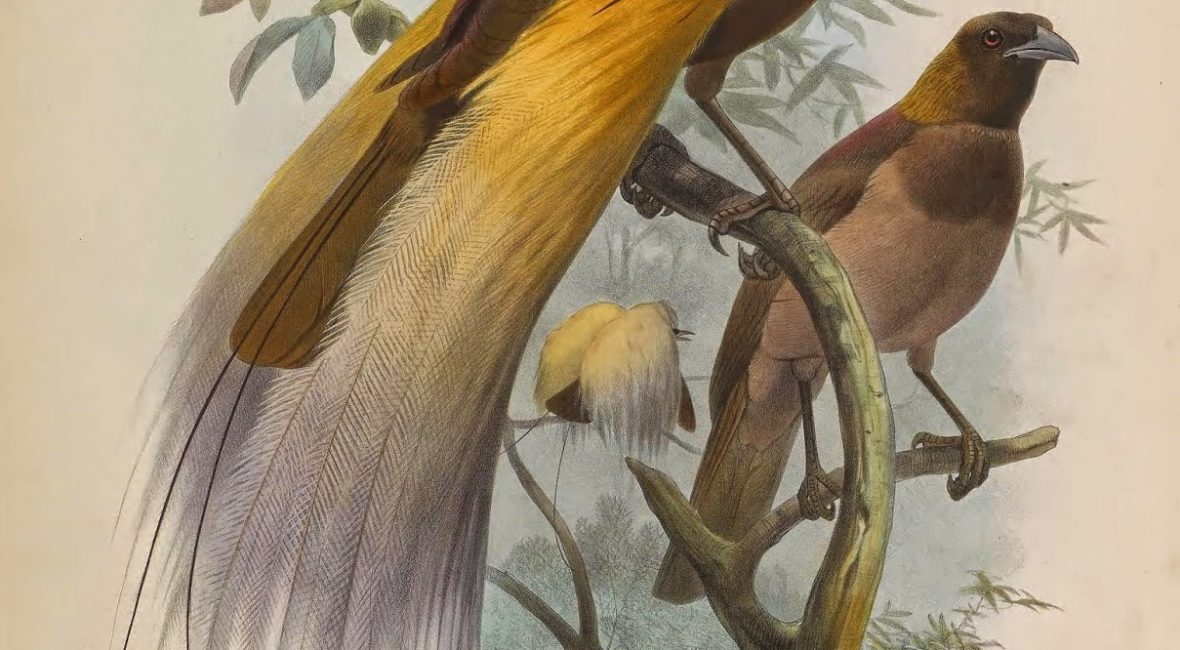
Deep within the rainforest canopy of the Aru Islands, just west of New Guinea, two male Greater Birds-of-Paradise dance among the branches in carefully coordinated steps, their magnificent yellow, white, and maroon plumage undulating gracefully to the rhythm of their own unique song.
Carl Linnaeus named this species Paradisaea apoda, meaning “legless bird-of-paradise.” The misnomer was based on early trade-skins prepared and shipped to Europe without feet, feeding a notion that these “visitors from paradise” glided endlessly through the air, remaining aloft until death.
Naturalist and explorer Alfred Russel Wallace (who simultaneous to Darwin developed the concept of evolution by means of natural selection), spent extensive time in the Aru Islands during the mid-1800s, collecting and describing many species, including P. apoda. Upon receiving a specimen, Wallace declared the bird “the most perfectly lovely of the many lovely productions of nature,” but lamented that, should “civilized man” ever reach these “virgin forests,” he would surely disturb nature’s balance and cause the creature’s extinction.
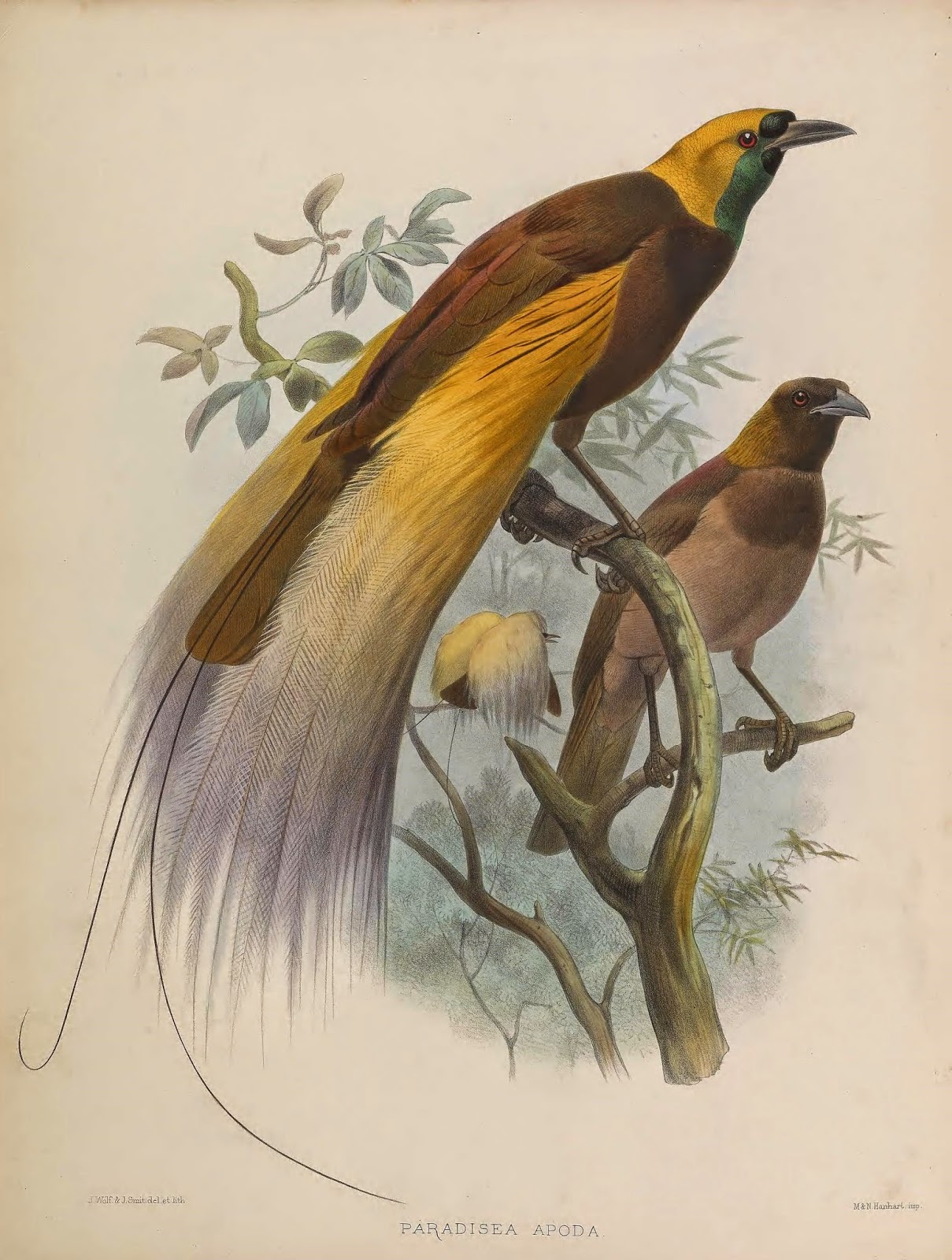 |
| Paradisaea apoda. Elliot, Giraud Daniel. A Monograph of the Paradiseidae. http://biodiversitylibrary.org/page/44792765 |
Daniel Giraud Elliot, one of the most important American ornithologists and naturalists of the nineteenth century, was enthralled with Wallace’s work, and his descriptions of birds of paradise. While Wallace was not the first western naturalist to see Birds-of-Paradise in the wild (a distinction held by René Primevère Lesson during the 1822-25 circumnavigation voyage of the French La Coquille), his accounts are poetic and highly detailed. They provided inspiration for one of Elliot’s crown-jewels, A Monograph of the Paradiseidae.
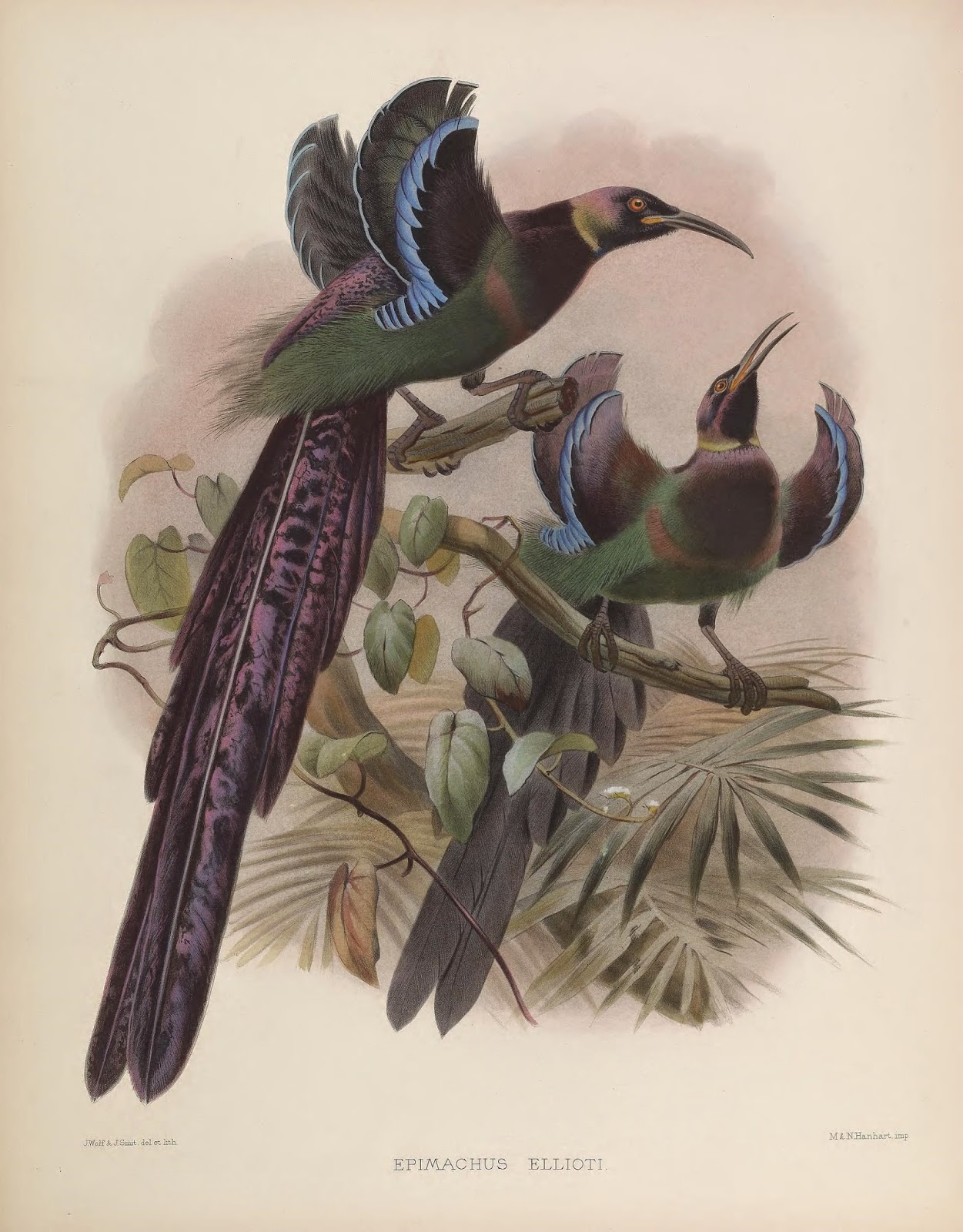 |
| Epimachus ellioti (named after Elliot). Elliot, Giraud Daniel. A Monograph of the Paradiseidae. http://biodiversitylibrary.org/page/44792854 |
Born in 1835, Elliot achieved many prestigious accomplishments over his lifetime. In 1869, he became one of the scientific founders of the American Museum of Natural History (for which his personal collection of North American birds comprised some of the museum’s first accessioned specimens). In 1894, Elliot became the curator of the Department of Zoology for the Field Museum of Natural History. He also traveled extensively, often for years at a time, and published hundreds of papers and multiple monographs relating his findings and experiences. These considerable accomplishments are even more impressive considering Elliot’s limited formal education.
While Elliot produced many works on mammals, his true passion was birds. He became famous for his monographs on bird families, which summarized previous taxonomic information about the species included, while also providing new observations and analysis based on his travels and museum specimens. He used his own wealth and formidable connections with elite European contacts to finance these publications.
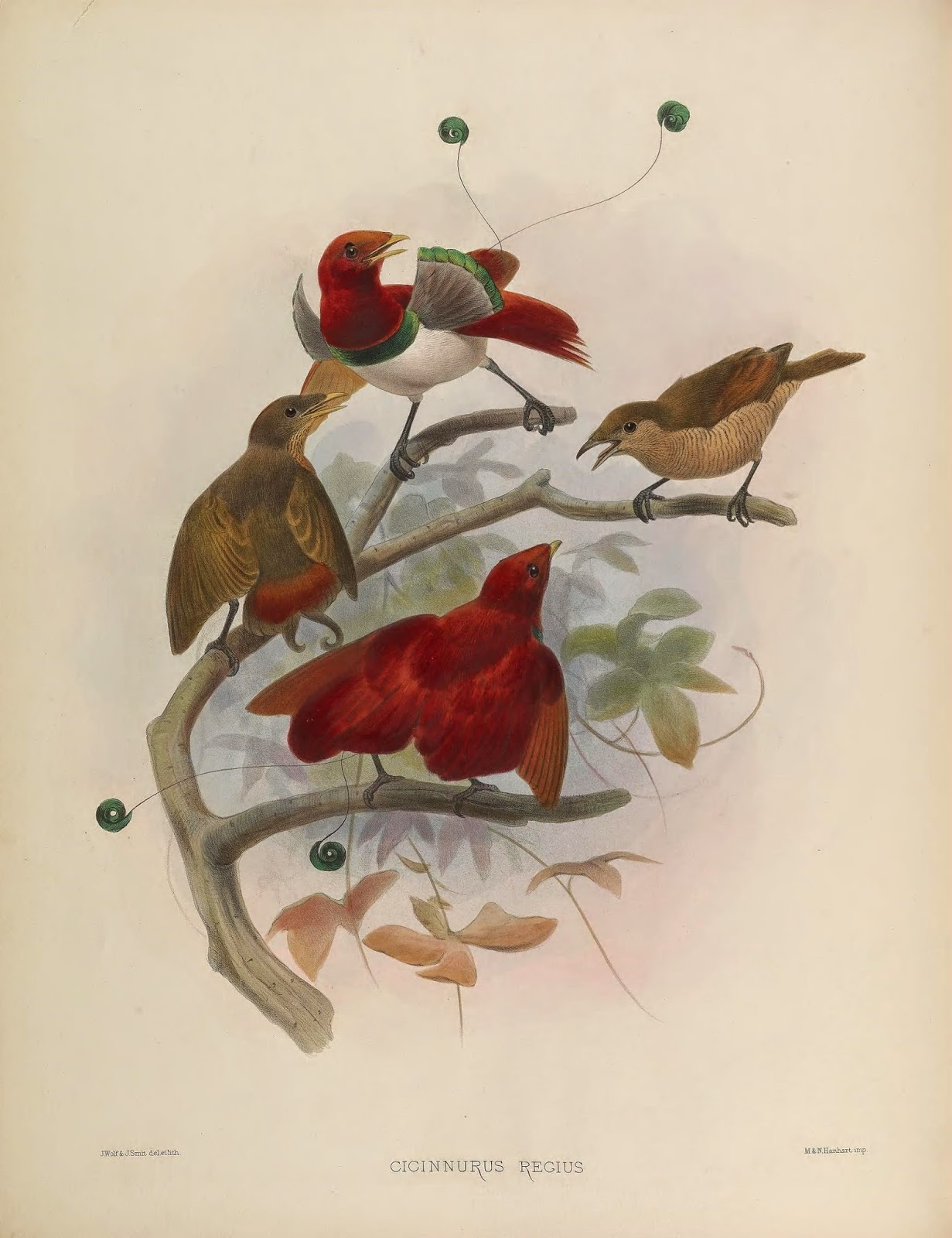 |
| Cicinnurus regius. Elliot, Giraud Daniel. A Monograph of the Paradiseidae. http://biodiversitylibrary.org/page/44792836 |
A Monograph of the Paradiseidae, published in London in 1873, is a large folio with 37 lithographs (36 of which are hand-colored) detailing typical Bird-of-Paradise species from the Paradiseae family, as well as members of the Epimachinae (now Epimachus genus) and Tectonarchinae (now Ptilonorhynchidae) families. His fourth illustrated monograph, Elliot chose the Birds-of-Paradise as his subject in order to finally present a “correct idea” of the birds’ appearance. At the time of his writing, quality specimens were finally making their way to Europe, replacing the “mutilated” skins that naturalists has previously relied upon. Elliot also acknowledges the contributions of Prof. Schlegel from the Museum at Leyden, John Gould, and M.J.P. Verreaux, all of whom allowed him to examine their own specimens to inform his publication.
The original watercolor paintings on which Paradiseidae’s lithographs are based were created by German artist Joseph Wolf, who also executed work for David Livingstone, Henry Walter Bates, John Gould (think the incredible Birds of Asia masterpiece), and Wallace himself. Of Wolf, Elliot wrote, “The drawings of Mr. Wolf will, I am sure, receive the admiration of those who see them; for, like all that artist’s productions, they cannot be surpassed, if equalled, at the present time.” The lithography for the work was performed by Joseph Smit, with coloration undertaken by John Douglas White.
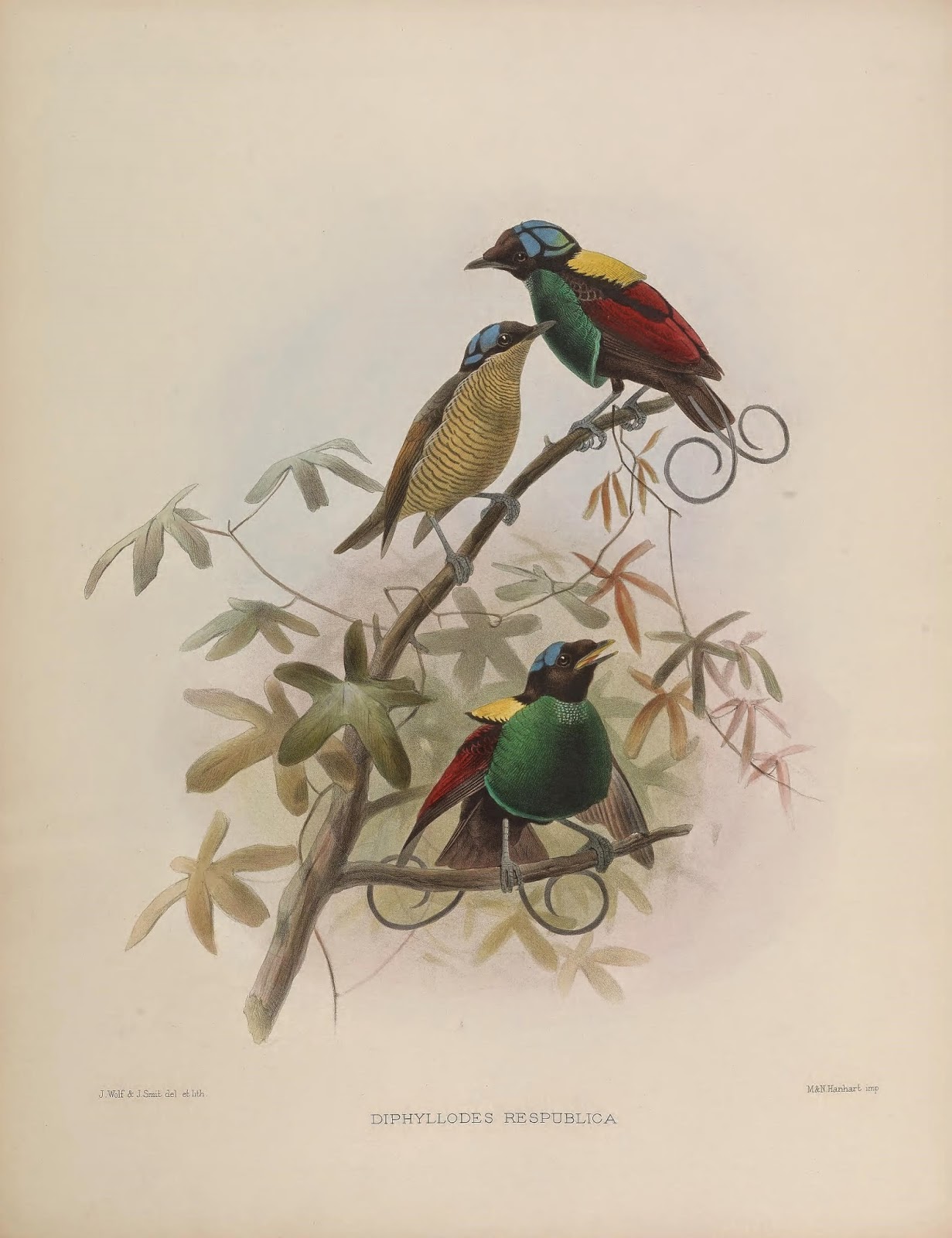 |
| Cicinnurus respublica. Elliot, Giraud Daniel. A Monograph of the Paradiseidae. http://biodiversitylibrary.org/page/44792828 |
Elliot’s regard for Wallace cannot be mistaken. For the book’s dedication, he writes, “To Alfred Russel Wallace, whose fame as a traveler is only eclipsed by that which he has gained as a naturalist; and to whom we are indebted for nearly all our authentic information regarding the habits of the many species of the Birds of Paradise.”
Elliot’s A Monograph of the Paradiseidae is one of the “most admired bird books ever produced.” As a commodity, it is also very valuable, fetching a hefty $45,924 USD price tag at a 2007 Christie’s auction. Thanks to the Smithsonian Libraries, however, you can view and download this book for free in BHL.
The digitized Smithsonian copy comes from the Joseph F. Cullman 3rd Library of Natural History, which holds the Smithsonian’s collection of over 10,000 rare books in anthropology and the natural sciences. The full collection of illustrations can also be found in the BHL Flickr.
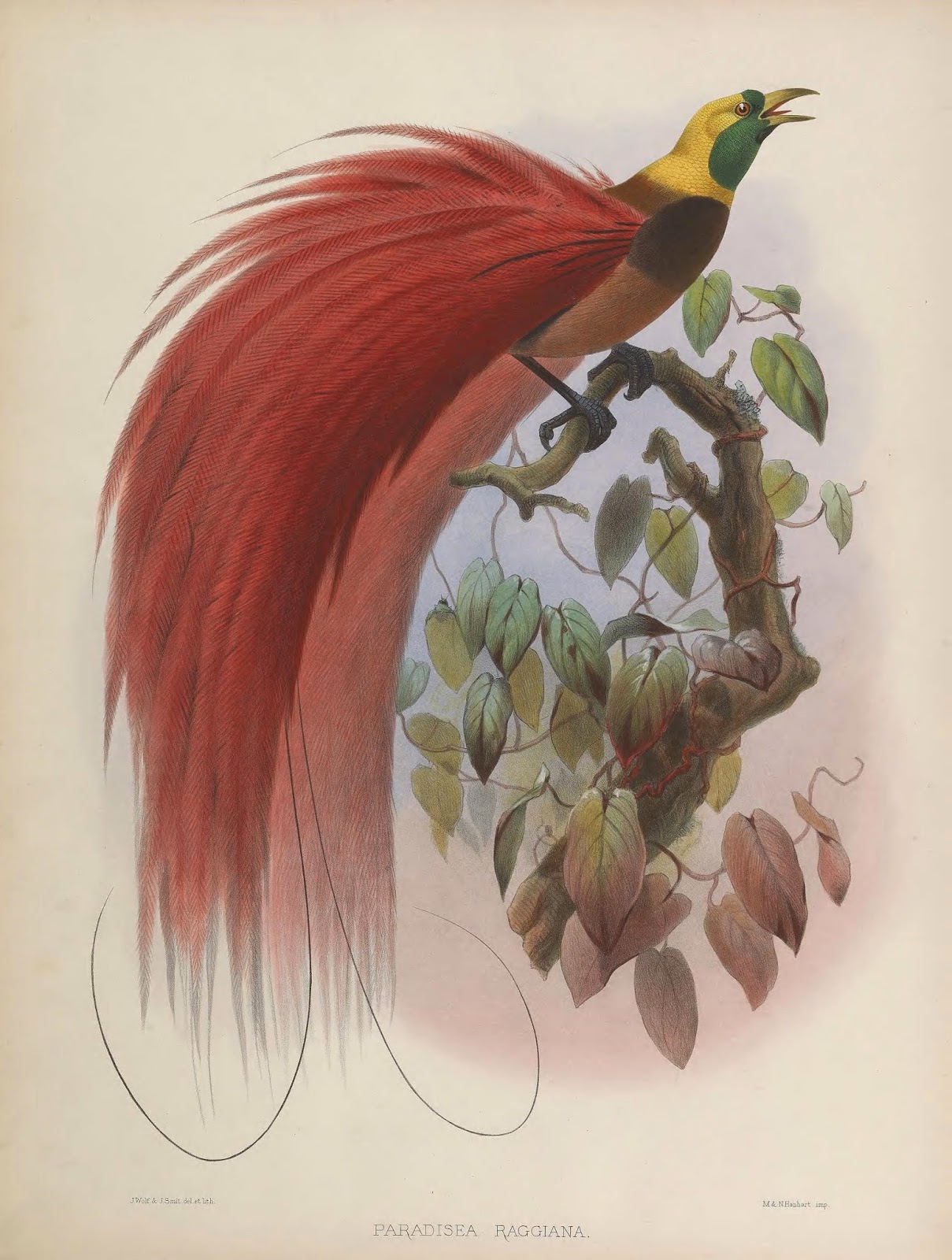 |
| Paradisaea raggiana. Elliot, Giraud Daniel. A Monograph of the Paradiseidae. http://biodiversitylibrary.org/page/44792727 |
Today, there are 41 recognized species of birds of paradise. They are all found almost exclusively in New Guinea and its satellites, with a few exceptions in the Maluku Islands and eastern Australia. Fortunately, Wallace’s prophecy has not come true. The Greater Bird of Paradise is common throughout its range, evaluated as a species of “least concern” by the IUCN. Currently, only 3 of the 41 recognized species are listed as “threatened”: Wahnes’s Parotia, the Blue Bird of Paradise, and the Black Sicklebill. Several are “near-threatened,” however, and hunting and habitat loss continues to be a concern.
As you enjoy the spectacular Paradiseidae illustrations, remember that awareness is a key component in conservation. We can all play a part in mitigating factors that contribute to species loss. And a tax-deductible gift to BHL can help us continue to provide scientists with the information they need to identify and protect our biodiversity. Let’s ensure that these beautiful birds are here for generations to come!
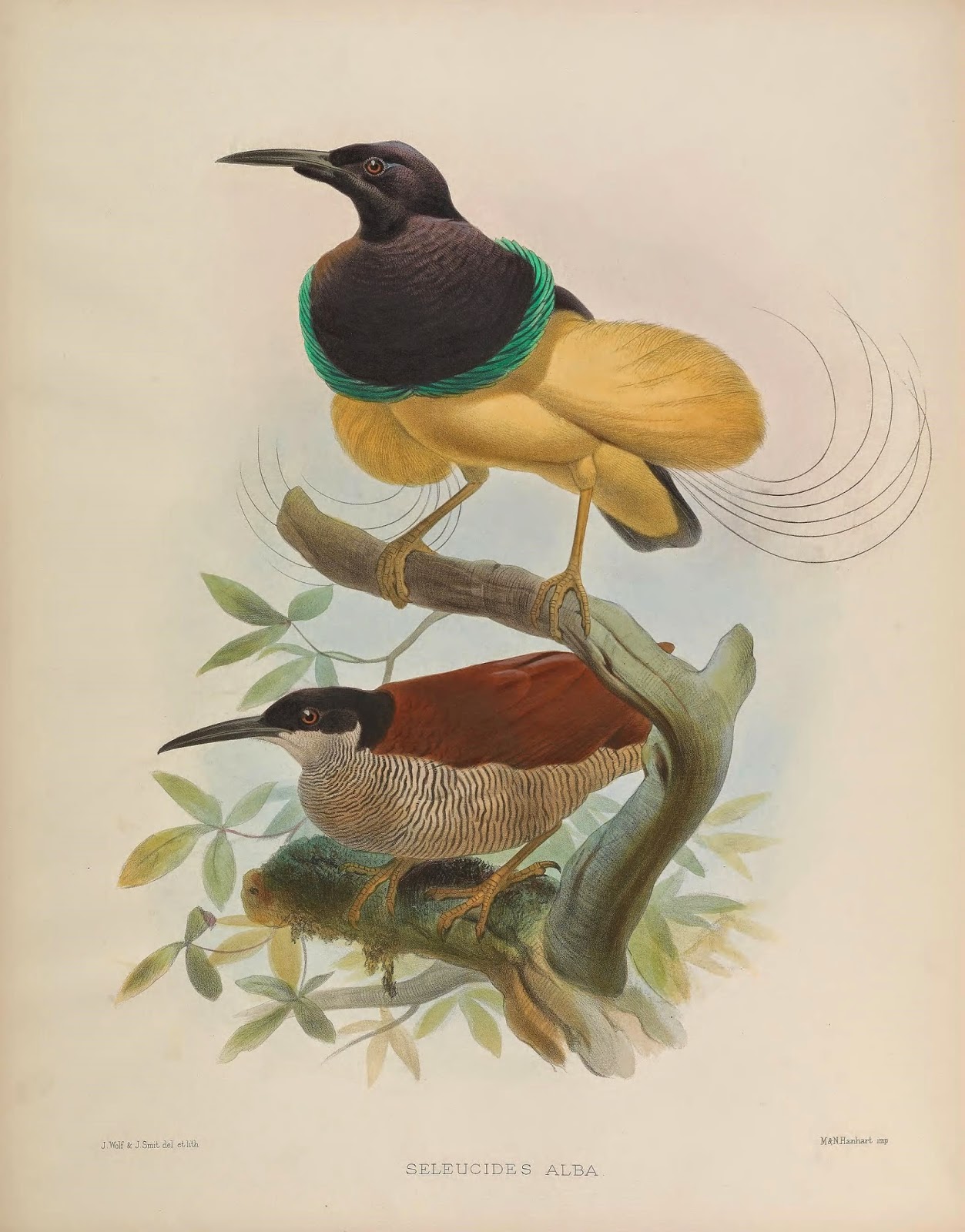 |
| Seleucidis melanoleucus. Elliot, Giraud Daniel. A Monograph of the Paradiseidae. http://biodiversitylibrary.org/page/44792862 |
