

 |
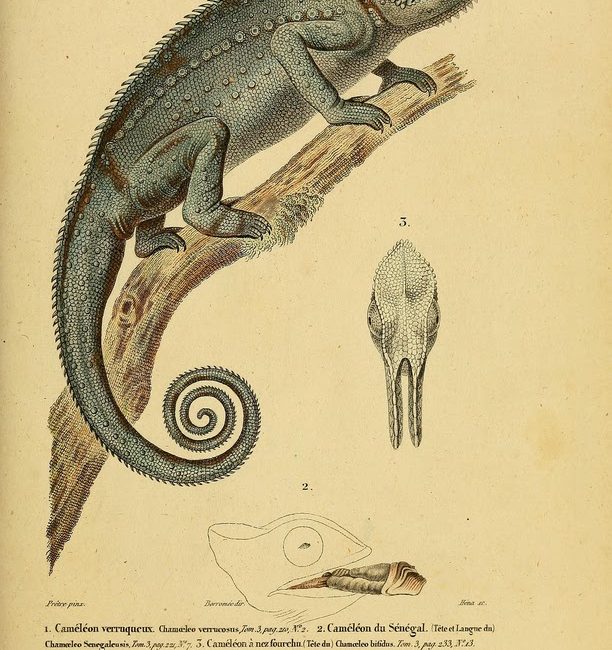
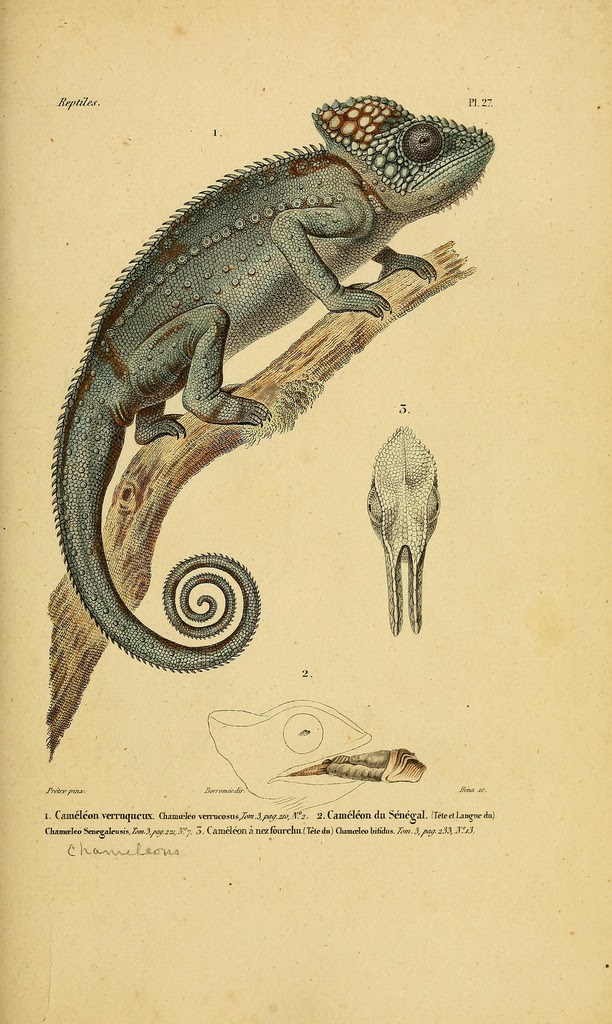
| Fig 1: Furcifer verrucosus (Madagascar warty chameleon); Fig 2: Tongue of Chamaeleo senegalensis (Senegal chameleon); Fig 3: dorsal head view of Furcifer bifidus (Two-horned Madagascar chameleon). Duméril, André Marie Constant. Erpétologie générale ou Histoire naturelle complète des reptiles (1834-53). http://biodiversitylibrary.org/page/31895806. |
1834 was a landmark year in the field of herpetology – the study of amphibians and reptiles. It was the year that the first volume of André Marie Constant Duméril‘s monumental work Erpétologie générale ou Histoire naturelle complète des reptiles was published. Produced over a twenty year period, between 1834-54, this nine volume set (plus atlas) became the first comprehensive scientific account of the world’s known amphibians and reptiles.
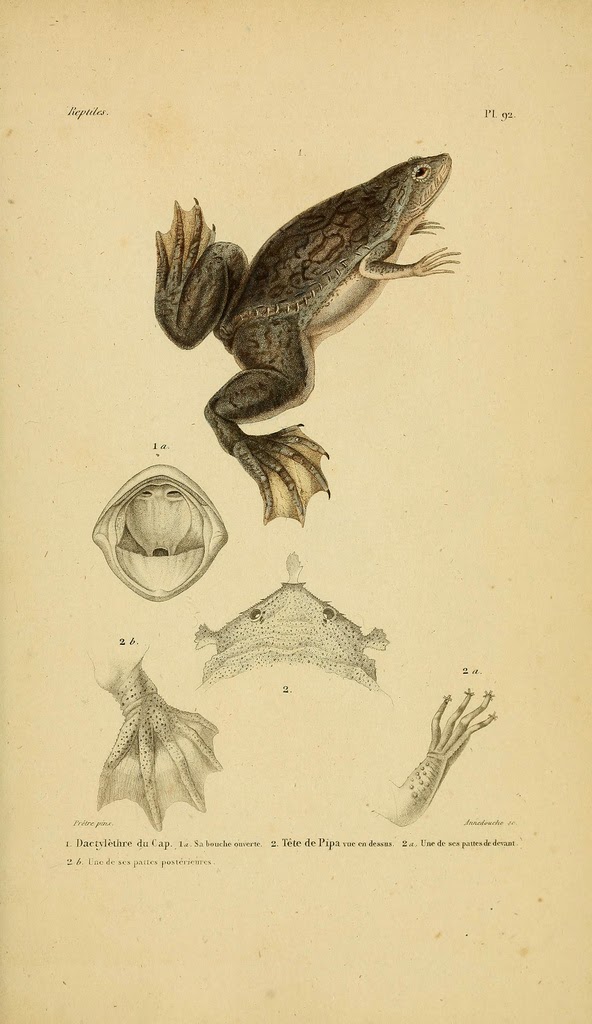 |
| Fig 1 and 1a: Xenopus laevis (African-clawed frog); Fig 2: Pipa pipa (Surinam toad). Duméril, André Marie Constant. Erpétologie générale ou Histoire naturelle complète des reptiles (1834-53). http://biodiversitylibrary.org/page/31895960. |
Duméril began his career as a doctor and professor of anatomy, but, at the beginning of the nineteenth century, George Cuvier selected him as the head of ichthyology and herpetology at the Muséum national d’histoire naturelle in Paris, thus making Duméril the curator of the largest and most diverse herpetological collection in the world at the time. Duméril set out to develop a revised higher-level taxonomic organization for amphibians and reptiles and, together with his assistant Gabriel Bibron, examined and described much of the museum’s enormous collection between 1832-48.
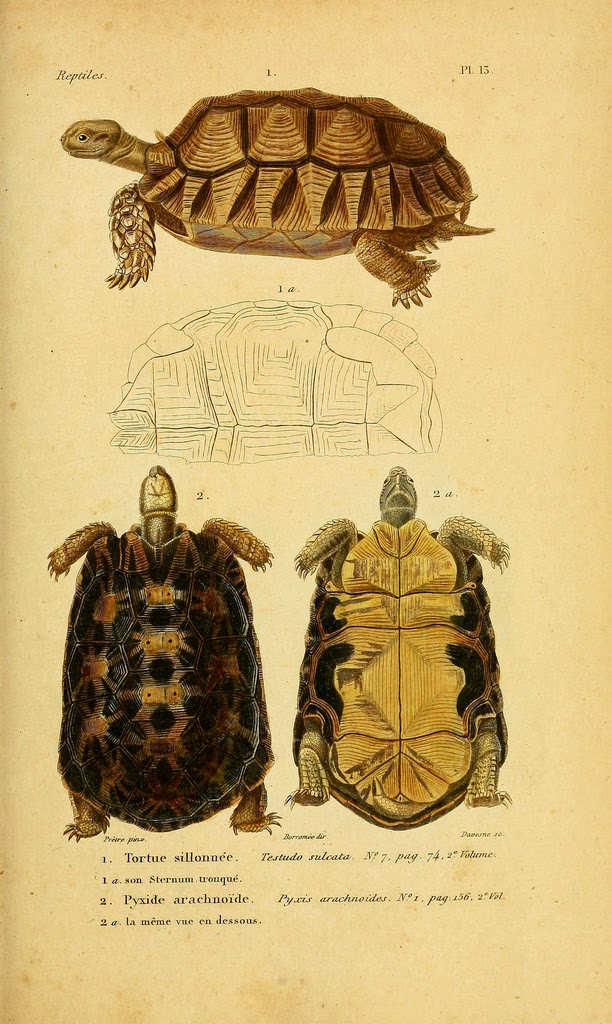 |
| Fig 1: Geochelone sulcata (African spur-thighed tortoise); Fig 2: Pyxis arachnoides (Madagascar spider tortoise). Duméril, André Marie Constant. Erpétologie générale ou Histoire naturelle complète des reptiles (1834-53). http://biodiversitylibrary.org/page/31895778. |
The revised taxonomy and detailed descriptions of the species in the Paris collection were presented within Erpétologie générale, which ultimately related 1,393 species and included 120 plates, many of which were hand-painted.
Bibron, sadly, died of tuberculosis in 1848, before the completion of the series. Duméril’s son, Auguste Henri André Duméril, then assisted his father in the completion of volumes 7, 9, and the atlas.
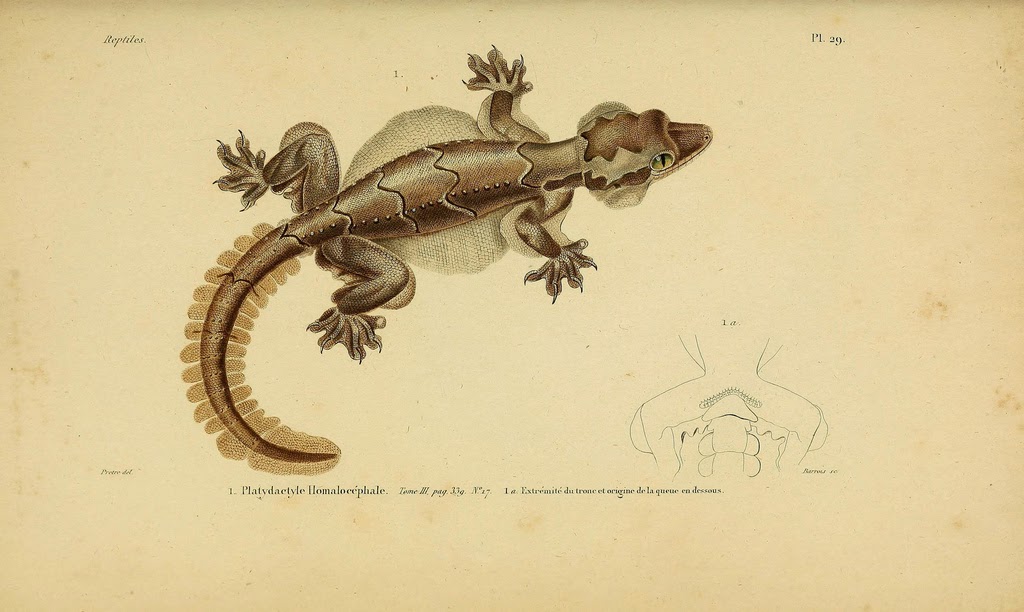 |
| Ptychozoon kuhli (Flying gecko). Duméril, André Marie Constant. Erpétologie générale ou Histoire naturelle complète des reptiles (1834-53). http://biodiversitylibrary.org/page/31895810. |
Erpétologie générale was a ground-breaking work, setting the standard for herpetological reference with copies deposited in major scientific libraries of the nineteenth century. The accurate species descriptions and remarkable plates ensures that this work is still of vital research interest to today’s scientific community, regardless of the fact that the presented taxonomic revision itself is now considered obsolete (Duméril, for instance, considered amphibians as one of four orders within Reptilia, alongside turtles, snakes and lizards, the latter including crocodiles).
Today, Reptilia and Amphibia are two separate classes, and the living subgroups recognized within Reptilia include Crocodilia (crocodiles, gavials, caimans, and alligators), Sphenodontia (tuatara from New Zealand), Squamata (lizards, snakes, and worm lizards), and Testudines (turtles, terrapins and tortoises). All told, over 10,000 species of reptiles and approximately 7,000 species of amphibians are known today.
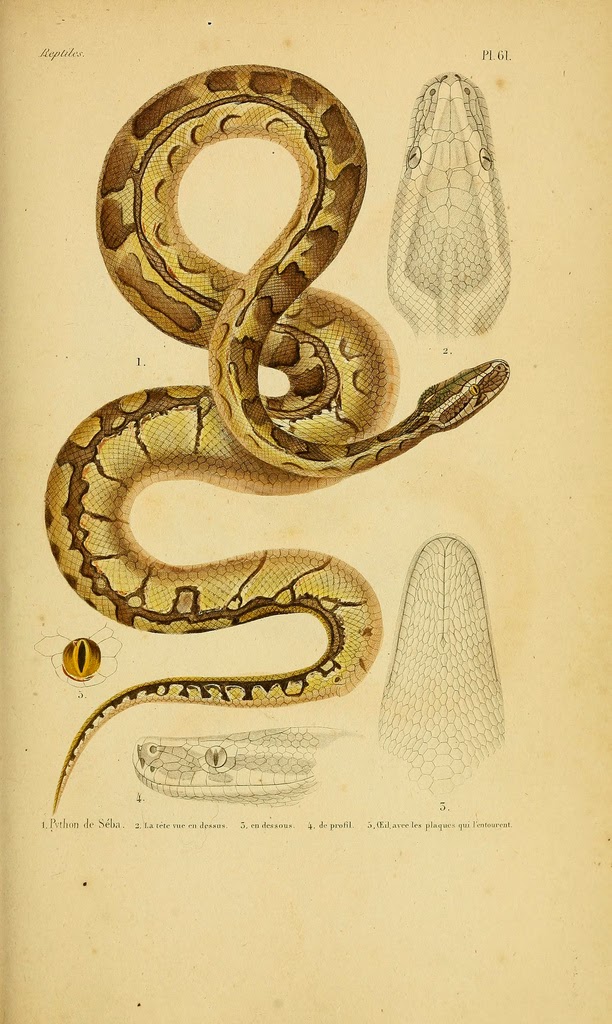 |
| Pytho sebae (African rock python). Duméril, André Marie Constant. Erpétologie générale ou Histoire naturelle complète des reptiles (1834-53). http://biodiversitylibrary.org/page/31895878. |
Duméril’s remarkable Erpétologie générale ou Histoire naturelle complète des reptiles is freely available within the Biodiversity Heritage Library, digitized by the Ernst Mayr Library of the Museum of Comparative Zoology at Harvard University and Smithsonian Libraries. Browse the complete work today and enjoy the stunning illustrations in Flickr.
The research for this post was obtained from “The First Comprehensive Description of the Amphibians and Reptiles of the World,” by Christopher J. Raxworthy. This essay can be found within Natural Histories (2012), an excellent resource on a selection of rare books found within the American Museum of Natural History Library, many of which are also freely available within BHL.
