

The Purposeful Gaming project has now ended and BHL is no longer utilizing outputs from the games created as part of this project: Smorball and Beanstalk. However, both games will remain live for your continued enjoyment. Learn more.
As game players are growing beanstalks and leading the Eugene Mellonballers to victory, historic books are being saved from digital oblivion. In June of 2015, the Biodiversity Heritage Library (BHL) and Tiltfactor released two games called Smorball and Beanstalk to help crowdsource the task of text correction.
What’s the Purpose?
When a book is first digitized, its pages are merely image files and the text cannot be searched. Optical character recognition software (OCR) converts these page images into machine encoded text that can be searched, but historic literature has many idiosyncrasies that inhibit accurate OCR. BHL wanted to harness the power of crowdsourcing and the fun of gaming to allow humans to help correct inaccurate OCR. The games present extracted words from BHL books that users type out, thus verifying the spelling. These submissions are used to correct the OCR in BHL. By presenting users with a high volume of words in rapid succession during each play-through, we can receive a large number of word corrections and achieve a significant level of OCR correction.
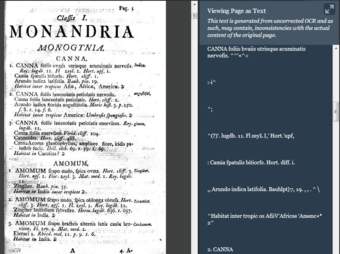 |
| Sample of poor OCR output. |
Who are the Audiences for each Game?
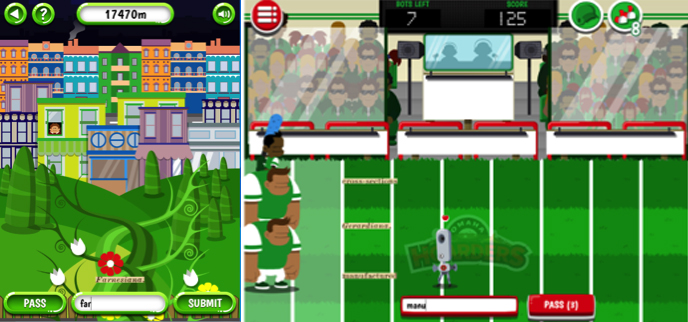
Smorball, which presents words at an increasingly rapid pace, is designed for a gaming audience with experience tackling progressively challenging levels and speedy data-entry. Beanstalk was designed for players that are not typically gamers, and are thus not as comfortable with gamification techniques such time-bound typing, but still want to help improve access to BHL books. Beanstalk allows players to type words at their own pace, but incorporates evolving sights, sounds, and a leaderboard to keep the game engaging and dynamic.
What are players saying?
Over two thousand people have played the games since the launch, and we have received positive feedback from players and news outlets.


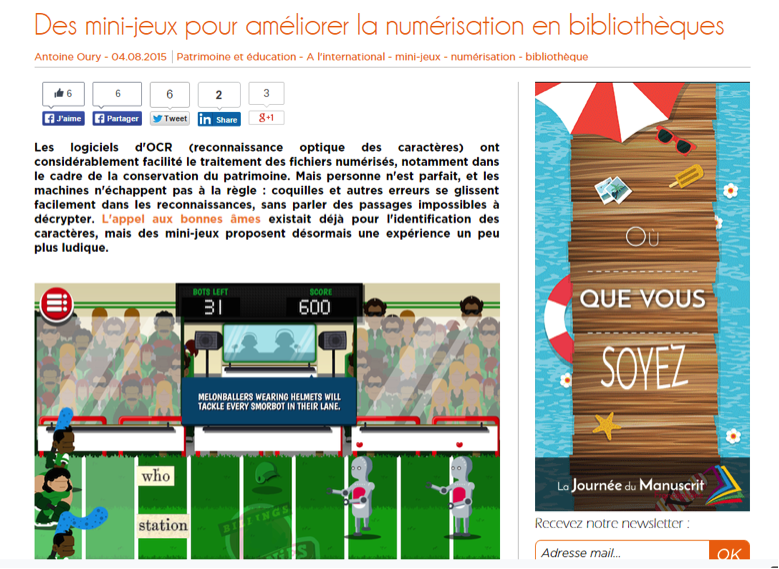
“Mini games to improve library digitization” by Antoine Oury.
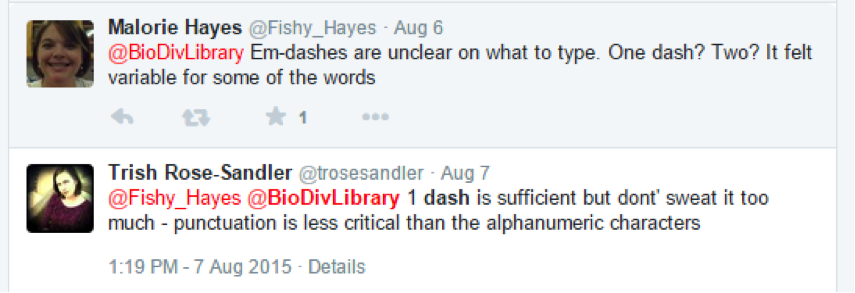
Some users have asked questions about typing strategies.
Other users have asked about the sometimes odd behavior of the games.

Repeated words occur when that word appears more than once on a single page. If OCR software misinterprets a word once, it will likely misinterpret it again. Sometimes it will even misinterpret in more than one way e.g. (“fish” may be interpreted as “f1sh” and “flsh”) which means that the game can’t filter out these duplicates from being shown to the player. Symbols may show up in the games when the OCR software has misinterpreted them as alpha-numeric characters. We suggest choosing the “skip” option or substituting any alpha-numeric character for the symbol.
The Buzz
The games have been demoed at several conferences and sites since launch including Empire Farm Days and the Howe Library in Hanover New Jersey.
Smorball will also be featured at this fall’s Boston Festival of Games (BFIG).

Reviewers at BFIG had this to say about Smorball:
- “The world of the sports game isn’t innovative or unique, but it’s an original made-up game where humans get to smash robots, which makes it fun to watch and play.”
- “ I do feel that this is a complete game, very polished, and addictive.”
Smorball is now available on Newgrounds.com – a site for “artists, game developers, musicians, voice actors and writers to share their stuff on the web.”

Reviewers on newground.com had this to say about the game:

We Need More Players!
In order for us to scale to an effective level we need tens of thousands of players. If you have not played Smorball or Beanstalk please give them a spin and let us know what you think. Submit your feedback here: Smorball and Beanstalk.
Please share widely with your friends, family and co-workers who would enjoy playing a good game and helping science research at the same time!
Finally, we couldn’t end this post without acknowledging some of the top players from our Beanstalk leaderboard. Thanks to “mlwoodward” “patty_john” and “ldv27” – Keep growing those beanstalks and helping us improve our texts!
 Smorball and Beanstalk were designed as part of the Purposeful Gaming and BHL project, which explores how digital games can make scanned content more accessible and searchable for cultural institutions. Based at the Missouri Botanical Garden in St. Louis, Missouri, “Purposeful Gaming and BHL” was established in 2013 through an Institute of Museum and Library Services (IMLS) grant and includes partners at Harvard University, Cornell University, and The New York Botanical Garden.
