Biodiversity Heritage Library - Program news and collection highlights from BHL
  • Home
  • News
  • Featured Books
    • All Featured Books
    • Book of the Month Series
    • BHL at 20
  • User Stories
  • Campaigns
    • Fossil Stories
    • Garden Stories
    • Monsters Are Real
    • Page Frights
    • Her Natural History
    • Earth Optimism 2020
  • Tech Blog
  • Visit BHL
Home
News
Featured Books
    All Featured Books
    Book of the Month Series
    BHL at 20
User Stories
Campaigns
    Fossil Stories
    Garden Stories
    Monsters Are Real
    Page Frights
    Her Natural History
    Earth Optimism 2020
Tech Blog
Visit BHL
  • Home
  • News
  • Featured Books
    • All Featured Books
    • Book of the Month Series
    • BHL at 20
  • User Stories
  • Campaigns
    • Fossil Stories
    • Garden Stories
    • Monsters Are Real
    • Page Frights
    • Her Natural History
    • Earth Optimism 2020
  • Tech Blog
  • Visit BHL
Biodiversity Heritage Library - Program news and collection highlights from BHL
BHL News, Blog Reel, Tech Updates

Planned Outage of BHL Website for Scheduled Maintenance 3/1/2016 at 6pm CST

Portrait version of the Biodiversity Heritage Library logo.

There will be a planned outage of the BHL website for scheduled maintenance on Tuesday, 1 March 2016, beginning at 6pm CST and lasting approximately two hours. We apologize for the inconvenience and thank you for your patience.

During the outage, you can access BHL’s content via Internet Archive: https://archive.org/details/biodiversity

February 29, 2016by ulib-libraryjobs
Blog Reel, Featured Books

Humboldt and Bonpland’s Essai sur la géographie des plantes and its significance

Over 210 years after Alexander von Humboldt and Aimé Bonpland’s work titled Essai sur la géographie des plantes was published, climate science, book conservation, and botanical research have converged around this 1805 work. This book was digitized and made available in 2008 by the Missouri Botanical Garden for the Biodiversity Heritage Library.

Modern science meets historic data

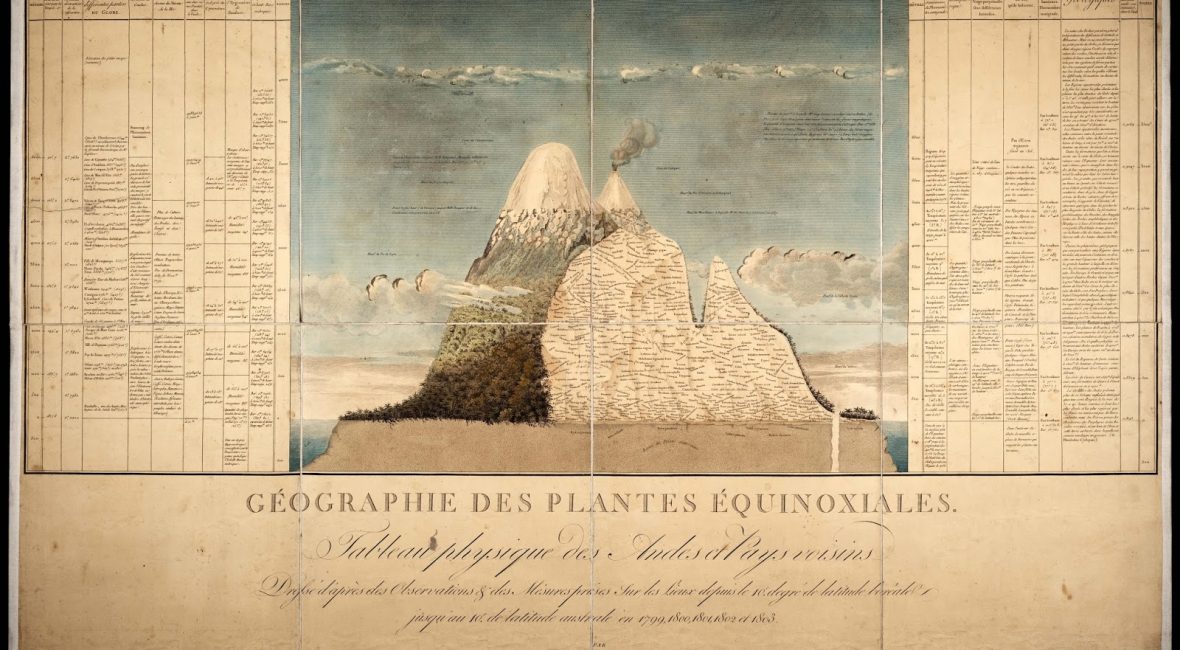
In 2015, scientists published a paper detailing their findings as they retraced the path that Humboldt and Bonpland took on their ascent up the dormant volcano, Chimborazo, in Ecuador. The paper, “Strong upslope shifts in Chimborazo’s vegetation over two centuries since Humboldt,” utilized the data and map contained in Essai sur la géographie des plantes and presented modern data from the same locations as detailed in Essai to reveal the effects of climate change on the volcano.

As Stephen T. Jackson writes in the 2009 book, Essay on the geography of plants, the significance of Humboldt and Bonpland’s work describing their ascent up Chimborazo lies in the detailed data they collected at various elevations. Jackson and historian Andrea Wulf have noted that while most people have forgotten Humboldt, his significance in unifying early scientific disciplines into an inter-connected web of life cannot be understated. Measurements taken on Chimborazo include light intensity, temperature, barometric pressure, and gravitational force. Descriptions of the flora and fauna at various levels of Chimborazo were described and illustrated on the map contained with Essai sur la géographie des plantes.

View Full Size Image
Figure 1: Map from Essai sur la geographie des plantes. (view detailed map here)

Morueta-Holme et al., the scientists who retraced Humboldt and Bonpland’s course up Chimborazo, also took measurements and made observations at the same locations that were originally recorded in 1802. More specifically they noted the migration of the flora up Chimborazo to look at the effects of anthropogenic climate change upon the region (something Andrea Wulf notes that Humboldt warned about in the early nineteenth century). And one more final fact, Humboldt’s expedition was record setting at that time for the highest ascent.

Modern conservation meets historic data

While the aforementioned paper was being written, in early 2014, the Peter H. Raven Library at the Missouri Botanical Garden loaned its copy of the Essai’s map to the Americas Society for an exhibition entitled, Unity of Nature: Alexander von Humboldt and the Americas. While the Americas Society did not want the text to accompany the map, the condition of both was given a cursory examination at that time. The Library’s director decided that the volume should be scheduled for a complete conservation treatment.

In December of 2014, the Library’s book conservator examined the volume more thoroughly to assess damage and make decisions about the book’s treatment.

The Essai still had what was apparently its original, early 19th century binding. It was bound in a style called half leather, which means that there was leather on the corners, the spine, and the edges of the covers next to the spine. The rest of the covers were lined with a marbled paper. The volume’s covers were detached from the textblock, and the leather on the spine was badly decayed. There were some other relatively minor issues, such as missing endbands and a few paper rips, but the detached covers and the decayed leather were the most significant problems that needed to be addressed in order to make the book functional again.

View Full Size Image
Figure 2: Detached board (left). Repaired board (right).

Because the Essai is a physical artifact as well as a text, the conservator attempted to save as much of the original binding as possible. The covers, with their attractive marbled papers, were reused, but the leather along the spine was so badly decayed that it had to be removed and replaced with new leather.

Board reattachment is a very common procedure in book conservation. Our conservator began the process by removing all of the decayed leather from the spine and the edges of the covers. She then cleaned the old glue and paper liner off of the book’s spine. Once the back of the book was clean, she adhered new paper and cotton cloth linings to the spine, using a water-based adhesive that can easily be removed if need be by conservators in the future.

View Full Size Image
Figure 3: Repairs to the half-title page and gutter.

The cotton cloth lining was cut to extend beyond the edge of the spine, and the boards were reattached to this cotton hinge, again using water-based adhesives.

View Full Size Image
Figure 4: Redone spine. Original (lower). Replacement (upper).

After reattaching the boards, the conservator cut and adhered a new piece of leather to the spine and the edge of the boards closest to the spine. Enough of the original spine was left to provide clues about its original appearance—it had 5 false raised-bands, gold lines on the sides of the bands, and a label of black leather. The conservator recreated this original, early 19th century style spine treatment in her new spine.

The finished book was functional and true in appearance and materials to the early 19th century.

Modern research meets historic data

Chimborazo is still a place of intrigue for scientists, and research on Chimborazo continues to this day. For example, the Missouri Botanical Garden’s curator, Dr. Carmen Ulloa Ulloa, frequently travels to Ecuador to do field collecting and research on Chimborazo and other equatorial volcanoes.

View Full Size Image
Figure 5: Dr. Ulloa Ulloa (front, left) and field assistants at the Humboldt statue on Chimborazo in 2009.

Dr. Ulloa Ulloa, whose research focuses on the páramo regions (the area of high elevation on mountains above the tree line yet below the snowcaps), has published numerous articles and books on the flora of the páramo regions of the Andes. Her favorite family of plants in the páramo is Berberidaceae (barberry).

To aid in the identification of Berberidaceae and other plants including many of the páramo region’s flora, a free app (available on Android phones) called Flóramo, developed by two young Ecuadorian computer engineers, Luz Marina Unda (Dr. Ulloa Ulloa’s niece) and Valetín Zapata, is also available for download. Additionally, people can explore images of Berberidaceae on both the Flora of the World website and on the Encyclopedia of Life website.

View Full Size Image
Figure 6: Dr. Ulloa Ulloa and team collecting specimens on the páramo area of Chimborazo.

Dr. Ulloa Ulloa describes Humboldt’s visit to Ecuador as inspirational and an influence upon her own career. She splits her time conducting research between the U.S. and Ecuador. She also has a presentation about her recent experience of following in the footsteps of Humboldt that has been presented to various audiences.

View Full Size Image
Figure 7: Werneria pumila photographed on Chimborazo by Dr. Ulloa Ulloa.

After 200 years, the significance of Humboldt and Bonpland’s expedition to Ecuador and Chimborazo have not diminished. His original work is being preserved to aid modern science and science is still turning to the Essai sur la géographie des plantes for modern answers.

February 25, 2016by ulib-libraryjobs
BHL News, Blog Reel

The Latest News from BHL

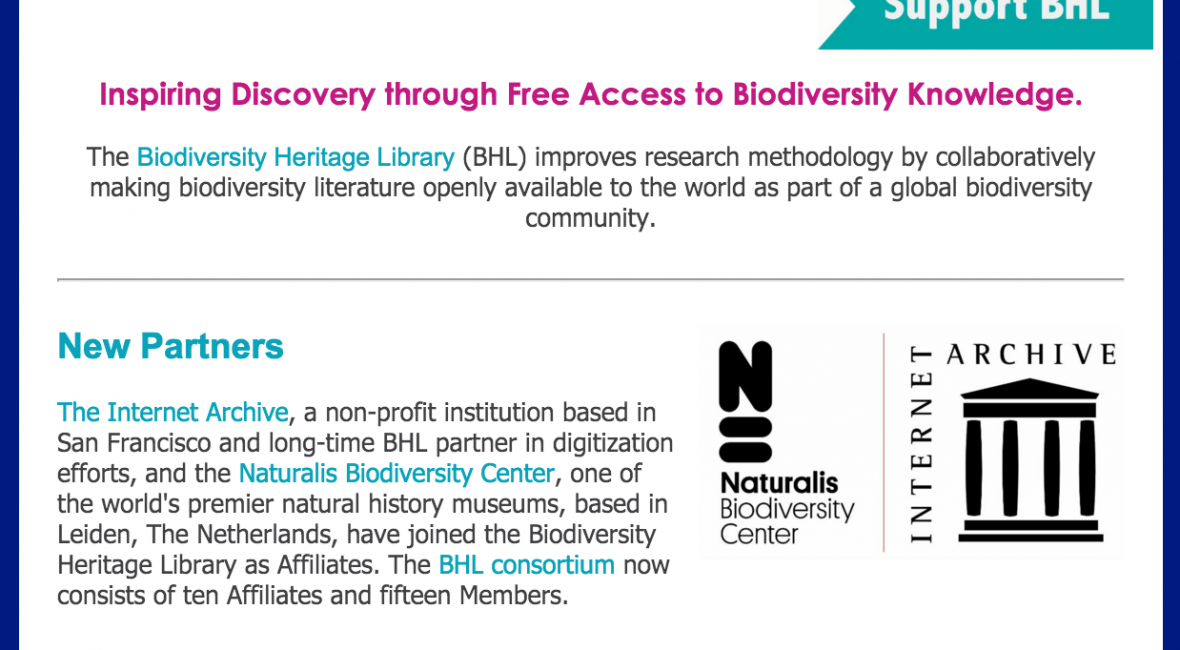
There have been some exciting developments in BHL-land, including new projects to add more content to BHL such as in-copyright titles, materials from new contributors, and field notes. These new projects come with new funding as well. We’ve also expanded our consortium with two new affiliates and participated in some fun outreach activities. Find all this and more in the Winter 2016 BHL Newsletter.

Stay up to date with all the latest news from BHL by subscribing to our newsletter.

View Full Size Image


February 24, 2016by ulib-libraryjobs
Blog Reel

BHL Website Issues Resolved 2/23/2016

Portrait version of the Biodiversity Heritage Library logo.

UPDATE: The technical issues we were experiencing with the BHL website have been resolved. All services back up and running. Thanks for your patience!

The BHL website is currently down due to technical difficulties. We are working to correct the issue as soon as possible, and apologize for the inconvenience. Thanks for your patience and stay tuned for more updates.

While we work to resolve the technical issues w/ the BHL website, you can explore our collections on Internet Archive.

February 23, 2016by michelle.underhill
BHL News, Blog Reel

The Impact of Coordinated Social Media Campaigns on Online Citizen Science Engagement

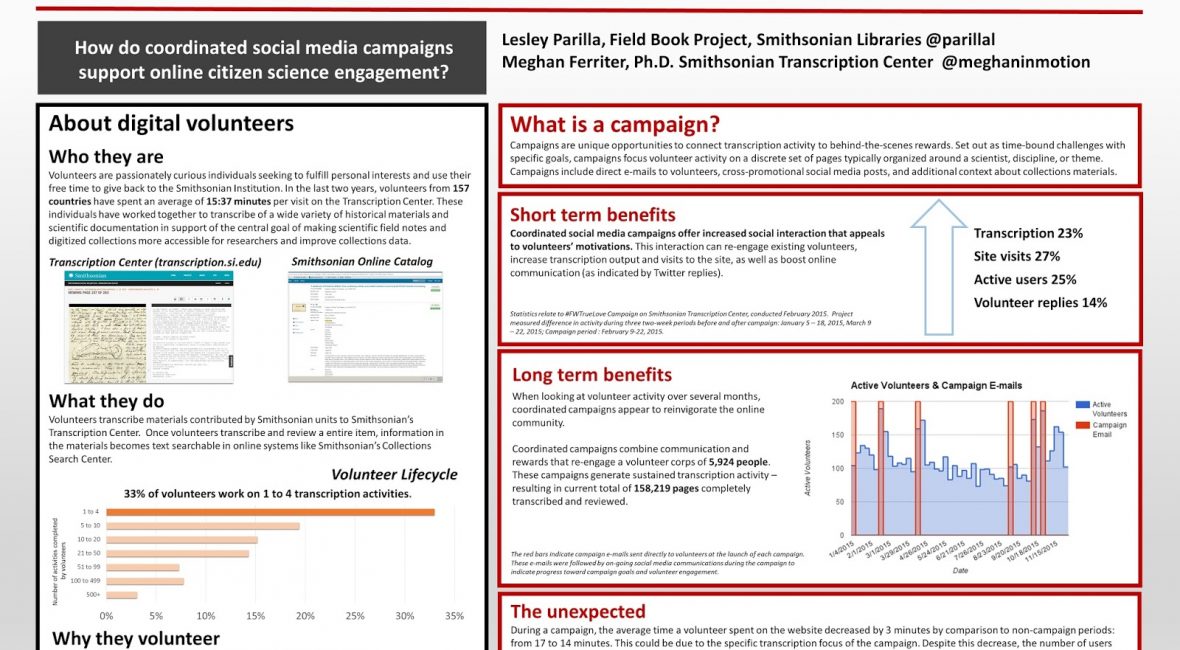
Smithsonian staff members recently presented a poster at the American Association for the Advancement of Science (AAAS) Annual Meeting in Washington, DC, 11-15 February, 2016. The poster, entitled “The Impact of Coordinated Social Media Campaigns on Online Citizen Science Engagement” by Lesley Parilla (Cataloging Coordinator, The Field Book Project) and Meghan Ferriter, Ph.D. (Project Coordinator, Smithsonian Transcription Center), highlighted the impact of a coordinated social media campaign on crowdsourced transcriptions of field notes.

View Full Size Image

The poster outlined the details and outcomes of the #FWTrueLove campaign, a collaboration involving The Field Book Project, the Smithsonian Institution Archives, the Smithsonian Transcription Center, Pyenson Lab, and the Biodiversity Heritage Library. The event challenged volunteers to fully transcribe a selection of field notes by Frederick W. True, held by the Smithsonian Institution Archives and uploaded to the Smithsonian Transcription Center, by the end of the campaign period. Materials for the challenge were identified and selected with Smithsonian Curator of Fossil Marine Mammals Dr. Nick Pyenson and the Smithsonian Field Book Project, a joint initiative of the National Museum of Natural History, Smithsonian Libraries and Smithsonian Institution Archives. The field notes are an important source of natural science data that is difficult to utilize, since they are often handwritten and fragile due to age.

The Transcription Center coordinated the multi-institutional campaign during the month of February 2015. The campaign involved blog posts, Twitter, Instagram, Facebook, and a targeted email to the Transcription Center’s current volunteers, all of which challenged users to completely transcribe 523 pages from F.W. True’s field notes within one week. Updates were posted on: http://nmnh.typepad.com/fieldbooks/fwtruelove/.

As a reward for the successful completion of the challenge, the Transcription Center coordinated Google Hangouts with Curator of Fossil Marine Mammals Dr. Nick Pyenson. Dr. Pyenson discussed the interdisciplinary nature of F.W. True’s scientific pursuits – plus True’s connections with Smithsonian researchers like Leonhard Stejneger and William Healey Dall.

The #FWTrueLove campaign contrasted with a typical experience by focusing on a specific set of materials. The modular design of the Transcription Center’s website, which incorporates multiple collection types, means that a typical volunteer experience is flexible and highly tailored to their individual interests. This flexible design enables volunteers to create their own online experience. This can be expanded with engagement via social media. An analysis of the event showed that coordinated social media campaigns increase volunteer interaction, transcription output, and the number of active users on the Transcription Center. However, there was a decrease in the average length of a visit during the campaign. This may be because new active users are specifically coming to spend time on the projects highlighted in the campaign. This varies from other periods of time on the site, when volunteers come to work on one project but move onto unrelated projects that catch their attention thanks to the site’s open structure. These focused campaigns that appear to work in direct opposition to the flexible nature of the Transcription Center may keep the community growing, serving to reinvigorate the volunteer community as a whole and combat the natural cycling of volunteers out of active participation.

Learn more about the results of the campaign on the AAAS website. See the posted in more detail on BHL’s Pinterest.

February 18, 2016by ulib-libraryjobs
BHL News, Blog Reel

Expanding Access Training Workshop

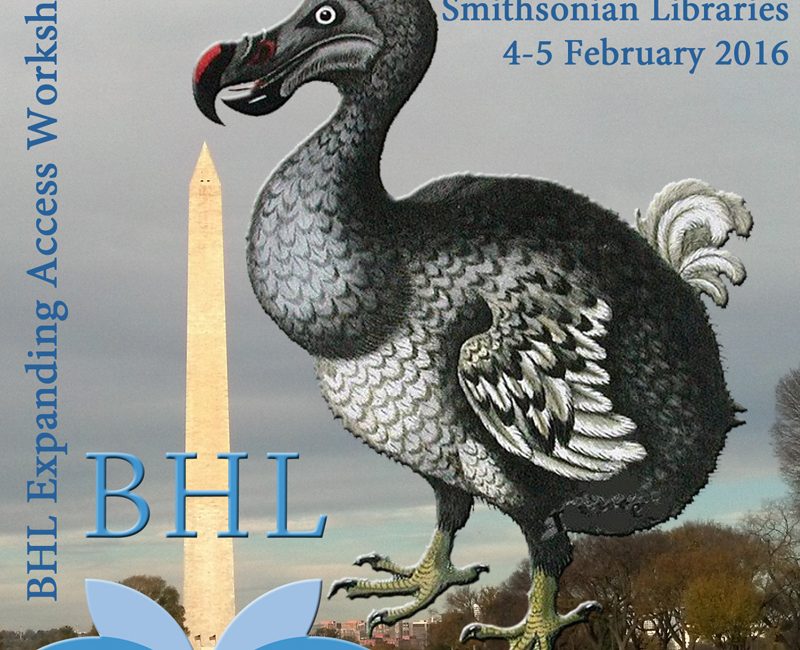
On February 4-5, 2016, Smithsonian Libraries hosted staff from the New York Botanical Garden, the Museum of Comparative Zoology (Harvard University), and the Missouri Botanical Garden as part of a training workshop for the New York Botanical Garden’s IMLS-funded grant, Expanding Access to Biodiversity Literature.

View Full Size Image

The BHL Secretariat staff (Carolyn Sheffield, BHL Program Manager; Bianca Crowley, BHL Collections Manager; Grace Costantino, BHL Communications and Outreach Manager; and BHL Program Director, Martin Kalfatovic) conducted the two day workshop based on previous workshops for BHL Africa and BHL Mexico. The workshop provided an intense overview of the methodologies for partnering with institutions not currently participating in the BHL in order to add new content to BHL and the Digital Public Library of America (DPLA).

Participating staff included:

New York Botanical Garden, LuEsther T. Mertz Library

  • Susan Fraser (Director of the NYBG LuEsther T. Mertz Library, Project Director)
  • Susan Lynch (Systems Librarian, Data Manager)
  • Mariah Lewis (Metadata Specialist – and former Smithsonian Libraries’ intern)

View Full Size Image

Ernst Mayr Library, Museum of Comparative Zoology, Harvard University

  • Constance Rinaldo (Librarian of the Ernst Mayr Library of the MCZ/Harvard University)
  • Joe deVeer (Project Manager and Museum Liaison for the Ernst Mayr Library of the MCZ/Harvard University)
  • Patrick Randall (Community Manager)

View Full Size Image

Missouri Botanical Garden, Center for Biodiversity Informatics

  • Trish Rose-Sandler (Digital Projects Coordinator, Center for Biodiversity Informatics, Missouri Botanical Garden and Data Analyst for BHL)

View Full Size Image

Thanks to the staff from the Smithsonian Libraries’ Natural History Library for hosting the event in their training room.

If you would like to learn more about Expanding Access to Biodiversity Literature, please visit the project’s wiki page.

February 16, 2016by [email protected]
Blog Reel, Featured Books

Darwin’s Early Love

Charles Darwin, the famous naturalist known around the world for his publication On the Origin of Species and contributions to evolutionary theory, was born on February 12, 1809. As such, February 12 is known as International Darwin Day – a celebration with a vision to:

“Inspire people throughout the globe to reflect and act on the principles of intellectual bravery, perpetual curiosity, scientific thinking, and hunger for truth as embodied in Charles Darwin. It will be a day of celebration, activism, and international cooperation for the advancement of science, education, and human well-being.”

February 12 also happens to be just days before Valentine’s Day, a holiday now associated with love and the presentation of valentines as expressions of affection. How might these two, seemingly disparate holidays, be brought together? Why not by thinking about who Darwin himself might give a valentine to in the natural world?

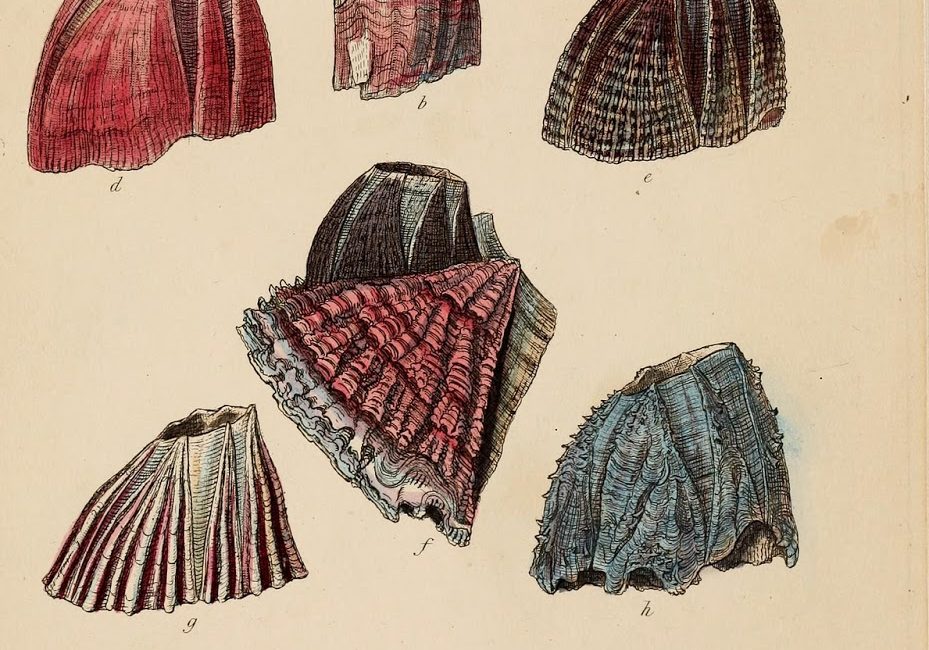
Many people, when thinking of Darwin, might associate him with finches, mockingbirds, rheas, or Galápagos tortoises. But when Darwin began to investigate natural history while studying medicine in Edinburgh in the 1820s, it was marine invertebrates that first sparked his interest. While still a teenager, Darwin became a member of the Plinian Society, which was dedicated to the study of natural history amongst Edinburgh students. The zoologist Robert Edmond Grant nurtured Darwin’s interest in natural history, especially marine invertebrates, and taught him how to collect and rear specimens. Darwin’s first scientific paper, which was presented to the Plinian Society in March of 1827, was about bryozoan larvae and the black spots sometimes seen on oyster shells, which he demonstrated were the eggs of marine leeches. Sadly, Darwin’s mentor Grant had presented these same findings just days before Darwin at another venue, leading Darwin to feel betrayed and prompting his exodus from Edinburgh (Stiassny, 83).

View Full Size Image
Darwin, Charles. A monograph on the sub-class Cirripedia, with figures of all the species. (1851-54). http://biodiversitylibrary.org/page/2007053. Digitized for BHL by the MBLWHOI Library.

Time passed, Darwin spent some time at Cambridge, and eventually he joined the voyage of the HMS Beagle thanks to a recommendation from his new mentor, botanist and geologist John Stevens Henslow. Darwin’s observations and research during the voyage would fuel his later revolutionary theories. But, as Dr. Melanie L.J. Stiassny, a curator at the American Museum of Natural History, points out in her article on Darwin within the book Natural Histories: Opulent Oceans, Darwin felt somewhat hesitant about his ideas during the early stages of their development. After all, they represented an entirely new way of looking at the natural world and thinking about its origins. So, while he fleshed out his theories on natural selection, Darwin also turned his attention back to, as Stiassny calls it, “his early love” – marine invertebrates. It was his work on barnacles that arguably helped pave the way for the acceptance of his later theories. As Stiassny states on page 84 of Opulent Oceans:

“It was the study of one group, the barnacles (Cirripedia), that would solidify his credentials as a taxonomic expert and provide him with empirical evidence for many of his evolutionary ideas…such as the loss of unnecessary structures (barnacles have no trace of the abdominal segments and swimming appendages of other crustaceans), and evidence that features inherited from a common ancestor can transform in anatomy and function (the typical walking limbs of crustaceans are modified into specialized feeding cirri in barnacles).”


View Full Size Image
Darwin, Charles. A monograph on the sub-class Cirripedia, with figures of all the species. (1851-54). http://biodiversitylibrary.org/page/2007061. Digitized for BHL by the MBLWHOI Library.

Darwin spent eight years working on his barnacle studies, and from 1851-54 finally published his work in a four-part series: A monograph on the sub-class Cirripedia, with figures of all the species. Within the work, Darwin provides a classification for the crustacean Subclass Cirripedia, making it “the first based on the evolutionary principle of common descent” (Stiassny, 85). His On the Origin of Species, published in 1859, five years after his Cirripedia work, references cirripedes twenty-six times, demonstrating the impact this research had on Darwin’s evolutionary ideas.

View Full Size Image
Darwin, Charles. A monograph on the sub-class Cirripedia, with figures of all the species. (1851-54). http://biodiversitylibrary.org/page/2011425. Digitized for BHL by the MBLWHOI Library.

Darwin’s name is arguably the most well-known from the world of natural history. Knowing Darwin’s history with the Cirripedia, one might wonder if he would have realized the heights of his scientific achievements without his barnacles.

So, we think, if Darwin were to give a Valentine to someone in the non-human animal kingdom, there’s a good chance it would go to a barnacle.

View Full Size Image
Darwin, Charles. A monograph on the sub-class Cirripedia, with figures of all the species. (1851-54). http://biodiversitylibrary.org/page/2007081. Digitized for BHL by the MBLWHOI Library.


  • See books and articles written by Charles Darwin in BHL.
  • Explore digitized versions of the books in his personal library in Charles Darwin’s Library in BHL.
  • Explore images from books in Charles Darwin’s Library in Flickr.

Reference:
Stiassny, Melanie L.J. (2014). Darwin’s “Beloved Barnacles.” Natural Histories Opulent Oceans: Extraordinary Rare Book Selections from the American Museum of Natural History Library (pp. 82-85). New York: Sterling Publishing.

February 12, 2016by ulib-libraryjobs
Page 1 of 212»

Help Support BHL

BHL's existence depends on the financial support of its patrons. Help us keep this free resource alive!

search

About BHL

The Biodiversity Heritage Library (BHL) is the world’s largest open access digital library for biodiversity literature and archives. BHL operates as a worldwide consortium of natural history, botanical, research, and national libraries working together to digitize the natural history literature held in their collections and make it freely available for open access as part of a global “biodiversity community.”

Join Our Mailing List

Sign up to receive the latest news, content highlights, and promotions.

Subscribe Now

Subscribe to Blog via Email

Enter your email address to subscribe to this blog and receive notifications of new posts by email.

Join 319 other subscribers

Subscribe to Blog Via RSS

Subscribe to the blog RSS feed to stay up-to-date on all the latest BHL posts.

Access RSS Feed

Inspiring Discovery through Free Access to Biodiversity Knowledge.

The Biodiversity Heritage Library makes it easier than ever for you to access the information you need to study and explore life on Earth…for free, anytime, anywhere.


64+ Million Pages of
Biodiversity Literature Online.

EXPLORE

Tools and Services
to Transform Research.

EXPLORE

300,000+
Illustrations on Flickr.

EXPLORE

ABOUT | HARMFUL CONTENT | PRIVACY | SITE MAP | TERMS OF USE