
Biodiversity Heritage Library - Program news and collection highlights from BHL
  • Home
  • News
  • Featured Books
    • All Featured Books
    • Book of the Month Series
    • BHL at 20
  • User Stories
  • Campaigns
    • Fossil Stories
    • Garden Stories
    • Monsters Are Real
    • Page Frights
    • Her Natural History
    • Earth Optimism 2020
  • Tech Blog
  • Visit BHL
Home
News
Featured Books
    All Featured Books
    Book of the Month Series
    BHL at 20
User Stories
Campaigns
    Fossil Stories
    Garden Stories
    Monsters Are Real
    Page Frights
    Her Natural History
    Earth Optimism 2020
Tech Blog
Visit BHL
  • Home
  • News
  • Featured Books
    • All Featured Books
    • Book of the Month Series
    • BHL at 20
  • User Stories
  • Campaigns
    • Fossil Stories
    • Garden Stories
    • Monsters Are Real
    • Page Frights
    • Her Natural History
    • Earth Optimism 2020
  • Tech Blog
  • Visit BHL
Biodiversity Heritage Library - Program news and collection highlights from BHL
Blog Reel, Featured Books

Fashion in the Natural World: Fusing Science with Art

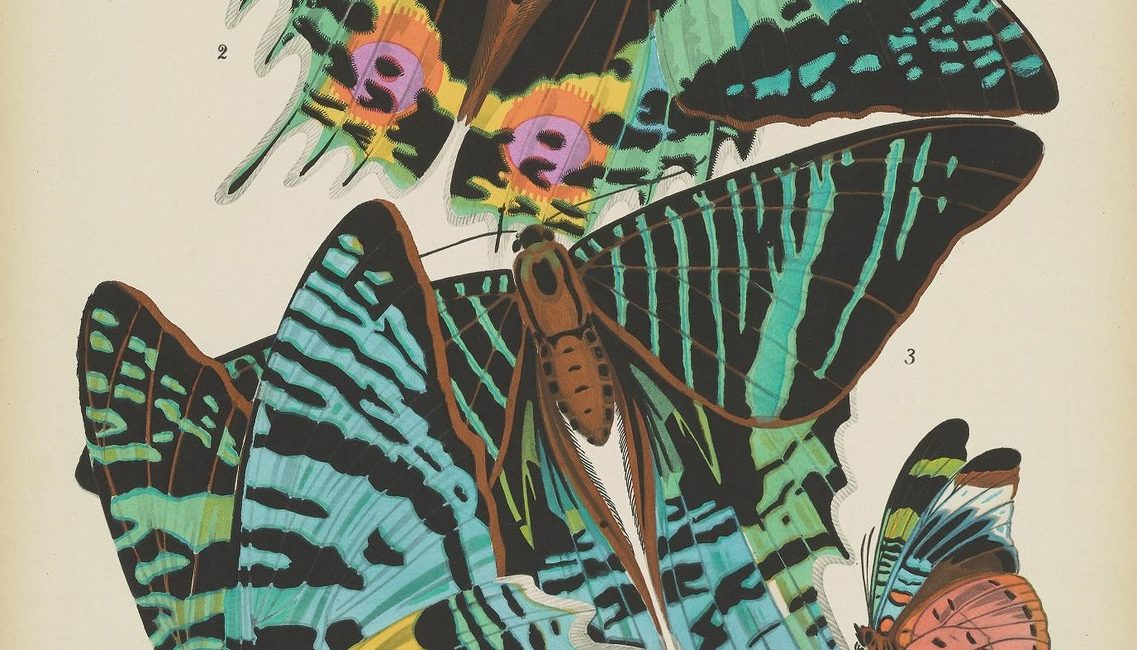
Emile-Allain Séguy was a popular French designer throughout the Art Deco and Art Nouveau movements of the 1920s. Often confused with the French entomologist Eugene Séguy who was active during the same time period, E.A. Séguy designed primarily patterns and textiles and was heavily influenced by the natural world. He was particularly fond of the intricate patterns and beauty of insects (Eugene would have approved), which he saw as “mechanic wonders” that provided abundant inspiration for interior design (Schiff, 157).

View Full Size Image
Séguy, Emile-Allain. Papillons. 1925. http://biodiversitylibrary.org/page/48852979. Digitized by Smithsonian Libraries.

In 1920, the American textile manufacturer F. Schumacher and Co. commissioned the work Papillons, which was to include stunning compositions of butterflies intended for use as wallpaper, textiles, and other interior and fashion design purposes. Referring to scientific illustrations for reference, Séguy reproduced 81 butterflies within 16 compositions, as well as four additional plates of decorative patterns inspired by butterfly wings, using the pochoir technique. The pochoir technique is based on an ancient method that uses stencils for color application. A costly and labor-intensive technique, pochoir was especially popular in Paris in the 1920s. Each color in a design has its own stencil and layers of gouache or other pigments are applied through each stencil by hand with a brush or sponge. The result is an intense and accurate representation of the colors intended for each composition (Schiff, 157).

View Full Size Image
Séguy, Emile-Allain. Papillons. 1925. http://biodiversitylibrary.org/page/48852961. Digitized by Smithsonian Libraries.

Though the butterflies and plates are ultimately meant for design applications, Séguy emphasized his use of scientific illustrations to inspire his art and included a table of scientific names within Papillons identifying the species depicted in each plate and its place of origin. The work includes species from across the globe (Schiff, 158).

View Full Size Image
Séguy, Emile-Allain. Papillons. 1925. http://biodiversitylibrary.org/page/48852957. Digitized by Smithsonian Libraries.

Séguy’s designs were reproduced extensively in textiles, wallpapers, and other decorative applications for nearly a century. You can view all of the plates from this work in Flickr. This week, we put the artwork to another use in the Color Our Collections event. The event invites you to download images from library and cultural institution collections, color them, and share them on social media using the event hashtag #ColorOurCollections. We created a plethora of content for the event, including a Flickr collection containing over 1,000 black and white illustrations from BHL’s collection. We also created a set of coloring pages from colored illustrations in our collection, which are available separately in Pinterest and also as a single PDF.

View Full Size Image
A coloring page made from Séguy’s Papillons. Digitized for BHL by Smithsonian Libraries.

A significant portion of the coloring pages we created are from Séguy’s Papillons, which was digitized for BHL by Smithsonian Libraries. While the colors chosen and so carefully applied by Séguy may reflect the true hues of the natural world, we invite you to design your own butterflies! Download the PDF, choose your own colors for Séguy’s outlines, and share the results on social media by tagging @BioDivLibrary and using the #ColorOurCollections hashtag.

View Full Size Image
A coloring page made from Séguy’s Papillons. Digitized for BHL by Smithsonian Libraries.

The natural world is alive with artistic inspiration. It’s your turn to color your world!

This post is derived from the article:
Schiff, Stacy J. (2012). Fashion in the Natural World. In T. Baione (Ed.), Natural Histories: Extraordinary Rare Book Selections from the American Museum of Natural History Library (pp. 157-159). New York: Sterling Publishing.

February 4, 2016by michelle.underhill

Help Support BHL

BHL's existence depends on the financial support of its patrons. Help us keep this free resource alive!

search

About BHL

The Biodiversity Heritage Library (BHL) is the world’s largest open access digital library for biodiversity literature and archives. BHL operates as a worldwide consortium of natural history, botanical, research, and national libraries working together to digitize the natural history literature held in their collections and make it freely available for open access as part of a global “biodiversity community.”

Join Our Mailing List

Sign up to receive the latest news, content highlights, and promotions.

Subscribe Now

Subscribe to Blog via Email

Enter your email address to subscribe to this blog and receive notifications of new posts by email.

Join 319 other subscribers

Subscribe to Blog Via RSS

Subscribe to the blog RSS feed to stay up-to-date on all the latest BHL posts.

Access RSS Feed

Inspiring Discovery through Free Access to Biodiversity Knowledge.

The Biodiversity Heritage Library makes it easier than ever for you to access the information you need to study and explore life on Earth…for free, anytime, anywhere.


64+ Million Pages of
Biodiversity Literature Online.

EXPLORE

Tools and Services
to Transform Research.

EXPLORE

300,000+
Illustrations on Flickr.

EXPLORE

ABOUT | HARMFUL CONTENT | PRIVACY | SITE MAP | TERMS OF USE