

 |
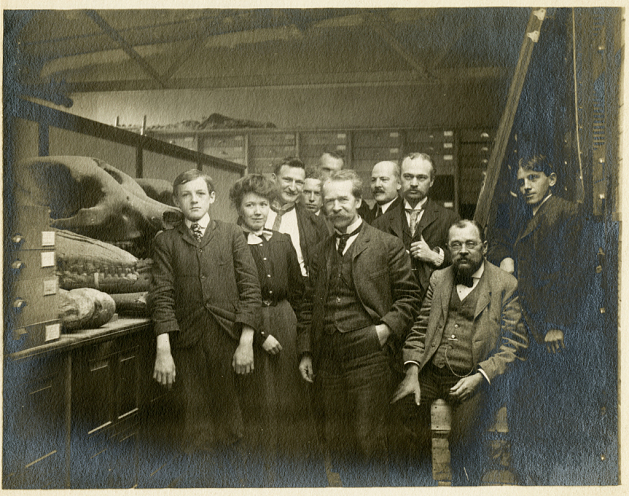
| Harrison G. Dyar, Jr., third from right, with Entomology staff of the U.S. National Museum in 1905. Courtesy of Smithsonian Institution Archives. |
If you have ever heard of entomologist Harrison Dyar, there’s a good chance that it was in relation to a series of tunnels that he dug beneath Washington, D.C. Or it may have been in relation to his bigamy. But if that’s all you know about Dyar, then you only know the tabloid tales.
Harrison Dyar was Honorary Custodian of Lepidoptera at the United States National Museum for over 30 years. He studied sawflies, moths, butterflies and mosquitos and described hundreds of species and genera. He also contributed significantly to the study of insect development by formulating Dyar’s Law of Geometric Growth. By observing that the width of caterpillar heads was fixed within each stage of development, Dyar realized that he could use a ratio to predict the width of the head at various stages of development, and that this ratio could in turn be used to differentiate insect instars. By using this law, entomologists can identify the developmental stage of an immature insect.
Dyar’s field notebooks, including his “blue books” and “catalogue” as they’re called, contain valuable information both on Dyar’s scientific research and aspects of his personal life. For instance, they include his scientific observations made while rearing specimens, head width data used to formulate Dyar’s Law, and, on a more personal note, the identity of relatives who helped Dyar collect and rear insects.
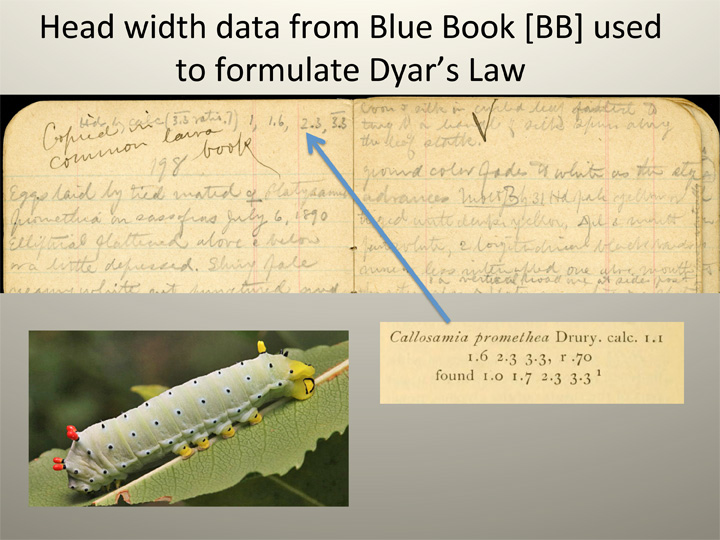 |
| Image Source: Smithsonian Libraries. |
Dyar’s field notebooks, which are held by the Smithsonian Institution Archives, have been digitized as part of The Field Book Project and are available in BHL, making it much easier for researchers around the world to access and study Dyar’s work.
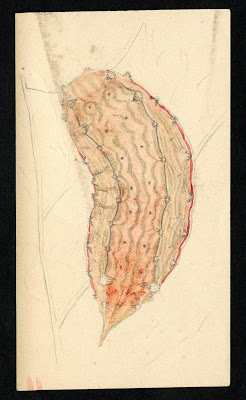 |
| Drawing from a Dyar blue book. H. G. Dyar bluebook 575 – 625. 1896-1898. Digitized by Smithsonian Institution Archives. http://biodiversitylibrary.org/page/46194051. |
One such researcher that has benefited from online access to this materials is Dr. Marc Epstein, Research Associate at the National Museum of Natural History and Senior Insect Biosystematist (Lepidoptera) at the Plant Pest Diagnostics Center of the California Department of Food and Agriculture. Dr. Epstein has studied Dyar’s work and legacy extensively and has authored a biography on this remarkable entomologist entitled Moths, Myths and Mosquitos:The Eccentric Life of Harrison G. Dyar, Jr.. Marc discovered BHL, thanks to recommendations from his colleagues, around the time that our online library launched. Since then, BHL’s collections have had an immense impact on Marc’s research.
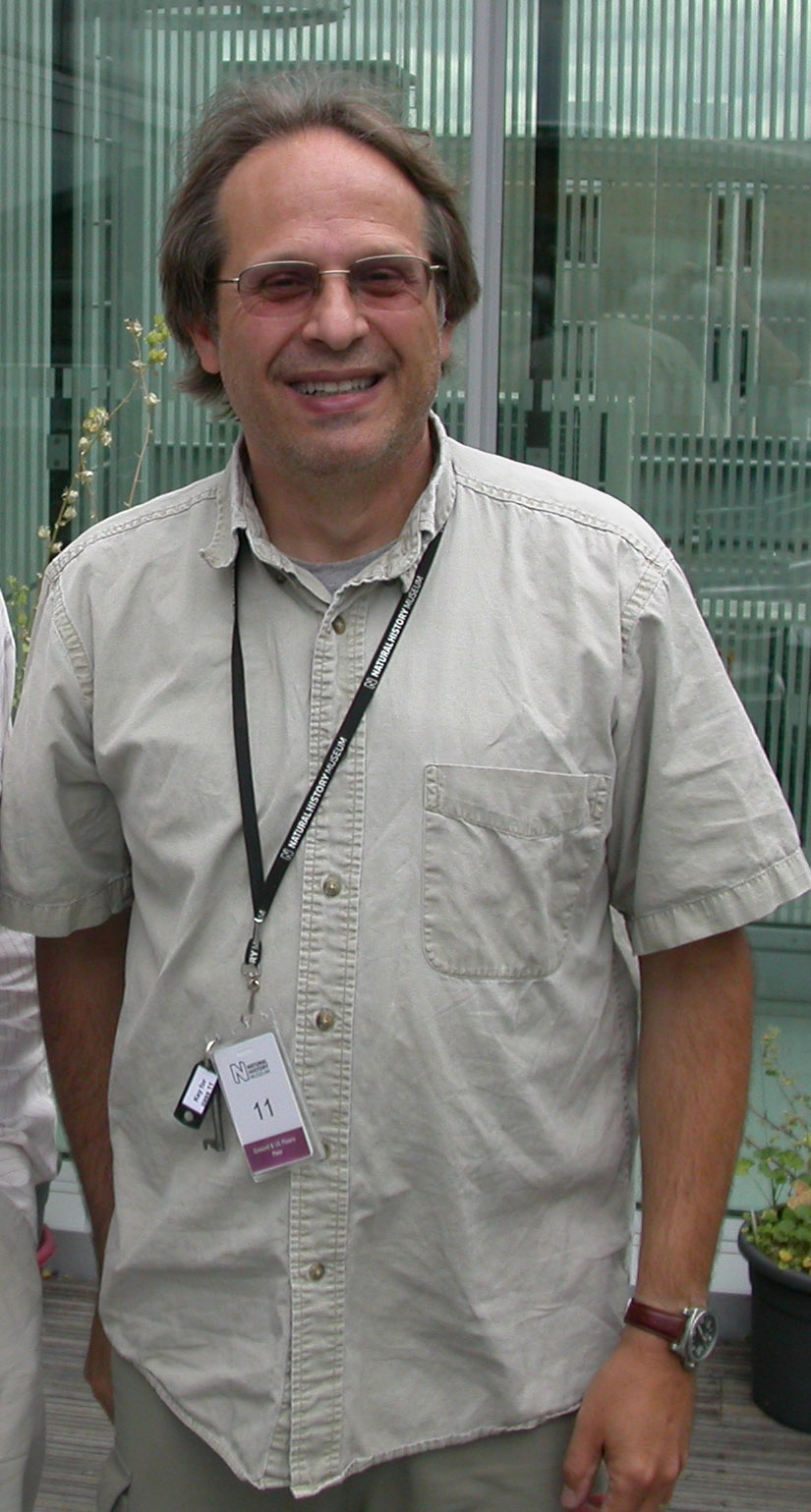 |
| Dr. Marc Epstein. Image Source: California Department of Food and Agriculture. |
“Even though I’m fortunate to have a good entomology library at the Plant Pest Diagnostics Center in Sacramento, CA, BHL has provided me access to so many journals that I haven’t had easy access to in California since with my move here in 2003,” asserts Marc. “In fact BHL has often provided me with the very copies I used to refer to in the Smithsonian National Museum of Natural History (NMNH) libraries!”
BHL has greatly facilitated Marc’s research on Lepidoptera and more specifically on Harrison Dyar.
“Day to day BHL has helped me do my job to identify Lepidoptera that threaten California agriculture, while providing a tremendous boost to my research projects,” explains Marc. “These have included the completion of Moths, Myths, and Mosquitoes: the Eccentric Life of Harrison G. Dyar, Jr. as well as studies on Costa Rican moths and the evolution of Lepidoptera and their caterpillars.
“Related to the Moths, Myths, and Mosquitoes, it enabled me to much more efficiently transcribe portions of Dyar’s hand-written notebooks, once in my office at NMNH. Prior to the availability of these notebooks on BHL, The Field Book Project at the Smithsonian provided me with electronic files of all of the notebooks, which are now becoming available along with transcriptions made by a corps of volunteers. Having both BHL and the notebooks on my [computer] desktop in Sacramento has enabled me to transcribe portions needed for my research while in Sacramento and saved me valuable time to focus on specimens during my visits to the NMNH entomology collections.”
The volunteer transcriptions that Marc refers to were the result of the May 2016 #DigIntoDyar campaign, which challenged volunteers to help transcribe five of Dyar’s blue books within the Smithsonian Transcription Center. The five blue books constituted a total of 169 pages, 60% of which were fully transcribed by over 60 volunteers by the end of May. Today, all 169 pages have been fully transcribed (thank you, citizen science volunteers!). You can browse the transcriptions in the Smithsonian Transcription Center at the links below:
H. G. Dyar – Bluebook 401- 414, 1893-1894 | https://transcription.si.edu/project/8144
H. G. Dyar – Bluebook 415-435, 1893-1894 | https://transcription.si.edu/project/8145
H. G. Dyar – Bluebook 436-450, 1893-1894 | https://transcription.si.edu/project/8146
H. G. Dyar – Bluebook 451-473, 1894 | https://transcription.si.edu/project/8147
H. G. Dyar, Bluebook 474-491, 1894-1897 | https://transcription.si.edu/project/8148
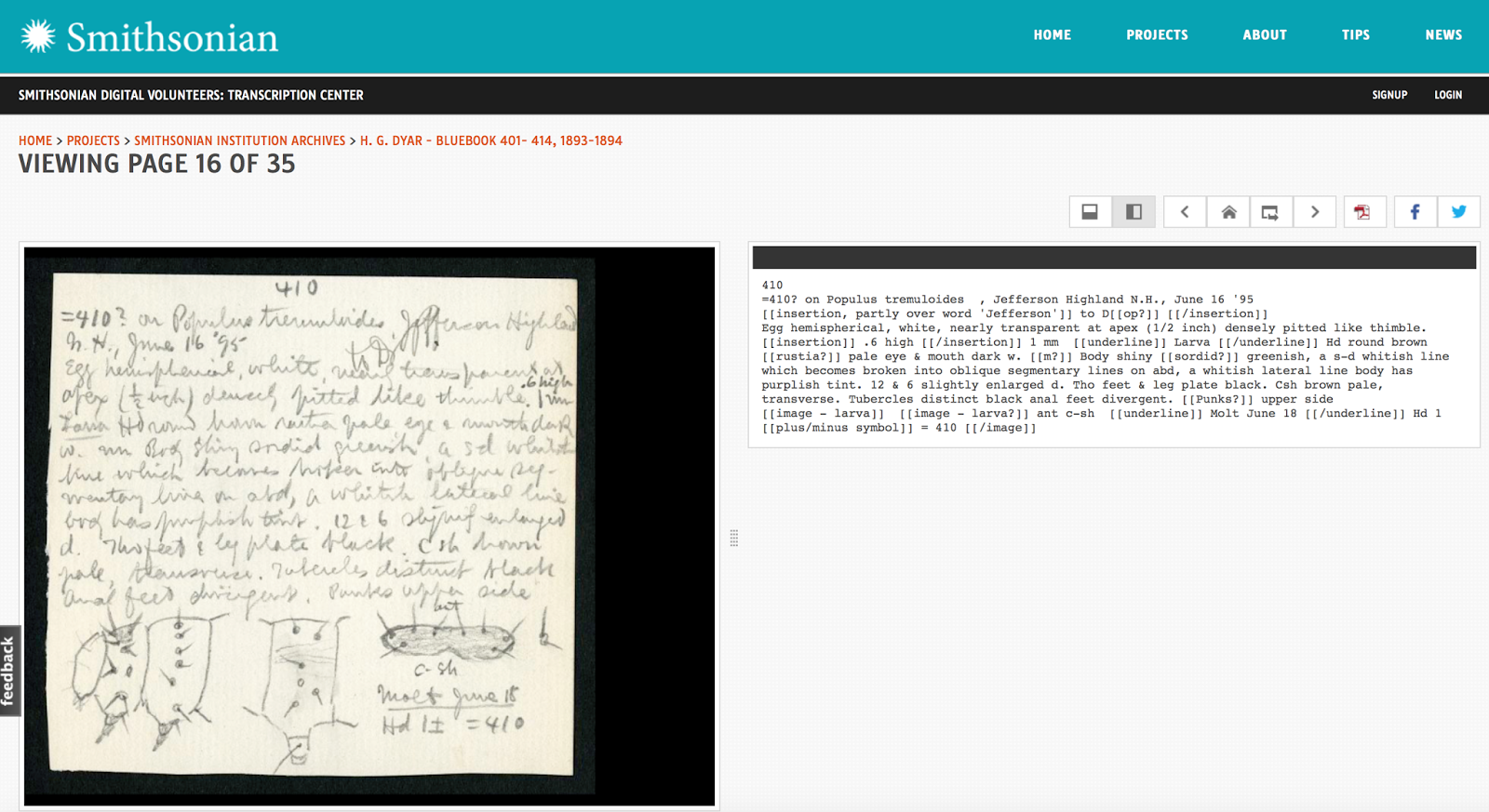 |
| A page from H. G. Dyar bluebook 401 – 414 (1893-94), transcribed in the Smithsonian Transcription Center. |
Interested in learning more about Harrison Dyar’s work and contributions? Then check out this Google Hangout from Smithsonian Libraries with Dr. Epstein. You can also learn more in this series of blog posts that Dr. Epstein wrote for Smithsonian Libraries as part of #DigIntoDyar.
Harrison Dyar’s contributions to science may often be overshadowed by his intriguing personal life, but hopefully the efforts of Dr. Epstein and others will ensure that his entire legacy is appreciated and remembered. We’re proud to be able to provide free, online access to materials, like the “blue books” and “catalogue,” that make it easier for researchers to study Dyar’s work.
______________________________________
This post may contain the personal opinions of BHL users or affiliated staff and does not necessarily represent the official Biodiversity Heritage Library (BHL) position on these matters.
