Biodiversity Heritage Library - Program news and collection highlights from BHL
  • Home
  • News
  • Featured Books
    • All Featured Books
    • Book of the Month Series
    • BHL at 20
  • User Stories
  • Campaigns
    • Fossil Stories
    • Garden Stories
    • Monsters Are Real
    • Page Frights
    • Her Natural History
    • Earth Optimism 2020
  • Tech Blog
  • Visit BHL
Home
News
Featured Books
    All Featured Books
    Book of the Month Series
    BHL at 20
User Stories
Campaigns
    Fossil Stories
    Garden Stories
    Monsters Are Real
    Page Frights
    Her Natural History
    Earth Optimism 2020
Tech Blog
Visit BHL
  • Home
  • News
  • Featured Books
    • All Featured Books
    • Book of the Month Series
    • BHL at 20
  • User Stories
  • Campaigns
    • Fossil Stories
    • Garden Stories
    • Monsters Are Real
    • Page Frights
    • Her Natural History
    • Earth Optimism 2020
  • Tech Blog
  • Visit BHL
Biodiversity Heritage Library - Program news and collection highlights from BHL
BHL News, Blog Reel

BHL Adds Two New European Affiliates

Over the past three months, BHL has welcomed two new European Affiliates: Bibliothèque cantonale et universitaire – Lausanne in Switzerland and the Mendel Museum of Masaryk University in the Czech Republic. The BHL consortium now consists of sixteen Members and fifteen Affiliates.

Bibliothèque cantonale et universitaire – Lausanne

View Full Size Image

Founded in the 16th century, the Bibliothèque cantonale et universitaire – Lausanne is one of the largest public and university libraries in Switzerland. The library contains approximately 2.5 million printed documents, representing academic, cultural heritage, general and special collections. The library also engages in a variety of digital initiatives, including a large-scale newspaper digitization project, various on-demand digitization services, and collaborative projects with regional libraries. Furthermore, in collaboration with Google Books, BCU Lausanne digitized over 106,000 volumes from its collection.

Through participation in BHL, BCU Lausanne will build upon current digitization efforts and further its commitment to providing free access to its library collections. The institution also hopes to leverage its existing partnerships within the regional library network in order to facilitate the inclusion of library collections from other institutions within Switzerland.

Mendel Museum of Masaryk University

View Full Size Image

Mendel Museum, which has been a department of Masaryk University in Brno (in the Czech Republic) since 2007, is dedicated to spreading the scientific legacy of the Augustinian abbot Gregor Johann Mendel. Mendel is renowned as the founder of the modern science of genetics. Additionally, the museum also promotes the wide range of scientific disciplines that Masaryk University students may encounter. Through interactive exhibits on Mendel’s legacy to internationally-recognized Mendel Lectures, the museum provides a place for the public to appreciate the connection of science with practice.

Mendel Museum holds a collection of Gregor Johann Mendel’s manuscripts, which are owned by the Augustinians in Brno and have never before been available online. These documents represent important scientific and cultural heritage materials and provide a unique perspective into the foundations of modern genetics. Participation in BHL will allow Mendel Museum to provide free and open access to this incredibly rich and valuable collection.

October 6, 2016by ulib-libraryjobs
Blog Reel, Campaigns, Featured Books, Page Frights

Sea Monks and Other Page Frights: Celebrate Halloween, Library and Archives Style!

View Full Size Image

Welcome to Page Frights, a month-long social media celebration of Halloween!

All this month (1-31 October), libraries and archives around the world will be sharing spooky, creepy, frightening, and otherwise Halloween-related books and images from their collections on social media with the hashtag #PageFrights.

Follow along and join the conversation on Twitter, Instagram, Facebook, Tumblr, and other social media sites and visit the Page Frights website to learn more.

We have lots of great content planned for BHL this month as part of Page Frights. Would you like a taste of what you can expect? If so, please allow us to introduce the sea monk!

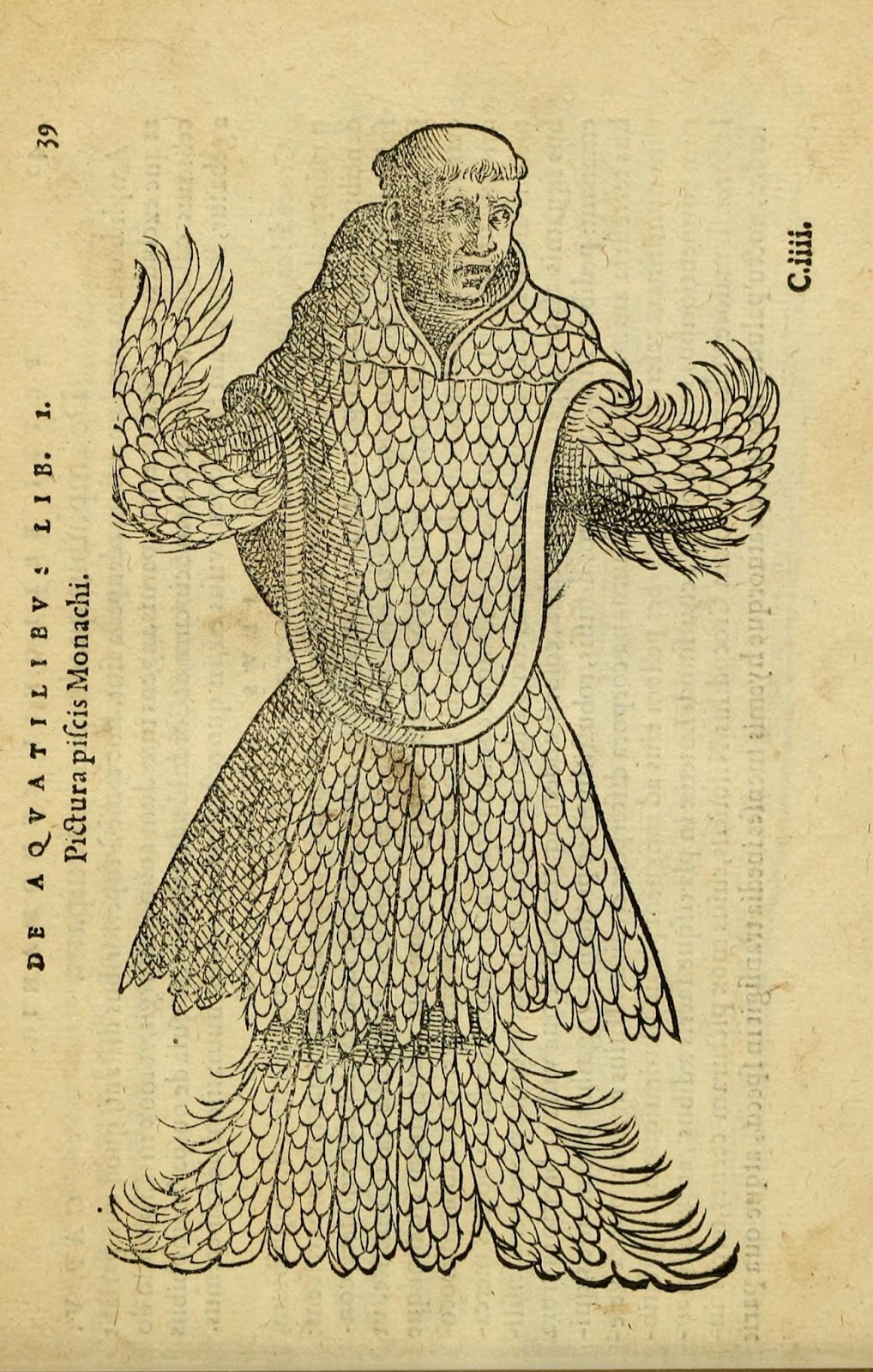
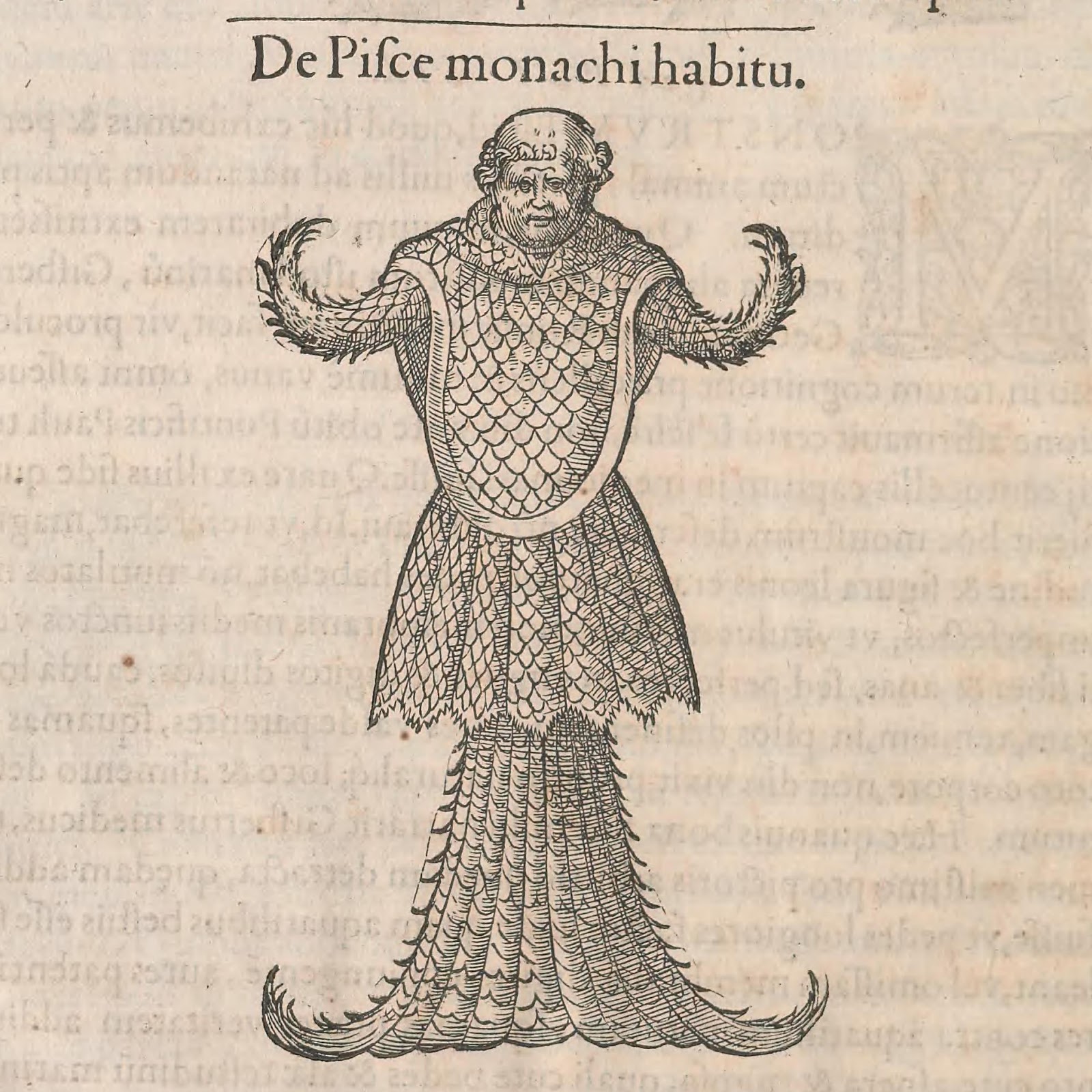
Piscis monachi habitu, “Fish with the habit of a monk”

In the 1540s (probably in 1546), a mysterious creature was caught in the Øresund, the strait between the island of Sjælland (Denmark) and Sweden. The creature was described as a sea monk (or monk fish) with “a human head and face, resembling in appearance the men with shorn heads, whom we call monks because of their solitary life; but the appearance of its lower parts, bearing a coating of scales, barely indicated the torn and severed limbs and joints of the human body” (Paxton & Holland, 39).

View Full Size Image
The monk fish, pisces monachus. Belon, Pierre. De Aquatilibus. 1553. http://biodiversitylibrary.org/page/4770183.  Digitized by the Ernst Mayr Library, Museum of Comparative Zoology, Harvard University.

The discovery was described by several naturalists of the day, including Pierre Belon (who described it as the monk fish, pisces monachus, in his 1553 publication De Aquatilibus), Guillaume Rondelet (who described it as piscis monachi habitu, “fish with the habit of a monk”, in his 1554 publication Libri de Piscibus Marinis), and Conrad Gesner (who summarized Rondelet and Belon’s accounts and referenced additional drawings by Georg Fabricius and a Hector Mythobius in his 1558 Historia Animalium). None of these men had actually seen the specimen that they described, and Belon and Rondelet’s accounts were obtained from as yet unidentified German source material (Paxton & Holland, 40, 46).

View Full Size Image
Piscis monachi habitu, “fish with the habit of a monk”. Rondelet, Guillaume. Libri de Piscibus Marinis. 1554. http://biodiversitylibrary.org/page/42089971. Digitized by Smithsonian Libraries.

While these publications were clearly linked to a 16th century encounter with a mysterious zoological specimen, they are not the earliest known references to a sea monk. Sea monks were referenced as early as the late 12th or early 13th centuries, such as in Alexander Neckham’s De Naturis Rerum (which includes the statement “other fish resemble monks”) and in Albertus Magnus’ De Animalibus (which references Monachus maris, “the sea monk…a fish occasionally seen in the British sea…[which] entices those travelling on the sea until it lures them in. It then seeks to the bottom and takes its fill of their flesh”) (Paxton & Holland, 43).

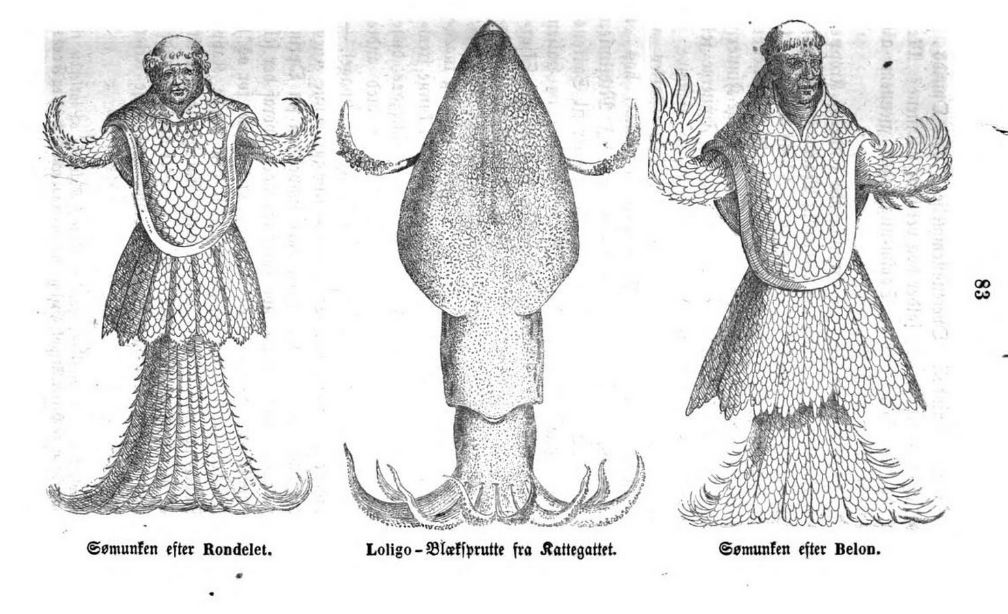
What species could have been the inspiration for such a mysterious creature? Many theories have been proposed. Danish zoologist Japetus Steenstrup proposed in his 1855 publication ‘Om den i Kong Christian IIIs tid i Øresundet fanget Havmund (Sømunken kaldet)‘ that the Øresund specimen was a giant squid (Paxton & Holland, 42). Other suggestions include various seal species or even a walrus. More recently, it was suggested that the Øresund monkfish was actually an angelshark species, possibly Squatina squatina (Paxton & Holland, 43).
View Full Size Image
Comparison of Rondelet and Belon’s sea monks with a giant squid. Steenstrup, Japetus. Om den i Kong Christian IIIs tid i Øresundet fanget Havmund (Sømunken kaldet). Dansk Maanedsskrift. v. 1 (1855). Obtained via Google Books.

Identifying an origin species for the monkfish is further complicated by the fact that these representations were also possibly influenced by religious tensions of the period. The association between clerical figures and monsters may be seen as a commentary on these tensions, with religious elements being imposed on natural entities.

Since the original Øresund specimen is lost, pisces monachus will likely forever remain shrouded in mystery – a frightening entry in the chronicles of natural history.

Celebrate Halloween, Library & Archives Style with Page Frights

We invite you to join us for Page Frights this month as we highlight other fascinating, frightening, and/or Halloween-related natural history images and publications. BHL content will include:

  • Social media posts on Twitter, Facebook, and Instagram
  • Blog posts
  • Page Frights image collections in Flickr and Pinterest
  • A collection of “monster” natural history books in our Monsters Are Real BHL collection
  • Pumpking carving patterns inspired by BHL images in the Page Frights Pumpkin Pattern Gallery

Also as part of Page Frights, joining this year’s GIF IT UP fun by encouraging you to create creepy GIFs inspired by #PageFrights images. Learn more.
View Full Size Image
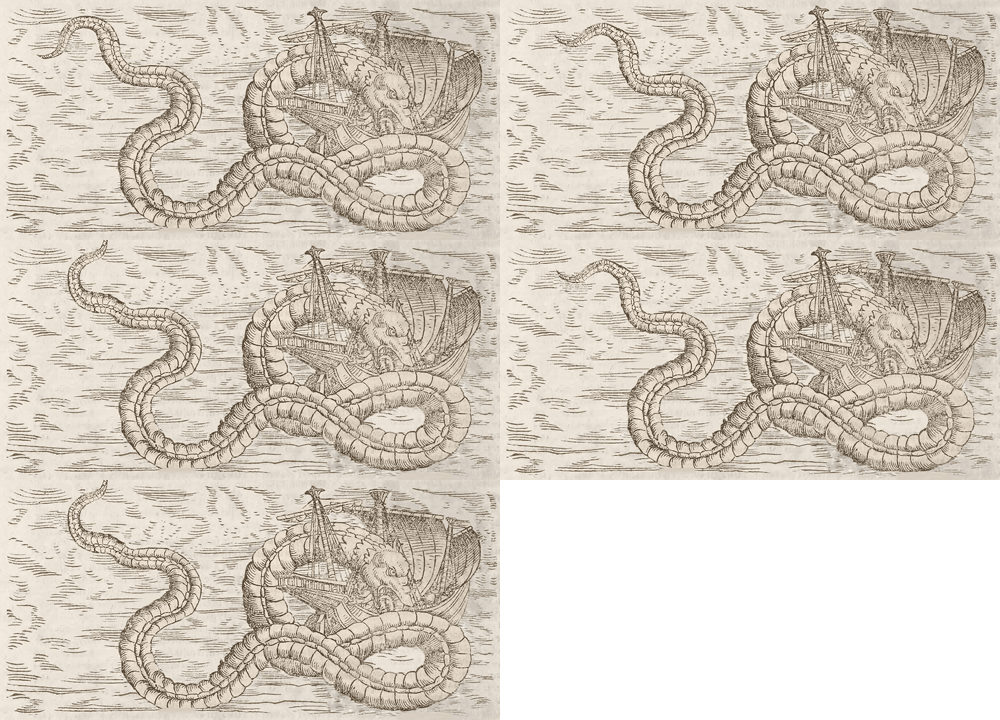
“Attack of the Sea Monster!” In 1555, Olaus Magnus published an image and description of the Soe Orm, which he claimed was a giant sea serpent 200 feet in length that lived near the shore or Bergen and came out at night to eat the farmers’ livestock. His image and description was republished for centuries. See more fantastic images come to life as part of GIF IT UP. GIF created by Richard Naples (Smithsonian Libraries), based on Gessner, Conrad. Historia Animalium. 2nd ed. 1604. http://biodiversitylibrary.org/page/42166517.

Get Your Own Sea Monster & Support Biodiversity Research

View Full Size Image
Shop the BHL Page Frights CafePress Collection today!

With our Page Frights CafePress collection, you can purchase your very own piece of the Page Frights fun and help support scientific research at the same time! 100% of the proceeds from product sales will be used to digitize more books for BHL.

Start shopping today!

Learn more about how free and open access to natural history publications on BHL can help save biodiversity and transform research.

Reference

Paxton, C. G. M. & R. Holland. Was Steenstrup Right? A New Interpretation of the 16th Century Sea Monk of the Øresund. – Steenstrupia 29 (1): 39–47. Copenhagen, Denmark. November 2005. ISSN 0375-2909.

October 1, 2016by ulib-libraryjobs
Page 2 of 2«12

Help Support BHL

BHL's existence depends on the financial support of its patrons. Help us keep this free resource alive!

search

About BHL

The Biodiversity Heritage Library (BHL) is the world’s largest open access digital library for biodiversity literature and archives. BHL operates as a worldwide consortium of natural history, botanical, research, and national libraries working together to digitize the natural history literature held in their collections and make it freely available for open access as part of a global “biodiversity community.”

Join Our Mailing List

Sign up to receive the latest news, content highlights, and promotions.

Subscribe Now

Subscribe to Blog via Email

Enter your email address to subscribe to this blog and receive notifications of new posts by email.

Join 319 other subscribers

Subscribe to Blog Via RSS

Subscribe to the blog RSS feed to stay up-to-date on all the latest BHL posts.

Access RSS Feed

Inspiring Discovery through Free Access to Biodiversity Knowledge.

The Biodiversity Heritage Library makes it easier than ever for you to access the information you need to study and explore life on Earth…for free, anytime, anywhere.


64+ Million Pages of
Biodiversity Literature Online.

EXPLORE

Tools and Services
to Transform Research.

EXPLORE

300,000+
Illustrations on Flickr.

EXPLORE

ABOUT | HARMFUL CONTENT | PRIVACY | SITE MAP | TERMS OF USE