

Origins of the Cleveland Museum of Natural History
The story of the Cleveland Museum of Natural History (CMNH) begins in the1830s, when a small group of men filled a two-room wooden building in Public Square, downtown Cleveland, with mounted animals. This building was known as the “Ark,” and the men who gathered there, united in their passion for natural history, were called “Arkites.”
The Arkites were led by William Case, who would later become mayor of Cleveland. He, his brother, and his father had used the Ark as a place to retreat from work, and in the absence of any other museums in the city, it became a hub for all kinds of collection and research.
 |
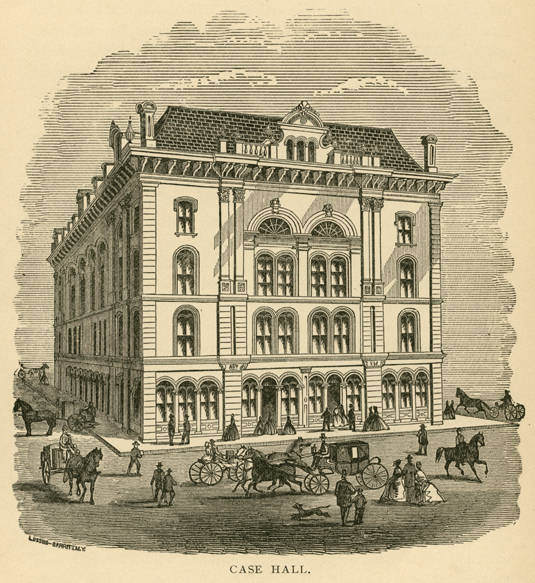
| Case Hall, engraving by William Payne, courtesy of Special Collections, Cleveland State University Library |
In 1876, the Ark was relocated to Case Hall. It shared the space with other organizations, including the Kirtland Society (formerly the Cleveland Academy of Natural Sciences), named after renowned naturalist and fellow Arkite Jared Potter Kirtland, who died the following year. Case Hall remained the home of the Ark until 1916, when it was demolished to make way for the U.S. Post Office, Court House, and Custom House.
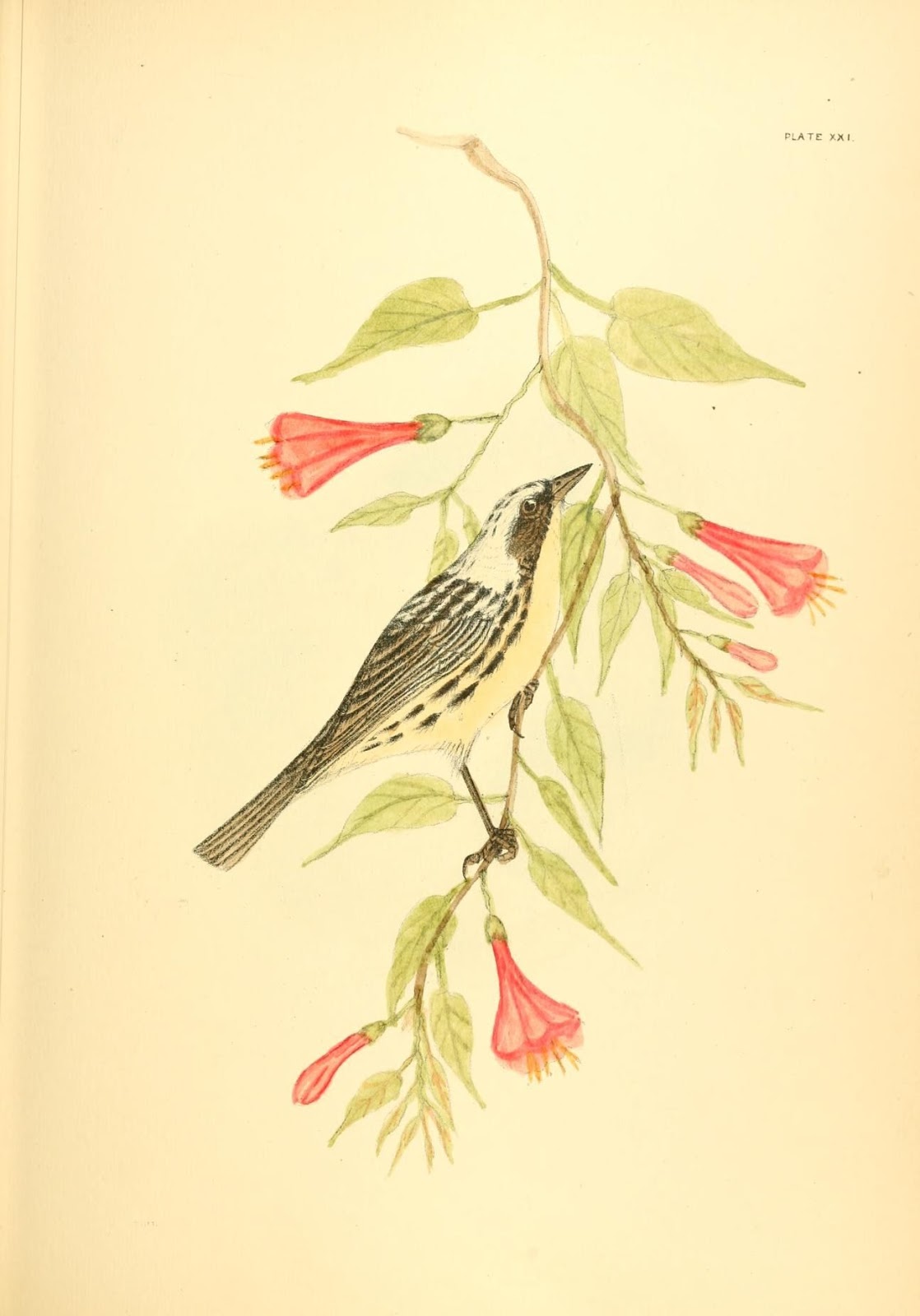 |
| Kirtland’s Warbler, namesake of Jared Potter Kirtland, from C.J. Maynard’s The Birds of Eastern North America, 1896, Plate XXI. Digitized by Smithsonian Libraries. |
The collections of both the Ark and the Kirtland Society found a new home in the Cleveland Museum of Natural History, founded in 1920. CMNH relocated several times as its collections grew, settling eventually at Wade Park, where it is today. William Case’s bird collection can still be viewed there, as well as many of the specimens provided by the Kirtland Society. Other exhibits include Balto, the hero dog of Nome, Alaska; “Dunk,” a large specimen of Dunkleosteus terrelli; and, most famous of all, “Lucy,” discovered in 1974 by former CMNH curator Donald Johanson.
The collections and physical space of the museum continue to grow today; this spring, CMNH unveiled the Ralph Perkins II Wildlife Center & Woods Garden, where visitors can view Ohio flora and fauna in their native habitat.
Kirtlandia
In 1972, CMNH began publishing Kirtlandia, a journal of original, peer-reviewed research by Museum staff. Wendy Wasman, Librarian and Archivist of the Harold T. Clark Library at CMNH, notes that Kirtlandia has a “long history of publishing cutting edge research in the natural sciences…Over the years, there have been articles on dinosaurs, fossil sharks, archaeology, botany, herpetology, mussels, moths, and even an entire issue devoted to paleontological research of the Kenya Rift Valley.”
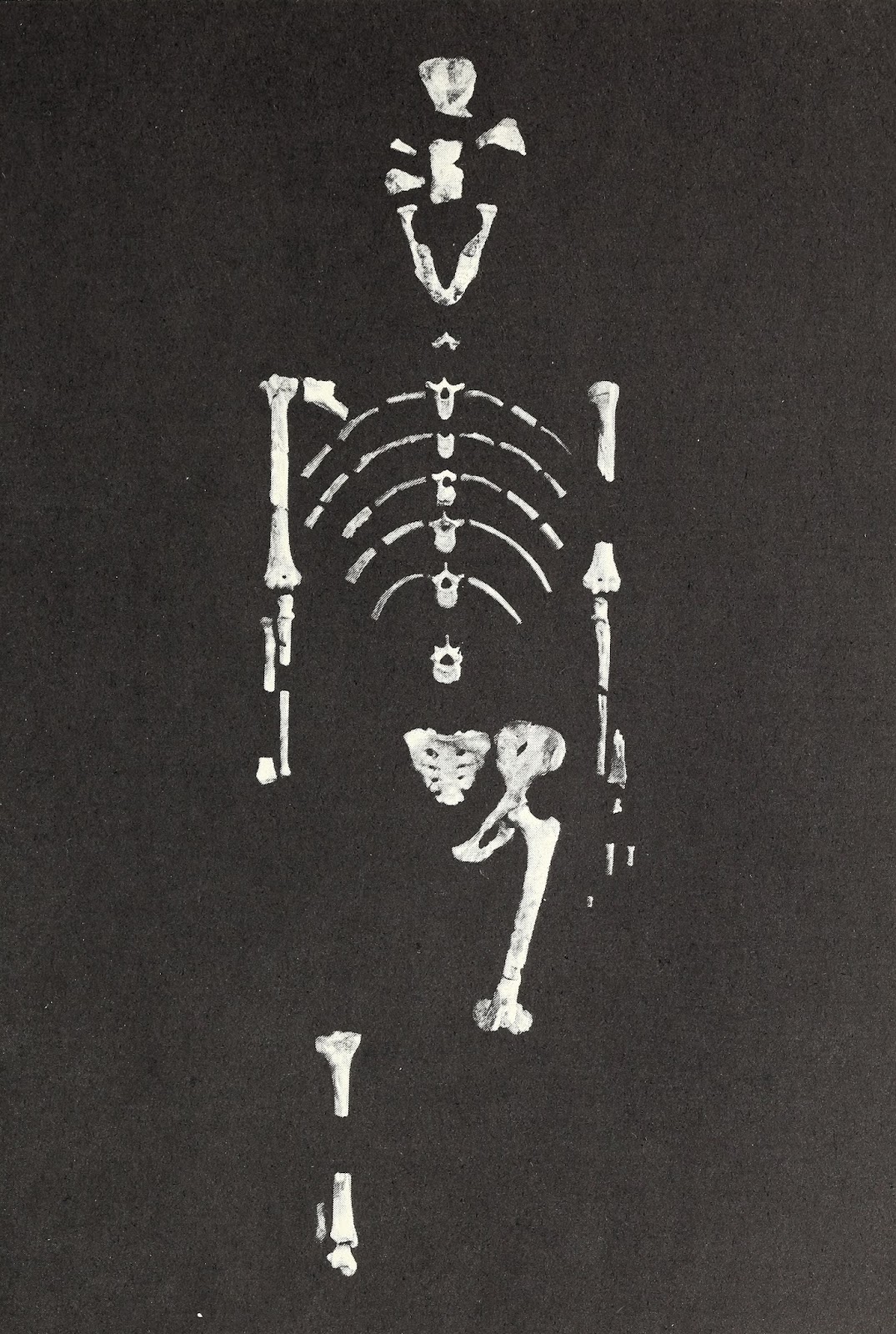 |
| Partial skeleton of “Lucy,”from Johanson, et al., “A New Species of the Genus Australopithecus…“, Kirtlandia, no. 28, 1978. Digitized by Smithsonian Libraries. |
Early on, Kirtlandia issues focused on a single topic. In the late 1970s, however, issues began to contain multiple articles, and the length of those articles increased. They also featured more photographs and diagrams, though they retained their simple, sparse design.
Kirtlandia is supported by the Kirtlandia Society, founded in 1976 to advance research and education at the museum. Wasman says that because the CMNH library (named the Harold Terry Clark Library in 1972) had an active publications exchange program from the beginning, Kirtlandia can now be found in over 200 university and museum libraries worldwide, and that while publication is currently in hiatus, BHL has given it an even wider reach.
Kirtlandia was digitized by the Smithsonian Libraries as a part of the IMLS-funded Expanding Access to Biodiversity Literature (EABL) project. Susan Lynch, an EABL team member at the New York Botanical Garden, worked with Rod Page and BioStor, using metadata provided by Wendy Wasman, to define all of the articles in Kirtlandia. This allows users to search for and navigate to individual articles in the journal without having to scroll through an entire volume or set of volumes.
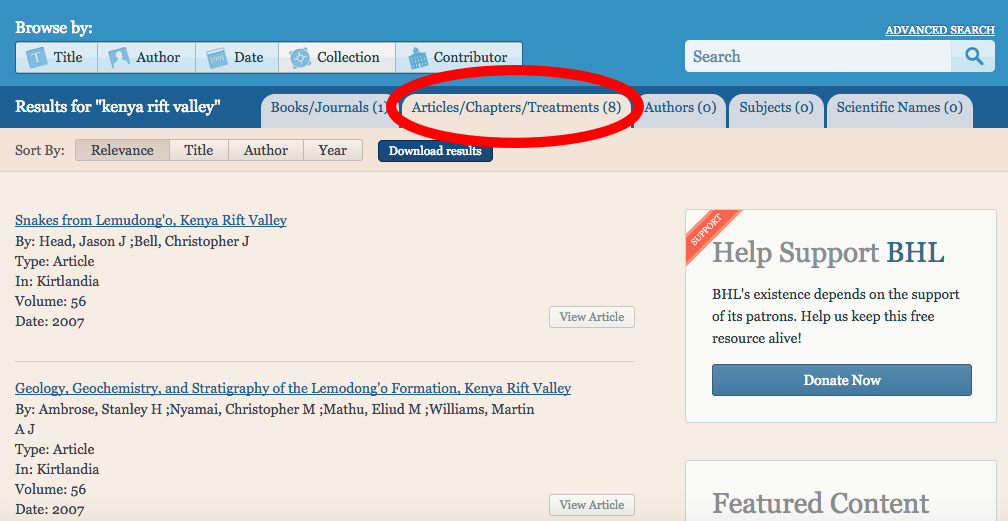
In search results, Kirtlandia articles can be found under the Articles/Chapters/Treatments tab:
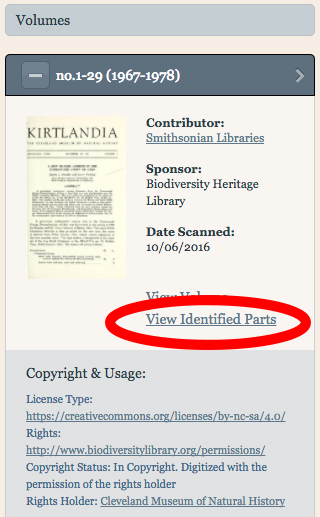
When browsing from the title page, articles can be found by clicking View Identified Parts:
Thank you to the Cleveland Museum of Natural History and the Harold T. Clark Library for giving us permission to make Kirtlandia available in BHL!
References
“ARK.” The Encyclopedia of Cleveland History. Last modified July 10, 1997. Accessed November 16, 2016. http://ech.case.edu/cgi/article.pl?id=A16.
“Case Hall.” The Encyclopedia of Cleveland History. Last modified November 9, 2005. Accessed November 16, 2016. http://ech.case.edu/cgi/article.pl?id=CH.
“History.” Cleveland Museum of Natural History. Accessed November 16, 2016. https://www.cmnh.org/about-the-museum/history.
“Kirtlandia Society.” Cleveland Museum of Natural History. Accessed November 16, 2016.
https://www.cmnh.org/kirtlandiasociety.
Splain, Emily. “Cleveland Museum of Natural History.” Cleveland Historical. Accessed November 16, 2016. https://clevelandhistorical.org/items/show/41.
