
Biodiversity Heritage Library - Program news and collection highlights from BHL
  • Home
  • News
  • Featured Books
    • All Featured Books
    • Book of the Month Series
    • BHL at 20
  • User Stories
  • Campaigns
    • Fossil Stories
    • Garden Stories
    • Monsters Are Real
    • Page Frights
    • Her Natural History
    • Earth Optimism 2020
  • Tech Blog
  • Visit BHL
Home
News
Featured Books
    All Featured Books
    Book of the Month Series
    BHL at 20
User Stories
Campaigns
    Fossil Stories
    Garden Stories
    Monsters Are Real
    Page Frights
    Her Natural History
    Earth Optimism 2020
Tech Blog
Visit BHL
  • Home
  • News
  • Featured Books
    • All Featured Books
    • Book of the Month Series
    • BHL at 20
  • User Stories
  • Campaigns
    • Fossil Stories
    • Garden Stories
    • Monsters Are Real
    • Page Frights
    • Her Natural History
    • Earth Optimism 2020
  • Tech Blog
  • Visit BHL
Biodiversity Heritage Library - Program news and collection highlights from BHL
Blog Reel, Featured Books

Artist Kumataro Ito Aboard the USS Albatross

This post was originally published on The Field Book Project blog on 30 June 2017.

View Full Size Image
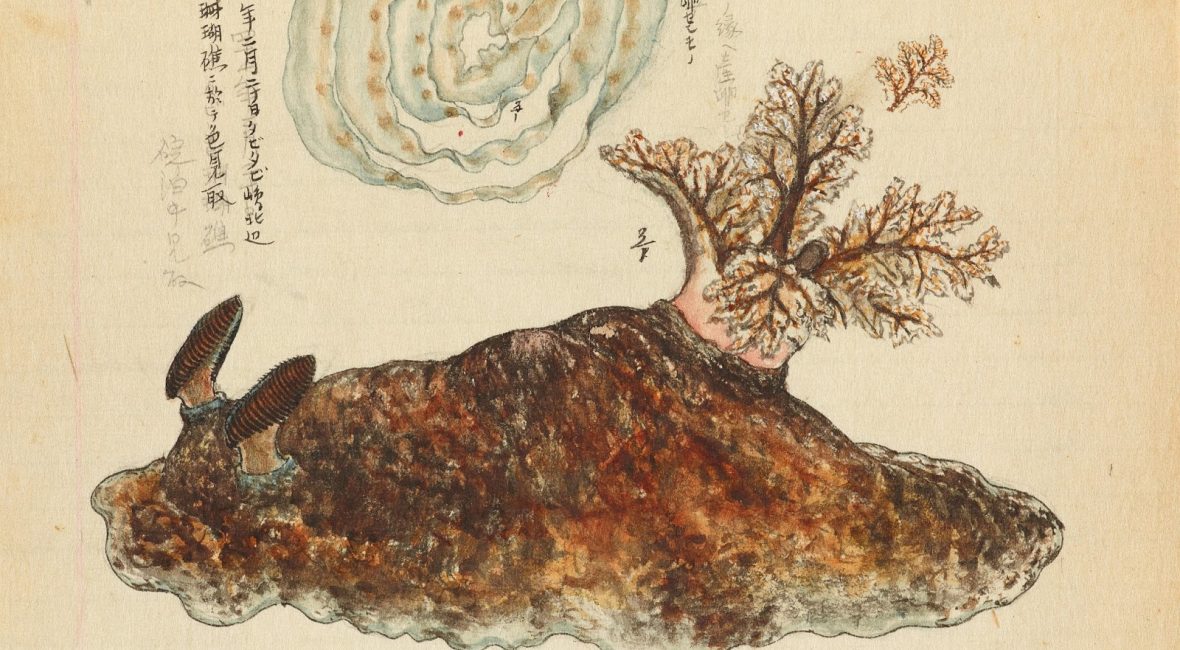
Bartsch, Paul. Notes and description of specimens collected on the Philippine Expedition of the Steamer Albatross, circa 1908. Illustration by Kumataro Ito. Digitized by Smithsonian Institution Archives. http://s.si.edu/2wm30MY.

In 1907, the U.S. Bureau of Fisheries—now known as NOAA Fisheries or the National Marine Fisheries Service—embarked on a 2 ½ year research trip to the Philippine and neighboring islands. Of the many research trips conducted on their steamer the USS Albatross, the Philippine expedition resulted in a staggering estimate of 490,000 specimens turned over to the U.S. National Museum, what is now the National Museum of Natural History. When specimens are stored in ethanol, as these were, they do not retain their original coloring. To capture this information, these trips would also include efforts to document the specimens in other ways, such as photos or illustrations.

At the time of this expedition, a portable, reliable way to create quality color photographs was still several decades away, so it wasn’t an option for researchers in the field. Having an artist on board was the only option to capture the brilliant colors of the collected marine species. For this particular outing of the Albatross, Tokyo-based artist Kumataro Ito was hired to illustrate specimens collected by researchers.

Ito studied under Gyozan Nakajima, noted illustrator of the 19th century, and had already established himself as a natural history painter at Department of Zoology of Tokyo University and working on publications such as the Fishes of Japan, an account principally on economic species.

View Full Size Image
Bartsch, Paul. Notes and description of specimens collected on the Philippine Expedition of the Steamer Albatross, circa 1908. Illustration by Kumataro Ito. Digitized by Smithsonian Institution Archives. http://s.si.edu/2iFc64e.

Over the course of the expedition, Ito created over 200 paintings of specimens collected by the small research crew, including mollusks collected by Smithsonian’s Paul Bartsch. Last month, our team digitized one of Bartsch’s notebooks from the expedition. The notebook caught our eye from the first time we saw it because of the beautiful full-color paintings of nudibranchs, all by Ito. Each painting includes notations in Japanese which supplement Bartsch’s notes. Based on how well the paintings have aged, it’s likely they were created on quality Japanese paper similar to what is used today for book repairs.

View Full Size Image
Bartsch, Paul. Notes and description of specimens collected on the Philippine Expedition of the Steamer Albatross, circa 1908. Illustration by Kumataro Ito. Digitized by Smithsonian Institution Archives. http://s.si.edu/2wgmjsR.

Unfortunately, Ito’s paintings often went unattributed or incorrectly credited to the researcher when later reproduced in publications. It’s a shame considering the clear talent Ito had in capturing the diversity of marine life. The nudibranch paintings in the Bartsch notebook are an incredible sight and we are pleased they are now available to view online, with proper credit to Kumataro Ito.

View Full Size Image
Bartsch, Paul. Notes and description of specimens collected on the Philippine Expedition of the Steamer Albatross, circa 1908. Illustration by Kumataro Ito. Digitized by Smithsonian Institution Archives. http://s.si.edu/2vClXJY.


Digitization of this field book was sponsored by a grant from Arcadia – a charitable fund of Peter Baldwin and Lisbet Rausing. 

Further Reading:

  • Bennett, William. “An Undersea Invertebrates Update: Treatment Progress on Bartsch’s Nudibranchs Field Book.” Smithsonian Institution Archives blog. May 18, 2017.
  • Bennett, William. “Coming Soon to the Transcription Center: Department of Invertebrate Zoology.” Smithsonian Institution Archives blog. November 15, 2016.
  • Springer, Victor G. “Kumataro Ito, Japanese Artist on Board the U.S. Bureau of Fisheries Steamer Albatross During the Philippine Expedition, 1907-1910.” Marine Fisheries Review 61, no.4 (1999): 42-57.
  • Bartsch, Paul. “Dr. Hugh M. Smith, Director of the Philippine Cruise of the “Albatross”” Copeia 1941, no. 4 (1941): 209-15.
August 31, 2017by mkahn

Help Support BHL

BHL's existence depends on the financial support of its patrons. Help us keep this free resource alive!

search

About BHL

The Biodiversity Heritage Library (BHL) is the world’s largest open access digital library for biodiversity literature and archives. BHL operates as a worldwide consortium of natural history, botanical, research, and national libraries working together to digitize the natural history literature held in their collections and make it freely available for open access as part of a global “biodiversity community.”

Follow BHL

  • Bluesky logo
  • Instagram logo
  • Facebook logo
  • Flickr logo
  • Twitter logo

Join Our Mailing List

Sign up to receive the latest news, content highlights, and promotions.

Subscribe Now

Subscribe to Blog via Email

Enter your email address to subscribe to this blog and receive notifications of new posts by email.

Join 319 other subscribers

Subscribe to Blog Via RSS

Subscribe to the blog RSS feed to stay up-to-date on all the latest BHL posts.

Access RSS Feed


64+ Million Pages of
Biodiversity Literature Online.

EXPLORE

Tools and Services
to Transform Research.

EXPLORE

300,000+
Illustrations on Flickr.

EXPLORE

ABOUT | HARMFUL CONTENT | PRIVACY | SITE MAP | TERMS OF USE