Biodiversity Heritage Library - Program news and collection highlights from BHL
  • Home
  • News
  • Featured Books
    • All Featured Books
    • Book of the Month Series
    • BHL at 20
  • User Stories
  • Campaigns
    • Fossil Stories
    • Garden Stories
    • Monsters Are Real
    • Page Frights
    • Her Natural History
    • Earth Optimism 2020
  • Tech Blog
  • Visit BHL
Home
News
Featured Books
    All Featured Books
    Book of the Month Series
    BHL at 20
User Stories
Campaigns
    Fossil Stories
    Garden Stories
    Monsters Are Real
    Page Frights
    Her Natural History
    Earth Optimism 2020
Tech Blog
Visit BHL
  • Home
  • News
  • Featured Books
    • All Featured Books
    • Book of the Month Series
    • BHL at 20
  • User Stories
  • Campaigns
    • Fossil Stories
    • Garden Stories
    • Monsters Are Real
    • Page Frights
    • Her Natural History
    • Earth Optimism 2020
  • Tech Blog
  • Visit BHL
Biodiversity Heritage Library - Program news and collection highlights from BHL
BHL News, Blog Reel

The Biodiversity Heritage Library Adds Museum für Naturkunde Berlin as a New Member

The Biodiversity Heritage Library is pleased to welcome the Museum für Naturkunde Berlin (MfN) as a new Member. MfN is the first German museum to join the Biodiversity Heritage Library as a Member.

The Museum für Naturkunde Berlin has been a part of the BHL global family for nearly a decade through BHL Europe. Launched in 2009 and coordinated by MfN, the three-year BHL Europe project aimed to improve the interoperability of European biodiversity digital libraries and bring together the digitization activities of institutions across the EU.

“The Museum für Naturkunde Berlin and BHL have been working together for many years towards a shared vision of global open access to worldwide biodiversity collections,” affirms BHL Program Director Martin R. Kalfatovic. “We are excited to strengthen our collaborative efforts through membership and look forward to working with our MfN colleagues to realize our shared vision, expand our international research impact, and pursue further partnerships within Germany and across Europe.”

As a BHL Member, Museum für Naturkunde Berlin will provide technical, digitization, and data management expertise and contribute rare and unique materials from its significant collections. The Museum will also explore opportunities to facilitate participation and contributions from other German organizations and societies. Ongoing participation in the Biodiversity Heritage Library will allow MfN to further its commitment to making biodiversity literature as freely and openly available as possible.

“We believe that the library collections of the Museum für Naturkunde Berlin are of high value for both the scientific community as well as other users like citizen scientists and the general public,” asserts Dr. Jana Hoffmann, Head of the Digital World and Information Science programme at the Museum für Naturkunde Berlin. “BHL supports our efforts in the science programme Digital World and Information Science to open our library physically and digitally, thus positioning the museum as a global and active player ‘For Nature.’”

About the Biodiversity Heritage Library

BHL is a consortium of major natural history, botanical and research libraries that seek to contribute to the global “biodiversity commons” by digitizing and providing free and open access to biodiversity literature and archives from across the globe. For more information, visit the Biodiversity Heritage Library website: www.biodiversitylibrary.org.

About Museum für Naturkunde Berlin

The Museum für Naturkunde – Leibniz-Institut für Evolutions- und Biodiversitätsforschung (MfN) in Berlin is an integrative research museum in the Leibniz Association, a union of non-university German research institutions dedicated to addressing scientific issues of societal importance. Consisting of over 30 million specimens, the Museum’s collections constitute a research infrastructure of worldwide importance. The MfN Library holds 374,000 items representing multidisciplinary fields within the natural sciences and the history of science. With the credo “Für Natur” (“For Nature”) driving all of its work, MfN is dedicated to tackling the major biodiversity and environmental challenges of the 21st century through its operations, research projects, exhibitions, and targeted collaborative efforts.

May 29, 2018by michelle.underhill
Blog Reel, Featured Books

Seeds in the Stacks: A Closer Look at Two Seedsmen from the Golden Age

The National Agricultural Library (NAL), Special Collections has one of the world’s largest collections of nursery and seed trade catalogs totaling over 200,000 from American as well as international companies. This collection, representing businesses located in all states plus over 50 countries, was named after its long-time curator, Henry G. Gilbert. The earliest catalog is from William R. Prince & Company dated 1771. NAL continues to collect modern-day catalogs.

The collection was begun by Percy Ricker, U.S. Department of Agriculture’s first economic botanist. Through the course of his work, he traveled to many plant nurseries throughout the country and collected duplicate copies of their catalogs. When he retired in the 1940s, he had amassed over 70,000 catalogs, and the collection grew from there.

NAL has been systematically digitizing its seed trade catalogs with over 41,000 catalogs available online through the Biodiversity Heritage Library (BHL) as well as Internet Archive. The bulk of the holdings begin in the late 1800s, which is considered the golden age of mail order catalogs.

James Vick and Peter Henderson are two men who epitomized that golden age.

James Vick and Sons

James Vick (1818-1882) started in the seed business in 1860. Born in England, he immigrated with his family to New York in 1833 and would go on to influence the nursery and seed trade catalog business with beautiful color illustrations and much more.

vicksfloralguide1889jame_00061.jpg

James Vick and Sons Charles, James, and Frank. Vick’s Floral Guide, 1889. Digitized by the U.S. Department of Agriculture, National Agricultural Library.

Prior to getting into the seed business, Vick was a printer for newspapers, experience which helped make his Floral Guides eye-catching. The first one was published in 1862. Vick used chromolithography in several of the guides, creating beautiful horticultural images. In fact, he was a pioneer in mass-producing color illustrations in mass-market catalogs as demonstrated by his 1864 catalog that contained a full-page chromolithograph of double zinnias. His images became so popular that he produced a set of large prints that were either sold separately or given with large orders.

vicksgardenflora1898jame_00411.jpg

Vick’s Garden and Floral Guide, 1898. Digitized by the U.S. Department of Agriculture, National Agricultural Library.

In addition to being a skilled printer, Vick was a successful writer, editor, publisher, and owner of several well-known horticultural publications, so he knew how to connect with people. He developed a personal, chatty style of communication. In addition to information on seeds and plants, his guides shared gossip, correspondence, gardening advice, and a special children’s section as well as space for a complaints forum (for example, the high price of postage).

vicksillustrated1873jame_0003.jpg

Vick’s Illustrated Floral Guide, 1873. Digitized by the U.S. Department of Agriculture, National Agricultural Library.

Throughout Vick’s life, he was constantly trying to improve his business. In the mid-19th century, the best seeds came from Europe. American seeds had an inferior reputation at the time. He wanted to grow high-quality seeds in America and went to Europe to study the methods of the Old World (in particular the effects of climate). In the 1873 Vick’s Illustrated Floral Guide, he shared the results of his studies with readers.

vicksflowerveget00vick_0184.jpg

Vick’s Flower and Vegetable Garden, 1878. Digitized by Smithsonian Libraries.

In addition to his guides, he published a book titled Vick’s Flower and Vegetable Garden and Vick’s Illustrated Monthly magazine. He followed a pattern with lovely etchings, essays, conversation, and beautiful color plates.

vicksfloralguide1881jame_0014.jpg

Vick’s Seed House, 1880. Vick’s Floral Guide, 1881. Digitized by the U.S. Department of Agriculture, National Agricultural Library.

James Vick and Sons was extremely successful, growing the business to include flower farms and a five-story seed house that included a printing office, bindery, box-making establishment, and artists’ and engravers’ rooms. It was a self-contained business and was one of the largest and most well-run seed houses of its time. It had 300 orders and 3,000 letters a day, and its publications reached an annual circulation of 250,000. While its products were excellent, much of its success was due to James Vick and his understanding of the power of connecting and engaging with the customer. His sons carried on that tradition until the early 20th century when the company was sold to Burpee Seed Company.

Peter Henderson

Another nurseryman whose catalogs enjoyed widespread distribution during the “Golden Age” of the mail order catalog business was Peter Henderson (1822-1890). One of the leading authorities on commercial floriculture of the time, he simplified and improved methods of handling plants for commercial purposes. He was head of Peter Henderson & Company, a seed and supply business. The company’s thick catalogs reflected Henderson’s sales concept of “Everything for the Garden” and offered seeds, bulbs, fertilizers, insecticides, and gardening and lawn tools. A prolific writer, Henderson gained popularity through his willingness to share horticultural techniques in his descriptive catalogs, books, articles, and letters.

Bailey_Cyclopedia_Horticulturists_Henderson.jpg

Peter Henderson, Bailey’s Standard Cyclopedia of Agriculture, 1881.

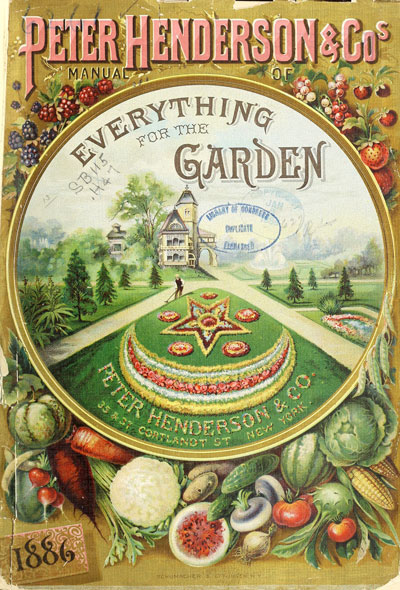
peterhendersonco1886frontpete_27_0003.jpg

Peter Henderson & Co.’s Manual of Everything for the Garden, 1886. Digitized by the U.S. Department of Agriculture, National Agricultural Library.

Born in Scotland in 1822, Henderson showed an early aptitude for handling plants. Perhaps his talent was inherited from his maternal grandfather who was a nurseryman and florist. Beginning at age 16, he apprenticed to head gardener George Sterling at Melville Castle. The following year, Henderson won a gold medal for the best herbarium of native and exotic plants submitted to the Royal Botanical Society of Edinburgh for a competition throughout Great Britain.

buistsprizemedal1894robe_0003.jpg

Scottish nurseryman Robert Buist’s property. Buist’s Garden Seeds, 1894. Digitized by the U.S. Department of Agriculture, National Agricultural Library.

In 1843, he immigrated to the United States and obtained employment as a gardener for several other Scottish nurserymen, including George Thorburn and Robert Buist. He remodeled Charles F. Spang’s greenhouses and grounds. In 1847, Peter and his brother James began a business growing vegetables in New Jersey and marketing them in nearby New York City.

Several years later, the brothers parted ways. Peter began growing and selling ornamental plants from his Jersey City property. In 1871, he founded Peter Henderson & Company and established a seed house and store in New York on Cortlandt Street. In 1880, from his property in nearby South Bergen, he erected state-of-the-art greenhouses with innovative heating and ventilation systems. The location of these greenhouses in the Jersey City area meant that his inventory could be transported conveniently across the country by means of rail and water ways.

peterhendersonco1886back.jpg

Peter Henderson & Co. located at 35-37 Cortlandt Street, New York City. Peter Henderson & Co.’s Manual of Everything for the Garden, 1886. Digitized by the U.S. Department of Agriculture, National Agricultural Library.

peterhendersonco18pete_26_0148_1885back.jpg

Peter Henderson & Co. greenhouses. Peter Henderson & Co.’s Manual of Everything for the Garden, 1885. Digitized by the U.S. Department of Agriculture, National Agricultural Library.

Henderson was willing to share his knowledge on gardening topics with the public, even though it meant letting his competitors know about his research. He contributed articles to magazines such as Hovey’s Magazine of Horticulture, The Horticulturist, Gardener’s Monthly, The Country Gentleman, and Moore’s Rural New-Yorker. His son Alfred wrote in Henderson’s biography that the American Agriculturist desired all his writings so they “…paid him a price per column that has been considered perhaps the largest rate ever paid an American writer.”

Henderson_Gardening-for-Profit.jpg

Gardening for Profit, revised in 1874. Copy in BHL digitized by the Library of Congress.

The U.S. Department of Agriculture asked him to write an article on market gardening for the Report of the Commissioner of Agriculture for the Year 1865. The public’s interest in the subject led to Henderson writing his first book, Gardening for Profit (1866), the first of its kind about commercial marketing of vegetables. He went on to author four more books, including Practical Floriculture (1868), Gardening for Pleasure (1875), Garden and Farm Topics (1884), and Henderson’s Hand Book of Plants (1881). He co-authored How the Farm Pays (1884) with William Crozier, one of the most successful farmers in the United States.

“““““““““““

“To supply a population of a million inhabitants daily, throughout the year, with fresh vegetables would, it might be supposed, require an immense tract of land. Such, however, is not the case.”

Peter Henderson, “Market Gardening in the Vicinity of New York.” Report of the Commissioner of Agriculture for the Year 1865. (Page 243)

“““““““““““`

everythingforgar1909_0190.jpg

Peter Henderson & Co.’s Manual of Everything for the Garden, 1909. Digitized by the U.S. Department of Agriculture, National Agricultural Library.

Henderson’s popular articles and books attracted customers for his plant and seed business. He wrote his own plant descriptions for his catalogs until 1890. He created clever and original advertisements. In fact, he was the first to use a heavy black border around his advertisements. Another reason for his popularity was his prompt and detailed response to correspondence. According to son Alfred in 1890, “…in the last thirty five years he wrote or dictated at least one hundred and seventy-five thousand letters.” He replied to correspondents the same day he received their letters, no matter how tired he was from the rigors of outdoor work and running a business.

peterhenderson1892bulbsplantss0082.jpg

An illustration of a gardener frequently appears in Henderson’s catalogs. Perhaps this figure represents Henderson. Bulbs, Plants, Seeds for Autumn Planting, Peter Henderson & Co., 1892. Digitized by the U.S. Department of Agriculture, National Agricultural Library.

Henderson even traveled long distances to give advice to entrepreneurs on such topics as land suitability, best plants to raise on the property, and greenhouse construction. It was the willingness of this leading florist, seed merchant, and horticultural writer to share knowledge that advanced horticulture from an art form to a science.

James Vick and Peter Henderson were shrewd businessmen who had great influence on the nursery and seed trade business through their catalogs, innovation, and personal styles. They became like friends to their readers and Vick’s seeds or Henderson’s opinions were often sought after. But, these were men who cared about horticulture both as art and science as well as business. They believed that gardening was an uplifting, healthy pursuit and wanted to promote the beauty of horticulture in addition to running successful businesses.

Bibliography

Bailey, Liberty Hyde. The Standard Cyclopedia of Horticulture. Volume III -F.-K. Page 1579. New York: The MacMillan Company, 1915.

Becker, Robert F. “Peter Henderson: Plant Pioneer.” American Horticulturist, 74, no. 12 (December 1995): 24-30.

Christopher, Thomas. “Heirloom Seed Catalogs.” Horticulture 63, no. 12 (December 1985): 24-27.

Henderson, Alfred. Peter Henderson, Gardener-Author-Merchant: A Memoir. New York: McIlroy and Emmet. 1890. Accessed on March 19, 2018. https://archive.org/details/peterhendersonga01hend.

Henderson, Peter. “Market Gardening in the Vicinity of New York.” Report of the Commissioner of Agriculture for the Year 1865. Washington, D.C.: Government Printing Office, 1866.

McIntosh, W.H. History of Monroe County, New York: With Illustrations, Descriptive of its Scenery, Palatial Residences, Public Buildings, Fine Blocks, and Important Manufactories 1788-1877. Philadelphia: Everts, Ensign and Events, 1877.

“Peter Henderson and Company – Peter Henderson and James Henderson.” Jersey City Past and Present. Accessed on March 12, 2018. http://www.njcu.edu/programs/jchistory/Pages/H_Pages/Henderson_Peter.htm.

Ricker, Percy L. and Magdalene R. Newman. The Nursery and Seed Trade Catalog Collection of the United States Department of Agriculture. Washington, 1945. Accessed on April 17, 2018. http://archive.org/details/CAT31064290.

Van Ravenswaay, Charles. A Nineteenth-Century Garden. New York: Universe Books, 1977.

“Vick, James (1818-1882).” n.d. Accessed March 13, 2018. http://www.sil.si.edu/SILPublications/seeds/vickjames.html.

May 24, 2018by Joel Richard
Blog Reel, Featured Books

Animal Keepers’ Forum Comes to BHL

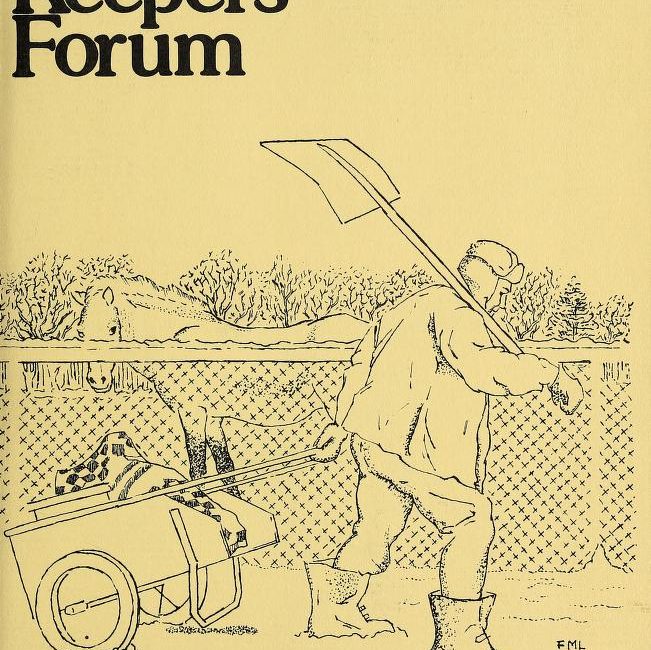
animalkeepersfor51978amer_0007.jpg

Image of a cover of Animal Keepers’ Forum, featuring a simple line drawing of a person pulling a wheelbarrow and carrying a shovel over one shoulder, in front of an enclosure with a horse. Text reads: “Animal Keepers’ Forum”, “Dedicated to Professional Animal Care.” Animal Keepers’ Forum. 1978. Digitized in BHL by Smithsonian Libraries.

Animal Keepers’ Forum, first published by the American Association of Zookeepers in 1974, set out to solve a problem: animal care and conservation requires specialized knowledge, but institutions were limited in their ability to share experience with each other. Animal Keepers’ Forum has connected animal care professionals for the past 44 years, and serves as both a current resource for husbandry best practices and a historical record of conservation efforts.

Now it’s openly accessible on the Biodiversity Heritage Library as part of the Expanding Access to Biodiversity Literature project, funded by the Institute of Museum and Library Services. Thanks to permission from the American Association of Zookeepers, Smithsonian Libraries has digitized the complete run of volumes from 1974 through the present, with a 2-year embargo period.

The 2015 special issue on prosimians gives a great sample of the publication’s scope: Duke University’s Lemur Center details their husbandry practices for mouse lemurs, with specifics from housing and diet to breeding and animal biometrics; St. Louis Zoo explains how they sustainably grow and harvest browse for their Coquerel’s Sifakas; and the Lemur Conservation Foundation shares how the AKO Project uses storytelling through picture books helps engage kids in wildlife conservation.

lemur_picturebooks.jpg

An image of two children’s picture-book covers featuring paintings of lemurs, and a photograph of children posing with picture books and smiling. Animal Keepers’ Forum. 2015. Digitized in BHL by Smithsonian Libraries.

animalkeepers42102015amer_0020.jpg

Photo of four chicks perched in a line. The chicks are black and white with yellow beaks. Article title: ‘Hand-reading White-crested Laughing Thrushes (Garrulax leucolophus) as a Method of Increasing Captive Population Sustainability’. Animal Keepers’ Forum. 2015. Digitized in BHL by Smithsonian Libraries.

The mission of the American Association of Zookeepers (AAZK) is “to advance excellence in the animal keeping profession, foster effective communication beneficial to animal care, support deserving conservation projects, and promote the preservation of our natural resources and animal life,” according to its website. The AAZK was founded in 1967 in San Diego, CA. Its first publication was an unofficial newsletter called The Ruptured Rhino (1968-1969), which is also coming to BHL along with the AAZK Bulletin. Eventually, The Rupture Rhino led to Animal Keepers’ Forum, which became the association’s official publication in 1975.

animalkeepersfo111974amer_0001.jpg

Image of the first page of Animal Keepers’ Forum, v. 1 no.1. Transcription from ‘Editorial Comment’ by Dave Ruhter: “Among zoo keepers, as with very few other professions, there exists a void in intraprofessional communications. If you are fortunate enough to have access to zoo magazines or occasionally obtain an AAZPA newsletter, you can find out what’s going on in the zoo world. But what’s happening among keepers at Denver or Brookfield? When was the last time you heard of new programs at Tulsa or Los Angeles? As problems come up, have you ever wondered what your fellow professionals are doing in similar situations? This is what Animal Keepers’ Forum is all about. We are offering to you a vehicle of communication with topics that concern and interest keepers… the more knowledgeable you are, the more valuable you are to your animals and to your zoo.” Animal Keepers’ Forum. 1974. Digitized in BHL by Smithsonian Libraries.

animalkeepersf4212015amer_0016.jpg

Photograph of an ocelot, a small, spotted wild cat, in profile. Article title: Overnight Behavioral Study on 1.1 Brazilian Ocelots (Leopardus pardalis). Animal Keepers’ Forum. 2015. Digitized in BHL by Smithsonian Libraries.

Until its digitization, accessibility to Animal Keepers’ Forum was fairly limited without a subscription. Jacqueline Chapman (Digital Collections Librarian) and Kristen Bullard (former Branch Librarian, National Zoological Park & Conservation Biology Institute and current Science Researcher Services Librarian, Natural & Physical Sciences Department) of Smithsonian Libraries authored a paper and presented at the 2017 AAZK National Conference to address the significance of making this resource available digitally and for free (‘Connecting Keepers to Collective Knowledge: The Digitization of Animal Keepers’ Forum and the Promise of Open Access to Zoological Scholarly Communication’).

They share that a search of the global online library catalogue WorldCat found only 30 libraries with Animal Keepers’ Forum, and that Smithsonian Libraries was the only institution listed as having a complete set of the periodical. As a result, it has been one of the most frequently requested titles from the Smithsonian’s Zoological Park and Conservation Biology Institute library branch through interlibrary loan. (While it is likely available at libraries that don’t participate in WorldCat, the WorldCat search result does indicate that it was relatively difficult to access for those without the resources to subscribe.)

“Some species are so unique that information about their care is hard to find and [Animal Keepers’ Forum] might be one of the only sources for this material,” Chapman and Bullard write. “The knowledge within [Animal Keepers’ Forum] is now available to anyone, allowing the best practices and lessons learned, this collective knowledge of zoo keepers, to be accessed without barrier to anyone. This will hopefully support capacity and knowledge building in institutions that have suffered from limited resources over time.”

animalkeepersf3422007amer_0001.jpg

Image of a cover of Animal Keepers’ Forum, featuring a simple black and white illustration of a California Condor chick being fed by a puppet resembling the head of an adult condor. The image is by Mary Deckert, a docent at the Los Angeles Zoo, which participates in a recovery program for this critically endangered species. Animal Keepers’ Forum. 2007. Digitized in BHL by Smithsonian Libraries.

Many thanks to: the American Association of Zookeepers for contributing this resource; the Institute of Museum and Library Services for funding the Expanding Access to Biodiversity Literature project; Smithsonian Libraries for digitization; and Jacqueline Chapman and Kristen Bullard for sharing their insights!

References:

‘About Us’ (aazk.org)
‘Animal Keepers’ Forum’ (aazk.org)
‘Connecting Keepers to Collective Knowledge: The Digitization of Animal Keepers’ Forum and the Promise of Open Access to Zoological Scholarly Communication’ (Chapman & Bullard, 2017)

May 17, 2018by michelle.underhill
Blog Reel, User Stories

BHL through the Eyes of a Student: An Inspiring Window to Natural History

white male in red hate standing in a snowy landscape

“The cultivation of natural science cannot be efficiently carried on without reference to an extensive library.”

Charles Darwin and fifty-six other signatories made this assertion as part of an appeal for support of natural history research at the British Museum in 1847.[1]

Over one hundred and fifty years later, this still holds true. The domain of systematic biology depends, perhaps more than any other science, upon historic literature. From original species descriptions to distribution data, locality records, behavioral observations and more, natural history literature underpins modern research and is critical to the study of biodiversity.

Thanks to the Biodiversity Heritage Library, researchers around the world have free and open access to these essential publications.

white male in red hate standing in a snowy landscape

Otto Stenberg, graduate student at the University of Helsinki, taking a detour on the way to the campus. Image Credit: Otto Stenberg

Graduate student Otto Stenberg has experienced the value of historical literature, and the benefits of BHL, first-hand throughout his studies on molecular and evolutionary biology at the University of Helsinki. One of these most memorable instances occurred during an undergraduate research project on pinniped evolution.

“We were gathering information on fossil localities,” explains Stenberg. “I ended up looking for some info on an eared seal fossil from Argentina. The fossil itself was lost in the early 20th century and was thus only briefly mentioned in a couple of other sources. However, on BHL, I managed to find Les mammiferes fossiles de l’Amerique du Sud – the original publication in which a species (Otaria fischeri) had been described based on the fossil. It had the info we were interested in!”

title page of an old book

Title page of Les mammiferes fossiles de l’Amerique du Sud. (1880). By Henri Gervais and Florentino Ameghino. Digitized in BHL by Smithsonian Libraries.

Stenberg discovered BHL early in his undergraduate studies, prompted by a discussion about Charles Darwin during an evolutionary biology class lecture.

“I decided to see if I could dig up a scan of the 1st edition of On the Origin of Species on the Internet,” recalls Stenberg. “While a quick search yielded several promising hits, the Biodiversity Heritage Library sounded most interesting – and it turns out it was! I spent several hours just browsing BHL, and didn’t actually end up reading any Darwin that day.”

Stenberg has since completed his undergraduate degree in molecular biosciences and is currently completing his Master’s thesis at the University of Helsinki with a focus on genetics in an evolutionary context. Since 2016, he has been part of a research team at the University’s Jernvall Evo-Devo Lab at the Institute of Biotechnology, where the group is exploring the relationship between dental complexity and diet in carnivoran mammals.

white male in a blue shirt analyzing an animal skill in a lab

Stenberg scanning the lower molars of a polar bear for further research on dental complexity in carnivoran mammals. Image Credit: Jacqueline Moustakas-Verho.

BHL continues to be a valuable resource for Stenberg’s graduate studies. He uses the library several times a month, browsing the titles online and occasionally downloading interesting publications for later reading on his phone during his commute. His favorite features include BHL’s multiple reading and download options and high resolution scans of scientific illustrations. He also finds the library’s social media feeds and “Today’s Pick” Flickr stream on the BHL homepage to be a great entry point to facilitate discovery of treasures in the collection.

Beyond its practical research applications, Stenberg emphasizes that BHL also provides an important historical perspective on biodiversity research.

“BHL has much value as a provider of historical context when it comes to biosciences!” lauds Stenberg. “Numerous times have I heard of an old experiment/hypothesis during a lecture and then later been able to find an original publication regarding it on BHL. Instead of just reading about the importance of old research, being able to actually read the thoughts of researchers past is a wonderful window to the history of science!”

For Stenberg, BHL is more than just a digital library. It is a tool for research, learning, and outreach that makes scientific knowledge freely available to scientists, faculty, students, and the general public alike. It is an inspirational archive that has expanded Stenberg’s own appreciation of science.

“There’s so much value in being able to ‘travel back in time’ to read the original publications with just a couple of clicks,” stresses Stenberg. “I’d argue that as a student, it’s important to also learn about the history upon which our modern knowledge was built. Broadening the context in which you view science is very rewarding!”

[1] Darwin Correspondence Project, “Letter no. 1070F,” accessed on 17 April 2018, http://www.darwinproject.ac.uk/DCP-LETT-1070F

May 10, 2018by michelle.underhill
BHL News, Blog Reel, Tech Updates

Announcing Full Text Search on BHL!

New enhancement for BHL’s full text search implementation added August 2018: You can now choose to search the catalog only (i.e. bibliographic metadata like title, author, etc.) or catalog + full text. Information below has been updated to reflect this enhancement.

—————————————–

We’re thrilled to announce that full text search is now available on the Biodiversity Heritage Library!

To start using this functionality, simply visit BHL, type a term into the search box with the “full text” button selected, and use our new interface enhancements to review your results. Search results will display hits for your term in both the bibliographic metadata (i.e. title, author, subject, publisher, related titles and series, etc.) as well as the full text of books in BHL.

If you wish to limit your search to just the bibliographic metadata, select the “catalog” button before performing your search.

For each result, expand “Details” to see where your term occurs within each item, be it in the title, keywords, or full text.

full text search overview in BHL website

Overview of the new full text search functionality on BHL.

Click on a title to view an item from your results list. You can then use the “search inside a book” functionality (discussed below) to navigate to specific pages mentioning your term.

Full text search makes it easier to discover a wider range of relevant content. For example, say you’re looking for information related to invasive zebra mussel (Dreissena polymorpha) populations in the Ohio River. A search for “zebra mussel” AND “Ohio River” yields several intriguing results that may not have been easily discoverable without full text search.

digital library website results for a search for "zebra mussel" and "ohio river"

Results of a search for “zebra mussel” AND “ohio river” yields several intriguing results in the full text. Note: Image edited to highlight specific results of interest.

Faceted Browsing

We’ve also enhanced the BHL interface with faceted browsing, making it easier for you to explore your search results by applying filters for content type, publication date, subject, language, and author. To narrow your results by one of the filters, simply check the box next to the desired facet value(s).

digital library interface showing faceted searching options

Use facets to narrow your search results.

Search results will automatically update when you select a value, but for best results, select one value at a time, allowing the results set to update, before selecting an additional facet value if you wish to further limit your results.

Search Inside a Book

We have also added “search inside a book” functionality, allowing you to search for terms within a book you’re viewing.

To use this feature, navigate to the top right corner of the book viewer, select the “Search Inside” tab and enter your search terms. In that same panel, results will display the pages where your search terms are found, along with snippets of the surrounding text. Navigate to any of those pages by clicking on the hyperlinked page number.

digital library interface showing "search inside" functionality

“Search inside a book” on BHL.

“Search inside a book” is a powerful way to uncover content of interest within a specific book. For example, say you want to find the passages where Darwin discusses his time at the Galápagos Islands within his Journal of Researches from the H.M.S Beagle voyage. By searching for “Galapagos”, you can easily find and navigate to the relevant pages.

digital library display of a book

A search for “Galapagos” within Darwin’s Journal of Researches using the “search inside a book” functionality.

Learn More

We’re excited to introduce this much-anticipated new functionality to BHL, and we look forward to seeing what further discoveries it enables.

Have questions about full text search or want to learn more about our features and functionality? See our General Search and Full Text Search FAQs. If you have further questions or suggestions for future enhancements, you can contact us via our webform or [email protected].

May 7, 2018by michelle.underhill
Blog Reel, Featured Books

28,000 Pages about the Sea: Challenges and Solutions for Digitizing the Fowler Collection

Workflow Meets Deluge

Henry Weed Fowler must have loved fish.

Ichthyology dominated his entire career. He started as a museum assistant at the Academy of Natural Sciences of Philadelphia in 1903. Other experts in his field soon recognized his prolific skill. In 1918, an assistant curator at the Smithsonian, Barton A. Bean, reached out to Fowler (then still an assistant) for help identifying fishes collected by the United States Exploring Expedition. Fowler dove into the work. He delivered a lengthy 750-page manuscript in two years, helping to discover 18 new species of fish in the process.[1]

For reference, the average field book here at the Smithsonian Institution Archives is 110 pages.

In 1925, Bean again sought out Fowler (then an associate curator) to identify fish from a 1907-1910 expedition by the steamer Albatross in the Philippines. Over the next several years, the pair published three manuscripts together (one | two | three), after which Fowler published three more of his own (one | two | three). Then, Fowler additionally completed six massive manuscripts – thousands of pages of independently written material – that were never published. Fowler passed away in 1965 after becoming a Curator of Fishes in 1940.[2] His unpublished manuscripts were transferred to the Smithsonian Institution Archives in 1975.[3]

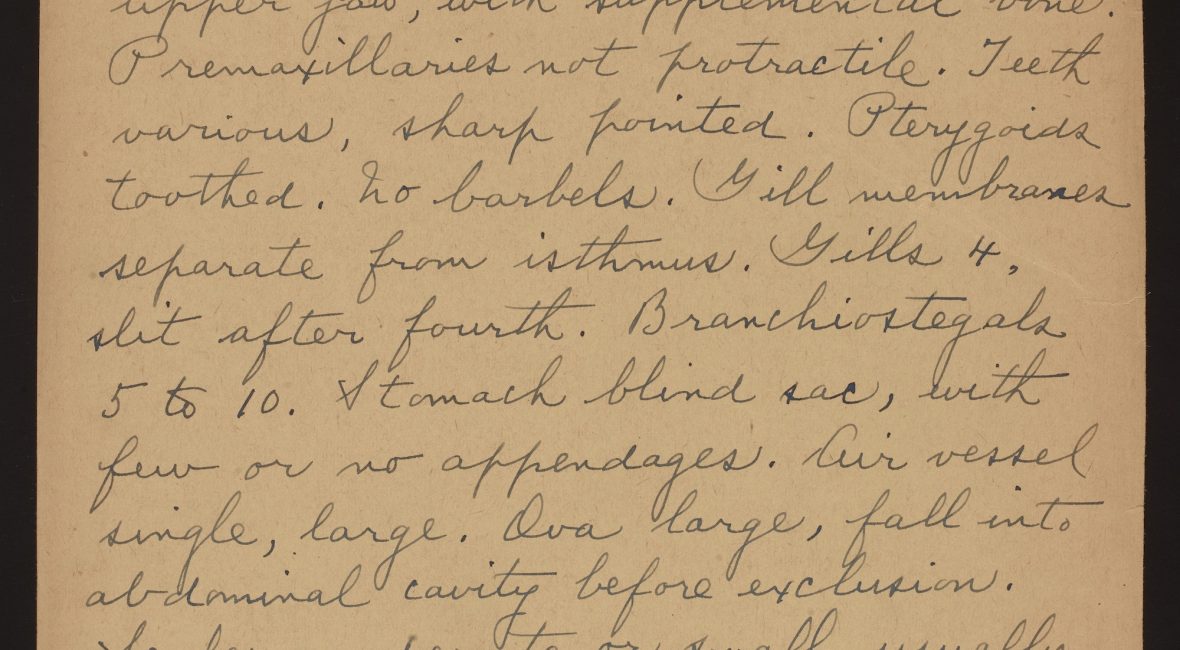
Fowler, Henry Weed. Manuscript of Henry Weed Fowler on the fishes of the Philippines, unpublished, circa 1930-1941. Families Argentinidae and Serpidae. Digitized in BHL by Smithsonian Institution Archives.

Fowler, Henry Weed. Manuscript of Henry Weed Fowler on the fishes of the Philippines, unpublished, circa 1930-1941. Families Argentinidae and Serpidae. Digitized in BHL by Smithsonian Institution Archives. https://biodiversitylibrary.org/page/55806651.

As a part of the BHL Field Notes Project, Smithsonian Institution Archives is digitizing one-of-a-kind field notes and manuscripts so they may be accessed online by researchers who may otherwise not be able to access the material. Logistically, each field book is assigned a unique identifier in the Archive’s Field Book Registry which we use to help track the item throughout the digitization process. On average, one unique identifier means one 110-page field book. We can normally digitize and deliver at least 30 field books per week.

Here’s where it got tricky: Fowler’s six unpublished manuscripts were grouped under a single identifier, MODSI6368. One 28,000-page item, 254-times larger than normal, and estimated 2.5 TB worth of images. One field book to outweigh them all.

Fowler’s unpublished manuscripts in the digital imaging lab, with imaging tech Charles Zange for scale. Photo by Mignonette D. Johnson. Smithsonian Institution Archives.

Fowler’s unpublished manuscripts in the digital imaging lab, with imaging tech Charles Zange for scale. Photo by Mignonette D. Johnson. Smithsonian Institution Archives.

The eight-Hollinger-box, 153-folder field book arrived in Staging in late February. Our team held a meeting. We needed a new approach.

Logistics of a Tidal Wave

Proceeding as normal would irreversibly skew project deliverables. Loading a 28,000 page manuscript in the BHL portal wouldn’t be the most useful approach for researchers. After detailed discussion, we settled on a plan: break out the manuscript into sub-elements at the folder level instead of the title level, photograph at ~650ppi so we wouldn’t have to adjust the camera during the day, and bulk scan smaller items that required a higher resolution.

This new approach offered several advantages. Adjusting the camera several times a day adds up and slows down imaging; removing the need to adjust constantly would save us time and make imaging the manuscript more efficient. Treating each folder as a separate sub-element would mean creating smaller, more manageable digital objects closer to the average 110 pages we usually work with. This would shorten descriptive metadata per image in our Collections Management System (CMS) records; otherwise we would be embedding page-long collection notes into each image. It would also allow us to take advantage of how BHL manages multi-volume titles. This in particular is a method already successfully implemented by our fellow Field Notes Project partners at the Missouri Botanical Garden on their George Engelmann material, so we knew it could be a user-friendly way to present the extensive Fowler manuscript.

We had a plan. Now we had to see if it would work.

Fowler, Henry Weed. Manuscript of Henry Weed Fowler on the fishes of the Philippines, unpublished, circa 1930-1941. Order Synbranchii. Digitized in BHL by Smithsonian Institution Archives. https://biodiversitylibrary.org/page/55811117

Fowler, Henry Weed. Manuscript of Henry Weed Fowler on the fishes of the Philippines, unpublished, circa 1930-1941. Order Synbranchii. Digitized in BHL by Smithsonian Institution Archives. https://biodiversitylibrary.org/page/55811117.

Results after the Storm

The first Fowler image came through the camera on March 14, 2018. Our team finished photography on April 17th. Delivery to the Biodiversity Heritage Library is ongoing (stay tuned!). Here are a few statistics from the Fowler photography project:

  • Final page count: 28,735
    • 153 folders, average 187.8 pages/folder (1.7 times larger than average field books)
  • 24 days of imaging and metadata processing
    • Average 1197.29 images/day
  • Highest one-day count of photography: 2,415 pages
    • 345 pages/hour (5.75 pages/minute) for 7 hours by one technician
  • 2.59 TB storage footprint
  • Widespread sense of accomplishment

Spread the Word across the Seas!

Fowler has started to make his way online. As the team moves to another collection (Edmund Heller), check out some of the other worldwide journeys by Smithsonian researchers at the Smithsonian Transcription Center and the Smithsonian Field Books Collection. Thank you to our many volunteers, both online and here in the lab, for your passion and dedication in support of this project!

The BHL Field Notes Project is funded by the Council on Library and Information Resources (CLIR).

Citations

[1] “Fowler, Henry Weed, 1878-1965,” Smithsonian Institution Archives

[2] Ibid.

[3] “Henry Weed Fowler Papers,” Record Unit 007180, Collections Management System, Smithsonian Institution Archives 

May 3, 2018by Joel Richard
BHL News, Blog Reel

BHL at the Northeast Natural History Conference

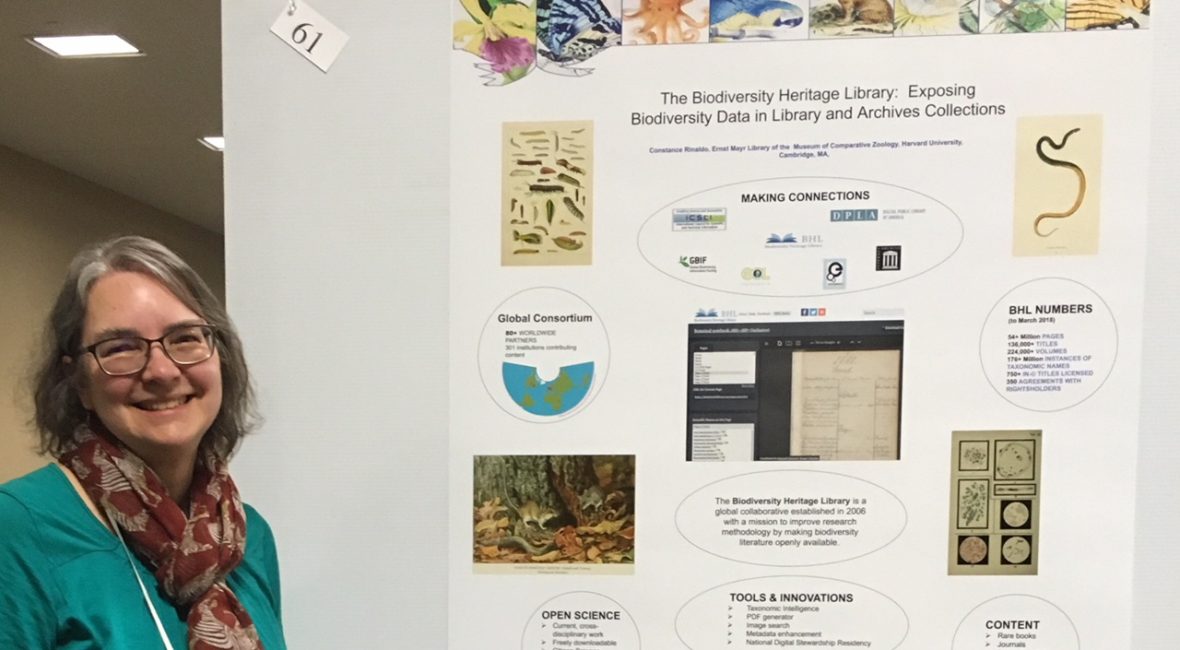
woman in green shirt standing in front of a poster.

The weekend looked promising:  a lovely clear Friday night for a drive to Burlington, Vermont, USA from southern New Hampshire to attend the Northeast Natural History Conference (13-15 April 2018).  What could be better than a hotel humming with botanists and zoologists and activities for them?  The conference was packed—five concurrent sessions (often standing room only) and around 140 posters Saturday and Sunday along with workshops (Bat houses anyone?) and demonstrations throughout the weekend.  Students, faculty and naturalists from colleges, universities and small research or rescue organizations presented posters and talks that focused on New England, New York and Eastern Canadian native vertebrates, invertebrates, plant species diversity and distribution, invasive species and wetland habitats.

woman in green shirt standing in front of a poster.

Constance Rinaldo (Librarian of the Ernst Mayr Library and Museum of Comparative Zoology Archives; Chair of the BHL Executive Committee) standing with her BHL poster at the Northeast Natural History Conference.

Some of the posters that caught my eye (beyond the BHL poster that I presented) included “Restoring Northeast Understory Species: A case of the Primary Literature” presented by Isabel A. Schmitt and Dr. James H. Graves.  They presented a literature review that led to practical methods to reintroduce native species.  Another interesting poster was the “Use of Point-and-Shoot Photography to Compare Regional Differences in Coyote (Canis latrans) Skull Size”.  Osrica Mclean et al developed an online collection of digital images of skulls and calibrated the images so that they could be measured accurately online.

I attended a talk about how specialist and generalist rodents disperse mycorrhizae (Ryan Stephens and Rebecca Rowe) along with a presentation that detailed 42 years of vegetation change on Franconia Ridge in New Hampshire by Charles Cogbill.  Dr. Cogbill used an archive of photographs (from 1860 to present) to identify the effects of hikers on the trail vegetation (much damage is done). Another conference theme was bats and how white nose syndrome has affected bats in New England.   In a talk by Meghan Lout, she described a house in Middlebury, VT from which 550 bats were seen exiting one evening.  The owners were unaware that their house was a haven for bats.

Interacting with so many enthusiastic people studying nature—from observational work to highly experimental research—was inspiring and exciting.  The BHL poster was well received.  University faculty members and naturalists from small organizations stopped by to tell me how much BHL has improved their research workflows. Many students discovered BHL at this conference and were suitably impressed.  I asked for suggestions to enhance BHL and the common theme was “more”.  More content (with some individuals offering resources) and more current materials.  New potential users were surprised that content is available for free download. A few of the more sophisticated users suggested that we needed a taxonomic name authority file so names can be plugged in and the historical names and current names could be viewed as a complete set.

Leaving was somewhat deflating—snow, sleet and freezing rain as only the north country can do it.  Miserable driving, 45 mph tops, cars off the road, 4 hours on the road instead of 3. But so worth it to be among so many people studying the natural world.

May 2, 2018by michelle.underhill
Page 1 of 212»

Help Support BHL

BHL's existence depends on the financial support of its patrons. Help us keep this free resource alive!

search

About BHL

The Biodiversity Heritage Library (BHL) is the world’s largest open access digital library for biodiversity literature and archives. BHL operates as a worldwide consortium of natural history, botanical, research, and national libraries working together to digitize the natural history literature held in their collections and make it freely available for open access as part of a global “biodiversity community.”

Join Our Mailing List

Sign up to receive the latest news, content highlights, and promotions.

Subscribe Now

Subscribe to Blog via Email

Enter your email address to subscribe to this blog and receive notifications of new posts by email.

Join 319 other subscribers

Subscribe to Blog Via RSS

Subscribe to the blog RSS feed to stay up-to-date on all the latest BHL posts.

Access RSS Feed

Inspiring Discovery through Free Access to Biodiversity Knowledge.

The Biodiversity Heritage Library makes it easier than ever for you to access the information you need to study and explore life on Earth…for free, anytime, anywhere.


64+ Million Pages of
Biodiversity Literature Online.

EXPLORE

Tools and Services
to Transform Research.

EXPLORE

300,000+
Illustrations on Flickr.

EXPLORE

ABOUT | HARMFUL CONTENT | PRIVACY | SITE MAP | TERMS OF USE