Biodiversity Heritage Library - Program news and collection highlights from BHL
  • Home
  • News
  • Featured Books
    • All Featured Books
    • Book of the Month Series
    • BHL at 20
  • User Stories
  • Campaigns
    • Fossil Stories
    • Garden Stories
    • Monsters Are Real
    • Page Frights
    • Her Natural History
    • Earth Optimism 2020
  • Tech Blog
  • Visit BHL
Home
News
Featured Books
    All Featured Books
    Book of the Month Series
    BHL at 20
User Stories
Campaigns
    Fossil Stories
    Garden Stories
    Monsters Are Real
    Page Frights
    Her Natural History
    Earth Optimism 2020
Tech Blog
Visit BHL
  • Home
  • News
  • Featured Books
    • All Featured Books
    • Book of the Month Series
    • BHL at 20
  • User Stories
  • Campaigns
    • Fossil Stories
    • Garden Stories
    • Monsters Are Real
    • Page Frights
    • Her Natural History
    • Earth Optimism 2020
  • Tech Blog
  • Visit BHL
Biodiversity Heritage Library - Program news and collection highlights from BHL
Blog Reel, Featured Books

The Life and Work of Robert Alexander Gilbert: Empowering New Insights through Digitization and Transcription of Archival Materials

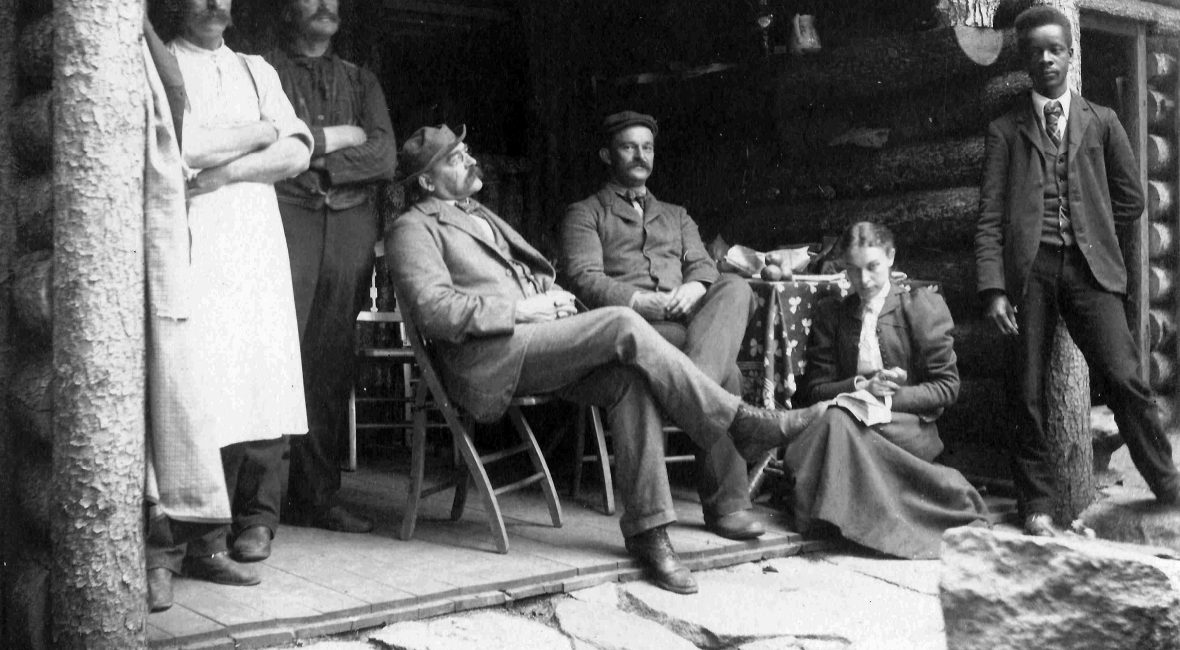
Black and white photo of a group of people standing on the porch of a log cabin.

This post is part of a series from the Ernst Mayr Library exploring the digitization and transcription of ornithologist William Brewster’s archival materials and the insights and scholarship made possible thanks to this work.

Black and white photo of a group of people standing on the porch of a log cabin.

Robert A. Gilbert, far right, at William Brewster’s cabin at Pine Point, Umbagog Lake, Maine. From the collection of the Museum of American Bird Art, Massachusetts Audubon Society and reproduced with their permission.

Robert Alexander Gilbert (1870-1942) was a Black photographer interested in ornithology and chemistry who worked for ornithologist William Brewster from the mid 1890s until Brewster’s death in 1919 and at various tasks around the Museum of Comparative Zoology (MCZ) at Harvard University beyond 1919. He was an Associate of the American Ornithologists’ Union.

Gilbert was not officially recognized for his photographic work with William Brewster, although Brewster did not claim credit for all the images in his collection. It was assumed that Brewster took all the photographic prints bequeathed to the Ernst Mayr Library and Archives of the MCZ (EMLA) upon his death. However, while conducting research for a book, author John Hanson Mitchell, former editor of the Massachusetts Audubon Society’s (MAS) Sanctuary magazine, discovered over 2000 of Brewster’s glass plate negatives in the attic of a building owned by the MAS. One of the images in particular, a photograph of a young, well-attired Black man standing in front of a rustic cabin in the wilderness, captured his interest. Mitchell was curious as to the identity of this young man. Later, in the mid-1970s, Mitchell had a chance encounter with an Archives Assistant at the MCZ who suggested to him that all of Brewster’s photographs were, in fact, taken by Brewster’s assistant, a young Black man named Robert Gilbert. This piqued Mitchell’s interest and launched his journey to discover more about Gilbert.[1] The quest culminated with the publication in 2005 of Mitchell’s Looking for Mr. Gilbert: the Reimagined Life of an African American. In 2014 an e-book edition was published as well.

Mitchell’s publication helps provide new insight into Robert Gilbert’s life and work. Brewster’s journals and diaries, now digitally available on the Biodiversity Heritage Library (BHL), are also valuable records attesting to Gilbert’s contributions in a variety of areas. While only a handful of Brewster’s photographs in the MCZ collection can be positively attributed to Gilbert, it is clear that Gilbert was with Brewster for photo sessions during the years they worked together. The photographic relationship between Brewster and Gilbert is intriguing. There is new enthusiasm to examine Brewster’s journals and diaries more closely now that they are digitized and being transcribed, to clarify Gilbert’s role in photographic collaboration with Brewster. As a result of identifying connections between the collections in the Museum of American Bird Art at the Massachusetts Audubon Society and the EMLA, a cooperative research project is underway.
Robert Gilbert was born and raised in the rural town of Natural Bridge, Virginia, in the valley of Broad Creek. In 1886, at the age of 16, he moved to Boston, Massachusetts where he would reside for the remainder of his life. Gilbert had an assortment of odd jobs during his first ten years in Boston, including working as a laboratory assistant for Dr. Arthur P. Chadbourne of Harvard Medical School, an amateur ornithologist and acquaintance of William Brewster. The records are unclear as to the actual year, but sometime between 1895 and 1897, work in Chadbourne’s lab slowed down and he recommended Gilbert to Brewster, who was in need of a temporary assistant to help him set up his personal bird museum. Gilbert met with Brewster, who showed him his extensive specimen collection and the tasks at hand, and for the next ten weeks Gilbert helped Brewster establish his new museum on the grounds of his home in Cambridge, MA. Afterward, Gilbert returned to working for Dr. Chadbourne, but shortly thereafter the laboratory experiments were completed whereupon Brewster hired Gilbert as his full-time assistant.[2] Brewster’s first mention of Gilbert in his journals is in his entry for March 31, 1897.

Black and white photograph of a brick house.

Brewster’s museum on the grounds of his home in Cambridge, MA. From the collection of the Ernst Mayr Library of the Museum of Comparative Zoology, Harvard University. Call number bBr 97.70.12.19.

It is clear from Brewster’s diaries and journals that the tasks performed by Gilbert in Brewster’s employ were many and varied. Glover M. Allen, Curator of Mammals at the MCZ, described Gilbert as “Mr. Brewster’s trusted assistant, looking after innumerable details at his museum or his camp, doing everything from photographic work to preparing and serving meals, and always with a quiet dignity and devotion that never for a moment failed.”[3] Gilbert quickly became Brewster’s right-hand man as evidenced by the innumerable references to him from 1897 to 1919 in his diaries and journals. Here are a few examples:

Journal, June 8, 1897. As a field assistant, note Gilbert’s observational skills and attention to detail as he documents the behavior of a Whistler Duck for Brewster:

“Gilbert who had been to the boat for his breakfast came to relieve me and to keep guard while I had mine. It was arranged between us that if the Whistler began taking out her young while I was absent he would shout a few times to let me know of the fact. I had just finished breakfast when I heard this signal and jumping into the St. Lawrence skiff rowed as hard as I could pull for the nest but as soon as I came in sight of it I knew I was too late for Gilbert was standing up in his boat and paddling slowly towards the tree. Here is his account of what happened during my absence: At 6.45 the old Duck appeared at the entrance (the lower hole) to the nest where she sat for five minutes moving her head continually and looking about in every direction included within her field of vision; then she sank back out of sight reappearing at the end of a minute and looking about as before for another five minutes. At the end of this second period of observation she flew down to the water and swam around the stub three times clucking and calling. On completing the third round she stopped directly under the hole and gave a single loud call or cluck when the ducklings at once began scrambling up to the entrance from the nest and dropping down to the water falling on top of one another. In other words the brood literally poured out of the nest much as shot would fall from one’s hand. One or two hesitated or paused for an instant reaching the mouth of the hole but the greater number toppled out over the edge as soon as they appeared. All used their tiny wings freely beating them continuously as they descended. They did not seem to strike the water with much fear.”

Journal, November 5, 1897. Bird observations reported to Brewster: “Gilbert counted fourteen Chickadees in one flock on Ball’s Hill this morning. With them was a Downy, two Tree Sparrows & two Juncos. He also saw five Black Ducks passing over the meadows at evening.”

Journal, March 24, 1898. Work at Brewster’s cabin in Concord, MA: “Spent the forenoon clearing out the path behind the hill, Gilbert helping me.”

Diary, March 6, 1909. Photographic work: “Lizzy Fuller came over at 8 P.M. She with C. & E.R.S. [Caroline and Elizabeth R. Simmons] spent evening in Museum where I showed them about 100 lantern slides that Gilbert has just made.”

Diary, January 9, 1918. Work in Brewster’s museum: “Gilbert is now going through the collections in search of Anthrinae [Anthrenus] & other insect pests. Thus far he has found traces of them in the cans only.”

In the 1890s Brewster was earnestly transitioning from collecting bird specimens with his shotgun to field observation and photography. He had, in Robert Gilbert, an assistant knowledgeable in ornithology and capable with photography and photographic processing. It is unfortunate that in the Ernst Mayr Library collection of over 1,700 of Brewster’s photographic prints, only six have an inscription on the verso stating that the photograph was taken by Robert Gilbert. Below are two such photographs:

Black and white photograph of a stone wood-house in the woods.

From inscription on verso: “Wood-shed, Hemlock Grove, Concord, Mass., April 1904, taken by R.A. Gilbert.” From the collection of the Ernst Mayr Library of the Museum of Comparative Zoology, Harvard University. Call number bBr 97.70.7.23.

Black and white photograph of a garden.

Brewster’s garden. From inscription on verso: “Garden, Cambridge, Mass. July 30th 1904. Taken by R. A. Gilbert.” From the collection of the Ernst Mayr Library of the Museum of Comparative Zoology, Harvard University. Call number bBr 97.70.12.59.

It is possible that many other photographs were taken by Gilbert, but we don’t know for sure. There are a number of occasions recorded in Brewster’s writings where it is clear that Brewster himself was doing the photography. In his journal entry for May 18, 1897, for example, Brewster writes:

“I visited the Hermit’s nest in the Brown clearing taking five photographs of it. The [female] was on the nest and for a Hermit sat very closely allowing me to set up the camera & focus on her at a distance of about 4 ft. but gliding away just as I was about to expose a second plate. She would not return to her eggs, however, while the camera was in position although I waited for her nearly an hour.”

Whether or not Gilbert was taking the picture, it is clear that he played a major role assisting with various aspects of Brewster’s photography. Inscriptions on the verso of photographic prints reveal that Gilbert owned darkroom apparatus and copied glass plate negatives to make prints. In a journal entry dated May 29, 1897 Brewster writes: “In the forenoon I took several photographs (with Gilbert’s help) in the gulf at the head of Great Island and along the western shore of the Sweat Cove.” Though Brewster was taking the pictures, Gilbert was assisting in some fashion.

It is evident that Gilbert was an invaluable assistant and friend who greatly facilitated Brewster’s ornithological accomplishments. Gilbert remained in Brewster’s employ until the latter’s death in 1919. Brewster arranged for the MCZ to hire Gilbert upon his death, another attestation to Brewster’s high regard for him.

There is little on record describing Gilbert’s tasks at the MCZ, but the Annual Report of the Director sheds some light. In the Report of the Director for 1931/1932 Thomas Barbour writes: “Robert Gilbert, aided by several young men, has done excellent work in rearranging some of the exhibition halls.” In the 1933/1934 Annual Report Glover Allen writes in his Report on Mammals: “In the ever-present work of cleaning skulls and skeletal material French and Gilbert have latterly borne a helpful hand, developing some skill.” Were Gilbert doing similar tasks today, he would likely be given the title Curatorial Assistant in the MCZ. Barbour’s report intimates that, among many other skills, supervision and at least familiarity with exhibit design properly belong on Gilbert’s resume. No doubt, Gilbert’s work in Brewster’s museum prepared him well for his tasks in the MCZ.

Gilbert worked at the MCZ until his death in 1942. In his 1941/1942 Director’s report, Barbour provided the following tribute:

“On January 7, 1942 Robert A. Gilbert died. For years before he came to the Museum he had helped Mr. Brewster in many ways and his sterling personal characters of integrity, affection, courtesy, and loyalty made him not only a [sic] honor to his race but one who was proud to do everything which he did as well as he could do it, and who was beloved by us all.”

Robert Gilbert’s many talents as well as his passion, curiosity and integrity enriched Brewster’s life and pursuits. It is evident that he brought these same qualities to his work at the MCZ.

The Ernst Mayr Library is actively transcribing the digitized journals, diaries and correspondence of William Brewster, enabling full-text searching of these resources in the Biodiversity Heritage Library. It is our hope that this will facilitate digital scholarship and further interest in the life and work of Robert Gilbert. In the next blog post we will discuss this transcription work.

References

[1] Mitchell, John Hanson. 2005. Looking for Mr. Gilbert: The Reimagined Life of an African American. Washington, DC: Shoemaker.

[2] Mitchell, John Hanson. 2014 e-book edition. Looking for Mr. Gilbert: The Unlikely Life of the First African American Landscape Photographer. New York, New York : Open Road Distribution.

[3] Allen, Glover M. 1942. Obituaries. Robert A. Gilbert. The Auk 59.3: 467. JSTOR. Accessed on 25 January 2021. https://www.jstor.org/stable/4079251.

February 23, 2021by Constance Rinaldo
Blog Reel, Campaigns, Earth Optimism 2020, Featured Books

Nature Conservation and William Brewster: Insights From a Lifetime of Scientific Observations

This post is part of a series from the Ernst Mayr Library exploring the digitization and transcription of ornithologist William Brewster’s archival materials and the insights and scholarship made possible thanks to this work.

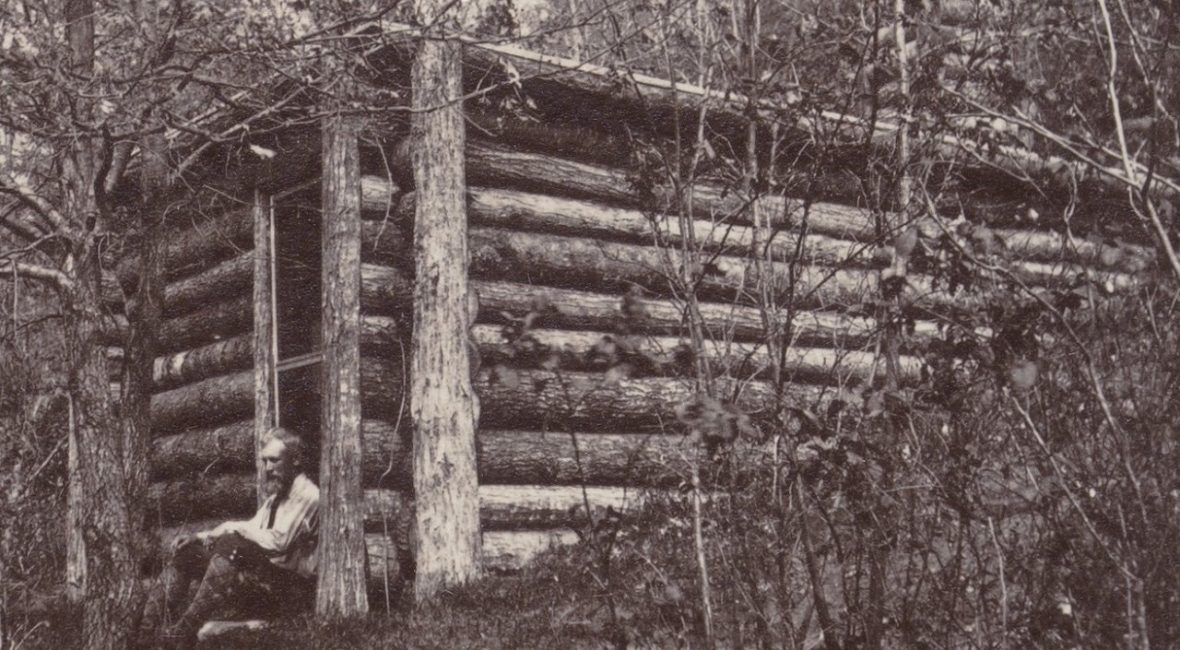
Black and white photo of a man sitting on the doorstep of a log cabin in the woods.

A black and white photograph of William Brewster sitting on the front doorstep of his cabin in Concord, Ma. The small, one-story log cabin is set in a hillside and surrounded by small trees and shrubs. The back of the photograph has the note: “Concord, Mass. May 20, 1892.” (Ernst Mayr Library Special Collections, call no. bBr97.70.7.)

The Ernst Mayr Library and Archives of the Museum of Comparative Zoology (MCZ), Harvard University, holds a unique and extensive collection of photographs, letters, manuscripts and field notes of William Brewster, a prominent ornithologist/naturalist of the late 19th and early 20th centuries. His published work is lauded as providing authoritative and novel additions to ornithology.

Brewster published more than 300 ornithological papers and several books which are widely available in academic and research libraries. He was the first president of the Massachusetts Audubon Society and was a founding member of the Nuttall Ornithological Club, out of which grew the national organization, the American Ornithologists’ Union. Brewster served as President of the American Ornithologists’ Union from 1895 to 1898, and the organization has awarded a medal in Brewster’s name since 1921.

Brewster’s ornithological studies covered the United States, although he worked most extensively in New England. Brewster was a Curator of Ornithology in the Harvard University Museum of Comparative Zoology from 1885 to 1902, continuing to work in the MCZ until his death in 1919. He deposited his bird specimen collection in the MCZ and his associated works such as his journals, diaries, correspondence and some photographic works in the Ernst Mayr Library & MCZ Archives. Brewster’s extensive specimen collection, in combination with his large body of published work, secures his place in ornithological history.

In 2012, the Ernst Mayr Library began digitizing Brewster’s journals, diaries, letters, and photographic prints. Many have been digitized as part of the CLIR-funded BHL Field Notes Project. To date, virtually all of Brewster’s more than 60,000 pages of notes, correspondence and images have been digitized and nearly 10,000 pages of the handwritten notes and diaries have been transcribed. All materials are in the process of being deposited in the Biodiversity Heritage Library, with more than half of the collection, including all of the journals and diaries, now available. The materials have been collated into the William Brewster Papers Collection.

Brewster kept journals and diaries, mostly devoted to his birding activities, for 54 years from the time he was 14 until he died in 1919. These written records afford us a glimpse into the daily inner workings of this scientist’s mind. The Ernst Mayr Library is fortunate to have his full set of journals and diaries, most of his correspondence and some of his photographs and glass negatives. This is indeed a treasure trove of information, now made more accessible as it is digitized and made openly available in BHL. This collection is more than a record of changing landscapes, bird lists, temperature and weather recorded for each day of writing. It shows us how Brewster developed his ideas, how he thought about the world, and how his thinking changed through his life. In his later correspondence with Frank Chapman (a then-young ornithologist that Brewster mentored into a more mature career), they debated about and revised how to do science with less killing of birds.

handwritten page from a field notebook.

Excerpt of a letter from Frank Michler Chapman to William Brewster. 15 June 1890. Contributed in BHL from the Harvard University, Museum of Comparative Zoology, Ernst Mayr Library.

“This miserable collecting. It is the cause of all higher failing, it lowers a true love of nature through a desire for gain. I don’t mean a specimen here and there, but this shooting right and left, this boasting of how many skins have been made in a day or season. We are becoming pot-hunters. We proclaim how little we know of the habits of birds and then kill them at sight. Sometimes I am completely disgusted with our ways and myself in particular… I long for an outing where the gun will be secondary, recorded observations primary, where I shall be entirely alone or with a companion whose object is my object … The question with me is, how am I going to change this?… Will you embark with me on a novel ornithological expedition, whose aim shall be to really observe birds to learn something of them. Where the gun shall be a servant, not a master, where days may pass without a skin being made, where there will be time to speculate and discuss the habits of birds observed, where systematic observation of certain phaenomena may be attempted.” 15 June 1890, Correspondence, Frank Michler Chapman to William Brewster.

Brewster’s detailed, long-term observations and notes are the key to his published contributions to ornithology and are a unique resource. His diaries, journals and correspondence are a gold mine of unpublished observations, journal notes, sketches, weather reports, specimen lists and travel narratives: these records are primary source data at its most raw and unevaluated. Historical collections of field notes may be the only documentation of a scientist’s thought processes, ideas and observations, particularly if only some of the writer’s material was ever published.

Brewster documented local environmental changes and gradual declines in number and presence of bird species over many years. He was concerned about vanishing wildlife, urbanization and landscape changes. He talked about ecological succession before the concept was officially published.

handwritten page from a field notebook.

Excerpt of a page from William Brewster’s 1896 journal, in which he documents the impact of roadwork on local wildlife. Contributed in BHL from the Harvard University, Museum of Comparative Zoology, Ernst Mayr Library.

“Where the road passes through the woods … the roadworkers last May cut away the mountain maples, [cornels] and other shrubs and low trees that made such a beautiful border to the forest clearing in their places a broad belt of bare rocks half covered with the fallen brush wood. This deed of vandalism was performed while I was here and at the time I feared that years must elapse before Nature, with all her diligence, could repair the injury. I underrated her powers for already this thicket of road is, if anything, more beautiful than ever. Fire weed, Eupatorium, Impatiens, Asters, Golden rod and several other tall and rank flowering plants have shot up through and almost perfectly concealed the unsightly brush and stone heaps and I have rarely seen a more brilliant or attractive display of wild flowers.” 15 August 1896, Lake Umbagog, Maine, Journals of William Brewster

Brewster helped develop legislation to discourage excessive hunting and the use of feathers in women’s hats, although at the same time advocating for the continued, but regulated, collection of scientific specimens. His conservation work led him to become the first president of the Massachusetts Audubon Society. The photographs and negatives from the collections chronicle landscape changes through time. Brewster’s growing concerns about the killing of wildlife, even for scientific purposes, can be seen developing in his field notes and correspondence.

handwritten page from a field notebook.

Excerpt of a page from William Brewster’s 1907 journal, which captures his transition from collecting bird specimens with his shotgun to field observation and photography. Contributed in BHL from the Harvard University, Museum of Comparative Zoology, Ernst Mayr Library.

“If he would become really familiar with the wood folk and their ways, let him go among them unarmed and in a spirit of peace and loving kindness towards them all. Then he will learn many things which the bearers of guns do not know and cannot be made to believe.” August 1907, Journals of William Brewster.

The availability of Brewster’s notebooks enhances contemporary studies and makes the entire research cycle of this scientist’s work available for analysis by historians of science, scientists, social scientists and humanists or anyone interested in the process of discovery, by creating a richer and more interactive history of science resource. Brewster’s careful observations enable comparisons of his birding lists with contemporary observations (100 years plus later), helping to document environmental changes that might not be evident otherwise.

References

Emmet, Alan. November-December 2007. William Brewster: Brief life of a bird-lover 1851-1919. Harvard Magazine. https://harvardmagazine.com/2007/11/william-brewster-html

Meyer, Elizabeth. April 5, 2018. From ‘Shotgun Ornithology’ to nature conservation: scientific stories and data from the field notes of William Brewster. https://blog.biodiversitylibrary.org/2018/04/from-shotgun-ornithology-to-nature-conservation-scientific-stories-and-data-from-the-field-notes-of-william-brewster.html

Meyer, Elizabeth. April 6, 2017. Notes from William Brewster: The evolving field of zoology. https://blog.biodiversitylibrary.org/2017/04/notes-from-william-brewster-evolving.html

Meyer, Elizabeth. September 9, 2016. Notes from William Brewster: Ecological change in the Maine woods. https://library.mcz.harvard.edu/blog/notes-william-brewster-ecological-change-maine-woods

Mitchell, John Hanson. 2014 e-book edition. Looking for Mr. Gilbert: The Unlikely Life of the First African American Landscape Photographer. New York, New York : Open Road Distribution.

Mitchell, John Hanson. 2005. Looking for Mr. Gilbert: the Reimagined Life of an African American. Washington, D.C. : Shoemaker & Hoard : Distributed by Publishers Group West

Randall, Patrick. June 5, 2014. Transcribing the field notes of William Brewster. https://blog.biodiversitylibrary.org/2014/06/transcribing-field-notes-of-william.html

Rinaldo, Constance, Linda Ford and Joseph deVeer. 2018. Museum, library and archives partnership: Leveraging digitized data from historical sources. Poster presentation at Society for the Preservation of Natural History Collections, August 2018, Dunedin, New Zealand.

Sears, M. 2020. Celebrating Robert Gilbert. Ernst Mayr Library Blog post: https://library.mcz.harvard.edu/blog/celebrating-robert-gilbert

February 22, 2021by Constance Rinaldo
BHL News, Blog Reel

BHL at the 2019 Society for the Preservation of Natural History Collections (SPNHC) and Digital Data in Biodiversity Meetings

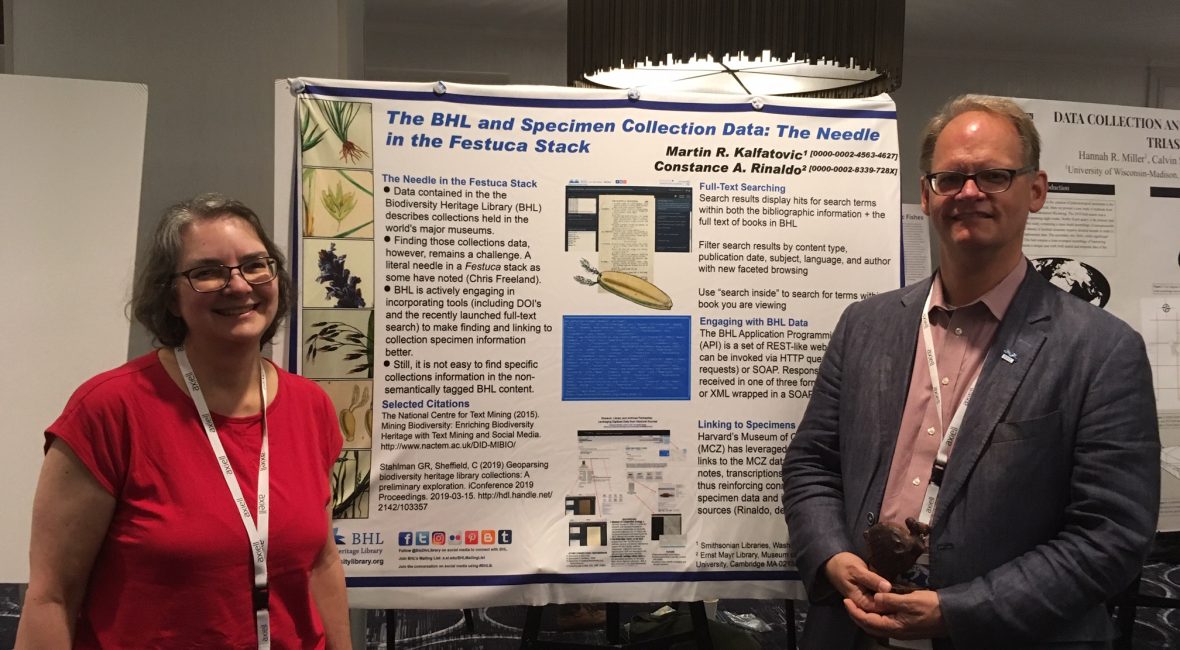
man and woman standing in front of a poster

Martin Kalfatovic (BHL Program Director) and Connie Rinaldo (Chair of the BHL Members’ Council) attended the recent Society for the Preservation of Natural History Collections (SPNHC) meeting held 25-31 May 2019 and hosted by the Field Museum of Natural History in Chicago, Illinois. The theme of the meeting was “Making the Case for Natural History Collections”.

There were opportunities for tours of the Field Museum of Natural History and workshops in addition to the strong array of presentations. One session focused on metrics for measuring impact, time working in the collection and increasing visibility of the behind-the-scenes work with museum specimens. If you are interested, there is a survey to gather data about metrics in collections. There were several talks related to library involvement in museum work such as copyright and metadata contributions and some talks mentioned BHL as a data source..

man and woman standing in front of a poster

Martin Kalfatovic and Connie Rinaldo with their poster at the 2019 Society for the Preservation of Natural History Collections (SPNHC) meeting.

We spoke with people who use the BHL frequently (to great praise) and to representatives of organizations with connections to the BHL such as Biodiversity Information Standards group (TDWG), Global Biodiversity Information Facility (GBIF), New York Botanical Garden, Consortium of European Taxonomic Facilities (CETAF), Field Museum of Natural History and Yale Peabody Museum. Martin and Connie presented a poster: “BHL and Specimen Collection Data: The Needle in the Festuca Stack”. There were a few visitors who did not know about the BHL and were excited to learn more.

Poster: “BHL and Specimen Collection Data: The Needle in the Festuca Stack”

Poster presented by Martin Kalfatovic and Connie Rinaldo 2019 Society for the Preservation of Natural History Collections (SPNHC) meeting.

Connie Rinaldo also attended the Digital Data in Biodiversity Research meeting hosted by the Yale Peabody Museum, 10-12 June 2019. The theme was….data! More specifically, there were 5 themes:

  • Methods and protocols for enhancing discovery with digitized specimen data;
  • Ongoing research projects that utilize digital data;
  • Gaps and deficiencies in currently available digital data that hinder effective use;
  • Pipelines that integrate digitization, data use, and research;
  • Use of digitized biodiversity specimen data within ecological research and practice.
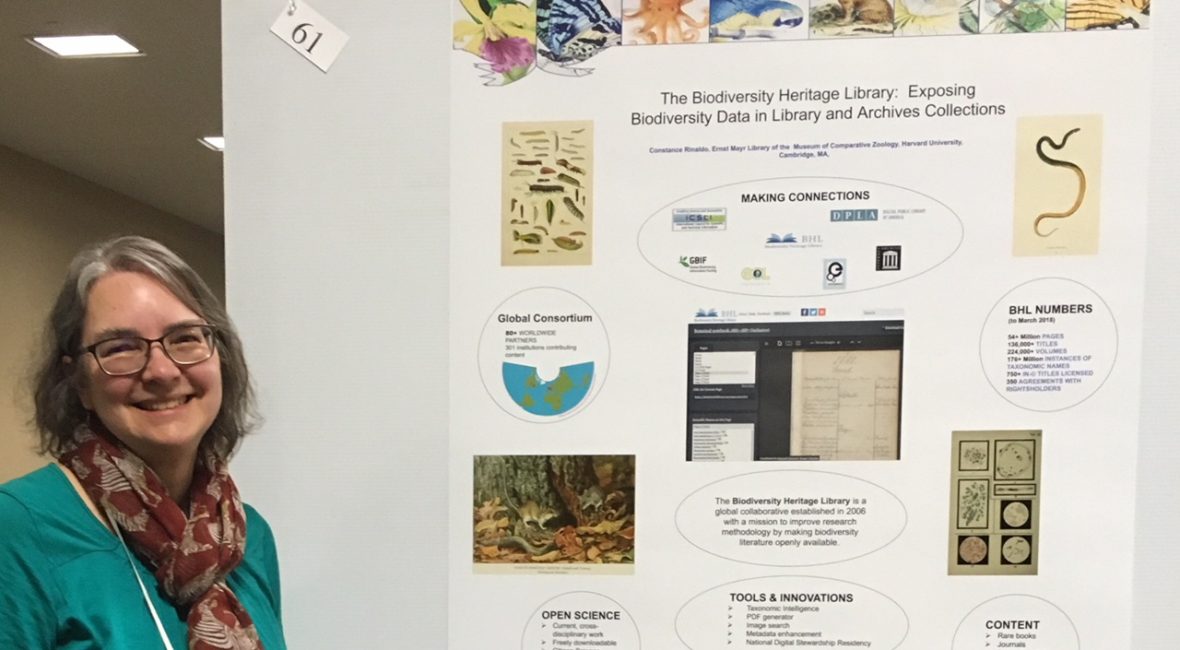
woman standing in front of a poster

Connie Rinaldo with the poster at the Digital Data in Biodiversity Research meeting. Photo by George Lauder.

Connie and Martin presented a poster “Biodiversity Heritage Library (BHL) as a Data Repository and a Literature Repository: Help us Surface More Content”. As we have done at other meetings in the past, our primary interest was to solicit ideas and comments to ensure that BHL meets the needs of biodiversity communities. There was interest expressed in better names and image extraction, annotation, georeferencing and linking to specimens from BHL content (and vice versa) — all further supporting BHL’s plans for BHL 2.0. I had conversations with organizational representatives from TDWG, GBIF, CETAF and Distributed Systems of Scientific Collections (DiSSco). Some of the talks mentioned BHL as a data source.

Poster: “Biodiversity Heritage Library (BHL) as a Data Repository and a Literature Repository: Help us Surface More Content”

Poster presented by Martin Kalfatovic and Connie Rinaldo at the Digital Data in Biodiversity meeting.

I also attended the GBIF North American Node meeting where there was discussion about how to increase funding for all the representative organizations, increasing participation, the Living Atlases community, and mobilizing new data types.

July 18, 2019by Constance Rinaldo
BHL News, Blog Reel

BHL at the GBIF 25th Governing Board Annual Meeting

GBIF 25th Annual Meeting logoAs Chair of the BHL Members’ Council, I had the privilege of attending the 25th Meeting of the GBIF Global Governing Board convened in Kilkenny, Ireland, 15-18 October 2018. I represent BHL in its capacity as an Associate Participant in GBIF at the governing board meeting. BHL has been a participant since 2014.

The Global Biodiversity Information Facility (GBIF) operates through a network of global nodes to develop and maintain an open data infrastructure for sharing digital biodiversity data.

Tour of Kilkenny Castle

Tour of Kilkenny Castle as part of the opening reception at the GBIF 25th Governing Board Annual Meeting. Photo credit: Constance Rinaldo.

GBIF Governing Board Chair Tanya Abrahamse (former CEO South African National Biodiversity Institute) and Donald Hobern (GBIF Executive Secretary), along with the host, Liam Lysaght (National Biodiversity Data Centre, Ireland) led the meeting. Abrahamse and Hobern provided an overview of GBIF activities over the past year, including a discussion of the GBIF Strategic Plan Goals and Work Program updates. The various GBIF Committee chairs (Science, Nodes, Budget) all reported the past year’s activities. Around 4 July 2018, GBIF reached the one billion record mark. The GBIF 26 Governing Board meeting will be part of the Biodiversity_next joint conference in Leiden, The Netherlands.

Tanya Abrahmse speaking

Tanya Abrahmse, chair of GBIF governing board, speaking at the GBIF 25th Governing Board Annual Meeting. Photo credit: Constance Rinaldo.

Results of the Governing Board elections with terms ending in 2020:

  • 1st Vice-Chair, Governing Board: Christoph Hauser, Deputy Director General, Museum fur Naturkunde, Berlin
  • 3rd Vice-Chair, Governing Board: Leonard Krishtalka, Director University of Kansas, Biodiversity Institute and Natural History Museum
  • Nodes Committee Chair: André Heughebaert, Belgian Biodiversity Platform
  • Nodes Committee 1st ViceChair : Anders Telenius, Swedish Museum of Natural History
  • Nodes Committee 2nd Vice-chair : Hulda Gideon, Tanzania Commission for Science and Technology
  • Science Committee 1st ViceChair: Gregory Riccardi, iDigBio/Institute of Scientific Data, Florida State University
Donald Hoburn speaking

Donald Hobern, Executive Secretary of GBIF, speaking during the GBIF 25th Annual Governing Board Meeting. Photo credit: Constance Rinaldo.

Public Session of GBIF Governing Board. GBIF applications and relevance: progress and next steps.

GBIF by the numbers. Photo credit: Constance Rinaldo.

All GBIF delegates and others from the greater biodiversity community in Ireland were invited to the public session. Many of the talks focused on data discovery and mobilization, improving functionality and relevance to policy.

Presentations were introduced by Tim Hirsch (GBIF).

  • org at 1 billion records: trends in data publication and research use
    Kyle Copas, Communications Manager, GBIF Secretariat | presentation
  • Encouraging a data citation culture
    Daniel Noesgaard, Science Communications Coordinator, GBIF Secretariat | presentation
  • Shining a light on ‘dark taxa’: naming and discovering DNA-based biodiversity data, Part 1
    Dmitry Schigel, Scientific Officer, GBIF Secretariat | presentation
  • Shining a light on ‘dark taxa’: naming and discovering DNA-based biodiversity data, Part 2
    Urmas Kõljalg, University of Tartu Natural History Museum & Botanic Garden, Estonia
  • Shining a light on ‘dark taxa’: naming and discovering DNA-based biodiversity data, Part 3
    Dmitry Schigel, Scientific Officer, GBIF Secretariat
  • Improved information on invasive and alien species, Part 1
    Shyama Pagad, IUCN Invasive Species Specialist Group (via video), New Zealand
  • Improved information on invasive and alien species, Part 2
    Tim Hirsch, Deputy Director, GBIF Secretariat | presentation
  • Improved ecological data capture and Essential Biodiversity Variables
    introduced by Donald Hobern, Executive Secretary, GBIF Secretariat
  • Improved ecological data capture and Essential Biodiversity Variables Laetitia Navarro, GEO BON: Group on Earth Observations – Biodiversity Observation Network, Germany | presentation
  • Overcoming the taxonomic challenge Olaf Bánki, Species 2000| Catalogue of Life, Netherlands | presentation
  • Biodiversity data for national reporting Liam Lysaght, National Biodiversity Data Centre, Ireland | presentation

View from Constance Rinaldo’s seat at the GBIF 25th Governing Board Annual Meeting. Photo credit: Constance RInaldo.

The winners of the 2018 Young Researchers Award and Ebbe Nielsen Challenge were presented at the end of the public session. The Young Researchers Award honors projects that foster innovative research and discovery in biodiversity informatics and provides financial support for winners.

  • Raquel Gaião Silva, University of Algarve, Portugal: Raquel is a Master’s student in International Science/ Marine Biodiversity Conservation. She has used GBIF mediated data in her work on climate-driven changes in seaweed distribution in Atlantic Iberian marine forests.
  • Kate Ingenloff, University of Kansas Biodiversity Institute is a doctoral student who used GBIF mediated data along with time-specific environmental and behavioral data to develop better niche models for highly mobile species such as pelagic birds.

The Ebbe Nielsen Challenge annual prize honors the memory of Dr Ebbe Schmidt Nielsen, a principal founder of GBIF and leader in biodiversity informatics. The six recipients shared prize money, some provided by the Swedish Research Council.

  • Checklist recipe: a template for reproducible standardization of species checklist data Lien Reyserhove, Damiano Oldoniand Peter Desmet, INBO: Research Institute for Nature and Forest, Belgium First prize
  • Ozymandias: a biodiversity knowledge graph Roderic D. M. Page, University of Glasgow, United Kingdom First prize
  • The bdverse. Tomer Guetaand Yohay Carmel, The Technion – Israel Institute of Technology, Israel, Vijay Barve, Florida Museum of Natural History, United States, Thiloshon Nagarajah, Informatics Institute of Technology, Sri Lanka, Povilas Gibas, Vilnius University, Lithuania, Ashwin Agrawal, Indian Institute of Technology (BHU), India Second prize
  • GBIF Issues Explorer. Luis J. Villanueva, Smithsonian Institution, United States Second prize
  • Smart mosquito trap to DwC pipeline. Connor Howingtonand Samuel Rund, VectorBase, United States Second prize
  • Taxonomy Tree Editor. Ashish Singh Tomar, University of Granada, Spain | BIG4 Second prize

Videos of the public sessions of the meeting are available on the GBIF website.

Other Explorations

people during an opening reception

Attendees at the opening reception of the GBIF 25th Governing Board Annual Meeting. Photo credit: Constance Rinaldo.

I had some productive, informal meetings with BHL partners and potential partners providing opportunities to explore new partnerships or deepen existing ones. During the reception and other networking events, I learned about GBIF’s Biodiversity Open Ambassador program, a chance to promote the principles of open data sharing in presentations, whether or not the work is about GBIF. GBIF will provide slides and information or you can develop your own to add to appropriate presentations. Discussions with Ana Casino of the Consortium of European Taxonomic Facilities (CETAF), Donald Hobern and Dmitry Shigel (GBIF), Dmitris Koureas (TDWG) and Patricia Koleff (BHL México), among others, determined that BHL’s future plans will augment interoperability in the biodiversity community and that BHL is a critical resource for many GBIF participants.

November 27, 2018by Constance Rinaldo
BHL News, Blog Reel

BHL Statement on the Fire at the National Museum of Brazil

On behalf of the Biodiversity Heritage Library community, the BHL Executive Committee, chaired by Constance Rinaldo (Ernst Mayr Library, Museum of Comparative Zoology, Harvard University) and the BHL Secretariat, led by Martin Kalfatovic (Smithsonian Libraries),  offer our condolences for the irreparable losses sustained by the National Museum of Brazil (Museu Nacional) in the tragic fire of 2 September 2018.

BHL staff are currently in communication with our colleagues at BHL SciELO in São Paulo to expedite processing of additional volumes of Archivos do Museu Nacional do Rio de Janeiro for the BHL. We are also exploring additional ways that the BHL’s extensive collection of biodiversity literature can support the work of researchers and scholars of the National Museum.

Em solidariedade ao Museu Nacional do Brasil.

The Biodiversity Heritage Library

Archivos do Museu Nacional do Rio de Janeiro

Title page. Archivos do Museu Nacional do Rio de Janeiro. v. 16 (1911). Contributed in BHL from the Peter H. Raven Library, Missouri Botanical Garden.

September 10, 2018by Constance Rinaldo
BHL News, Blog Reel

BHL at the Northeast Natural History Conference

woman in green shirt standing in front of a poster.

The weekend looked promising:  a lovely clear Friday night for a drive to Burlington, Vermont, USA from southern New Hampshire to attend the Northeast Natural History Conference (13-15 April 2018).  What could be better than a hotel humming with botanists and zoologists and activities for them?  The conference was packed—five concurrent sessions (often standing room only) and around 140 posters Saturday and Sunday along with workshops (Bat houses anyone?) and demonstrations throughout the weekend.  Students, faculty and naturalists from colleges, universities and small research or rescue organizations presented posters and talks that focused on New England, New York and Eastern Canadian native vertebrates, invertebrates, plant species diversity and distribution, invasive species and wetland habitats.

woman in green shirt standing in front of a poster.

Constance Rinaldo (Librarian of the Ernst Mayr Library and Museum of Comparative Zoology Archives; Chair of the BHL Executive Committee) standing with her BHL poster at the Northeast Natural History Conference.

Some of the posters that caught my eye (beyond the BHL poster that I presented) included “Restoring Northeast Understory Species: A case of the Primary Literature” presented by Isabel A. Schmitt and Dr. James H. Graves.  They presented a literature review that led to practical methods to reintroduce native species.  Another interesting poster was the “Use of Point-and-Shoot Photography to Compare Regional Differences in Coyote (Canis latrans) Skull Size”.  Osrica Mclean et al developed an online collection of digital images of skulls and calibrated the images so that they could be measured accurately online.

I attended a talk about how specialist and generalist rodents disperse mycorrhizae (Ryan Stephens and Rebecca Rowe) along with a presentation that detailed 42 years of vegetation change on Franconia Ridge in New Hampshire by Charles Cogbill.  Dr. Cogbill used an archive of photographs (from 1860 to present) to identify the effects of hikers on the trail vegetation (much damage is done). Another conference theme was bats and how white nose syndrome has affected bats in New England.   In a talk by Meghan Lout, she described a house in Middlebury, VT from which 550 bats were seen exiting one evening.  The owners were unaware that their house was a haven for bats.

Interacting with so many enthusiastic people studying nature—from observational work to highly experimental research—was inspiring and exciting.  The BHL poster was well received.  University faculty members and naturalists from small organizations stopped by to tell me how much BHL has improved their research workflows. Many students discovered BHL at this conference and were suitably impressed.  I asked for suggestions to enhance BHL and the common theme was “more”.  More content (with some individuals offering resources) and more current materials.  New potential users were surprised that content is available for free download. A few of the more sophisticated users suggested that we needed a taxonomic name authority file so names can be plugged in and the historical names and current names could be viewed as a complete set.

Leaving was somewhat deflating—snow, sleet and freezing rain as only the north country can do it.  Miserable driving, 45 mph tops, cars off the road, 4 hours on the road instead of 3. But so worth it to be among so many people studying the natural world.

May 2, 2018by Constance Rinaldo
BHL News, Blog Reel

Capstone event for BHL NDSR program

On January 4, 2018, in the midst of a memorable storm in the Northeastern US, approximately 30 intrepid travelers met to celebrate the successful completion of the BHL National Digital Stewardship Residencies developed for the IMLS, Laura Bush 21st Century Librarian grant submission: Foundations to Actions: Extending Innovations in Digital Libraries in Partnership with NDSR Learners.  The program plan included hiring five geographically-distributed residents, all graduates of LIS or related master’s programs, to work on collaborative projects to improve tools, curation, and content stewardship for BHL. This work supported BHL development plans for the next generation portal for the world’s largest open access digital library for biodiversity literature.

The Capstone event was beautifully hosted by the Smithsonian Libraries at the Natural History Museum in the room where the first DC planning meeting for BHL occurred. Martin Kalfatovic (BHL Program Director and Associate Director, Digital Program and Initiatives for the Smithsonian Libraries) and Dr. Nancy Gwinn (Director of the Smithsonian Libraries) welcomed the group.  Robin Dale (Deputy Director for Library Services at IMLS) described the NDSR program within the context of the IMLS goals for a national digital platform, mentoring digital library leaders and developing communities of practice.  Dr. Scott Miller (Deputy Undersecretary for Collections and Interdisciplinary Support at the Smithsonian Institution) congratulated BHL on its accomplishments in making biodiversity literature accessible but also suggested further work on linking content, mobile access and establishing standards.

Constance Rinaldo (Librarian of the Ernst Mayr Library of the Museum of Comparative Zoology, Harvard University and Chair of the BHL Members’ Council) gave an overview of the grant and process emphasizing the importance of ensuring the development of a strong cohort with leadership capacity among the geographically dispersed residents. Leora Siegel (Senior Director, Lenhardt Library of the Chicago Botanic Garden and a BHL NDSR Mentor) reflected on the past year and how rewarding it was to be a mentor to a recent graduate, wrestle with how to push the project forward, and connect with colleagues mentoring related projects with residents across the United States.  Mentors wished for more time, more opportunities to meet face to face with all participants and more professional meeting opportunities.

Katie Mika (BHL NDSR Resident at the Ernst Mayr Library) reflected on being a resident, struggling with the contrary thrusts of independence yet adherence to a partially defined project in a tight time frame.  Residents wished for more time, more structure and an in-depth technical introduction to BHL, yet all were successful in their work and learned more than they expected.

Trevor Owens (Head of Digital Content Management in Library Services at the Library of Congress) wrapped up the event with a keynote that focused on the push towards a National Digital Platform for digital data and his thoughts on digital preservation.

Although the final grant report looms large for the mentors, the Capstone event was an engaging send-off for the residents and we all look forward to following their future accomplishments.

Scott Miller presenting the
opening keynote
Katie Mika presenting the
BHL NDSR Resident Reflection
Trevor Owens presenting the
closing keynote

For specific information about the work of the residents, see their blog
and related BHL blog posts.

BHL NDSR Residents and Mentors

Alicia Esquivel, Resident at Chicago Botanic Garden, focused on Content Analysis.
Leora Siegel, Senior Director, Lenhardt Library

Marissa Kings, Resident at Natural History Museum, Los Angeles County, focused on Digital Library Best Practices.
Richard Hulser, Chief Librarian

Pamela McClanahan, Resident at Smithsonian Libraries, focused on User Needs and Usability.
Carolyn Sheffield, BHL Program Manager

Katie Mika, Resident at Ernst Mayr Library, Harvard University Museum of Comparative Zoology, focused on Crowdsourced Data Corrections and Enhancements.

Constance Rinaldo, Librarian, Ernst Mayr Library
and Program Director, BHL-NDSR Program
Joseph DeVeer, Project Manager and Museum Liaison, Ernst Mayr Library

Ariadne Rehbein, Resident at Missouri Botanical Garden, focused on Enhancing Image Discovery.
Doug Holland, Library Director, Peter H. Raven Library
Trish Rose-Sandler, Project Manager, Center for Biodiversity Informatics

Thank you to the speakers, external and internal to the grant project, for providing us with encouragement, support and reflections that we can take forward in our day to day work.  I want to especially thank Carolyn Sheffield (BHL Program Manager and Mentor to the Smithsonian Libraries resident) for managing the logistics of the Capstone event and ensuring its excellence.

January 17, 2018by Constance Rinaldo
Page 1 of 3123»

Help Support BHL

BHL's existence depends on the financial support of its patrons. Help us keep this free resource alive!

search

About BHL

The Biodiversity Heritage Library (BHL) is the world’s largest open access digital library for biodiversity literature and archives. BHL operates as a worldwide consortium of natural history, botanical, research, and national libraries working together to digitize the natural history literature held in their collections and make it freely available for open access as part of a global “biodiversity community.”

Join Our Mailing List

Sign up to receive the latest news, content highlights, and promotions.

Subscribe Now

Subscribe to Blog via Email

Enter your email address to subscribe to this blog and receive notifications of new posts by email.

Join 319 other subscribers

Subscribe to Blog Via RSS

Subscribe to the blog RSS feed to stay up-to-date on all the latest BHL posts.

Access RSS Feed

Inspiring Discovery through Free Access to Biodiversity Knowledge.

The Biodiversity Heritage Library makes it easier than ever for you to access the information you need to study and explore life on Earth…for free, anytime, anywhere.


64+ Million Pages of
Biodiversity Literature Online.

EXPLORE

Tools and Services
to Transform Research.

EXPLORE

300,000+
Illustrations on Flickr.

EXPLORE

ABOUT | HARMFUL CONTENT | PRIVACY | SITE MAP | TERMS OF USE