

There are more described species of beetles (order Coleoptera) than any other group of organisms on the planet. With over 350,000 described extant and extinct species and subspecies, beetles represent about 40% of all described arthropods and about 25% of all described species [1,2].
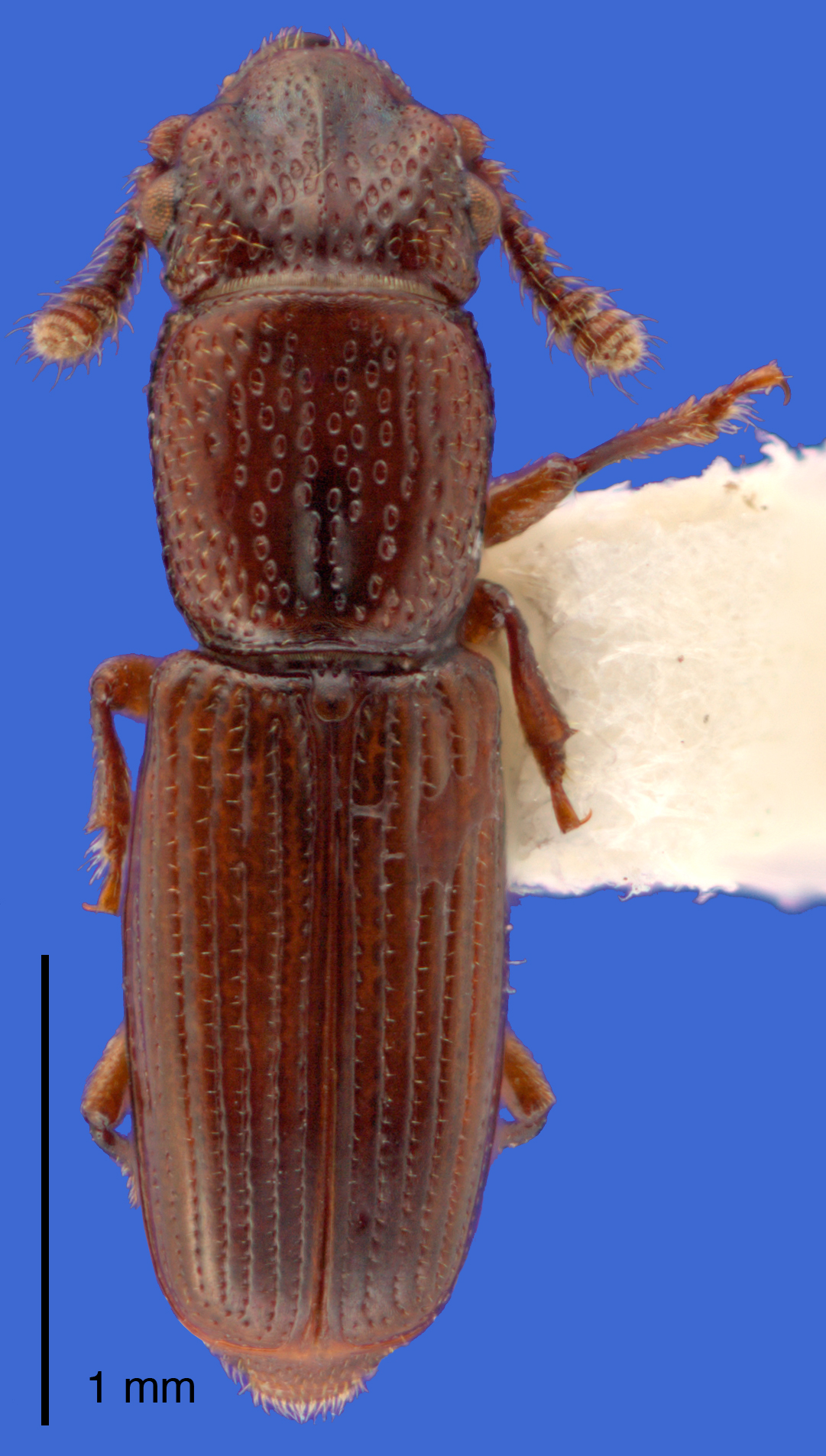
Europs frontalis (Grouvelle, 1896), a monotomid beetle from Chile described by Antoine Henri Grouvelle in the Annales de la Société entomologique de France. Photo by TC McElrath.
One of the myriad families of beetles is Monotomidae, with over 250 described species [3]. Commonly called minute clubbed beetles, the family includes such species as Europs frontalis (found only in south temperate forests of Argentina and Chile) and Pycnotomina cavicolle (found exclusively in forested regions of eastern North America).
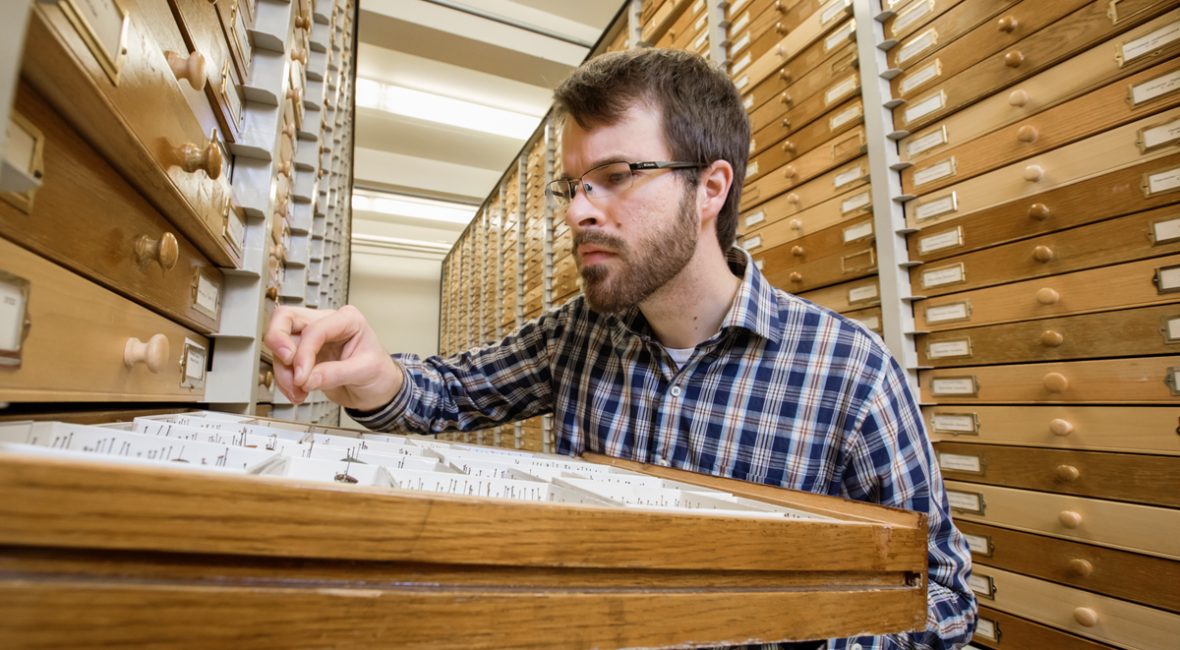
Dr. Thomas McElrath, Insect Collections Manager at the Illinois Natural History Survey, has been studying the systematics of Coleoptera for nine years. He is currently working on compiling a worldwide checklist of the Monotomidae. The Biodiversity Heritage Library is a crucial resource for his research on this project.
“The BHL is an integral research tool for beetle systematists like me. I absolutely love it. It has saved me time, money, and resources,” lauds McElrath. “Most of the older, obscure literature I need to reference to study the taxonomy of beetles is now available from the BHL. Soon, I hope to have a worldwide checklist available for the Monotomidae, thanks, in part, to the resources available on the BHL.”
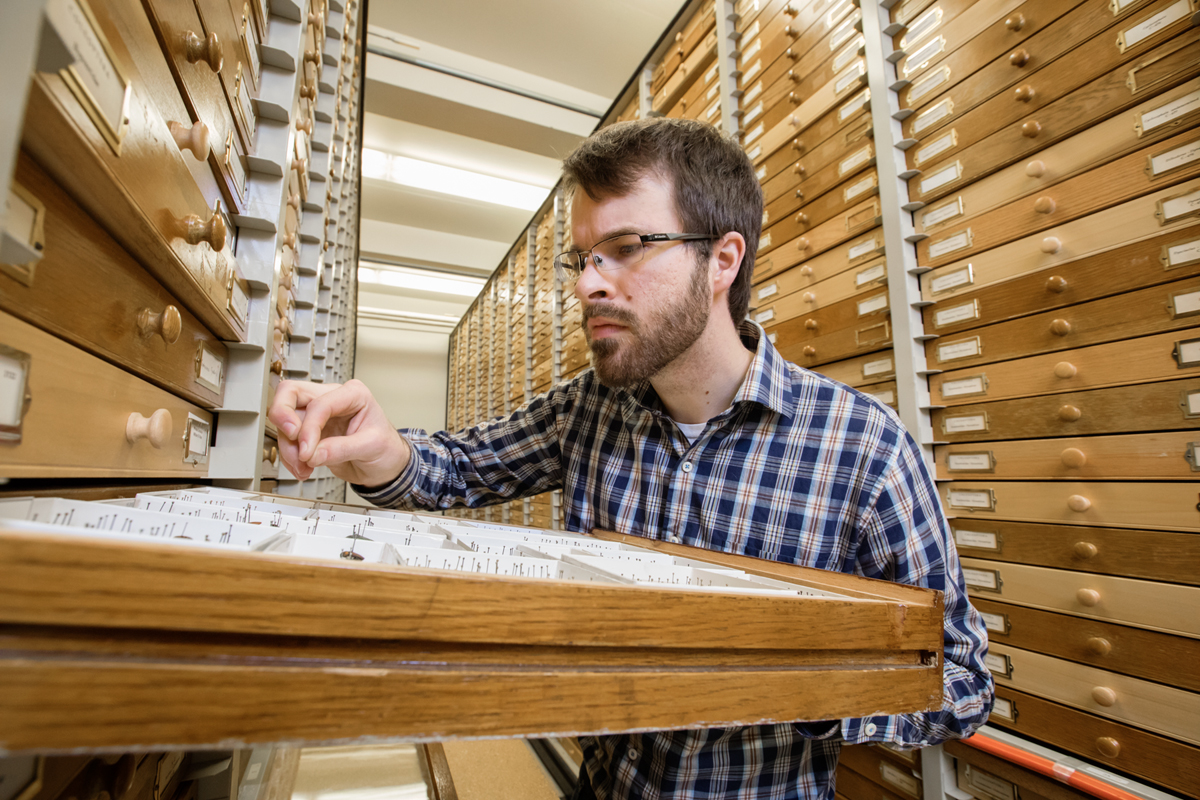
Dr. Thomas McElrath in the Illinois Natural History Survey Coleoptera Collection. Photo by L. Brian Stauffer.
McElrath first discovered BHL around 2011, and it soon became an essential research tool, particularly during his PhD, when it was not uncommon for him to use the Library multiple times a day in search of older publications and species descriptions.
“Without BHL, my PhD would have taken much longer, and I wouldn’t have been able to do as much as I did within the time period available to me,” explains McElrath. “It saved me hundreds of hours of library research, interlibrary loan requests, and scanning.”
Today, McElrath still uses BHL daily to weekly, typically downloading whole or custom PDFs to support his research on the Monotomidae. The Library allows him to access relevant materials in a variety of languages quickly and easily.
“Without BHL, finding all the the species descriptions in American, German, French, and Italian taxonomic journals would have been much harder,” affirms McElrath. “My advisor always told me I had it ‘too easy’ with BHL, and that in his day they would have to beg for reprints from colleagues all around the world, which sometimes took months to arrive. Now, I just log onto BHL and download a high quality scan for free. It’s really amazing.”
McElrath also views BHL as a great way for institutions to share collections-related information. To that end, the Illinois Natural History Survey (INHS), in collaboration with BHL Member the University of Illinois at Urbana-Champaign (UIUC), has started uploading accession logs related to collections in the INHS to BHL.
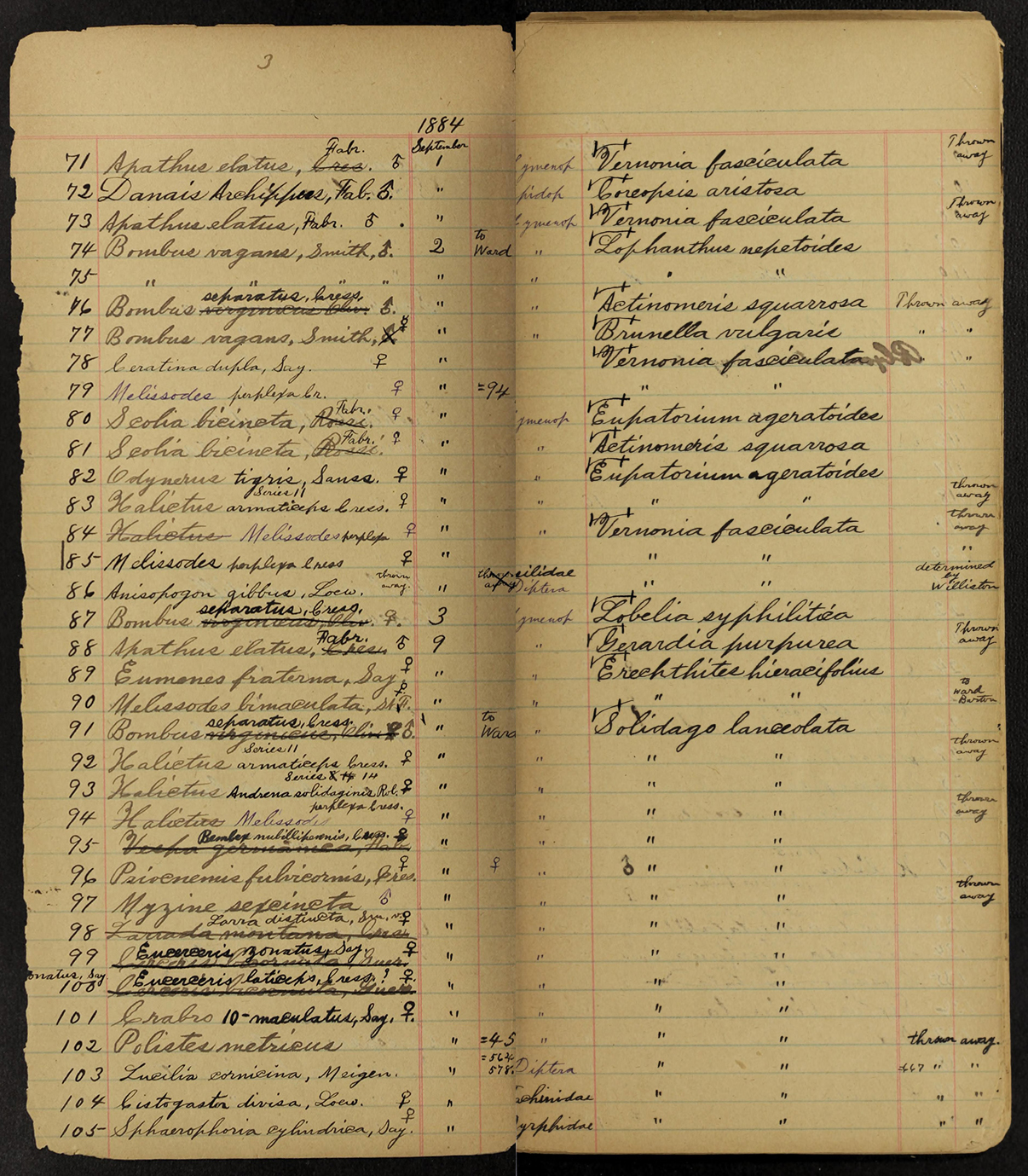
Page from Specimen Collection Logs of Charles Robertson. Contributed in BHL from University Library, University of Illinois Urbana Champaign.
For example, the Specimen Collection Logs of Charles Robertson document insect specimens collected by Robertson, providing information such as specimen number, scientific names, sex of specimen, date of collection, locality, insect order, host plant scientific name, and notes. The logs, now available on BHL, are held in the Archives of UIUC, while the corresponding specimens are held by INHS.
“My museum and institutional library have used BHL to host scans of our accession logs so that researchers can access them from around the world, alongside our already digitized specimens,” explains McElrath. “I would love to see more institutions and individuals put their field notes and accession logs on the BHL for others to access.”
Thanks to recent initiatives such as the BHL Field Notes Project and the Smithsonian Field Book Project, over 6,000 field notes, correspondence, and related archival materials have been made available in BHL, with more being added regularly. These materials serve as unique primary source documents and provide valuable context for and data around specimens, collecting events, and the activities, observations, and personal notes of individual researchers. Thanks to their availability on BHL, researchers across the globe can easily access this valuable information.
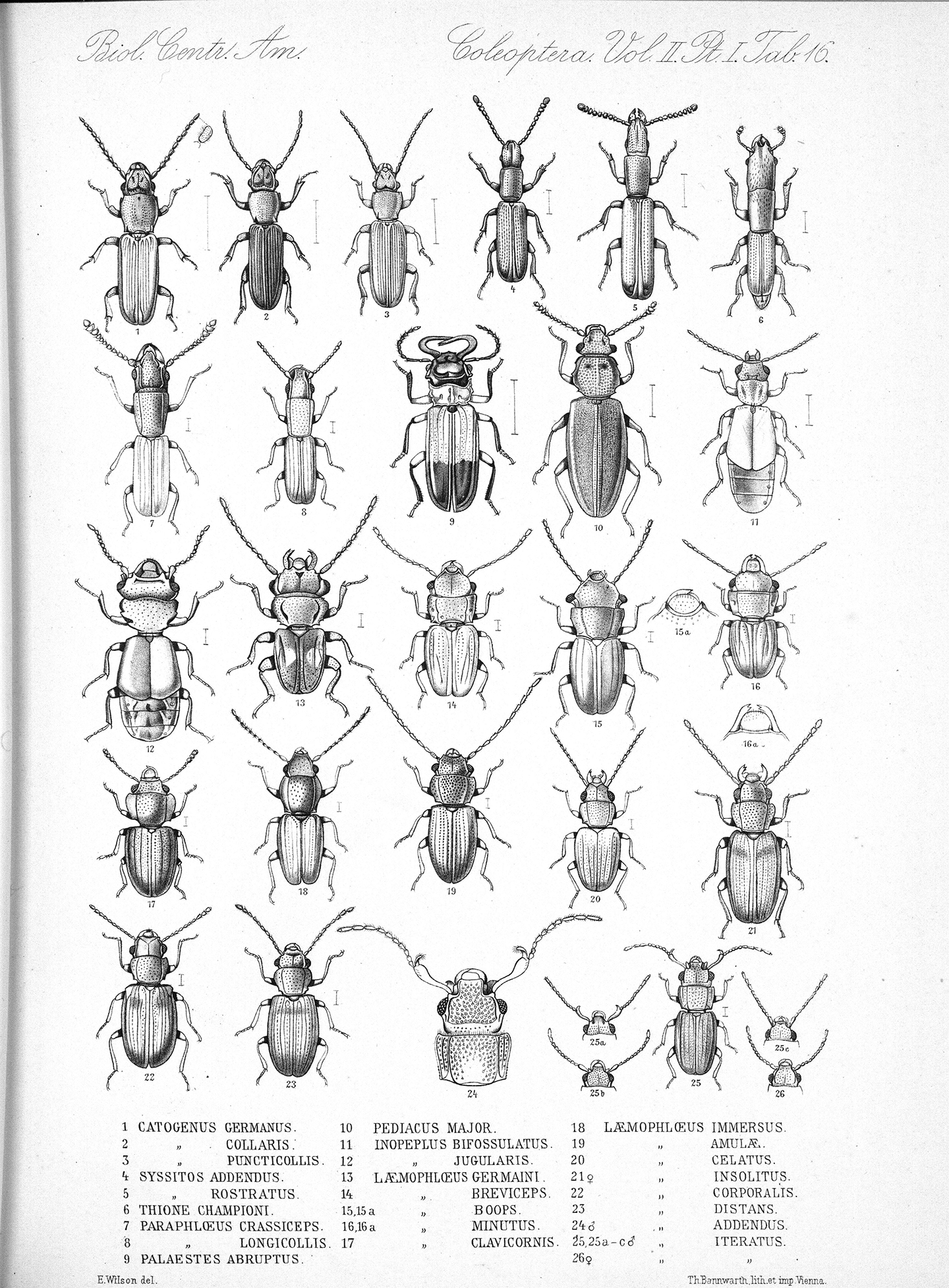
The Biologia Centrali-Americana was published around the turn of the century and describes several unique monotomids, including Thione championi, figured at top right of this page. Contributed in BHL from Smithsonian Libraries.
Beyond supporting research activities, McElrath also appreciates the wealth of illustrations available from BHL. Since 2011, BHL has been uploading the scientific illustrations found within the collection to Flickr, making it easier for anyone to explore and download these images, which are valuable both as scientific documents and works of art.
“My wife and I also download high resolution plates of cool biodiversity (insects, plants, etc.) from the BHL Flickr page and use them to make prints for decorating our house,” shares McElrath.
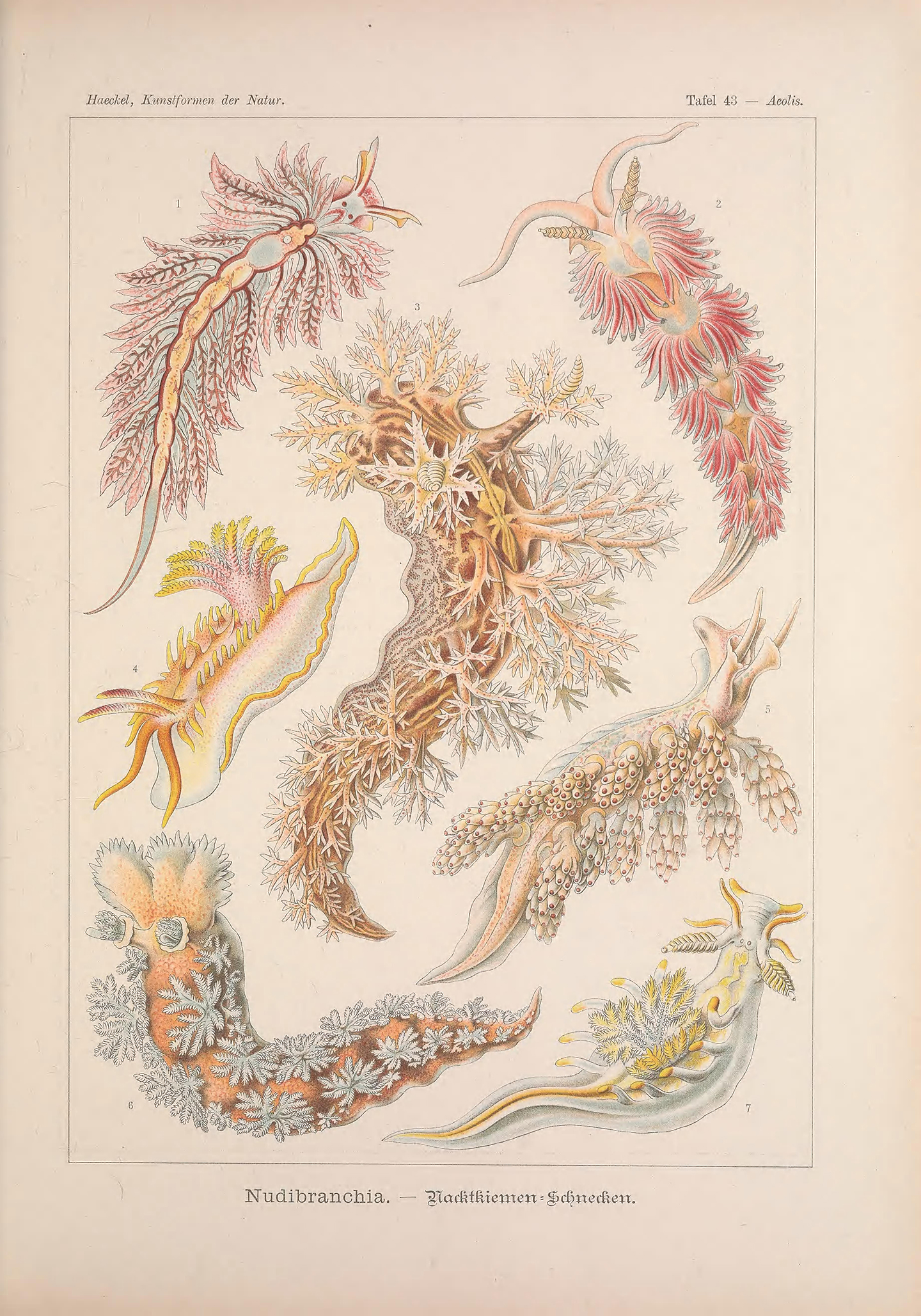
Nudibranchs by Ernst Haeckel, one of the images McElrath and his wife have printed for their “natural history wall” at home. Kunstformen der Natur. 1905. Contributed in BHL from Smithsonian Libraries.
Whether it be supporting research on clubbed beetles or as a source of beautiful home decor, the Biodiversity Heritage Library is making it easier for everyone to explore, study, and appreciate the natural world.
For McElrath, BHL has been a game-changer. In short: “Its existence is extraordinary.”
