Biodiversity Heritage Library - Program news and collection highlights from BHL
  • Home
  • News
  • Featured Books
    • All Featured Books
    • Book of the Month Series
    • BHL at 20
  • User Stories
  • Campaigns
    • Fossil Stories
    • Garden Stories
    • Monsters Are Real
    • Page Frights
    • Her Natural History
    • Earth Optimism 2020
  • Tech Blog
  • Visit BHL
Home
News
Featured Books
    All Featured Books
    Book of the Month Series
    BHL at 20
User Stories
Campaigns
    Fossil Stories
    Garden Stories
    Monsters Are Real
    Page Frights
    Her Natural History
    Earth Optimism 2020
Tech Blog
Visit BHL
  • Home
  • News
  • Featured Books
    • All Featured Books
    • Book of the Month Series
    • BHL at 20
  • User Stories
  • Campaigns
    • Fossil Stories
    • Garden Stories
    • Monsters Are Real
    • Page Frights
    • Her Natural History
    • Earth Optimism 2020
  • Tech Blog
  • Visit BHL
Biodiversity Heritage Library - Program news and collection highlights from BHL
Blog Reel, Featured Books

A Day for Worms on BHL

The Biodiversity Heritage Library (BHL) is replete with publications which have had a seminal influence on their field. A highly-credentialed member of this category is John H. Day’s A Monograph on the Polychaeta of Southern Africa, published in 1967 in two volumes by the (then) British Museum (Natural History) in London. It is timely to celebrate this book now: on 25 August 2019 the author John Day would have had his 110th birthday. And, as of this month, the author’s own copy of the book has been digitised for the BHL.

Years ago, this copy was loaned to me by John Day’s son, Professor Rob Day (also a marine biologist) from the The University of Melbourne — just down the road from my office and from the Australian node of BHL, both at Museums Victoria in Melbourne.  When my librarian colleagues discovered I had the copy, annotated in pencil by the author with a 2nd edition in mind, they were keen to digitise it, even though BHL had previously digitised another copy. (A new version of Day’s monograph was later prepared but never published, perhaps due to lack of funding.)

Polychaetes are important to marine biologists due to their weight of numbers: in nearly all seafloor environments anywhere in the world, polychaetes are just about the most numerous and the most species-rich invertebrate. Therefore, many marine ecologists spend a lot of time identifying polychaetes — usually a difficult task. Which is why John Day’s monograph was so influential. For decades before, and for decades after, there was nothing like it, and so the two volume work, known to most researchers simply as Day, was indispensable.

Day was a comprehensive synthesis of descriptions, diagnoses and drawings of this rich and diverse component of the marine fauna (currently there are about 12,000 described species of polychaetes). And because most polychaete families and genera occur worldwide, and because there was no other equivalent publication anywhere, Day was a vital reference for anybody anywhere who needed to identify their local marine fauna.

Day is still a model for anyone who sets out to write such a monograph, because of the simplicity and clarity of both text and illustrations. In particular, the introductory pages provide a visual overview and key to the numerous families.

day_1967_p23_400px.jpg

Page 23. Day, John H. A Monograph on the Polychaeta of Southern Africa. Volume 1, 1967. Author-annotated copy. Digitized in BHL by Museums Victoria.

These handful of pages encapsulate what would otherwise be an overwhelming variety; even beginners can begin to think that they may one day be able to interpret the myriad forms and structures of polychaetes. Thus, although the documentation of polychaete diversity has marched on, well-thumbed 50 year old copies of Day are still in regular use in marine laboratories world-wide.

It seems to me that John Day must have honed and improved his diagrams over many years of teaching (he was Professor of Zoology at The University of Cape Town) and that he must have given a lot of thought to the layout and presentation. Day had begun annotation of his own copy with species to be added, but he didn’t touch these introductory pages, suggesting that he too was satisfied with the published version. Even today, for me and many of my colleagues, there is nothing quite like it for introducing novices to the mysterious world of polychaetes — there have been numerous revisions and name changes in intervening decades, but the worms themselves still look the same.

JHDay_students_Durban_Bay_1951_400px.jpg

John H. Day (third from right) showing students a tray of specimens collected from an estuary mudflat.  Durban Bay, South Africa, 1951.  Photograph supplied by Rob Day, 2019.

John Day was ahead of his time in other respects too. Our understanding of evolutionary relationships of polychaetes, and how they should be classified within the phylum Annelida, has long seemed an intractable task. Many alternative classifications having been offered up in publications both before and since the publication of Day. The author himself took a purely pragmatic approach and followed earlier workers, arranging the families in two major groups, one per volume: Errantia (mostly mobile worms with similar segments and often with jaws) and Sedentaria (mostly tube dwellers often with a crown of feeding tentacules and modified body regions).

Even though Day only ever claimed this as an arbitrary arrangement, he would have surely been pleased to know that this practical solution has a lot in common with the most recent phylogenetic analyses based on DNA sequence data, which recognise many elements of the old Errantia / Sedentaria scheme and even retain the names! Nor, I think, would he have been dismayed by another discovery confirmed by DNA data: there is no such thing as “Polychaeta”, which is now known to comprise a variety of forms which do not all belong on a single branch of the annelid phylogeny. Furthermore, several other kinds of worms previously known as separate Phyla are now known to belong within the Annelida — a possibility also canvassed by John Day in the introduction to his monograph.  (I’ll nevertheless keep using polychaetes as an informal term.)

I never met John Day, but his no-nonsense attitude was evident in other ways. He had lost a leg when hit by flak on a bombing raid while flying as a navigator for the RAF during the Second World War (he was still able to provide a course before passing out and the tail gunner saved his life by limiting loss of blood until they returned to base). There are unconfirmed stories that after the war, on trips between Cape Town and London, he would bring preserved polychaete specimens for study through customs in his prosthetic leg.

Taxonomists nowadays are wont to criticise Day, and other publications of the era, for accepting as valid many “cosmopolitan species”.

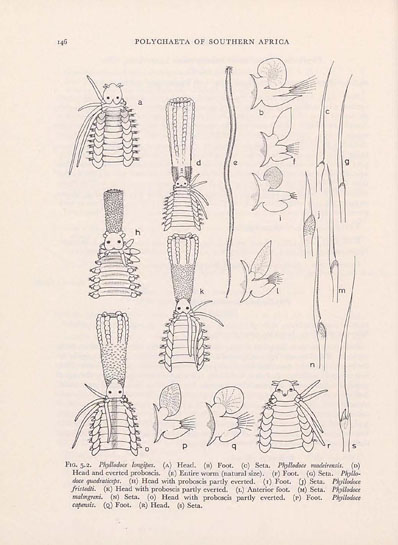
day_1967_p146_400px.jpg

Page 146. Phyllodoce malmgreni and related taxa in the family Phyllodocidae. Page 146 from Day, John H. A Monograph on the Polychaeta of Southern Africa. Volume 1, 1967. Author-annotated copy. Digitized in BHL by Museums Victoria.

Phyllodoce_cf_malmgreni_F135127_dorsal_pharynx_400px.jpg

Phyllodoce malmgreni was described from the Red Sea, but has been much more widely recorded throughout the Indo-Pacific. This museum specimen of Phyllodoce cf. malmgreni is from Australia. Photograph Robin Wilson.

Typically, these were originally described from European localities but subsequently recorded (or rather very similar forms were found) from more widespread regions. If they could not be distinguished, specimens from widespread localities were assigned to a single species.

In recent decades, taxonomists have split many “cosmopolitan species” into a number of new species, each from a different ocean or region.  At first, this seemed an almost routine tidy up task. The advent of molecular systematics has shown that the situation is far more complex and interesting. DNA sequence data has repeatedly demonstrated that even within a region (for example northern Europe), what was thought to represent a single species is often discovered to comprise many species. Usually, these newly recognised species can barely, or not at all, be distinguished morphologically, yet they show very deep genetic divergences.  Understanding of how these taxa have evolved and dispersed (for example, is each instance a single global, monophyletic radiation?) is arguably among the most interesting questions in marine diversity studies today.

Whatever the answers turn out to be, it seems clear that many of these cryptic species will only be distinguishable through genetic analysis. Until such time as rapid genetic diagnoses become routine, ecologists and other non-taxonomists are likely to have to resort to some kind of species-complex definition to cope with messy nature. It seems that such species-complexes might look a lot like the often-maligned “cosmopolitan species” accepted by the pragmatic (and prescient?) John Day.

September 26, 2019by Joel Richard
BHL News, Blog Reel, Featured Books

The John Torrey Papers: Increasing Accessibility with Full Text Transcriptions in BHL

screenshot of a transcription in the from the page platform
black and white portrait of a young man, john torrey

Drawing of John Torrey by Sir Daniel MacNee. From the collection of Sir William Hooker, The Royal Botanic Gardens at Kew, England.

Since July 2016, the papers of taxonomic botanist John Torrey (1796-1873) have been the focus of a digitization and crowdsourced transcription project at the New York Botanical Garden (NYBG). Digitizing and Transcribing the John Torrey Papers, organized in coordination with the Biodiversity Heritage Library (BHL) and funded by the National Endowment for the Humanities and the Carnegie Corporation of New York, was created in an effort to digitize and make virtually accessible the correspondence of John Torrey and his colleagues, specifically letters received by Dr. Torrey.

Access to the correspondence of Dr. Torrey is particularly useful to natural scientists and natural historians alike as these letters provide a glimpse into the thought process and workflow for many of the 19th century’s greatest botanical minds. These letters are filled with a variety of different content, including commentary on plant taxonomy, personal biographical details, and anecdotal information on the daily lives of these natural scientists. The content within these letters aid in our understanding of the realities faced by these pioneering botanists, including the shift from the Linnaean system to the natural system and the systemic challenges faced by individuals in an emerging profession..

The John Torrey Papers collection contains over 9,500 pages from more than 350 correspondents, including Asa Gray, Amos Eaton, and Joseph Henry. The collection is organized alphabetically by correspondent then chronologically by the date each letter was written. Each page of each letter is scanned as a .tif file and uploaded to Macaw, BHL’s metadata management system, which aggregates the .tif file with a New York Botanical Garden MARC XML record. Once appropriate metadata has been applied in Macaw, the correspondence are uploaded to the Biodiversity Heritage Library Collection in the Internet Archive. The correspondence’s placement in the BHL Collection then allows for BHL to harvest new material from the Internet Archive on a weekly basis.

Digital content management is a crucial aspect of the project, but the heart of the process lies in the crowdsourced transcriptions done by volunteers from the New York Botanical Garden. These volunteers, recruited through citizen science outreach events, workshops, and tabling opportunities at various locations, work on the transcription platform From the Page, which is one of three transcription platforms whose exports are currently accepted by the Biodiversity Heritage Library, allowing the automatically-generated OCR for these items to be replaced with crowdsourced transcriptions, enabling full text search.

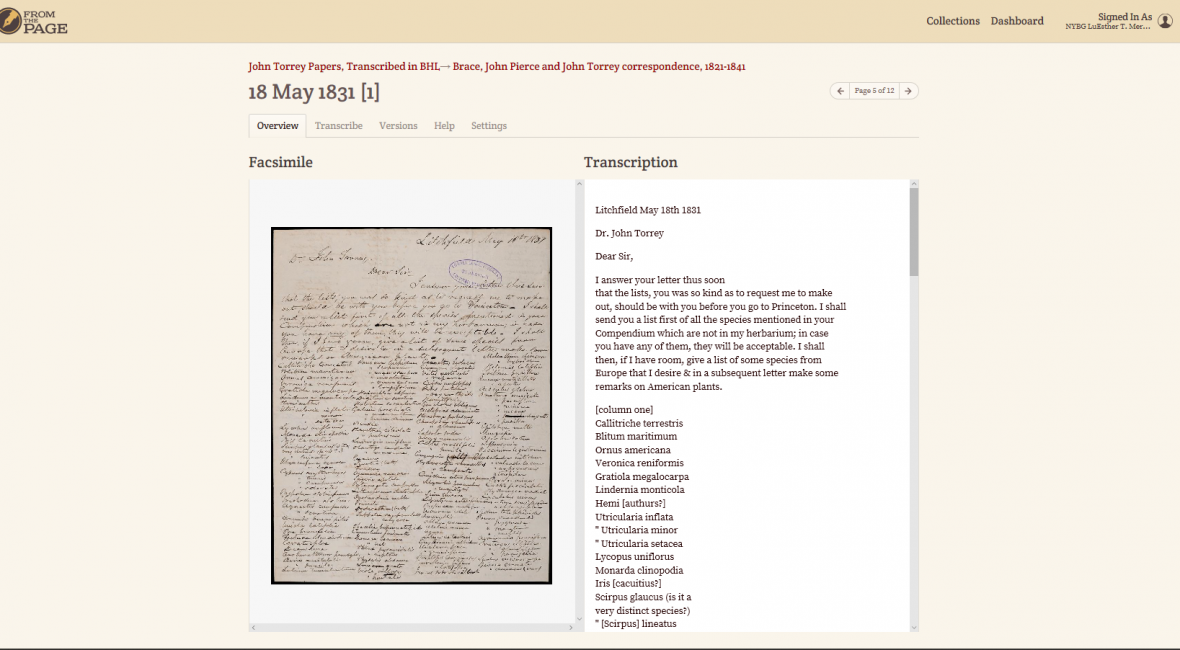
FTP Example Screenshot.PNG

A screenshot of a completed transcription from John Pierce Brace to John Torrey (May 1831) in From the Page.

The work done by these volunteers is a contribution to the project for two reasons. First, the handwriting, colloquialisms, and personal shorthand of many of Dr. Torrey’s correspondents are exceptionally difficult to read or interpret. With the correspondence of many correspondents containing several hundred pages, it takes a considerable amount of time for our volunteers to develop a proficiency capable of not only accurately deciphering poor handwriting but also of uncovering the intention or context of particular writings.

Second, the transcriptions produced by the Garden’s volunteers coupled with BHL’s new support for transcriptions facilitates full text searching of materials that would otherwise be unavailable. The introduction of full text searching to the world of transcriptions is extremely impactful as it allows researchers to execute a more thorough examination of resources available to them at a faster pace and with higher levels of productivity. A prime example of this is the Biodiversity Heritage Library’s page index of scientific names, as seen in the lower left hand corner of the figure below.

In effect, the Digitizing and Transcribing the John Torrey Paper’s volunteers are the bridge between the content we are looking for and how we look for it.

BHL Blog Screenshot.PNG

Screenshot of the completed John Pierce Brace page once the transcription and image files have been matched in BHL.

To date, more than 7,000 pages have been transcribed and more than 6,000 transcribed pages are available for view in BHL, but the goals of the Digitizing and Transcribing the John Torrey Papers project still have not been met.

With less than 1,500 pages remaining, the New York Botanical Garden is in search of new volunteers to help reach our goal and transcribe some of our most interesting correspondents remaining to be done such as William Jackson Hooker, the former Director of the Royal Botanic Gardens, Kew, and New England natural scientist Dewey Chester. While many of our volunteers are drawn to the project due to their interest in botany, many more are captivated by narratives not typically associated with botany, such as Carl Bogenhard’s struggles as an immigrant in the United States or Jacob Whitman Bailey’s experimentation with photography.

If you would like to become a volunteer transcriber for the Digitizing and Transcribing the John Torrey papers project, you can sign up online here or email [email protected] for more information or assistance with the sign up process.

If you would like to learn more about the life of John Torrey, works he published, or plants named after him, please visit out digital exhibit “John Torrey: American Botanist.”

September 24, 2019by Joel Richard
BHL News, Blog Reel

Live Digitisation for BHL at the Long Night of Museums in Berlin

At the Long Night of the Museums on 31 August 2019, the library of the Museum für Naturkunde presented its digitisation activities around a current project to index its Drory Library. In addition to particularly impressive books from the collection, which are already accessible in the Biodiversity Heritage Library, two books were digitised which were not yet available in BHL.

LNDM_01.jpg

Fig. 1. Display during the Long Night of the Museum 2019. Photo by: Elisa Herrmann | MfN.

Long Night of the Museums

The Long Night of the Museums is a popular series of events and a highlight in Berlin’s cultural calendar. This year, 40,000 visitors accepted the invitation of 75 Berlin museums, which opened their collections and offered deeper insight into their research. For the second time in a row, the Museum für Naturkunde was the most popular destination with 10,500 visitors. Current scientific research and internal developments were presented to the public at 20 events. The latter included in particular the digitisation of the museum’s collections. In addition to insect boxes and archival material, the focus was also on the library collection. The Museum für Naturkunde has been a Member of BHL since 2018 and will primarily digitize for BHL.

The Drory Library

The Drory Library is a sub-collection of the Historic library collection and of special importance. It is the library of Edward Drory (1844-1904), an enthusiastic beekeeper but also an important Berlin personality. Edward Drory was a successful entrepreneur and owner of the English Gas Institute in Berlin. In his time, he owned the “largest apist library” with publications beginning in 1470, although most of the collection dates from the 18th and 19th centuries. In 1904, Edward Drory donated his beekeeping library to the Royal Zoological Museum in Berlin with the agreement that all volumes would receive an ex-libris (fig. 3) and be displayed in the library of the Hymenoptera collection.

026 Eduard Drory Bienenhaus 1874_smal.jpg

Fig. 2. Edward Drory in front of his apiary, 1874. Photo Courtesy: Viola Richter | MfN.

LNDM_05.jpg

Fig. 3. Ex-Libris of the Dory library. Photo courtesy: Elisa Herrmann | MfN.

The collection comprises approximately 2,400 volumes — of which about 800 are journals and about 1,600 are monographic volumes (around 480,000 pages) — and contains literature in various languages — German, French, English, Latin, Italian, Dutch, Spanish, Finnish, and Polish.

The long-term goal is to digitize the Drory library and the corresponding card catalogue completely or at least partially and to make it available as a research basis or scientific-historical contribution for a number of disciplines — history of science, biology (species diversity of bees, taxonomic findings, endangerment of honeybees by humans), medicine (allergies to bee venoms), pharmacy & naturopathy (bee venom, propolis as a means of treatment) and agricultural sciences (economic significance of bees). To reach this goal, the library started an indexing project with a grant from the von Pawel-Rammingen Stiftung that will answer the most important questions before starting the digitization, such as the exact scope, conservatory condition and availability on the Internet.

LNDM_02.jpg

Fig. 4. File from the Historical archive of the Museum für Naturkunde Berlin, documenting the handover of the Drory library to the museums. Photo by: Elisa Herrmann | MfN.

LNDM_04.jpg

Fig. 5. Books from the Drory library that went on display during the Long Night of the Museum 2019. Photo by: Elisa Herrmann | MfN.

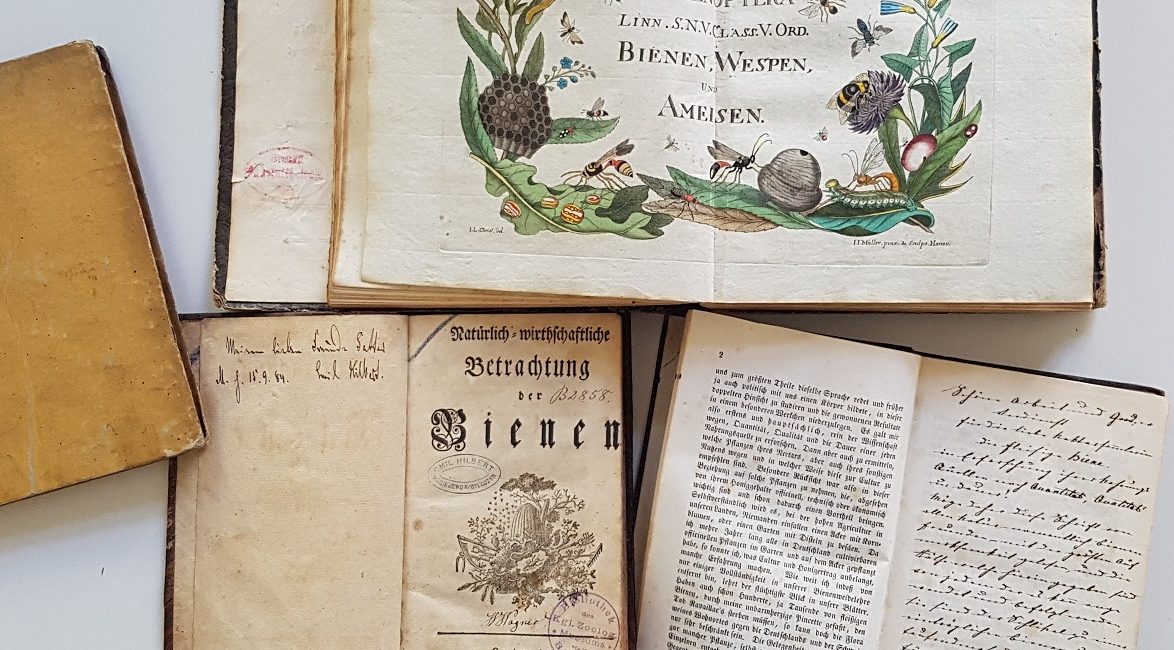
During the Long Night, selected works were presented to the visitors, including a copy of Naturgeschichte, Klassification und Nomenclatur der Insekten vom Bienen, Wespen und Ameisengeschlecht […] by J. L. Christ from 1791, as well as books on beekeeping, bee-friendly plants and philosophical-literary essays on bees, in order to illustrate the range of the Drory Library. One highlight on display was the archive file with the documents for the handover of the library to the museum from 1905 (fig. 4).

Many books from the collection are not yet in BHL; two of them were scanned in front of the visitors that night. They are currently undergoing final quality control and will soon be uploaded to BHL as the first digital collections of the Museum für Naturkunde.

However, at the event visitors were already able to select motifs from digitised material that they took home with them as buttons (fig. 6) and BHL’s motif cards also enjoyed great popularity.

LNDM_03.jpg

Fig. 6. Buttons with motifs chosen from digitised BHL material next to a copy of the original. Photo by: Elisa Herrmann | MfN.

The library team answered many interesting questions about the materials and technology used and was thus able to present not only the library collection but also the digitisation infrastructure and the rich treasure of BHL. Many visitors did not yet know about BHL and were enthusiastic about the prospect of over 54 million freely accessible pages — whether for scientific work, homework or to marvel at the beautiful illustrations.

Digitisation at the Museum für Naturkunde

The Museum für Naturkunde sees itself facing great opportunities to digitally open up its collection through an investment of several million euros by the federal and state governments. The library thus has the opportunity to scan a large number of holdings for BHL and its own digital collections to make them accessible to the scientific community and the general public. The highest priority is given to unique material, such as handwritten entry books, followed by holdings that are not yet available in BHL.

September 19, 2019by Joel Richard
Blog Reel, User Stories

Flower Flies and BHL: Empowering Taxonomic Research on Important Pollinators

photo of a person standing on a car with binoculars
photo of a flower fly

A flower fly in the family Syrphidae: Platycheirus obscurus (female). It was this genus that attracted Dr. Andrew D. Young to the study of Dipterology. He revised this genus for his M.Sc. Photo by Andrew D. Young, taken in Algonquin Park, Ontario Canada.

The family Syrphidae, commonly called hover flies or flower flies, include some 6,000 living species.[1] As “one of the most abundant groups of flower visiting insects”, with adults of most species feeding almost exclusively on pollen and nectar or honeydew, these flies are among the most important pollinators, both for wild plants and numerous crops.[2]

The multi-volume Diptères exotiques nouveaux ou peu connus (1838-[43]) by Justin Macquart contains the first descriptions of numerous Diptera species, including many members of the Syrphidae. Systema Dipterorum, the biosystematic database of world Diptera, attributes 430 Syrphidae names to Macquart.[3]

“Macquart wrote so many early Syrphidae genus and species descriptions that it’s almost impossible to write a syrphid taxonomic paper without referencing this title at some point,” explains Dr. Andrew D. Young.

photo of a person standing on a car with binoculars

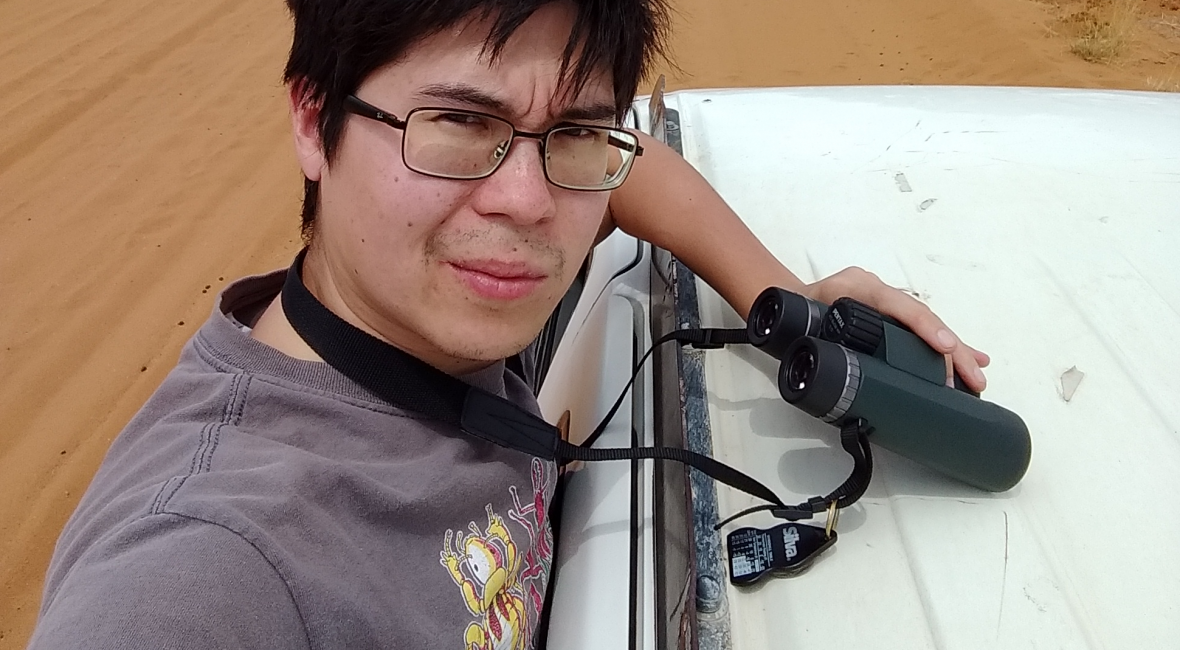
Dr. Andrew D. Young, UC Davis postdoc at the California Department of Food and Agriculture Plant Pest Diagnostics Center. Photo by: Andrew D. Young.

Young is a University of California, Davis postdoc, working out of the California Department of Food and Agriculture Plant Pest Diagnostics Center, where he specializes in Diptera taxonomy and phylogenetics. Although he studies Tephritidae (fruit flies) in his current position, most of Young’s entomological training has been focused on Syrphidae. While Macquart’s monographic series is an essential resource for this group, it’s not easy to come by.

“Each volume is several hundred pages, and was published in the mid 1800s, so hardcopies are not particularly easy to get ahold of,” explains Young. “Most of the time when you do find a hardcopy, it’s one that’s been photocopied so many times it’s barely legible.”

Fortunately, Diptères exotiques nouveaux ou peu connus is freely available on the Biodiversity Heritage Library (BHL).

“There are certainly a lot of titles on BHL that have impacted my research, but Macquart’s work is the one I end up referring to the most often,” shares Young. “It would be a difficult work to obtain on my own if BHL did not exist.”

photo of a flower fly

Psilota coerulescens, a species of Australian Psilota (Family: Syrphidae). This species was part of Young’s PhD project, which involved phylogenomic analysis of Syrphidae and related families, as well as a taxonomic revision of the Australian Psilota. This species was previously described by Macquart in 1847, but there are several morphologically similar undescribed species. Easy access to Macquart’s works via BHL helped Young confirm the identity of this species, although photographs of the type material from the Paris museum were also necessary. Photo Courtesy of Andrew D. Young.


Young was drawn to the study of insects during his studies at the University of Guelph. While originally intending to study herpetology, a third year entomology course with Dr. Steve Marshall changed his mind. In 2009, he started his M.Sc. in Marshall’s insect systematics lab at the University, studying Syrphidae.

It was during the first year of his M.Sc. that a fellow graduate student introduced Young to BHL. It was a game-changer.

“BHL gave me faster and easier access to papers I would have otherwise had to wait weeks for and access to many other papers I might not have been able to obtain at all,” lauds Young.

photo of two people sitting on the road with insect collecting gear

Andrew D. Young and Jeff Skevington in the field, collecting Syrphidae in Japan. Photo by: Sander Bot.

When actively working on a taxonomic revision, Young accesses the Library multiple times a week. Typically, he uses the custom PDF feature to select and download specific pages containing individual taxonomic descriptions. The feature significantly improves his research efficiency.

“I often need a single page from a 400+page book, so this saves me a lot of time,” explains Young. “Without the custom download feature, I would be stuck downloading massive PDFs and then extracting pages from them myself.”

By providing open access to so much essential entomological literature, BHL has had a profound impact on Young’s research, as the examination of both original species descriptions and original type material is essential for taxonomic research.

“BHL is often my only recourse for obtaining older taxonomic works. Because of BHL, I have been able to quickly locate original descriptions from early taxonomic authors, allowing me to compare the descriptions to the material I have access to,” explains Young. “BHL is invaluable to my taxonomic research.”

photo of a flower fly

An undescribed species of Psilota (Family: Syrphidae) from Australia, also included as part of Young’s PhD project. He will be naming this species after his partner Aislinn, for all the support they provided him during his academic journey. Photo Courtesy of Andrew D. Young.

Pollinators like flower flies perform invaluable services for ecosystem health, food security, natural resource production, and more. We’re thrilled to know that BHL, in turn, is an invaluable resource for researchers studying these important species.

References

[1] Catalogue of Life. 2019. “Syrphidae.” 2019 Annual Checklist. April 2019. Accessed on June 11, 2019. http://www.catalogueoflife.org/col/browse/tree/id/8613c97b8136a49c6a4b458020142f50.

[2] Klecka J, Hadrava J, Biella P, Akter A. 2018. “Flower visitation by hoverflies (Diptera: Syrphidae) in a temperate plant-pollinator network.” PeerJ 6:e6025 https://doi.org/10.7717/peerj.6025.

[3] Systema Dipterorum. 2019. “Nomenclator Search Results: Macquart and Syrphidae.” Accessed on June 11, 2019. http://sd.zoobank.org/Nomenclator?op_name=&Name=&-op_author=&Author=Macquart&op_year=&Year=&op_family=&Family=Syrphidae&op_validname=&ValidName=&kind=&Sortfield=unsorted&sortorder=ascending&max=10&-find=Start+Search.

September 12, 2019by michelle.underhill
Blog Reel

Meredith Wray: BHL Digital Content Intern, Summer 2019

My name is Meredith Wray, and I had the wonderful opportunity to serve as a Biodiversity Heritage Library digital content intern this summer.

First off, a little bit about myself. I am from Richmond, VA and obtained my undergraduate degree in American Studies from William & Mary. I am working to achieve my master’s in library and information science from Rutgers University, with a concentration in archives and preservation. I am extremely interested in the work of digital libraries and archives. My program is remote, so I was very excited to find a learning opportunity like the BHL internship in which I could expand my librarian skill set and apply my coursework to the goals of the Biodiversity Heritage Library. The remote nature of the internship allowed for a flexible work schedule on my part as I balance coursework and my job.

Picture of Meredith Wray

Meredith Wray, digital content intern at the Biodiversity Heritage Library for summer 2019;.

The Biodiversity Heritage Library is an open access digital library for biodiversity literature and archives that aims to improve research methodology by facilitating collaboration between biodiversity facilities. I quickly grew to appreciate the mission of BHL as a means to inspire biodiversity discovery through free access. I was able to work with and learn from my supervisor, Bianca Crowley, Digital Collections Manager for BHL. I had weekly video conference calls with Bianca and worked the rest of the week remotely to achieve progress on assigned projects, tracking assignments through digitization workflow tools.

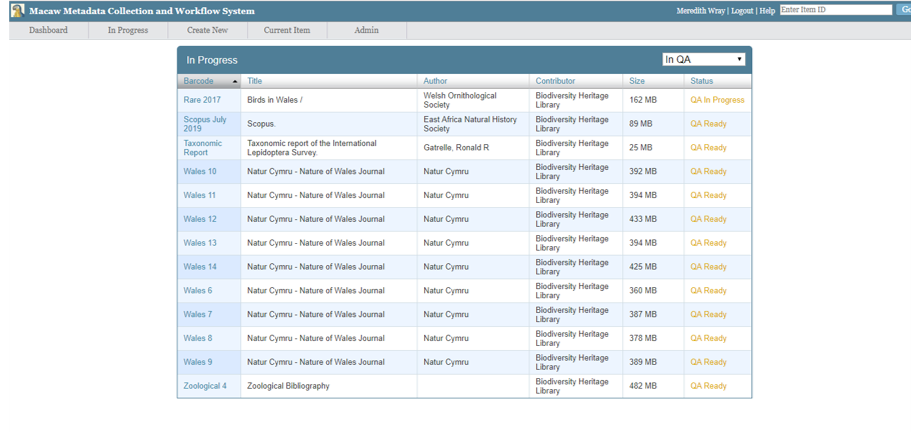
The goals of the internship are to focus on metadata creation, cataloging, and gain experience with digitization workflows. I was taking a cataloging and classification course over the summer, so it was very rewarding to apply my coursework learning about MARC records and cataloging principles in a digital library environment like BHL. My day-to-day consisted of assigning MARC records to items, often finding them in OCLC; uploading items to BHL’s digitization workflow management tool, Macaw; and filling out item-level metadata, such as the sponsoring institution, author, or volume information, before passing them along to be uploaded to Internet Archive.

Picture1.png

Here you can see a screenshot of what Macaw (BHL’s digitization workflow management tool) looks like when I’m working on several items — these are the items currently in QA.

I would usually have several issues going at once — either uploading or assigning metadata to digitized items. Once uploaded, I would go through each item to assign page level metadata — page numbers, page sides, volume and year information. I would also assign page types to each, taking note of any tables, text, photographs, illustrations, and front or back matter (title page, cover, table of contents, or bibliography). This was to help researchers and users of BHL scan the item to see what its contents may hold.

My conversations with Bianca challenged me to think about the items from the perspective of a researcher — what information would be most helpful, as well as really taking and describing the item as-is and not attempting to make judgements on any of the items. This principle was emphasized in my cataloging class, but it was rewarding to apply in an online library environment. Although most of my day-to-day work consisted of cataloging and metadata creation, I was lucky enough to develop a better understanding of copyright issues and moving walls through my training and ongoing discussions with Bianca, who explained the ongoing partnerships and communications needed to obtain legal and physical access to materials for BHL.

The items I worked on ranged from International Congress of Entomology proceedings to nature journals focused on the biodiversity heritage of Wales. The most time-intensive and at times challenging items were compiling abstracts and conference proceedings from the International Congress of Entomology. Several of the items were several thousand pages long and required some patience uploading, but I was able to gain experience digitally stitching PDFs together and preparing them for upload.

My favorite item to work with was probably several of the Nature in Wales journals. These journals have a variety of content types and covered the biodiversity of the Welsh region with interesting articles, photographs, and illustrations, so assigning page-level metadata to these items was always interesting.

Picture2.png

Uploaded volume of Natur Cymru : a review of wildlife in Wales.

In the end, I contributed 28 items and 16,053 pages to BHL. The variety of materials and content was really exciting to work with, and I am honored to have contributed  several items to BHL for potential use by researchers and students. I am thrilled to have had the opportunity to work on BHL projects and appreciate the learning experience as it relates to my master’s degree and professional goals.

September 10, 2019by Joel Richard
Blog Reel, User Stories

Getting Fishy with BHL: Empowering Discoveries and Connections Around Museum Collections

Man in a white shirt standing in front of a dried fish specimen.
Photograph of a fish specimen.

Type specimen of Cubiceps capensis in the Natural History Museum of London’s dry specimen store, which houses most of the Museum’s skeletons, skins and stuffed fishes. Many specimens in the collection are well over 100 years old. James Maclaine, senior curator of fishes at the Museum, often uses BHL when conducting research on specimens in the collection. Photo by: Kevin Webb, NHM Photo Unit.

Twitter is a popular communication channel amongst the scientific community. Scientists use the platform to communicate with colleagues and share their research findings with both other scientists and the public.[1]

Twitter may also be a valuable source of data for researchers. For example, ecologists from the University of Gloucestershire found that “Twitter-mined” data is useful for phenological studies, such as winged-ant emergence or the appearance of house spiders in the fall.[2]

Twitter conversations can also spark unexpected discoveries. For example, a recent @BioDivLibrary Twitter conversation helped uncover a connection between the scientific literature and a museum’s collections.

It began with Boops boops, a fish — commonly called a bogue — native to the eastern Atlantic. @BioDivLibrary posted an illustration of the species in response to a tweet from Deborah Paul (@idbdeb), who shared the species as an example of a name uncovered while experimenting with parsing taxon names as part of the recent BHL data mining workshop at the University of Illinois.

?

Boops boops #SciArt from “A history of the fishes of the British Islands”, v. 1 (1868), in #BHLib via @SILibraries ➡️ https://t.co/A37BOVJ4Ru pic.twitter.com/HZVxA1ntoT

— BHL (@BioDivLibrary) June 18, 2019

The illustration, published in A History of the Fishes of the British Isles (1862-65), was based on a specimen collected in October 1842 and deposited in the Museum of the Royal Cornwall Institute at Truro. The text also mentions a second specimen, which was presented to the British Museum by a “W.P. Cocks, Esq.”. Paul tweeted an inquiry to see if anyone could help track down the current location of the specimen.

… and did you see this?! https://t.co/WzTtJjf6iN ~ specimen collected October 1842 ~ deposited Museum of the Royal Cornwall Institute at Truro ~ Wonder where it is now? Any help @NHM_Digitise? Who has Boops boops specimen from 1842? @ASIHCopeia @SPNHC @GBIF @DiSSCoEU @iDigBio? pic.twitter.com/TuJ09ueKGK

— Deborah Paul (@idbdeb) June 19, 2019

@NHM_Digitise called on James Maclaine (@beardiddley), senior curator of fishes at the Natural History Museum in London, for help tracking down the specimens. Pulling from a reference in Albert Gunther’s Catalogue of the Fishes in the British Museum, Maclaine responded that the Museum likely held the “W.P. Cocks, Esq.” specimen (with the label reading “Cork” instead of “Cocks”) and proceeded to tweet a picture of the specimen itself.

We do have one of the other ones in the reference I think (assuming W.P.Cocks and W.P.Cork are the same person!). From Albert Gunther’s Catalogue of Fishes, 1859, vol.1, p.419. pic.twitter.com/uZ5gibJmOm

— James Maclaine (@beardiddley) June 20, 2019

Here’s what the Cocks/Cork specimen looks like! The missing one will probably be dried too. pic.twitter.com/sFdaUMn5jW

— James Maclaine (@beardiddley) June 20, 2019

Beyond providing an example of the kinds of discoveries possible on the Twitterverse, this conversation also highlights the value of scientific literature for providing information on museum collections.

“Sadly, despite their many other qualities, the Victorians weren’t great at recording some details which we now would consider essential, so it is often difficult to determine the history of a 19th century fish specimen,” shares Maclaine.

When information is missing on specimen labels, the literature may be able to help fill in the gaps. For Maclaine and others managing collections, having access to this literature through BHL is incredibly valuable.

Can I just say as well, I LOVE BHL, I use it nearly every day!

— James Maclaine (@beardiddley) June 20, 2019

Maclaine finds BHL’s collections particularly useful when researching type specimens, the specific specimen used to describe a new species and the “typical” example of that species.

“Types are the most important part of our collection and are essential to any research on the species that they represent,” explains Maclaine. “However, many currently lurk unrecognized on our shelves, and it’s part of my job to find them, correctly identify them as types, and then update our records accordingly. This is where BHL comes in.”

Man in a white shirt standing in front of a dried fish specimen.

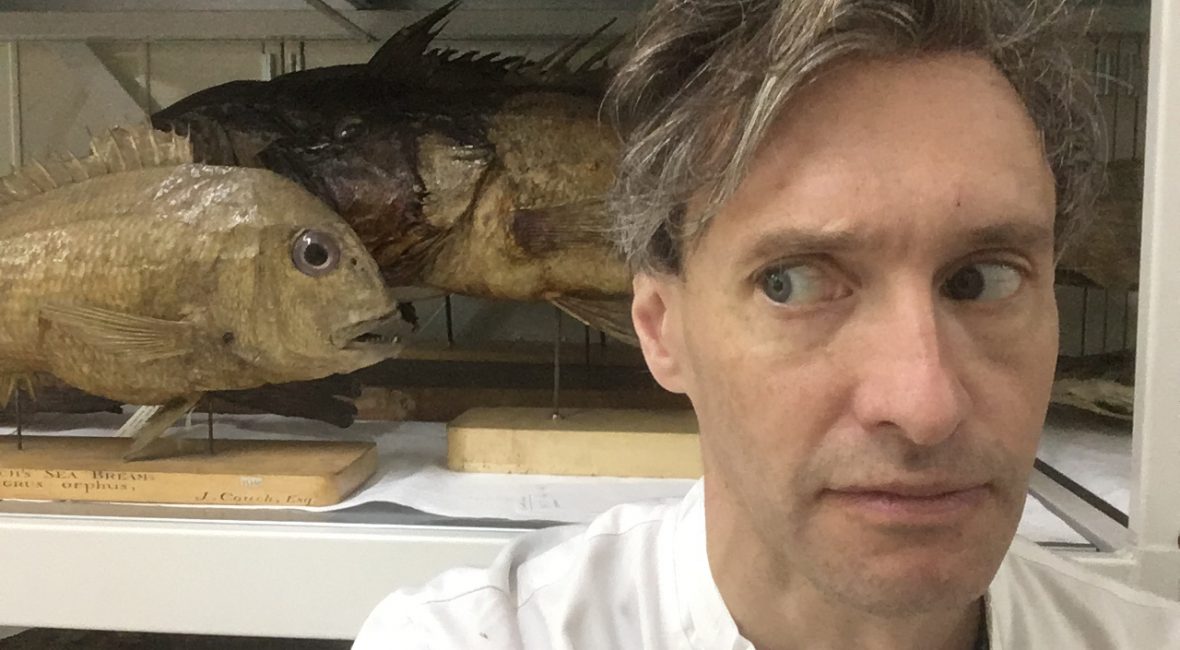
James Maclaine, senior curator of fishes at the Natural History Museum in London, with a seabream collected from Cornwall by naturalist Jonathan Couch in 1843. The specimen is housed in the Museum’s dry specimen store. Photo by: James Maclaine.

Maclaine uses BHL sometimes several times each day, using the taxonomic name finding feature to locate literature on specific species, downloading relevant documents as PDFs, and linking to useful references using page permalinks.

“BHL has been fundamentally useful in two ways,” asserts Maclaine. “Firstly, it’s very easy to quickly get old references. Secondly, being able to download them is very helpful too. When investigating potential type specimens, I often have to go back to those first original species descriptions in the 19th century journals, which is now so quick and easy to do online. If I’m lucky, the species author will give a collecting locality, a collector and a measurement. If all three of those and the species name tie up with the specimen, I can be fairly certain that it was used when the species was described and is a type.”

Maclaine first discovered BHL via Eschmeyer’s Catalog of Fishes, a fish taxonomy database of all known fish names, the history of those names and where they were first published.

“One day I noticed a blue hyperlink next to a reference with the message ‘See ref. at BHL’, and that was that,” recalls Maclaine.

Man inspecting fish specimens in a museum drawer.

James Maclaine, senior curator of fishes at the Natural History Museum in London, inspecting specimens in the Museum’s dry specimen store, which houses most of the Museum’s skeletons, skins and stuffed fishes. Photo by: Kevin Webb, NHM Photo Unit.

As the manager of the fish collection at the Natural History Museum, Catalogue of the Fishes in the British Museum (1859-1868) is one of the most useful books in BHL’s collection for Maclaine’s work. In fact, it was this title that led him to the “W.P. Cocks, Esq.” specimen that he shared on Twitter.

Managing a 250+ year old collection means that Maclaine is responsible for ensuring that the information available for the specimens in his care is correct and up-to-date. BHL not only helps him provide reliable data for current researchers, but is also a valuable contributor to the legacy he will leave for future researchers.

“I have to think of all the generations of curators and researchers who will come after me and think, will what I’m doing be clear and comprehensible hundreds of years after I’m dead?” says Maclaine. “So, it’s great that I can now download the relevant references and then attach them to the specimen record so that everyone can see what I’ve done and why. I think the only bad thing about BHL is that it means I now spend less time in our Museum Library, another fantastic and irreplaceable resource!”

Man standing in a storage room for fish specimens.

James Maclaine, senior curator of fishes at the Natural History Museum in London, inspecting specimens in the Museum’s dry specimen store, which houses most of the Museum’s skeletons, skins and stuffed fishes. Photo by: Kevin Webb, NHM Photo Unit.

By making their literature digitally available, our Partners have ensured that anyone, anywhere can access important collections data. We’re proud to be a part of empowering new discoveries and connections, whether that be through a Twitter conversation or the diligent work of a museum collections manager.

References

[1] Phys.org. 2016. “New Study Reveals How Scientists Use Social Media.” Social Sciences, October 12. Accessed on July 9, 2019. https://phys.org/news/2016-10-reveals-scientists-social-media.html.

[2] Adam G. Hart, William S. Carpenter, Estelle Hlustik-Smith, Matt Reed, Anne E. Goodenough. “Testing the potential of Twitter mining methods for data acquisition: Evaluating novel opportunities for ecological research in multiple taxa.” Methods in Ecology and Evolution, 2018; DOI: 10.1111/2041-210X.13063.

September 5, 2019by michelle.underhill

Help Support BHL

BHL's existence depends on the financial support of its patrons. Help us keep this free resource alive!

search

About BHL

The Biodiversity Heritage Library (BHL) is the world’s largest open access digital library for biodiversity literature and archives. BHL operates as a worldwide consortium of natural history, botanical, research, and national libraries working together to digitize the natural history literature held in their collections and make it freely available for open access as part of a global “biodiversity community.”

Join Our Mailing List

Sign up to receive the latest news, content highlights, and promotions.

Subscribe Now

Subscribe to Blog via Email

Enter your email address to subscribe to this blog and receive notifications of new posts by email.

Join 319 other subscribers

Subscribe to Blog Via RSS

Subscribe to the blog RSS feed to stay up-to-date on all the latest BHL posts.

Access RSS Feed

Inspiring Discovery through Free Access to Biodiversity Knowledge.

The Biodiversity Heritage Library makes it easier than ever for you to access the information you need to study and explore life on Earth…for free, anytime, anywhere.


64+ Million Pages of
Biodiversity Literature Online.

EXPLORE

Tools and Services
to Transform Research.

EXPLORE

300,000+
Illustrations on Flickr.

EXPLORE

ABOUT | HARMFUL CONTENT | PRIVACY | SITE MAP | TERMS OF USE