Biodiversity Heritage Library - Program news and collection highlights from BHL
  • Home
  • News
  • Featured Books
    • All Featured Books
    • Book of the Month Series
    • BHL at 20
  • User Stories
  • Campaigns
    • Fossil Stories
    • Garden Stories
    • Monsters Are Real
    • Page Frights
    • Her Natural History
    • Earth Optimism 2020
  • Tech Blog
  • Visit BHL
Home
News
Featured Books
    All Featured Books
    Book of the Month Series
    BHL at 20
User Stories
Campaigns
    Fossil Stories
    Garden Stories
    Monsters Are Real
    Page Frights
    Her Natural History
    Earth Optimism 2020
Tech Blog
Visit BHL
  • Home
  • News
  • Featured Books
    • All Featured Books
    • Book of the Month Series
    • BHL at 20
  • User Stories
  • Campaigns
    • Fossil Stories
    • Garden Stories
    • Monsters Are Real
    • Page Frights
    • Her Natural History
    • Earth Optimism 2020
  • Tech Blog
  • Visit BHL
Biodiversity Heritage Library - Program news and collection highlights from BHL
Blog Reel, Featured Books

A Basic Guide to Rare Book Research

In my job as the manager of the Library at Museums Victoria (Australia), I am frequently required to conduct rare book research for programs, displays, online projects, or to establish the provenance of a book. I remember being a little daunted by this task at first, not knowing quite what to cover or what the relevant references were in this field. I have put together this quick guide as a reference for newcomers, using digitised books in BHL to demonstrate how to “read” a book for rare book research. I’ve also included some useful links and further reading if you’d like to delve deeper.

Having conducted numerous talks and tours on rare books in my career, I am now familiar with the questions people ask and prepare by trying to cover as much as possible of the following:

  • Bibliographical information: publication date and the dates of any parts if applicable, edition statement, number of volumes, parts and plates
  • Production details: method of printing and illustrating, method of colouring
  • Print run (edition)
  • Remaining (extant) copies
  • Biographical information of authors/illustrators/contributors
  • Provenance
  • Significance

Here are my top tips for finding that information.

1. Look at the book!

Much information can be gleaned from the item itself. The title page is normally the go-to for bibliographical details and may also provide information about illustrations. For instance, title pages frequently advertise methods of printing and colouring plates.
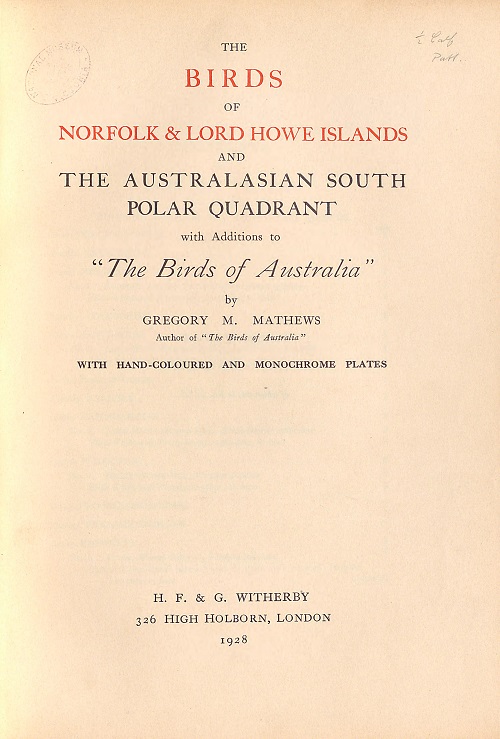
1. t.p. Mathews small.jpg

Image: This title page informs us that the book contains hand-coloured and monochrome plates. Source: Mathews, Gregory. The birds of Norfolk & Lord Howe Islands and the Australasian South Polar quadrant. 1928. Contributed in BHL from Museums Victoria.

The illustrations themselves often bear further information, such as the names of contributors or the method of printing.
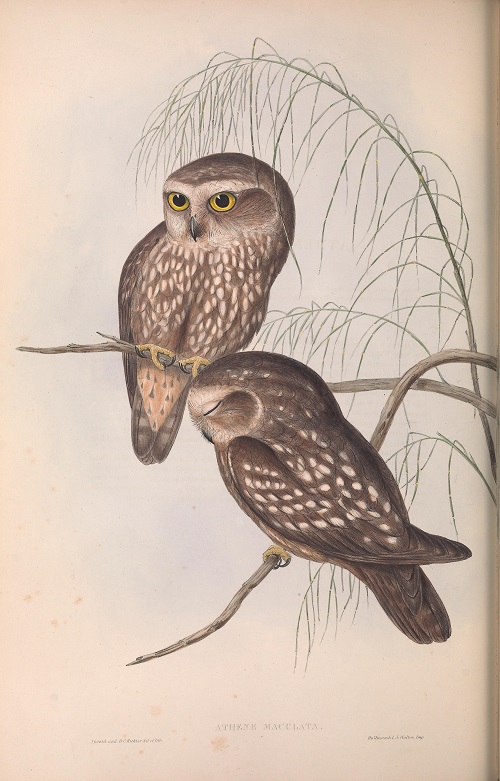
2. Plate Gould small.jpg

Plate 33. Gould, John. Birds of Australia. Volume 1 (1848). Contributed in BHL from Smithsonian Libraries.

You may need to do some detective work to decipher abbreviations. In the example above “J. Gould & H. C. Richter” appears on the left with the abbreviation del et lith and “Hullmandel & Walton” appears on the right with the abbreviation Imp. There are a number of references that you can consult to illuminate these terms (see further reading). Princeton University Library’s post on Printmaker’s abbreviations provides the following information:

  • del = drawn by
  • lith = lithographed by
  • imp = printed by

Therefore, this illustration indicates that it was transferred to (drawn on) the lithographic stone by J. Gould and H. C. Richter and printed by the firm Hullmandel & Walton.

The preface and introduction may also contain acknowledgements of contributors and details on production methods.

3. Preface Gould crop.jpg

Preface. Gould, John. Birds of Australia. Volume 1 (1848). Contributed in BHL from Smithsonian Libraries.

For instance, John Gould’s preface to Birds of Australia provides greater detail than the acknowledgements on individual plates. He laments the loss of his wife Elizabeth part-way through the production of the work, and we learn that she drew the preliminary sketches that Richter used to develop the final prints. Gould also mentions that the illustrations were hand-coloured by a Mr. Bayfield.

Rare books may also contain traces of their previous owners, or provenance. Provenance information is commonly found in the first few pages of a book, such as the inside front cover, flyleaves or title page. Hints as to previous owners can include inscriptions, bookplates or library stamps (more on stamps in my library here).
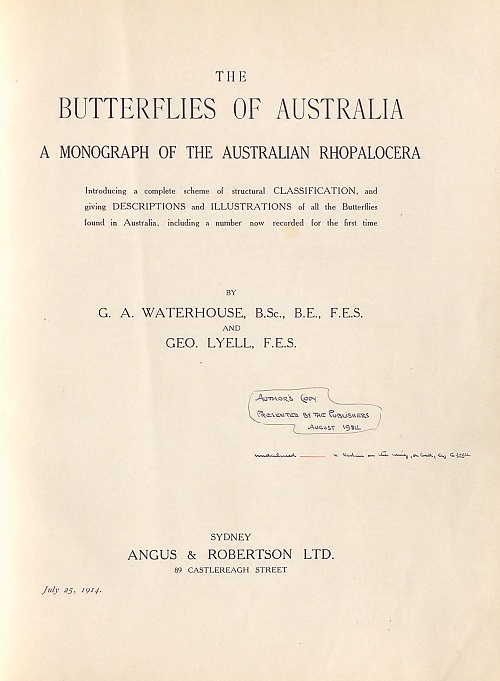
4. Inscription Lyell small.jpg

Image: This inscription on the title page indicates that this book belonged to author George Lyell. Source: Waterhouse, G. A & Lyell, G.. Butterflies of Australia. 1914. Contributed in BHL from Museums Victoria.
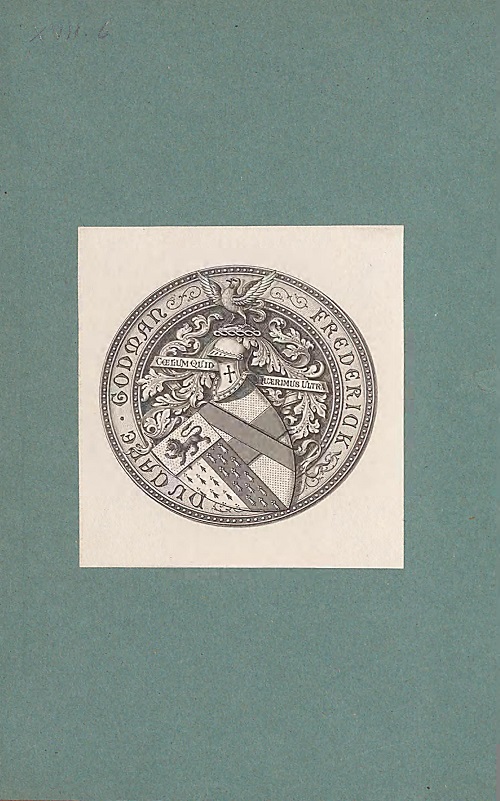
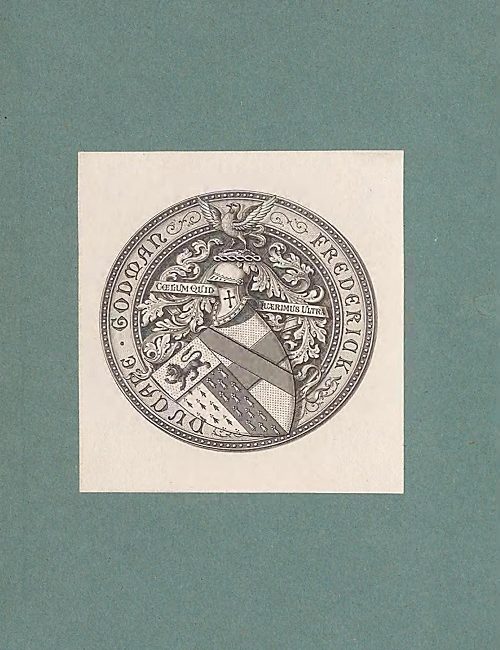
5. Bookplate Ducane Godman small.jpg

Image: Bookplate of naturalist Frederick Ducane Godman, co-author of Biologia Centrali-Americana with Osbert Salvin. Source: Salvin, Osbert. [Collected articles from The Ibis on the ornithology of Central America]. 1859-1864. Contributed in BHL from Museums Victoria.
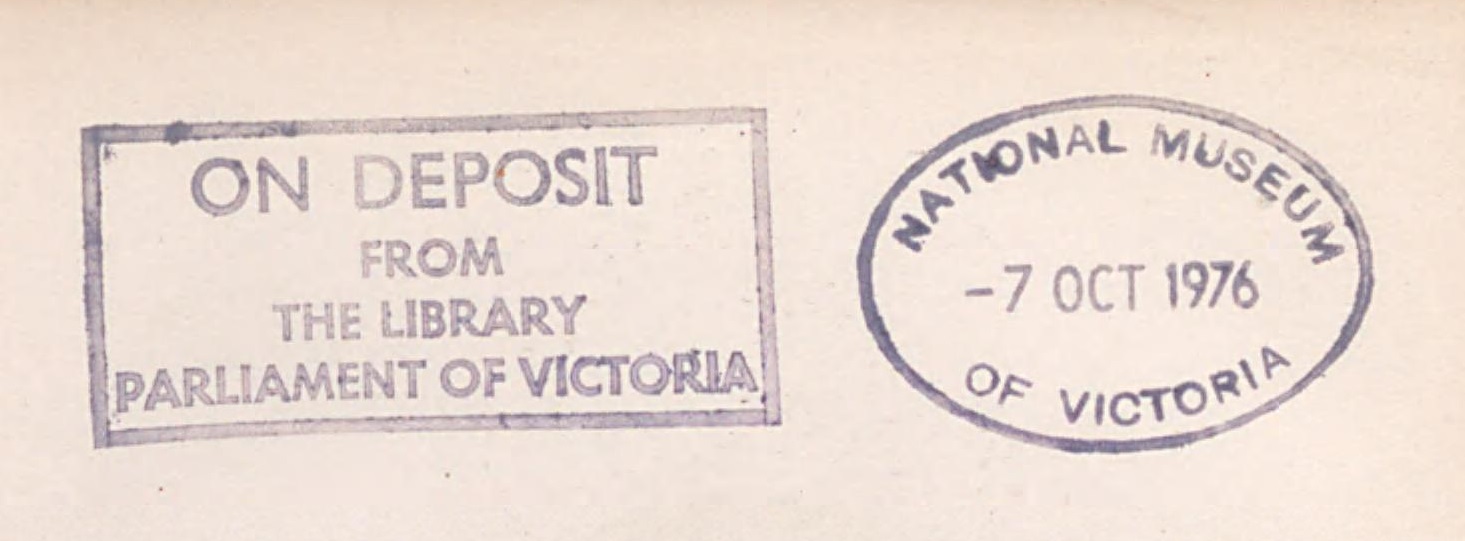
6. Library stamps Antarctica crop.jpg

Image: These library stamps demonstrate the transfer of this item between institutions. The Museums Victoria Library has received two significant donations of material from the Parliamentary Library of Victoria in its history. Source: Elisha Kent Kane. Arctic explorations : the second Grinnell Expedition in search of Sir John Franklin, 1853, ’54, ’55. Volume 1. 1856. Contributed in BHL from Museums Victoria.

Institutional or library markings may direct you to relevant archival materials.
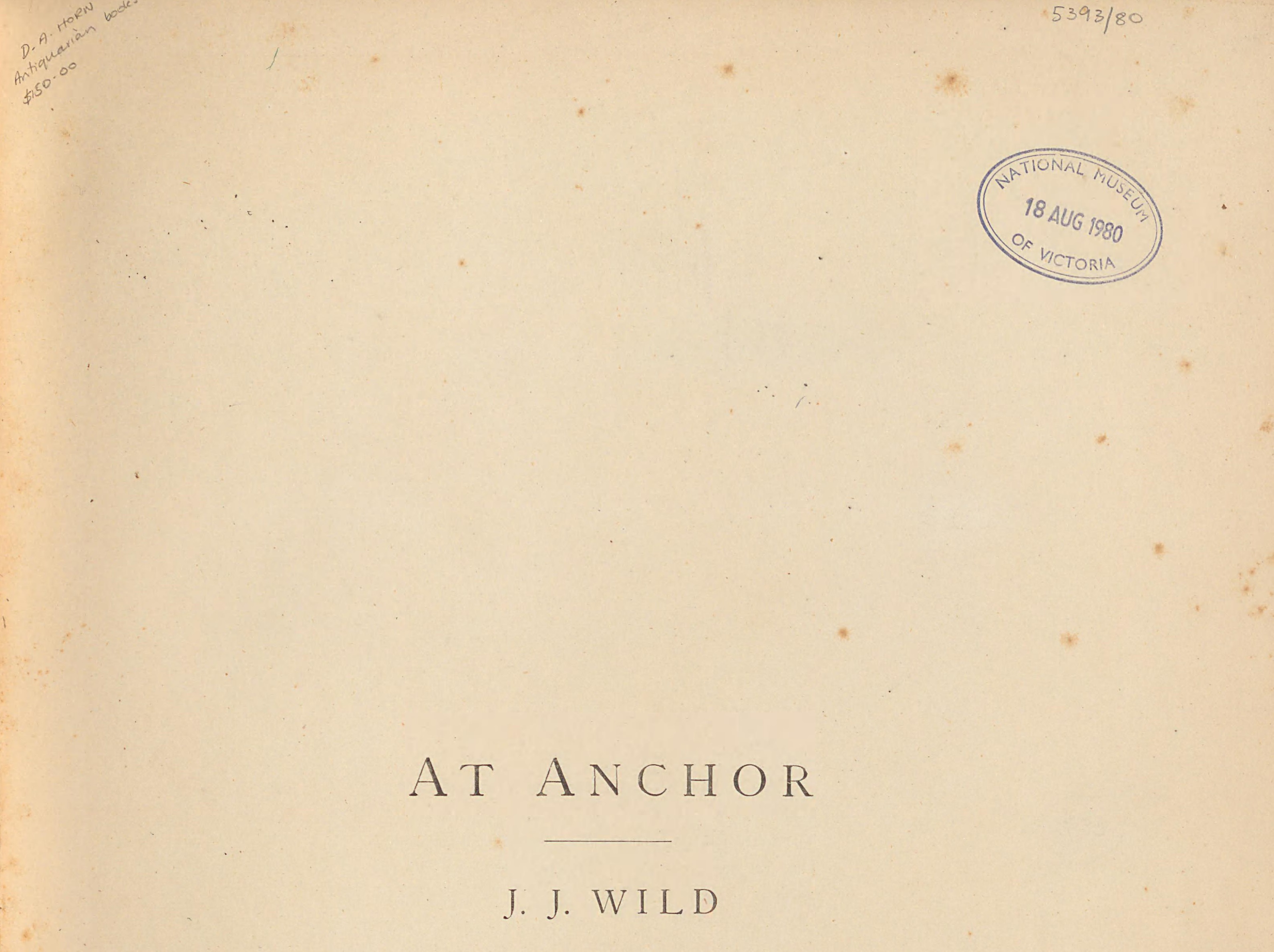
7. Archival References JJ Wild crop.jpg

Image: Pencil notes in the top right-hand corner of this page indicate that this book was for sale by D. A. Horn Antiquarian Books for $50. The top left-hand numbers are an acquisition number that would allow us to trace the purchase in our archives. Source: Wild, John James. At anchor : a narrative of experiences afloat and ashore during the voyage of H.M.S. Challenger, from 1872 to 1876. 1878. Contributed in BHL from Museums Victoria.

Be particularly attentive to any dates as these should help narrow the date range for further archival research.

2. Consult catalogue records

If you are working with a library book, the catalogue record will be an indispensable resource for bibliographic details, and may contain additional contributor, production or provenance information. Comparing your local catalogue record to other library records will allow you to compare basic details of your copy with others to verify the completeness of your item. Trove and Worldcat are useful for locating library catalogue records and identifying how many copies remain in public collections in Australia or worldwide. It is often difficult to establish the number of extant copies with any certainty unless a census has been conducted (such as this one of the Aurora Australis.)

Auction catalogue records are useful as they normally provide a physical description, brief biography of the author, list any known contributors, and highlight points of significance. The price estimate can be helpful too! Some auction houses make their catalogue records freely available online, so you will be able to find them through an internet search. Otherwise, try consulting your public or institutional library to see if they can help you locate relevant resources.

3. Locate digitised versions

Sometimes it can be useful to consult a digitised version of the book, such as may be found in online repositories like the Biodiversity Heritage Library. This level of detailed research may be needed if you suspect the copy is incomplete, or to compare variations in hand-colouring or binding.
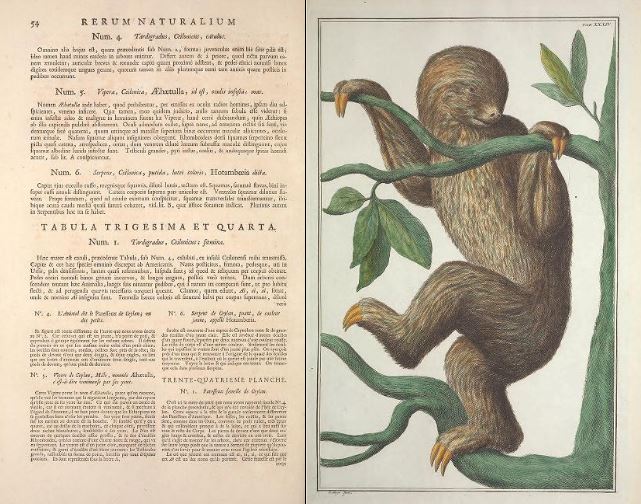
9. Seba Smithsonian.JPG

Image: By comparing our copy of Albertus Seba’s Thesaurus with a Smithsonian copy, I was able to establish that our copy is bound differently; two volumes of plates and two volumes of text, rather than the usual four volumes with plates interleaved throughout. Source: Seba, Albertus. Locupletissimi rerum naturalium thesauri accurata descriptio. Volume 1. 1734-1765. Contributed in BHL from Smithsonian Libraries.

4. Consult secondary references

Verify the information you have compiled by consulting relevant secondary sources. Rare books are described using specific terminology that you may not be familiar with, so it can be helpful to utilise a glossary such as this one from the International League of Antiquarian Booksellers.

Become familiar with standard references in your subject area and region. For instance, in Australia biographical information is readily accessible through the Australian Dictionary of Biography. The Bibliography of Australia by John Alexander Ferguson provides a list of Australian publications, and similar titles document publications in other regions.

Subject-specific bibliographies may also be of use. For instance, in my library I have consulted Antarctica, 1772-1922 : freestanding publications through 1999, Natural science books in English, 1600-1900 and Bibliography of Australian entomology, 1775-1930 : with bibliographical notes on authors and collectors when undertaking rare book research. These types of references can help outline significance and sometimes provide additional information on contributors, editions, or production methods.

If the book or author you are researching is well-known, there will be an array of books, journal articles and websites that provide biographical and contributor information, methods of production, and significance. For instance, recent secondary material on John Gould tends to emphasise the important role of his wife Elizabeth in more detail than is readily apparent from acknowledgements on the works themselves. Secondary sources also suggest that while John Gould certainly had input into the illustrations that adorn his publications, he would not have been the one to transfer the drawing to the lithographic stone.

However, if the book or author is more obscure, this can present a greater challenge. This is a good opportunity to utilise the reference services offered by your local or institutional library!

5. Remember the wider context

In my role as a librarian, I undertake rare book research on items in our collection as required, and therefore my research tends to be object-oriented. While this guide aims to assist this type of research, it is important to be aware of the broader social and historical context that a book was produced in and to consider how this might affect your interpretation (a much bigger topic than I can cover here!).

This guide outlines a basic approach to rare book research and is based on my professional experience. It is most applicable to rare printed materials such as you will find in BHL. If a more detailed approach appeals, the study of bibliography offers techniques for analysing and describing rare books at a more technical level.

Further Reading

Antiquarian Booksellers’ Association of America, ABAA Glossary. Retrieved from https://www.abaa.org/glossary

Carter, John (1980) ABC for book collectors, 6th ed., London & New York, Granada.

Gascoigne, Bamber (2004) How to identify prints : a complete guide to manual and mechanical processes from woodcut to inkjet, London, Thames & Hudson.

International League of Antiquarian Booksellers, ILAB Glossary. Retrieved from https://ilab.org/glossary

Melby, Julie (2009) Printmaker’s abbreviations, Princeton University Library Blog, Retrieved from https://www.princeton.edu/~graphicarts/2009/02/printmakers_abbreviations.html

Pearson, David (2019) Provenance research in book history : a handbook, 2nd ed. London & New Castle, Delaware, Bodleian Library & Oak Knoll.

Russell, Roslyn and Winkworth, Kylie (2009) Significance 2.0 : a guide to assessing the significance of collections, Rundle Mall, South Australia, Collections Council of Australia, https://www.arts.gov.au/what-we-do/museums-libraries-and-galleries/significance-20

Webster, Hayley (2019) Provenance and Library Stamps at Museums Victoria and on BHL, BHL blog, Retrieved from https://blog.biodiversitylibrary.org/2019/10/provenance-and-library-stamps.html#more-23080
November 26, 2019by michelle.underhill
Blog Reel, Featured Books

From Canada’s National Capital to “the Rock” — The Tale of a Traveling Book by Philip Henry Gosse

dragonflies

The Island of Newfoundland was nicknamed “The Rock” because of its rocky terrain and high cliffs.

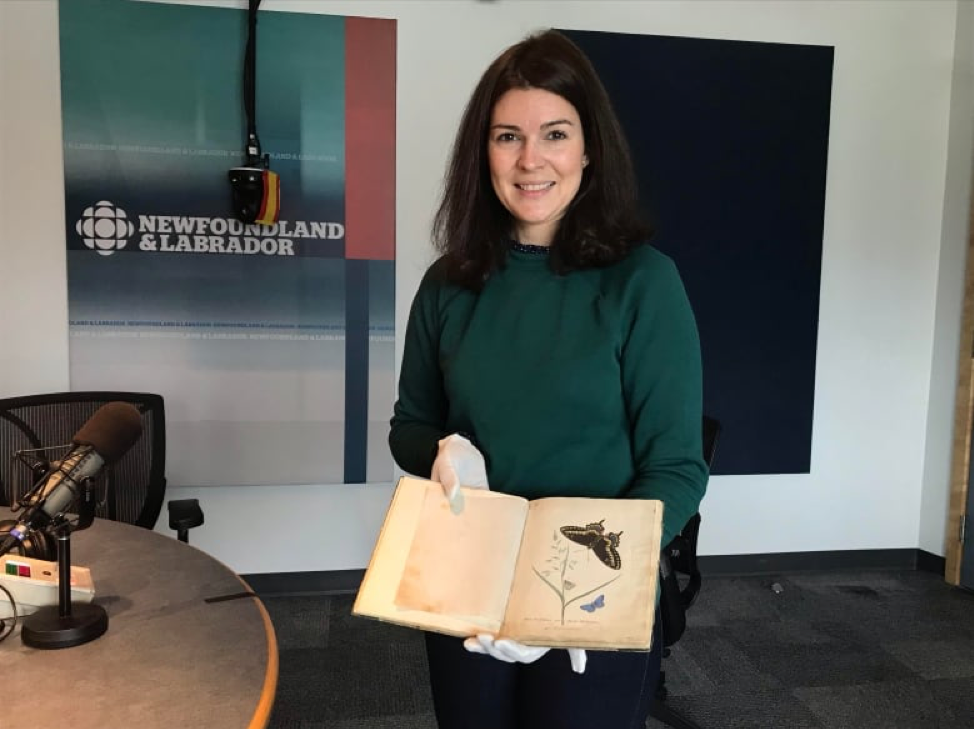
I’m Elizabeth Smith, and I work at the Canadian Museum of Nature’s Library & Archives as Acquisitions and Cataloguing Officer. In this capacity, I have the privilege of caring for a rare book collection consisting of approximately 4,000 pre-20th century monographs, manuscripts and periodicals, including a special unpublished manuscript, Entomologia Terrae Novae by Philip Henry Gosse — which I had the privilege of hand couriering to St John’s Newfoundland for a short exhibit and panel talk at Memorial University’s QEII Library this past September.

photo of a version with dark hair and green sweater holding a manuscript with illustrations of butterflies

Elizabeth Smith is an acquisitions and cataloguing officer with the Canadian Museum of Nature in Ottawa. Here she holds Philip Henry Gosse’s unpublished manuscript, Entomologia Terrae Novae. (Francesa Swan/CBC). Source.

This special manuscript has been digitized by the Museum’s Library & Archives on BHL.

On arrival in St John’s, I was greeted by the managing editor for Boulder Books and whisked over to the CBC Radio station to do an interview for On-The Go with Ted Blades. Months prior, Boulder reached out to our library to inquire about borrowing the manuscript to be shown in tandem with the launch of their newest field guide, Stouts, Millers & Forky-Tails: Insects of Newfoundland & Labrador, which drew inspiration from Gosse’s work. I was ultimately invited to speak alongside Dr. Tom Chapman, head of the Department of Biology at Memorial University and co-author of that field guide, at an engagement and advocacy event held by Memorial’s QEII Library in the Centre for Newfoundland Studies (CNS). The event was fittingly called A Bug’s Life: Tales of the N.L. Insect (1833-2019).

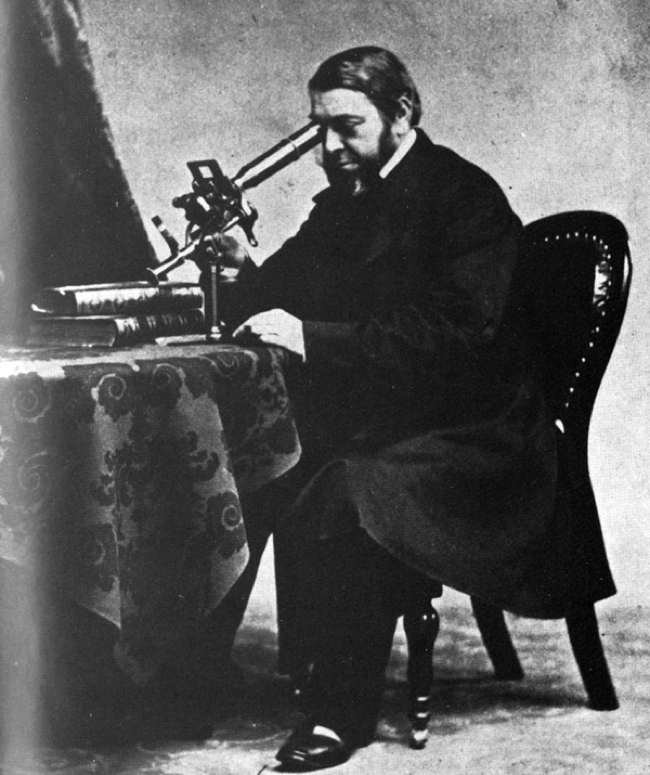
black and white photo of a man looking into a microscope

Philip Henry Gosse, 1863. Source: Canadian Museum of Nature Blog.

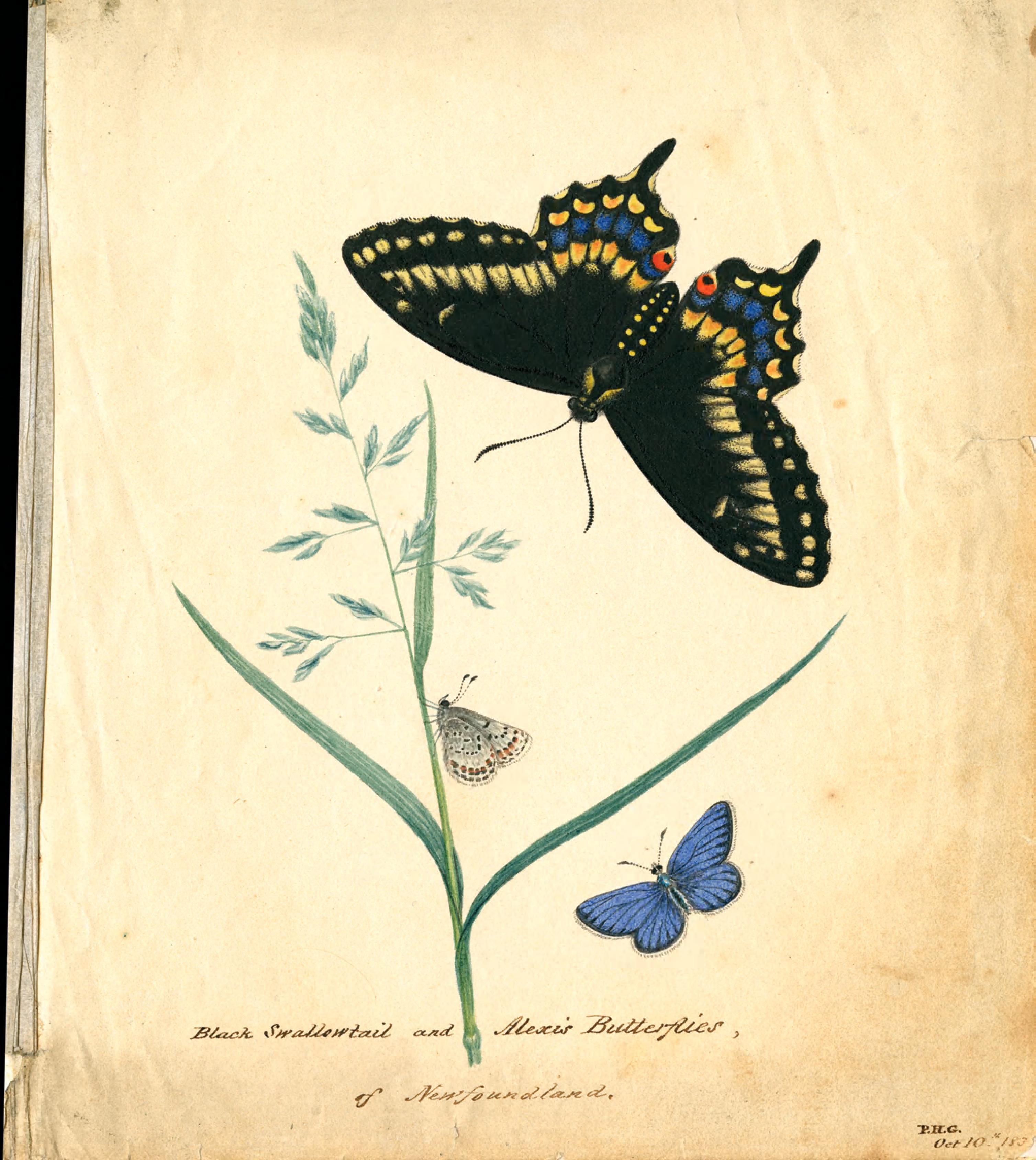
Entomologia Terrae Novae, authored by Philip Henry Gosse in 1833, was the first attempt to classify and illustrate the insect fauna of Newfoundland. About 250 magnificent illustrations adorn its pages — many of which are of the Lycaenidae family, which is the second-largest family of butterflies.

butterflies

(Below) The common blue butterfly (Polyommatus icarus) of the Lycaenidae family along with (above) the black swallowtail (Papilio polyxenes). Gosse, Philip Henry. Entomologia terrae novae. 1833. Contributed in BHL from the Canadian Museum of Nature Library / Bibliothèque du Musée canadien de la nature.

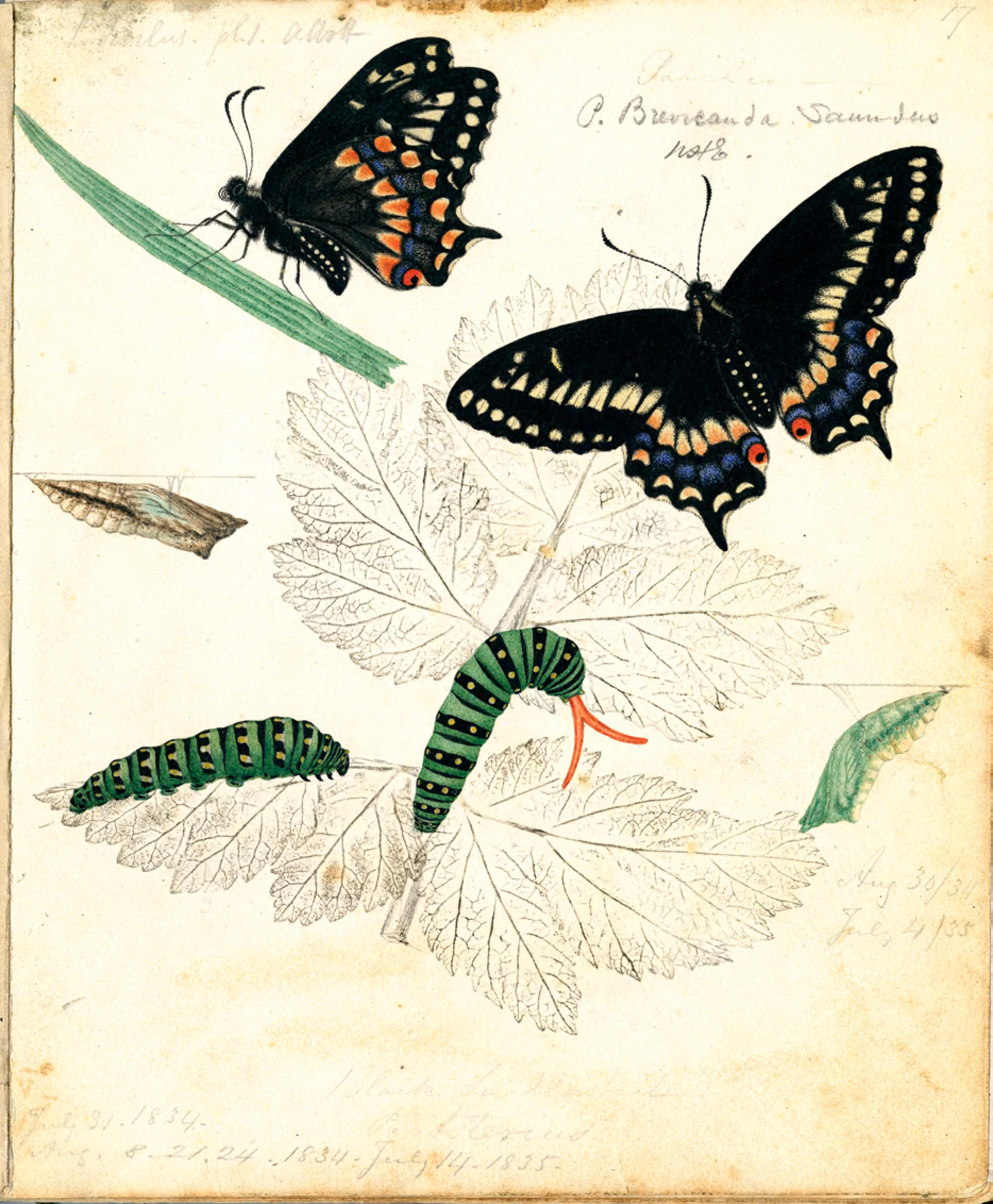
I pondered with my entomologist colleague, Dr. Bob Anderson, as to why that might be. Perhaps it was the metamorphosis process that fascinated Gosse? We reflected on the fact that much of the world’s life forms were only starting to be explored, and that exploration and illustration was a hobby in this (almost) Victorian Era. Dr. Anderson also taught me of the value in capturing the host plants in scientific illustrations, as it can inform research scientists of various things. There are several examples of this throughout the book.

butterflies and caterpillars on plants

Gosse captured the metamorphosis process and host plants in his drawings. Gosse, Philip Henry. Entomologia terrae novae. 1833. Contributed in BHL from the Canadian Museum of Nature Library / Bibliothèque du Musée canadien de la nature.

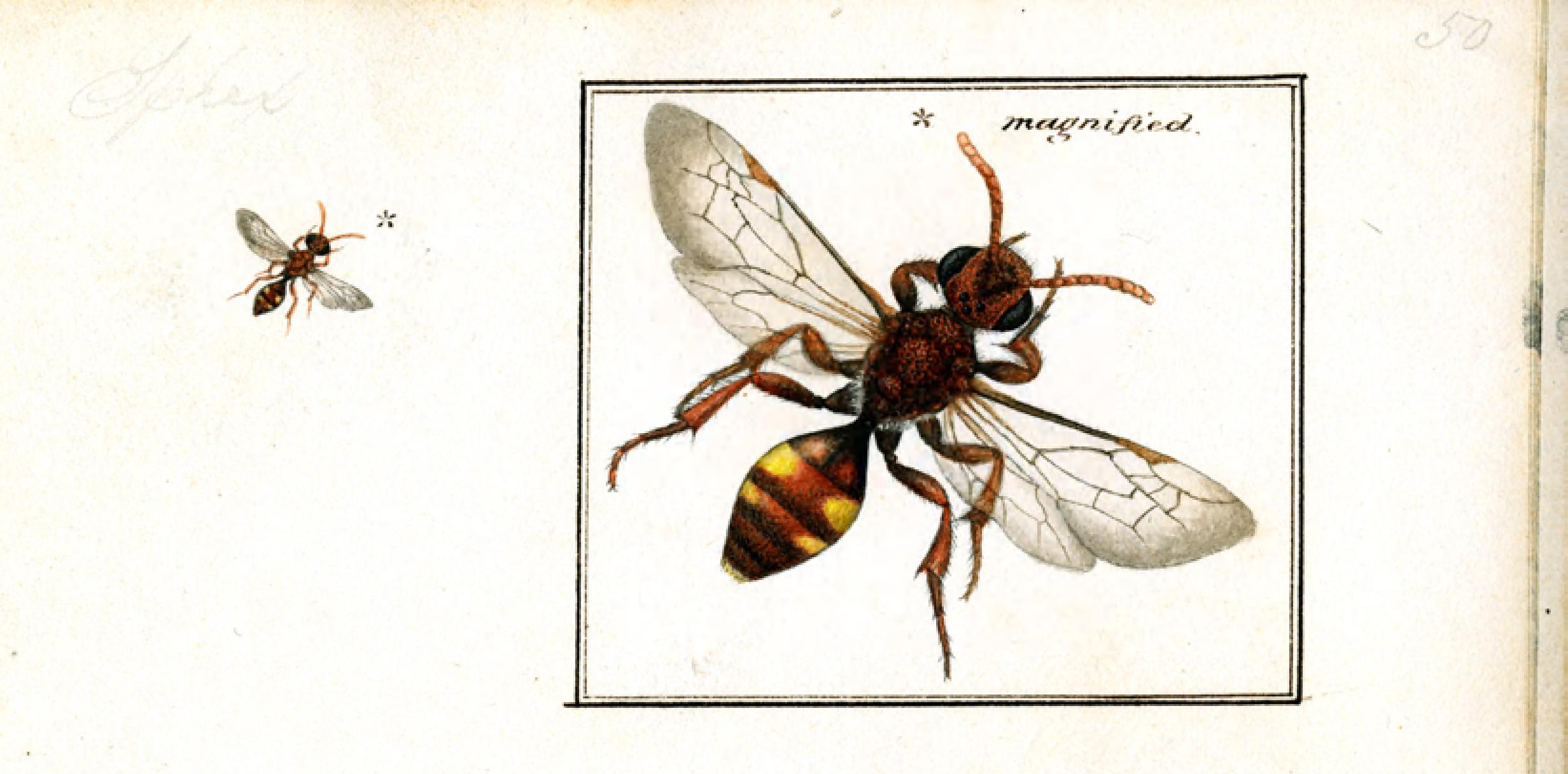
Philip Henry Gosse was the son of Thomas Gosse and Hannah (née Best). He was sent from England to Carbonear at age 17 to work as a clerk. Gosse’s father, Thomas, was a miniature portrait artist himself, but it was Gosse’s aunt (Susan Bell) who first taught him to draw. He did so exquisitely, sometimes with the help of a microscope. Throughout the manuscript, readers can see examples of insects which Gosse carefully represented in their actual size and enlarged to a magnified proportion to show more detail.

illustration of a bee at scale and magnified

Example from Gosse’s manuscript of an insect drawn to scale and magnified. Gosse, Philip Henry. Entomologia terrae novae. 1833. Contributed in BHL from the Canadian Museum of Nature Library / Bibliothèque du Musée canadien de la nature.

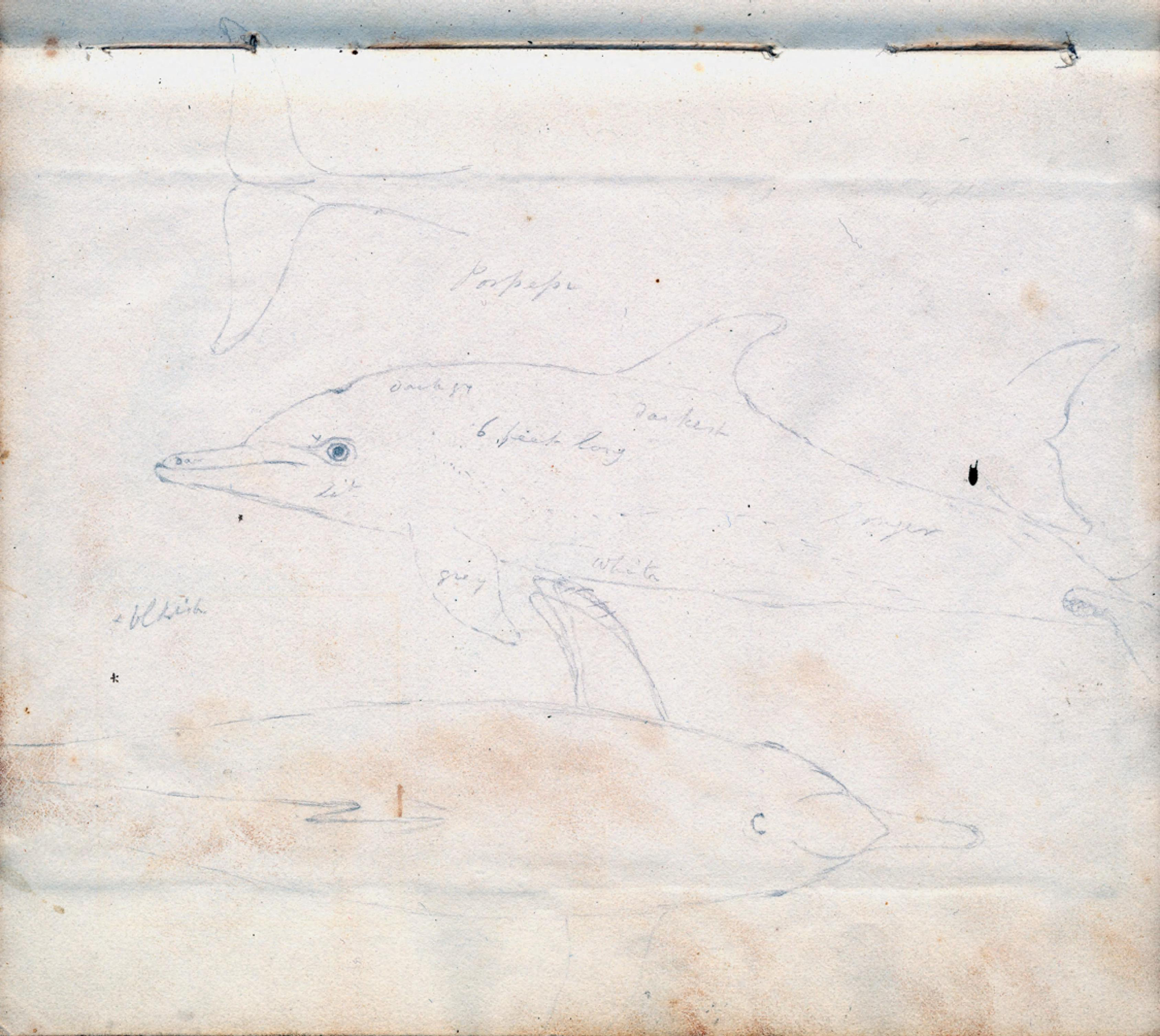
Meticulously hand drawn insects like these are nothing short of impressive. If you take a closer look, you will also notice annotations and even … a dolphin sketch! Gosse went on to illustrate other forms of life, some for which he was more famous (for example, he’s known for inaugurating the word “aquarium” and making these glass enclosures popular with the publication of his 1854 monograph dedicated to the subject).

dolphins

Dolphins, an unexpected inclusion in Gosse’s manuscript. Gosse, Philip Henry. Entomologia terrae novae. 1833. Contributed in BHL from the Canadian Museum of Nature Library / Bibliothèque du Musée canadien de la nature.

Gosse moved on from Newfoundland to Quebec and other locations, taking the manuscript with him and eventually passing it along to his son, Edmund Gosse. It was passed down through the Gosse family until it was donated to the Canadian Museum of Nature in the 1950s.

This singular manuscript holds many treasures and a few surprises. We were excited to bring this work back to Newfoundland for the first time since its creation in the 1830s to be showcased as part of this special event with the Memorial University’s QEII Library. While it is a phenomenal experience to view the manuscript in person and appreciate the almost 3D quality of the drawings, the digitized copy in the Biodiversity Heritage Library ensures that everyone can enjoy this unique item and the important milestone it represents for the history of entomological studies in Newfoundland.

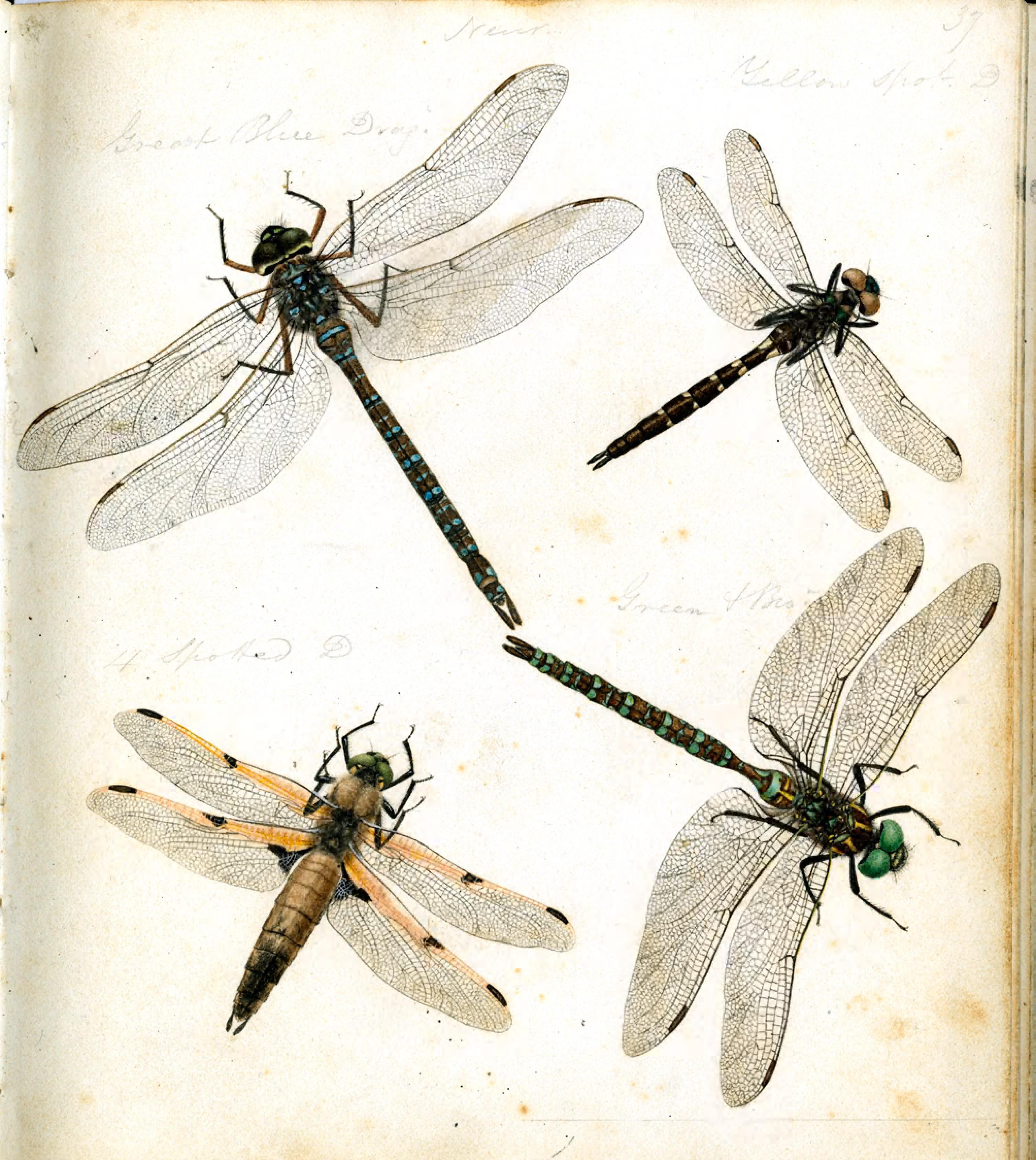
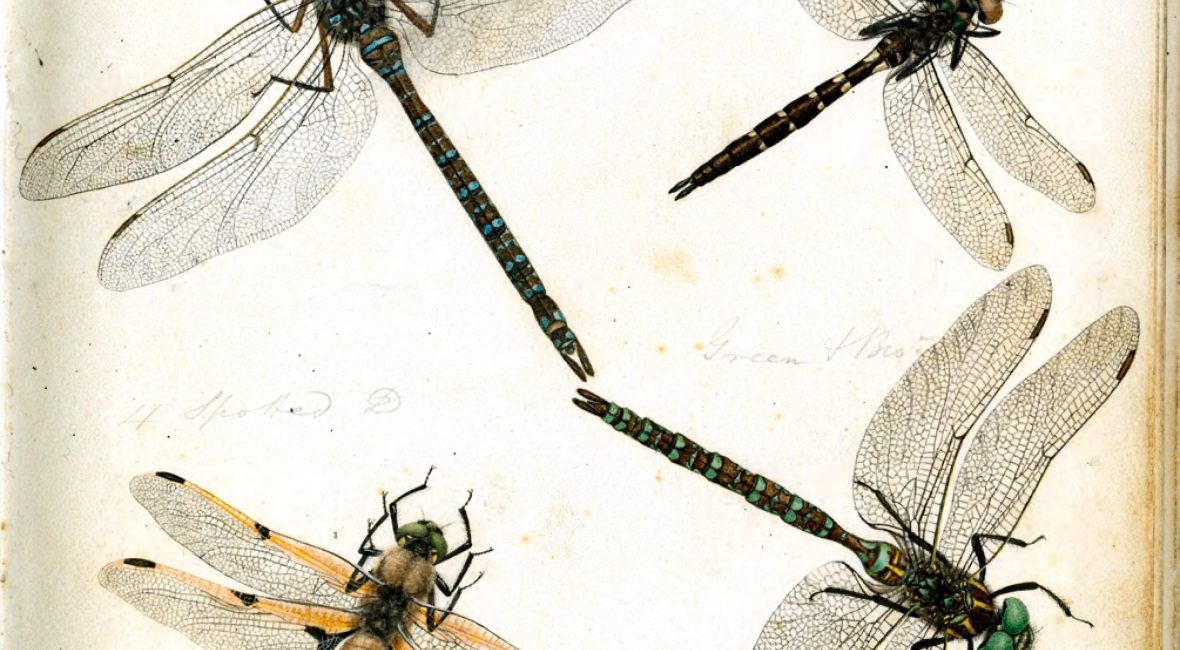
dragonflies

Dragonflies of Newfoundland. Gosse, Philip Henry. Entomologia terrae novae. 1833. Contributed in BHL from the Canadian Museum of Nature Library / Bibliothèque du Musée canadien de la nature.

November 22, 2019by michelle.underhill
BHL News, Blog Reel

2019 Fall BHL Newsletter Now Available!

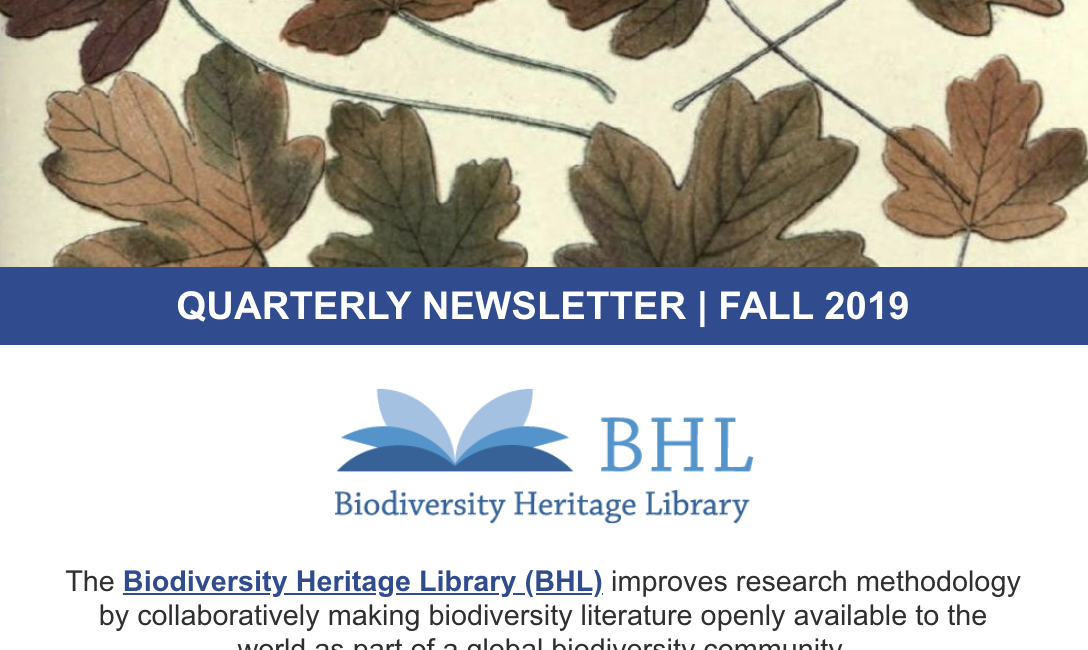
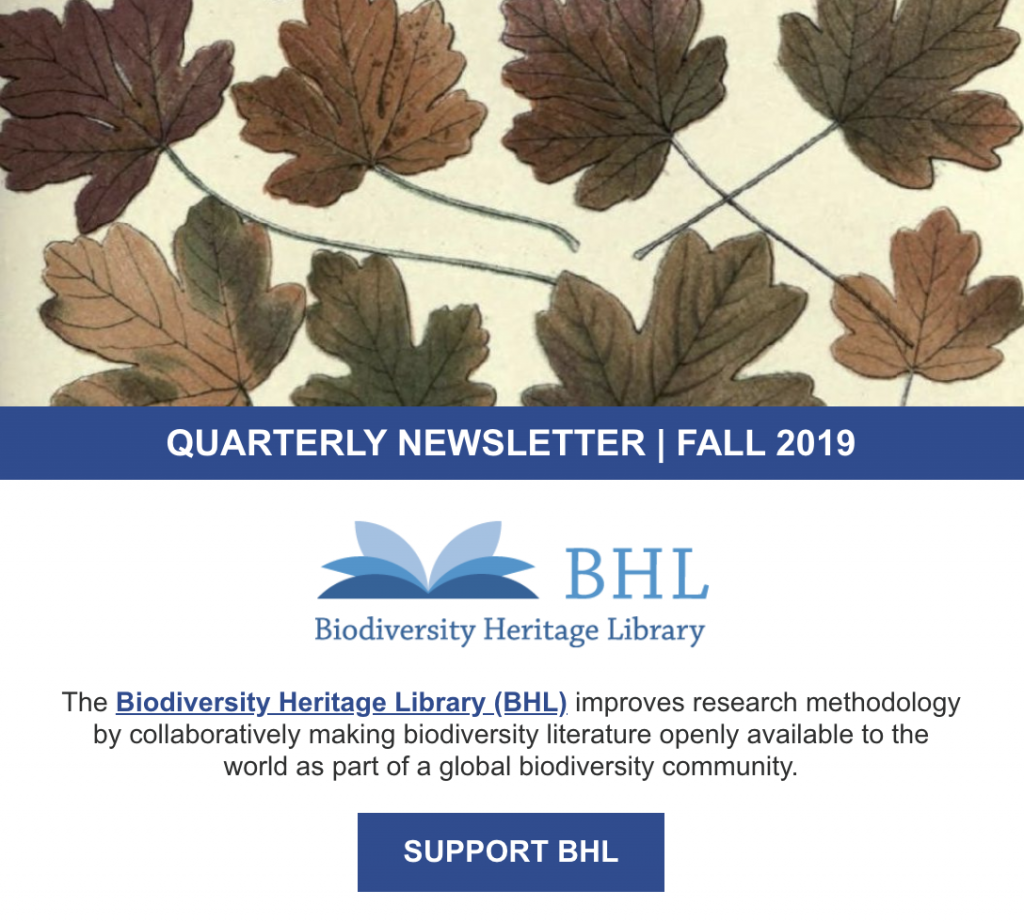
screenshot of the fall 2019 BHL newsletter

screenshot of the fall 2019 BHL newsletter

Autumn is here, at least for those in the Northern Hemisphere. It’s been a busy couple of months at BHL and we have a lot of updates to share. From a new species named after the Library to participation in Biodiversity_Next and article indexing via Unpaywall, check out all the latest program news in our Fall 2019 BHL Newsletter.

Be sure to subscribe to our mailing list to keep up to date with all the latest BHL news.

November 21, 2019by michelle.underhill
Blog Reel, Featured Books, User Stories

Building the Smithsonian’s Dinosaurs with Materials from the Smithsonian Libraries and BHL

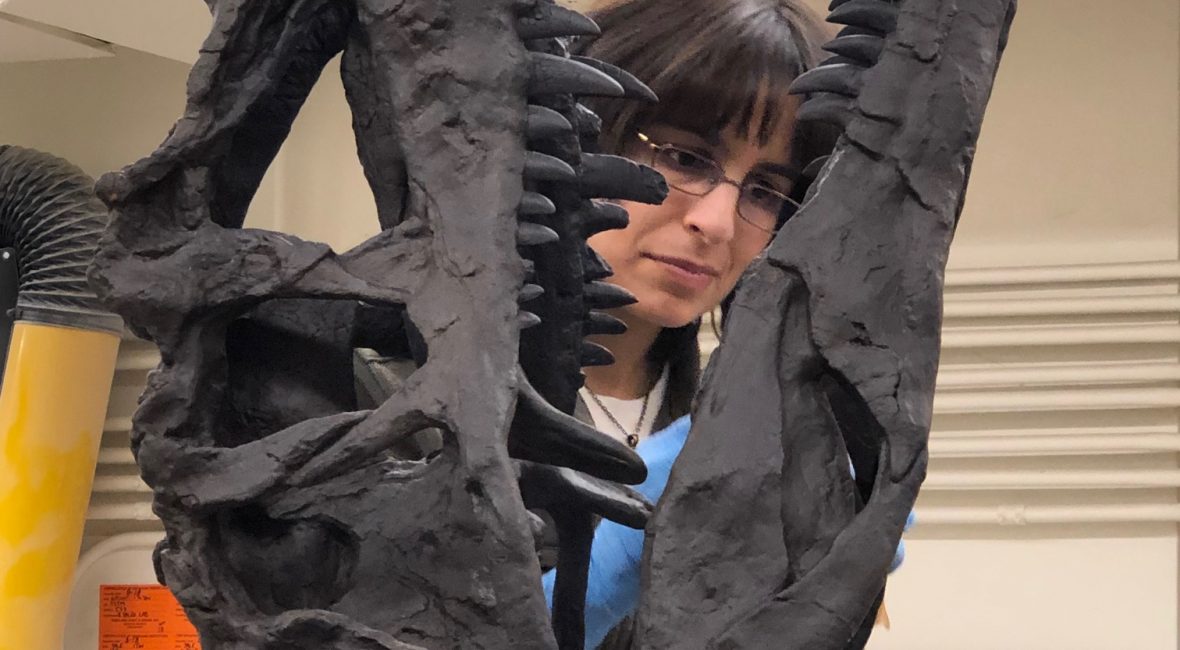
Woman working on a dinosaur skull specimen

This blog post is part of a series from Smithsonian Libraries highlighting Unearthed, a new collection of paleobiology literature in the Biodiversity Heritage Library curated by Smithsonian Libraries in celebration of the opening of the National Museum of Natural History’s David H. Koch Hall of Fossils – Deep Time exhibit. Follow the series throughout 2019 as Smithsonian scientists and librarians discuss the collection, identify their favorite books within it, and explain the importance of paleobiology literature in research today.

My name is Michelle Pinsdorf, and I am a paleontologist and preparator of fossil vertebrates in the Smithsonian National Natural History Museum’s Department of Paleobiology. Preparators’ work can cover a wide variety of duties, from fieldwork to discovering new fossil specimens, freeing those specimens from their surrounding host rock in our laboratories, safely housing specimens for research collections, and helping to build exhibits for specimens going out on display. We call it “grave to cradle” work.

Most of the time you’ll find a fossil preparator leaning over a lab bench with a fine tool in hand, peering through a microscope and exposing the details of a fossil that helps researchers identify and publish about it. But for the past five years, my lab colleagues and I have been working on the renovation of the Natural History Museum’s fossil exhibits. This has involved the dismantling of many previously exhibited fossil mounts to allow for the conservation of the fossils and remounting them in new poses and settings. With the significant scientific value of these fossils, a lot of research and planning happens before each individual specimen is worked on.

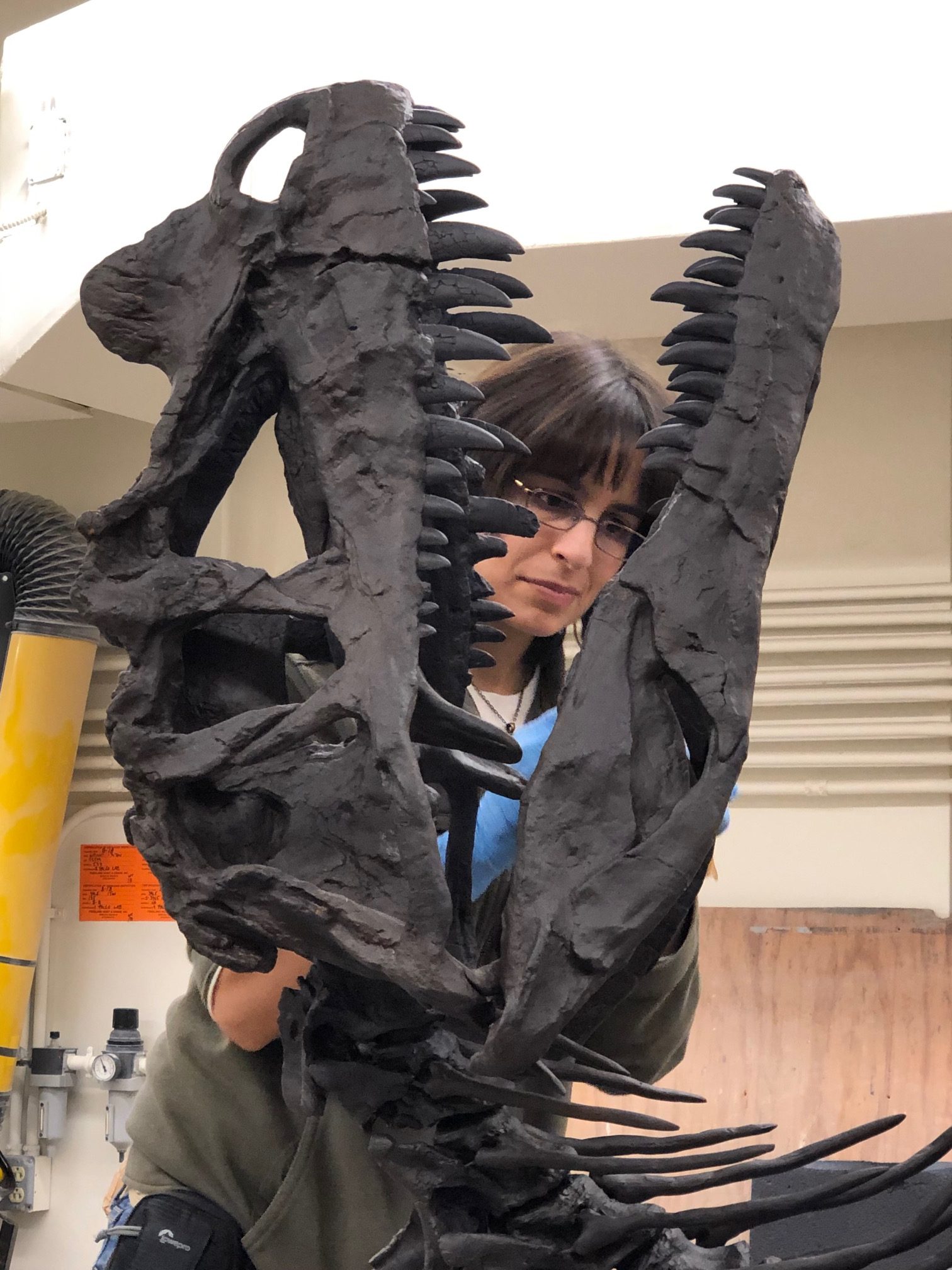
Woman working on a dinosaur skull specimen

Michelle Pinsdorf working on the cast model of the Ceratosaurus before it was installed in the David H. Koch Hall of Fossils – Deep Time.

When research is needed in a museum, a research library is essential! A publication of great help to my work is fortunately quickly accessible to me through the Smithsonian Libraries system and the Biodiversity Heritage Library. One of the crown jewels of the Museum’s collections is the nearly complete skeleton of the carnivorous dinosaur Ceratosaurus nasicornis. It is the most complete skeleton of this species found to date, originally named by Othniel Charles Marsh.

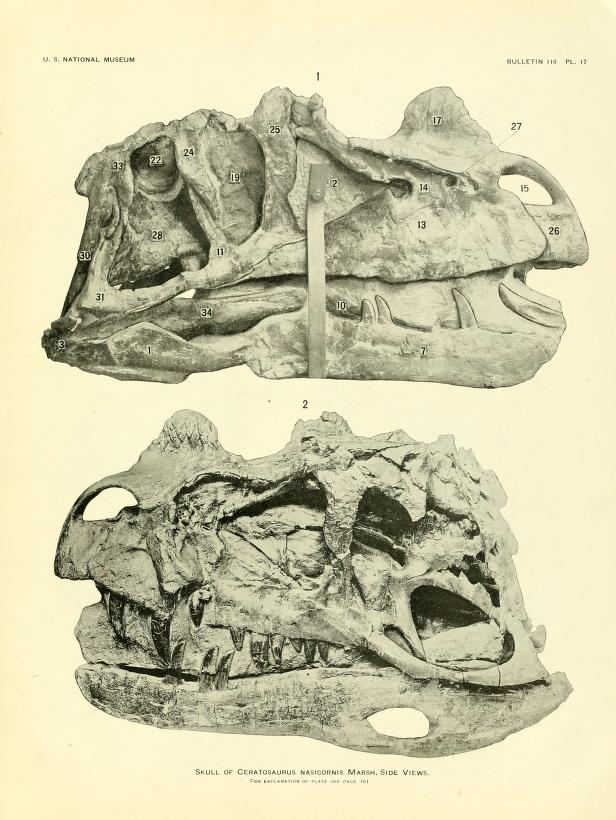
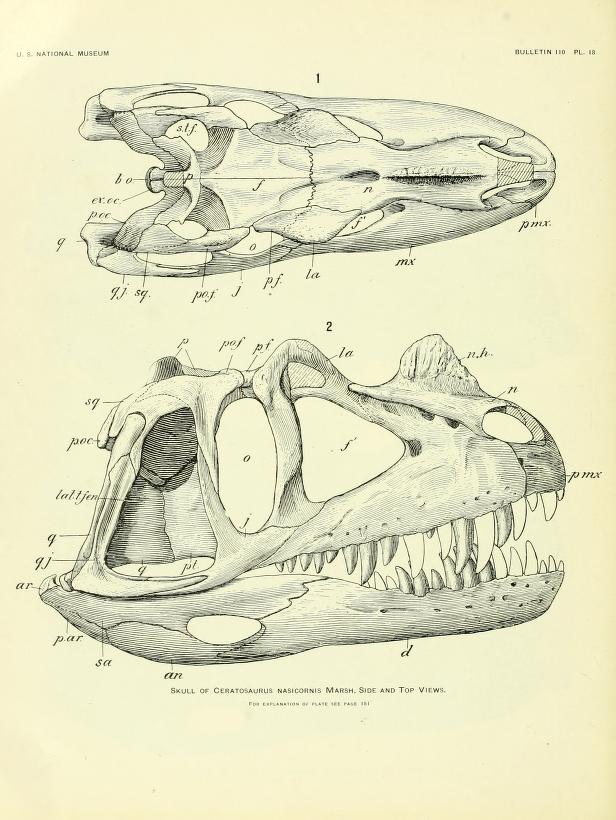
When the specimen was mounted for exhibit at the Smithsonian in 1911, it was fully described by curator Charles Whitney Gilmore, and included in the publication Osteology of the carnivorous Dinosauria in the United States National Museum: with special reference to the genera Antrodemus (Allosaurus) and Ceratosaurus, in Bulletin of the United States National Museum, volume 110. Gilmore provided detailed descriptions and illustrations of this unique specimen, figured prior to it being partially embedded in a display plaque for exhibit. Those figures and measurements proved essential to my work to re-prepare the specimen out of the plaster plaque, exposing a side of the fossils no one since Gilmore’s time had been able to see.

Illustration of a dinosaur skull

Plate depicting the skull of Ceratosaurus nasicornis from Osteology of the carnivorous Dinosauria in the United States National museum: with special reference to the genera Antrodemus (Allosaurus) and Ceratosaurus, in Bulletin of the United States National Museum, volume 110 (1920). Contributed in BHL from Smithsonian Libraries.

This fascinating specimen now gets to serve science in multiple ways. With each bone removed and cleaned, the fossils have been once again made available to paleontologists for study. Each bone was molded and cast, so that the casts could be reassembled in a dynamic new pose for public display in the new Deep Time fossil exhibit halls. The digitization of Gilmore’s publication allowed for me to quickly reference it from my workstation, my home computer, even on my phone. And the physical copy is also close at hand in the Natural History Museum itself, for when I need the kind of inspiration that comes with smelling old paper and seeing neat rows of bindings.

I look forward to seeing what new research will come from my work with Ceratosaurus, and the reactions of museum visitors when they get to see the new mount for the first time.

Illustration of a dinosaur skull

Plate depicting the skull of Ceratosaurus nasicornis from Osteology of the carnivorous Dinosauria in the United States National museum: with special reference to the genera Antrodemus (Allosaurus) and Ceratosaurus, in Bulletin of the United States National Museum, volume 110 (1920). Contributed in BHL from Smithsonian Libraries.

November 14, 2019by Joel Richard
BHL News, Blog Reel

BHL at Biodiversity Next

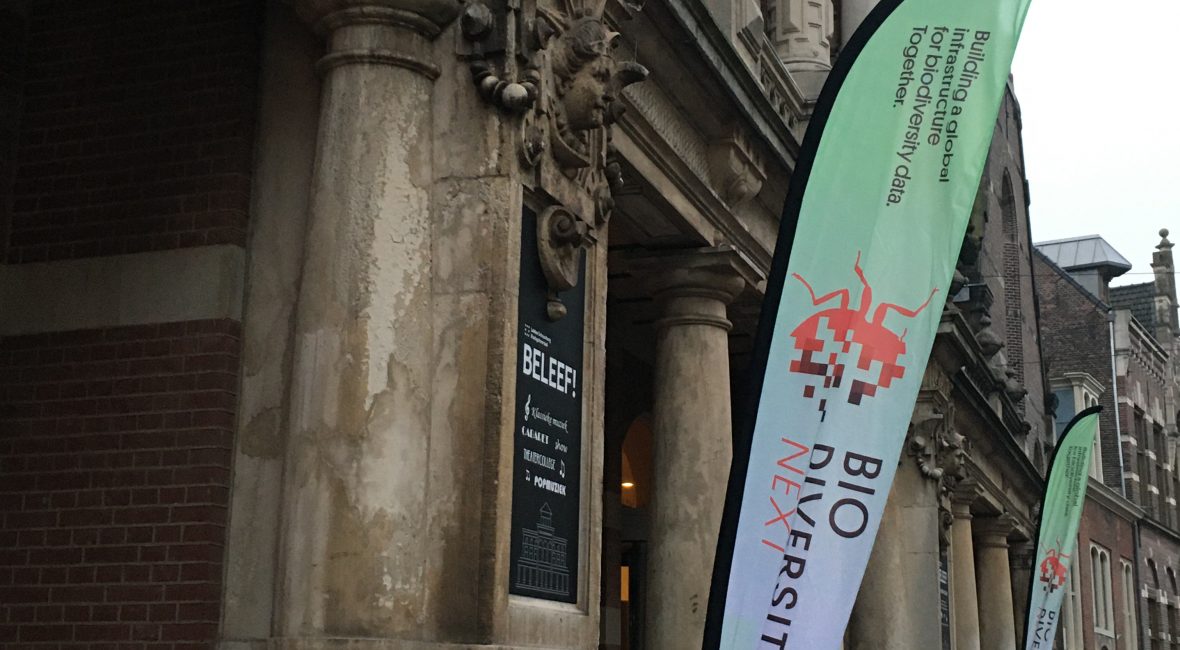
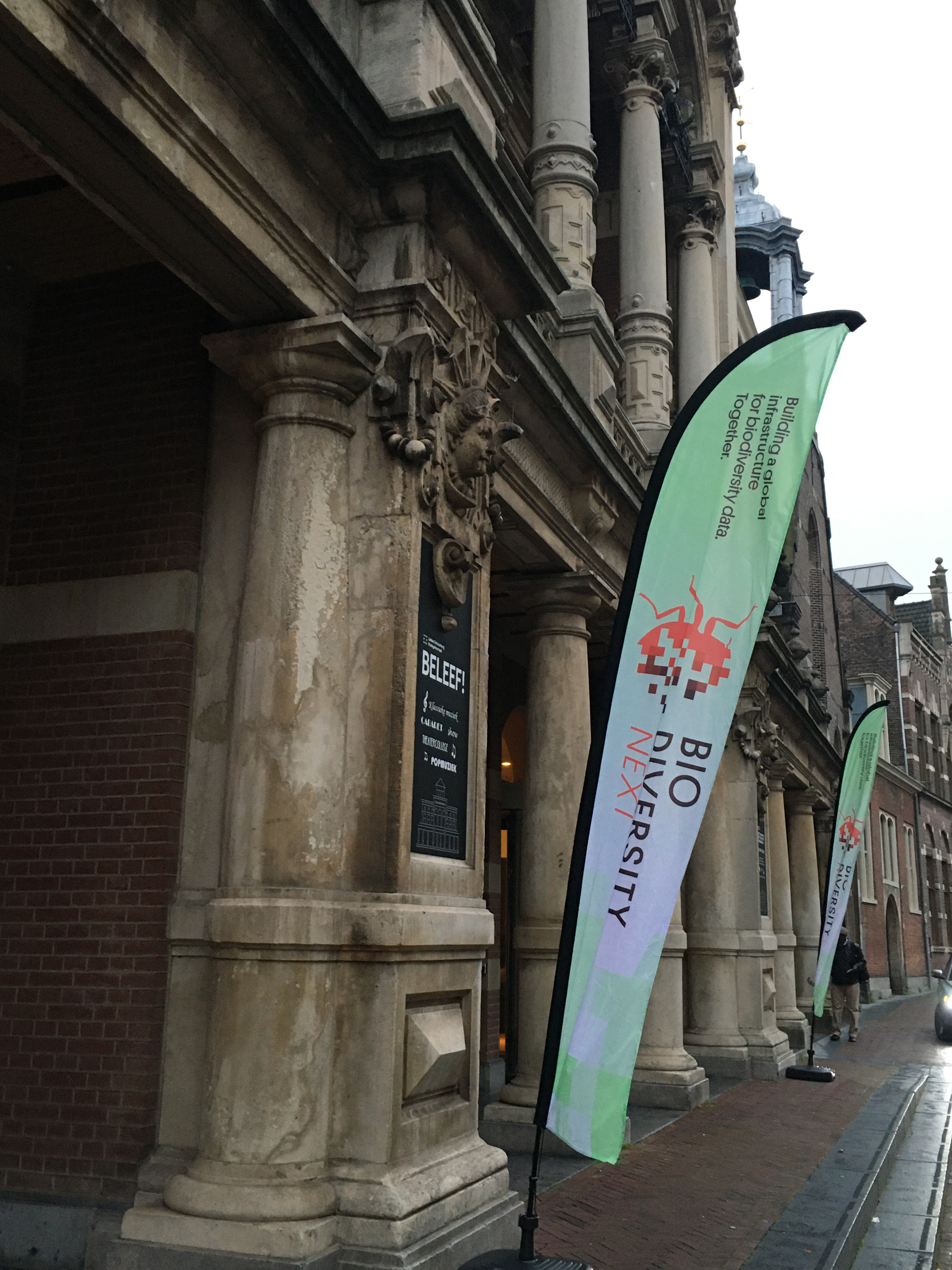
Biodiversity_Next banners

Biodiversity_Next main conference venue, Stadsgehoorzaal, in Leiden, Netherlands. Photo Credit: Grace Costantino.

In October 2019, more than 700 people from over 75 countries gathered in Leiden, the Netherlands for Biodiversity_Next, a joint conference by GBIF, DISSCo, iDigBio, CETAF, TDWG, and LifeWatch Eric. The first conference of its kind to bring together so many major international biodiversity organizations, the conference aimed to promote innovation in biodiversity and geodiversity information management and applications; encourage collaboration across these communities to enhance data standards and management practices; and foster the development of the skill sets necessary to embark on data-intensive scientific research and solutions.

Hosted by the Naturalis Biodiversity Center, a BHL Affiliate, in collaboration with the Netherlands Biodiversity Information Facility, the main conference ran from 22-25 October 2019, with pre-conference workshops occurring 20-21 October, as well as organization-specific meetings for GBIF, CETAF, and TDWG being held in conjunction with the conference.

BHL colleagues from around the world traveled to Leiden for Biodiversity_Next. Eighteen BHL-affiliated representatives from our partner community, representing 13 institutions from nine countries, attended the conference. Dr. Elycia Wallis, Engagement Manager at the Atlas of Living Australia and the BHL Member representative for BHL Australia, served as a key member of the Programme Committee.

Each conference day began with a plenary session featuring diverse speakers ranging from scientists to policy makers and even artists. From the policy perspective, Ana Maria Hernandez Salgar outlined major findings from the recent IPBESGlobal Assessment, while Jorge Soberón described efforts by the Mexican biodiversity agency CONABIO (a BHL Member) to make data useful for politicians and policy makers, and Maxwell Gomera of the UN Environment Program examined the importance of finding solutions that protect both wildlife and people and the value of using storytelling to reach policy makers in profound ways. On the science side, Paul Hebert of the International Barcode of Life Consortium described advances and ambitions in DNA barcoding and global bio-surveillance, while Carrie Seltzer spoke about the diverse and impactful ways that iNaturalist engages people in the biodiversity data system through citizen science.

The plenary sessions also brought in representatives from the world of art and design. Dutch artist Theo Jansen shared his work for the past 30 years creating “beach animals” constructed of PVC pipes that move using wind energy, while Dutch artist Jalila Essaidi described her work to create bio-art, from “bulletproof human skin” created using synthetic spider silk to clothing made from fabric produced from manure.

Beyond the plenary sessions, more than 300 speakers presented over 350 talks as part of over 60 sessions and workshops related to science, policy, standards, and infrastructure. Several major themes emerged across many of the sessions, including the importance of adopting FAIR data principles; the need to link together the many diverse biodiversity data systems; the importance of unique identifiers for data, including DOIs and ORCIDs; and the possibilities of using Wikidata as a source of and way to connect various identifiers.

BHL colleagues were very active in the conference, with 11 BHL-affiliated staff presenting or moderating 16 talks or sessions. See the full list of BHL-affiliated staff presentations at the end of this post. Additionally, members of the BHL Executive Committee (EC), including Constance Rinaldo (EC Chair, Ernst Mayr Library, Harvard University) and Martin Kalfatovic (BHL Program Director, Smithsonian Libraries), as well as colleagues from the Muséum national d’Histoire naturelle, represented BHL at the various organizational meetings, including GBIF, TDWG, and CETAF.

BHL was also highlighted frequently throughout the conference, with many talks discussing the importance of historic literature for science today, the need to integrate BHL data into other biodiversity data services like GBIF and the Catalogue of Life, and the importance of incorporating reciprocal links between BHL and these various data systems. These concepts were distinguished as a high value priority by many of the session presenters.

“Biodiversity_Next was an inspiring and exciting opportunity to hear from more than 700 colleagues representing organizations all over the world,” said Constance Rinaldo, Chair of the BHL Executive Committee. “As a representative to GBIF and TDWG and by leading a symposium, I came away fully understanding the impact of collaboration among biodiversity organizations and data integration: this is the key to the future of biodiversity science.”

BHL Symposium

The Biodiversity Heritage Library organized a Symposium as part of Biodiversity_Next. Entitled Improving Access to Hidden Scientific Data in the Biodiversity Heritage Library, the session featured presentations offering examples of and ideas about how BHL data can be used to empower research and how enhanced data delivery methods can facilitate real-time computing.

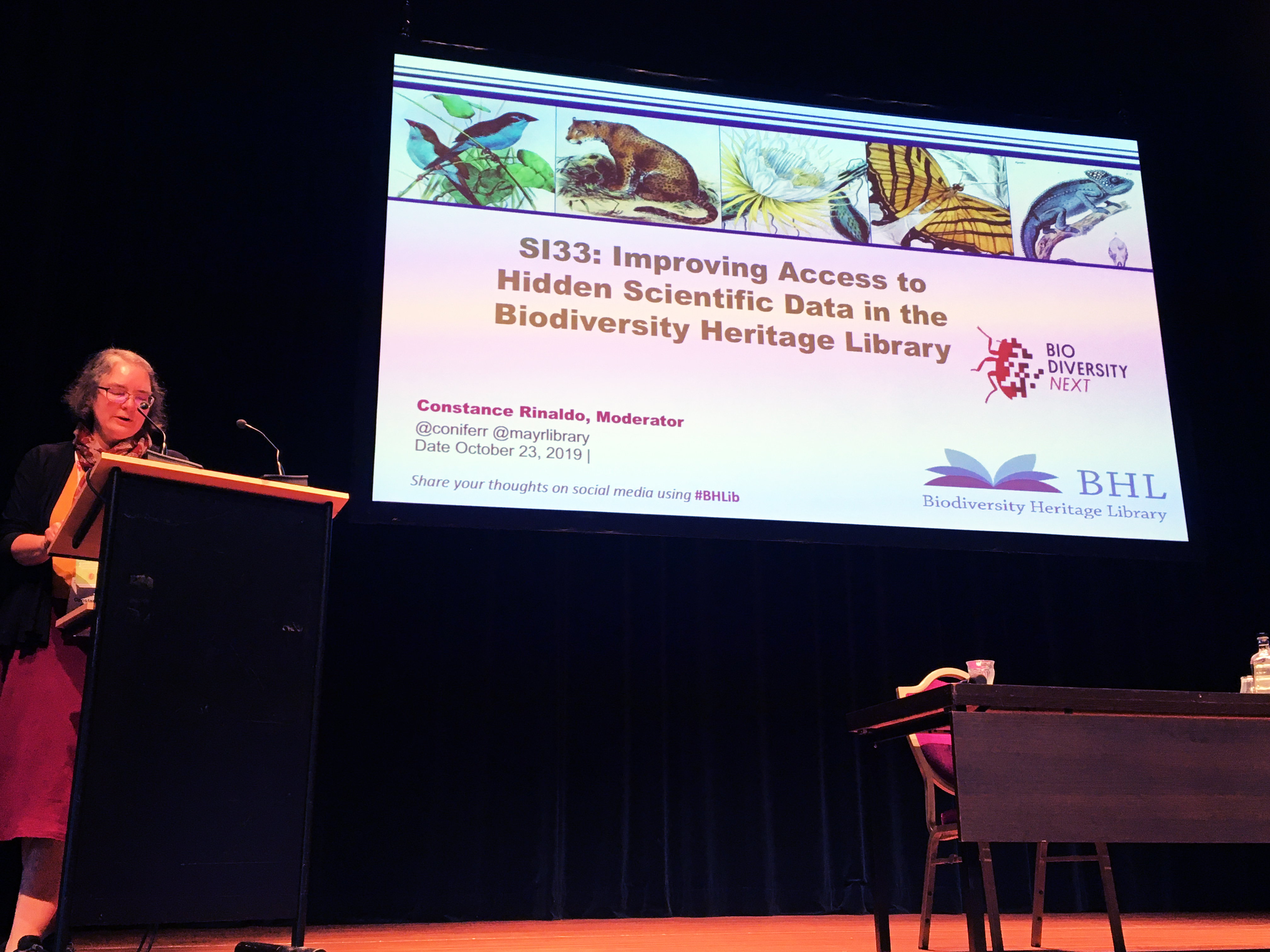
Woman standing at a podium

Constance Rinaldo introducing the BHL Symposium at Biodiversity_Next. Photo Credit: Grace Costantino.

The Symposium was moderated by Constance Rinaldo (Chair, BHL Executive Committee) and included the following presentations:

  • “Introduction to the Symposium: Improving Access to Hidden Scientific Data in the Biodiversity Heritage Library” (Presented By: Constance Rinaldo — Ernst Mayr Library, Harvard University). Abstract | Slides
  • “BioStor Next (a.k.a. Text-Mining BHL: Towards New Interfaces to the Biodiversity Literature” (Presented By: Roderic Page — University of Glasgow | BioStor). Abstract | Slides
  • “It’s Not Always FAIR: Choosing the Best Platform for Your Biodiversity Heritage Literature” (Presented By: Nicole Kearney — BHL Australia, Museums Victoria). Abstract | Slides
  • “Finding Scientific Names in Biodiversity Heritage Library, or How to Shrink Big Data” (Presented By: Dmitry Mozzherin — University of Illinois, Champaign). Abstract | Slides
  • “Extracting Data From Legacy Taxonomic Literature: Applications for Planning Field Work” (Presented By: Francisco Andres Rivera-Quiroz — Naturalis Biodiversity Center). Abstract | Slides
  • “BHL and Specimen Collection Data: The Needle in the Festuca Stack” (Presented By: Martin Kalfatovic — Smithsonian Libraries). Abstract | Slides
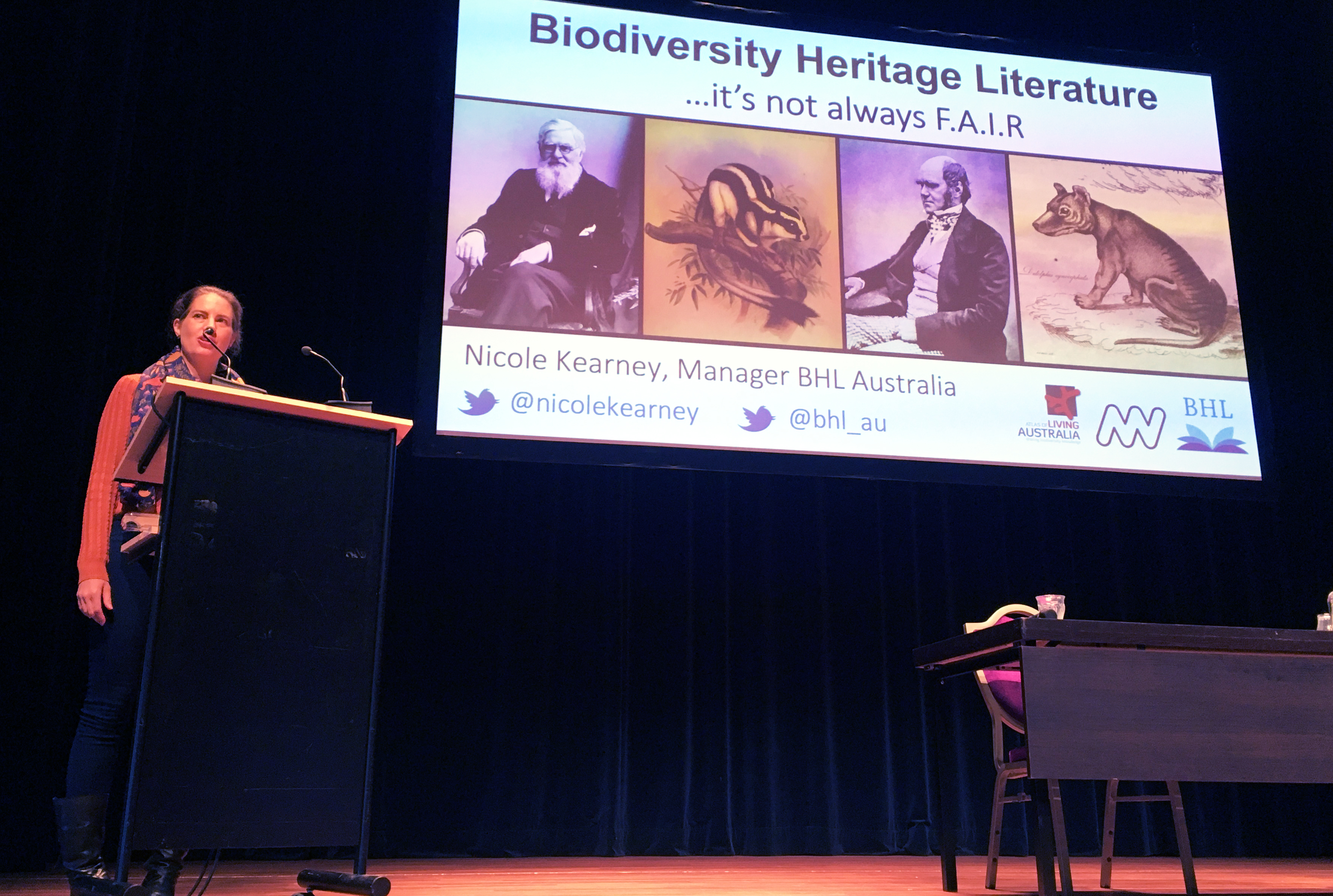
Woman standing at a podium.

Nicole Kearney presenting during the BHL Symposium at Biodiversity_Next. Photo Credit: Grace Costantino.

Topics covered within the Symposium presentations included exploring the types of data—from scientific names and geographic localities to species treatments and specimen codes—that can be extracted from the literature; methods to extract that data, including recent work to improve the speed and effectiveness of the Global Names algorithm for identifying taxonomic names in the BHL corpus; applications for that data, including helping to inform field work; recent work by BHL to improve access to the content in its collection, including full text search and the utilization of transcriptions for archival materials; the value of linking BHL literature collections with other databases like GBIF; and the importance of and the role BHL can play in the assignment of DOIs for historic literature.

You can explore more details about each of the presentations in this @BioDivLibrary Twitter thread.

Beyond the Conference

Beyond the sessions and workshops, there were several opportunities for networking and tours around the conference.

people gathered in a cafe

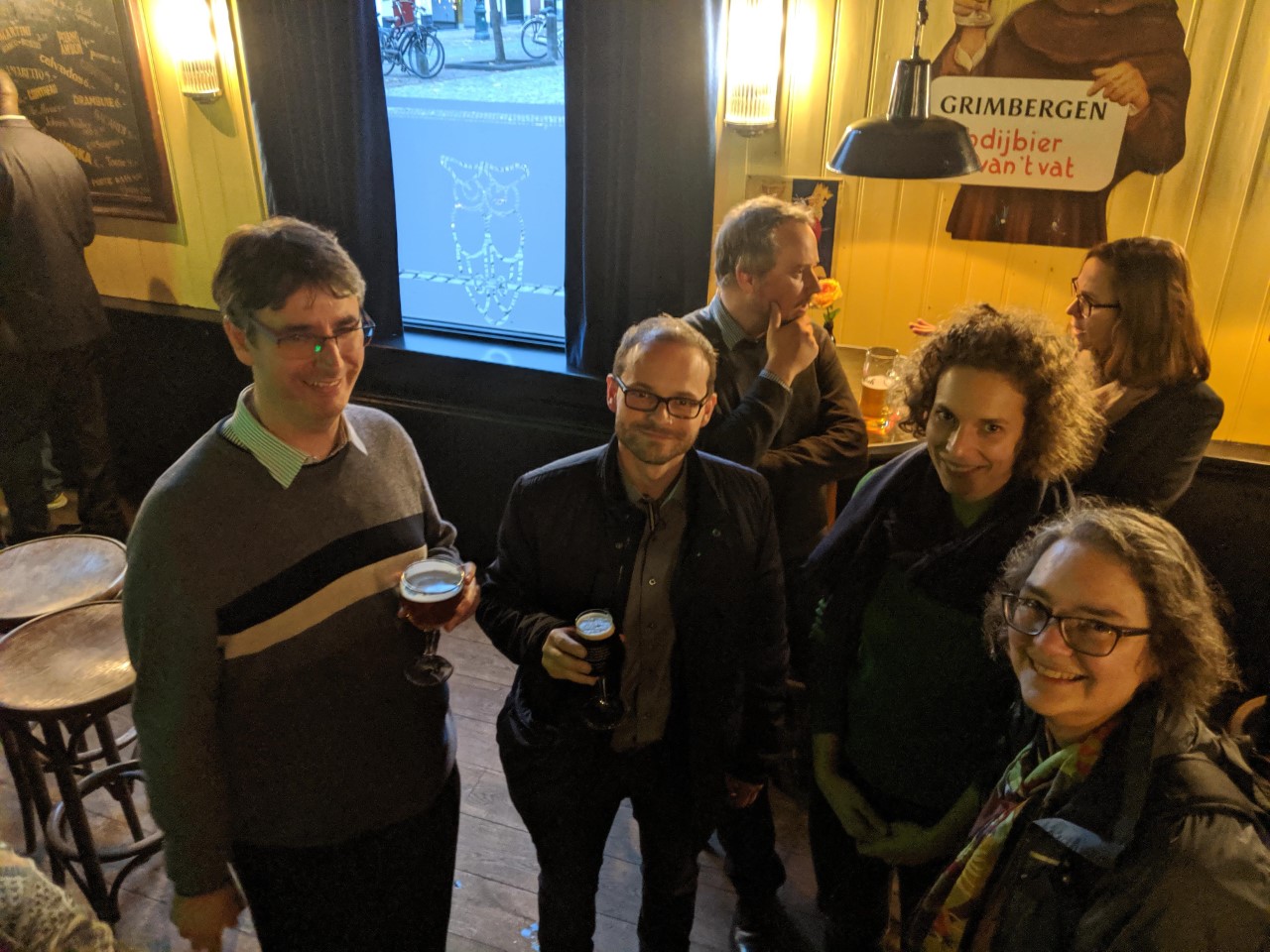
BHL colleagues gathered for the informal get-together at a local Leiden venue. Left to Right: David Iggulden (Library, Art & Archive, Royal Botanic Gardens, Kew); Clément Oury (Muséum national d’Histoire naturelle); Jiří Frank (National Museum, Prague); Chloé Besombes (Muséum national d’Histoire naturelle); Jana Hoffmann (Museum für Naturkunde Berlin); Constance Rinaldo (Ernst Mayr Library, Harvard University). Photo Credit: Martin Kalfatovic.

On Monday, 21 October, the day before the start of the main conference, BHL colleagues gathered for an informal get-together at a local Leiden venue. The gathering was an excellent opportunity for colleagues—some of which had never met in person—to connect.

large group of people at a party

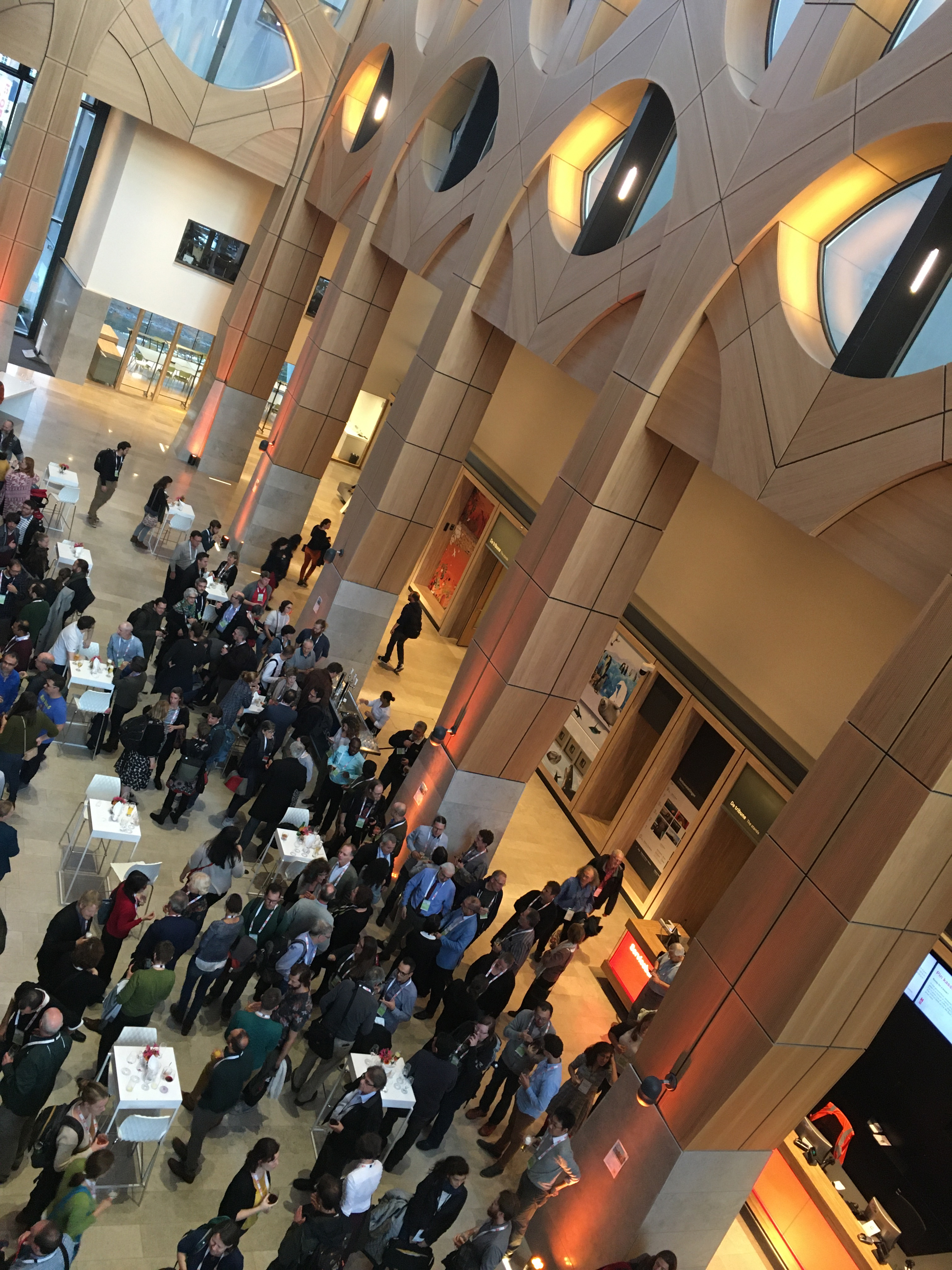
Attendees at the Biodiversity_Next reception hosted in the Naturalis Biodiversity Center. Photo Credit: Grace Costantino.

Biodiversity_Next also hosted a reception the evening of the first conference day at the newly-opened Naturalis Biodiversity Center. Hundreds of attendees had a unique opportunity to explore the museum’s exhibits and network with representatives from around the world.

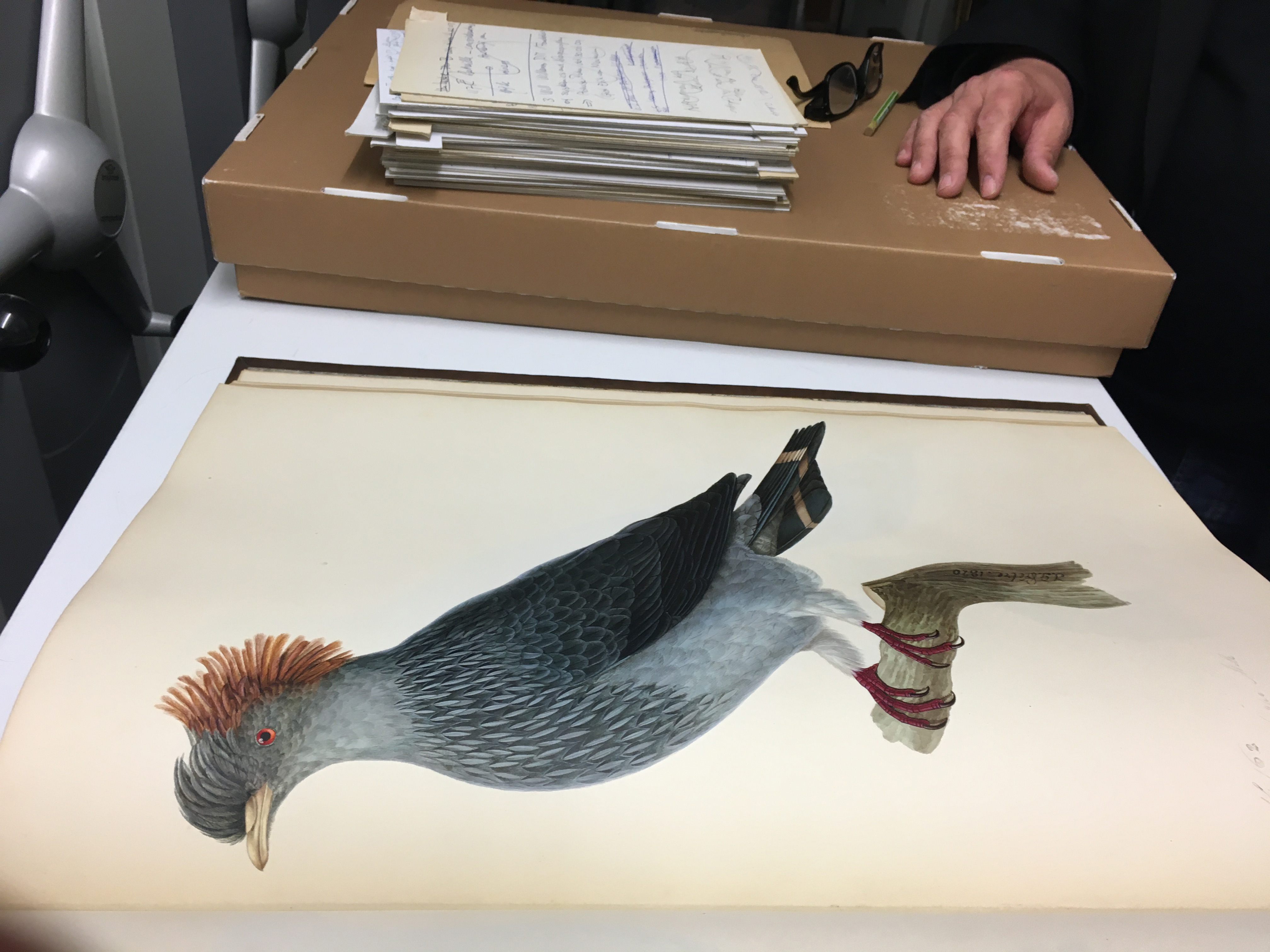
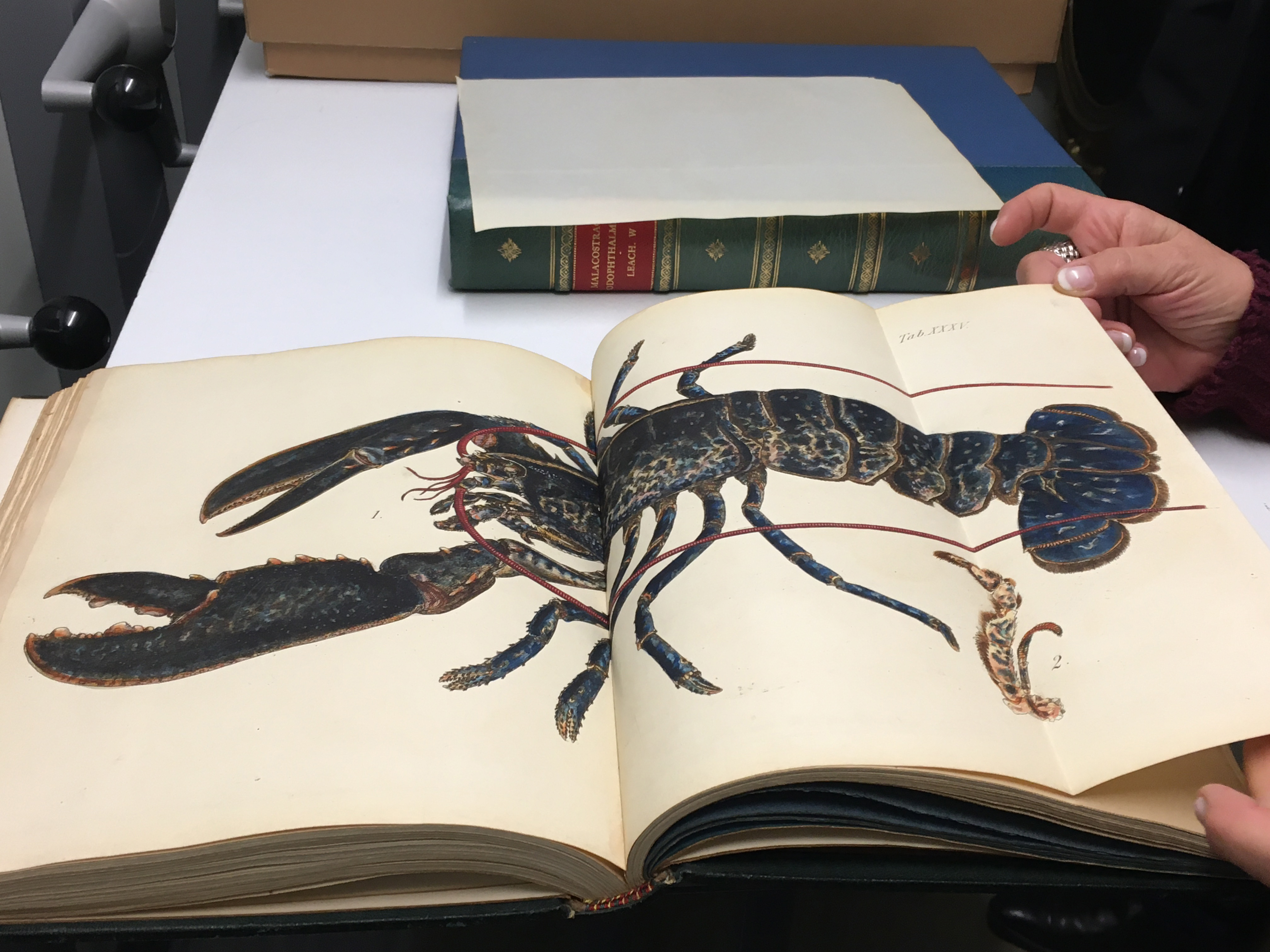
The Library of the Naturalis Biodiversity Center, a BHL Affiliate, also arranged tours of the general and special collections for several BHL colleagues. Godard Tweehuysen, Librarian and Information Specialist at Naturalis, showcased several special and unique items from the collection, including a copy of Les Pigeons (1808) by Coenraad Jacob Temminck (the first director of Rijksmuseum van Natuurlijke Historie—today Naturalis) with the original artwork by Pauline Courcelles and a special proofprint copy of Malacostraca Podophthalmata Brittanniae (1815-1875), which Naturalis has digitized for BHL and featured on the BHL blog.

drawing of a pigeon in a book

Original artwork from Les Pigeons (1808) in the Naturalis Library collection. Photo Credit: Grace Costantino.

drawing of a lobster in a book,

Proofprint copy of Malacostraca Podophthalmata Brittanniae (1815-1875) in the Naturalis Library collection. Photo Credit: Grace Costantino.

Looking ahead, during the Biodiversity_Next closing ceremony, conference organizers made an exciting announcement. A follow-up to the Biodiversity_Next conference will be held in Arlington, Virginia, USA in September 2020. The Biodiversity Summit is a joint meeting organized by iDigBio, GBIF, TDWG, and the Smithsonian’s National Museum of Natural History. Scheduled for 20-25 September 2020, the Summit will be an excellent opportunity to reconnect, continue the momentum fueled by Biodiversity_Next, and further strengthen collaborations to advance biodiversity information science and offer real, innovative, and attainable solutions to tackle today’s climate and environmental challenges.

We were privileged to be a part of such an exciting, constructive, and collaborative opportunity as Biodiversity_Next and look forward to coming together again in 2020 for the Biodiversity Summit! Until then, we’ll continue to work with the biodiversity community to incorporate data from the literature into the broader network of systems and services supporting the work of researchers, policy makers, citizen scientists and beyond.

Presentations and Moderated Sessions by BHL-Affiliated Staff from BHL Consortium Institutions

  • “The European Journal of Taxonomy: Enhancing Taxonomic Publications for Dynamic Data Exchange and Navigation” (Presented By: Laurence Bénichou — Muséum national d’Histoire naturelle). Abstract
  • “People of Collections: Facilitators of Interoperability?” (Presented By: Chloé Besombes — Muséum national d’Histoire naturelle). Abstract
  • “Hazards and Disasters in the Geological and Geomorphological Record: A Key to Understanding Past and Future Hazards and Disasters and Their Impact on Life” (Presented By: Jiří Frank — National Museum, Prague). Abstract
  • BHL Presentation as part of “Biodiversity Informatics 101: Preparing for Biodiversity_Next and Beyond” (Presented By: David Iggulden — Library, Art & Archives, Royal Botanic Gardens, Kew). Abstract
  • “BHL and Specimen Collection Data: The Needle in the Festuca Stack” (Presented By: Martin Kalfatovic — Smithsonian Libraries). Abstract | Slides
  • “It’s Not Always FAIR: Choosing the Best Platform for Your Biodiversity Heritage Literature” (Presented By: Nicole Kearney — BHL Australia, Museums Victoria). Abstract | Slides
  • “If Wikipedia Is the Gateway to Biodiversity Knowledge, How Do We Open the Gate?” (Presented By: Nicole Kearney — BHL Australia, Museums Victoria). Abstract | Slides
  • “Mesoamerica’s Crop Wild Relatives: A New Approach for Conservation Planning” (Presented By: Patricia Koleff — CONABIO). Abstract
  • “Planning Landscape Connectivity in Mexico Under Global Change” (Presented By: Patricia Koleff — CONABIO). Abstract
  • “Biodiversity Data Management: Regional Challenges” (Presented By: Lawrence Monday — National Museums of Kenya). Abstract
  • “Introduction to the Symposium: Improving Access to Hidden Scientific Data in the Biodiversity Heritage Library” (Presented By: Constance Rinaldo — Ernst Mayr Library, Harvard University). Abstract | Slides
  • “Lessons Learned From Managing Millions of Records to Create the World Flora Online” (Presented By: William Ulate — Missouri Botanical Garden). Abstract
  • “Sharing Species Pages in the Atlas of Living Costa Rica Using Plinian Core” (Presented By: William Ulate — Missouri Botanical Garden). Abstract
  • “Building a Global Infrastructure for Biodiversity Data. Together” — Plenary Panel Discussion (Moderated By: Elycia Wallis — BHL Australia, Atlas of Living Australia). Abstract
  • “A Fireside Chat – Reflections on the Conference” — Closing Ceremony Panel Discussion (Moderated By: Elycia Wallis — BHL Australia, Atlas of Living Australia). Abstract
  • “Contributed Papers: Data Extraction, Literature and Collections” (Moderated By: Elycia Wallis — BHL Australia, Atlas of Living Australia). Abstract
November 12, 2019by michelle.underhill
BHL News, Blog Reel

Now Hiring! Program Manager for the Biodiversity Heritage Library at Smithsonian Libraries

now hiring bhl program manager

Biodiversity Heritage Library and Smithsonian Libraries logos

Do you want to help empower global biodiversity research and serve as part of a vibrant, international community dedicated to providing free, worldwide access to biodiversity information? The Biodiversity Heritage Library seeks a Program Manager committed to elevating current successes and challenging our Program into the future by ensuring organizational excellence, fostering strategic partnerships, and embracing advances in digital technologies, information science, big data, and bioinformatics to serve the evolving needs of 21st century researchers.

Headquartered at the Smithsonian Institution, the Biodiversity Heritage Library (BHL) is the world’s largest open access digital library for biodiversity literature and archives. Through the collaborative efforts of a global consortium of over 80 natural history, botanical, research, and national libraries, BHL provides free access to over 57 million pages from hundreds of thousands of volumes, representing over 500 years of scientific exploration, discovery, and data. Working closely with the international community of biodiversity data providers and natural history collection service organizations, including GBIF, CoL, CETAF, TDWG, EOL and iDigBio, BHL is part of the core infrastructure for biodiversity research and data. As an important contributor to this global network, BHL helps equip researchers with the information they need to tackle today’s biodiversity, environmental, and climate crises.

As the Program Manager, you will help BHL build its partnerships and maintain and grow its infrastructure and services, ensuring that the Library fulfills the research needs of a global, diverse audience. You will be responsible for managing BHL’s administrative and financial functions and providing project management support across BHL’s global consortium. Additional responsibilities include partner stewardship; fundraising and grant-writing support; participation in national and international organizations to develop strategic partnerships; and facilitation of stakeholder input to inform BHL’s growth and development.

The Program Manager is an essential member of the BHL Secretariat located at the Smithsonian Libraries in Washington, D.C. with offices in the National Museum of Natural History. This is a GS-12 federal position (salary range USD $83,398 – $108,422) open only to U.S. citizens. It includes a comprehensive benefits package offering vacation and sick leave, life/health insurance, and retirement program options.

Visit USAJOBS.gov to apply. Applications are due by 18 November 2019.

USAJOBS announcement number 20R-SA-305207-DEU-SIL.

November 6, 2019by michelle.underhill

Help Support BHL

BHL's existence depends on the financial support of its patrons. Help us keep this free resource alive!

search

About BHL

The Biodiversity Heritage Library (BHL) is the world’s largest open access digital library for biodiversity literature and archives. BHL operates as a worldwide consortium of natural history, botanical, research, and national libraries working together to digitize the natural history literature held in their collections and make it freely available for open access as part of a global “biodiversity community.”

Join Our Mailing List

Sign up to receive the latest news, content highlights, and promotions.

Subscribe Now

Subscribe to Blog via Email

Enter your email address to subscribe to this blog and receive notifications of new posts by email.

Join 319 other subscribers

Subscribe to Blog Via RSS

Subscribe to the blog RSS feed to stay up-to-date on all the latest BHL posts.

Access RSS Feed

Inspiring Discovery through Free Access to Biodiversity Knowledge.

The Biodiversity Heritage Library makes it easier than ever for you to access the information you need to study and explore life on Earth…for free, anytime, anywhere.


64+ Million Pages of
Biodiversity Literature Online.

EXPLORE

Tools and Services
to Transform Research.

EXPLORE

300,000+
Illustrations on Flickr.

EXPLORE

ABOUT | HARMFUL CONTENT | PRIVACY | SITE MAP | TERMS OF USE