Biodiversity Heritage Library - Program news and collection highlights from BHL
  • Home
  • News
  • Featured Books
    • All Featured Books
    • Book of the Month Series
    • BHL at 20
  • User Stories
  • Campaigns
    • Fossil Stories
    • Garden Stories
    • Monsters Are Real
    • Page Frights
    • Her Natural History
    • Earth Optimism 2020
  • Tech Blog
  • Visit BHL
Home
News
Featured Books
    All Featured Books
    Book of the Month Series
    BHL at 20
User Stories
Campaigns
    Fossil Stories
    Garden Stories
    Monsters Are Real
    Page Frights
    Her Natural History
    Earth Optimism 2020
Tech Blog
Visit BHL
  • Home
  • News
  • Featured Books
    • All Featured Books
    • Book of the Month Series
    • BHL at 20
  • User Stories
  • Campaigns
    • Fossil Stories
    • Garden Stories
    • Monsters Are Real
    • Page Frights
    • Her Natural History
    • Earth Optimism 2020
  • Tech Blog
  • Visit BHL
Biodiversity Heritage Library - Program news and collection highlights from BHL
Blog Reel, Featured Books

An Annotated Copy of Butterflies of Australia by Waterhouse and Lyell (1914)

Published in 1914, Butterflies of Australia by Gustavus Athol Waterhouse and George Lyell was the first comprehensive work on Australian butterflies to appear in Western scientific literature. It is a thick and rather chunky volume, with descriptions of 332 butterfly species, and was the product of many years of research. The copy held in Museums Victoria’s Rare Book Collection is even thicker than a standard issue, as it is bound with lined pages interleaved throughout. It is an author’s copy, owned and annotated by George Lyell.
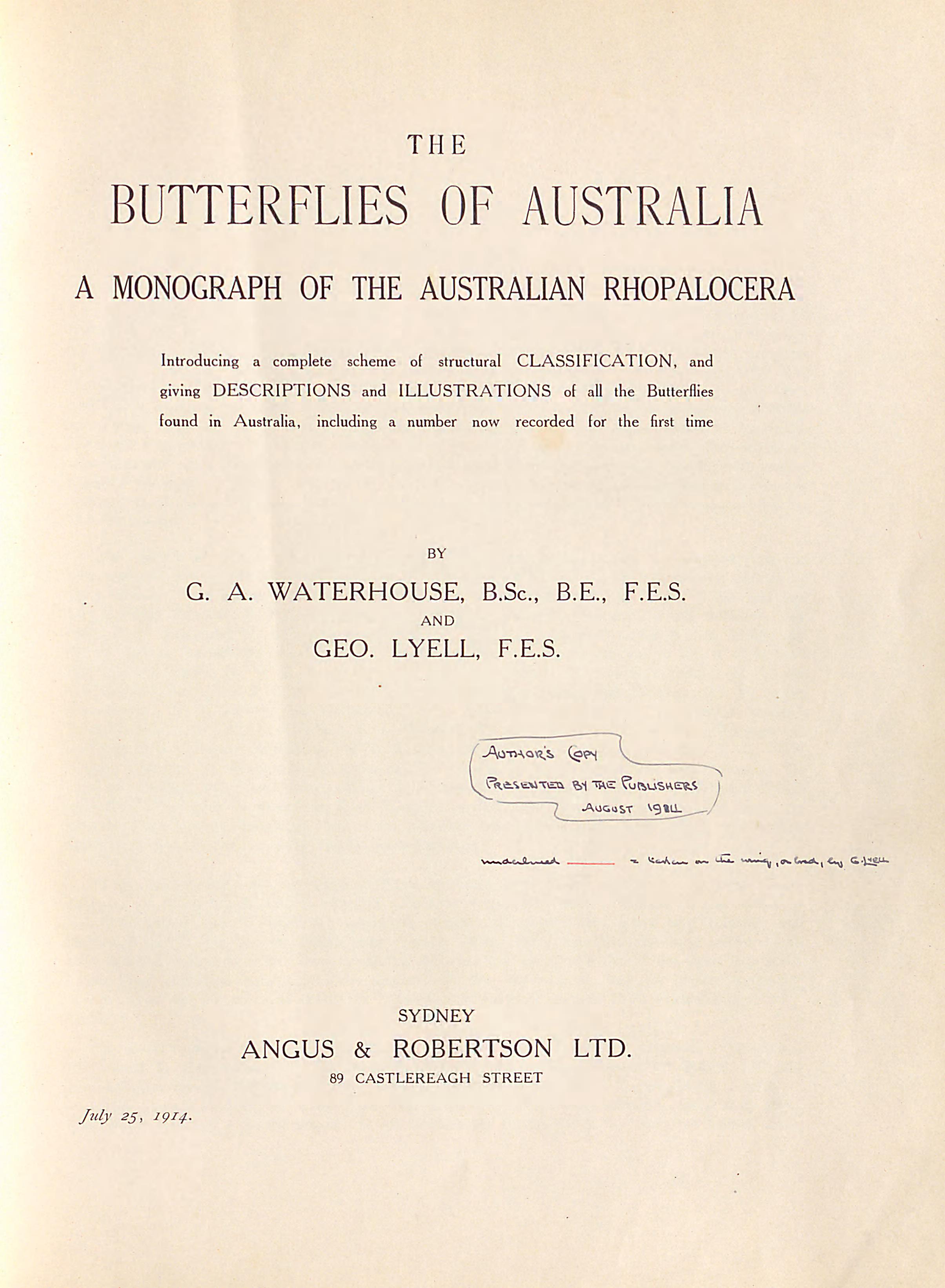
1. Inscription Lyell.jpg

Title page of annotated author’s copy of Butterflies of Australia (1914.) Contributed in BHL by Museums Victoria.

Lyell and Waterhouse worked on the book separated by some distance; Lyell’s location in Gisborne, Victoria was 862km (536 miles) away from Waterhouse’s residence in Sydney. They corresponded regularly via mail, and the Museums Victoria Archives now houses some 400 of Lyell’s letters from Waterhouse, which came to the museum with Lyell’s extensive donation of butterflies and moths in 1932. In 2019 a McCoy Seed Fund project enabled further exploration of the archival material to see what it could reveal about the scientists’ collaboration and Lyell’s collection. It also shed some light on the annotated copy in our collection.

The archival material reveals that their publisher, Angus & Robertson, prepared the handsome interleaved copy for Lyell and gave it to Waterhouse to pass on. In a letter dated 28 August 1914 Waterhouse writes “I have the interleaved copy for you, but it is much too bulky & too nicely done to trust to the post” (OLDERSYSTEM~03030, Museums Victoria Archives). Instead Waterhouse entrusted the volume to friend E. H. Proctor to give to Lyell’s brother in Melbourne.
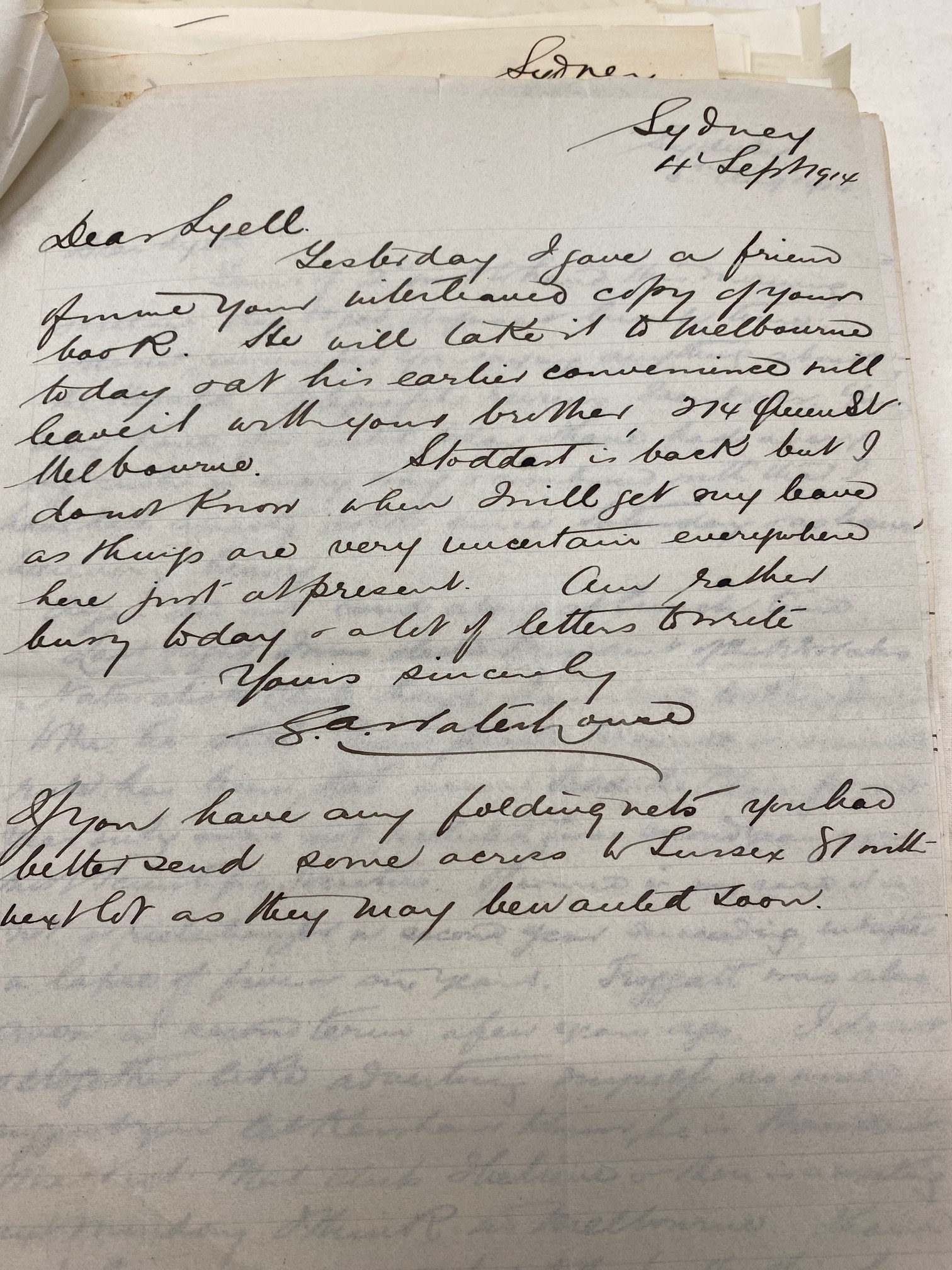
Letter to Lyell.jpg

Letter to George Lyell from his co-author and friend G. A. Waterhouse. Photo Credit: Hayley Webster / Source: Museums Victoria.

Their correspondence also demonstrates how carefully they considered every aspect of the publication. For instance, a letter to Lyell on 20 March 1914 states “I like very much the black headings as they seem to show the divisions at a glance & generally speaking I like the size of the type” (OLDERSYSTEM~03030, Museums Victoria Archives), showing that the typography was carefully considered for readability. Waterhouse was pleased with the plates, writing on 4 Feb 1914 “Dear Lyell, Coloured plate no. 1 is glorious, magnificent drawings, just showed it to [Allan Riverstone] McCulloch who was delighted with it” (OLDERSYSTEM~03030, Museums Victoria Archives).

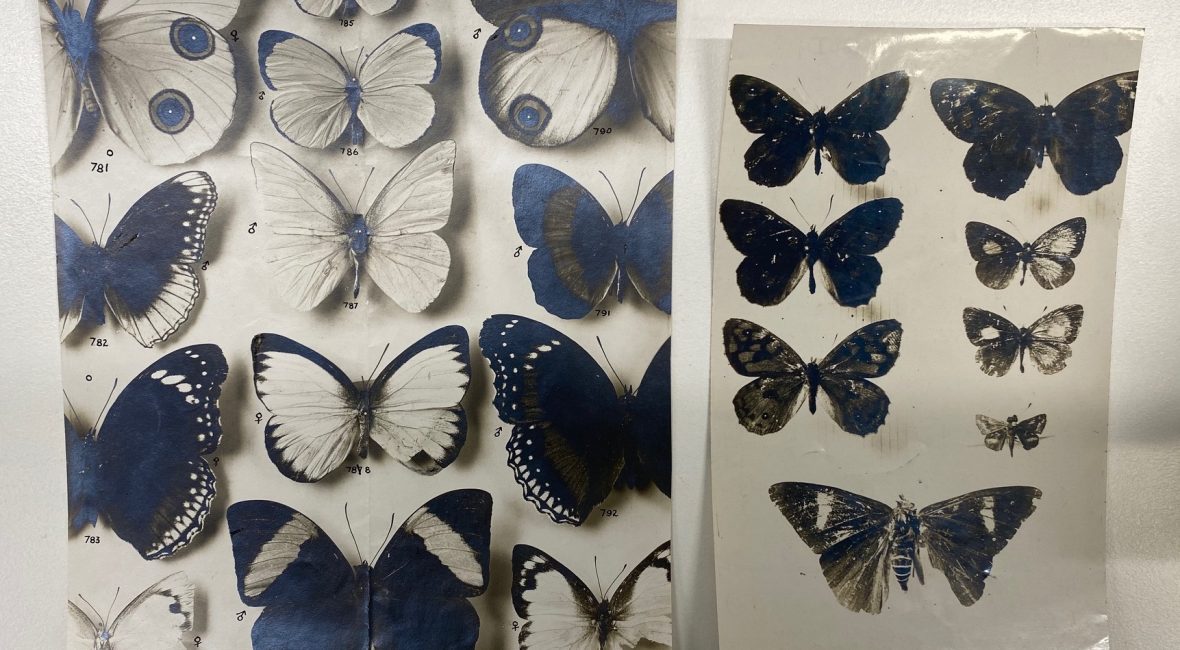
The illustrations are a combination of original drawings and photographic reproductions: original coloured plates by H. W. Simmonds, drawings of larvae and pupae by Miss J. Kong Sing, and the remaining are from photographs by Henry King. Butterflies of Australia includes 43 plates, and a total of 888 illustrations; its considerable scope and detail was considered very helpful by scientists and collectors when the book was published.

As Museums Victoria Archivist Nik McGrath recounts, Waterhouse destroyed his letters after entering the relevant scientific data onto index cards. While this might seem like a curiously destructive working method, it is not unheard of; researchers working with Charles Darwin’s correspondence have noted that he crossed out personal matters in his letters so he would not be distracted if he needed to return to them for scientific purposes [1]. In this case, in spite of the loss of Lyell’s letters, we retain a lot of the archival material relating to the book including a manuscript, index cards from Waterhouse, notebooks, proofs, black and white photographs of specimens used by illustrators for the book, specimen lists, and newspaper clippings of book reviews.
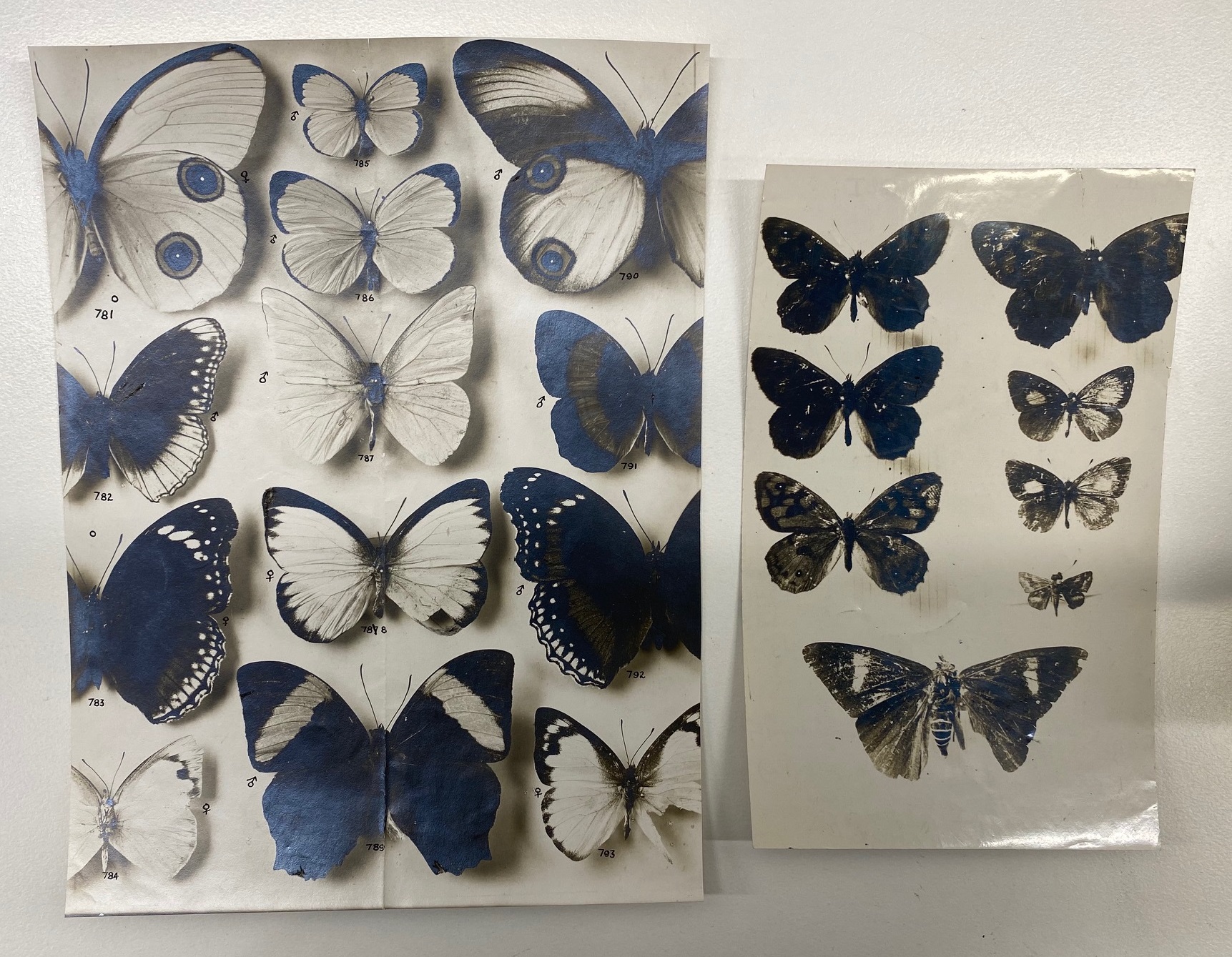
Butterfly photos.jpg

Along with many others, these photographs of butterflies were used to develop the illustrations for Butterflies of Australia. Photo Credit: Hayley Webster / Source: Museums Victoria.

In addition to looking at the archival material, an examination of the book itself is also revealing. Annotations are dated throughout the 1910s and 1920s and most appear to record sightings. In the introduction to the work, Waterhouse and Lyell note of the geographical focus of their study: “We are hoping this work will serve to indicate the need and point to that direction, and so induce collectors to aid us: we are carefully tabulating every verified record reaching us, and will much appreciate dated specimens for examination and return, especially those from points distant from localities given in our list.”

Lyell is systematic in his approach to annotations, including roughly the same information and formatting for each entry. The marginalia primarily consists of locations added to specimen descriptions, often dated, and sometimes includes a number, gender, and occasionally an elevation.

elevation crop.jpg

The initials GAW frequently appear throughout, and refer to Lyell’s co-author Gustavus Athol Waterhouse. Here Lyell notes that the species is “very plentiful at 5000ft diminishing to 4500 none lower, only few at 6000ft”. Annotated copy of Butterflies of Australia. Contributed in BHL by Museums Victoria.

There are also often initials entered next to the information, which relate to the person collecting the data, as you can see in the example above.

The annotations use a similar approach from the beginning to end of the text; Lyell underlines the printed text in pen, circling the relevant figure numbers, and then notes the date, locations and other data on the interleaved pages.
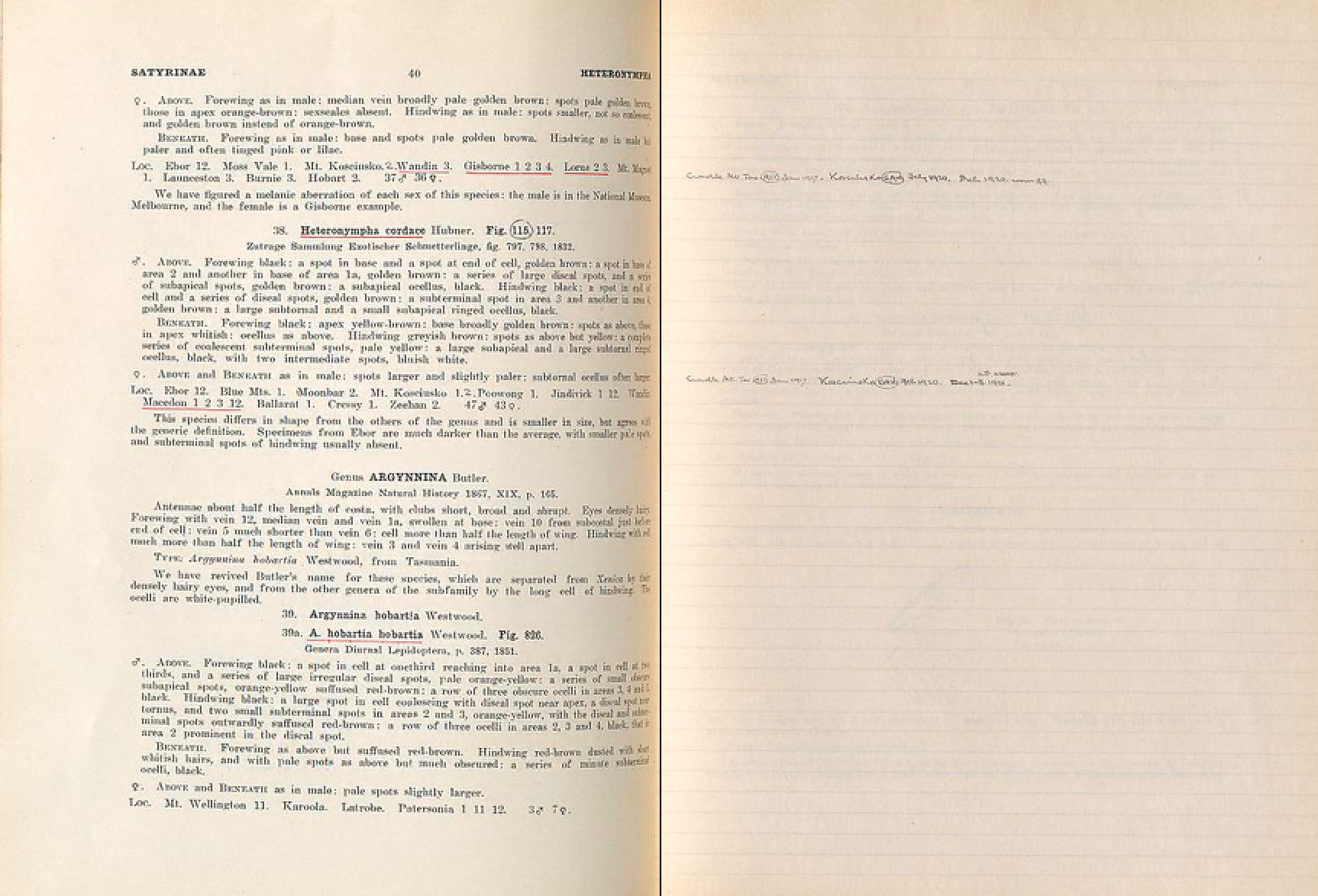
This is a typical example of how Lyell annotated his copy of Butterflies of Australia, underlining the relevant information and then adding details to the opposite interleaved page. Contributed in BHL by Museums Victoria.

Though the method of data entry is reasonably consistent, there are noticeable changes in ink, indicating that Lyell completed the annotations across a period of time. It would appear that Lyell was copying across data from other sources such as his own field notes and correspondence from other scientists as he received it.

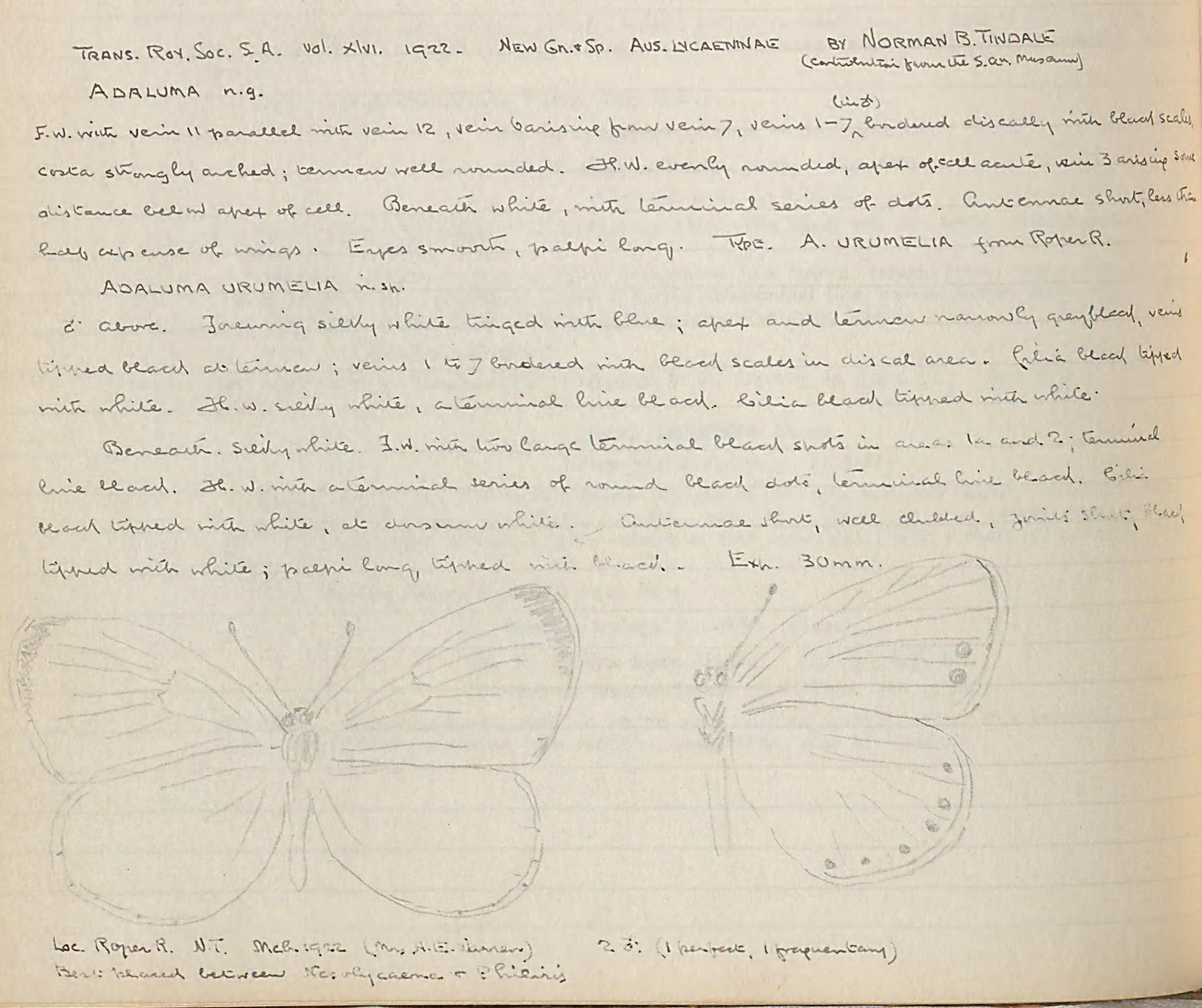
Lyell’s marginalia mainly seems to record observational data, but occasionally includes a reference to secondary reference material. One reference appears to have been copied in its entirety—this is Norman Tyndale’s description of Lycaeninae adaluma from the Transactions of the Royal Society of South Australia in 1922. Tyndale’s description references Waterhouse and Lyell’s work, and suggests a placement of the new species within their system. The placement suggested corresponds to where Lyell has copied in the description.
Revised description crop.jpg

The annotation replicates Tyndale’s description of Lycaeninae adaluma and includes a sketch of the species. Annotated copy of Butterflies of Australia. Contributed in BHL by Museums Victoria.

What exactly was Lyell doing with his annotations? It appears he was using the book to record ongoing research by himself and a group of naturalists across the east coast of Australia. H. J. Jackson notes in Romantic Readers that the practice of interleaving in books by scientists originated in earlier educational practices [2]. I have certainly come across other similar examples in the Museums Victoria Library. It is notable that Lyell’s annotations drop off after the early 1930s. He suffered an illness in 1931 that led to his decision to deposit his collection with the National Museum of Victoria. The rest of his life was dedicated to preparing his collection for transfer to the museum, and this seems to correlate to a decline in annotating.

References

  1. Gregorio, Mario A. & Gill, N. (1990) Charles Darwin’s Marginalia Vol. 1, New York, Garland, p. xiv.
  2. Jackson, H. J, (2005) Romantic Readers: the Evidence of Marginalia, New Haven & London, Yale University Press, p. 84.

Bibliography

Administration – George A. Lyell – Internal Correspondence 1891-1947- Waterhouse, G. A – Museums Victoria Archives, National Museum of Victoria OLDERSYSTEM~03030

Gregorio, Mario A. & Gill, N. (1990) Charles Darwin’s Marginalia Vol. 1, New York, Garland.

Jackson, H. J. (2005) Romantic Readers: the Evidence of Marginalia, New Haven & London, Yale University Press.

McGrath, Nik (2019) Kindred Spirits, Museums Victoria Blog, Retrieved from https://museumsvictoria.com.au/article/kindred-spirits/

McGrath, Nik (2019), Butterflies of the night, University of Melbourne Blog, Retrieved from https://blogs.unimelb.edu.au/insect-museum-collection/2019/01/30/butterflies-of-the-night/


February 27, 2020by Joel Richard
Blog Reel, User Stories

Plants and the People Who Name Them: The International Plant Names Index and BHL

photo of a woman with brown hair

At the end of the twentieth century, the The Royal Botanic Gardens, Kew, The Harvard University Herbaria, and The Australian National Herbarium began collaboration on an ambitious project—to create an online index of names for all of the world’s vascular plants [1].

By combining the data in the nomenclatural indices of these three institutions—namely Index Kewensis, the Gray Card Index, and the Australian Plant Names Index—the collaboration created the International Plant Names Index (IPNI). Hosted by the Royal Botanic Gardens, Kew, today the database includes over 1.6 million records. As part of the provided nomenclatural information, IPNI includes bibliographic details linked to scanned literature in the Biodiversity Heritage Library (BHL) and links to taxonomic data through the Plants of the World Online.

Not surprisingly, given its role as a source of scanned literature for the Index, BHL is a vital resource for those working to build and maintain the IPNI database.

“I started working for the International Plant Names Index in 2013,” says Heather Lindon, Plant and Fungal Names Editor at the Royal Botanic Gardens, Kew . “I need to be able to look up protologues—the original place of publication of plant names and their descriptions. If the earliest place of publication isn’t known, we can use the name search in BHL to try to find it. Since our modern naming system dates to 1753, BHL has a lot of relevant literature for my work. Also, the rules of the International Code of Nomenclature that govern plant names apply to names published in the past, so consulting older works is still relevant for names being published today.”

photo of a woman with brown hair

Heather Lindon, editor of the International Plant Names Index (ipni.org). Photo credit: Christodoulos Foufoulides.

Lindon has worked in the botanical sciences since 2003. Her resume is extensive and varied, and includes: serving as a paleobotanist at the Smithsonian; working on a native seed collection project at Chicago Botanic Gardens; digitizing plant specimens at the Natural History Museum, London and Kew; teaching university level botany; working in entomology on invasive plant control; running a molecular research lab; and conducting field surveys for the US Army.

For the past seven years, Lindon has worked at the Royal Botanic Gardens, Kew as an editor on the Plant and Fungal Names Curation team, which curates the name, author, and publication data in IPNI. While BHL is often praised for providing access to literature that researchers may not otherwise be able to obtain, it also helps improve the research efficiency of those who do have access to robust research libraries.

“Although the library at Kew Gardens is extensive, since I often only need to look at a single page quickly to confirm a name, it’s much faster to use BHL,” explains Lindon. “With over 1.6 million plant name records to curate, and 6,000 more added every year, anything that can speed up the process is welcome. BHL also gives me access to editions or volumes that might be missing from Kew’s Library.”

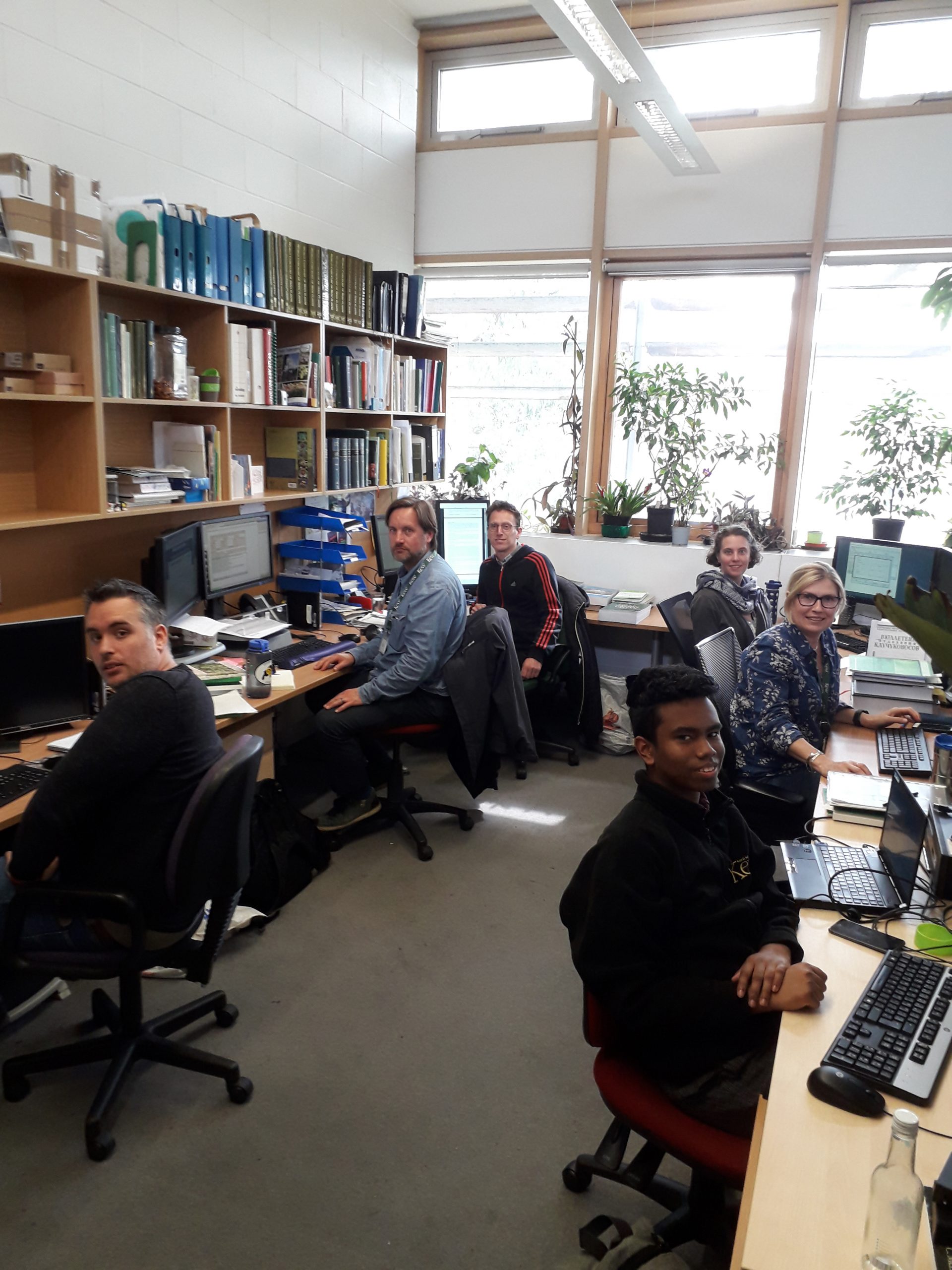
The Plant and Fungal Names team hard at work in their office at Royal Botanic Gardens, Kew. Clockwise from Front Left: Ben Moon (Checklist volunteer), Jonathan Krieger (IPNI), Rafaël Govaerts (World Checklist of Vascular Plants), Heather Lindon, Helen Hartley (both IPNI) Rahim Dina (Student Intern on IPNI to scan literature and link IPNI to BHL).

From verifying the accuracy of the place, date and publication data in IPNI to confirming original spellings, establishing the correct author of a name, or reviewing the language of the original plant description, Lindon and her colleagues use BHL almost daily. For the small team managing the IPNI database, including Lindon and two other content editors at Kew and a collaborator at Harvard University Herbarium, the access and efficiencies that BHL provides are essential.

“BHL is a fantastic tool,” lauds Lindon. “For me personally, it also allows me to work from home more often, which is a huge bonus. That would not have been possible just five or 10 years ago in this kind of work. Even when I am in the office, I can find the information I need quickly.”

The Library is also useful both for answering reference questions received from users and as a way for users to provide feedback to the IPNI team members.

“We receive emails daily from users of our database to address matters of nomenclature. Answering these questions often involves searching through BHL’s literature,” shares Lindon. “Our users who send in questions and corrections can also send us a link directly to the relevant BHL page, which means we can sort out and answer their questions quickly.”

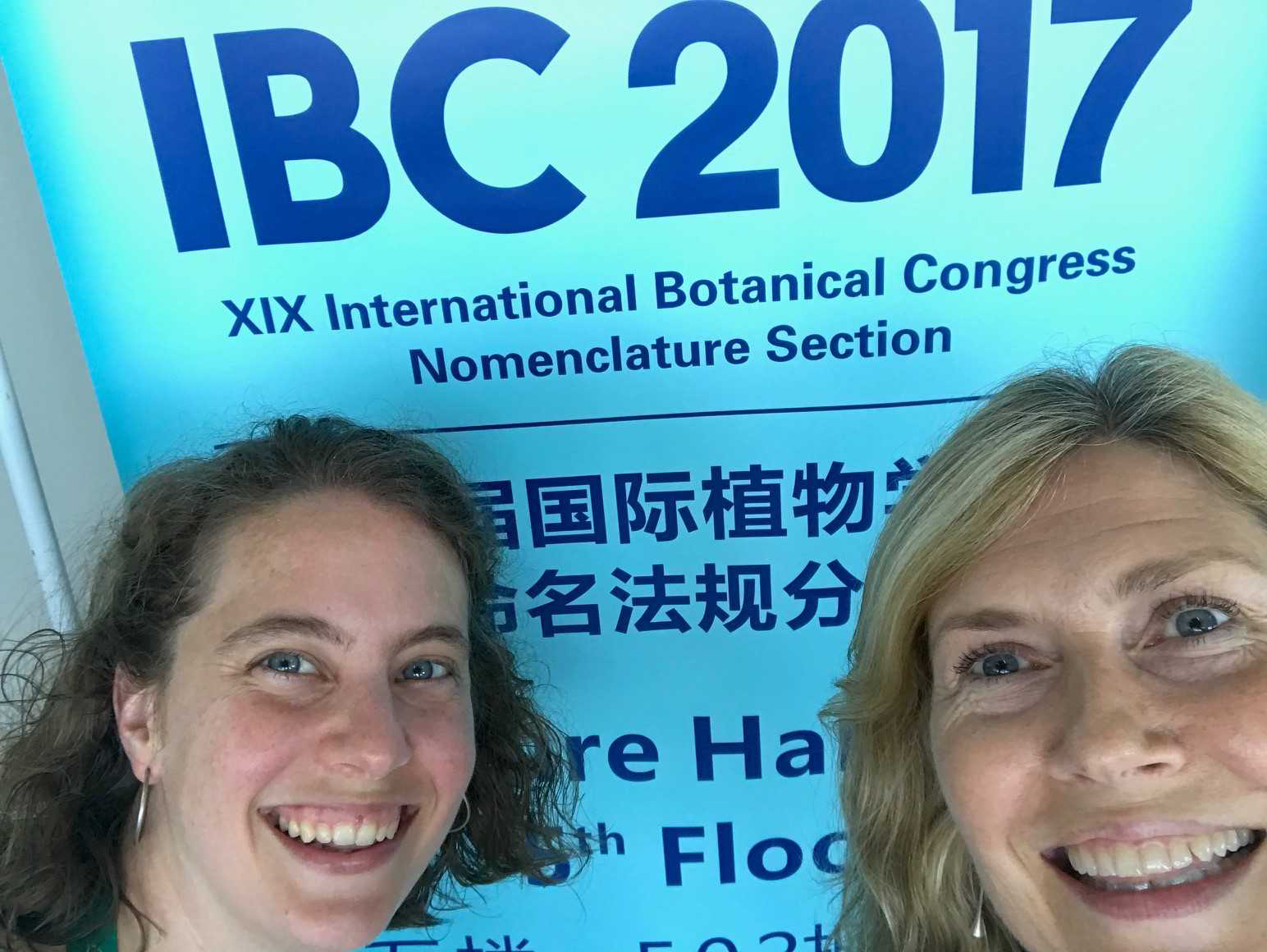
The chance to get together every 6 years to discuss nomenclature for a week is very exciting – for a nomenclaturist! IPNI team members Heather Lindon and Helen Hartley went to the conference in Shenzhen, China in 2017. Photo credit: Helen Hartley.

While BHL is an important repository of scanned literature for the database, inserting links to relevant pages on BHL was once a manual process for Lindon and her colleagues. However, a redesign of the IPNI website dramatically improved this workflow by making use of BHL’s OpenURL Resolver to create dynamic links to BHL pages.

“When IPNI designed its new website, we made sure that it could parse the information about the publication title, volume page and year,” says Lindon. “That means we don’t have to make individual links from names in our system to BHL. We can just tidy up the publication details in one go, and it will automatically link to the correct page in BHL.”

Lindon hopes that IPNI and BHL can build upon this progress to collaborate even further in the future.

“We would like for there to be stronger ties between the IPNI name list and the scientific name finder in BHL,” asserts Lindon. “That will make it easier for us to find names for keeping the database updated, but also for users to find literature on plant names in the search.”

While there are many publications in the Library are are useful for her research, such as the digitized volumes of the original printed copies of Index Kewensis, Lindon’s favorite publication in BHL is Taxonomic Literature 2 (TL-2). TL-2 is a 15 volume guide to the literature of systematic botany published between 1753 and 1940. It serves as the standard by which authors’ names and titles should be abbreviated in works on systematic botany [2].

“Having Taxonomic Literature 2 scanned means that we can easily link to it in our system,” shares Lindon. “If there is a question of publication date or authorship, we can click right through from the author’s record in IPNI and find the answer in TL-2 via BHL.”

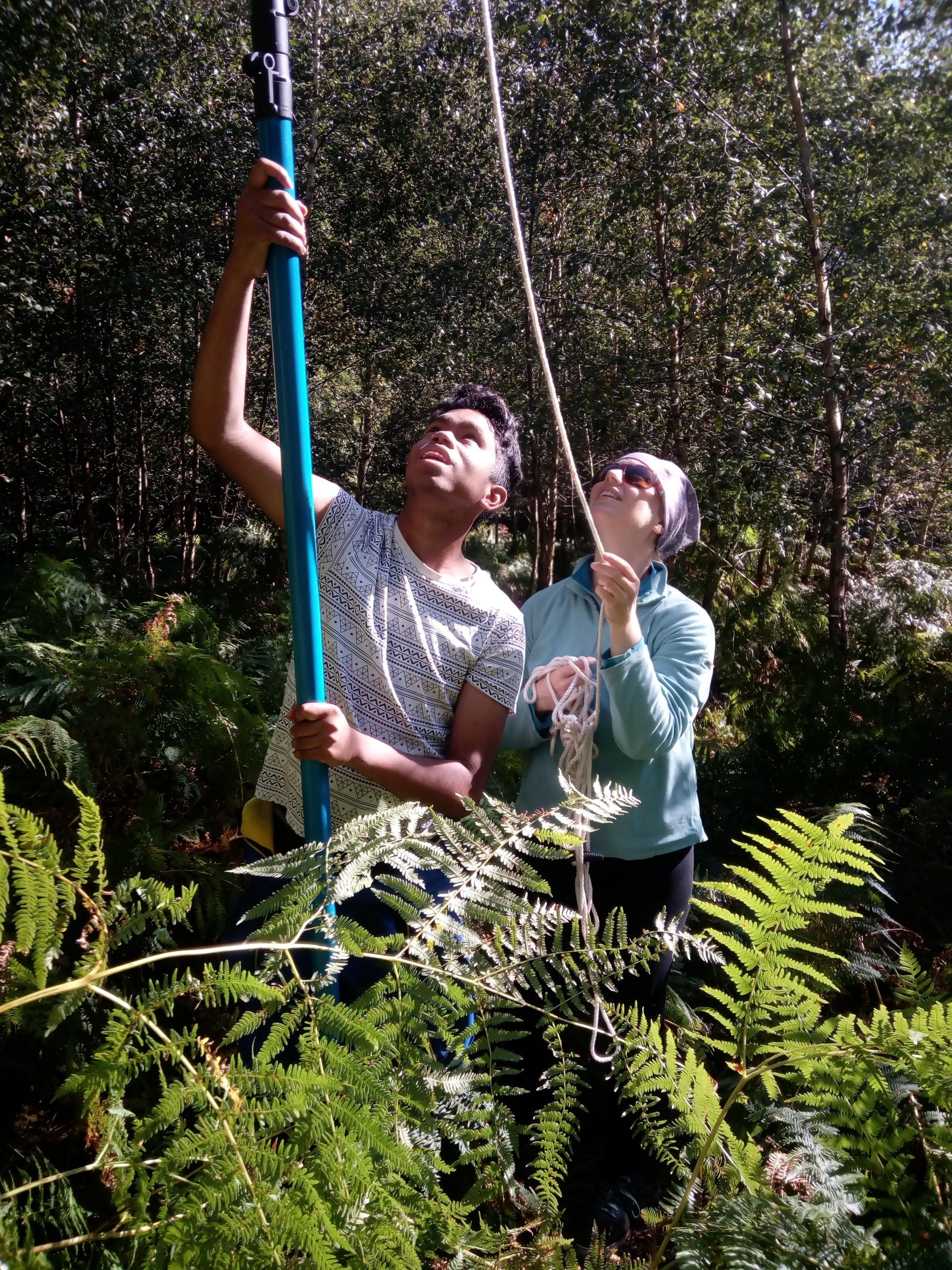
Occasionally, the IPNI team does get out of the office for other projects. Heather Lindon and IPNI Intern Rahim Dina did some seed collecting for Kew’s UK Native Tree Seed Collecting project. Photo credit: Fran Culverhouse.

As an enthusiastic BHL user, Lindon is not only grateful for the support that BHL provides to herself, her colleagues, and the IPNI user community, but she is also proud that her institution is part of BHL’s global consortium—a passionate community working to ensure that everyone, everywhere has access to essential literature.

“It’s been good for Kew’s scientific library to be able to share what they have with users around the world,” affirms Lindon. “BHL makes the information that is often hidden away in institutions accessible, especially for those who might not always have access to a botanical library.”

We are proud to know that BHL is such a vital resource for the International Plant Names Index and its community of editors and users, allowing the Library to support the progression of the plant sciences and the work of systematic botanists around the world.

References

[1] Croft, J., Cross, N., Hinchcliffe, S., Lughadha, E.N., Stevens, P.F., West, J.G. and Whitbread, G. (1999), Plant names for the 21st century: the International Plant Names Index, a distributed data source of general accessibility. TAXON, 48: 317-324. doi:10.2307/1224436

[2] Smithsonian Libraries. “Taxonomic Literature II (TL-2).” Collections. Accessed on December 4, 2019. https://www.sil.si.edu/DigitalCollections/tl-2/.

February 20, 2020by michelle.underhill
BHL News, Blog Reel

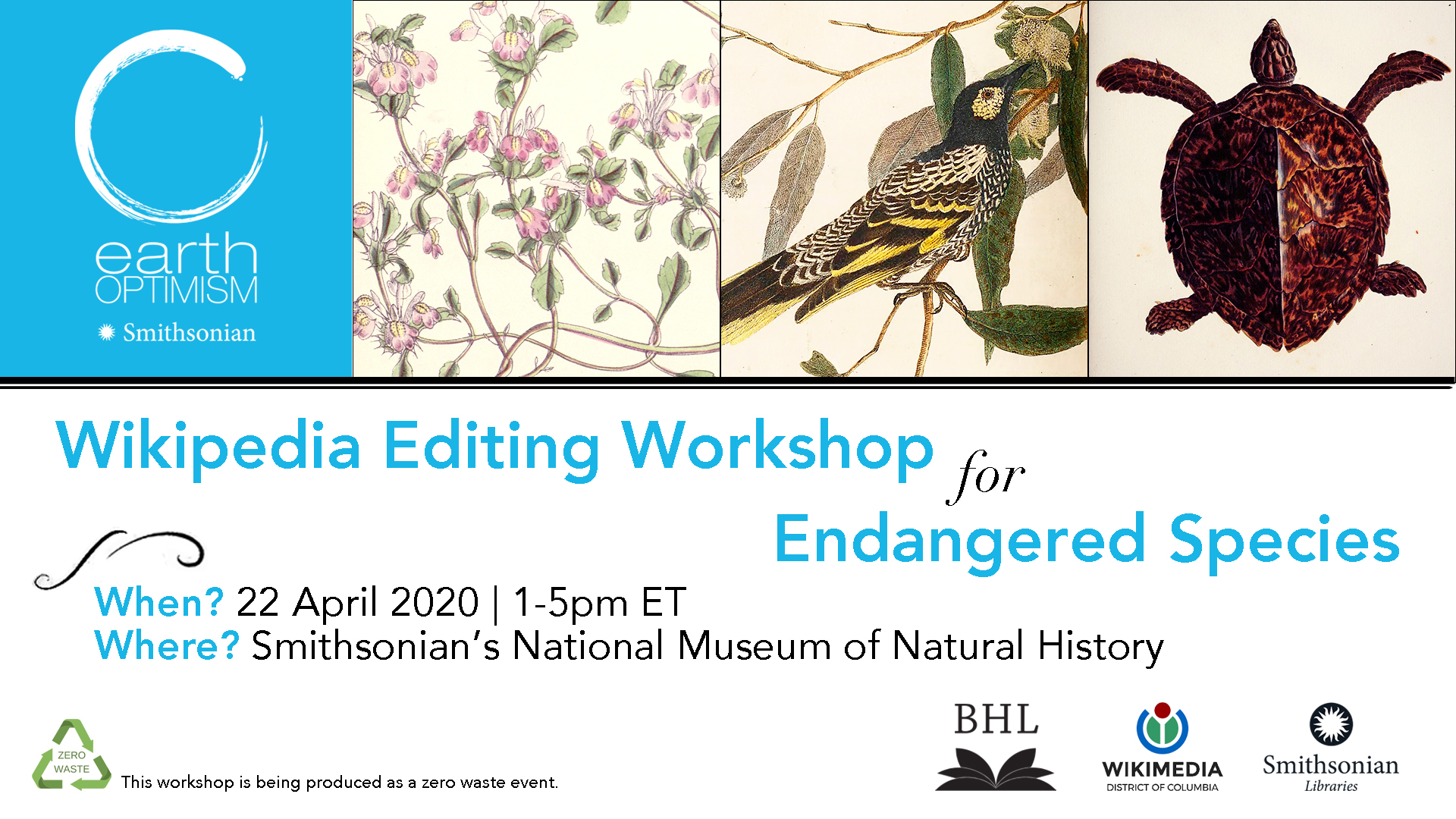
Earth Optimism Wikipedia Editing Workshop on Endangered Species at Smithsonian Libraries (22 April 2020)

graphic for wikipedia workshop with illustrations of endangered species

This Wikipedia Editing Workshop has been postponed for a later date. Please stay tuned – we will update when a new date is determined.

All Smithsonian museums and Smithsonian Libraries locations continue to be closed to support the effort to contain the spread of COVID-19. A re-opening date has not been announced at this time. Smithsonian will provide updates on a regular and as-needed basis. See http://si.edu/events for details.

graphic for wikipedia workshop with illustrations of endangered species

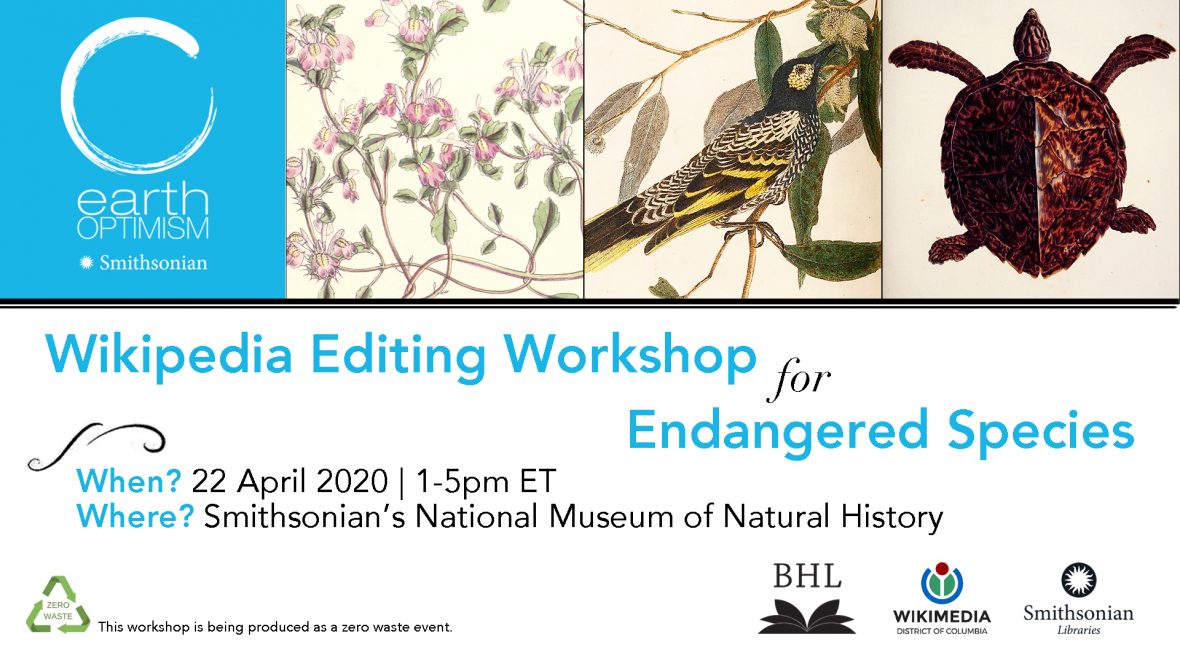
The illustrations of endangered species featured in this graphic are part of the suggested worklist for this workshop. Left to Right: San Diego thornmint (Acanthomintha ilicifolia), endangered under the California Endangered Species Act. Art by Matilda Smith for Curtis’s Botanical Magazine, v. 110 (1884). Contributed in BHL from the Peter H. Raven Library of the Missouri Botanical Garden. | Regent honeyeater (Anthochaera phrygia), critically endangered on the IUCN Red List. Art by John William Lewin from his A Natural History of the Birds of New South Wales: collected, engraved and painted faithfully after nature, 3rd ed. (1822). Contributed in BHL from Museums Victoria. | Hawksbill sea turtle (Eretmochelys imbricata), critically endangered on the IUCN Red List. Art from Naturgeschichte der Schildköten by Johann David Schöpf (1792-1801). Contributed in BHL from Smithsonian Libraries.

This year marks the 50th anniversary of Earth Day. In celebration, the Biodiversity Heritage Library (BHL) and our partners are joining the global Earth Optimism movement.

Spearheaded by the Smithsonian, Earth Optimism is a global event and movement to shift the conservation conversation from one of doom and gloom to hope and optimism. Occurring throughout 2020, Earth Optimism invites participants to celebrate conservation success stories and inspire continued success through social media, events, and other outreach opportunities.

BHL and our partners will be participating in the Earth Optimism movement with a social media campaign this April (3-30 April 2020). Follow our blog for more information coming next month about the campaign.

As part of our participation in Earth Optimism, several BHL partners, including Smithsonian Libraries, will host events on Earth Day, 22 April 2020. Find information about the Smithsonian event below and stay tuned for more information about Earth Optimism events from other BHL partners to be announced soon.

Smithsonian Earth Optimism Wikipedia Editing Workshop on Endangered Species (Washington, DC)

Help improve information in Wikipedia about endangered species as part of the Earth Optimism Wikipedia Workshop on Endangered Species hosted by the Smithsonian Libraries (Washington, D.C.) with support from Wikimedia DC.

Drawing on BHL’s free and extensive online collections as source materials, attendees will help to improve information about endangered species in Wikipedia — the third most-visited website in the world in 2019. By including citations to materials in BHL, attendees will provide easy access points for researchers and the public alike to primary data about these species while also helping to raise public awareness about many endangered species, which can be the first step in gaining momentum for conservation activities.

When? Wednesday, 22 April 2020, 1-5pm ET
Where? Smithsonian’s National Museum of Natural History, Washington, D.C.

Laptops are required. Please bring your own. Wikimedia has two laptops to loan. Reserve one by emailing [email protected]. This event is free and open to the public, but space is limited, so register today.

Registration is required:

  • Register for the Smithsonian Workshop

More Information:

  • Smithsonian Wikipedia Event Page
February 11, 2020by michelle.underhill
Blog Reel, Featured Books

Flora Graeca: “The Most Costly and Beautiful Book Devoted to Any Flora”

plants
plants

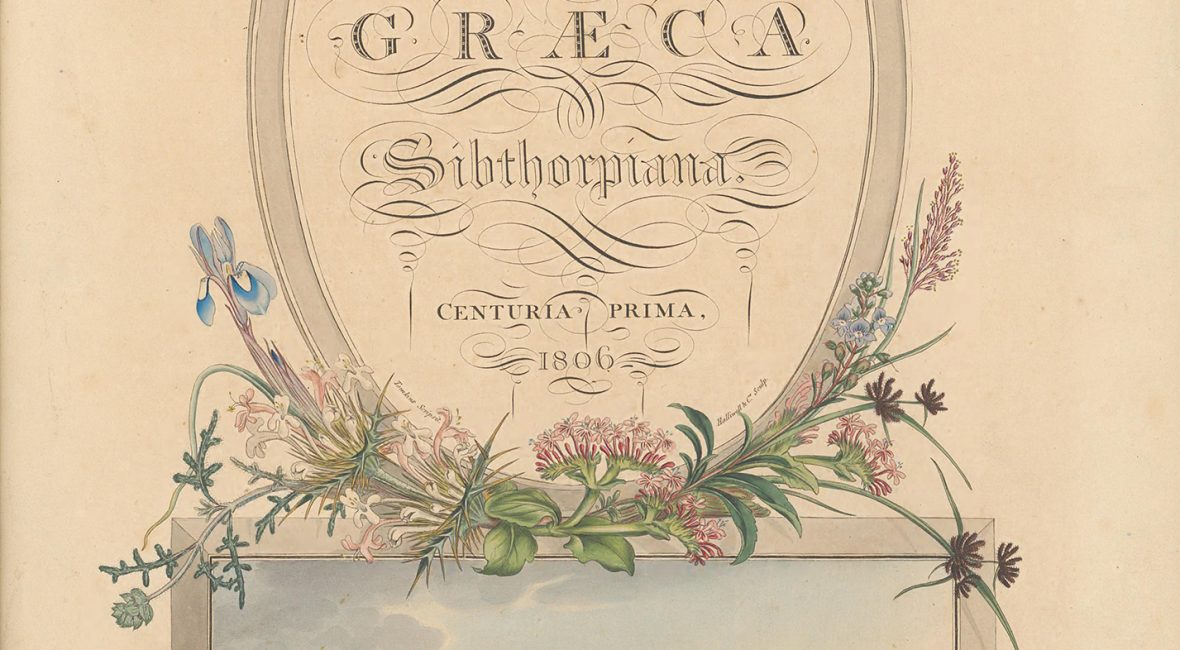
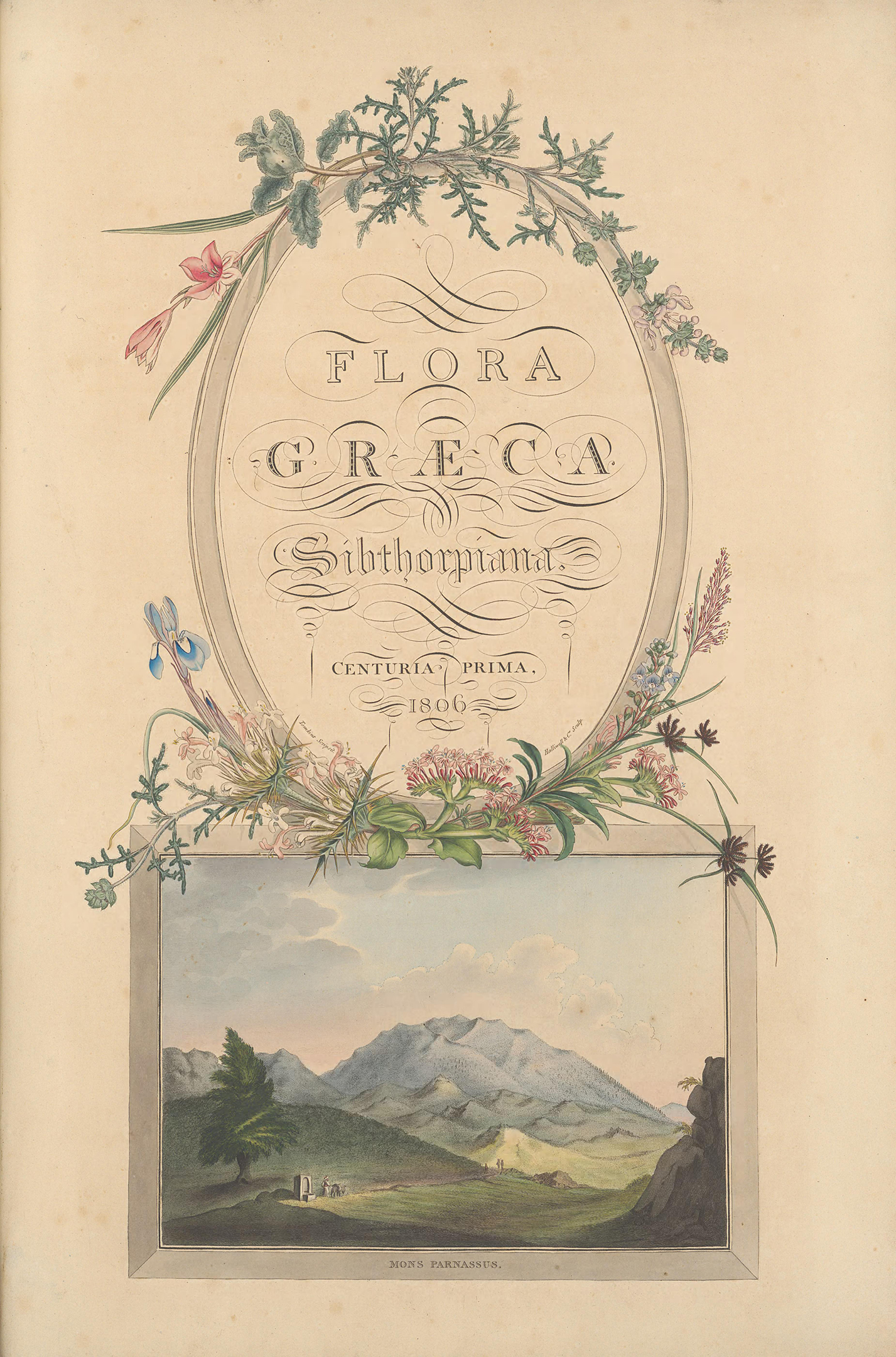
Title page. Sibthorp, John. Flora Graeca. v. 1 (1806). Contributed in BHL from Lloyd Library and Museum. Digitized by Public Library of Cincinnati and Hamilton County.

John Sibthorp’s Flora Graeca (1806-1840) has been described as “the most costly and beautiful book devoted to any flora” [1]. Dedicated to the plants of Greece and the eastern Mediterranean, only 30 subscriptions for the first edition were sold and of those, only 25 were completed. While each copy was sold for £254, the cost to produce each copy was about £620 [2, 176].

Flora Graeca arose out of botanical expeditions carried out by English botanist John Sibthorp in Greece and Asia Minor between 1786-87 and 1794-1795. Sibthorp employed Austrian artist Ferdinand Lukas Bauer to accompany him on the first expedition and serve as illustrator. During the expedition, Bauer created around one thousand plant sketches, using a color coding process to record the exact colors of the specimens he observed in the field, allowing him to produce accurate final drawings based on his field sketches [3].

plants

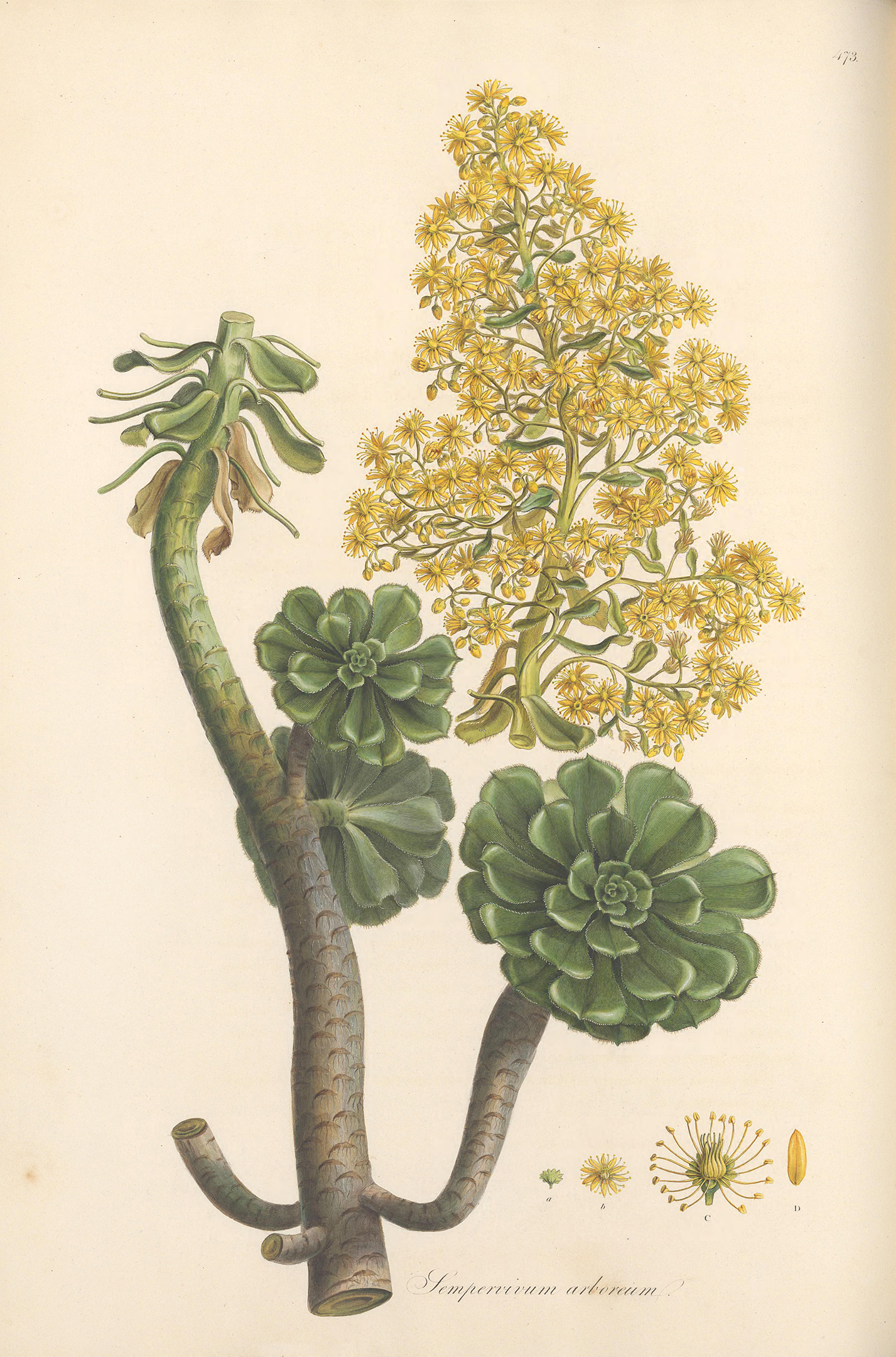
Plate 473. Sibthorp, John. Flora Graeca. v. 5 (1825). Contributed in BHL from Lloyd Library and Museum. Digitized by Public Library of Cincinnati and Hamilton County.

plants

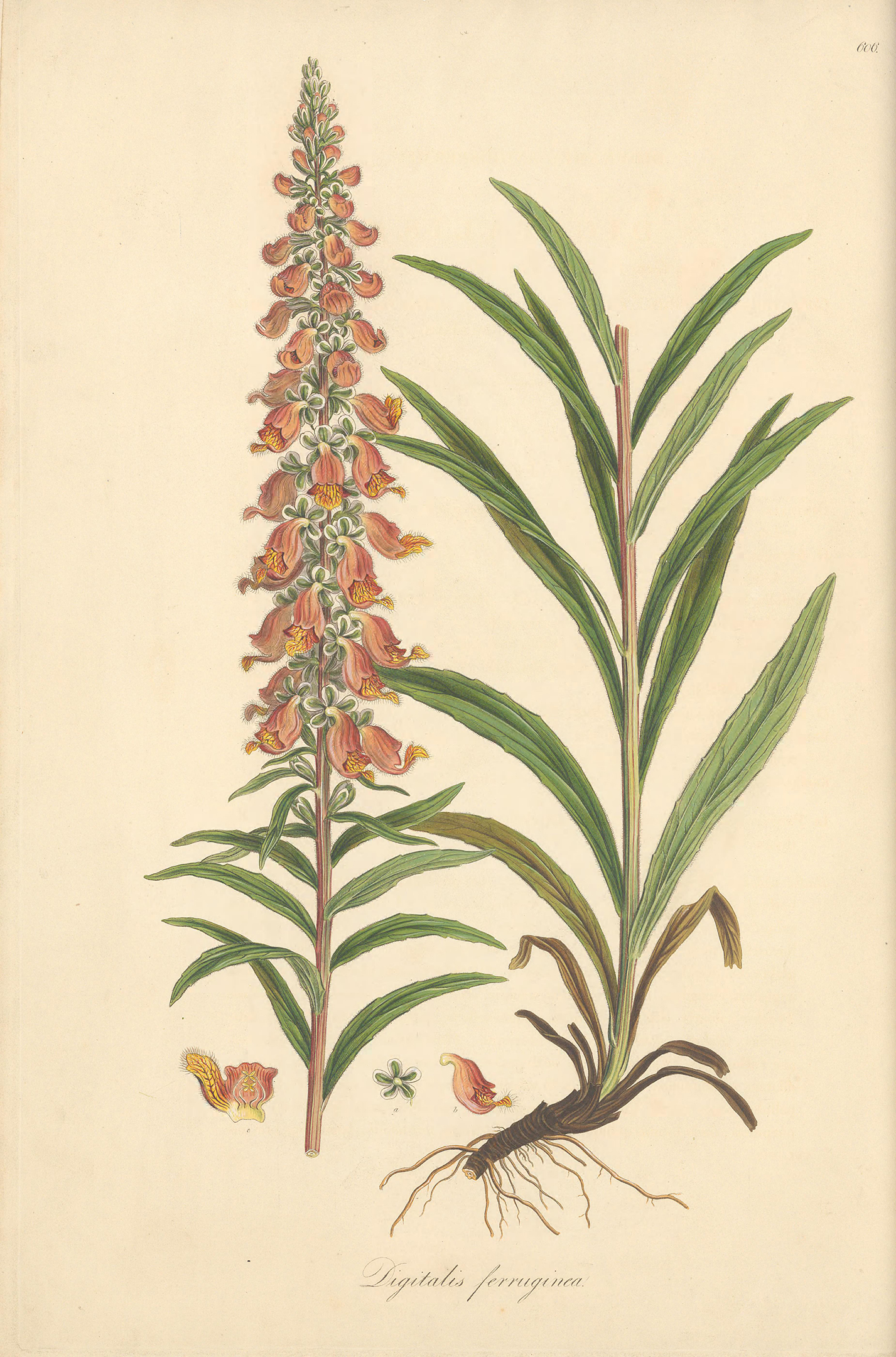
Plate 606. Sibthorp, John. Flora Graeca. v. 7 (1830). Contributed in BHL from Lloyd Library and Museum. Digitized by Public Library of Cincinnati and Hamilton County.

Unfortunately, Sibthrop contracted tuberculosis during the return from his second expedition. He died on 8 February 1796 in Bath, before the work could be completed. His will, however, provided an endowment to ensure the completion of the publication [4].

Sibthorp’s friend and fellow botanist, James Edward Smith, and Sibthorp’s brother-in-law, John Hawkins, oversaw the publication of the first six volumes between 1806-1828. Volume seven was published in 1830, and volumes eight through ten were edited by John Lindley and published between 1833-40. The first nine volumes included 100 plates each, with the final volume consisting of 66 plates [5]. The hand-colored plates were engraved on copper by Bauer, James Sowerby and James de Carle Sowerby after Bauer’s drawings [2, 175].

plants

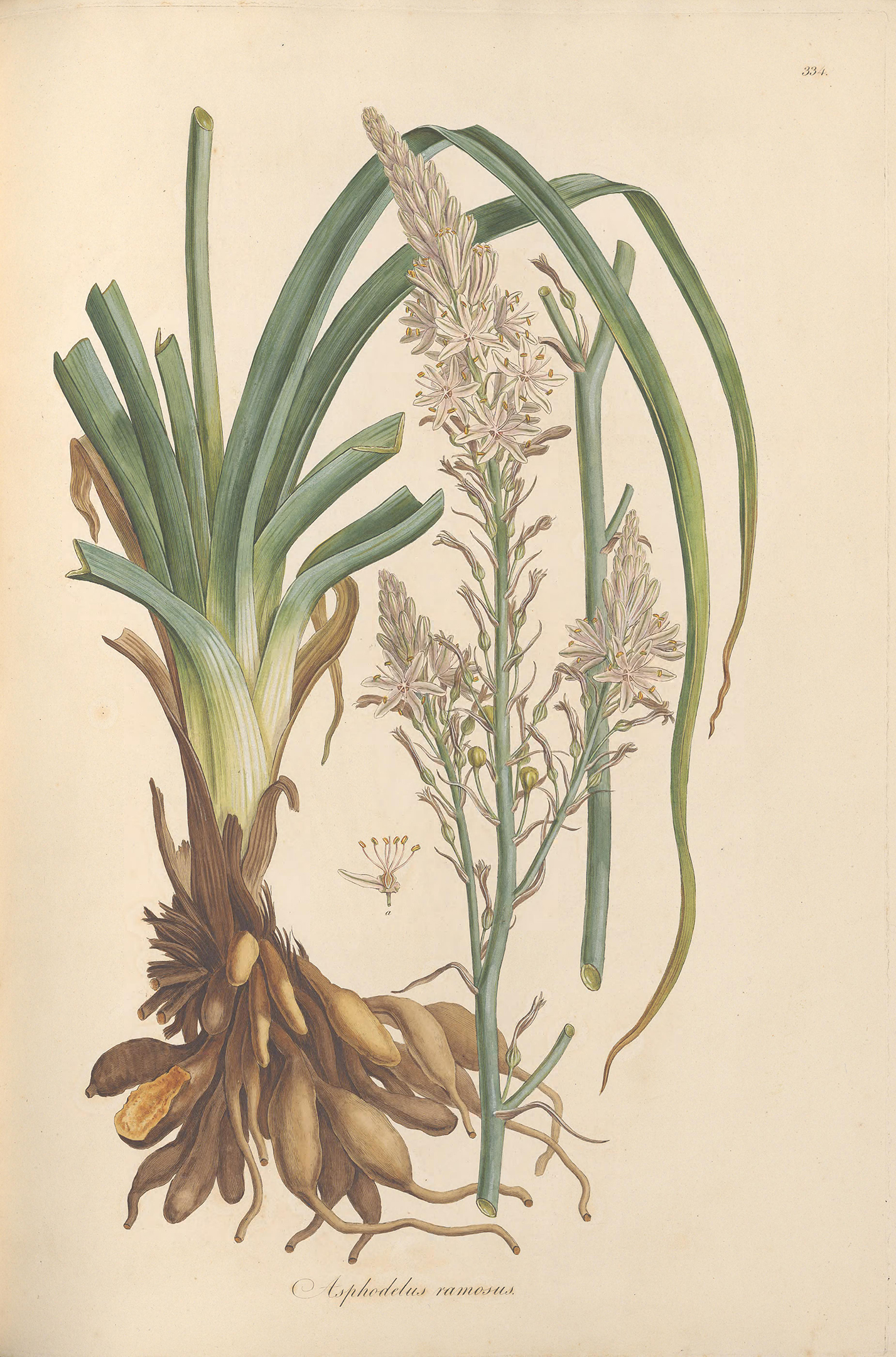
Plate 334. Sibthorp, John. Flora Graeca. v. 4 (1823). Contributed in BHL from Lloyd Library and Museum. Digitized by Public Library of Cincinnati and Hamilton County.

plants

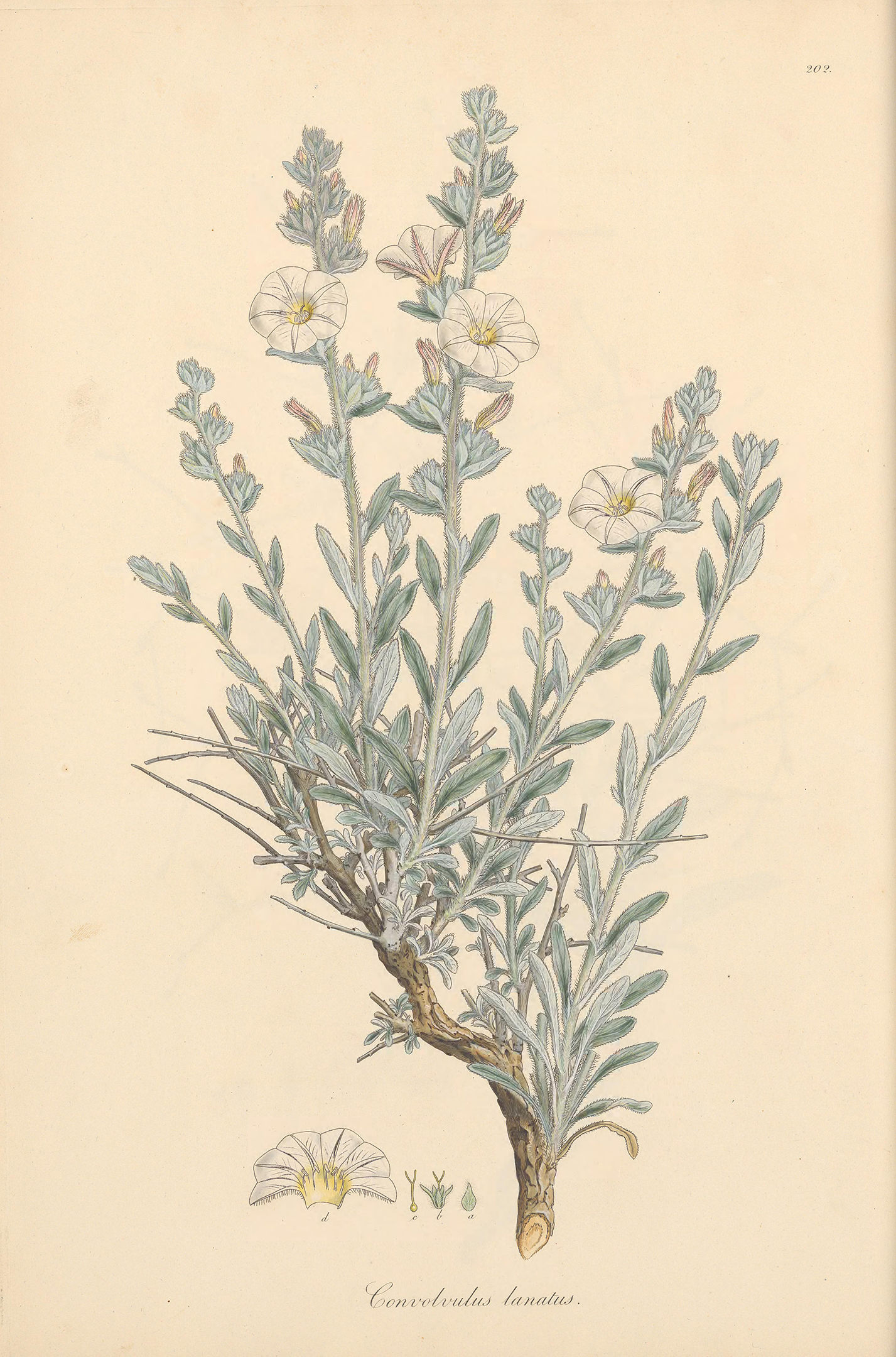
Plate 202. Sibthorp, John. Flora Graeca. v.3 (1819). Contributed in BHL from Lloyd Library and Museum. Digitized by Public Library of Cincinnati and Hamilton County.

The Lloyd Library and Museum is fortunate to own one of the 25 complete copies of the first edition of this title. This copy was digitized by the Public Library of Cincinnati and Hamilton County as part of the BHL Expanding Access to Biodiversity Literature project (funded by the Institute of Museum and Library Services) and is freely available for all to enjoy in the Biodiversity Heritage Library. A volume from this title is also currently on display at the Lloyd Library & Museum as part of the current exhibit Treasures of the Lloyd, which is open until 21 February 2020.

plants

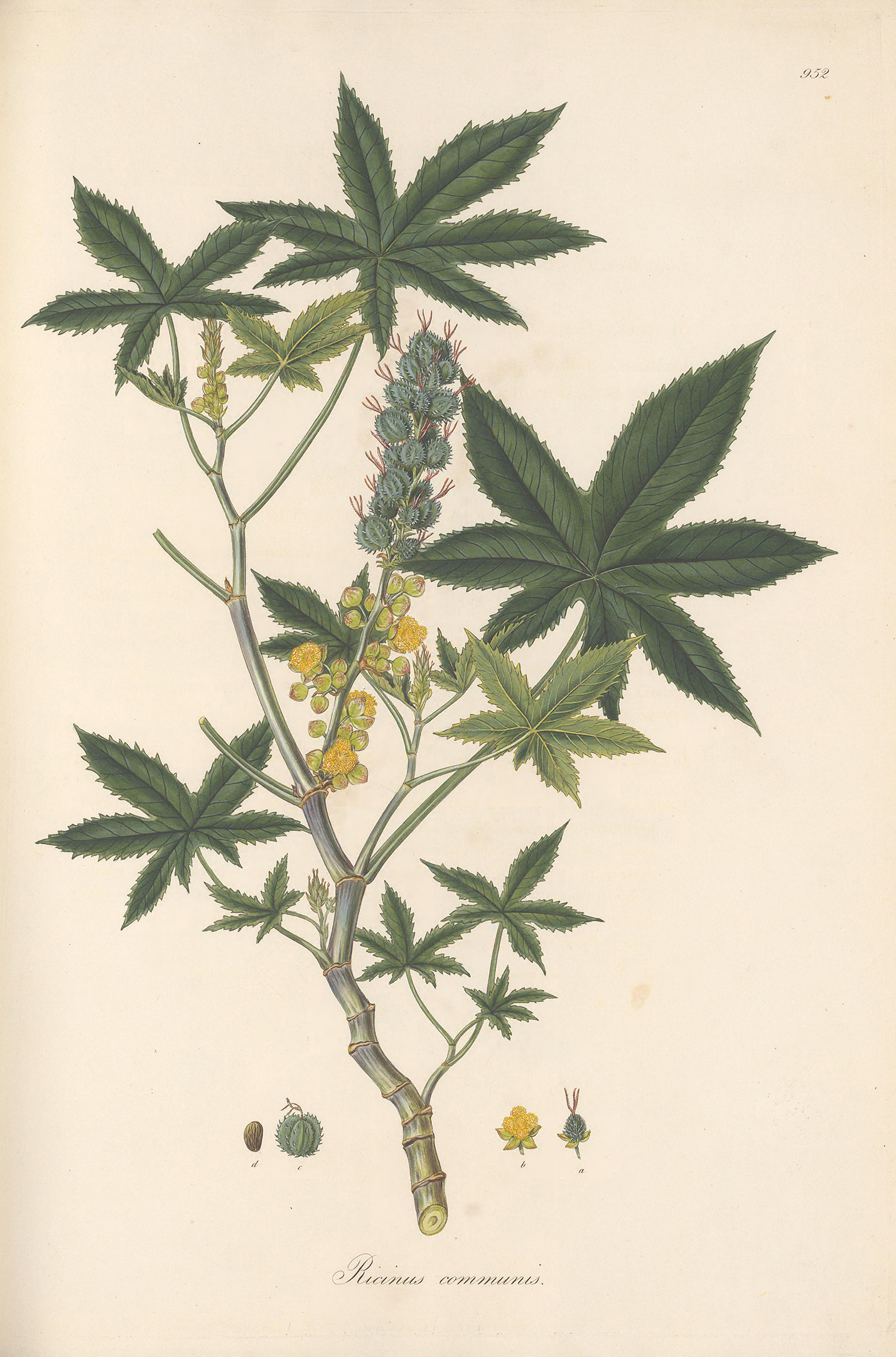
Plate 952. Sibthorp, John. Flora Graeca. v.10 (1840). Contributed in BHL from Lloyd Library and Museum. Digitized by Public Library of Cincinnati and Hamilton County.

plants

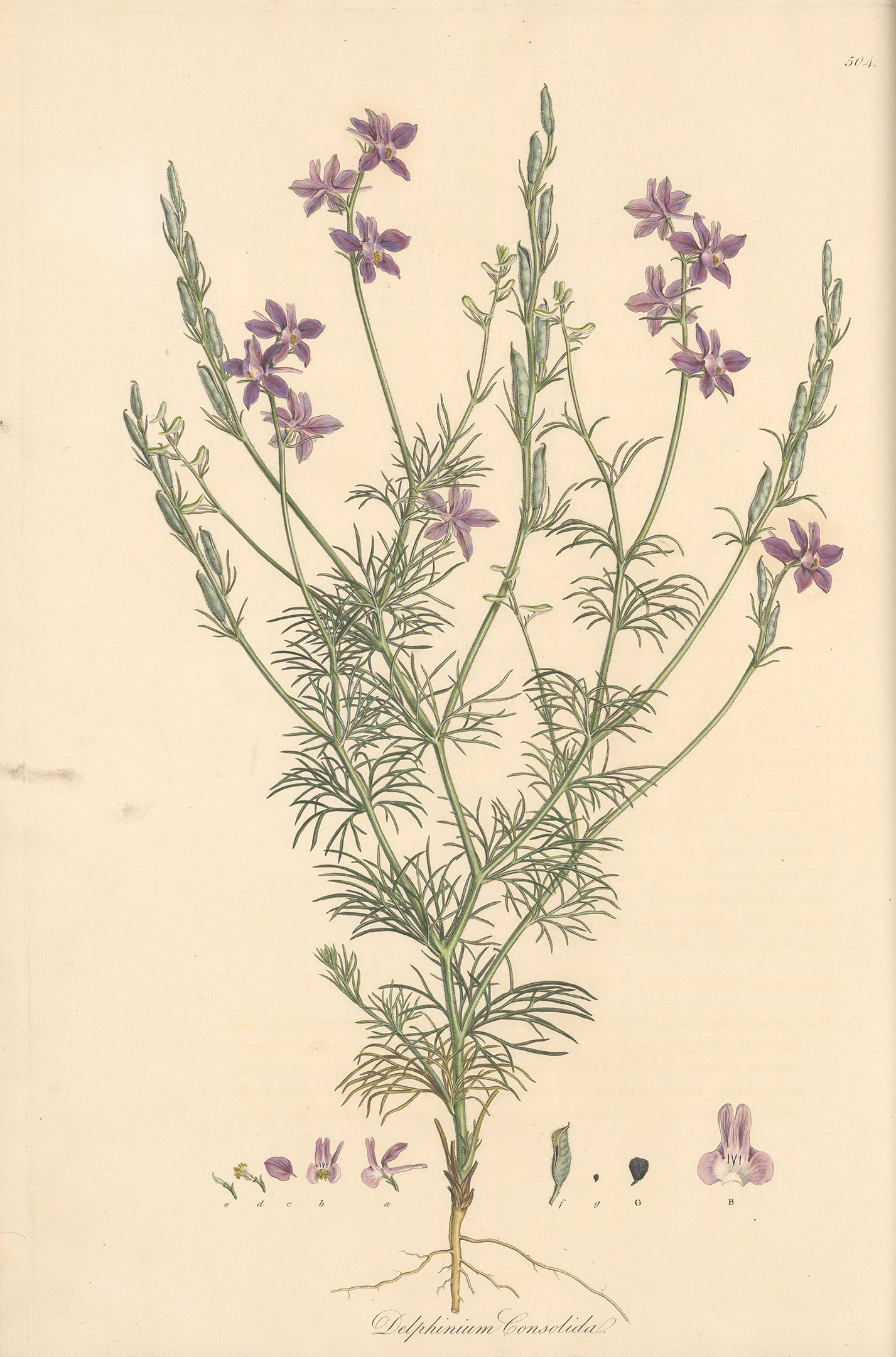
Plate 504. Sibthorp, John. Flora Graeca. v.6 (1828). Contributed in BHL from Lloyd Library and Museum. Digitized by Public Library of Cincinnati and Hamilton County.

plants

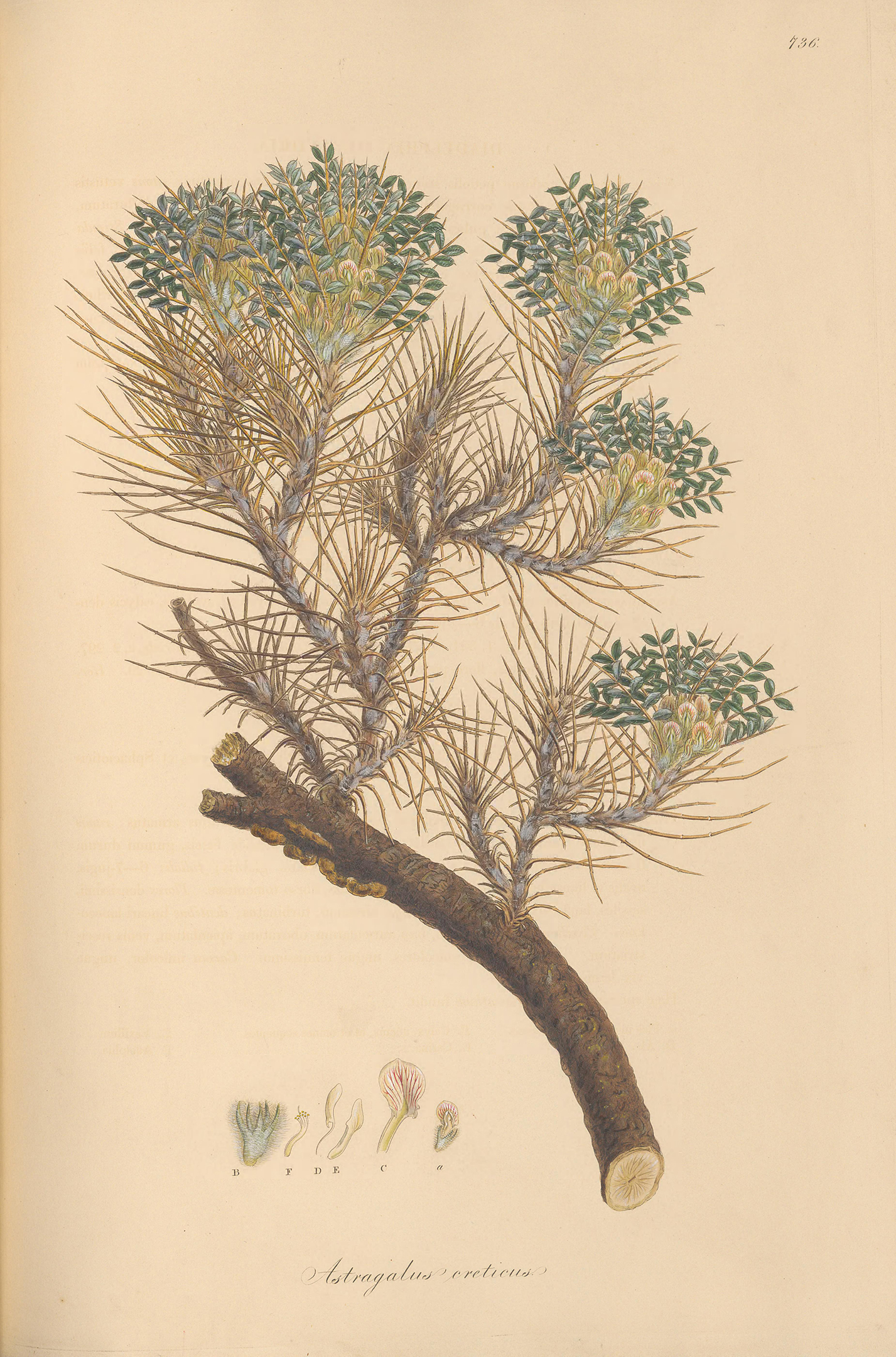
Plate 736. Sibthorp, John. Flora Graeca. v. 8 (1833). Contributed in BHL from Lloyd Library and Museum. Digitized by Public Library of Cincinnati and Hamilton County.

plants

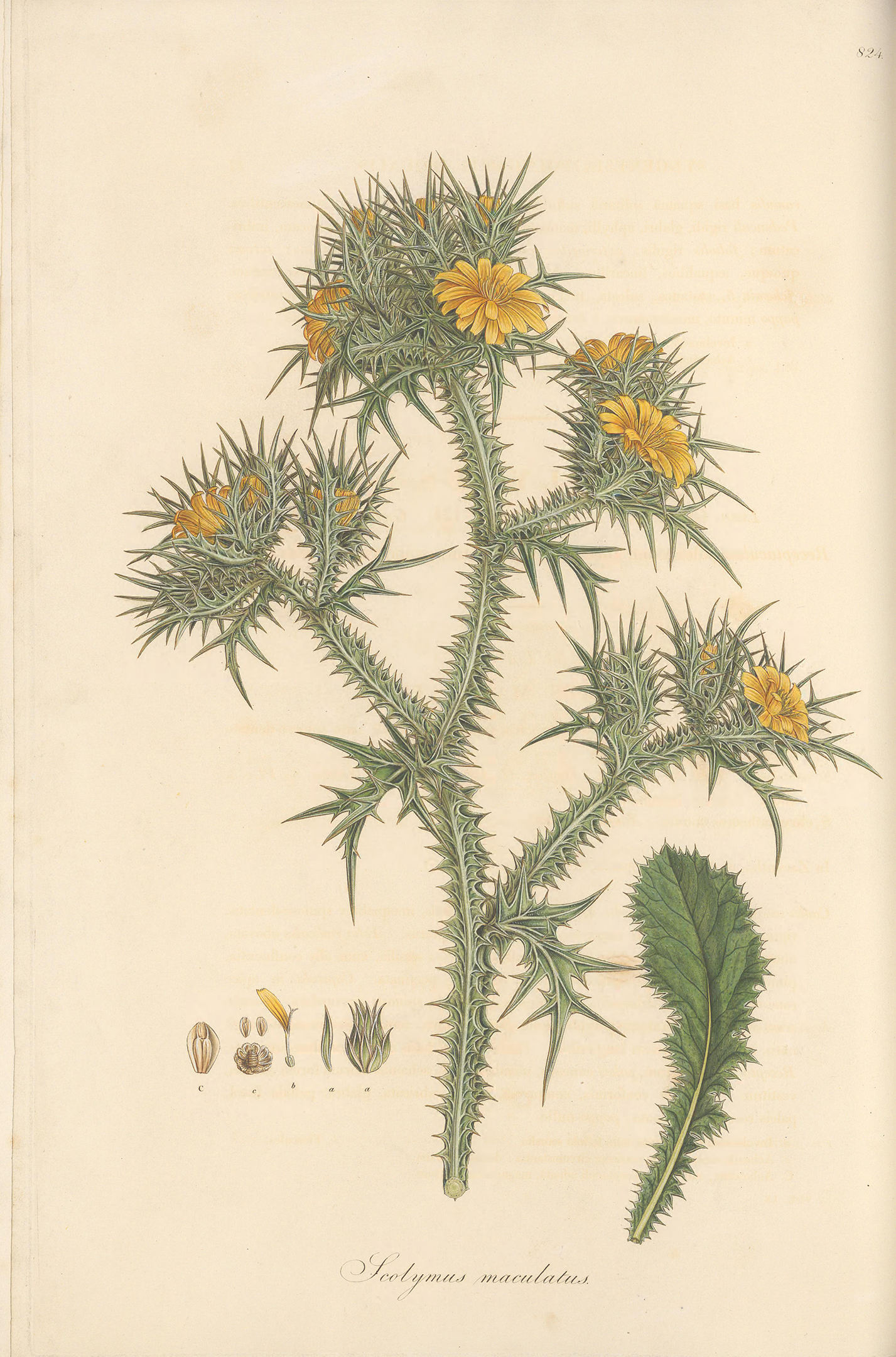
Plate 824. Sibthorp, John. Flora Graeca. v. 9 (1837). Contributed in BHL from Lloyd Library and Museum. Digitized by Public Library of Cincinnati and Hamilton County.

plants

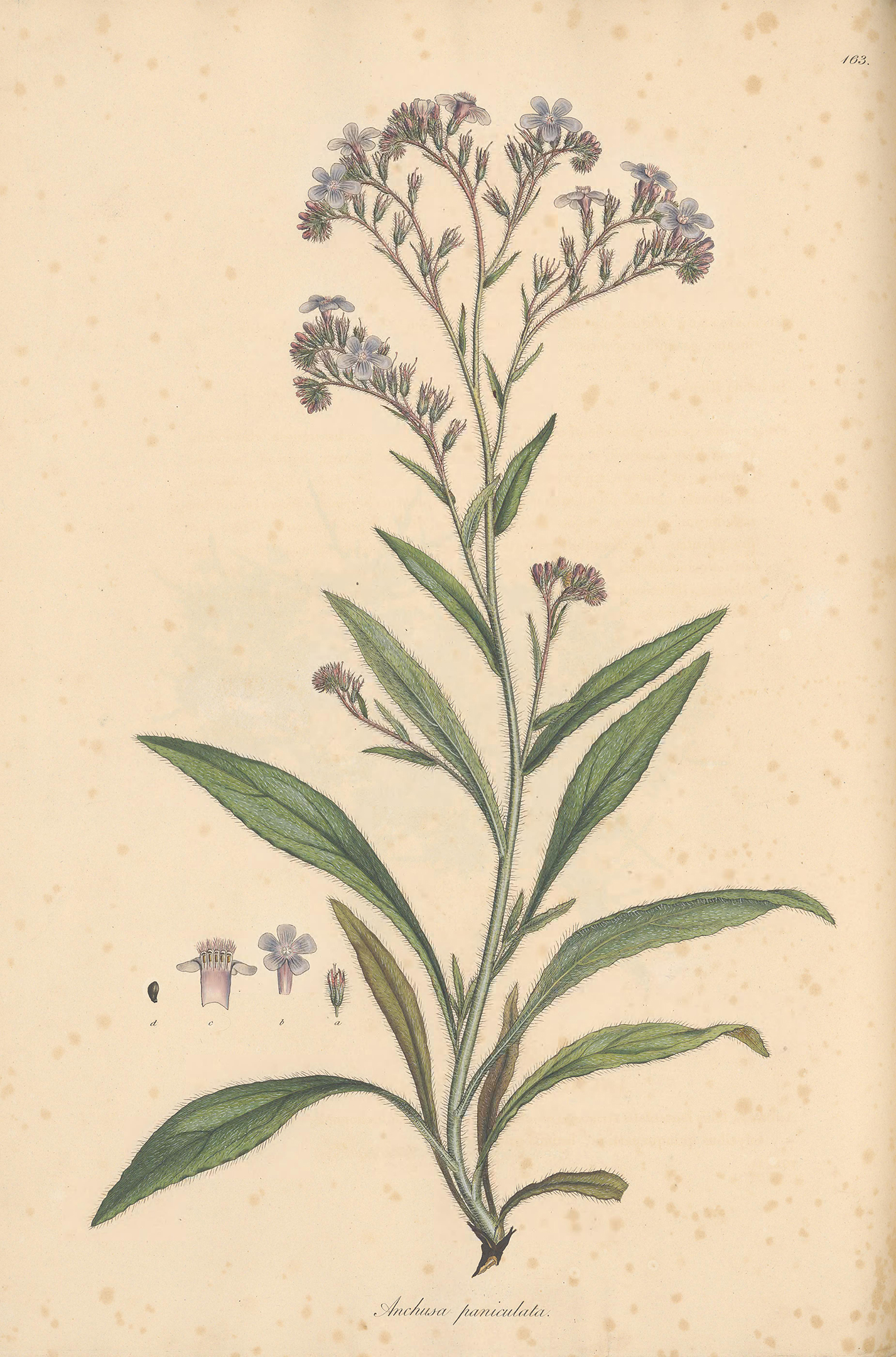
Plate 163. Sibthorp, John. Flora Graeca. v. 2 (1813). Contributed in BHL from Lloyd Library and Museum. Digitized by Public Library of Cincinnati and Hamilton County.

References

[1] Stearn, W. T. (1960). “Franz and Ferdinand Bauer, masters of botanical illustration”. Endeavour 19(73).
[2] Stearn, W. (1967). Sibthorp, Smith, the ‘Flora Graeca’ and the ‘Florae Graecae Prodromus’. Taxon, 16(3), 168-178. doi:10.2307/1216982
[3] Walsh, H. (2003). “Ferdinand Lukas Bauer”. Rare Books from the MBG Library. 23 October. Accessed on 4 February 2020. http://www.illustratedgarden.org/mobot/rarebooks/author.asp?creator=Bauer, Ferdinand Lukas&creatorID=96.
[4] Christie’s. (1997). “Flora Graeca”. Lot 138, sale 8690. Accessed on 4 February 2020. https://www.christies.com/lotfinder/Lot/sibthorp-john-james-edward-smith-and-john-228372-details.aspx.
[5] Europeana. (2020). “Flora Graeca”. Accessed on 4 February 2020. https://www.europeana.eu/portal/en/record/92002/BibliographicResource_1000093325414_source.html.

February 6, 2020by michelle.underhill

Help Support BHL

BHL's existence depends on the financial support of its patrons. Help us keep this free resource alive!

search

About BHL

The Biodiversity Heritage Library (BHL) is the world’s largest open access digital library for biodiversity literature and archives. BHL operates as a worldwide consortium of natural history, botanical, research, and national libraries working together to digitize the natural history literature held in their collections and make it freely available for open access as part of a global “biodiversity community.”

Join Our Mailing List

Sign up to receive the latest news, content highlights, and promotions.

Subscribe Now

Subscribe to Blog via Email

Enter your email address to subscribe to this blog and receive notifications of new posts by email.

Join 319 other subscribers

Subscribe to Blog Via RSS

Subscribe to the blog RSS feed to stay up-to-date on all the latest BHL posts.

Access RSS Feed

Inspiring Discovery through Free Access to Biodiversity Knowledge.

The Biodiversity Heritage Library makes it easier than ever for you to access the information you need to study and explore life on Earth…for free, anytime, anywhere.


64+ Million Pages of
Biodiversity Literature Online.

EXPLORE

Tools and Services
to Transform Research.

EXPLORE

300,000+
Illustrations on Flickr.

EXPLORE

ABOUT | HARMFUL CONTENT | PRIVACY | SITE MAP | TERMS OF USE