Biodiversity Heritage Library - Program news and collection highlights from BHL
  • Home
  • News
  • Featured Books
    • All Featured Books
    • Book of the Month Series
    • BHL at 20
  • User Stories
  • Campaigns
    • Fossil Stories
    • Garden Stories
    • Monsters Are Real
    • Page Frights
    • Her Natural History
    • Earth Optimism 2020
  • Tech Blog
  • Visit BHL
Home
News
Featured Books
    All Featured Books
    Book of the Month Series
    BHL at 20
User Stories
Campaigns
    Fossil Stories
    Garden Stories
    Monsters Are Real
    Page Frights
    Her Natural History
    Earth Optimism 2020
Tech Blog
Visit BHL
  • Home
  • News
  • Featured Books
    • All Featured Books
    • Book of the Month Series
    • BHL at 20
  • User Stories
  • Campaigns
    • Fossil Stories
    • Garden Stories
    • Monsters Are Real
    • Page Frights
    • Her Natural History
    • Earth Optimism 2020
  • Tech Blog
  • Visit BHL
Biodiversity Heritage Library - Program news and collection highlights from BHL
Blog Reel, Featured Books

Making the Best of Difficult Times: Accelerating the Transcription of William Brewster’s Writings During the COVID-19 Pandemic

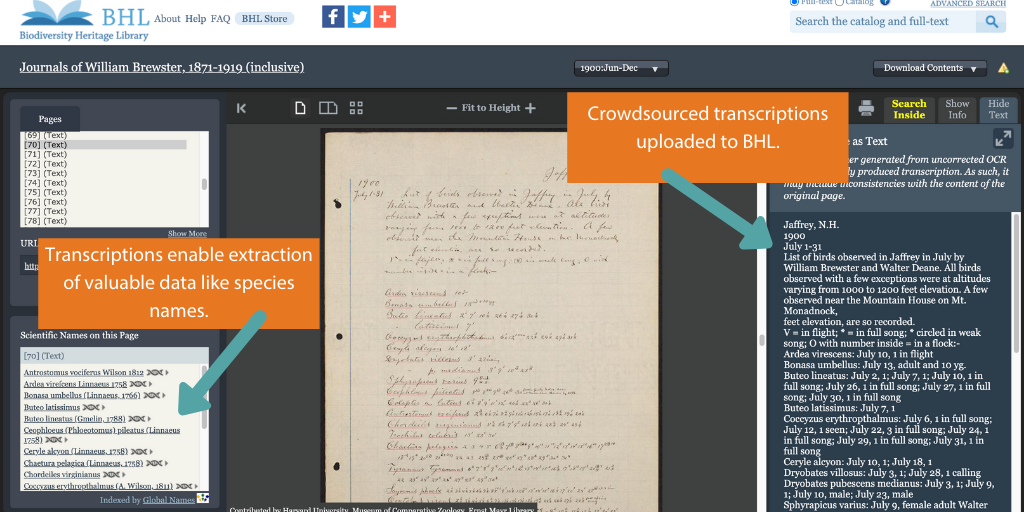
Screenshot of the BHL book viewer with crowdsourced transcriptions available for a handwritten journal.

This post is part of a series from the Ernst Mayr Library exploring the digitization and transcription of ornithologist William Brewster’s archival materials and the insights and scholarship made possible thanks to this work.

Many of us have searched for silver linings during the COVID-19 pandemic of 2020-2021. For many in the library and museum profession, one positive outcome of the mandatory transition to remote work has been the resurrection of some long-postponed projects. These are activities put on hold during normal times in deference to ever-proliferating, higher-priority onsite tasks. One such project in the Ernst Mayr Library and Archives (EMLA) of the Museum of Comparative Zoology (MCZ) at Harvard University is transcription of the digitized journals and diaries of William Brewster.

As discussed in Part One of this series, EMLA began digitization of its Brewster collection in 2012. In 2014, Library staff began transcription of Brewster’s digitized journals and diaries to produce a corpus of text files for the Purposeful Gaming and BHL project. As part of this project, EMLA was charged with leading an effort to select an appropriate open source transcription tool. At this time (early 2014), manuscript materials such as field notes and correspondence were beginning to appear in the Biodiversity Heritage Library (BHL) thanks to other grant-funded efforts among BHL members. Tools under consideration for Purposeful Gaming were thus also viewed as potential long-term transcription solutions for libraries contributing such materials to BHL.

After four months of research and testing, the grant partners selected DigiVol, a crowdsourcing transcription platform developed by the Australian Museum in collaboration with the Atlas of Living Australia, and EMLA staff set up a project space for the Library. One significant advantage of DigiVol is that it was developed specifically for the transcription of natural history materials such as specimen labels and field notes. Thus, there was the advantage of a pre-existing community of volunteers both interested in and adept at transcribing such items.

At the end of the Purposeful Gaming project (November 2015), volunteers and library staff had transcribed 12 volumes of Brewster’s journals and diaries, totaling 3,470 pages. That left 37,000 pages of Brewster’s writings in our collection awaiting transcription. Over the next four years, progress in the transcription work at EMLA was relatively slow at an average of 1,262 pages transcribed per year. During this time, EMLA had only a single, albeit enthusiastic, part-time library assistant who was able to dedicate one-third of her time or less to the project due to other higher-priority tasks.

On March 16, 2020, Harvard University staff began working remotely. Expecting a large influx of volunteers due to the quarantine in Australia, and anticipating an increase in staff availability at participating institutions, DigiVol administrators sent out a call for more materials to be uploaded for transcription. Working remotely, the author had the time available to regularly upload new volumes of Brewster’s diaries for transcription, respond to questions posted by volunteer transcribers, and validate completed transcriptions. Another EMLA staff member was able to offer several hours per week of her time as well. This was fortuitous as the volunteers were, indeed, ramping up their transcription activity, completing each diary volume in about two weeks time.

As the pandemic wore on, greater numbers of staff across the Harvard University library system were in need of work that could be done remotely. In response to this need, Harvard Library established a work share program whereby libraries in need of help could offer temporary assignments or projects to those in need of some additional work. By this time (September 2020), the volunteer transcribers were making so much progress that we were falling behind in the work of validating transcriptions. EMLA thus posted its project via the work share program, and we were fortunate to obtain the assistance of two library colleagues able to devote several hours each week to the work of transcription and validation.

With a total of 4 staff members and an average of 11 DigiVol volunteers (up from a previous average of 7) working on the project, more pages of Brewster’s writings were transcribed in 2020 than in any of the previous four years, as shown in the graphic below. There was a 242% increase in the number of pages transcribed over 2019, and a 165% increase over the average yearly number of pages transcribed from 2016 through 2019.
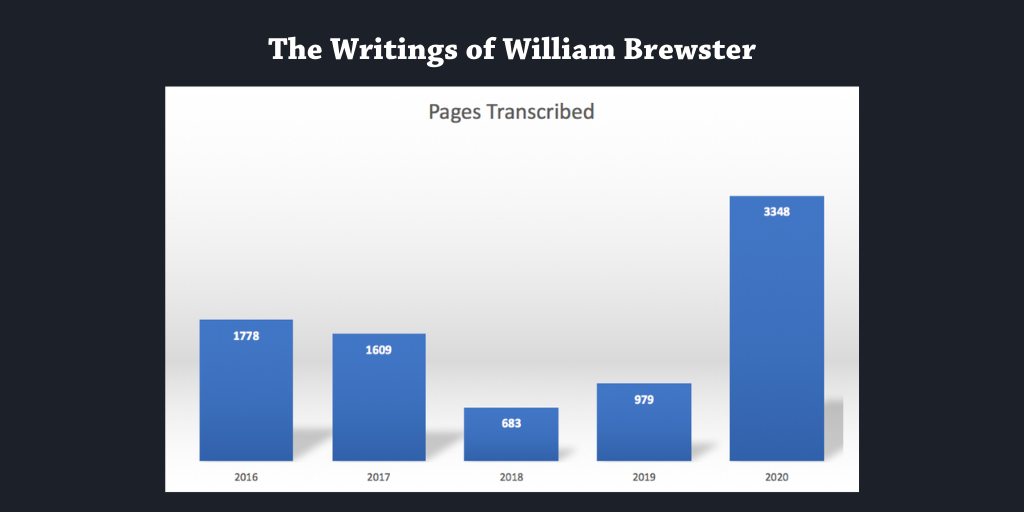
Bar graph showing number of pages transcribed per year, 2016-2020.

Number of pages transcribed per year, 2016-2020.

Transcriptions in the Biodiversity Heritage Library

The fruit of our transcribers’ labors began to materialize in 2018 when BHL developers introduced transcription import functionality to BHL. When member libraries began uploading transcribed pages of field notebooks and correspondence, the potential for access and discovery became readily apparent. Full-text indexing and searching of transcribed manuscript materials was now possible. For example, in researching the previous blog post about Robert Gilbert, the author was able to search for the name Gilbert in several transcribed volumes of Brewster’s journals. The result of such a search in Brewster’s 1898 journal is shown below.
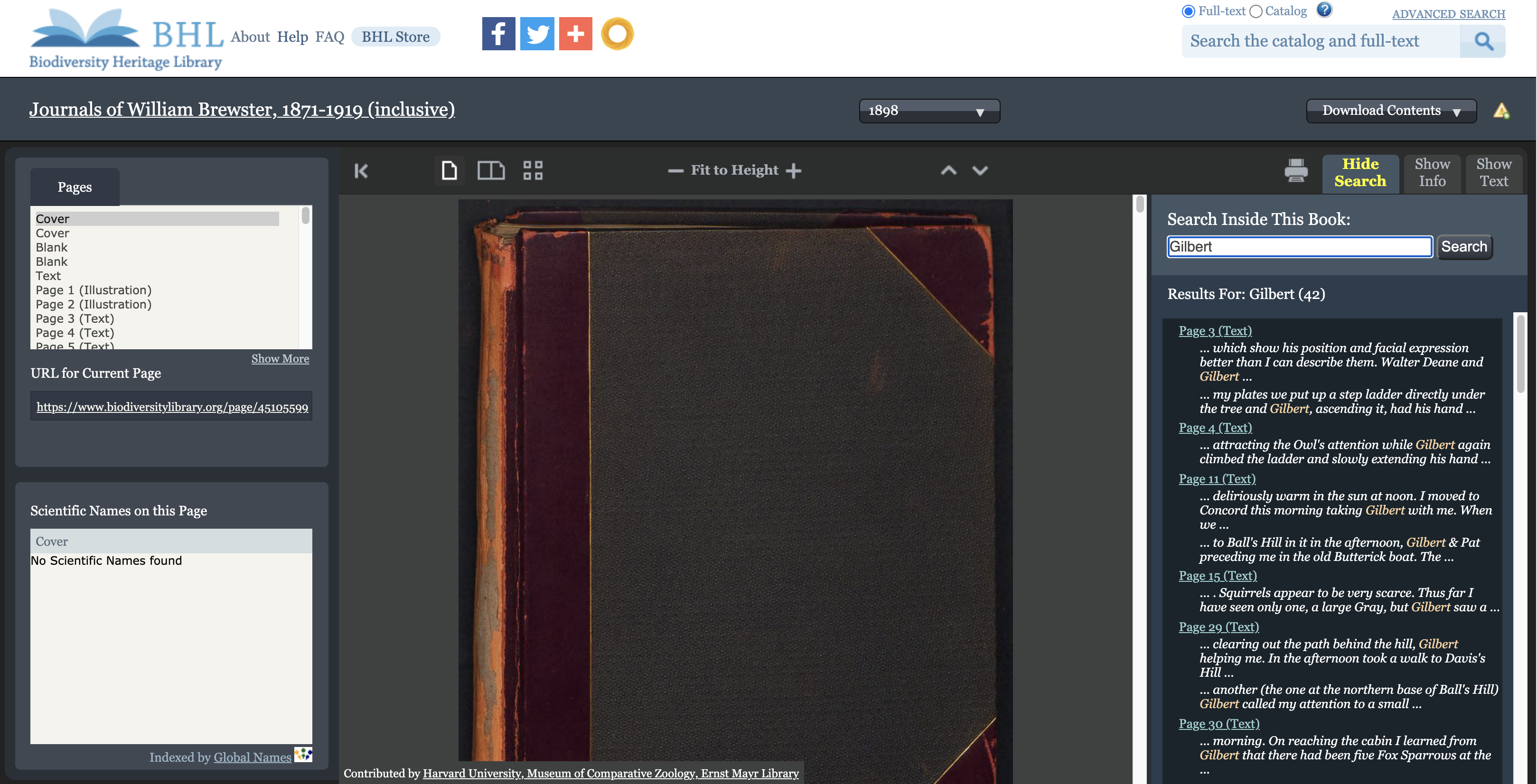
Screenshot of the BHL book viewer with full text search results for "Gilbert" displayed.

Searching for the name Gilbert in the 1898 volume of Brewster’s Journals retrieves 42 references to Robert Gilbert in this volume. The search results are shown in the right-hand panel of the BHL book viewer.

Like most field notebooks, Brewster’s diaries and journals are replete with scientific names. In order for these to be recognized by BHL’s name-finding utility, Global Names Architecture (GNA), they must be carefully transcribed. Transcription tutorials for the Brewster project in DigiVol ask that scientific names be given extra care, expanding abbreviations and correcting misspellings where possible. Our team of volunteers and staff have done an exquisite job of accurately transcribing scientific names, sometimes even doing research when unsure of the correct spelling of a name. Some of the transcribers so enjoy delving into Brewster’s world that they frequently research people, localities, or unfamiliar terms used in his writings as well.
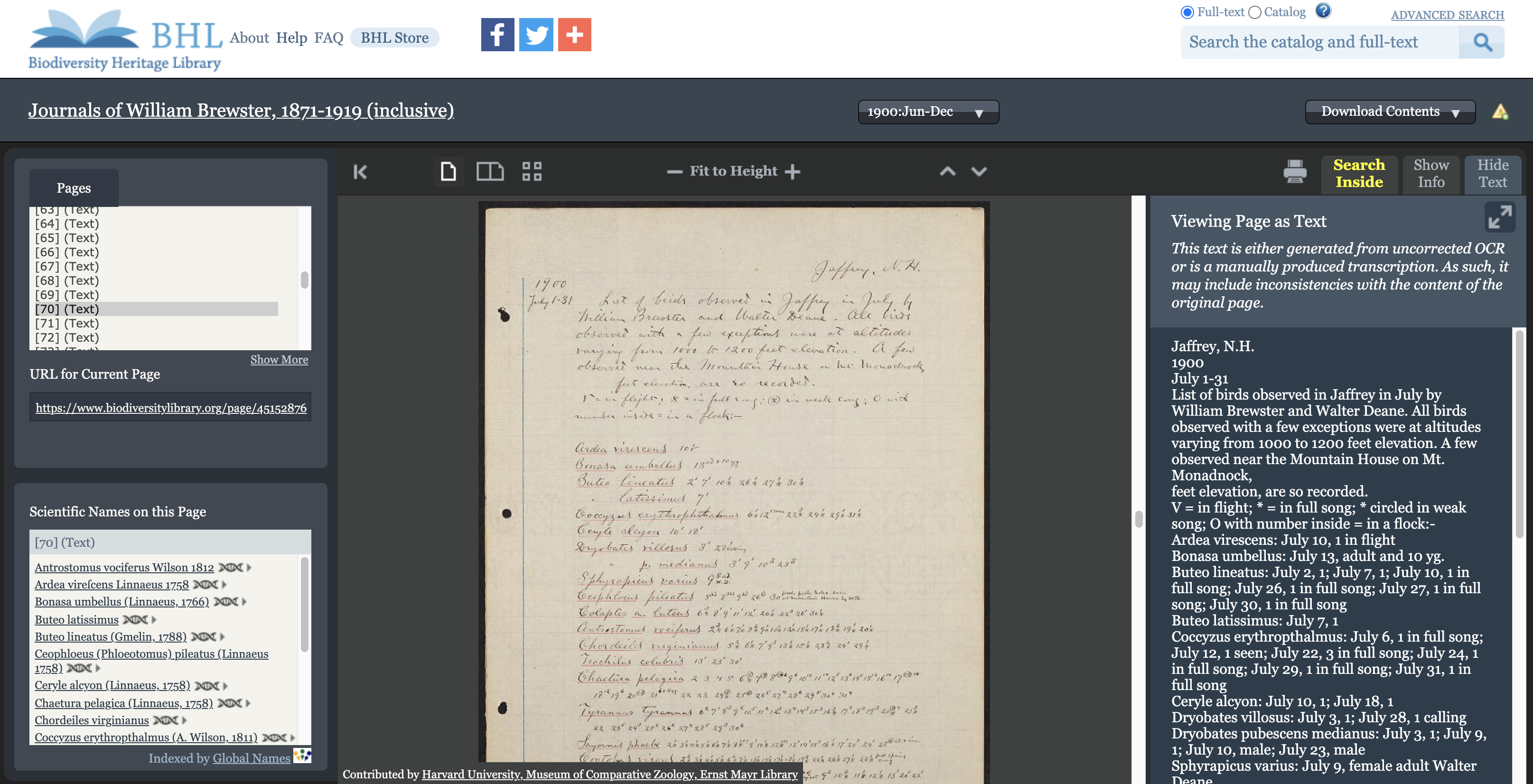
Screenshot of the BHL book viewer with scientific names found on the page.

A species observation list from Brewster’s 1900 Journal with transcription of species names and observations in the text panel on the right. Note the scientific names on the lower left, extracted from the transcription text by Global Names Architecture (GNA). Prior to addition of the transcription text, no names were found by GNA.

The end result is that the myriad of ornithological taxa mentioned in Brewster’s writings are being indexed in BHL. Thus a search across the full BHL repository for a specific taxon retrieves results from field notes and correspondence as well as the published literature. The resulting species bibliography will thus lead researchers to field observations, specimen collecting accounts, habitat and weather descriptions, and other content that may not be included in secondary sources.
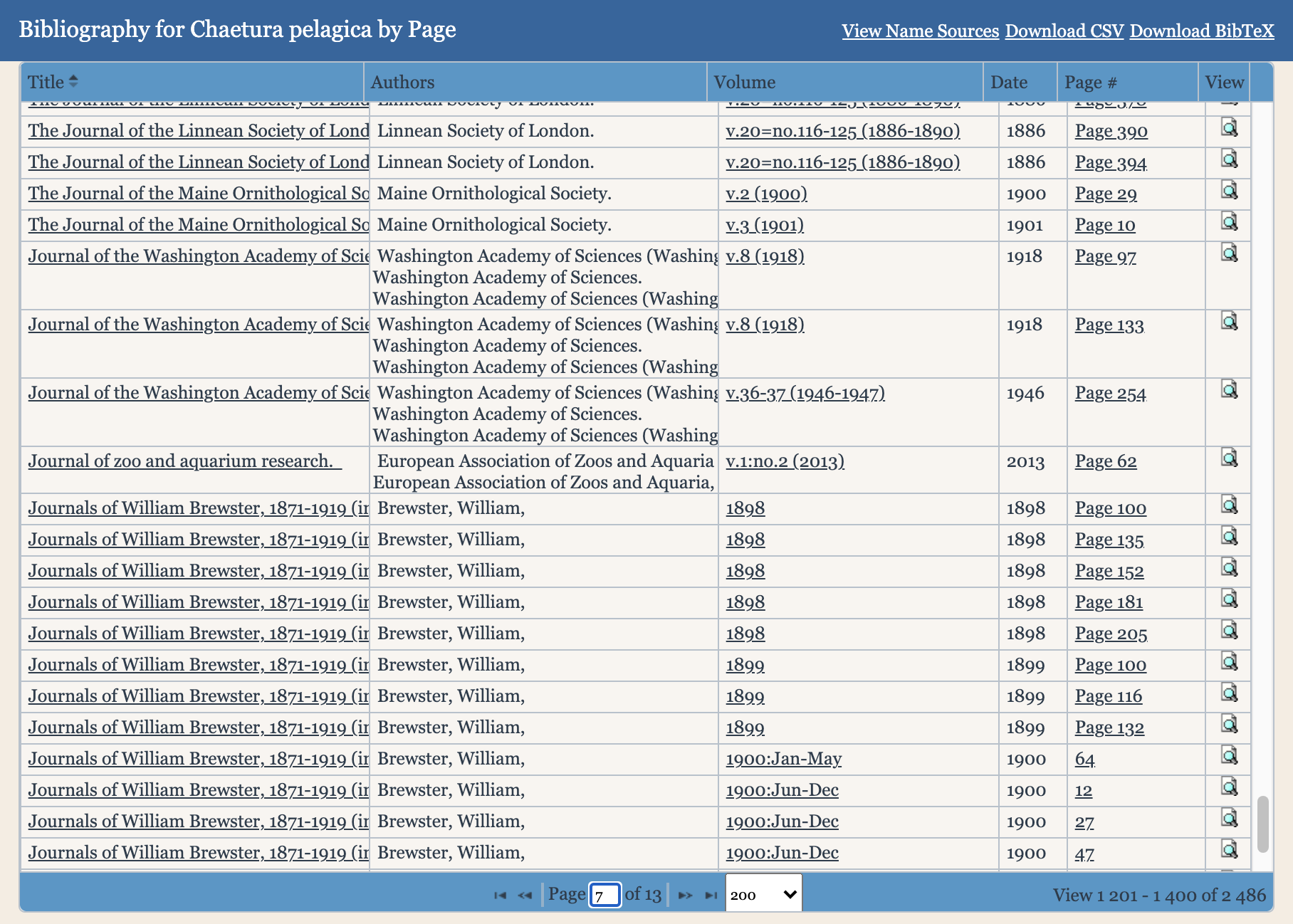
Screenshot of a species bibliography in BHL for Chaetura pelagica.

A search for Chaetura pelagica (Chimney Swift) across the full BHL repository retrieves instances of this taxon in Brewster’s transcribed Journals as well as the published literature.

Because of the hard work of our volunteer transcribers, full transcriptions of thousands of pages of Brewster’s diaries, journals, and correspondence are now being added to BHL, making this content available for text analysis, data mining, digital scholarship, and the creation of new information. Connections with similar collections in other institutions will likely be discovered as more primary source material is digitized and transcribed. Brewster’s meticulous record of species occurrences, habitat, landscape ecology, and weather can help in addressing the current climate and biodiversity crises. His record of historical events and his account of the work of Robert Gilbert might be used in social justice or other humanitarian research efforts. The staff of the EMLA are deeply indebted to the team of volunteers and our two Harvard Library colleagues who have given so much of their time and energy to help unlock the riches of the Brewster collection for the benefit of all.

If you would like to help transcribe Brewster’s writings, there is still plenty of work to do. We will soon complete his diaries and journals after which we will begin transcribing his extensive collection of correspondence. If you are interested, please visit our project page.
February 24, 2021by michelle.underhill
Blog Reel, Featured Books

The Life and Work of Robert Alexander Gilbert: Empowering New Insights through Digitization and Transcription of Archival Materials

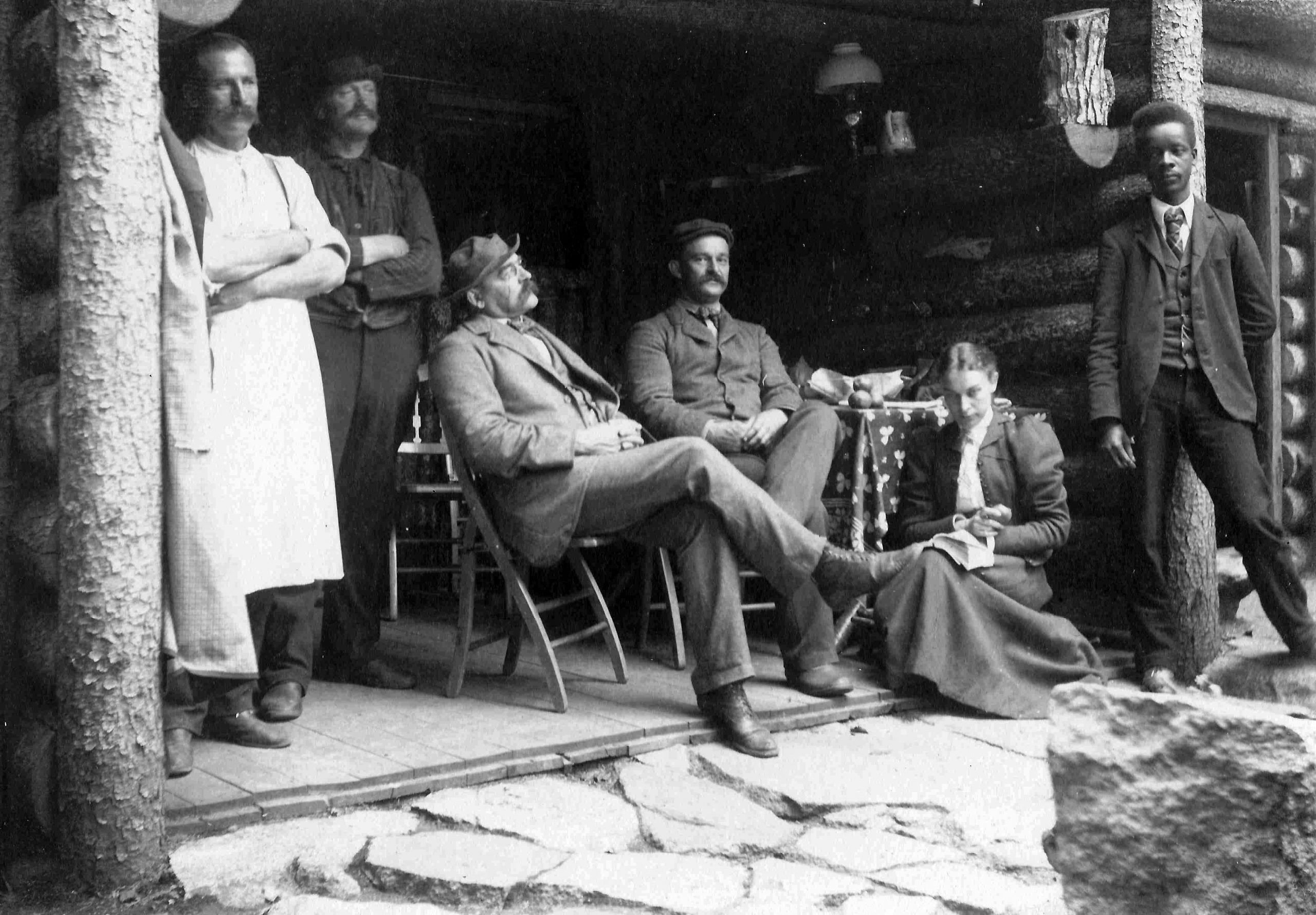
Black and white photo of a group of people standing on the porch of a log cabin.

This post is part of a series from the Ernst Mayr Library exploring the digitization and transcription of ornithologist William Brewster’s archival materials and the insights and scholarship made possible thanks to this work.

Black and white photo of a group of people standing on the porch of a log cabin.

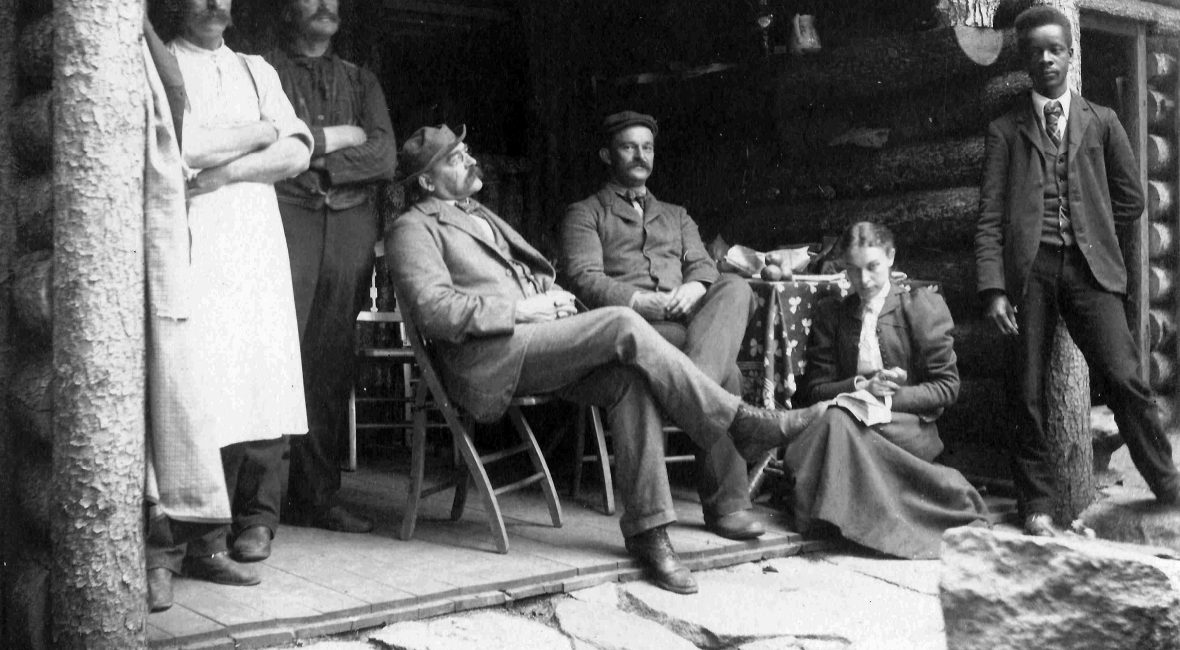
Robert A. Gilbert, far right, at William Brewster’s cabin at Pine Point, Umbagog Lake, Maine. From the collection of the Museum of American Bird Art, Massachusetts Audubon Society and reproduced with their permission.

Robert Alexander Gilbert (1870-1942) was a Black photographer interested in ornithology and chemistry who worked for ornithologist William Brewster from the mid 1890s until Brewster’s death in 1919 and at various tasks around the Museum of Comparative Zoology (MCZ) at Harvard University beyond 1919. He was an Associate of the American Ornithologists’ Union.

Gilbert was not officially recognized for his photographic work with William Brewster, although Brewster did not claim credit for all the images in his collection. It was assumed that Brewster took all the photographic prints bequeathed to the Ernst Mayr Library and Archives of the MCZ (EMLA) upon his death. However, while conducting research for a book, author John Hanson Mitchell, former editor of the Massachusetts Audubon Society’s (MAS) Sanctuary magazine, discovered over 2000 of Brewster’s glass plate negatives in the attic of a building owned by the MAS. One of the images in particular, a photograph of a young, well-attired Black man standing in front of a rustic cabin in the wilderness, captured his interest. Mitchell was curious as to the identity of this young man. Later, in the mid-1970s, Mitchell had a chance encounter with an Archives Assistant at the MCZ who suggested to him that all of Brewster’s photographs were, in fact, taken by Brewster’s assistant, a young Black man named Robert Gilbert. This piqued Mitchell’s interest and launched his journey to discover more about Gilbert.[1] The quest culminated with the publication in 2005 of Mitchell’s Looking for Mr. Gilbert: the Reimagined Life of an African American. In 2014 an e-book edition was published as well.

Mitchell’s publication helps provide new insight into Robert Gilbert’s life and work. Brewster’s journals and diaries, now digitally available on the Biodiversity Heritage Library (BHL), are also valuable records attesting to Gilbert’s contributions in a variety of areas. While only a handful of Brewster’s photographs in the MCZ collection can be positively attributed to Gilbert, it is clear that Gilbert was with Brewster for photo sessions during the years they worked together. The photographic relationship between Brewster and Gilbert is intriguing. There is new enthusiasm to examine Brewster’s journals and diaries more closely now that they are digitized and being transcribed, to clarify Gilbert’s role in photographic collaboration with Brewster. As a result of identifying connections between the collections in the Museum of American Bird Art at the Massachusetts Audubon Society and the EMLA, a cooperative research project is underway.

Robert Gilbert was born and raised in the rural town of Natural Bridge, Virginia, in the valley of Broad Creek. In 1886, at the age of 16, he moved to Boston, Massachusetts where he would reside for the remainder of his life. Gilbert had an assortment of odd jobs during his first ten years in Boston, including working as a laboratory assistant for Dr. Arthur P. Chadbourne of Harvard Medical School, an amateur ornithologist and acquaintance of William Brewster. The records are unclear as to the actual year, but sometime between 1895 and 1897, work in Chadbourne’s lab slowed down and he recommended Gilbert to Brewster, who was in need of a temporary assistant to help him set up his personal bird museum. Gilbert met with Brewster, who showed him his extensive specimen collection and the tasks at hand, and for the next ten weeks Gilbert helped Brewster establish his new museum on the grounds of his home in Cambridge, MA. Afterward, Gilbert returned to working for Dr. Chadbourne, but shortly thereafter the laboratory experiments were completed whereupon Brewster hired Gilbert as his full-time assistant.[2] Brewster’s first mention of Gilbert in his journals is in his entry for March 31, 1897.

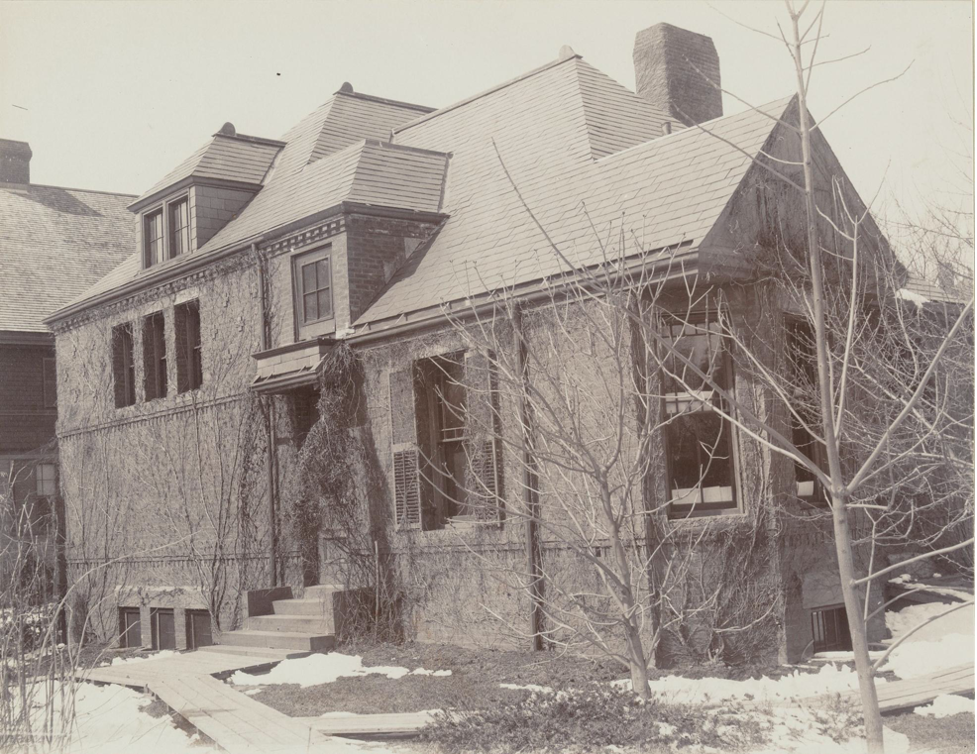
Black and white photograph of a brick house.

Brewster’s museum on the grounds of his home in Cambridge, MA. From the collection of the Ernst Mayr Library of the Museum of Comparative Zoology, Harvard University. Call number bBr 97.70.12.19.

It is clear from Brewster’s diaries and journals that the tasks performed by Gilbert in Brewster’s employ were many and varied. Glover M. Allen, Curator of Mammals at the MCZ, described Gilbert as “Mr. Brewster’s trusted assistant, looking after innumerable details at his museum or his camp, doing everything from photographic work to preparing and serving meals, and always with a quiet dignity and devotion that never for a moment failed.”[3] Gilbert quickly became Brewster’s right-hand man as evidenced by the innumerable references to him from 1897 to 1919 in his diaries and journals. Here are a few examples:

Journal, June 8, 1897. As a field assistant, note Gilbert’s observational skills and attention to detail as he documents the behavior of a Whistler Duck for Brewster:

“Gilbert who had been to the boat for his breakfast came to relieve me and to keep guard while I had mine. It was arranged between us that if the Whistler began taking out her young while I was absent he would shout a few times to let me know of the fact. I had just finished breakfast when I heard this signal and jumping into the St. Lawrence skiff rowed as hard as I could pull for the nest but as soon as I came in sight of it I knew I was too late for Gilbert was standing up in his boat and paddling slowly towards the tree. Here is his account of what happened during my absence: At 6.45 the old Duck appeared at the entrance (the lower hole) to the nest where she sat for five minutes moving her head continually and looking about in every direction included within her field of vision; then she sank back out of sight reappearing at the end of a minute and looking about as before for another five minutes. At the end of this second period of observation she flew down to the water and swam around the stub three times clucking and calling. On completing the third round she stopped directly under the hole and gave a single loud call or cluck when the ducklings at once began scrambling up to the entrance from the nest and dropping down to the water falling on top of one another. In other words the brood literally poured out of the nest much as shot would fall from one’s hand. One or two hesitated or paused for an instant reaching the mouth of the hole but the greater number toppled out over the edge as soon as they appeared. All used their tiny wings freely beating them continuously as they descended. They did not seem to strike the water with much fear.”

Journal, November 5, 1897. Bird observations reported to Brewster: “Gilbert counted fourteen Chickadees in one flock on Ball’s Hill this morning. With them was a Downy, two Tree Sparrows & two Juncos. He also saw five Black Ducks passing over the meadows at evening.”

Journal, March 24, 1898. Work at Brewster’s cabin in Concord, MA: “Spent the forenoon clearing out the path behind the hill, Gilbert helping me.”

Diary, March 6, 1909. Photographic work: “Lizzy Fuller came over at 8 P.M. She with C. & E.R.S. [Caroline and Elizabeth R. Simmons] spent evening in Museum where I showed them about 100 lantern slides that Gilbert has just made.”

Diary, January 9, 1918. Work in Brewster’s museum: “Gilbert is now going through the collections in search of Anthrinae [Anthrenus] & other insect pests. Thus far he has found traces of them in the cans only.”

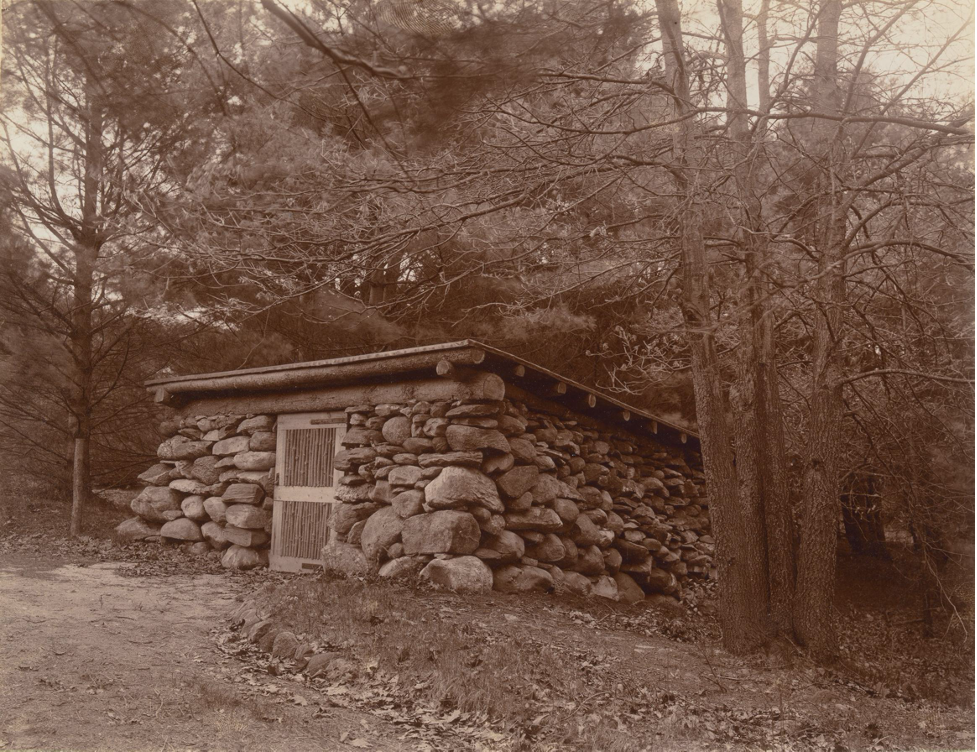
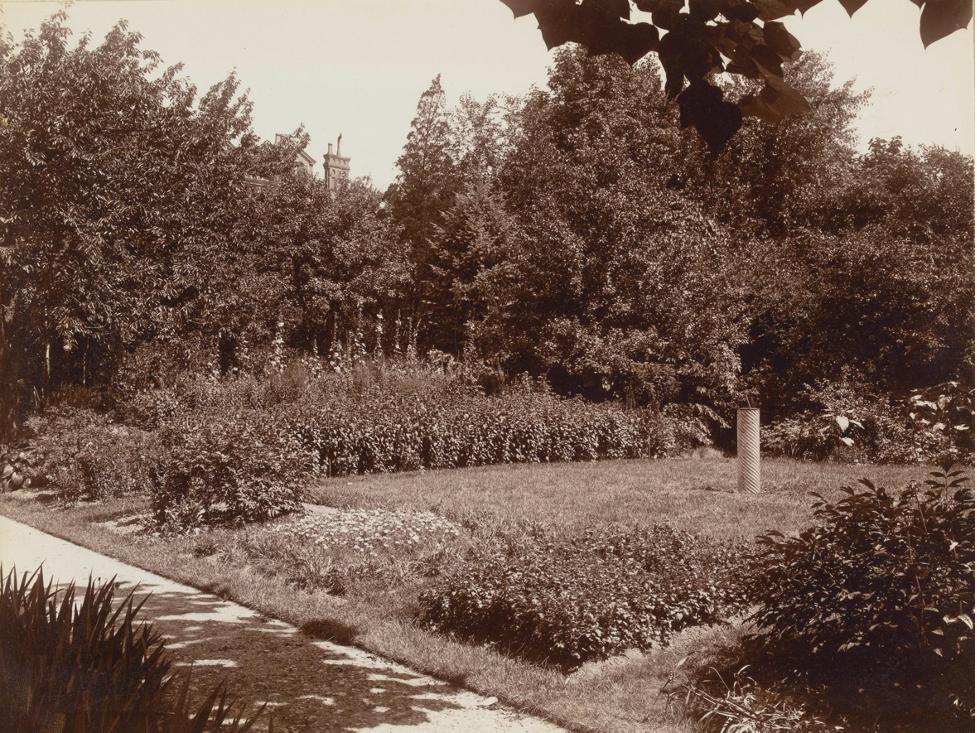
In the 1890s Brewster was earnestly transitioning from collecting bird specimens with his shotgun to field observation and photography. He had, in Robert Gilbert, an assistant knowledgeable in ornithology and capable with photography and photographic processing. It is unfortunate that in the Ernst Mayr Library collection of over 1,700 of Brewster’s photographic prints, only six have an inscription on the verso stating that the photograph was taken by Robert Gilbert. Below are two such photographs:

Black and white photograph of a stone wood-house in the woods.

From inscription on verso: “Wood-shed, Hemlock Grove, Concord, Mass., April 1904, taken by R.A. Gilbert.” From the collection of the Ernst Mayr Library of the Museum of Comparative Zoology, Harvard University. Call number bBr 97.70.7.23.

Black and white photograph of a garden.

Brewster’s garden. From inscription on verso: “Garden, Cambridge, Mass. July 30th 1904. Taken by R. A. Gilbert.” From the collection of the Ernst Mayr Library of the Museum of Comparative Zoology, Harvard University. Call number bBr 97.70.12.59.

It is possible that many other photographs were taken by Gilbert, but we don’t know for sure. There are a number of occasions recorded in Brewster’s writings where it is clear that Brewster himself was doing the photography. In his journal entry for May 18, 1897, for example, Brewster writes:

“I visited the Hermit’s nest in the Brown clearing taking five photographs of it. The [female] was on the nest and for a Hermit sat very closely allowing me to set up the camera & focus on her at a distance of about 4 ft. but gliding away just as I was about to expose a second plate. She would not return to her eggs, however, while the camera was in position although I waited for her nearly an hour.”

Whether or not Gilbert was taking the picture, it is clear that he played a major role assisting with various aspects of Brewster’s photography. Inscriptions on the verso of photographic prints reveal that Gilbert owned darkroom apparatus and copied glass plate negatives to make prints. In a journal entry dated May 29, 1897 Brewster writes: “In the forenoon I took several photographs (with Gilbert’s help) in the gulf at the head of Great Island and along the western shore of the Sweat Cove.” Though Brewster was taking the pictures, Gilbert was assisting in some fashion.

It is evident that Gilbert was an invaluable assistant and friend who greatly facilitated Brewster’s ornithological accomplishments. Gilbert remained in Brewster’s employ until the latter’s death in 1919. Brewster arranged for the MCZ to hire Gilbert upon his death, another attestation to Brewster’s high regard for him.

There is little on record describing Gilbert’s tasks at the MCZ, but the Annual Report of the Director sheds some light. In the Report of the Director for 1931/1932 Thomas Barbour writes: “Robert Gilbert, aided by several young men, has done excellent work in rearranging some of the exhibition halls.” In the 1933/1934 Annual Report Glover Allen writes in his Report on Mammals: “In the ever-present work of cleaning skulls and skeletal material French and Gilbert have latterly borne a helpful hand, developing some skill.” Were Gilbert doing similar tasks today, he would likely be given the title Curatorial Assistant in the MCZ. Barbour’s report intimates that, among many other skills, supervision and at least familiarity with exhibit design properly belong on Gilbert’s resume. No doubt, Gilbert’s work in Brewster’s museum prepared him well for his tasks in the MCZ.

Gilbert worked at the MCZ until his death in 1942. In his 1941/1942 Director’s report, Barbour provided the following tribute:

“On January 7, 1942 Robert A. Gilbert died. For years before he came to the Museum he had helped Mr. Brewster in many ways and his sterling personal characters of integrity, affection, courtesy, and loyalty made him not only a [sic] honor to his race but one who was proud to do everything which he did as well as he could do it, and who was beloved by us all.”

Robert Gilbert’s many talents as well as his passion, curiosity and integrity enriched Brewster’s life and pursuits. It is evident that he brought these same qualities to his work at the MCZ.

The Ernst Mayr Library is actively transcribing the digitized journals, diaries and correspondence of William Brewster, enabling full-text searching of these resources in the Biodiversity Heritage Library. It is our hope that this will facilitate digital scholarship and further interest in the life and work of Robert Gilbert. In the next blog post we will discuss this transcription work.

References

[1] Mitchell, John Hanson. 2005. Looking for Mr. Gilbert: The Reimagined Life of an African American. Washington, DC: Shoemaker.

[2] Mitchell, John Hanson. 2014 e-book edition. Looking for Mr. Gilbert: The Unlikely Life of the First African American Landscape Photographer. New York, New York : Open Road Distribution.

[3] Allen, Glover M. 1942. Obituaries. Robert A. Gilbert. The Auk 59.3: 467. JSTOR. Accessed on 25 January 2021. https://www.jstor.org/stable/4079251.

February 23, 2021by michelle.underhill
Blog Reel, Campaigns, Earth Optimism 2020, Featured Books

Nature Conservation and William Brewster: Insights From a Lifetime of Scientific Observations

This post is part of a series from the Ernst Mayr Library exploring the digitization and transcription of ornithologist William Brewster’s archival materials and the insights and scholarship made possible thanks to this work.

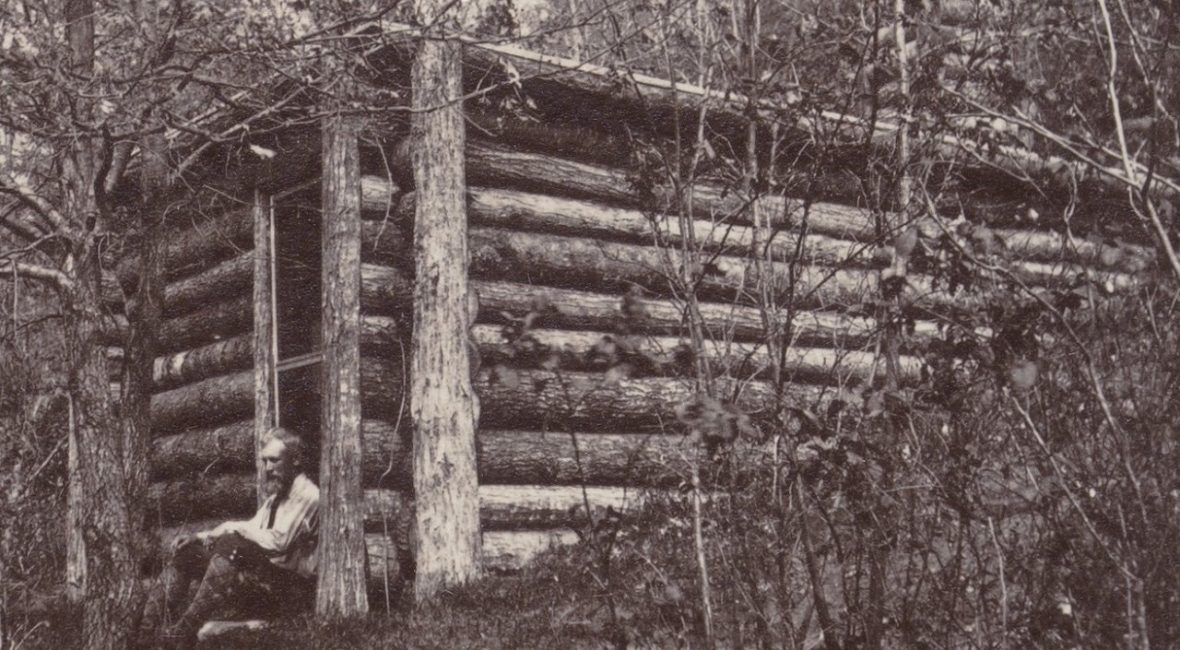
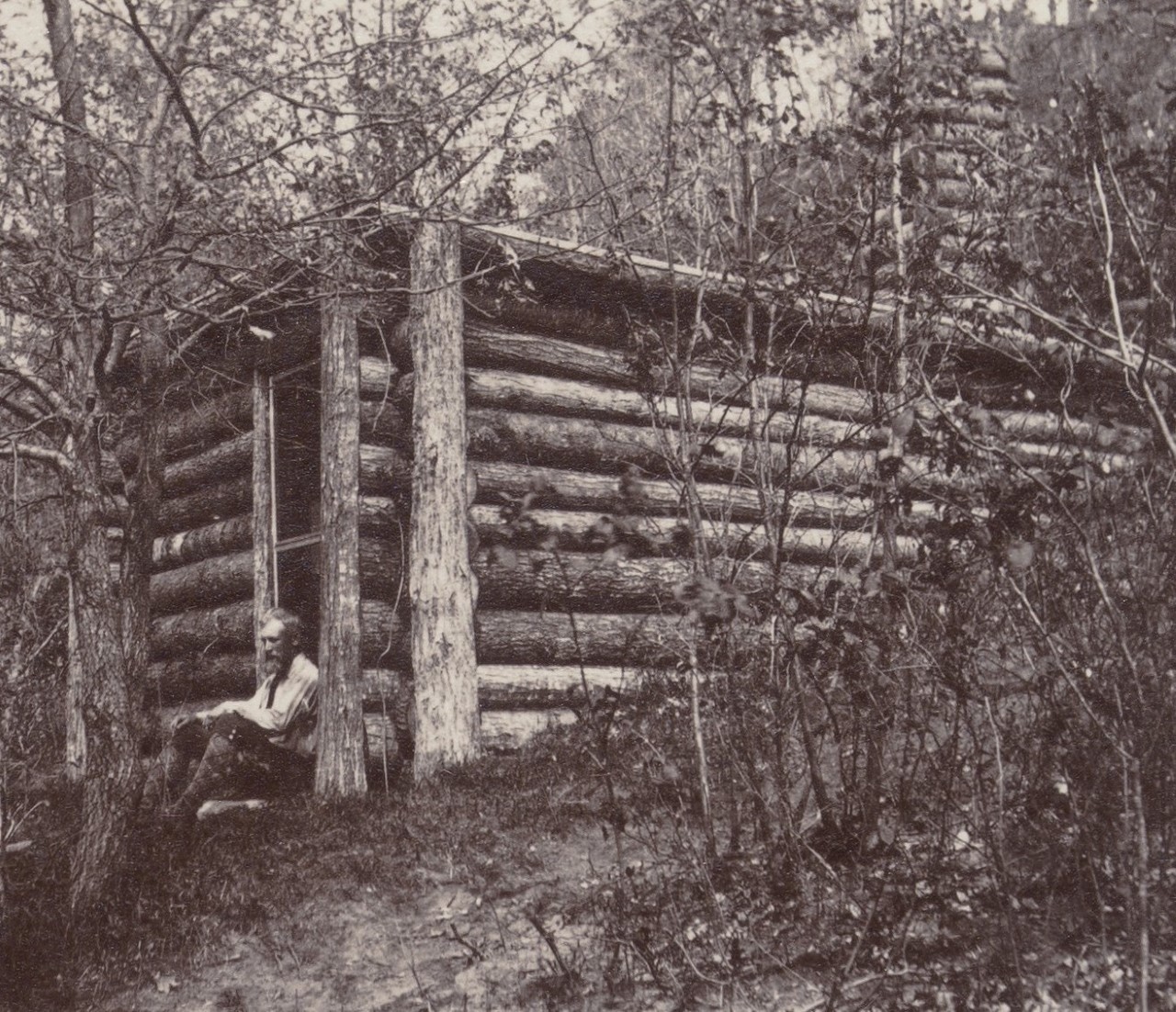
Black and white photo of a man sitting on the doorstep of a log cabin in the woods.

A black and white photograph of William Brewster sitting on the front doorstep of his cabin in Concord, Ma. The small, one-story log cabin is set in a hillside and surrounded by small trees and shrubs. The back of the photograph has the note: “Concord, Mass. May 20, 1892.” (Ernst Mayr Library Special Collections, call no. bBr97.70.7.)

The Ernst Mayr Library and Archives of the Museum of Comparative Zoology (MCZ), Harvard University, holds a unique and extensive collection of photographs, letters, manuscripts and field notes of William Brewster, a prominent ornithologist/naturalist of the late 19th and early 20th centuries. His published work is lauded as providing authoritative and novel additions to ornithology.

Brewster published more than 300 ornithological papers and several books which are widely available in academic and research libraries. He was the first president of the Massachusetts Audubon Society and was a founding member of the Nuttall Ornithological Club, out of which grew the national organization, the American Ornithologists’ Union. Brewster served as President of the American Ornithologists’ Union from 1895 to 1898, and the organization has awarded a medal in Brewster’s name since 1921.

Brewster’s ornithological studies covered the United States, although he worked most extensively in New England. Brewster was a Curator of Ornithology in the Harvard University Museum of Comparative Zoology from 1885 to 1902, continuing to work in the MCZ until his death in 1919. He deposited his bird specimen collection in the MCZ and his associated works such as his journals, diaries, correspondence and some photographic works in the Ernst Mayr Library & MCZ Archives. Brewster’s extensive specimen collection, in combination with his large body of published work, secures his place in ornithological history.

In 2012, the Ernst Mayr Library began digitizing Brewster’s journals, diaries, letters, and photographic prints. Many have been digitized as part of the CLIR-funded BHL Field Notes Project. To date, virtually all of Brewster’s more than 60,000 pages of notes, correspondence and images have been digitized and nearly 10,000 pages of the handwritten notes and diaries have been transcribed. All materials are in the process of being deposited in the Biodiversity Heritage Library, with more than half of the collection, including all of the journals and diaries, now available. The materials have been collated into the William Brewster Papers Collection.

Brewster kept journals and diaries, mostly devoted to his birding activities, for 54 years from the time he was 14 until he died in 1919. These written records afford us a glimpse into the daily inner workings of this scientist’s mind. The Ernst Mayr Library is fortunate to have his full set of journals and diaries, most of his correspondence and some of his photographs and glass negatives. This is indeed a treasure trove of information, now made more accessible as it is digitized and made openly available in BHL. This collection is more than a record of changing landscapes, bird lists, temperature and weather recorded for each day of writing. It shows us how Brewster developed his ideas, how he thought about the world, and how his thinking changed through his life. In his later correspondence with Frank Chapman (a then-young ornithologist that Brewster mentored into a more mature career), they debated about and revised how to do science with less killing of birds.

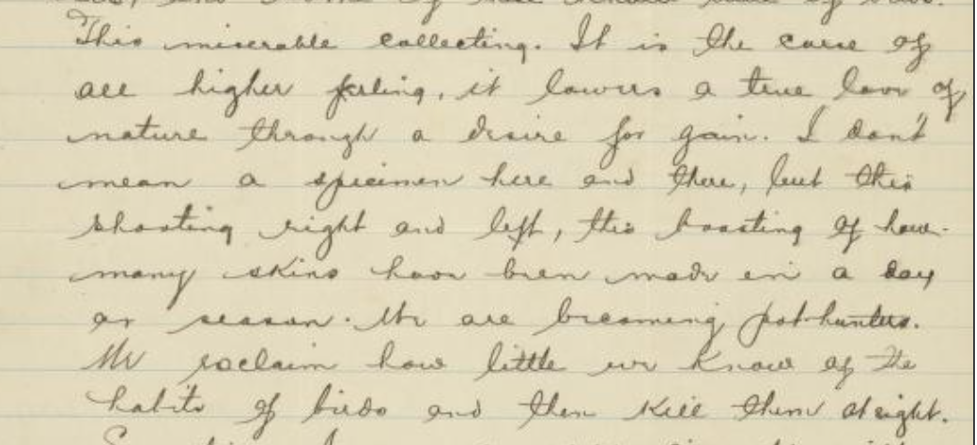
handwritten page from a field notebook.

Excerpt of a letter from Frank Michler Chapman to William Brewster. 15 June 1890. Contributed in BHL from the Harvard University, Museum of Comparative Zoology, Ernst Mayr Library.

“This miserable collecting. It is the cause of all higher failing, it lowers a true love of nature through a desire for gain. I don’t mean a specimen here and there, but this shooting right and left, this boasting of how many skins have been made in a day or season. We are becoming pot-hunters. We proclaim how little we know of the habits of birds and then kill them at sight. Sometimes I am completely disgusted with our ways and myself in particular… I long for an outing where the gun will be secondary, recorded observations primary, where I shall be entirely alone or with a companion whose object is my object … The question with me is, how am I going to change this?… Will you embark with me on a novel ornithological expedition, whose aim shall be to really observe birds to learn something of them. Where the gun shall be a servant, not a master, where days may pass without a skin being made, where there will be time to speculate and discuss the habits of birds observed, where systematic observation of certain phaenomena may be attempted.” 15 June 1890, Correspondence, Frank Michler Chapman to William Brewster.

Brewster’s detailed, long-term observations and notes are the key to his published contributions to ornithology and are a unique resource. His diaries, journals and correspondence are a gold mine of unpublished observations, journal notes, sketches, weather reports, specimen lists and travel narratives: these records are primary source data at its most raw and unevaluated. Historical collections of field notes may be the only documentation of a scientist’s thought processes, ideas and observations, particularly if only some of the writer’s material was ever published.

Brewster documented local environmental changes and gradual declines in number and presence of bird species over many years. He was concerned about vanishing wildlife, urbanization and landscape changes. He talked about ecological succession before the concept was officially published.

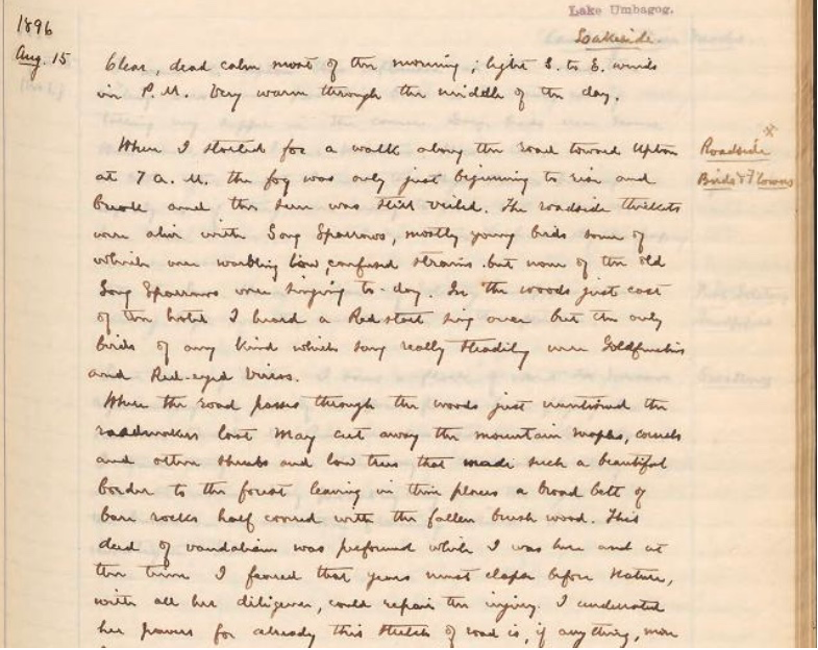
handwritten page from a field notebook.

Excerpt of a page from William Brewster’s 1896 journal, in which he documents the impact of roadwork on local wildlife. Contributed in BHL from the Harvard University, Museum of Comparative Zoology, Ernst Mayr Library.

“Where the road passes through the woods … the roadworkers last May cut away the mountain maples, [cornels] and other shrubs and low trees that made such a beautiful border to the forest clearing in their places a broad belt of bare rocks half covered with the fallen brush wood. This deed of vandalism was performed while I was here and at the time I feared that years must elapse before Nature, with all her diligence, could repair the injury. I underrated her powers for already this thicket of road is, if anything, more beautiful than ever. Fire weed, Eupatorium, Impatiens, Asters, Golden rod and several other tall and rank flowering plants have shot up through and almost perfectly concealed the unsightly brush and stone heaps and I have rarely seen a more brilliant or attractive display of wild flowers.” 15 August 1896, Lake Umbagog, Maine, Journals of William Brewster

Brewster helped develop legislation to discourage excessive hunting and the use of feathers in women’s hats, although at the same time advocating for the continued, but regulated, collection of scientific specimens. His conservation work led him to become the first president of the Massachusetts Audubon Society. The photographs and negatives from the collections chronicle landscape changes through time. Brewster’s growing concerns about the killing of wildlife, even for scientific purposes, can be seen developing in his field notes and correspondence.

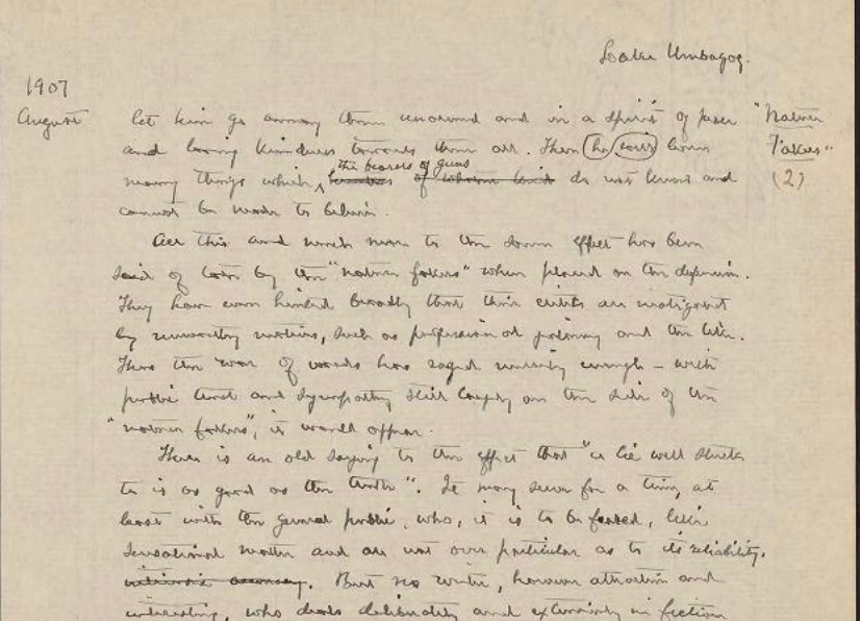
handwritten page from a field notebook.

Excerpt of a page from William Brewster’s 1907 journal, which captures his transition from collecting bird specimens with his shotgun to field observation and photography. Contributed in BHL from the Harvard University, Museum of Comparative Zoology, Ernst Mayr Library.

“If he would become really familiar with the wood folk and their ways, let him go among them unarmed and in a spirit of peace and loving kindness towards them all. Then he will learn many things which the bearers of guns do not know and cannot be made to believe.” August 1907, Journals of William Brewster.

The availability of Brewster’s notebooks enhances contemporary studies and makes the entire research cycle of this scientist’s work available for analysis by historians of science, scientists, social scientists and humanists or anyone interested in the process of discovery, by creating a richer and more interactive history of science resource. Brewster’s careful observations enable comparisons of his birding lists with contemporary observations (100 years plus later), helping to document environmental changes that might not be evident otherwise.

References

Emmet, Alan. November-December 2007. William Brewster: Brief life of a bird-lover 1851-1919. Harvard Magazine. https://harvardmagazine.com/2007/11/william-brewster-html

Meyer, Elizabeth. April 5, 2018. From ‘Shotgun Ornithology’ to nature conservation: scientific stories and data from the field notes of William Brewster. https://blog.biodiversitylibrary.org/2018/04/from-shotgun-ornithology-to-nature-conservation-scientific-stories-and-data-from-the-field-notes-of-william-brewster.html

Meyer, Elizabeth. April 6, 2017. Notes from William Brewster: The evolving field of zoology. https://blog.biodiversitylibrary.org/2017/04/notes-from-william-brewster-evolving.html

Meyer, Elizabeth. September 9, 2016. Notes from William Brewster: Ecological change in the Maine woods. https://library.mcz.harvard.edu/blog/notes-william-brewster-ecological-change-maine-woods

Mitchell, John Hanson. 2014 e-book edition. Looking for Mr. Gilbert: The Unlikely Life of the First African American Landscape Photographer. New York, New York : Open Road Distribution.

Mitchell, John Hanson. 2005. Looking for Mr. Gilbert: the Reimagined Life of an African American. Washington, D.C. : Shoemaker & Hoard : Distributed by Publishers Group West

Randall, Patrick. June 5, 2014. Transcribing the field notes of William Brewster. https://blog.biodiversitylibrary.org/2014/06/transcribing-field-notes-of-william.html

Rinaldo, Constance, Linda Ford and Joseph deVeer. 2018. Museum, library and archives partnership: Leveraging digitized data from historical sources. Poster presentation at Society for the Preservation of Natural History Collections, August 2018, Dunedin, New Zealand.

Sears, M. 2020. Celebrating Robert Gilbert. Ernst Mayr Library Blog post: https://library.mcz.harvard.edu/blog/celebrating-robert-gilbert

February 22, 2021by michelle.underhill
BHL News, Blog Reel

More than 250,000 Free Nature Images Now Available in the BHL Flickr

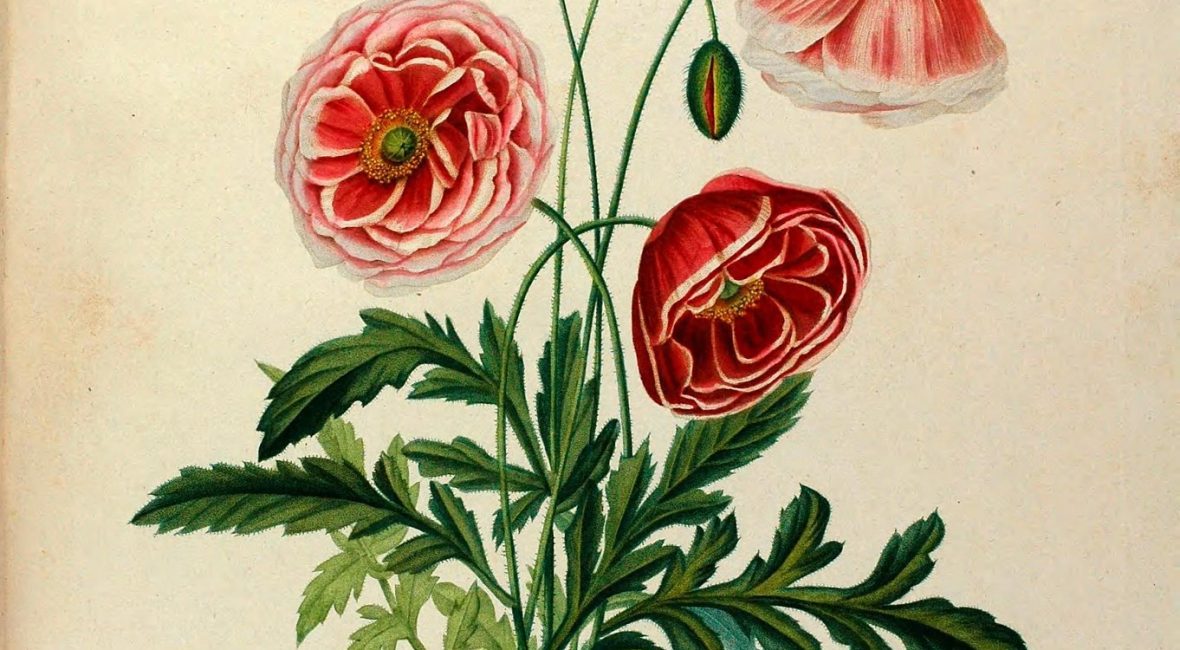
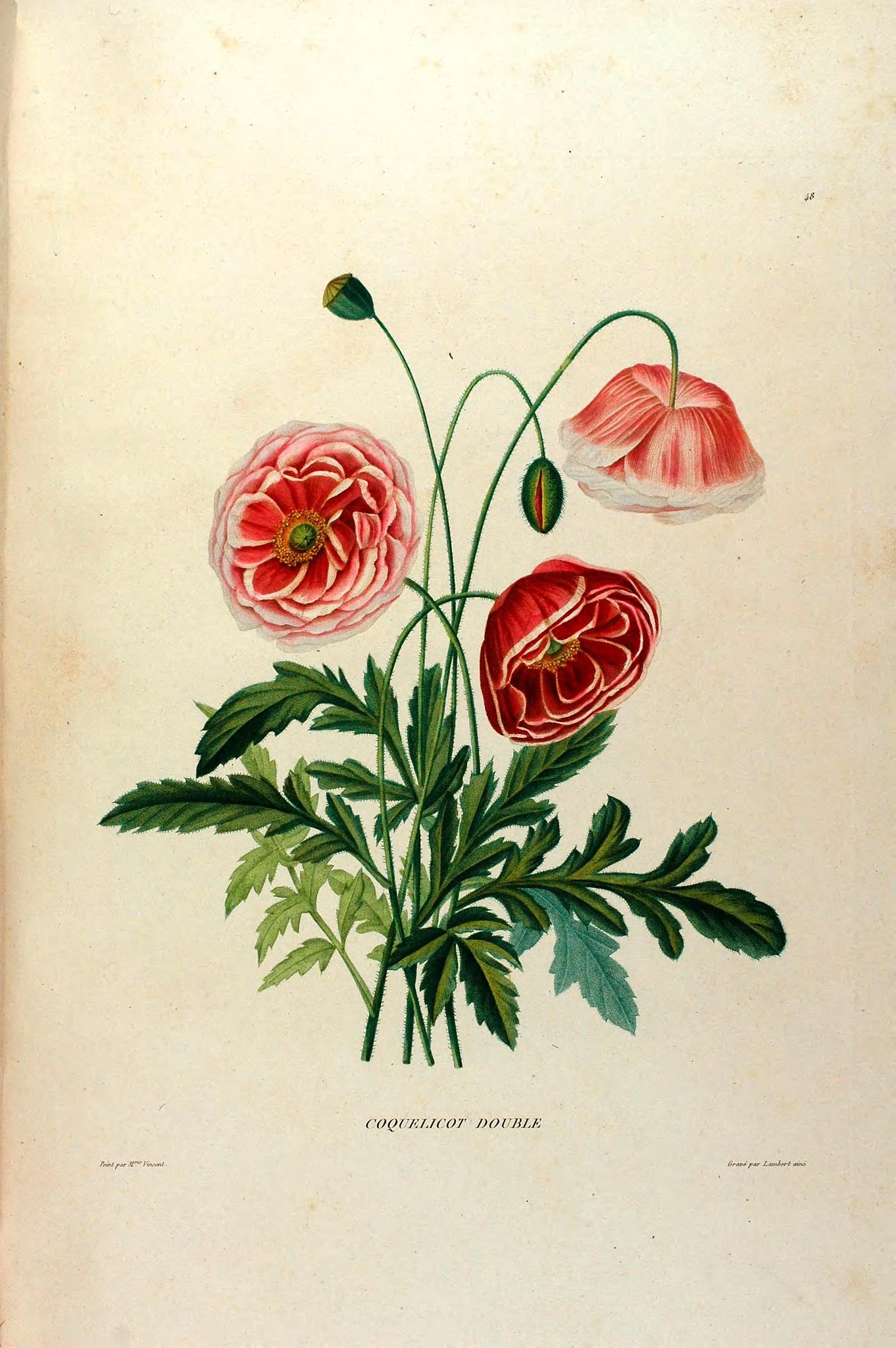
illustration of red flowers with green stems and leaves.

The most-viewed image in the BHL Flickr as of February 2021. Vincent, Henriette Antoinette. Études de fleurs et de fruits. c1820. Art by Vincent. Contributed in BHL from Chicago Botanic Garden, Lenhardt Library. Link in Flickr. Link in BHL.

Over a quarter of a million nature images are now freely available through the BHL Flickr!

Since 2011, we’ve been making many of the illustrations from BHL’s collection available via Flickr. While it has long been a community favorite amongst our audiences, in 2020 our Flickr’s popularity increased significantly when it received considerable media attention in outlets including Colossal, Laughing Squid, Český rozhlas, ZME Science, Cultura Inquieta, Hyperallergic, Graffica, Smithsonian Magazine, Open Culture, la Repubblica, Genbeta, My Modern Met (en Español), eCulture Greece, Daily Geek Show, Вокруг Света, Atlas Obscura, Shifter, Lifehacker, Indiehoy, Microsiervos, and Vice. As a result of this publicity in February 2020, we saw a 518% increase in daily views on Flickr images (2.5 million daily views compared to an average of 400,000) and an over 100% increase in visits and unique visitors to BHL. This popularity continued throughout the year, culminating in over 343 million views on images in 2020 alone—a 123% increase over 2019, bringing our all-time views to over 902 million!

Last year also offered a unique opportunity to substantially build our Flickr collection. With many of our partners working virtually in 2020 due to the COVID-19 pandemic, we focused on projects to improve our digital collections remotely. This work included uploading images to Flickr. In 2020, over 40 BHL partner staff and volunteers contributed to the upload of over 90,000 new images to Flickr—a nearly 200% increase in images uploaded compared to 2019.

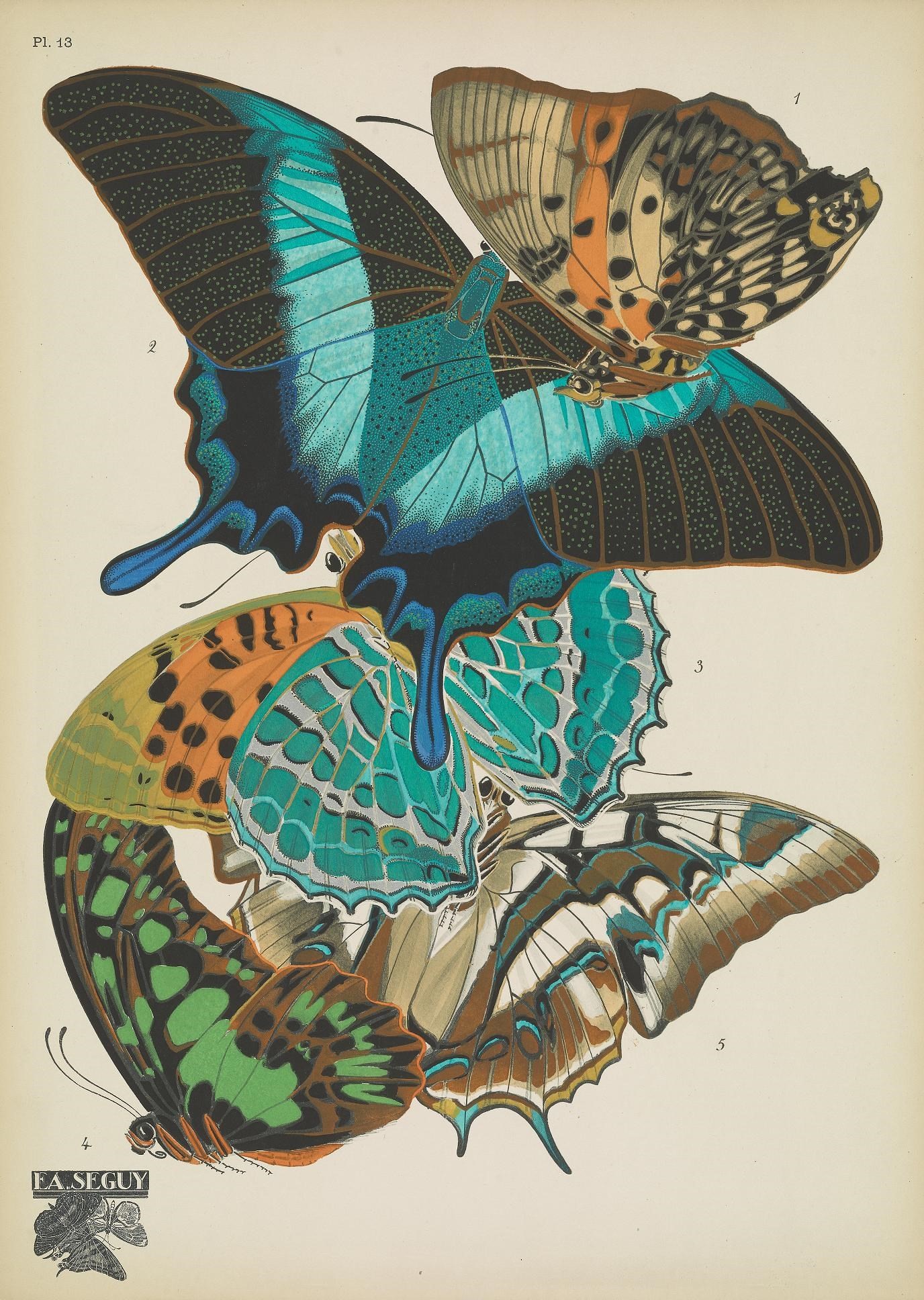
illustration of multiple butterflies positioned on top of one another.

The second most-viewed image in the BHL Flickr as of February 2021. Séguy, Emile-Allain. Papillons. 1925. Art by Séguy. Contributed in BHL from Smithsonian Libraries and Archives. Link in Flickr. Link in BHL.

Thanks to this impressive work, our Flickr collection now includes over 250,000 free images dating from the 16th-20th centuries and representing a range of biodiversity subjects, from plants and animals to fungi, microscopic organisms, and even artifacts like tools made from shells. All images in the BHL Flickr are free to browse, download, and reuse. You can learn more about reusing images from Flickr on the BHL About site.

This post features some of the most popular (by views) images in the BHL Flickr.

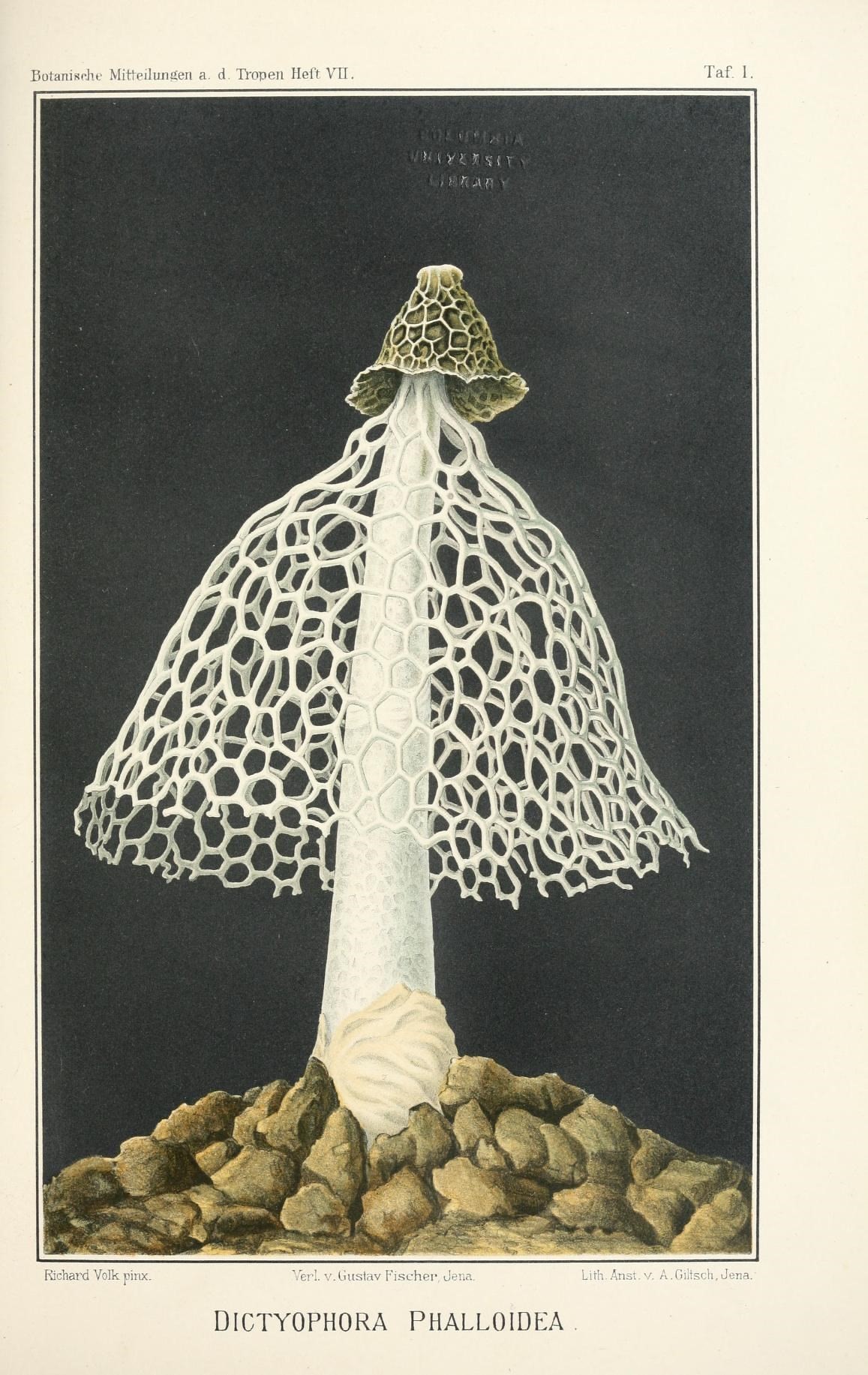
illustration of fungi with an indusium.

The third most-viewed image in the BHL Flickr as of February 2021. Möller, Alfred. Brasilische Pilzblumen. 1895. Art by Richard Volk. Contributed in BHL from The LuEsther T Mertz Library, the New York Botanical Garden. Link in Flickr. Link in BHL.

Images in Flickr are curated by album and collection. Each album corresponds to a particular volume in BHL and contains all of the full page images from that volume. Images and albums are further curated into collections on particular subjects, from botanical art to marine species, gardening, endangered species, and more. We also have collections associated with BHL’s various social media campaigns, including Her Natural History (featuring a collection of illustrations by women artists, each tagged with the name of the artist), Monsters Are Real (featuring images of mythical creatures like hydra, sea serpents, and kraken), Color Our Collections (featuring black and white illustrations perfect for printing and coloring), and Fossil Stories (featuring a wealth of historic paleontological art).

Flickr helps improve image discoverability for BHL, not only by making it easier to browse images from BHL’s collection of over 59 million pages, but also by providing an opportunity for the public to help enhance the metadata for these images through crowdsourcing, making it easier to search the images by species, artist, geographic location, and more! Visit our About site to learn more about how to search images in the BHL Flickr.

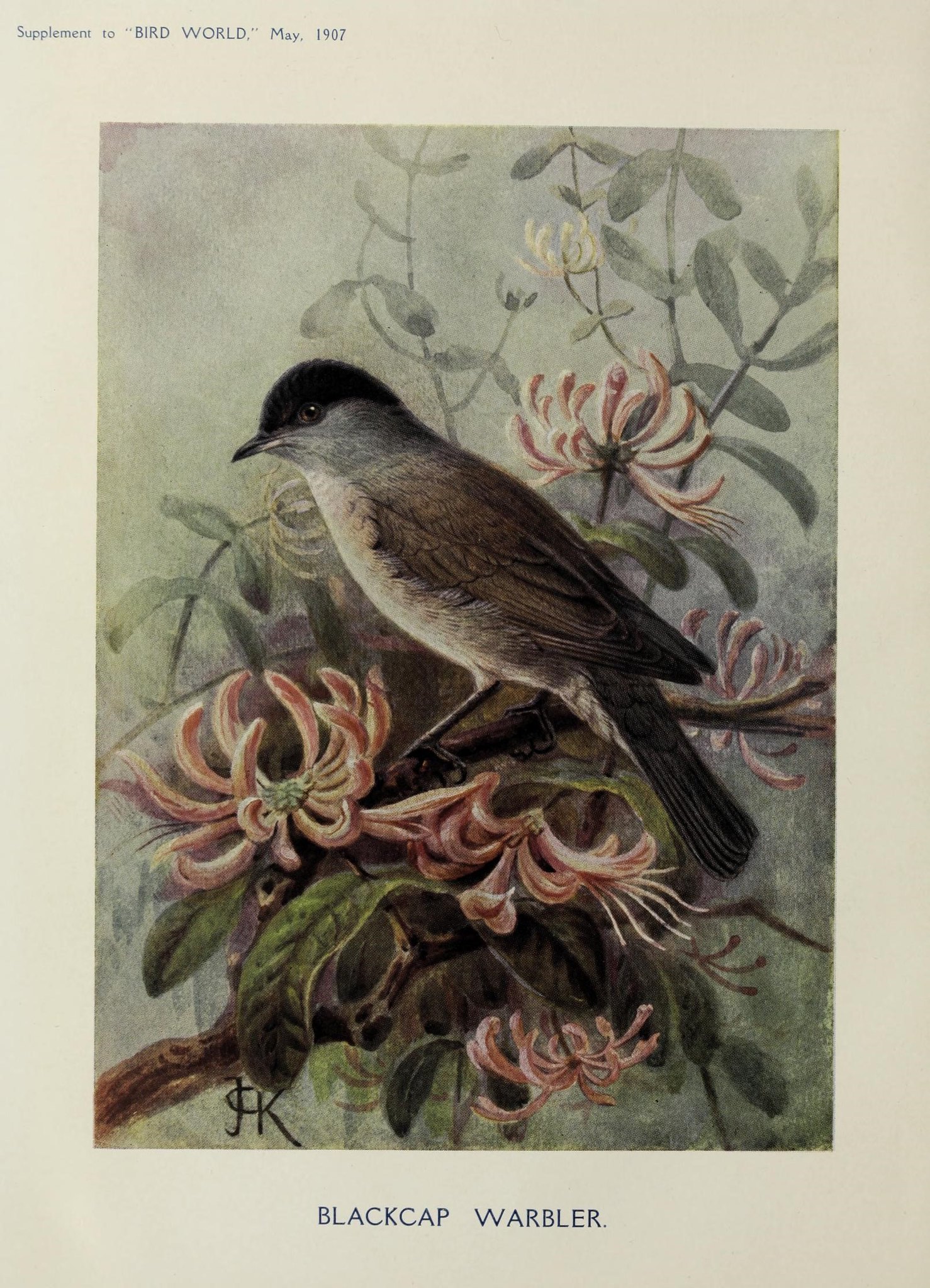
illustration of a bird sitting amongst pink flowers.

The fourth most-viewed image in the BHL Flickr as of February 2021. Bird World Magazine, v.1 (1906-1907). Art by John Gerrard Keulemans. Contributed in BHL from the University Library at the University of Illinois at Urbana-Champaign. Link in Flickr. Link in BHL.

Through our Flickr Tagging Crowdsourcing Project, we invite anyone to help add tags to Flickr images that describe the species depicted, identify the artist of the image, or indicate the geographic location in which the depicted species lives. To date, over 46,000 images, or about 18% of our Flickr collection, has been tagged by the public. This is an incredible accomplishment, but don’t worry—there’s still plenty of images in need of tags. And the best part? This is an educational activity that you can do from home!

We are so grateful to all of our volunteers who have helped tag our images. Thanks to you, these images are more accessible and discoverable for others to support their research and educational activities.

We welcome anyone to join us in tagging images in our Flickr. Learn how to get started with these detailed tagging instructions.

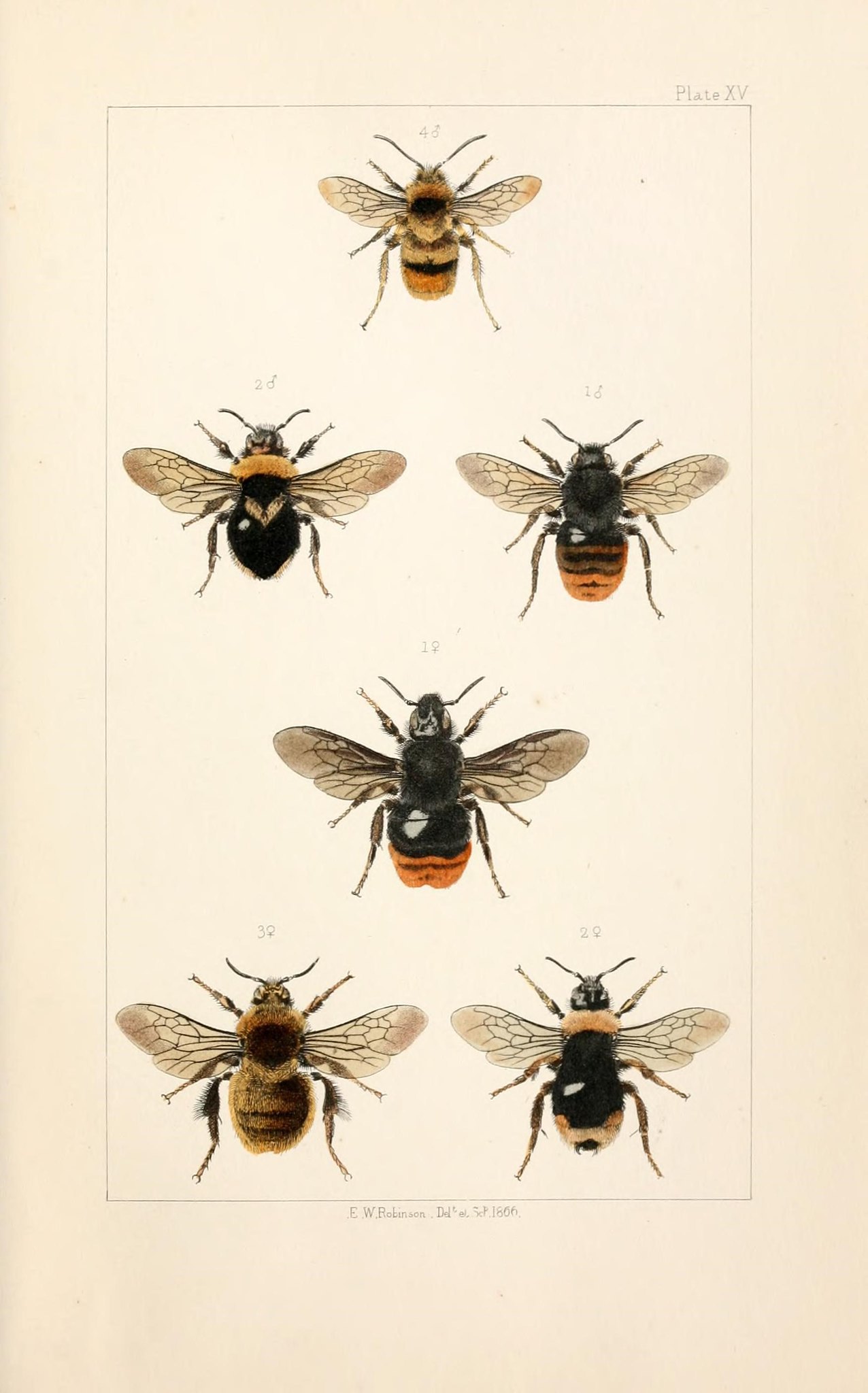
Illustration of bees.

The fifth most-viewed image in the BHL Flickr as of February 2021. Shuckard, William Edward. British Bees. 1866. Art by Edward William Robinson. Contributed in BHL from MBLWHOI Library. Link in Flickr. Link in BHL.

We invite you to explore our image collections on Flickr today. Thank you to all of our incredible partners who have helped build this amazing resource, and to all of our volunteers who have helped improve it through image tagging. We encourage you to download and reuse the images for your own educational, artistic, personal, and professional uses, and to help us improve the collections by participating in our tagging project.

Enjoy immersing yourself in the beauty of nature through art!

February 18, 2021by michelle.underhill
BHL News, Blog Reel, Tech Updates

Updates to Bibliography Pages in BHL

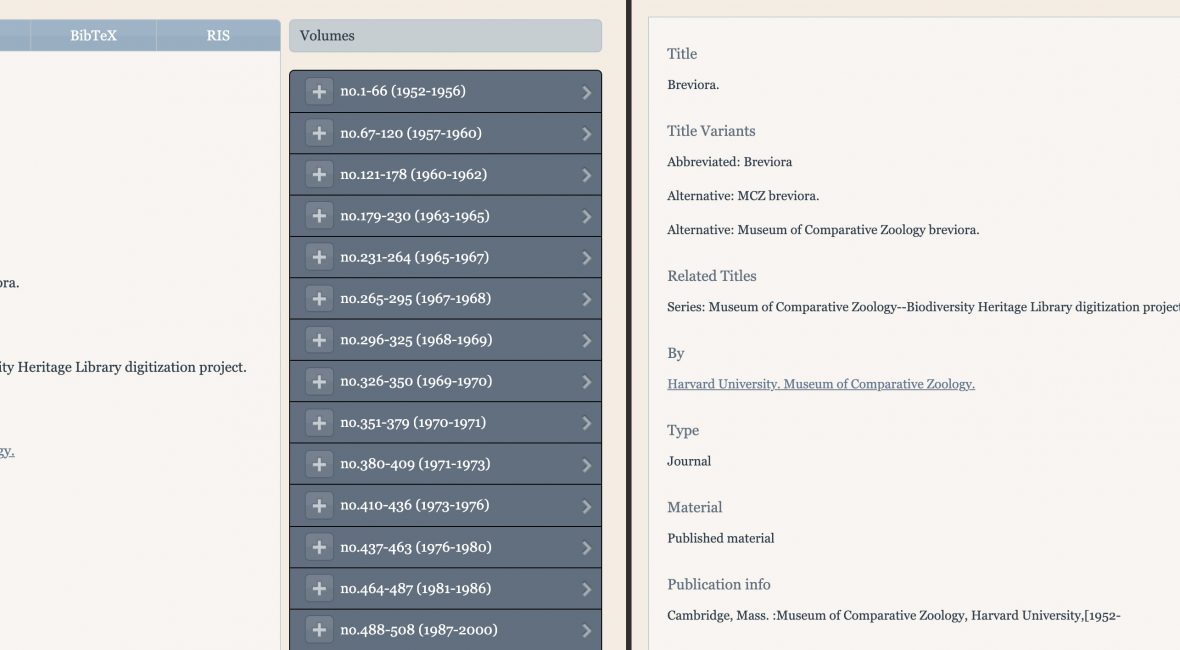
Screenshot of bibliography pages in BHL with and without tabs.

We have updated the bibliography pages in BHL to streamline the presentation of information about and metadata export options for content in the Library.

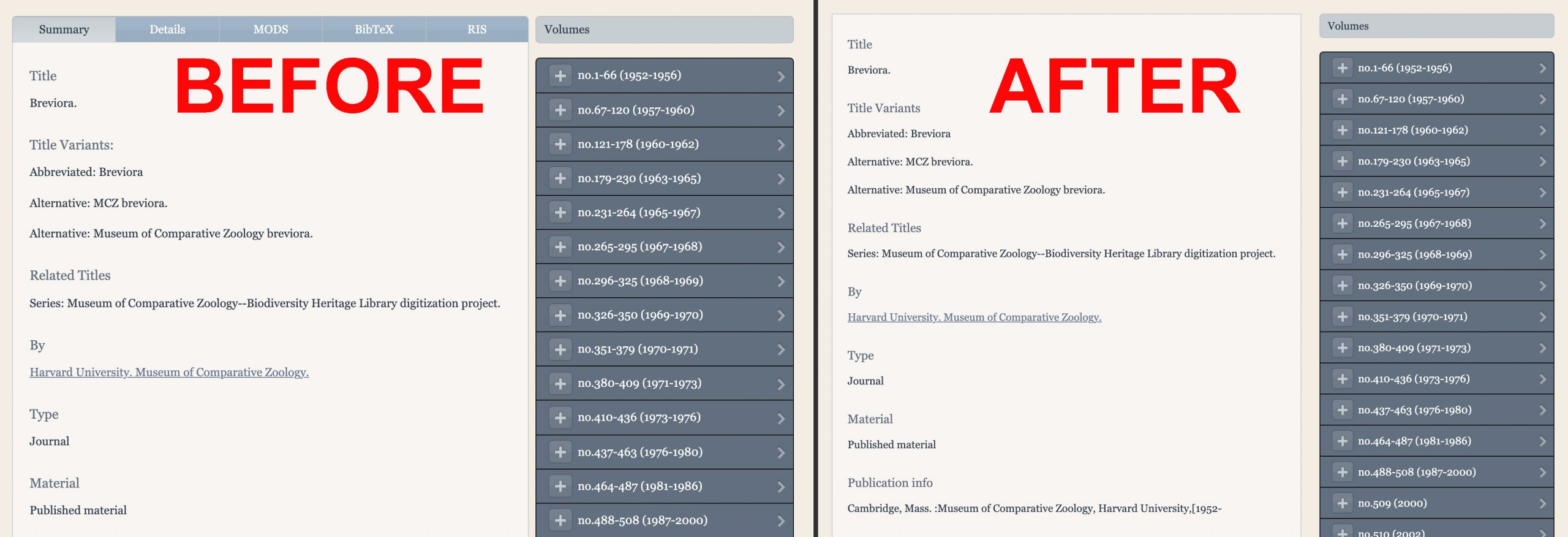
Previously, bibliographic details and export options were available through different tabs on title and part pages. These tabs have now been removed, and all bibliographic information is consolidated into a single display.

Screenshot showing BHL bibliography pages before and after.

The various tabs on title and part bibliography pages have now been consolidated into a single display.

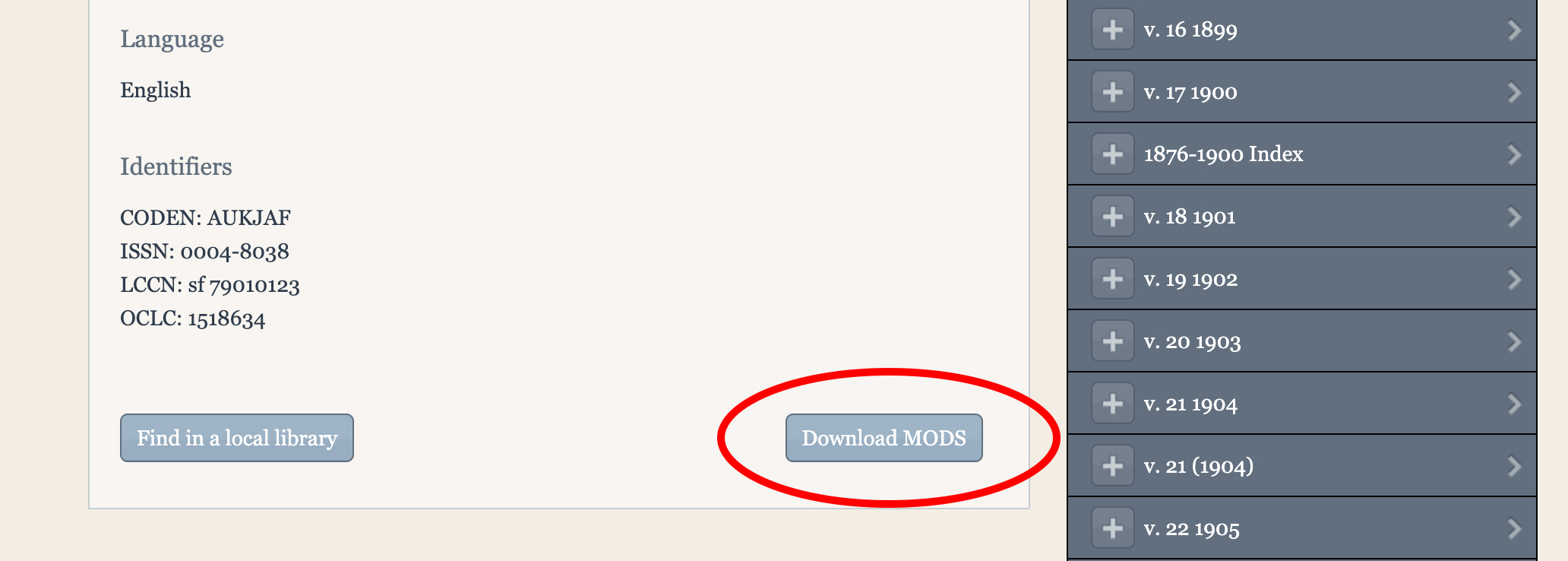
BHL’s metadata export options have also been relocated. BHL offers metadata exports in MODS, BibTex, and RIS formats. MODS is an XML-based bibliographic description schema used in a variety of library applications. BibTex and RIS are bibliographic citation files that are compatible with a variety of citation management tools. The MODS file is a title-level download. The BibTex and RIS files are item-level downloads.

The MODS download is available at the bottom of the title and part bibliography pages.

Screenshot of a title page in BHL with the "Download MODS" button circled.

MODS download on the title and page bibliography pages.

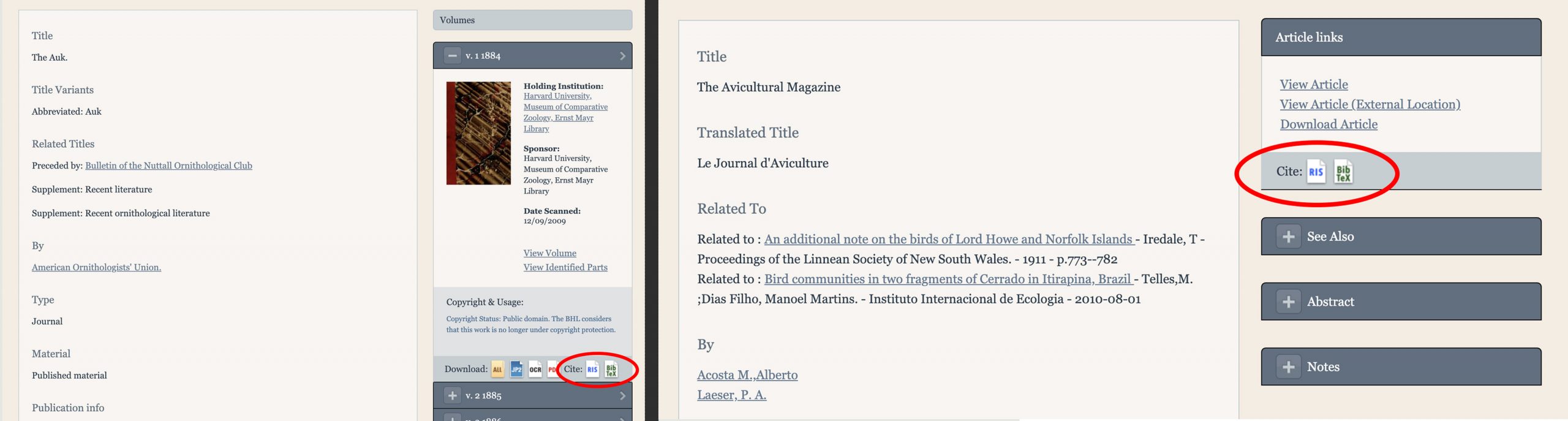
The BibTex and RIS downloads are available in two places:

1) Under the volume or part details on bibliography pages.

Screenshot of the citation download options in the BHL website.

BibTex and RIS downloads on title (left) and part (right) bibliography pages.

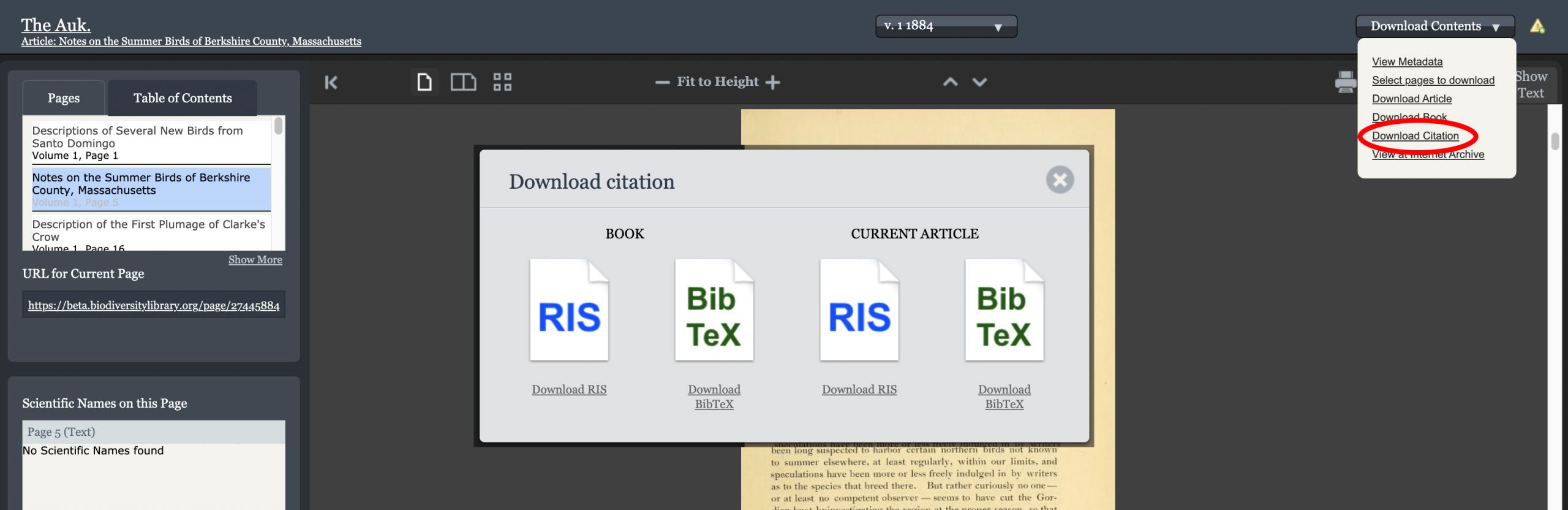
2) Under the “Download Contents” menu in the book viewer, via the “Download Citation” option.

Screenshot of the BHL book viewer with the citation download options displayed.

Download citation options in the BHL book viewer.

As part of this update, we have removed the direct Mendeley import from BHL, as the generic RIS and BibTex formats are compatible with a variety of citation management softwares including Mendeley.

Details about our metadata export services are also available in the FAQ on the BHL About site.

February 11, 2021by michelle.underhill
Blog Reel, User Stories

Finding Refuge in the Library: How BHL Inspired the Mycological Book Club

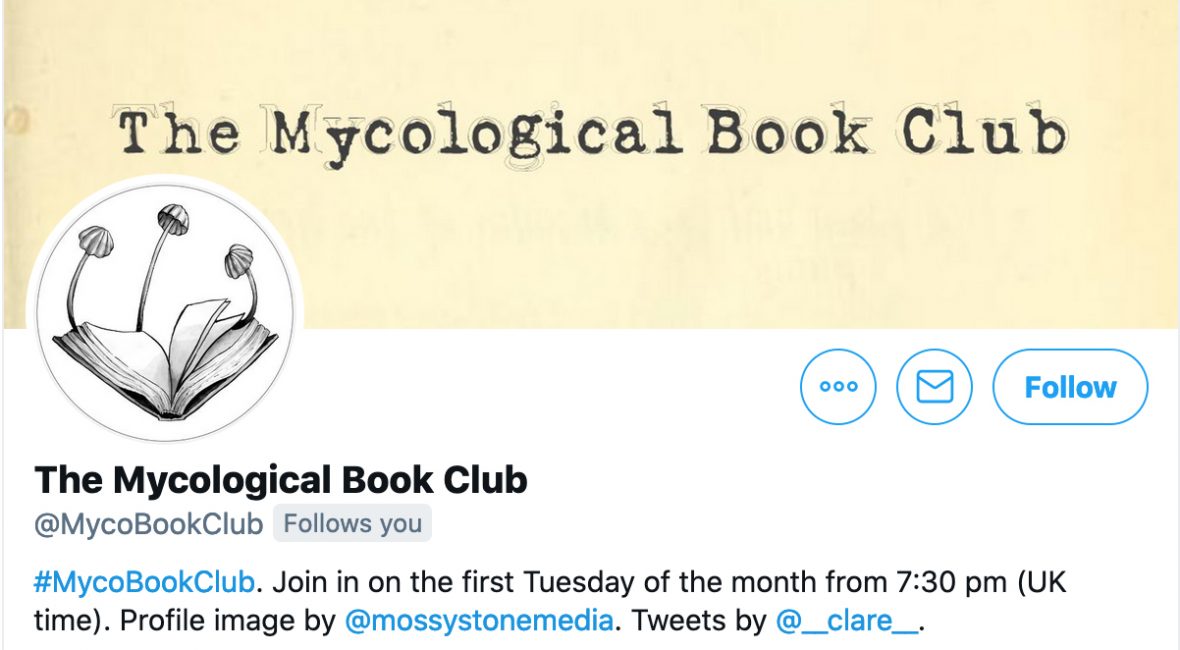
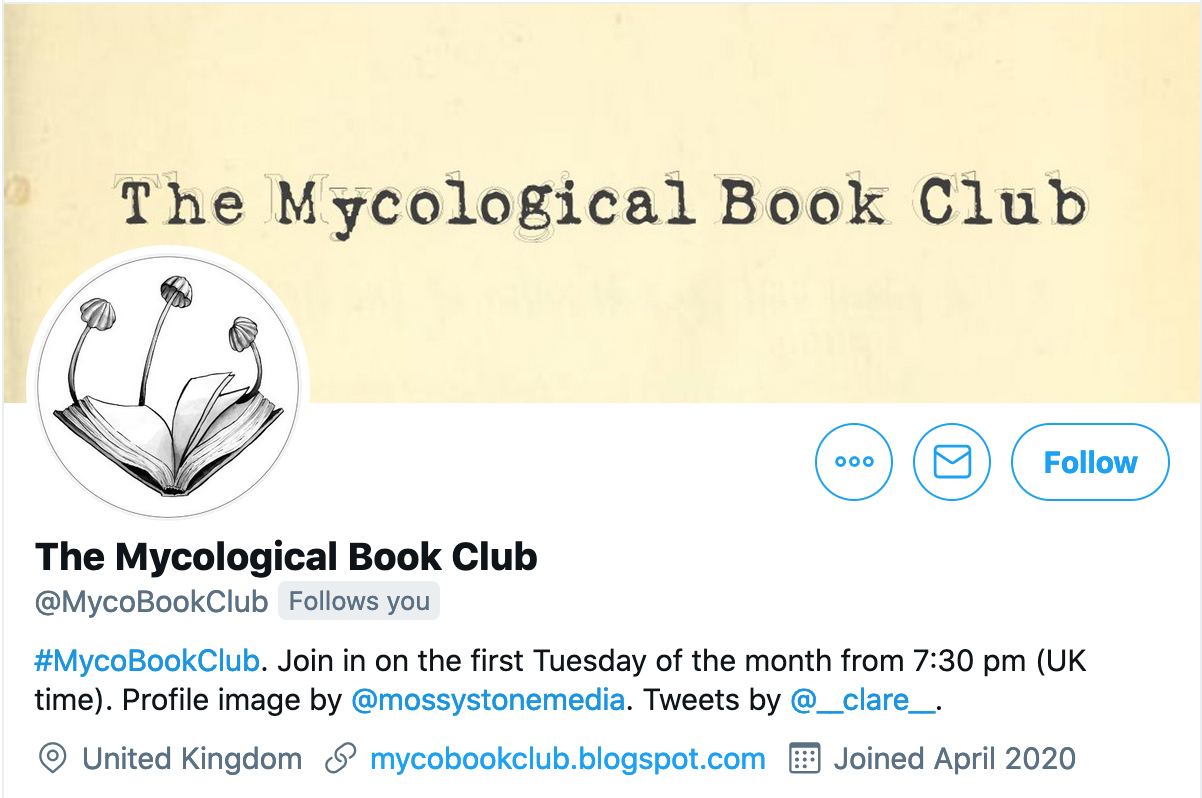
Screenshot of the Twitter profile of @MycoBookClub.

On 23 March 2020, the U.K. went into its first national lockdown in response to the COVID-19 pandemic. Social distancing and teleworking became the norm, and the walls of our homes became, in many ways, the boundaries of our individual worlds.

Amateur mycologist Clare Blencowe was eager to find a positive distraction from the realities of life during a pandemic. The Biodiversity Heritage Library’s open access collections, which for Blencowe had become a welcome refuge from the continuous onslaught of negative news articles, now became the inspiration for a new, socially distanced way to connect with other fungi lovers—in the form of “The Mycological Book Club”, an online, Twitter-based book club with a particular focus on open access literature.

#MycoBookClub logo fungi growing out of a book

#MycoBookClub logo, designed by illustrator Kelsey Sconberg of Mossy Stone Media.

“We were at the beginning of a national lockdown,” recalls Blencowe. “All social events were cancelled, and I found myself endlessly scrolling through increasingly doom-laden news, feeling increasingly doom-y. #MycoBookClub started as a simple distraction, an opportunity for a shared experience: people reading the same book and discussing it on Twitter at an allotted time.”

Screenshot of the Twitter profile of @MycoBookClub.

@MycoBookClub on Twitter.

Blencowe brought her idea to life by founding the @MycoBookClub Twitter account, establishing the #MycoBookClub hashtag to facilitate discussion, and setting a recurring date and time for book club meetings—the first Tuesday of the month at 7:30pm (GMT) on Twitter. She then scheduled the first #MycoBookClub meeting for 5 May 2020.

That first meeting, which brought together just a handful of followers, was dedicated to Mordecai Cubitt Cooke’s Rust, Smut, Mildew & Mould: An Introduction to the Study of Microscopic Fungi (Fifth ed. 1886), which club members accessed through BHL.

Welcome to #MycoBookClub, folks! It’s a pleasant evening here at @MycoBookClub headquarters in Sussex, England.

We’re talking about ‘MICROSCOPIC FUNGI: Rust, Smut, Mildew & Mould’ by M.C. Cooke (1886). You can find it at: https://t.co/7WO005ZS5Q pic.twitter.com/GxWzmYhnxg

— The Mycological Book Club (@MycoBookClub) May 5, 2020

With passages celebrating the beauty and wonder of the often unheeded nature in our own backyards and neighborhoods, the title was a fitting—and motivating—choice for an audience confined to their homes and local natural surroundings.

As Cooke writes,

“We might traverse the primeval forests of the new world, and explore the unknown regions of the old, and not encounter so much to excite our admiration, or cause our wonder, as lies about our feet at home; marvels which we tread beneath our feet, or kick from our path, because they appear to be only rotten sticks, withered grass, and decaying leaves.”

“Cooke’s writing provided inspiration for enjoying nature near home,” shares Blencowe. “I felt myself lifted by his soaring rhetoric.”

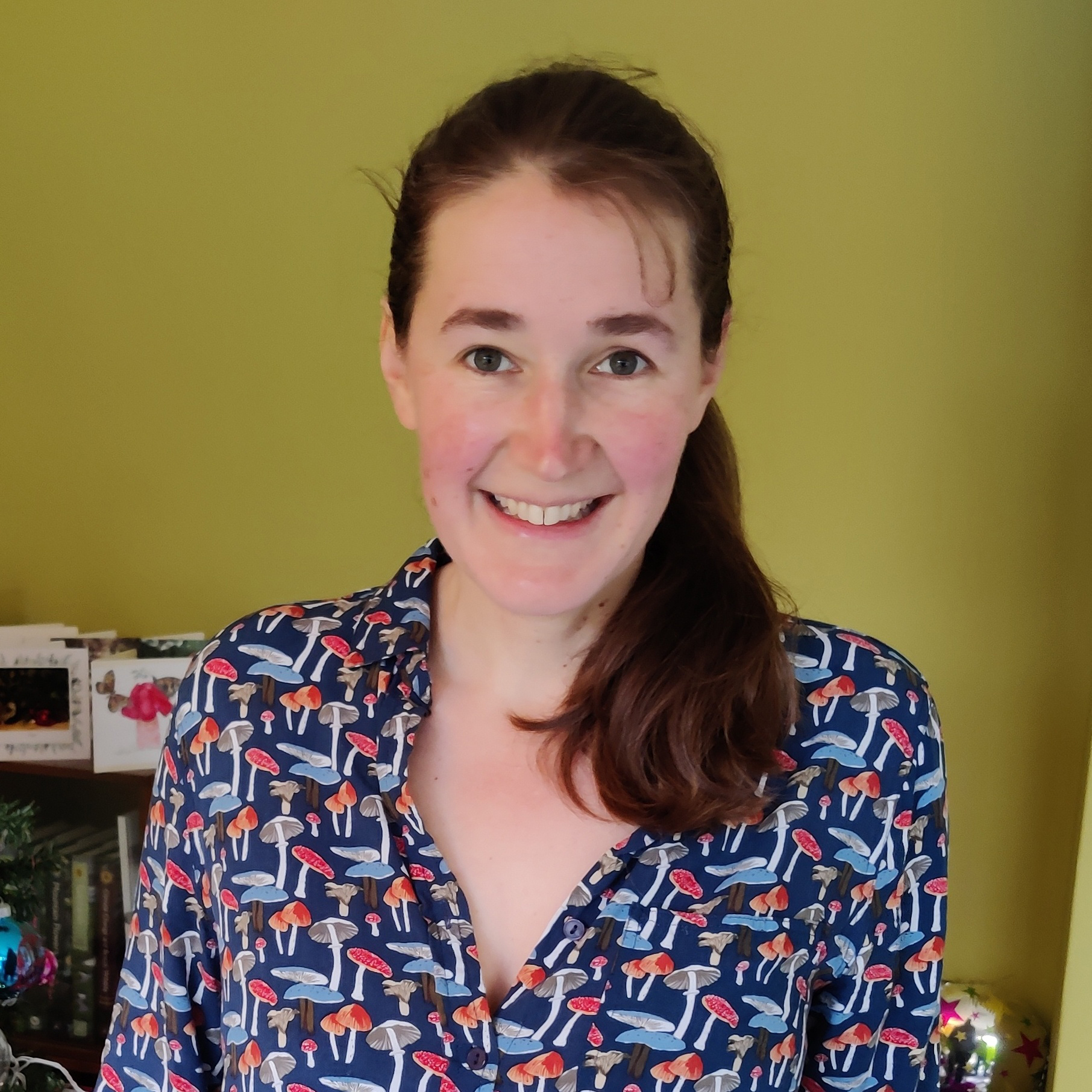
Photo of a human with long brown hair in a shirt with fungi images on it.

Amateur mycologist Clare Blencowe, founder of the #MycoBookClub. Photo courtesy of Clare Blencowe.

#MycoBookClub has allowed Blencowe to share and grow her interest in mycology—an interest that began in earnest about five years ago when a new job as manager of the Sussex Biodiversity Record Centre, and the much shorter commute that came with it, provided her with newfound time to pursue her interest in fungi. While she considers mycology a hobby, her involvement in the field has grown over the years through membership in the British Mycological Society, where she was recently elected to their Field Mycology and Conservation Committee.

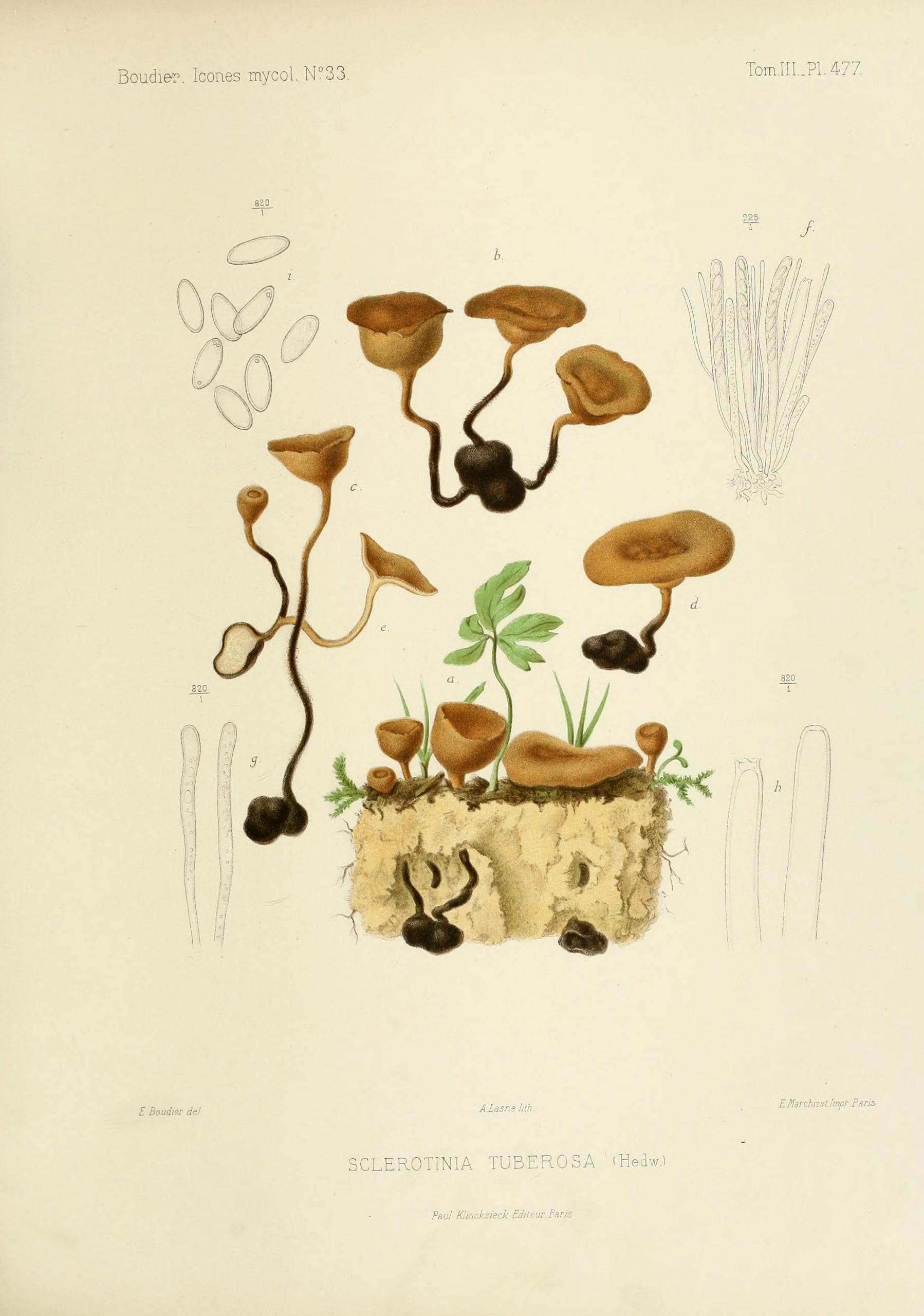
BHL helped nurture this love of mycology well before the birth of #MycoBookClub. Blencowe’s first in-depth interaction with the Library occurred in April 2019, when her discovery of a small brown fungus cup in the woods led her to seek confirmation of its identity—which she believed to be the Anemone Cup Dumontinia tuberosa—by posting to the British Mycological Society Facebook group. UK-based mycologist Lukas Large responded to her post with the link to a color plate for comparison from Émile Boudier’s Icones Mycologicæ (1905-1910) in BHL.

Illustration of fungi.

Illustration of Dumontinia tuberosa, plate 477. Boudier, Émile. Icones Mycologicæ (1905-1910), v.3. Art by Boudier. Contributed in BHL from the University Library, University of Illinois Urbana Champaign.

“The information contained in this beautiful colour plate far surpassed anything I had access to in my field guides at home,” shares Blencowe. “It helped me to understand the structure and features of this fungus I had in front of me, and spurred me on to take a closer look at it under the microscope. That experience really opened my eyes to what a useful resource the books in BHL can be: to inform observation and help identify species in a present day context. Sure, species concepts and nomenclature may have moved on, but the detail with which mycologists such as Boudier recorded their observations is a lesson in itself.”

Since that eye-opening experience, Blencowe continues to turn to BHL as a resource to support her interests in mycology, reading titles online and downloading select pages and images as needed. Some of her favorite aspects of the Library include a good search functionality, user-friendly online reading and content downloading, high quality scans, clear copyright information, easily-shareable direct page links, and the image collections in Flickr. Since founding #MycoBookClub, she uses BHL almost every week.

We’ve talked already here at #MycoBookClub about M.C. Cooke, but tonight we’re also feasting our eyes on ‘Selecta Fungorum Carpologia’ by The Brothers Tulasne.

You can find their illustrations in the Biodiversity Heritage Library: https://t.co/DN4Hi816XE pic.twitter.com/buaU9fMTa4

— The Mycological Book Club (@MycoBookClub) June 2, 2020

“I love the little bookish details that are preserved in BHL: the gilt decoration on a publication’s cover, ornate book plates, library stamps, barely-decipherable pencil marks and blank pages uniquely speckled with foxing,” shares Blencowe. “The scanned pages hold so much more than simply the words and the illustrations. They do your soul good.”

A reminder that it’s #MycoBookClub night tonight, from 7:30pm UK time.

We’re trying out a theme this evening: illustration ?https://t.co/Bvx0nDHY08

— The Mycological Book Club (@MycoBookClub) November 3, 2020

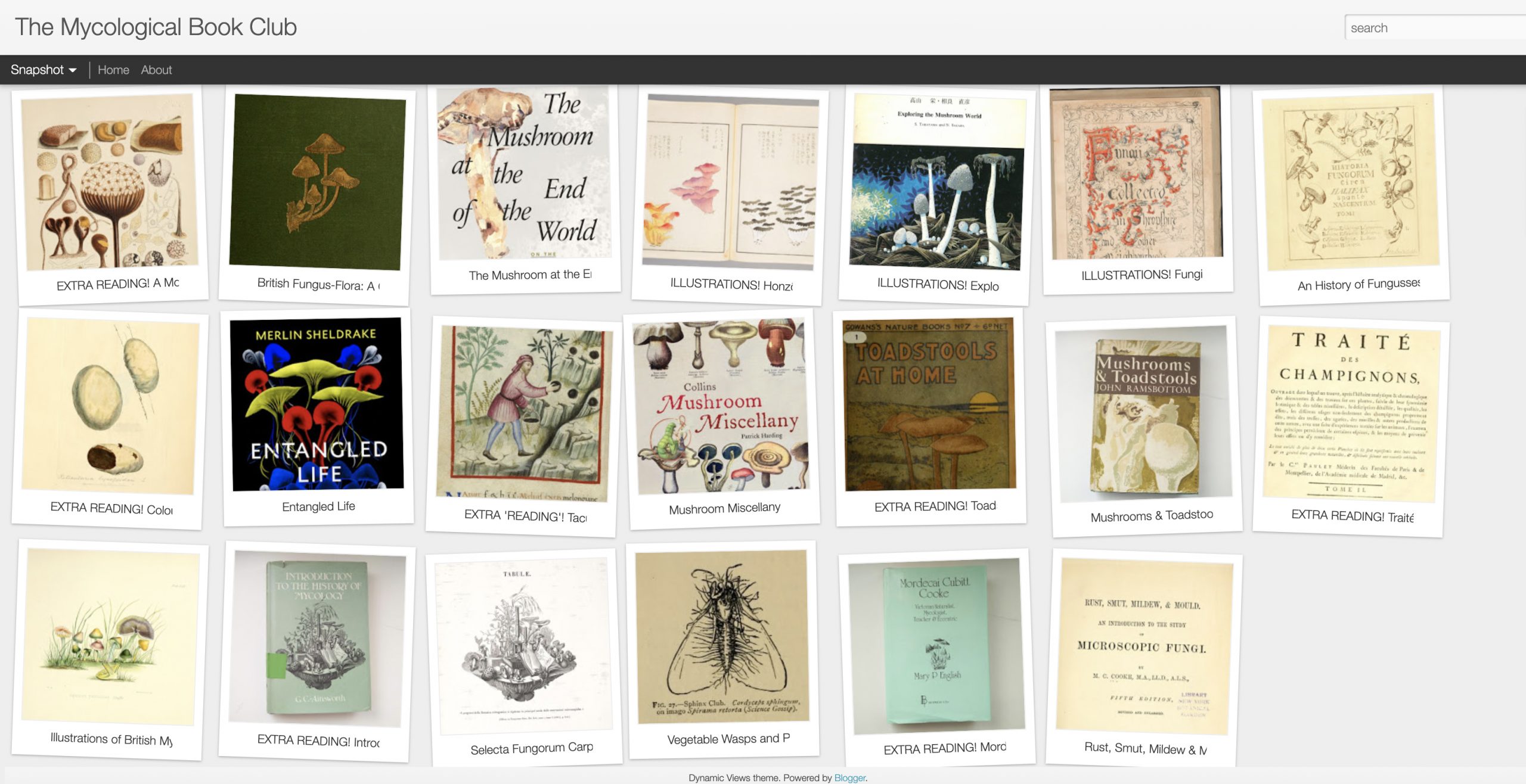
In the months following the club’s first meeting in May 2020, #MycoBookClub continued to grow, amassing more followers and receiving attention in outlets like The British Mycological Society Newsletter and IMA Fungus. Blencowe established a “virtual bookshelf” to maintain a list of all the books that #MycoBookClub had discussed—many of which were accessed through BHL.

Screenshot of a virtual bookshelf with thumbnails of book covers.

#MycoBookClub “virtual bookshelf.” Source: https://mycobookclub.blogspot.com

“The more time I spend in the Library, the more amazed I am by the vast amount of literature it contains—and the neat way it is organised and presented,” lauds Blencowe. “BHL also provides the opportunity to take a deep dive into the source material for a fascinating glimpse into the machinery of global science in the 19th century.”

While she’s enjoyed many titles in BHL, a recent favorite is Anna Maria Hussey’s Illustrations of British Mycology (1847-55), which was the subject of the July 2020 #MycoBookClub meeting. Published under the name Mrs. T.J. Hussey, the two-volume work illustrates and describes species collected by Hussey and her sister, Frances Reed.

#MycoBookClub returns Tues 7 July, 7:30pm (UK time).

Thought we could take a broader look at the fungal kingdom this month with ‘Illustrations of British Mycology’ by Anna Maria Hussey (1847).

You can read it in the @BioDivLibrary, here: https://t.co/4BPXfDyWhd pic.twitter.com/icBcIRd1xM

— The Mycological Book Club (@MycoBookClub) June 7, 2020

“Hussey writes from the perspective of an enthusiastic amateur which I found both highly relatable and genuinely inspiring,” affirms Blencowe. “She writes in a chatty, conversational style which is peppered with fascinating contemporary details (such as her observation that Boletus subtomentosus has ‘the texture of a Limerick glove’) and timeless wisdom (‘life passes in gaining experience for ourselves…till at last we have acquired the wisdom to guide us safely…’).”

Illustration of fungi.

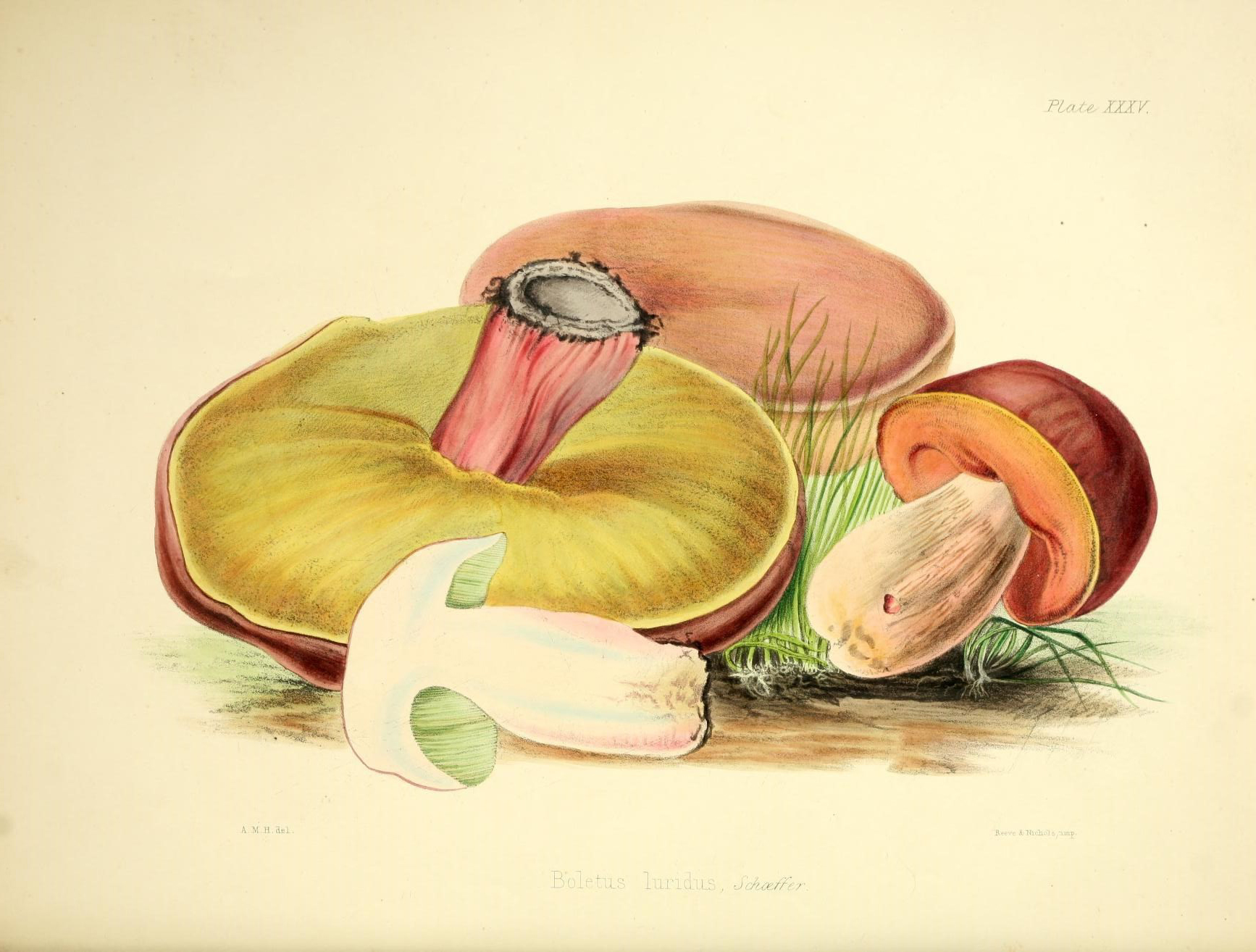
Illustration of Suillellus luridus, plate 35. Hussey, Anna Maria. Illustrations of British Mycology, ser.2 (1855). Art by Hussey. Contributed in BHL from The New York Botanical Garden, LuEsther T. Mertz Library. Explore all illustrations from Illustrations of British Mycology in the BHL Flickr.

Blencowe has gathered and shared via @MycoBookClub some of her favorite elements from Hussey’s work, including her approach to mycology, her discussion of fungus names, her commentary on fungi in nature, her descriptions of fungal habitats, and miscellaneous myco-chatter. Illustrations of British Mycologyis also noteworthy as a rare female-authored work in the bibliography of historic mycological literature.

“Browsing the historic biodiversity literature, it is very noticeable that certain perspectives predominate,” notes Blencowe. “The books are mostly written by men—white men. So it was a particular joy to come across Hussey’s book. I’m keen to explore ways that @MycoBookClub can provide a platform for different perspectives and respectfully champion Indigenous knowledge of fungi.”

While ours may still be a socially-distanced world, initiatives like #MycoBookClub remind us that there are still opportunities to connect with others, share our passions, and nurture a community. And while the news may still be filled with dire headlines, naturalists like Mordecai Cubitt Cooke and Anna Maria Hussey remind us that we can still find solace in nature close to home and in unexpected places, if we are just willing to look.

To quote Hussey: “The world is full of beauty that we pass by unheeded.”

Illustration of fungi.

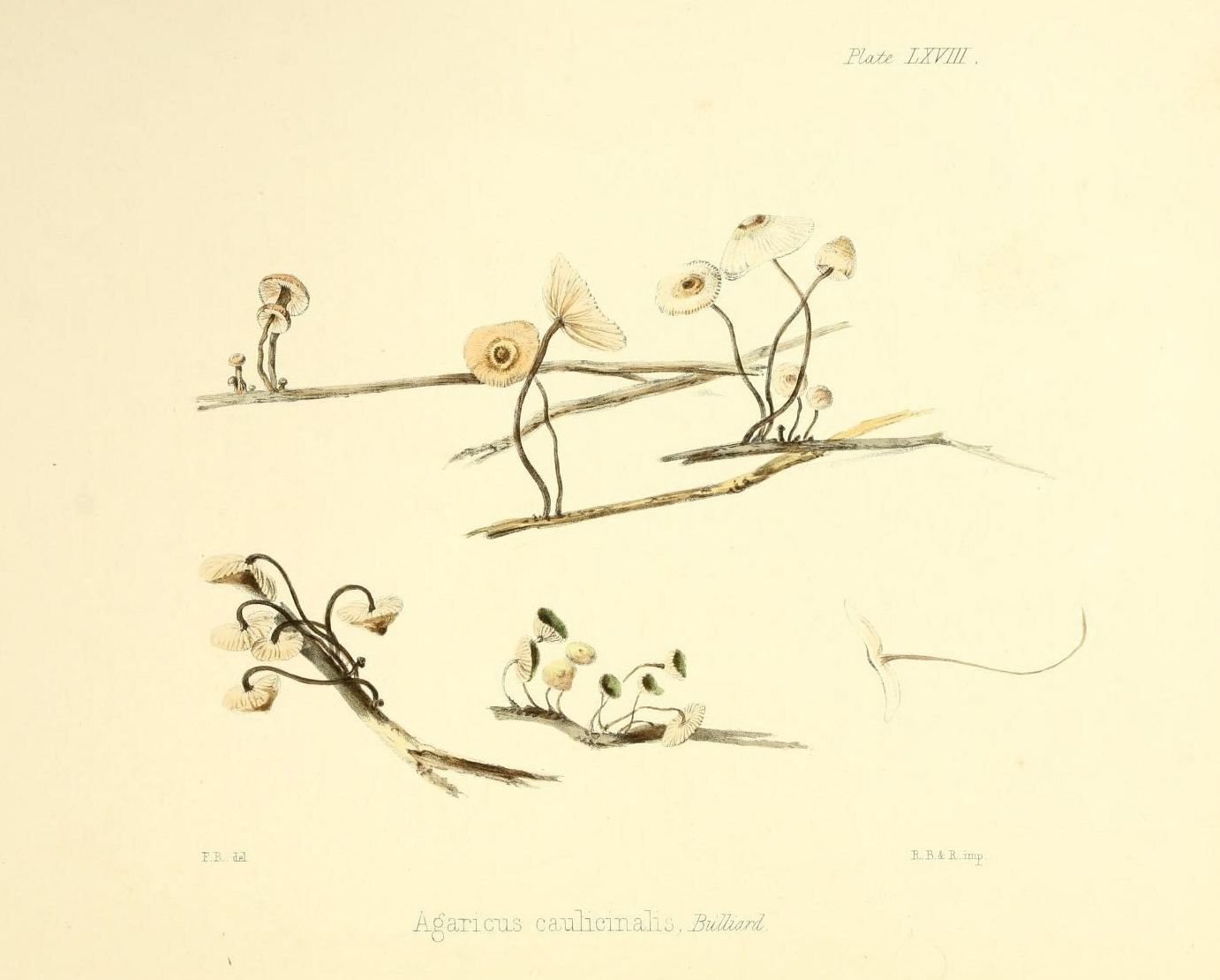
Illustration of Crinipellis scabella, plate 68. Hussey, Anna Maria. Illustrations of British Mycology, ser.1 (1847). Art by Frances Reed. Contributed in BHL from The New York Botanical Garden, LuEsther T. Mertz Library. This plate accompanies Hussey’s quote: “The world is full of beauty that we pass by unheeded.”

Everyone is welcome to join the #MycoBookClub. Follow @MycoBookClub for updates and meeting information, and join the discussion the first Tuesday of each month at 7:30pm (GMT) using the #MycoBookClub hashtag on Twitter.

February 1, 2021by michelle.underhill

Help Support BHL

BHL's existence depends on the financial support of its patrons. Help us keep this free resource alive!

search

About BHL

The Biodiversity Heritage Library (BHL) is the world’s largest open access digital library for biodiversity literature and archives. BHL operates as a worldwide consortium of natural history, botanical, research, and national libraries working together to digitize the natural history literature held in their collections and make it freely available for open access as part of a global “biodiversity community.”

Join Our Mailing List

Sign up to receive the latest news, content highlights, and promotions.

Subscribe Now

Subscribe to Blog via Email

Enter your email address to subscribe to this blog and receive notifications of new posts by email.

Join 319 other subscribers

Subscribe to Blog Via RSS

Subscribe to the blog RSS feed to stay up-to-date on all the latest BHL posts.

Access RSS Feed

Inspiring Discovery through Free Access to Biodiversity Knowledge.

The Biodiversity Heritage Library makes it easier than ever for you to access the information you need to study and explore life on Earth…for free, anytime, anywhere.


64+ Million Pages of
Biodiversity Literature Online.

EXPLORE

Tools and Services
to Transform Research.

EXPLORE

300,000+
Illustrations on Flickr.

EXPLORE

ABOUT | HARMFUL CONTENT | PRIVACY | SITE MAP | TERMS OF USE