
Biodiversity Heritage Library - Program news and collection highlights from BHL
  • Home
  • News
  • Featured Books
    • All Featured Books
    • Book of the Month Series
    • BHL at 20
  • User Stories
  • Campaigns
    • Fossil Stories
    • Garden Stories
    • Monsters Are Real
    • Page Frights
    • Her Natural History
    • Earth Optimism 2020
  • Tech Blog
  • Visit BHL
Home
News
Featured Books
    All Featured Books
    Book of the Month Series
    BHL at 20
User Stories
Campaigns
    Fossil Stories
    Garden Stories
    Monsters Are Real
    Page Frights
    Her Natural History
    Earth Optimism 2020
Tech Blog
Visit BHL
  • Home
  • News
  • Featured Books
    • All Featured Books
    • Book of the Month Series
    • BHL at 20
  • User Stories
  • Campaigns
    • Fossil Stories
    • Garden Stories
    • Monsters Are Real
    • Page Frights
    • Her Natural History
    • Earth Optimism 2020
  • Tech Blog
  • Visit BHL
Biodiversity Heritage Library - Program news and collection highlights from BHL
Blog Reel, User Stories

Chronicling the History of the Former Squires of Coulsdon: Rare Book Digitization Informs Research on the Byron Family

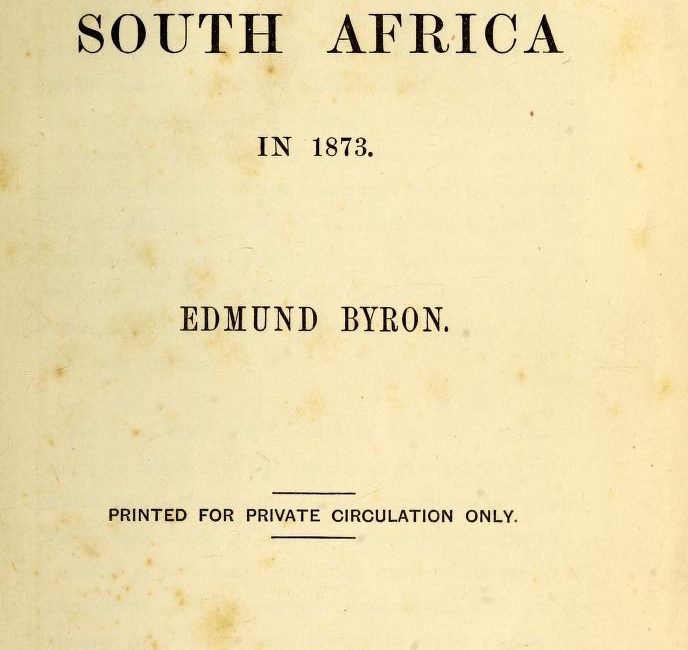
Title page of "What we did in South Africa in 1873".

The Joseph F. Cullman 3rd Library of Natural History at the Smithsonian Libraries and Archives in Washington, D.C. is home to many rare and special books. Amongst the approximately 20,000 volumes in the library’s collection is a particularly rare item—one of only six known copies in public and institutional libraries worldwide.

Title page of "What we did in South Africa in 1873".

Title Page. Byron, Edmund. What we did in South Africa in 1873 (1874). Digitized copy from the Joseph F. Cullman 3rd Library of Natural History at the Smithsonian Libraries and Archives. Freely available in the Biodiversity Heritage Library.

The book is a privately printed journal by Edmund Byron entitled What we did in South Africa in 1873, which details Byron and his wife Charlotte’s 1873 exploratory and hunting expedition to South Africa. In 2015, at the request of a researcher, the Smithsonian digitized its copy of the journal and made it freely available online in the Biodiversity Heritage Library (BHL), where it was discovered by Dr. Nigel Elliott, who was conducting research on the Byron family.

“My research was prompted by a donation to the Museum of Croydon, UK, of an archive of family papers relating to the Byrons, who were Lords of the Manor and Squires of the village of Coulsdon from 1782 to 1921,” explains Elliott. “Since the archive’s acquisition in 2012, a team from the Bourne Society has been working on cataloguing the archive, with a view to online publication. The archive provides a rich resource for exploring the domestic, social, business and farming history of the family, their role and relationship as local squires within the wider village community of Coulsdon, and the extensive foreign travels undertaken over the years by members of the family.”

A man with white hair in a gray suit, white shirt, and blue tie.

Dr. Nigel Elliott. Photo courtesy of Dr. Elliot.

Inspired by his work with the Bourne Society cataloging these archives—and the intensive research that it required—Elliott authored a book on the family, published by the Society: The Byrons of Coulsdon: Abroad and at Home (2020). The book itself covers three generations, with a particular focus on Edmund Byron.

Red book cover with title in yellow, The Byrons of Coulsdon: Abroad and at Home.

Cover: The Byrons of Coulsdon: Abroad and at Home (2020) by Dr. Nigel Elliott. Image courtesy of Dr. Elliott.

One of Elliott’s chapters is devoted to Edmund and Charlotte’s South African expedition—as detailed in Edmund’s journal—during which the pair, accompanied by Edmund’s manservant Mr. Kemp, traveled via a combination of coaster (a shallow-hulled ship used for trade) and ox wagon from Cape Town to present-day Kruger National Park and Great LimpopoTransfrontier Park, where, faced with the remote and challenging terrain of that area in 1873, they travelled and hunted wholly on foot. The Byrons employed a team of local Black staff—on whose hunting skills the Byrons were particularly dependent—as well as a White employee, Mr. Dubois, to manage the expedition.

“In the chapter, I follow Edmund’s journal closely and in detail,” shares Elliott. “I have attempted to place their visit in the context of South Africa at the time. My background reading revealed to me the extent to which the 1870s were critical in the country’s history, and I have attempted to set this decade within the wider trajectory of South African history.”

Online access to Edmund’s journal was indispensable for Elliott’s research and the publication of his book.

“From Edmund’s journal, which I accessed online via a PDF download of the Smithsonian’s copy on BHL, I was able to construct a detailed narrative of the tour,” affirms Elliott. “This easy access to the journal was critical in providing a thorough history of the family and in meeting the research objectives set out in the book.”

According to Elliott, the journal provides valuable perspective on the dualities of the Byrons’ lives as both a gentry family deeply rooted in a small English community and intrepid world travelers eager to experience different places and cultures. The journal also reveals a duality within Edmund himself as he—a privileged White male—interacts with new cultures and people. When referring to the Black men and women they encountered, Edmund sometimes uses derogatory terms reflective of the White supremacist culture so pervasive during the European colonial period. At the same time, and unlike many of his compatriots, Edmund strove to act with integrity towards his Black staff and others and even, when faced with a direct appeal for help, enabled one woman to escape enslavement by providing her with protection and employment.

“The journal provides a fine opportunity to deepen the character study of Edmund, a truly patriarchal man in the context of his home life in Coulsdon, that comprises one of the central themes to my book,” shares Elliott.

The Smithsonian’s copy of Edmund’s journal was originally owned by Eliza Vans Agnew, who had connections to Edmund through his wife, Charlotte, whose mother was a Vans Agnew. Today, the volume is part of the Russell E. Train Africana Collection of the Smithsonian Libraries and Archives, which contains manuscript and printed materials, photographic prints and negatives, slides, audio tapes, film, original and reproduction artwork, maps, scrapbooks, and historical and natural artifacts related to the history of African exploration and natural history. The collection was originally assembled by the Honorable Russell E. Train, a former judge, top administrator of the Environmental Protection Agency, and a past president of the World Wildlife Fund. It was acquired by the Smithsonian in 2004.

The circumstances surrounding the digitization of Edmund’s journal was a fortuitous coincidence for Elliott. The Smithsonian Libraries and Archives digitized the volume—unbeknownst to Elliott—at the request of one of his colleagues, who was conducting tangential research with possible connections to the Byrons’ South African expedition.

“My colleague was impressed by the courtesy of the Smithsonian staff, who responded quickly to his expression of interest by digitizing Edmund’s journal,” shares Elliott. “As it turned out, the book was of no direct use to him but, as this story reveals, there was a serendipitous consequence of the Smithsonian’s helpful response and the digitized journal proved invaluable for my research.”

When Edmund Byron decided to “have printed a few copies of the Journal which we kept during our travels”, he did so with the expectation that it “would be of no interest to the general public.” Would he be surprised to know that, nearly 150 years later, researchers would view this journal as an informative historical document useful for modern-day research? Thanks to the Smithsonian Libraries and Archives and the Biodiversity Heritage Library, this volume—once available only to a few select readers—is now freely accessible to researchers everywhere.

June 10, 2021by michelle.underhill

Help Support BHL

BHL's existence depends on the financial support of its patrons. Help us keep this free resource alive!

search

About BHL

The Biodiversity Heritage Library (BHL) is the world’s largest open access digital library for biodiversity literature and archives. BHL operates as a worldwide consortium of natural history, botanical, research, and national libraries working together to digitize the natural history literature held in their collections and make it freely available for open access as part of a global “biodiversity community.”

Join Our Mailing List

Sign up to receive the latest news, content highlights, and promotions.

Subscribe Now

Subscribe to Blog via Email

Enter your email address to subscribe to this blog and receive notifications of new posts by email.

Join 319 other subscribers

Subscribe to Blog Via RSS

Subscribe to the blog RSS feed to stay up-to-date on all the latest BHL posts.

Access RSS Feed

Inspiring Discovery through Free Access to Biodiversity Knowledge.

The Biodiversity Heritage Library makes it easier than ever for you to access the information you need to study and explore life on Earth…for free, anytime, anywhere.


64+ Million Pages of
Biodiversity Literature Online.

EXPLORE

Tools and Services
to Transform Research.

EXPLORE

300,000+
Illustrations on Flickr.

EXPLORE

ABOUT | HARMFUL CONTENT | PRIVACY | SITE MAP | TERMS OF USE