

Plant species worldwide face an increasing barrage of threats to their survival. The deliberate collection of rare plants poses a far greater threat to wild plant species. In Wild Plants in Trade (1992), the reasons and effects of wild collection on plants for cultivation and international trade can be found. The trade of orchids, bulbs, cycads, palms and tree ferns, cacti and other succulent plants, carnivorous plants and air plants were introduced in detail in the second half of this book, as well as the attempts to control the collection of these plants by the Convention on International Trade in Endangered Species of Wild Fauna and Flora (CITES) and governments.
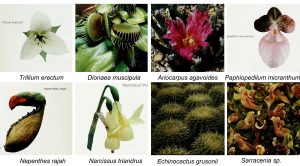
Pictures of some wild plants in trade. Jenkins, M., & Oldfield, S. Wild Plants in Trade. 1992. Contributed in BHL from UNEP-WCMC, Cambridge. Rights Holder: TRAFFIC International
Forests are also an important source for plant trade. The dipterocarp forests of Southeast Asia are today the largest source of hardwoods in international trade, but they are likely to be logged over within a decade or two. India, Burma and Southeast Asia are rich centers of genetic variation in cultivated fruit trees. The scale of exploitation of the forests in the last few decades has led to serious forest degradation. In The Conservation Atlas of Tropical Forests: Asia and the Pacific (1991), tropical timber trade of Asia and the Pacific areas are discussed in detail, along with government policies and land-use planning. The International Tropical Timber Organization (ITTO) created in 1983 is largely concerned with improving market conditions and encouraging the development of national policies aimed at “maintain[ing] the ecological balance in the regions concerned”.
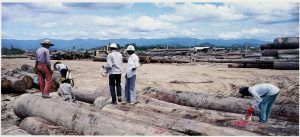
Men scaling or measuring logs in Kimanis, Sabah, Malaysia. Collins, M. N., Sayer, J. A., & Whitmore, T. C. (Eds.). The Conservation Atlas of Tropical Forests: Asia and the Pacific. 1991. Contributed in BHL from UNEP-WCMC, Cambridge. Rights Holder: IUCN
One of the important economic values of plants, especially herbal plants, is in medicine. Approximately 60,000 plant species are harvested mainly for medicinal usage in the world. Today, people in many Asian countries still use medicinal plants for traditional health care treatments. The World Health Organization (WHO) has also acknowledged the importance of traditional medicines.
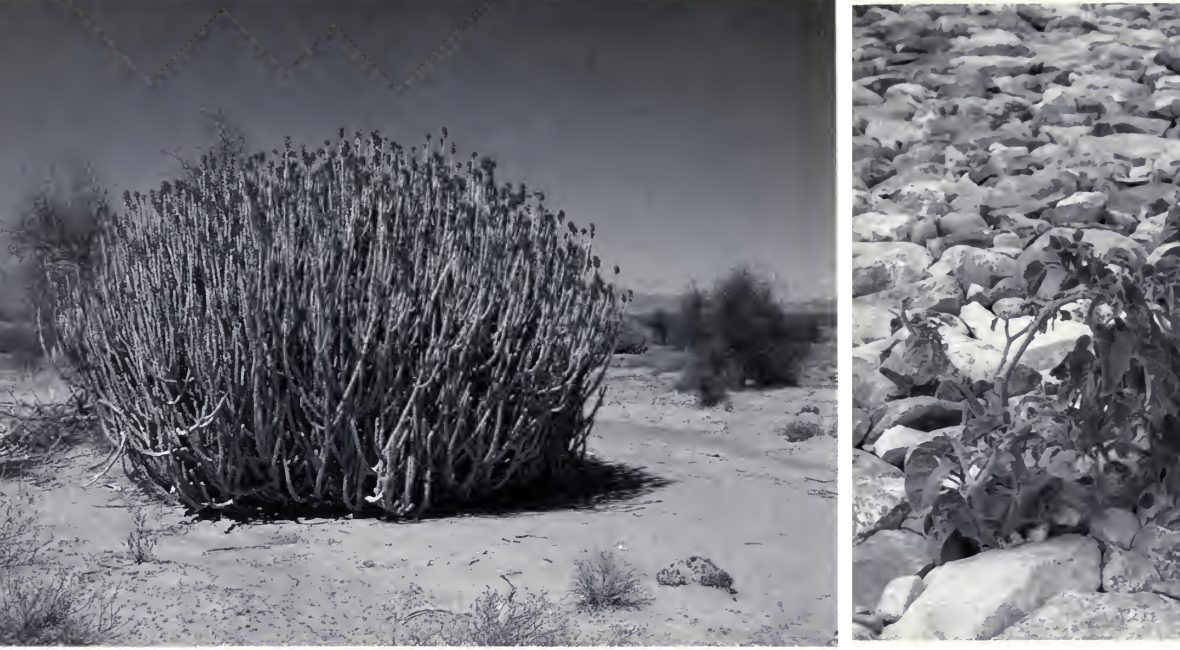
The ethnobotany of southern Balochistan, Pakistan: with particular reference to medicinal plants (1992) collects two distinct types of ethnobotanical information: (1) plants used by nomads and village dwellers for nutritional, utilitarian, and medicinal purposes; and (2) plants prescribed and/or dispensed by herbalists or herbal doctors residing in population centers. The Latin binomial, relevant synonyms, field collection number, locality collected, local vernacular name(s), use(s), specifics of preparation(s) or treatment(s), and miscellaneous comments are provided for each species.
Some of the plants in southern Balochistan, Pakistan (left: Nannorhops ritchiana; middle: Euphorbia caducifolia, right: Datura innoxia). Goodman, S. M., & Ghafoor, A. The ethnobotany of southern Balochistan, Pakistan: with particular reference to medicinal plants. 1992. Contributed in BHL from University Library, University of Illinois Urbana Champaign. CC BY-NC-SA 3.0. Rights Holder: Field Museum of Natural History.
The medicinal plants of the Philippines (1901) describes the Philippines’ Dicotyledonous (including Polypetalous and Gamopetalous) and Monocotyledonous plants which have medicinal properties.
Ethnobotanical Use of Medicinal Plants by Inhabitants of Al-Mafraq, Jordan (2015) records and lists all medicinal plants that have shown therapeutic effects as analgesic/stimulant by the inhabitants of Al-Mafraq in the northern parts of Jordan during March 2011 to May 2013.
Taxonomy and Conservation of Medicinal Plants in Canal-Irrigated Areas of Punjab, Pakistan (2006) presents the taxonomic position of 131 medicinal plants belonging to 112 families and 52 genera from the canal-irrigated areas of Punjab. Some of the important families are Fabaceae (21 medicinal species), Apiaceae, Asteraceae, Lamiaceae, Solanaceae (6 species each), Cucurbitaceae, Malvaceae, and Poaceae (5 species each). The life form, parts used and pharmaceutical uses of these plants are also described.
Food and medicinal plants used for childbirth among Yunnanese Chinese in northern Thailand (2003) describes the folk knowledge of medicinal foods and plants used for childbirth care by Yunnanese Chinese in northern Thailand. More than 40 species of steam bath herbs were collected and identified. This paper also makes an initial ethnobotanical comparison with steam bath herbs among other ethnic groups in northern Thailand.
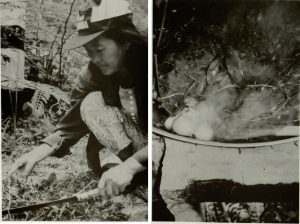
Left: Woman collecting medicinal plants along the roadside in Chiang Mai, a Yunnanese village in Fang district. Right: Steam bath herbs being steamed with eggs in a pan. Liulan, W., Nanakorn, W., & Fukui, K. Food and medicinal plants used for childbirth among Yunnanese Chinese in northern Thailand. 2003. Contributed in BHL from Missouri Botanical Garden, Peter H. Raven Library. CC BY-NC-SA 3.0. Rights Holder: Society of Ethnobiology
References
Jenkins, M., & Oldfield, S. (1992). Wild plants in trade. TRAFFIC International. https://doi.org/10.5962/bhl.title.44938
Collins, M. N., Sayer, J. A., & Whitmore, T. C. (Eds.). (1991). The Conservation Atlas of Tropical Forests: Asia and the Pacific. Macmillan Press Ltd. https://doi.org/10.5962/bhl.title.44927
Goodman, S. M., & Ghafoor, A. (1992). The ethnobotany of southern Balochistan, Pakistan: with particular reference to medicinal plants. Field Museum of Natural History. https://doi.org/10.5962/bhl.title.2542
Pardo de Tavera, T. H. (1901). The medicinal plants of the Philippines. (J. B. Thomas, Jr., Trans.). P. Blakiston’s Son & Co. https://doi.org/10.5962/bhl.title.21044
Al-Quran, S. (2014). Ethnobotanical use of medicinal plants by inhabitants of Al-Mafraq, Jordan. Arnaldoa, 21(1), 119-126. https://www.biodiversitylibrary.org/page/46625105
Akbar, K. F., & Athar, M. (2006). Taxonomy and conservation of medicinal plants in canal-irrigated areas of Punjab, Pakistan. SIDA, contributions to botany, 22(1), 593-606. https://www.biodiversitylibrary.org/page/9182015
Liulan, W., Nanakorn, W., & Fukui, K. (2003). Food and medicinal plants used for childbirth among Yunnanese Chinese in northern Thailand. Journal of Ethnobiology, 23(2), 209-226. https://www.biodiversitylibrary.org/page/32740176
