Biodiversity Heritage Library - Program news and collection highlights from BHL
  • Home
  • News
  • Featured Books
    • All Featured Books
    • Book of the Month Series
    • BHL at 20
  • User Stories
  • Campaigns
    • Fossil Stories
    • Garden Stories
    • Monsters Are Real
    • Page Frights
    • Her Natural History
    • Earth Optimism 2020
  • Tech Blog
  • Visit BHL
Home
News
Featured Books
    All Featured Books
    Book of the Month Series
    BHL at 20
User Stories
Campaigns
    Fossil Stories
    Garden Stories
    Monsters Are Real
    Page Frights
    Her Natural History
    Earth Optimism 2020
Tech Blog
Visit BHL
  • Home
  • News
  • Featured Books
    • All Featured Books
    • Book of the Month Series
    • BHL at 20
  • User Stories
  • Campaigns
    • Fossil Stories
    • Garden Stories
    • Monsters Are Real
    • Page Frights
    • Her Natural History
    • Earth Optimism 2020
  • Tech Blog
  • Visit BHL
Biodiversity Heritage Library - Program news and collection highlights from BHL
Blog Reel, User Stories

The Geopolitics of Metadata: Knowing Panama Through the Biodiversity Heritage Library

Color coded co-occurrence network map of subjects in a data set

In the first part of this blog series, I explained a portion of the analyses I performed during my time as an intern for the Biodiversity Heritage Library (July-August 2021). These analyses revolved around metadata patterns in BHL’s collection that highlight shortcomings in terms of diversification in the Library’s catalogue. In that post, by focusing on comparative metadata and the case of BHL México, I argued that an outreach plan that included the establishment of global partnerships between BHL and institutions in the Global South was a solid strategy to diversify the Library’s collections. This same argument is sustained by the second portion of the analyses I performed during my internship and that I present here, which deal primarily with patterns of associations and representation in the subject lists of BHL’s materials and the specific case of Central America and Panama.

The goal of the second part of my internship was thus to identify semantic patterns in subject lists that highlight the diversification—or lack thereof—in materials about Latin American biodiversity contained in BHL. To this end, I began my analyses with the extraction of the subject lists of those materials. In order to perform this extraction, and following, once more, the methodology employed by Chris Freeland (Freeland, steps 1–3), I cross-referenced BHL’s data file on items and that on subjects to match each title ID to the subjects it includes.[i] Finally, from the resulting dataset, I extracted the records of materials that included subjects related to Latin America to build six subsets:[ii]
  1. West Indies (WI): This subset contains all materials (228 title IDs) that include the subject/term West Indies in their subject list.
  2. Central-Latin-South America (CLS): This subset contains all materials (710 title IDs) that include at least of one of these subjects/terms in their subject list: Central America, Latin America, South America. Out of these three, South America is considerably more frequent at 528 occurrences,[iii] more than three times the occurrences of the other subjects, with 168 occurrences of Central America and 104 of Latin America.
  3. Central American Countries (CAC): This subset contains all materials (485 title IDs) that include at least one Central American country in their subject list: Belize, Guatemala, Honduras, Nicaragua, Costa Rica, Panama, El Salvador. Out of these countries, Panama is by far the most frequent subject (240 occurrences).
  4. South American Countries (except Brazil) (SAC): This subset contains all materials (1221 title IDs) that include at least one South American country (except Brazil) in their subject list: Argentina, Bolivia, Colombia, Chile, Ecuador, Guyana, (French) Guiana, Paraguay, Peru, Surinam/Suriname, Uruguay, Venezuela. Out of these subjects, Peru, Chile, and Argentina are the most frequent, with over 230 occurrences each, followed by Colombia (193) and Ecuador (154). The remaining countries occur less than 100 times each, with Uruguay being the least frequent (25 occurrences).
  5. Brazil (BR):[iv] This subset contains all materials (543 title IDs) that include the subject/term Brazil in their subject list.
  6. Mexico (MEX): This subset contains all materials (917 title IDs) that include the subject/term Mexico in their subject list.

As I explained in my previous blog post, the geopolitics of publication and housing of materials in BHL’s catalogue reflect an unequal and still colonial relationship between the Global South and North. In addition to this, I argue that a lack of diversification in terms of knowledge production results in unequal representations and valorization of the Global South and North that perpetuate colonial dynamics in biodiversity-related knowledge production. To test this thesis through subject lists, I generated frequency lists, co-occurrence networks, and hierarchical clusters using KH Coder 3 for each of the previously mentioned subsets.[v] By taking a closer look at the patterns of subject lists in the subsets described above and revealed by these text analyses, it becomes clearer how a colonial niche of biodiversity-related publications can lead to biased and colonial representations of biodiversity and communities from the Global South. That is the case, for instance, of materials in BHL that focus on the biodiversity of Central America and, specifically, Panama.

As previously mentioned, in the CAC subset, Panama is the most frequent subject with 240 occurrences, followed by the compound field note with 188 and Costa Rica with 99 (Figure 1). These numbers suggest that Panama is the most studied Central American country in BHL’s materials. Furthermore, when looking at the subject lists in which it appears, it is possible to note that it is often associated with the Canal Zone and the United States, terms that are significantly frequent in this subset as well (Figure 2).

List of subject terms and rate of frequency in data set

Figure 1 The 20 most frequent words in the CAC subset. Generated on KH Coder 3 in September 2021. Data from https://www.biodiversitylibrary.org/data as of July 1st, 2021.


List of subject terms with Panama occurrences highlighted in red

Figure 2 Sample of subject lists that include the word Panama. Generated on KH Coder 3 in September 2021. Data from https://www.biodiversitylibrary.org/data as of July 1st, 2021.

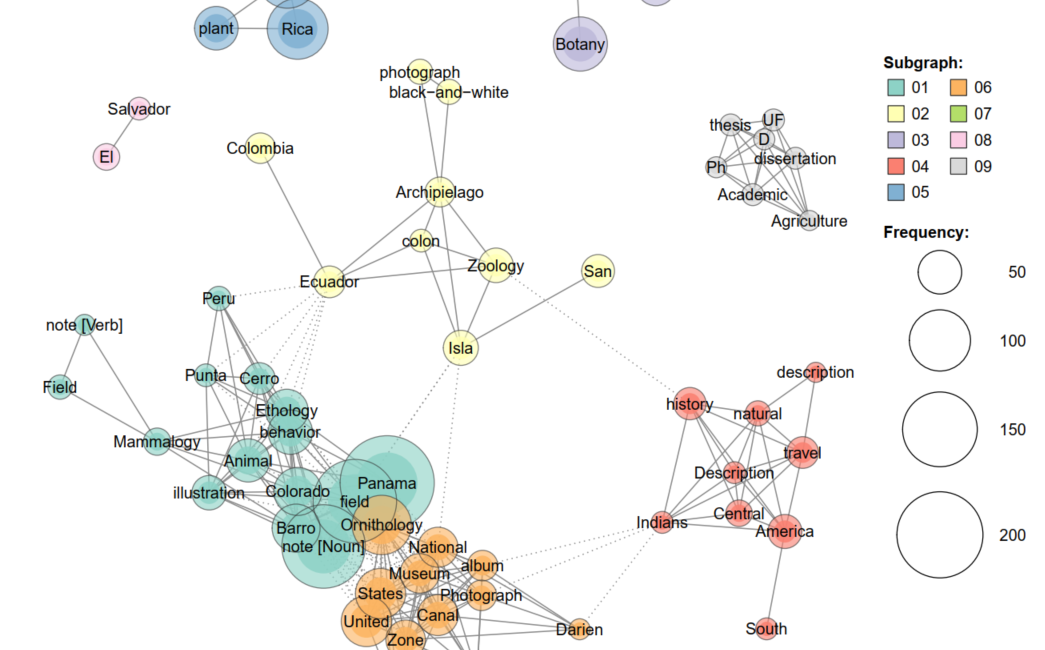
These initial observations in terms of word-frequencies and associations in the CAC subset led to the hypothesis that the frequency of Panama in this subset is due to the biological (Smithsonian Tropical Research Institute, ‘Why Is the Smithsonian in Panama?’) but also economic importance of the country and the Central American region, especially given its strong association with US-related subjects. For instance, in the co-occurrence network and hierarchical clustering of the CAC subset, it is possible to identify a strong relationship between Panama and the United States. The most intricated subgraph in the co-occurrence network is built around Panama and includes nonhuman species and biodiversity-related topics (mammalogy, ethology, Animalbehavior, Ornithology) alongside US-related subjects and institutions (UnitedStates, NationalMuseum), as well as the compound Canal Zone (Figure 3). Given these observations and to further test this hypothesis, I repeated the extraction and selection process to create a subset specifically for this country, the PAN subset.[vi] The goal of the creation of this additional subset was to verify whether these US-centric interests and findings around Panama also manifest in the rest of the metadata of records containing the subject Panama.

Color coded co-occurrence network map of subjects in a data set

Figure 3 Co-occurrence network of the CAC subset. The overlapping of subgraphs 01 and 06 shows the strong association between Panama and the United States. Generated on KH Coder 3 in September 2021. Data from https://www.biodiversitylibrary.org/data as of July 1st, 2021.

As I explained in the first part of this blog series, mapping the places of publication of subject-based subsets of materials in BHL can help visualize the relationships between the Global South and North as both objects and subjects of knowledge production. When mapping the PAN subset, however, I noticed that almost 70% of the materials (125 out of 185 title IDs) had no identified place of publication. When looking more closely at each of these materials, I found that almost all of them[vii] were handwritten field notes. Therefore, I looked at each of these titles to identify the origin of these field notes. While their place of publication cannot be identified because these materials are not publications per se, identifying the affiliation of the field work and expeditions that originated them helped more clearly illuminate the geopolitics of biodiversity-related knowledge production about Panama. For instance, out of the 125 materials with no identified place of publication, 76 (60.8%) are field notes resulting from US-based expeditions to Central America,[viii] meaning that such expeditions constitute the predominant point of origin of materials in the PAN subset[ix] (Figure 4). Looking at these details for each of the records with no identified place of publication in the PAN subset is particularly important as the hierarchical clustering for the CAC subset also shows this significantly strong connection between the subjects Panama and field note(s) (Figure 5). Given that the majority of field notes with no identified place of publication in the metadata are the product of US-based expeditions to Central America, this connection further emphasizes the determining role that US interests play in the presence and representation of Panama in BHL.

Bar chart listing number of titles by place of publication in a data set

Figure 4 Number of titles per place of publication in the PAN subset (with cleaned data for missing fields). Generated on Tableau in September 2021. Data from https://www.biodiversitylibrary.org/data as of July 1st, 2021.

Hierarchical cluster of subject terms in a data set

Figure 5 Hierarchical clusters for the CAC subset. Cluster 8 (pink) shows a strong association between Panama and field note(s). Generated on KH Coder 3 in September 2021. Data from https://www.biodiversitylibrary.org/data as of July 1st, 2021.

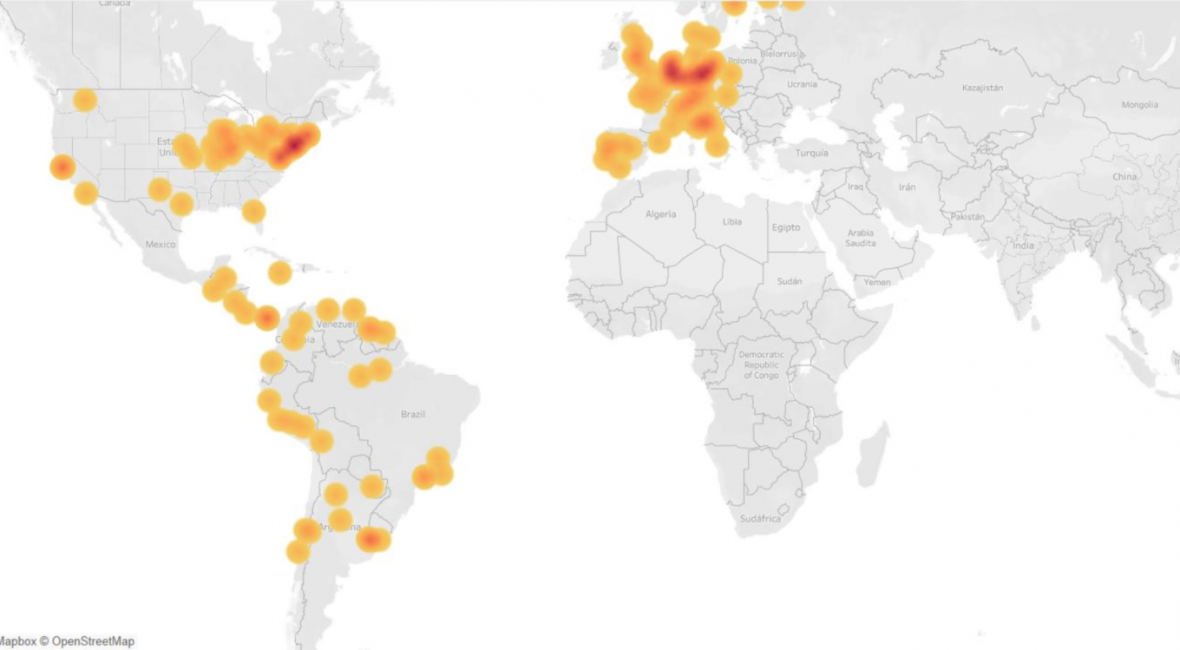
Of the remaining materials, seven (5.6%) are affiliated with the Smithsonian Environmental Research Center (with its headquarters in Chesapeake Bay) and the Smithsonian Migratory Bird Center (in Washington, D.C.). The latter is particularly interesting, as it could contribute, at least in part, to the importance of the subject ornithology in connecting the subject Panama with the subgraph built around the term United States in the CAC subset (Figure 3, subgraph 06). Finally, the remaining 41 materials with no identified place of publication are affiliated to the Smithsonian Tropical Research Institute (STRI). What is particularly notable about the STRI is that it is located in Ancón, Panama (Smithsonian Tropical Research Institute, ‘Why Is the Smithsonian in Panama?’). This means that even if the STRI is affiliated with the Smithsonian and, therefore, the United States, the knowledge production about Panama sponsored by the Institute could be seen as an epistemic collaboration between researchers from Panama, the US, and beyond (Smithsonian Tropical Research Institute, Biological and Cultural Diversity of the Tropics 4). Nevertheless, even when considering the place of publication of STRI affiliated documents as being located in Ancón, the knowledge production about Panama and her biodiversity as housed in BHL continues to be greatly dominated by the United States (Figure 6).

Global map showing places of publication in a data set

Figure 6 Map showing places of publication (density per number of records) in the PAN subset (with cleaned data for missing fields). Generated on Tableau in September 2021. Data from https://www.biodiversitylibrary.org/data as of July 1st, 2021.

Other than places of publication showing a predominance of the United States as the main producer of the knowledge about Panama available in BHL, the year of these publications[x] is particularly important to further evidence the impact of US politics and interests in the production of these materials, especially given the history of the US construction and administration of the Panama Canal throughout the 20th Century. After its beginnings as a French project in the late 19th Century, the construction of the Panama Canal was initiated by the US in 1904 and concluded in 1914 (Autoridad del Canal de Panamá). The concession of this region was a result of US participation in “the separatist movement in Colombia [after which] the separatists achieved in breaking the province of Panama from Colombia [and] the United States was awarded with what was to become the Panama Canal Zone” (‘Panama Canal Zone in World War II’). The US control of the Canal continued until 1979, when it was transferred to “the Panama Canal Commission, a joint agency of the United States and the Republic of Panama” (Padelford). It was not until 1999 that the Canal’s administration was left exclusively in the hands of Panama (Autoridad del Canal de Panamá).

Line chart indicating number of titles per year in data set

Figure 7 Distribution per year of titles in the PAN subset (with cleaned data for missing fields). Generated on Tableau in September 2021. Data from https://www.biodiversitylibrary.org/data as of July 1st, 2021.

Mirroring this historical context, 161 out of the 185 records in the PAN subset (87%) were published between the years 1903 and 1996, that is, during the US administration of the Panama Canal, with the peak occurring in the late fifties (Figure 7). Furthermore, out of the 16 materials in the PAN subset published prior to the 20th Century, only six are affiliated with the US: four published in New York and two being the product of US-based expeditions. In contrast, the other 74 of the 76 materials that are the product of US-based expeditions (as previously explained) were published between 1910 and 1983, meaning that 97.4% of these expeditions occurred during US control of the Panama Canal (Figure 8). Moreover, the STRI itself, in spite of its global collaboration outlook, is “closely tied to the construction of the Panama Canal” as it resulted from “Smithsonian scientists and naturalists across the United States urg[ing] U.S. President Theodore Roosevelt to support a biological expedition to take an inventory of the future Canal Zone’s flora and fauna” (Smithsonian Tropical Research Institute, ‘Why Is the Smithsonian in Panama?’). Therefore, given these patterns of publication across time—alongside the importance of US expeditions and the STRI in the production of the knowledge contained in BHL and the semantic associations and word frequencies of subject lists in the PAN subset—it is possible to conclude that biodiversity-epistemologies about Panama in the Library are greatly subsumed to US history, politics, and economic interests.

Timeline listing year and place of publication

Figure 8 Chronological distribution per place of publication of titles in the PAN subset (with cleaned data for missing fields). Generated on Tableau in September 2021. Data from https://www.biodiversitylibrary.org/data as of July 1st, 2021.

In addition to these categories of metadata showing the dominance of US-centric and Global-North-centric epistemologies and interests in BHL’s materials about Panama, it is essential to consider the language of the materials, another fundamental category in terms of the diversification not only of representation but also of access and audiences, as I have argued elsewhere.[xi] In this regard, out of the 185 records in the PAN subset, only seven (3.78%) are in languages other than English,[xii] of which only three (1.62%) are in Spanish, the official language of Panama (Zajícová 185)(Figure 10).

Color coded bar chart depicting number of titles per language in a data set

Figure 9 Number of titles per language in the PAN subset (with cleaned data for missing fields). Generated on Tableau in September 2021. Data from https://www.biodiversitylibrary.org/data as of July 1st, 2021.

The three materials in the PAN subset that are written in Spanish are James Zetek’s Los moluscos de la República de Panamá (1918), the Smithsonian Tropical Research Institute’s Panamá, puente biológico: Las Charlas Smithsonian del Mes (2001),[xiii] and Rafael Tobías Marquís Oropeza’s Algunas palmeras industriales de la flora istmeña (1908). The first two, albeit being published in Panama, are affiliated to the US through their authors and holding institutions. These two materials are held by the Smithsonian Libraries, with the STRI also being the author of the second one. Likewise, James Zetek (1886-1959) was a US entomologist who worked for the US Department of Agriculture and was in charge of research expeditions and international relations with Central America, especially the Canal Zone in Panama, during both world wars (Snyder et al. 1230–31). This record, thus, further evidences the importance of the history of the Canal and US interests in the materials in the PAN subset. On the contrary, the third record is a unique example that counteracts US-centric tendencies. Marquís Oropeza was a Venezuelan scientific philosopher and agronomist who acted as the first Director of the Museo Nacional de Panamá (Moreno 169–70). Therefore, and even though this work is held by the New York Botanical Garden, Marquís Oropeza’s book is the only record in the PAN subset (out of 185) that is written in Spanish and where the knowledge production took place in Panama and independently from the US and Europe. Moreover, this work highlights biodiversity-related collaboration within the Global South, further acting as an example of epistemic agency in non-hegemonic spaces.

Nevertheless, the evident shortcoming of the record by Marquís Oropeza is the rareness of its case, which, given the observations made through the analysis of the CAC and PAN subsets explained so far, turns it into a one-case exception. The goal of the diversification of BHL’s collection should then be to make these cases the rule and not the anomaly, an objective that could be achieved through a more thorough incorporation of non-hegemonic materials and the establishment of more BHL nodes across the Global South. In this sense, the findings explained throughout this blog post reveal the important need for BHL to strengthen bonds with institutions in the Global South, not only to achieve a truly global repository but to diversify representation, a particularly pressing matter in topics related to colonial and (neo)imperial issues, such as the case of Panama. The overwhelming predominance of US-centric narratives and perspectives in the knowledge production about Panama and her biodiversity in BHL’s catalogue reveals the urge to diversify, decentralize, and decolonize bio-diverse epistemologies. As I argued in my previous blog post, a strong collaboration with institutions in the Global South, as exemplified by BHL México, can lead to more diverse collections, not only in terms of language but also of semantic associations. In this regard, for example, when comparing the co-occurrence networks of the CAC and MEX subsets, it is possible to note that the MEX subset presents an arguably more diversified network of subjects (Figure 10). For instance, it shows a wider variety of both nonhuman species and groups and of geographical regions. Furthermore, while subjects and locations related to the United States are still present (subgraphs 01, 03, and 08), their connection to the subject Mexico itself is less strong than in the case of the CAC subset and the subject Panama (Figure 3). Thus, given that a large number of materials in the MEX subset are the product of BHL México, I continue to argue that a more solid, profound, meaningful, and critical strategy for the establishment of BHL partnerships throughout the Global South can lead to a truly global, open, decolonial, and bio-diverse BHL, deeply in line with the Library’s goals and mission.

Color coded co-occurrence network map of subjects in a data set

Figure 10 Co-occurrence network of the MEX subset. Generated on KH Coder 3 in September 2021. Data from https://www.biodiversitylibrary.org/data as of July 1st, 2021.


[i] This process included all materials in BHL—regardless of subject—as of July 1st, 2021. The full list of title IDs and subjects can be found in BHL’s GitHub repository.

[ii] Tables for these subsets can be found in BHL’s GitHub repository. Due to the constraints of the extension and nature of this blog post, not all subsets are discussed in detail. However, the files are publicly available, and the author can be contacted at any point with any further questions or inquiries.

[iii] Word frequency tables for each subset can be found in BHL’s GitHub repository.

[iv] Both Brazil and Mexico were treated as separate subsets given that a large portion of materials about Brazilian and Mexican biodiversity in BHL comes from the BHL SciELO and BHL México projects respectively. Thus, considering these materials as separate subsets can illuminate the impact of global collaboration in the diversification of the Library’s collection.

[v] All graphs for each subset can be found in BHL’s GitHub repository.

[vi] All files (subject lists, word frequency, co-occurrence network, hierarchical clustering) for this subset can be found in BHL’s GitHub repository.

[vii] The one exception is Dr. William Mark Whitten’s Ph.D. thesis (1985) at the University of Florida.

[viii] The affiliations of these expeditions vary but are mostly associated with academic and research institutions throughout the United States, such as the New York Botanical Garden and Harvard University, and government dependencies, such as the US Navy and the US Department of Agriculture.

[ix] Tables for the PAN subset with both raw data and data cleaned for missing fields (places of publication, year, and language) can be found in BHL’s GitHub repository. In the file with cleaned data, previously missing fields are highlighted in yellow.

[x] Missing fields of year of publication in the PAN subset (see previous note) were fixed by looking into other metadata categories (such as the start date for periodicals and the publication details) and verified with the material itself.

[xi] I discussed the importance of multilingual representation in the Library for the diversification of access in more detail in a previous blog post and in my presentation for BHL Day 2021.

[xii] Missing fields of language in the PAN subset (see note ix) were mostly for albums and field notes. These fields were fixed by considering the language of notes, comments, introductions, and/or descriptions/captions for images or photographs, which were all in English.

[xiii] This is the one material affiliated to the STRI in the PAN subset that is not written in English, meaning that almost all materials affiliated with the STRI are in English, which, again, hinders the collaborative nature of their research endeavours.

Works cited

Autoridad del Canal de Panamá. ‘Reseña Histórica del Canal de Panamá’. Canal de Panamá, https://micanaldepanama.com/historia-del-canal/resena-historica-del-canal-de-panama/. Accessed 5 Oct. 2021.

Freeland, Chris. ‘BHL Poster for AETFAT2010’. ChrisFreeland, 19 Apr. 2010, http://blog.chrisfreeland.com/2010/04/.

Moreno, Hiram A. ‘Tras las elusivas huellas de Rafael T. Marquís Oropeza. El primer Director del Museo Nacional de Panamá’. Canto Rodado, vol. 10, 2015, pp. 163–75.

Padelford, Norman J. ‘Panama Canal’. Encyclopedia Britannica, 2005, https://www.britannica.com/topic/Panama-Canal.

‘Panama Canal Zone in World War II’. WW2DB – World War II Database, https://ww2db.com/country/panama_canal_zone. Accessed 5 Oct. 2021.

Smithsonian Tropical Research Institute. Biological and Cultural Diversity of the Tropics: Extraordinary Opportunities and Challenges in the Midst of the Anthropocene. Strategic Plan 2019-2024. Smithsonian Tropical Research Institute, 2019, https://stri.si.edu/sites/default/files/stri_strategic_plan_aug_2019.pdf.

—. ‘Why Is the Smithsonian in Panama?’ Smithsonian Tropical Research Institute, Smithsonian Tropical Research Institute, 19 Dec. 2016, https://stri.si.edu/why-panama.

Snyder, Thomas, et al. ‘James Zetek. 1886-1959’. Journal of Economic Entomology, vol. 52, no. 6, 1959, pp. 1230–32, https://doi.org/10.1093/jee/52.6.1230.

Zajícová, Lenka. ‘Lenguas Indígenas En La Legislación de Los Países Hispanoamericanos’. Onomázein. Revista de Lingüística, Filología y Traducción, 2017, pp. 171–203, https://doi.org/DOI: 10.7764/onomazein.amerindias.10.

November 18, 2021by [email protected]
Blog Reel, User Stories

Understanding BHL Through Metadata: Patterns of Bio-Diverse Knowledge Production

Global map showing places of publication in LAC dataset

During my time as an intern for the Biodiversity Heritage Library (July-August 2021), I worked on a project, I hope, will help engender important and critical conversations around the Library’s work and responsibilities vis-á-vis the sometimes harmful and problematic origins of its materials, as well as around the possibilities for the decolonization of its collection and archival practices. By focusing on the case of Latin America and her biodiversity, the main goal of this project was to identify patterns in the metadata of BHL’s collection that can inform decolonial policies and strategies for the diversification of the Library’s catalogue.

To identify such patterns, I extracted and analyzed the metadata of materials that include a subject related to Latin America in their subject lists. These analyses shed important light on diversification issues, specifically in the case of this region. The first part of this project was to perform subject-based extractions from BHL’s collection. Following a similar methodology to that of Chris Freeland (Freeland, steps 1–3), I extracted all records from BHL’s online datasets[i] (as of July 1st, 2021[ii]) that included specific subjects[iii] to build five subsets:

  1. Greater Regions (GR) subset. This subset incorporates all BHL records (4465 total[iv]) that include one of the following subjects—all of which refer to Latin America as a whole or in subcontinental terms—in their subject list: Latin America, Central America, South America, West Indies.
  2. Latin American Countries (LAC) subset. This subset incorporates all BHL records (6801 total) that include the name of at least one Latin American country—except Mexico—in their subject list: Argentina, Belize, Bolivia, Brazil,[v]British Guiana, Chile, Colombia, CostaRica/Costa-Rica, Ecuador, El Salvador, French Guiana, Guatemala, Guiana/Guyana, Honduras, Nicaragua, Panama, Paraguay, Peru, Surinam/e, Uruguay, Venezuela.
  3. Mexico (MEX) subset. This subset incorporates all BHL records (2995 total) that include the subjects Mexico; Mexico, North; and/or Mexico, Northern in their subject lists. Mexico was treated as a separate subset given that a large portion of materials about Mexican biodiversity in BHL comes from the BHL México project. Thus, considering these materials as a separate subset can illuminate the impact of global collaboration in the diversification of the Library’s collection.
  4. Indigenous Peoples – General (IP-G) subset. This subset incorporates all BHL records (1052 total) that include one of the following subjects—all of which refer to Latin American Indigenous peoples in generalizing/homogenizing terms—in their subject list: Indians of Central America, Indians of Mexico, Indians of South America, Indians of the West Indies. Although of a different nature, the subjects Aztecs and Incas are also included in this subset, as they refer to the Indigenous empires that existed at the arrival of European colonizers in the Americas but that no longer exist and were conglomerates of several Indigenous groups of these regions.
  5. Indigenous Peoples – Specific (IP-S) subset. This subset incorporates all BHL records (135 total) that include one of the following subjects—all of which refer to specific Latin American Indigenous peoples—in their subject list: Carib Indians, Choco Indians, Cuna Indians, Diaquita Indians, Goajiro Indians, Huichol Indians, Kickapoo Indians, Mapuche Indians, Mayas, Mayoruna Indians, Mojo Indians, Shipibo-Conibo Indians, Taino Indians, Tairona Indians, Tarahumara Indians, Yahgan Indians.

Once the subsets were created, from the different BHL datasets available online and using Microsoft Access, I extracted specific information for each of the records included in these subsets:[vi] title ID (used as primary key), full title, author, holding institution, year of publication (including start and end year of publication for periodicals), publication details, language, title URL, and the subject they include to be part of the subset.

The next step of this project was to prepare the data, especially for geolocation. In this regard, it is important to mention that BHL’s metadata do not have separate categories for place of publication and publisher. On the contrary, these two are included under the category Publication details, which sometimes includes the year of publication as well. Therefore, to understand the geopolitical affiliations of the records included in each subset, I cleaned the data[vii] to have a separate category for place of publication. In some cases, this required the modernization and/or translation of place names, given that BHL’s metadata often include publication information in the original language and format of the material. For example, the publication details of a volume of José de Acosta’s Historia natural y moral de las Indias (included in the LAC subset) read “Impresso en Seuilla :en casa de Iuan de Leon.,Año de 1590.” This record, then, required the isolation of the place of publication (Seuilla), its modernization from 16th-century Spanish to its modern form Sevilla, and its translation into English, Seville, for software readability. After the cleaning phase and running Microsoft Excel’s geographical data identification, I obtained coordinates (longitude and latitude) for each place of publication included in the subsets.[viii]

After preparing the datasets, the next step was to generate statistics and visualizations, mostly done in Tableau. For geographical data, I also employed Google Maps, which makes it easier to map the locations of holding institutions, as they are already recorded in Google. For Google Maps, given its restrictions in the number of nodes that can be mapped at a time, only unique IDs were included:[ix]GR, LAC, MEX, IP-G, IP-S.[x] In Tableau, however, I generated separate maps and graphs for two groups per subset, one for all title IDs and one for unique IDs only. For most subsets, the generated data visualizations[xi] include a density map for places of publication, graphs for number of titles (unique and non-unique) per place of publication, graphs for number of titles (unique and non-unique) per language of publication, graphs for number of titles (unique and non-unique) per year of publication, graphs for frequency of subject based on number of titles (unique and non-unique), graphs for frequency of holding institution based on number of titles (unique and non-unique), a graph for language versus year of publication, a graph for included subject versus place of publication, and a graph for included subject versus holding institution.[xii]

In almost all subsets,[xiii] mapping metadata categories evidences a discrepancy between the object of study, in this case, the biodiversity and peoples of Latin America, and the networks of knowledge production about said object. These colonial epistemic dynamics are particularly important for the IP-G and IP-S subsets, which not only include Indigenous peoples as objects of study but also show—arguably more than any other subsets—a clear distinction of the Global North as producer of knowledge about Indigenous peoples in Latin America (Figure 1).

Global map showing places of publication in IP-G dataset

Figure 1 Map showing places of publication (density per number of records) in the IP-G subset. Generated on Tableau in August 2021. Data from https://www.biodiversitylibrary.org/data as of July 1st, 2021.

Moreover, the IP-G subset is anchored in homogenizing terms such as “Indians of…” The very fact that the word Indians is being employed to refer to Indigenous peoples in Latin America perpetuates colonial homogenizing discourses that began with the first arrival of Europeans to the Americas (and not India) in the late 15th Century, thus flattening the cultural diversity of the Global South. Additionally, employing this formula alongside general geographical areas further blurs the cultural diversity of Indigenous peoples in the region. For instance, there are 70 identified Indigenous peoples in Mexico (Sistema de Información Cultural SIC México), at least four in Belize, 24 in Guatemala, seven in Honduras, three in El Salvador, nine in Nicaragua, eight in Costa Rica, eight in Panama, 30 in Argentina, 36 in Bolivia, 241 in Brazil, 83 in Colombia, nine in Chile, 12 in Ecuador, nine in Guyana, six in French Guiana, 20 in Paraguay, 43 in Peru, five in Suriname, and 37 in Venezuela (UNICEF España). However, these more than 660 Indigenous cultures are homogenized in the generalizing terms Indians of Mexico, Indians of Central America, and Indians of South America. In sum, the use of the formula Indians of… in subject lists requires a critical reformation that allows for a better representation of Indigenous peoples and topics in metadata practices.

In contrast to the IP-G subset, the IP-S subset is built around subjects that specify the Indigenous group they are referring to, which could potentially mean that the cultural specificity of these communities is being more accurately represented. Nevertheless, the IP-S subset is the only subset where all materials were published and are held in the Global North (Figure 2). Therefore, despite its apparent cultural diversity and specificity, this subset reveals that the Library’s materials about Indigenous peoples continue to be anchored in a stark contrast between the North as epistemic subject—those who know—and the South as a passive object—that to be known. Furthermore, the dichotomy subject-object perpetuates the historical colonial association between nonhuman animals and Indigenous peoples. The animal-human dichotomy is the primeval binary on which other power-based categories are constructed and that characterizes the relationship between colonizers and colonized (Wolfe xx; Rajamannar 5). In this sense, several critics have identified a profound connection between colonization in the Americas and the establishment of a racial system for the classification of human groups (Greer et al.). Therefore, a link between species and race is constructed in the world-making process of colonization, a link that is still palpable in the use of subjects such as Indians of… in BHL’s metadata. These colonial dynamics can only be counteracted by an acknowledgement of the colonial roots of such materials as well as a stronger diversification of the Library’s collection that increases the presence of Indigenous peoples as agents of knowledge production.

Global map showing places of publication in IP-S dataset

Figure 2 Map showing places of publication (density per number of records) in the IP-S subset. Generated on Tableau in August 2021. Data from https://www.biodiversitylibrary.org/data as of July 1st, 2021.

Even in subsets such as LAC, where there is a considerable diversity of places of publication,[xiv] the holding institutions of the materials are almost exclusively located in the Global North (Figure 3). In fact, there are only three works—out of 1982 unique IDs in this subset (LAC)—that are held in institutions outside of Europe and Anglo North America: Jean Baptiste Boussingalt and Francois Desire Raulin’s Viajes científicos a los Andes Ecuatoriales ó Colección de memorias sobre física, química e historia natural de la Nueva Granada, Ecuador y Venezuela (1849) translated by Joaquín Acosta and held in the Universidad Autónoma de Nuevo León in Mexico; the Anales del Museo de Historia Natural de Valparaíso, authored and held by the Museo de Historia Natural de Valparaíso in Chile; and Evangelina Schwindt, Nicolás Battini, Clara Giachetti, Karen Castro, and Alejandro Bortolus’s Especies exóticas marino-costeras: Argentina (2018), edited and contributed to BHL by authors Schwindt and Bortolus.

Global map showing places of publication in LAC dataset

Figure 3 Map showing places of publication (density per number of records) in the LAC subset. Generated on Tableau in August 2021. Data from https://www.biodiversitylibrary.org/data as of July 1st, 2021.

Boussingalt and Raulin’s work and, especially, Acosta’s translation is, in fact, a considerable example of historical efforts to decentralize biodiversity-related knowledge. Acosta himself, in his prologue, highlights the goal of his translation as being that of the sharing of the knowledge produced by Boussingalt and Raulin in French, especially so that it can be accessed by “Granadinos, Venezolanos y Ecuatorianos” (Acosta 10) that is, the people from the places established as the object of study of this work, Colombia, Venezuela, and Ecuador. As the translator mentions, the people from these countries had, during that time, little to no access to these volumes due to their limited distribution and high costs. Furthermore, Acosta emphasizes that his translation is the product of a strong collaboration between him and the authors and that the edition was sponsored by a French editor (10-11). Thus, already in 1844, Acosta’s translation of this work was an example of collaboration between the Global South and North. Moreover, his goals echo in the access provided to these volumes by BHL, even more so given that they are contributed by a Mexican institution, meaning that a fundamental part of the collaborative network of bio-diverse knowledge production of this text, from the 19th century to today, is notably located across the Global South.

In turn, both the volumes of the Anales of the Museo de Historia Natural de Valparaíso in Chile and Schwindt et al’s book are powerful examples of local biodiversity-related knowledge production. The latter is also a more recent example of global collaboration and the role of BHL in promoting it, and it exemplifies the fruitful outcomes of a truly diverse and trans-geopolitical network of bio-diverse knowledge production. The result of an extensive local project to understand marine species in Argentina, Especies exóticas marino-costeras is also bilingual (English and Spanish) and includes the voices of researchers in different parts of the world. It incorporates, for instance, three prologues by researchers from the US, South Africa, and Argentina respectively. Similarly, this book includes a remarkably diverse list of acknowledgements, with individuals from Canada, Argentina, Uruguay, Brazil, France, Sweden, South Africa, the US, the UK, Spain, the Netherlands, Colombia, and Chile, who the authors thank for “provid[ing] valuable assistance and help during the entire creative process … by supplying administrative assistance, photographs and specimens, as well as commenting and improving the text” (Schwindt et al. 15–16). Finally, this work was also featured in a BHL blog post published in October 2020 and written by former Outreach and Communication Manager for BHL, Grace Costantino. At the moment of publication, the blog post was also shared on the Library’s accounts on Twitter and Facebook, thus promoting this bio-diverse trans-geopolitical collaborative work through other important online avenues, a decolonial and truly global representation of Latin America for which I myself have argued elsewhere.

Despite, however, the richness and diverse geopolitical affiliations of these materials, their small numbers blur their presence and continue to evidence an overwhelming predominance of the Global North as the housing site of biodiversity-related knowledge production, thus positing it as a sort of legitimizing epistemic centre for such production. While local and collaborative knowledge production is present in it, BHL still has a long way ahead to achieve a more equitable and diversified collection. In sum, what the statistics and maps of these subsets show is a colonial object-subject relationship between the Global South and North that requires a profound diversification of the networks of knowledge production that constitute BHL’s catalogue.

In the case of BHL, global partnerships are a strong strategy to achieve such diversification, both in terms of its collection and of access to materials. A notable example of this is the MEX subset. A significant portion of the materials about Mexico in BHL is contributed to its collection through the BHL México project, which is the result of a partnership between the Library and several Mexican institutions led by Mexico’s Comisión Nacional para el Conocimiento y Uso de la Biodiversidad (CONABIO). As a result, the MEX subset shows significant diversification in comparison to other subsets, especially regarding places of publication and language distribution. For instance, Mexico City is, by far, the most frequent place of publication in this subset, meaning that the MEX subset is the only one where the most frequent place of publication is not in the Global North and is located in the same country that is included as subject (Figure 4).

Bar chart listing the frequencies of places of publication in MEX dataset

Figure 4 Frequencies of places of publication (non-unique IDs) in the MEX subset. Generated on Tableau in August 2021. Data from https://www.biodiversitylibrary.org/data as of July 1st, 2021.

Such a strong presence of Mexico in the geographical affiliations of these texts thus posits the country not only as an object of study but, especially, as an agent of knowledge production, particularly of local knowledge production. Furthermore, although in most[xv] subsets—including the MEX subset—English continues to be the most frequent language of publication, the MEX subset shows a considerable number of materials in Spanish, with the difference between the two languages being significantly smaller than in other subsets (Figure 5). Therefore, at least to a certain extent, the meaningful presence of Spanish in materials about Mexico—which are part of both the BHL México project and the collection Publicaciones en español—counteracts the English dominance found throughout BHL’s collections, as I have also shown before.

Table listing frequency of English and Spanish publications in all datasets

Figure 5 Frequency of English and Spanish in all subsets. Data from https://www.biodiversitylibrary.org/data as of July 1st, 2021.

Moreover, it is important to note that the substantial presence of Spanish as a fundamental language of publication in the MEX subset is only true for non-unique IDs. On the contrary, when considering only unique IDs in this subset, the gap between English and Spanish increases dramatically, showing, once more, an overwhelming predominance of the former (Figure 6). Given that many of the materials contributed through BHL México and CONABIO are also periodicals, the difference of distribution when considering unique and non-unique IDs further strengthens the hypothesis that linguistic diversification in the MEX subset is strongly related to this partnership. Thus, the diversification of BHL’s collection proves to be deeply related to the diversification of its global partnerships, the BHL México project being a case in point.

Two bar charts comparing the language distribution for non-unique and unique ID titles in MEX dataset

Figure 6 Language distribution for non-unique (left) and unique (right) ID titles in the MEX subset. Graph generated on Tableau in August 2021. Data from https://www.biodiversitylibrary.org/data as of July 1st, 2021.

The Biodiversity Heritage Library is a rich and invaluable resource for researchers across the world. Nevertheless, to maximize access to its collection and an equitable and decolonial representation of diverse human and nonhuman subjects, the Library must continue its efforts regarding decoloniality, diversity, multiculturalism, and multilingualism. Diversification must be a primary goal of BHL’s outreach strategies. As I argued in a previous post on BHL’s blog, increasing multicultural representation can lead to diversified and equitable access that can increase the participation of audiences from the Global South including, at the very least in the case of Latin America, Indigenous communities. Therefore, a critical understanding of metadata, representational paradigms, and collection practices can highlight the dimensions of the Library where more work needs to be done as well as the benefits of previous strategies undertaken towards diversification. For instance, in the case of the subsets I analyzed during my internship with BHL, a stronger collaboration between the Library and institutions in the Global South seems to have a positive impact on the diversification and multicultural representation of topics related to these regions of the world. Thus, the establishment of more and stronger BHL nodes in the Global South can potentially lead to a more decolonial, equitable, and truly global collection anchored in bio-diverse networks of knowledge production, so that the Library can continue to honour its mission of providing global and open access to biodiversity-related content in collaborative and ethical ways.


[i] The files used for the extraction and building of the subsets were creator.txt, item.txt, subject.txt, and title.txt.

[ii] As of this date, the total number of BHL records was 146,806.

[iii] All subjects are presented here and used in the analyses exactly as they appear in BHL’s subject dataset (as of July 1st, 2021).

[iv] Total numbers for these subsets include non-unique ID records, meaning that some title IDs are repeated when the work includes several numbers, volumes, or issues.

[v] Includes the subjects Brazil 0 and Brazil 7 as they appear in BHL’s subject dataset.

[vi] Tables for these subsets (including cleaned geographical data as explained later in this text) can be found in BHL’s GitHub repository.

[vii] Data were cleaned directly on Microsoft Excel, separating values by punctuation and replacing terms that needed modernization and/or translation.

[viii] See note vi.

[ix] This means that works in volumes, issues, and/or numbers were treated as a single record and comprised in their shared title ID.

[x] Additional details can be found in the description of each map on Google. For the IP-G and IP-S subsets, additional information about Indigenous groups is included in each node on the map.

[xi] All visualizations for all subsets can be found in BHL’s GitHub repository.

[xii] Given the one-subject nature of the subset, all subject-based visualizations are not included in the MEX subset.

[xiii] The exception is the MEX subset, which is discussed later in this text.

[xiv] Meaning that they include several places of publication throughout Latin America. It is important to note, however, that there is almost no knowledge production about Latin America from other regions in the Global South.

[xv] The most frequent language in the IP-G subset is French, followed by English. In the GR, LAC, and IP-S subsets, French is the second most frequent language, after English.

[xvi] It is notable that the IP-S subset, along with its dichotomy between the Global South and North in terms of places of publication, is also the only subset with no materials in Spanish.


Works Cited

Acosta, Joaquín, translator. ‘Advertencia Preliminar’. Viajes Cietíficos a Los Andes Ecuatoriales ó Colección de Memorias Sobre Física, Química e Historia Natural de La Nueva Granada, Ecuador y Venezuela Presentada a La Academia de Ciencias de Francia, by Jean Baptiste Boussingault and Francois Desire Raulin, Librería Castellana, 1849, pp. 10–11, https://www.biodiversitylibrary.org/item/235575#page/6/mode/1up.

Freeland, Chris. ‘BHL Poster for AETFAT2010’. ChrisFreeland, 19 Apr. 2010, http://blog.chrisfreeland.com/2010/04/.

Greer, Margaret, et al., editors. Rereading the Black Legend: The Discourses of Religious and Racial Difference in the Renaissance Empires. 2008.

Rajamannar, Shefail. Reading the Animal in the Literature of the British Raj. Palgrave Macmillan, 2012.

Schwindt, Evangelina, et al. Especies Exóticas Marino-Costeras: Argentina. Marine-Coastal Exotic Species: Argentina. Edited by Evangelina Schwindt and Alejandro Bortolus, Vázquez Mazzini Editores, 2018, https://www.biodiversitylibrary.org/bibliography/169323.

Sistema de Información Cultural SIC México. ‘Pueblos Indígenas’. Gobierno de México, 2021, https://sic.cultura.gob.mx/lista.php?table=grupo_etnico&disciplina=&estado_id=.

UNICEF España. UNICEF Presenta El Atlas Sociolingüístico de Pueblos Indígenas En América Latina | UNICEF. https://www.unicef.es/prensa/unicef-presenta-el-atlas-sociolinguistico-de-pueblos-indigenas-en-america-latina. Accessed 29 June 2020.

Wolfe, Cary. ‘Introduction’. Zoontologies: The Question of the Animal, edited by Cary Wolfe, University of Minnesota Press, 2003, pp. ix–xxiii.

November 16, 2021by [email protected]
BHL News, Blog Reel

BHL Bi-annual Newsletter (November 2021) Now Available!

Screenshot of the November 2021 BHL newsletter

Screenshot of the November 2021 BHL newsletter

Our latest bi-annual newsletter is now available! From the release of an Acknowledgment of Harmful Content to supporting research on natural mosquito control measures and landscape gardening history, don’t miss the latest news from the BHL community.

View our November 2021 Bi-annual Newsletter.

November 15, 2021by [email protected]
BHL News, Blog Reel

Supporting the Biodiversity Community: BHL Engages in Global Biodiversity Projects

Screenshot of GBIF GB28 meeting with speakers and slides

The Biodiversity Heritage Library thrives on international partnerships and collaborative projects. In the fall of 2021, representatives from BHL participated in a number of planning meetings and conferences in support of global biodiversity projects.

BiCIKL (Biodiversity Community Integrated Knowledge Library)

BiCIKL is a European-funded partnership with 14 partners from 10 countries. The objective is to improve infrastructure to create a Biodiversity Knowledge Hub that provides a full set of linked, open biodiversity data, including names, genetics, occurrence data, natural history, authors and publications. The end result will be access to data at all points in the research cycle. The underpinnings of BiCIKL are Open Science and FAIR (Findable, Accessible, Interoperable and Reusable) data practices.

Within the BiCIKL project, there are 12 work packages. While most of the work packages are of some interest to BHL, BHL Chair Constance Rinaldo is participating most consistently in Work Package 6: “Liberation of data from literature, next-generation semantic publishing and delivery of FAIR data.” The main goals are to rapidly find, extract and link information in published literature during as well as after publication. Plazi and Pensoft are key participants in organizing how literature and snippets of literature (location, taxonomic treatments, occurrence notation, figures and tables for instance) can be integrated into the Global Biodiversity Information Facility (GBIF) and made easily accessible in context.

During the week of 20-24 September, several teams from the BiCIKL technical community attended a hybrid hackathon, hosted virtually and at Meise Botanic Garden in Belgium. Teams worked on small pilot projects to extract data and test linkages among existing infrastructures. Constance Rinaldo and Martin Kalfatovic, BHL Program Director, attended the introductory and final sessions virtually. There were nine projects overall. The pilots that potentially reflect BHL interests included: Linking specimens with material citation and vice versa; Hidden women in science; and Enriching Wikidata with information from OpenBiodiv about type specimens in context from different literature sources. The higher level conclusions were: harmonizing APIs across platforms; the shared cloud facilitates collaboration; wikidata is very useful for connecting different infrastructures; and scalability/granularity will be ongoing issues. A summary of the hackathon was presented by Quentin Groom at the TDWG 2021 conference.

Global Biodiversity Information Facility 2021 Governing Board Meeting (GB28)

The GBIF GB28 was once again held virtually from 5-7 October 2021. GB28 brought together delegates and other representatives from GBIF participating countries and organizations. BHL Chair Constance Rinaldo represented BHL as Head of Delegation (non-voting), and BHL Program Director Martin Kalfatovic is the BHL Node representative.

Tanya Abrahamse, Chair of the GBIF Governing Board, opened the meeting and presented a welcome from Joanne S. Tornow, Assistant Director, National Science Foundation, USA.

Over the course of the meeting, reports from the GBIF Executive Secretary (Joe Miller), the Budget Committee, Science Committee, and Nodes Committee were presented. Updates from the GBIF Secretariat were delivered as well as the GBIF 2022 Work Programme and draft budget.

Screenshot of GBIF GB28 meeting with speakers and slides

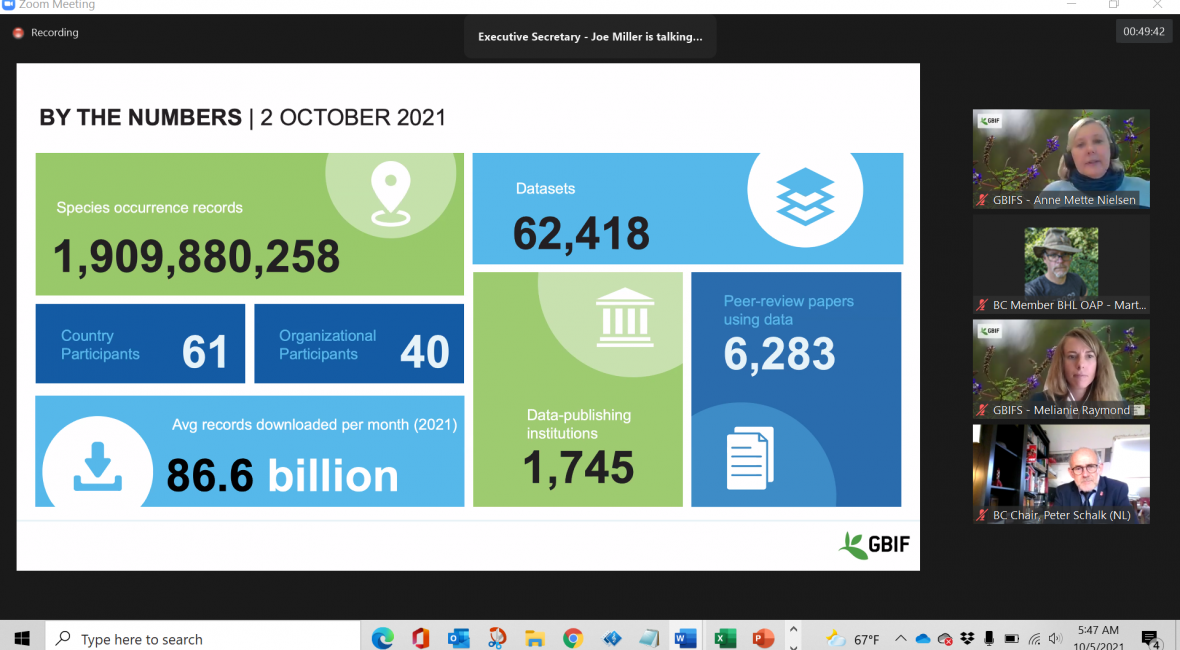
GBIF Executive Secretary, Joe Miller, presents GBIF By the Numbers at the annual GBIF Governing Board Meeting (GB28).

A highlight of the Governing Board meeting included the presentation of the winner of the Ebbe Nielsen Challenge. This year, an International team led by Alexander Zizka of iDiv won for creating a web-based tool linking natural science and political science. The tool, Bio-Dem, is an open-source web-app for exploring temporal and spatial relationships between the availability of biodiversity data and the dimensions of democracy.

The Young Researcher Awards this year went to:

  • Michael Belitz, a PhD candidate from the United States, selected for work on linking new analytical approaches aimed at advancing understanding of phenological impacts of climate change; and
  • Julen Torrens Baile, a Master’s student at the University of Navarra, selected for research into improving methods of modelling species distributions for invasive freshwater fish.

In other actions, Belgium was selected as the host for the 2023 Governing Board meeting, and Martin Kalfatovic was elected as 2nd Chair of the Budget Committee.

BHL Symposium at TDWG 2021

Biodiversity Information Standards (TDWG) hosted its virtual annual conference from 18-22 October with a theme of “Connecting the world of biodiversity data: uniting people, processes, and tools.” Hosted by the University of Florida Biodiversity Institute along with the Florida Museum of Natural History and iDigBio, TDWG 2021 brought more than 400 attendees together via the Whova virtual conference platform. The community engaged in online discussions, interactive workshops, in-depth symposia, contributed oral presentations, and a TDWG 2021 Worldwide Bioblitz.

TDWG 2021 conference logo: Connecting the world of biodiversity data: standards uniting people, processes, and tools

TDWG 2021 Virtual Annual Conference. Connecting the world of biodiversity data: standards uniting people, processes, and tools

On 21 October, BHL hosted a symposium titled “SYM11 Building collaborative resiliency through the Biodiversity Heritage Library,” organized by Constance Rinaldo (BHL Chair) and Colleen Funkhouser (BHL Program Manager, Smithsonian Libraries and Archives).

Moderated by Constance Rinaldo, the symposium included six talks from speakers around the world.

  • Cultivating Resilience in the Biodiversity Heritage Library During the Global Pandemic: Improving access to existing content – Colleen Funkhouser (BHL Secretariat, Smithsonian Libraries and Archives)
  • BHL and the Pandemic: An accelerator of digital advances and transformation – Alice Lemaire (Muséum national d’Histoire naturelle, Paris)
  • Algorithms for connecting scientific names with literature in the Biodiversity Heritage Library via the Global Names Project and Catalogue of Life – Geoffrey Ower (University of Illinois)
  • Biodiversity Heritage Library and Global Names: Successes, opportunities and the challenges for the future collaboration – Dmitry Mozzherin (University of Illinois Urbana-Champaign)
  • #RetroPIDs: The missing link to the foundation of biodiversity knowledge – Nicole Kearney (BHL Australia)
  • The BHL-Plazi Partnership: Getting data from the 1800s directly into 21st century, reused digital accessible knowledge – Donat Agosti (Plazi)

Discussions throughout the conference emphasized the need for better ways to extract and connect data from historic literature including the collections within BHL.

You can view a complete list of symposia, workshops, and discussion session descriptions on the TDWG conference website. All conference abstracts are published in the TDWG Proceedings 2021 in Biodiversity Information Science and Standards.

November 10, 2021by

Help Support BHL

BHL's existence depends on the financial support of its patrons. Help us keep this free resource alive!

search

About BHL

The Biodiversity Heritage Library (BHL) is the world’s largest open access digital library for biodiversity literature and archives. BHL operates as a worldwide consortium of natural history, botanical, research, and national libraries working together to digitize the natural history literature held in their collections and make it freely available for open access as part of a global “biodiversity community.”

Join Our Mailing List

Sign up to receive the latest news, content highlights, and promotions.

Subscribe Now

Subscribe to Blog via Email

Enter your email address to subscribe to this blog and receive notifications of new posts by email.

Join 319 other subscribers

Subscribe to Blog Via RSS

Subscribe to the blog RSS feed to stay up-to-date on all the latest BHL posts.

Access RSS Feed

Inspiring Discovery through Free Access to Biodiversity Knowledge.

The Biodiversity Heritage Library makes it easier than ever for you to access the information you need to study and explore life on Earth…for free, anytime, anywhere.


64+ Million Pages of
Biodiversity Literature Online.

EXPLORE

Tools and Services
to Transform Research.

EXPLORE

300,000+
Illustrations on Flickr.

EXPLORE

ABOUT | HARMFUL CONTENT | PRIVACY | SITE MAP | TERMS OF USE