Biodiversity Heritage Library - Program news and collection highlights from BHL
  • Home
  • News
  • Featured Books
    • All Featured Books
    • Book of the Month Series
    • BHL at 20
  • User Stories
  • Campaigns
    • Fossil Stories
    • Garden Stories
    • Monsters Are Real
    • Page Frights
    • Her Natural History
    • Earth Optimism 2020
  • Tech Blog
  • Visit BHL
Home
News
Featured Books
    All Featured Books
    Book of the Month Series
    BHL at 20
User Stories
Campaigns
    Fossil Stories
    Garden Stories
    Monsters Are Real
    Page Frights
    Her Natural History
    Earth Optimism 2020
Tech Blog
Visit BHL
  • Home
  • News
  • Featured Books
    • All Featured Books
    • Book of the Month Series
    • BHL at 20
  • User Stories
  • Campaigns
    • Fossil Stories
    • Garden Stories
    • Monsters Are Real
    • Page Frights
    • Her Natural History
    • Earth Optimism 2020
  • Tech Blog
  • Visit BHL
Biodiversity Heritage Library - Program news and collection highlights from BHL
Blog Reel, Featured Books

Spending Time with Circa Instans, Now BHL’s Oldest Item

A double page spread of a very old book with yellowed pages and red and brown text.

Reflections on Digitizing Medieval Medical and Botanical History

This post is part of BHL at 20: Treasures from the Biodiversity Heritage Library, a series contributed by members of the BHL community, highlighting remarkable works from across the collection in celebration of its 20th anniversary.

A double page spread of an historic text: yellowed pages with red and brown text.

Circa Instans (c. 1190), attributed to Matthaeus Platearius. Courtesy of the New York Botanical Garden’s LuEsther T. Mertz Library. https://www.biodiversitylibrary.org/page/65015749

Last summer, as the Archival Systems Intern for the LuEsther T. Mertz Library of the New York Botanical Garden, I had the privilege of uploading several unique new items to the Biodiversity Heritage Library. Among them was one of the earliest Western medical manuscripts, a medieval pharmacopeia known as the Circa Instans. This manuscript, digitized from the New York Botanical Garden’s physical collections, was written in approximately 1190, making it the oldest item in the BHL’s collection. Although I did not know that it would become the BHL’s oldest item when I added it to the library, I nevertheless found myself marveling at the Circa Instans and the history of this particular manuscript.

The origins of the Circa Instans are not definitively known, but it is widely believed that physician Matthaeus Platearius wrote the manuscript while working as a lecturer at Europe’s first medical school, the School of Salerno in Italy. The Circa Instans — also known as Liber de Simplici Medicina, Le Livre des Simples Médecines, or The Book of Simple Medicines — is written in Latin on vellum parchment. Composed of what was known as materia medica (“medical material”), the manuscript details the medicinal uses of plants, animals, and minerals in pre-Gothic script. It lists 258 items in alphabetical order and describes the appearance, effects, and applications for each. The majority of the items listed are common plants such as aloe, garlic, anise, dill, bitter almond, saffron, cardamom, and absinthe, among others.

At the time of its writing, the fields of botany, medicine, and pharmacology comprised one school of thought, and the manuscript helped to provide clarity to practitioners across medieval Europe by standardizing plant names and their uses. For this reason, it is considered to be a fundamental text in the development of modern botany. Due to its simple organization and accessibility for readers, many copies of the Circa Instans were created over the centuries, and it was translated from Latin into several languages, including French, German, Italian, Danish, Serbian, and English. The work was given no formal title by its author, and the name Circa Instans (“about the present”) was adopted simply because these two words begin its first chapter.

The particular manuscript digitized in the BHL is considered to be the earliest version of the Circa Instans still in existence, and its journey from 12th-century Italy to 20th-century New York City was precarious and fairly extraordinary. Almost 750 years after its creation, the manuscript was acquired by Emil Starkenstein, one of the founders of clinical pharmacology. A prominent Czech-Jewish pharmacologist, Starkenstein was deported by the Nazi regime to Mauthausen-Gusen concentration camp in 1941. Shortly thereafter, his family sold his rare book collection to a local book dealer named Ludwig Gottschalk. The book dealer, also facing deportation to the camps, managed to hide the collection across several locations, including the Black Forest and, allegedly, the shelves of the Amsterdam Public Library. Tragically, Starkenstein was killed at Mauthausen-Gusen, but Gottschalk survived and later reassembled Starkenstein’s collection. In 1975, the New York Botanical Garden’s Mertz Library acquired a portion of the collection, including this copy of the Circa Instans. At the time of its acquisition, the New York Botanical Garden wrote that it was “an excellent example of the type of manuscript documentation that predated printed books and carried forward the knowledge of antiquity to the Dark Ages.”

A double page spread of a very old book with yellowed pages and red and brown text.

Circa Instans (c. 1190), attributed to Matthaeus Platearius. Courtesy of the New York Botanical Garden’s LuEsther T. Mertz Library. https://www.biodiversitylibrary.org/page/65015641

This manuscript can now add “becoming the oldest item in a digital library containing hundreds of thousands of biodiversity materials” to its long and unique history. While preparing to import the Circa Instans into the BHL, I found myself reflecting on how remarkable it was to be able to peruse and add metadata to an ancient medieval work from the comfort of my own home. As a graduate student focusing on digital collections and archives, I recognize that virtual representations of a beautiful historical object such as the Circa Instans do not fully encapsulate what it is to experience it in person, but I cannot deny that leafing through the pages online allowed me to connect with medical and botanical history in a way I may never have otherwise. Although my interactions with the Circa Instans were mediated by bits and electricity, it felt exciting to explore its pages and marginalia and imagine a physician composing them more than 800 years ago. As someone who cares about increasing access to historical materials, I know that having easy access to a work like this will help future researchers in their quest to understand and learn from the past. I am delighted that we now have the ability to make this piece of medical and botanical history available using technologies that Platearius and early readers of the Circa Instans could have only imagined.

From the Biodiversity Heritage Library

As we celebrate twenty years of open biodiversity knowledge, we are also looking ahead to what comes next. BHL’s future depends on the global community that built it and continues to sustain it. If you value open access to biodiversity literature, we invite you to be part of the next chapter.

Orange button with a heart icon

Sources

American Library Association. (1976). College & research libraries news: news from the field. Library Association, 37(3). https://crln.acrl.org/index.php/crlnews/article/view/22274/28393

Blackletter (2026, February 19). In Wikipedia. https://en.wikipedia.org/wiki/Blackletter

Britannica Editors (2025, February 1). Salerno. Encyclopedia Britannica. https://www.britannica.com/place/Salerno-Italy

Callery, B. G. (1995). Collecting Collections: Building the Library of the New York Botanical Garden. Brittonia, 47(1), 44–56. https://doi.org/10.2307/2807247

Circa Instans. (2025, April 1). In Wikipedia. https://de.wikipedia.org/wiki/Circa_instans

Emil Starkenstein. (2025, October 5). In Wikipedia. https://en.wikipedia.org/wiki/Emil_Starkenstein

Gottschalk, L. (1995). USC Shoah Foundation Institute testimony of Ludwig Gottschalk [Oral Testimony]. United States Holocaust Memorial Museum Collection, Washington, DC., United States. Retrieved February 16th, 2026 from https://collections.ushmm.org/search/catalog/vha1490

Graham, A. (2023). Folio 186r. Circa Instans by Matthaeus Platearius. Retrieved March 5, 2026, from https://grahama9.msu.domains/2023/02/?order=as

Jaroslav, J. (2006). Emil Starkenstein – One of the most important personalities of European continental pharmacology in the period between the two World Wars. Neuroendocrinology Letters. 27. https://web.archive.org/web/20110720012001/http://node.nel.edu/?node_id=3542

Materia Medica. (2025, April 8). In Wikipedia. https://en.wikipedia.org/wiki/Materia_medica

New York Botanical Garden. (1998). Verdant riches revealed: a selection from the treasures of the LuEsther T. Mertz Library at the New York Botanical Garden. Newswise. https://www.newswise.com/articles/verdant-riches-revealed-a-selection-from-the-treasures-of-the-luesther-t-mertz-library-at-the-new-york-botanical-garden

S. Sinon, personal communication, March 17 2026.

Ventura, I. (2017, February 23) A Medieval Pharmaceutical Bestseller: The ‘Circa instans’. Brewminate: A Bold Blend of News and Ideas. https://brewminate.com/a-medieval-pharmaceutical-bestseller-the-circa-instans/

Ventura, I. (2015). Il Circa instans attribuito a Platearius : trasmissione manoscritta, redazioni, criteri di costruzione di un’edizione critica. Revue d’Histoire des Textes, 10(1), 251–362. https://doi.org/10.1484/j.rht.1.103260
April 21, 2026by nkearney
Blog Reel, Featured Books

Osbert Salvin’s Central American Field Diary

Handwritten field notes with a detailed painted illustration of an bird’s head, surrounded by cursive annotations describing the specimen.

This post is part of BHL at 20: Treasures from the Biodiversity Heritage Library, a series contributed by members of the BHL community, highlighting remarkable works from across the collection in celebration of its 20th anniversary.

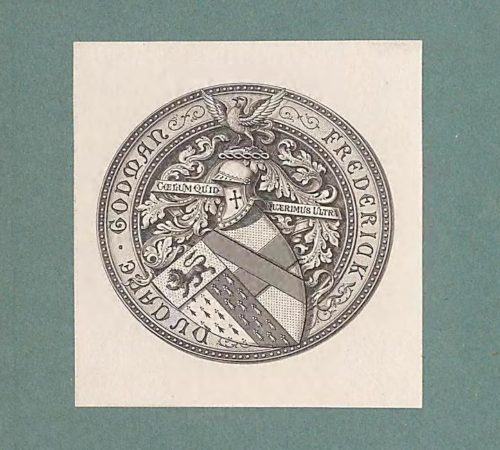
We uncovered this lovely tome when we were relocating our Museums Victoria Library Collection in 2015-16. It was housed with our run of the Ibis, an important ornithology journal published by the British Ornithologists Union since 1859. However, when we opened it up it was clearly something special. Interleaved between 12 articles on Central American ornithology from the Ibis were sheets of lined blue paper with handwritten annotations and beautiful hand painted illustrations. There was also a bookplate from British naturalist Frederick DuCane Godman (1834–1919).

Bookplate of Frederick DuCane Godman featuring a heraldic crest with shield, motto, and decorative border on a green background.

Bookplate of Frederick DuCane Godman, from [Collected articles from The Ibis on the ornithology of Central America] 1859-1864. Contributed to BHL by Museums Victoria. https://www.biodiversitylibrary.org/page/58147838

The printed articles are all written or co-authored by British ornithologist Osbert Salvin (1835-1898). Godman and Salvin were two of the founding members of the British Ornithologists Union formed in 1858 at Cambridge. As students, they discovered a mutual interest in natural history that grew into a lifelong collaboration, honing their field research skills by observing local birds and butterflies. Later they both travelled extensively, including in Central America, where they collected widely, once again zoning in on birds and butterflies. In many cases, the collectors they worked with during their travels continued to send them specimens years after they had returned to England. Salvin and Godman worked with a range of collectors, including Herbert Huntington Smith and his wife Amelia “Daisy” Woolworth Smith. They also employed an Indigenous collector Mr M. Trujillo.

Inspired by their experience of Central American wildlife, the two scientists decided to publish an encyclopaedia on the fauna and flora of that region. While their initial plans were reasonably modest, the material they gathered was so extensive that Biologia Centrali-Americana eventually ran to 63 volumes and included a whopping 50,263 species.

This unique volume of articles from the Ibis is a wonderful example of how books were customised for use by scientists in their research. Interleaving was an established practice in 19th century education that allowed students to copy the work of more advanced practitioners (the bookish equivalent of a budding artist copying grand masters in an art gallery). This practice carried across into scientific research, leaving us with examples such as this volume, which reveals an intermediate stage in the research and publishing process. The annotations show Salvin revising his work to prepare for the ornithology section of Biologia Centrali-Americana, which he co-authored with Godman.

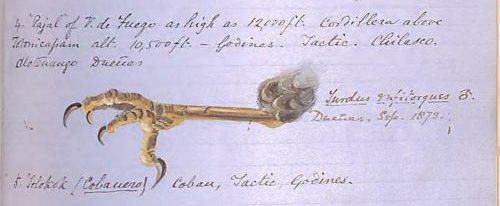
By comparing the unpublished material with Biologia Centrali-Americana, we can see that the manuscript work fed in directly to the finished work. The original published description of Turdus rufitorques in Sclater and Salvin’s 1859 article ‘On the ornithology of Central America’ records an altitude of 7,000 feet. However, the revised altitude of 12,000 feet in Volcan de Fuego and 10,500 feet at Cordillera above Totonicapam in Biologia Centrali-Americana can be seen in the manuscript material below.

Handwritten notebook page with a painted illustration of a bird’s head and leg, accompanied by scientific notes dated 1873.

Manuscript revisions to the description of Turdus rufitorques in Osbert Salvin’s Central American Field Diary. Contributed to BHL by Museums Victoria. https://www.biodiversitylibrary.org/page/58147817

Printed page from a 19th-century scientific publication describing bird species, with dense text in two columns.

Published revisions to Turdus rufitorques in Biologia Centrali-Americana. Contributed to BHL by Museums Victoria. https://www.biodiversitylibrary.org/page/38446923

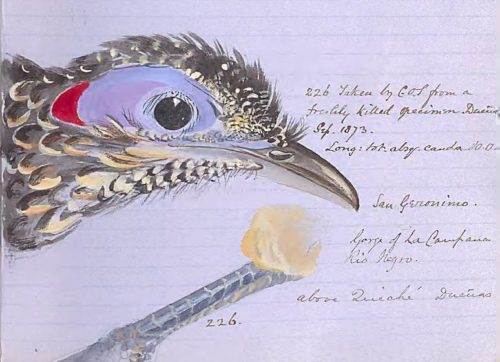
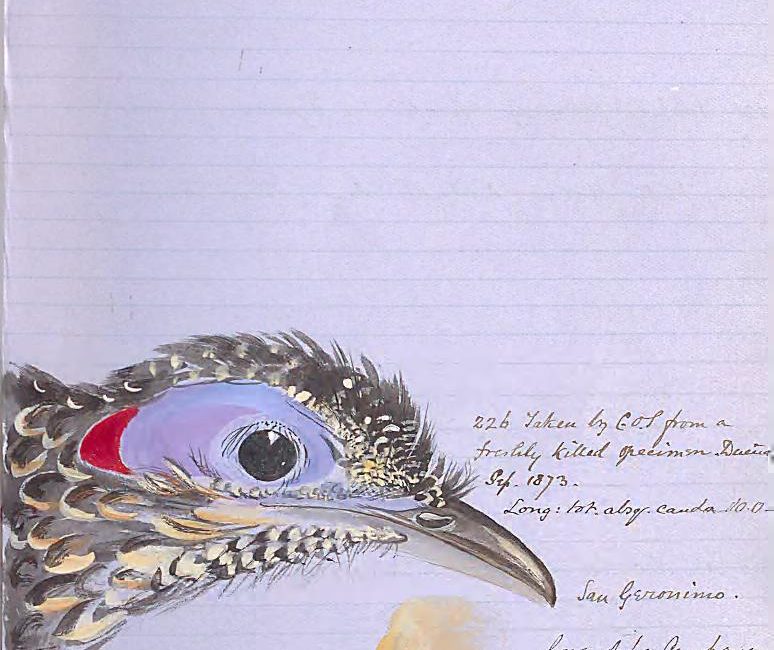
This hand drawn illustration of Geococcyx affinis deftly illustrates the published description of the species, which states “The large space round the eye in life is of a chalky bluish-white colour, and has at its further end a large crescent-shaped patch of vermilion. ‘The legs are of a slate-colour.”

Handwritten field notes with a detailed painted illustration of an bird’s head, surrounded by cursive annotations describing the specimen.

Hand painted illustration of Geococcyx affinis in Osbert Salvin’s Central American Field Diary. Contributed to BHL by Museums Victoria. https://www.biodiversitylibrary.org/page/58147753

Printed scientific text describing a bird species, including habitat and physical characteristics.

Published description of Geococcyx affinis in Biologia Centrali-Americana. Contributed to BHL by Museums Victoria. https://www.biodiversitylibrary.org/page/37639717

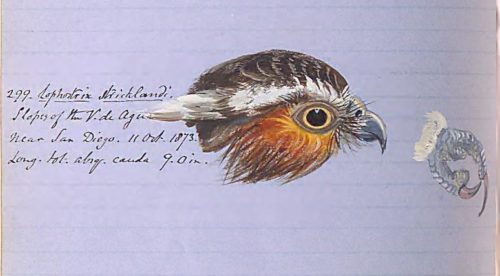
The published description of Lophostrix stricklandi is clearly based on the annotations and illustration in our volume, reading “it also occurs in the forests of the mountains trending to the Pacific, whence two birds were brought us on October 11 1873, from the slopes of the V. [Volcan] de Agua, above the village of San Diego. The iris of these fresh specimens was bright yellow and the toes lead-colour.”

Notebook page with handwritten notes and a painted illustration of a bird’s head and foot, documenting observations from field research.

Hand painted illustration of Lophostrix stricklandi in Osbert Salvin’s Central American Field Diary. Contributed to BHL by Museums Victoria. https://www.biodiversitylibrary.org/page/58147850

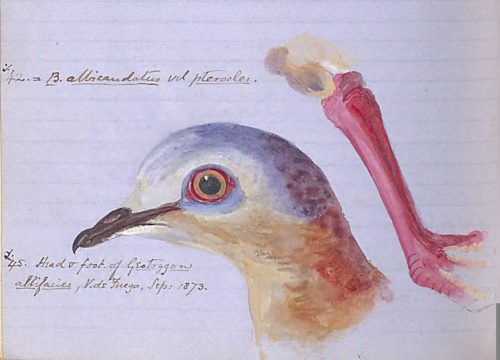
In Biologia Centrali-Americana the authors discuss two different colourings observed in species of Geotrygon albifacies from different regions, debating whether this difference is pronounced enough to distinguish two different species. Meanwhile the manuscript contains an illustration of the lighter variation from Volcan de Fuego, showing the artist closely observing and recording the bird’s colouration.

Handwritten field notes with a painted illustration of a bird’s foot and brief annotations recording location and date.

Hand painted illustration of Geotrygon albifacies with light colouration in Osbert Salvin’s Central American Field Diary. Contributed to BHL by Museums Victoria. https://www.biodiversitylibrary.org/page/58148008

While it is Godman’s bookplate that appears on the volume, the handwriting more closely matches that of Salvin. The two worked closely together, forming a significant collection and library that Godman oversaw after Salvin died in 1898. They began to donate their scientific collection to the British Museum in 1885, and Godman continued to donate specimens after Salvin’s death as the various parts of Biologia Centrali-Americana were completed. Their shared library stayed in Godman’s possession and was gradually dispersed after Godman’s death in 1919.

Based on the dates that appear alongside the illustrations, the volume appears to have been used as a field diary during Salvin’s trip to Guatemala in 1873-1874. The commentary throughout mainly focuses on localities and altitude, with a view to confirming or revising what Salvin had already published in earlier journal articles. This treasure of the Biodiversity Heritage Library is a significant and unique volume that shows late 19th century field research in practice.

From the Biodiversity Heritage Library

As we celebrate twenty years of open biodiversity knowledge, we are also looking ahead to what comes next. BHL’s future depends on the global community that built it and continues to sustain it. If you value open access to biodiversity literature, we invite you to be part of the next chapter.

Orange button with a heart icon

Acknowledgements

Thanks to former Museums Victoria staff members Gemma Steele and Catriona McPhee for their help in identifying Salvin’s handwriting.

References

‘Biographical Notices of the Original Members of the British Ornithologists’ Union, of the principal Contributors to the First Series of ‘The Ibis’ and of the Officials’ (1909) Ibis, 50, pp. 71-232. https://doi.org/10.1111/j.1474-919X.1909.tb05250.x

British Museum (n.d.) Frederick DuCane Godman, British Museum website, https://www.britishmuseum.org/about-us/british-museum-story/people-behind-collection/frederick-ducane-godman (Accessed 8 January 2026).

‘Godman and Salvin Memorial’ (1923) Science, 58 (1496), pp. 157–157. http://www.jstor.org/stable/1648226

Holland, W. J. (1919) ‘Herbert Huntington Smith’, Science, 49(1273), pp. 481–483. http://www.jstor.org/stable/1641319

Horsham Museum & Art Gallery (2021) A Collector Collected – unique items reveal all, Horsham Museum & Art Gallery website,

https://horshammuseum.org/collections/blog/posts/collectors (Accessed 8 January 2026).

Horsham Museum & Art Gallery (2023) Frederick DuCane Godman: The Legacy of a Collector, Horsham Museum & Art Gallery website https://horshammuseum.org/collections/blog/posts/godman-legacy-of-a-collector (Accessed 8 January 2026).

Jackson, C.E. (1975) Bird illustrators: some artists in early lithography. London: H.F. & G. Witherby.

Jackson, H. J. (2005) Romantic Readers: The Evidence of Marginalia. New Haven: Yale University Press.

‘Osbert Salvin’ in Sidney, L. (ed.) (1901) The dictionary of national biography: founded in 1882 by George Smith Supplement Vol. 3. New York & London: Macmillan & Smith & Elder.

Vitiello, Regina M. (2020) Hidden Women Botanists – Mrs. Herbert Huntington Smith, NYBG Steere Herbarium website, https://sweetgum.nybg.org/science/the-hand-lens/explore/narratives-details/?irn=7427# (Accessed 24 March 2026).

April 8, 2026by nkearney
BHL News, Blog Reel, Tech Updates

A Brief Bit on BHL Battling a Barrage of Bots

People swatting a swarm of flying green and brown grasshoppers.

Summary

Over the past year, BHL has been forced to contend with the issue of AI Bot (short for robot) Crawlers and the effect of their unreasonable requests for BHL’s content. I say unreasonable because while BHL’s content is made freely available and is probably beneficial to modern Large Language Models (LLMs), the behavior of these bots and their disruptive effect on BHL has proven that they are bad partners in the exchange of information.

BHL is not the only organization to contend with this in recent months. Other cultural heritage organizations have reported the same or similar experiences, most notably this detailed report from Michael Weinberg at the GLAM-E Lab.

By the time this and other articles had been posted in mid-2025, BHL had already crested the first wave of interruptions.

A bit of background

When a request is made to a website, all actors are expected to identify themselves. Your browser informs the website that it is Firefox or Chrome. Many of the bots that come to a site are there to fill the index for a search engine. They have clever names like “GoogleBot” or “BingBot”. Furthermore, many LLM bots identify themselves, too. “ClaudeBot” or “GPTBot”, for example.

On the other side of the equation we have the “robots.txt” file which is meant to create an informal agreement between website and Bot to set rules on how the bots should behave. It contains directives like “you can go to these these URLs”, “please don’t go to these other URLs” or “please don’t make more than 10 requests per second”. These directives can be set individually for different bots to help guide them to what we think is the most useful content for them.

Some LLM bots ignore all of this.

The disruptive effect

In fact, the Grok bot sneaks its way into web servers by lying about who it is. No one has seen a “GrokBot” visiting their sites. This behavior is recently well documented. This is bad behavior, and it’s not something a handful of humans can fight alone.

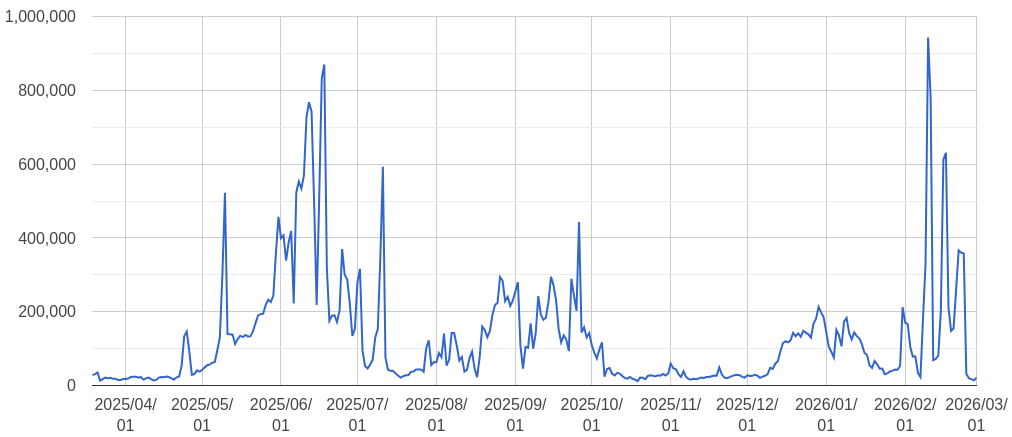
We found that this is what was happening at BHL: The traffic that we saw did not identify themselves and they also came from many thousands of locations around the internet, making it difficult to control or block them. The numbers show it:

A line graph showing overall traffic to BHL with a step in the average traffic in the middle of the chart.

This chart shows traffic to BHL’s “/search” URL for approximately the past year. The peaks in June 2025 and February 2026 exceeded BHL’s capacity.

Beginning in April 2025, we saw a gradual increase in traffic that peaked on 19 June 2025 when it dropped off completely. This was the first wave of disruptions which we saw again later in 2025 and into 2026.

During this time, the Smithsonian was the host for the BHL servers and making changes in their ecosystem was a challenge, but the firewalls (and the team) at the Smithsonian are amazing and played a large part in keeping BHL operational. Regardless, we believe that enough traffic was allowed to get through the firewalls to still cause disruptions and unexpected errors trying to get to BHL.

Bar chart showing tall bars for many days over the past month.

The Smithsonian’s firewalls were an important part of blocking traffic to BHL in February 2026. This chart shows requests per hour that were blocked by the firewalls for one week in February.

Our Response

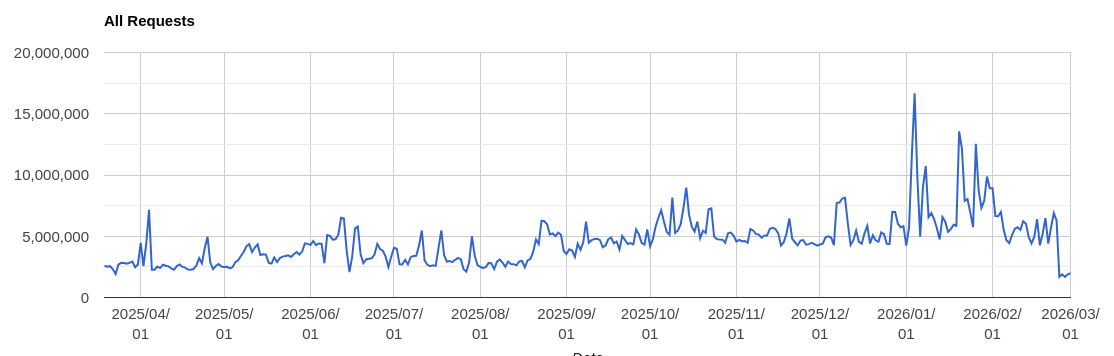
Starting in June 2025 and continuing through September, Mike Lichtenberg, BHL Lead Software Engineer, made some small but effective changes to how BHL works internally. This allowed BHL to serve a new, higher level of traffic on the same technical infrastructure. Another change we made was to redirect certain requests to the Internet Archive, which was already protected by Cloudflare. This freed up capacity at BHL to serve more requests.

A line graph showing overall traffic to BHL with a step in the average traffic in the middle of the chart.

This chart shows per-day traffic to BHL. On the left side before August 2025, our regular traffic was around 2.5 million hits per day. On the right side, after Mike’s improvements the new baseline is closer to 5 million hits per day.

Unfortunately this was not enough. In January 2026, the bots returned, and worse than before.

The Cloudflare Cavalry

After a few weeks, it became clear that our efforts were no longer sufficient. Around 19 June 2025, BHL had responded to 870,000 search requests. This far exceeded our usual 22,000 searches per day.

On 10 February 2026, BHL received a peak of 943,000 search requests.

We’d been encouraged to pursue Cloudflare for some time, but it wasn’t until mid-February that our technical infrastructure was ready for the switch. On 20 February we officially started using Cloudflare and after a few missteps, everything was in place by 24 February.

But what is Cloudflare, you ask? It’s a service that sits between a web site and the rest of the internet and it looks at requests to that website to decide if they should be allowed through. As a very large player on the internet, Cloudflare has access to mountains of data on bot-like behavior to accurately analyze traffic in real-time.

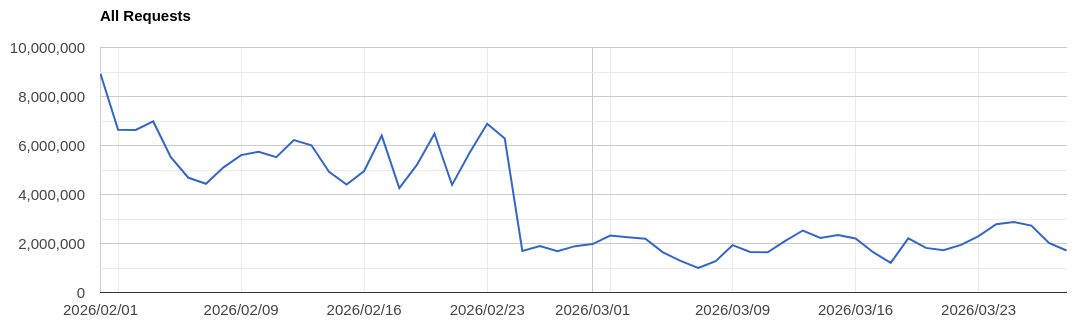
After activating Cloudflare, we immediately saw a reduction in traffic and much more stability at BHL. In the following weeks, we made other changes, such as adding the ubiquitous “are you human?” checkbox that has become common across the internet.

A line chart showing a 60% drop in traffic around February 23 2026

This chart shows traffic to BHL’s servers dropped dramatically when Cloudflare was fully activated.

Cloudflare is not simply a gatekeeper preventing unwanted traffic from coming to BHL. They also cache regularly requested parts of BHL (images, scripts, and styles) to deliver them to you from a location that is geographically closer to you. This means BHL will often seem to load faster than it did before. This also accounts for the drop in traffic to BHL as indicated in the chart above.

A line chart with three lines indicating that 2/3 of traffic to BHL is blocked by Cloudflare.

Cloudflare is now blocking a large amount of automated traffic coming to BHL. 

This chart shows a bit more detail of how Cloudflare is affecting requests to BHL. The top line is requests blocked by Cloudflare, the middle line is requests served by BHL’s own infrastructure, and the bottom line is requests served by  Cloudflare’s caches.

In Closing

It’s been a long journey, but BHL is much safer from the army of bots. This doesn’t mean that our work is done. We’ve had to make special efforts to not block access to BHL’s APIs and data feeds, which are often used by software or code…and which often behave like a bot! These settings have been in place for a few weeks now.

Additionally, we are investigating whether to allow the LLM bots to resume accessing our high-quality content, but we must be able to limit their flow of traffic to prevent overwhelming BHL’s servers.

Rest assured that BHL’s Technical Team is committed to keeping BHL up and running as we always have, but now we have a powerful new tool to help us in those efforts.

April 6, 2026by Joel Richard

Help Support BHL

BHL's existence depends on the financial support of its patrons. Help us keep this free resource alive!

search

About BHL

The Biodiversity Heritage Library (BHL) is the world’s largest open access digital library for biodiversity literature and archives. BHL operates as a worldwide consortium of natural history, botanical, research, and national libraries working together to digitize the natural history literature held in their collections and make it freely available for open access as part of a global “biodiversity community.”

Join Our Mailing List

Sign up to receive the latest news, content highlights, and promotions.

Subscribe Now

Subscribe to Blog via Email

Enter your email address to subscribe to this blog and receive notifications of new posts by email.

Join 319 other subscribers

Subscribe to Blog Via RSS

Subscribe to the blog RSS feed to stay up-to-date on all the latest BHL posts.

Access RSS Feed

Inspiring Discovery through Free Access to Biodiversity Knowledge.

The Biodiversity Heritage Library makes it easier than ever for you to access the information you need to study and explore life on Earth…for free, anytime, anywhere.


ABOUT | HARMFUL CONTENT | PRIVACY | SITE MAP | TERMS OF USE