

Osbert Salvin’s Central American Field Diary
This post is part of BHL at 20: Treasures from the Biodiversity Heritage Library, a series contributed by members of the BHL community, highlighting remarkable works from across the collection in celebration of its 20th anniversary.
We uncovered this lovely tome when we were relocating our Museums Victoria Library Collection in 2015-16. It was housed with our run of the Ibis, an important ornithology journal published by the British Ornithologists Union since 1859. However, when we opened it up it was clearly something special. Interleaved between 12 articles on Central American ornithology from the Ibis were sheets of lined blue paper with handwritten annotations and beautiful hand painted illustrations. There was also a bookplate from British naturalist Frederick DuCane Godman (1834–1919).
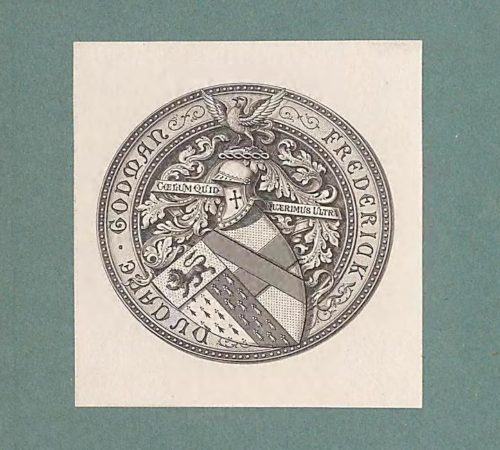
Bookplate of Frederick DuCane Godman, from [Collected articles from The Ibis on the ornithology of Central America] 1859-1864. Contributed to BHL by Museums Victoria. https://www.biodiversitylibrary.org/page/58147838
Inspired by their experience of Central American wildlife, the two scientists decided to publish an encyclopaedia on the fauna and flora of that region. While their initial plans were reasonably modest, the material they gathered was so extensive that Biologia Centrali-Americana eventually ran to 63 volumes and included a whopping 50,263 species.
This unique volume of articles from the Ibis is a wonderful example of how books were customised for use by scientists in their research. Interleaving was an established practice in 19th century education that allowed students to copy the work of more advanced practitioners (the bookish equivalent of a budding artist copying grand masters in an art gallery). This practice carried across into scientific research, leaving us with examples such as this volume, which reveals an intermediate stage in the research and publishing process. The annotations show Salvin revising his work to prepare for the ornithology section of Biologia Centrali-Americana, which he co-authored with Godman.
By comparing the unpublished material with Biologia Centrali-Americana, we can see that the manuscript work fed in directly to the finished work. The original published description of Turdus rufitorques in Sclater and Salvin’s 1859 article ‘On the ornithology of Central America’ records an altitude of 7,000 feet. However, the revised altitude of 12,000 feet in Volcan de Fuego and 10,500 feet at Cordillera above Totonicapam in Biologia Centrali-Americana can be seen in the manuscript material below.
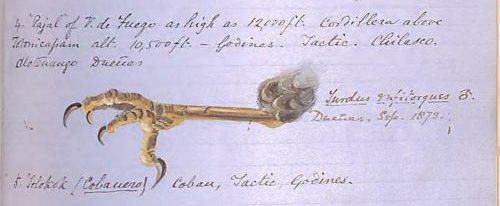
Manuscript revisions to the description of Turdus rufitorques in Osbert Salvin’s Central American Field Diary. Contributed to BHL by Museums Victoria. https://www.biodiversitylibrary.org/page/58147817

Published revisions to Turdus rufitorques in Biologia Centrali-Americana. Contributed to BHL by Museums Victoria. https://www.biodiversitylibrary.org/page/38446923
This hand drawn illustration of Geococcyx affinis deftly illustrates the published description of the species, which states “The large space round the eye in life is of a chalky bluish-white colour, and has at its further end a large crescent-shaped patch of vermilion. ‘The legs are of a slate-colour.”
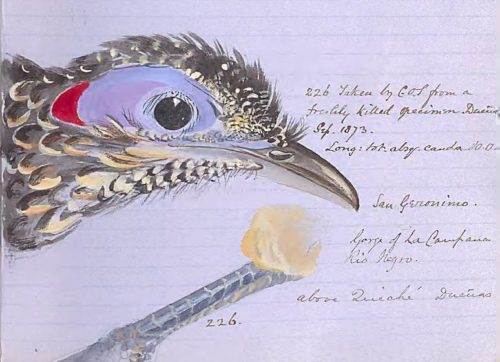
Hand painted illustration of Geococcyx affinis in Osbert Salvin’s Central American Field Diary. Contributed to BHL by Museums Victoria. https://www.biodiversitylibrary.org/page/58147753

Published description of Geococcyx affinis in Biologia Centrali-Americana. Contributed to BHL by Museums Victoria. https://www.biodiversitylibrary.org/page/37639717
The published description of Lophostrix stricklandi is clearly based on the annotations and illustration in our volume, reading “it also occurs in the forests of the mountains trending to the Pacific, whence two birds were brought us on October 11 1873, from the slopes of the V. [Volcan] de Agua, above the village of San Diego. The iris of these fresh specimens was bright yellow and the toes lead-colour.”
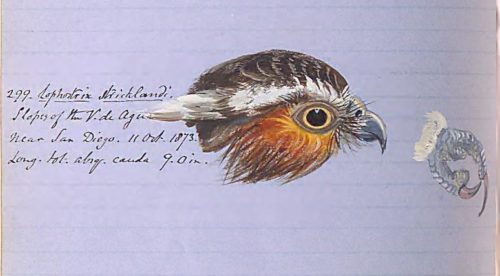
Hand painted illustration of Lophostrix stricklandi in Osbert Salvin’s Central American Field Diary. Contributed to BHL by Museums Victoria. https://www.biodiversitylibrary.org/page/58147850
In Biologia Centrali-Americana the authors discuss two different colourings observed in species of Geotrygon albifacies from different regions, debating whether this difference is pronounced enough to distinguish two different species. Meanwhile the manuscript contains an illustration of the lighter variation from Volcan de Fuego, showing the artist closely observing and recording the bird’s colouration.
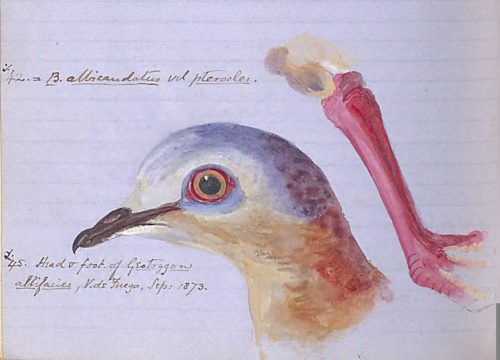
Hand painted illustration of Geotrygon albifacies with light colouration in Osbert Salvin’s Central American Field Diary. Contributed to BHL by Museums Victoria. https://www.biodiversitylibrary.org/page/58148008
While it is Godman’s bookplate that appears on the volume, the handwriting more closely matches that of Salvin. The two worked closely together, forming a significant collection and library that Godman oversaw after Salvin died in 1898. They began to donate their scientific collection to the British Museum in 1885, and Godman continued to donate specimens after Salvin’s death as the various parts of Biologia Centrali-Americana were completed. Their shared library stayed in Godman’s possession and was gradually dispersed after Godman’s death in 1919.
Based on the dates that appear alongside the illustrations, the volume appears to have been used as a field diary during Salvin’s trip to Guatemala in 1873-1874. The commentary throughout mainly focuses on localities and altitude, with a view to confirming or revising what Salvin had already published in earlier journal articles. This treasure of the Biodiversity Heritage Library is a significant and unique volume that shows late 19th century field research in practice.
From the Biodiversity Heritage Library
As we celebrate twenty years of open biodiversity knowledge, we are also looking ahead to what comes next. BHL’s future depends on the global community that built it and continues to sustain it. If you value open access to biodiversity literature, we invite you to be part of the next chapter.

Acknowledgements
Thanks to former Museums Victoria staff members Gemma Steele and Catriona McPhee for their help in identifying Salvin’s handwriting.
References
‘Biographical Notices of the Original Members of the British Ornithologists’ Union, of the principal Contributors to the First Series of ‘The Ibis’ and of the Officials’ (1909) Ibis, 50, pp. 71-232. https://doi.org/10.1111/j.1474-919X.1909.tb05250.x
British Museum (n.d.) Frederick DuCane Godman, British Museum website, https://www.britishmuseum.org/about-us/british-museum-story/people-behind-collection/frederick-ducane-godman (Accessed 8 January 2026).
‘Godman and Salvin Memorial’ (1923) Science, 58 (1496), pp. 157–157. http://www.jstor.org/stable/1648226
Holland, W. J. (1919) ‘Herbert Huntington Smith’, Science, 49(1273), pp. 481–483. http://www.jstor.org/stable/1641319
Horsham Museum & Art Gallery (2021) A Collector Collected – unique items reveal all, Horsham Museum & Art Gallery website,
https://horshammuseum.org/collections/blog/posts/collectors (Accessed 8 January 2026).
Horsham Museum & Art Gallery (2023) Frederick DuCane Godman: The Legacy of a Collector, Horsham Museum & Art Gallery website https://horshammuseum.org/collections/blog/posts/godman-legacy-of-a-collector (Accessed 8 January 2026).
Jackson, C.E. (1975) Bird illustrators: some artists in early lithography. London: H.F. & G. Witherby.
Jackson, H. J. (2005) Romantic Readers: The Evidence of Marginalia. New Haven: Yale University Press.
‘Osbert Salvin’ in Sidney, L. (ed.) (1901) The dictionary of national biography: founded in 1882 by George Smith Supplement Vol. 3. New York & London: Macmillan & Smith & Elder.
Vitiello, Regina M. (2020) Hidden Women Botanists – Mrs. Herbert Huntington Smith, NYBG Steere Herbarium website, https://sweetgum.nybg.org/science/the-hand-lens/explore/narratives-details/?irn=7427# (Accessed 24 March 2026).
Discover more from Biodiversity Heritage Library
Subscribe to get the latest posts sent to your email.

Hayley, well done upon the blog. It was an interesting treasure that was found in the Library.
Also, well done BHL upon sharing it with us.