

Industrial and Technological Museum Economic Botany Illustrations and the Wax Fruit Collection
This post is part of BHL at 20: Treasures from the Biodiversity Heritage Library, a series contributed by members of the BHL community, highlighting remarkable works from across the collection in celebration of its 20th anniversary.
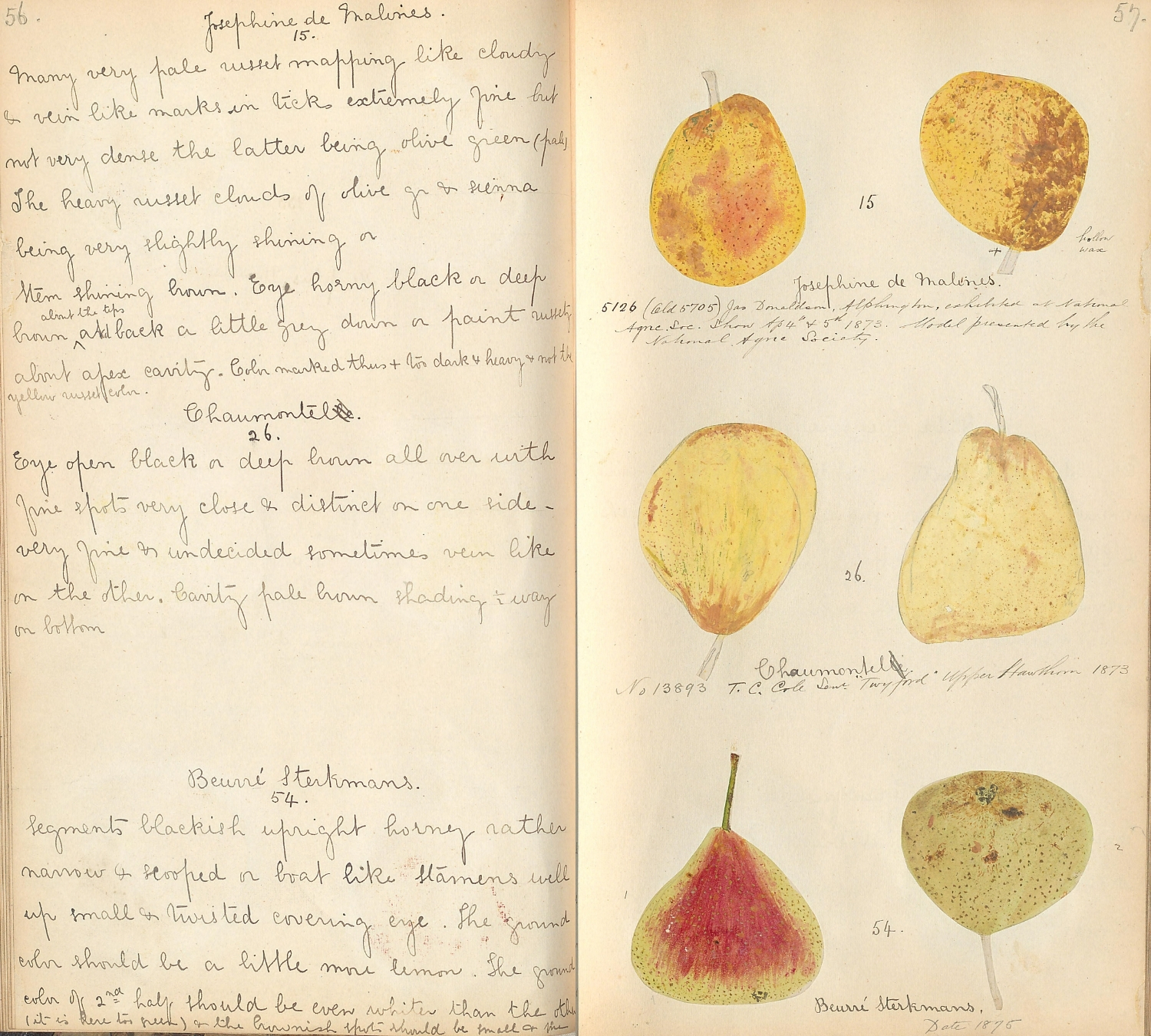
Pages 56 and 57 of the ITM Register, showing handwritten descriptions and illustrations of the pears Josephine de Malines, Chaumontel, and Beurre Sterkmans. Source: Museums Victoria Archives.
One of the most vibrant and colourful volumes available on BHL from the Museums Victoria Archives is the Economic Botany Fruit and Vegetable Specimen Register (ITM Register) created by Industrial and Technological Museum (ITM) model makers and used as a reference when producing the Wax Fruit Collection. This collection dates from when the ITM (now Museums Victoria) opened to the public in 1870.
The ITM ensured that Victorians had access to the industrial and technological developments taking place overseas through its collections on display and educational programs, such as modelling and model-making. The realistic wax fruit and vegetable models created by museum model makers document almost a century of Victorian agriculture, from the 1870s to 1960s. They were exhibited at the Melbourne International Exhibition of 1880, and remained on display into the 1960s (see image below).
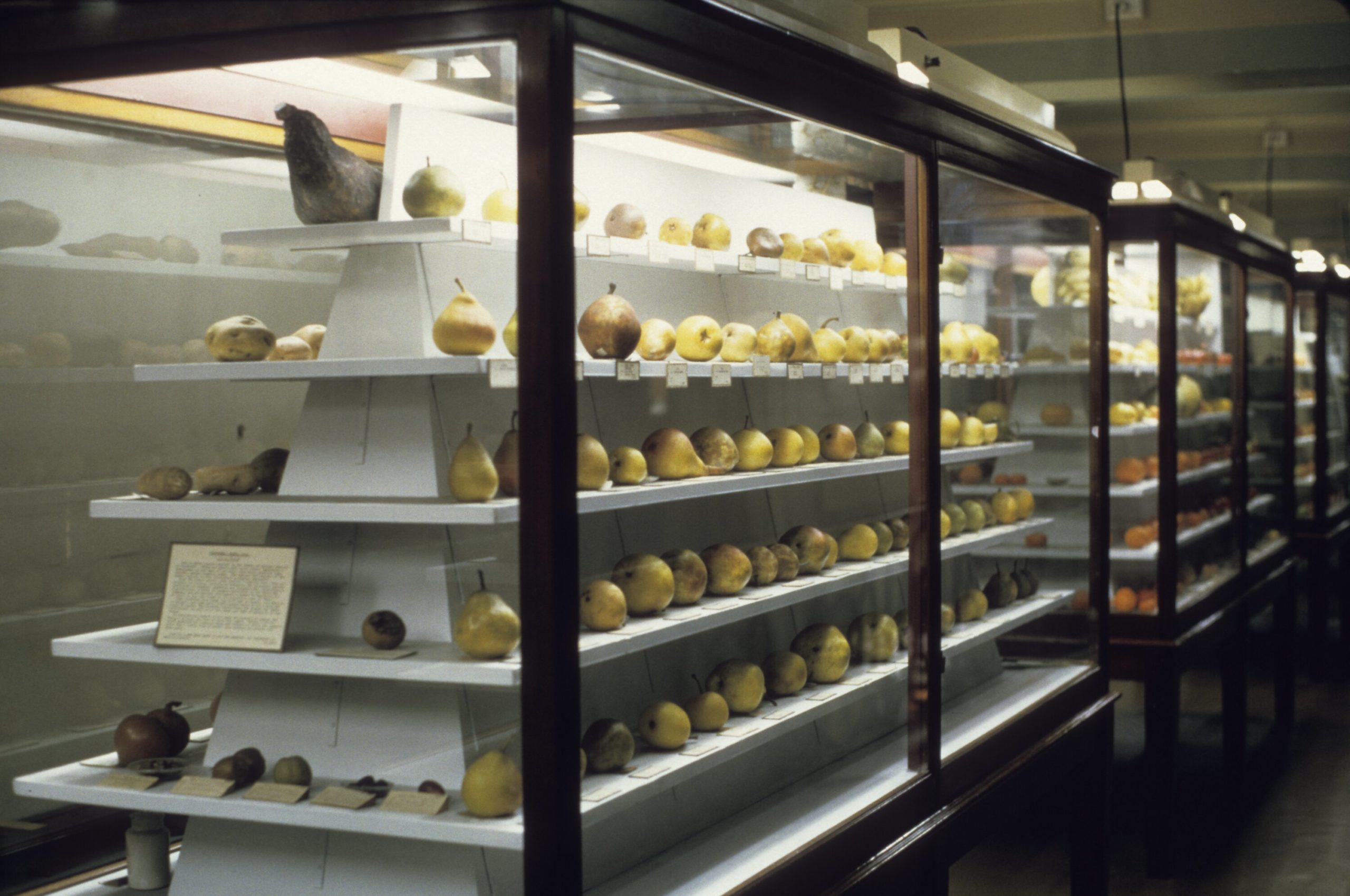
Visitors could view the wax models in display cases such as this, Queen’s Hall Upper, Institute of Applied Science (predecessor of Museums Victoria), 1969. Source: Museums Victoria.
Note that the ITM Register (c.1870-1890) has two related volumes: Album – Wax Fruit Models, Industrial and Technological Museum ST 40030 (1872-1879), and Album – Wax Fruit Models produced by model maker Miss M. J. McMillan, ST 40029 (1904).
The ITM Register held in Museums Victoria Archives includes eighty pages of watercolour botanical illustrations of fruit and vegetables pasted into the volume. Drawn to scale, with bruises and imperfections included, each illustration contains the detailed visual information required to create the wax models. Two sides of each fruit or vegetable are illustrated, depicting the unique colours and markings on either side of the specimen. For example, on page 22 (see below), a Blue Permain (Old No. 16320), an American apple variety, is illustrated green on one side and red on the other.
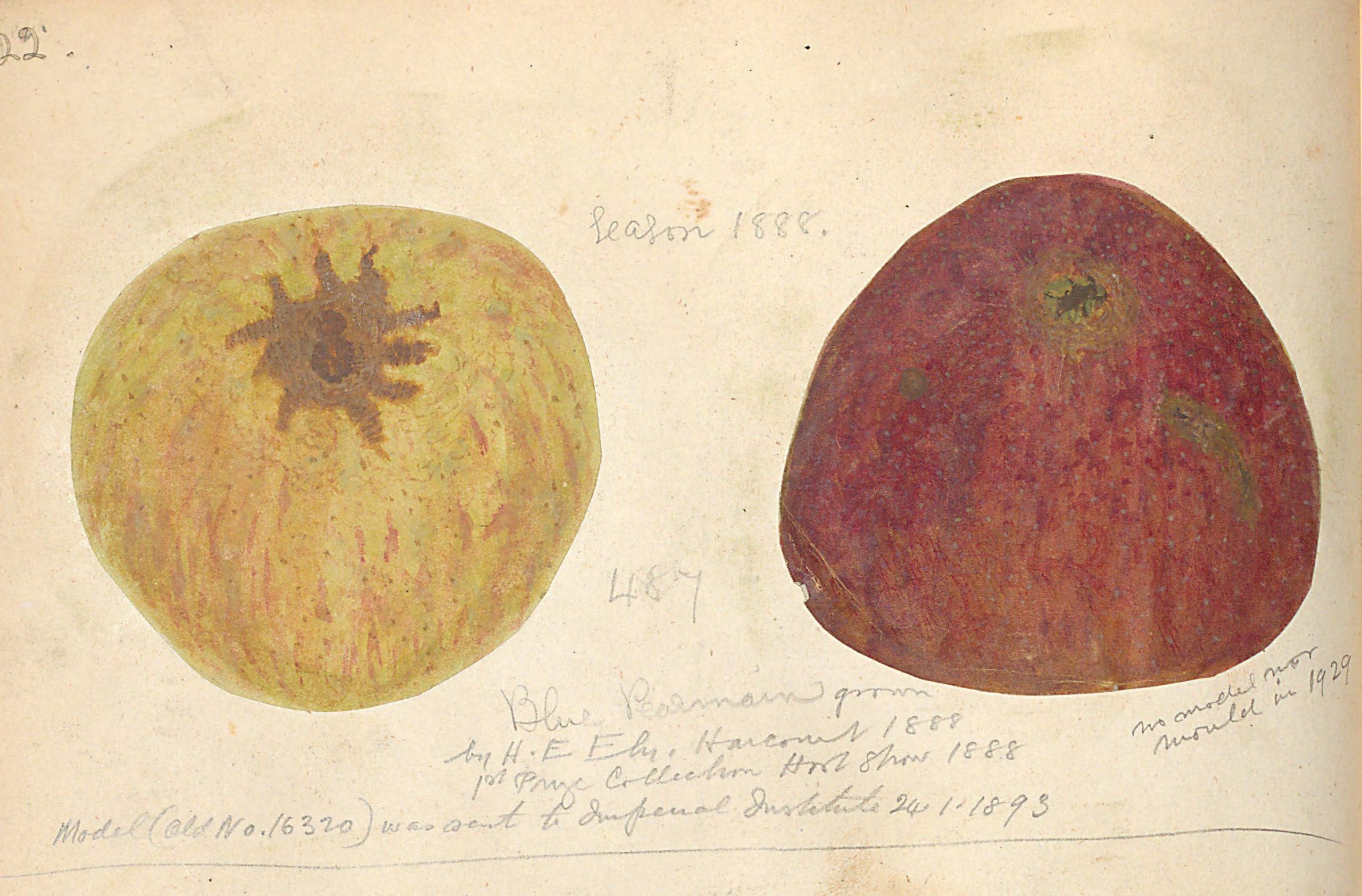
Cropped image of page 22 of the ITM Register, showing an illustration of a Blue Permain specimen (487). Source: Museums Victoria Archives.
The ITM Register includes handwritten descriptions of varieties of apples, apricots, oranges, peaches, pears, plums, potatoes and a turnip; names of orchardists and farmers; place names across Victoria, both regional and within inner-city Melbourne/Naarm; dates grown; and unique numbers assigned to each illustration. Some of these specimens were moulded and modelled into wax and relate to Museums Victoria’s State Collection registration numbers. Some descriptions include a “new” number. For example “New 4981” (“Old 8420”) refers to the wax model ST 4981 in the State Collection. The drawing is comparable to the photograph of the apple model; however, the drawing has greener hue than the model. If no “old” number is listed with the specimen, the number, typically between four and five digits, may be the new number. This can be verified by searching for the ST State Collection registration number on the Museums Victoria Collections website and comparing the description and illustration with the information in the ITM Register.
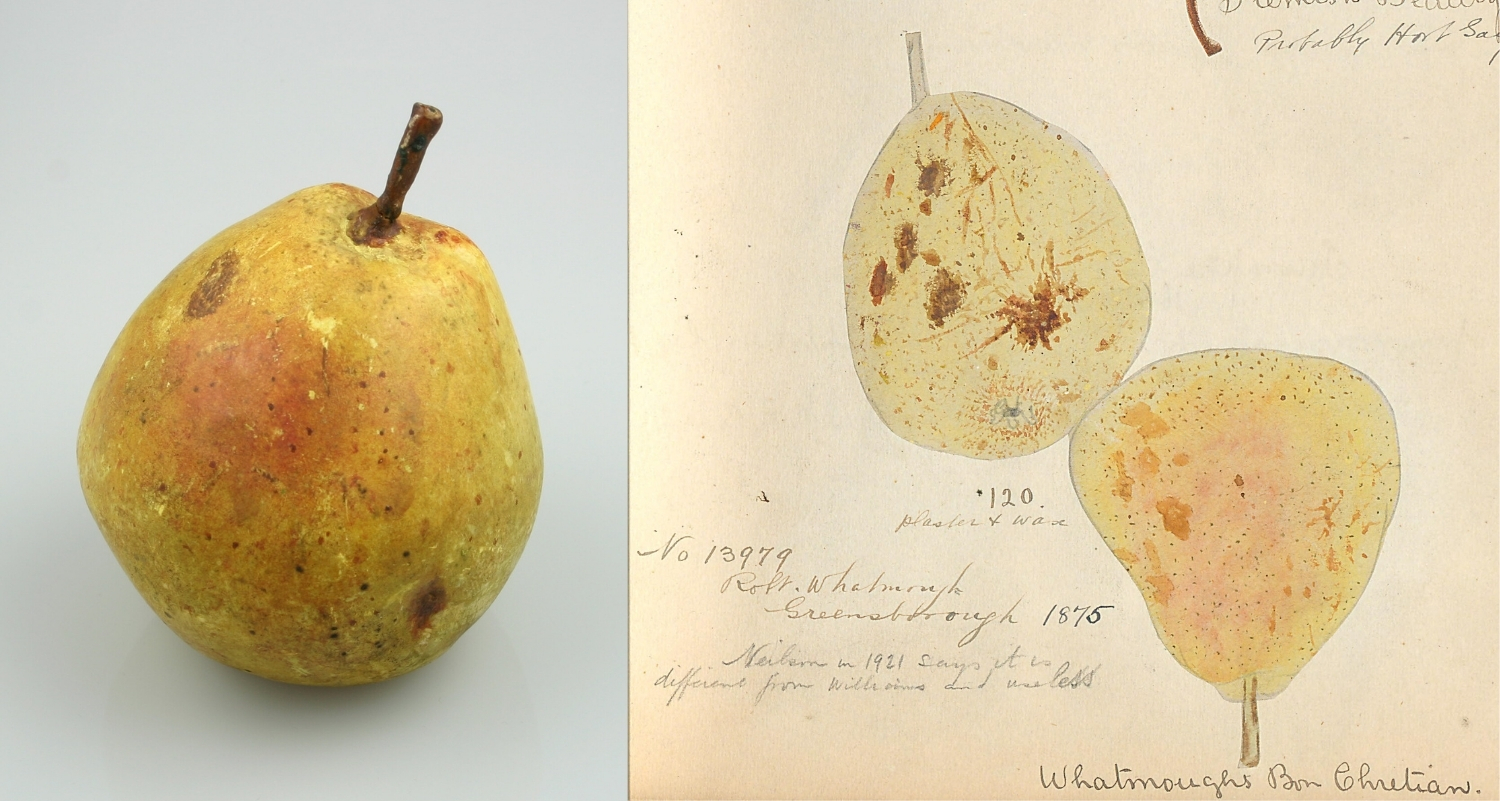
Whatmough’s Bon Chretian (ST 13979), left: wax model; right: illustration, page 61 of the ITM Register. Source: Museums Victoria.
In the above example, compare the photograph of the wax model on the left with the related botanical illustration on the right. Note the shape of the pear model, the detailed bruising, surface dots, and the orange hue at the centre in comparison to the illustration. Mr Robert Whatmough grew the Bon Chretian at Willis Vale orchard in Greensborough, Victoria, and donated the specimen to the museum in 1875. Thomas McMillan made the wax model for the Philadelphia Centennial Exhibition of 1876.
Museum model maker Thomas McMillan managed the Botanical Collection from 1872 to 1882. He established a workroom for casting and modelling fruit and vegetables and led a fruit modelling class. His daughter, Anna McMillan, held the role of pupil-assistant. Anna McMillan and model-making student Ida Ingamells entered a collection of models in the Juvenile Industrial Exhibition, where both won prizes. After Thomas McMillan retired in 1882, Anna McMillan continued working as a model maker with the collection.
Specimens that were not modelled into wax were noted as such in the descriptions in the ITM Register. Descriptions also record when wax models were sent to the Imperial Institute in 1893, when models were exhibited at the National Agricultural Show and later presented to the Museum, and when prizes were received, such as at the Horticultural Show of 1888.

Cropped image of page 103 of the ITM Register, showing an illustration of Dix (175). Source: Museums Victoria Archives.
Some illustrations include detailed descriptions, such as “Dix 175” on page 102 of the ITM Register: “Colour too bright or golden – more white & not so much body. Spots rather bright & not numerous enough. Eye nearly closed by the leaning forward of the small leathery-like segments. Stem ¾ inch curved greenish sienna & black end.” This detailed illustration of a pear (see image above) does not have a corresponding wax model.
In later years, photography was used to document varieties of fruit, as noted by ITM Curator R. Henry Walcott in the Trustees Report of 1916: “Sections, both longitudinal and transverse, of 123 varieties of pears and apples were photographed by Mr Wilson, and prints of these will be mounted and exhibited in due course. It is only through the study of the internal characters of the fruits of pears and apples that many varieties can safely be distinguished, and our object will be to try and make the collection of models and photographs a standard for reference purposes.”
Providing digital access to the ITM Register in BHL allows researchers to study and compare images of the illustrations and associated data, alongside information about the related Fruit Wax Model Collection available on the Museums Victoria Collections website. The historical and scientific significance of the agrobiodiversity documented in the volume is an important record for contemporary economic botanists studying changes in the region.
Thank you to the BHL Australia team for making this volume available online and for the vital work you do for our region.
From the Biodiversity Heritage Library
If this work matters to you, we invite you to help shape what comes next. With your support, BHL can continue to connect biodiversity knowledge across time, making it freely available to researchers, communities, and future generations worldwide.

Discover more from Biodiversity Heritage Library
Subscribe to get the latest posts sent to your email.

This is sooooo fascinating!!!
Thank you!!