

Celebrating 50 Years of a Field Naturalists Club Through its Newsletters
This post is part of BHL at 20: Treasures from the Biodiversity Heritage Library, a series contributed by members of the BHL community, highlighting remarkable works from across the collection in celebration of its 20th anniversary.
The Castlemaine Field Naturalists Club in Central Victoria, Australia, is celebrating its 50th year in 2026. Since its inception in March 1976, the Club has produced a monthly newsletter for members, except in January, when no issue is produced. All issues are available on the Club’s website and through the Biodiversity Heritage Library (BHL). Through BHL, they are fully searchable, meaning that species names, locations, and historical observations can be discovered by researchers anywhere in the world. Taxonomic names are identified and indexed, articles are structured as individual records, and persistent identifiers ensure the Club’s observations are part of the global biodiversity knowledge network. This ensures that local knowledge contributes to a global, interconnected biodiversity resource.
Issue number 1, published in April 1976, was a modest, typed, black-and-white, four-page circular called, simply, News Sheet, featuring two line drawings to break up the text. Family memberships were $5, single memberships were $3, and student memberships were $1. Expenses were recorded as $17.48. By the second issue the title Castlemaine Naturalist had been adopted, the name by which the newsletter is still known.
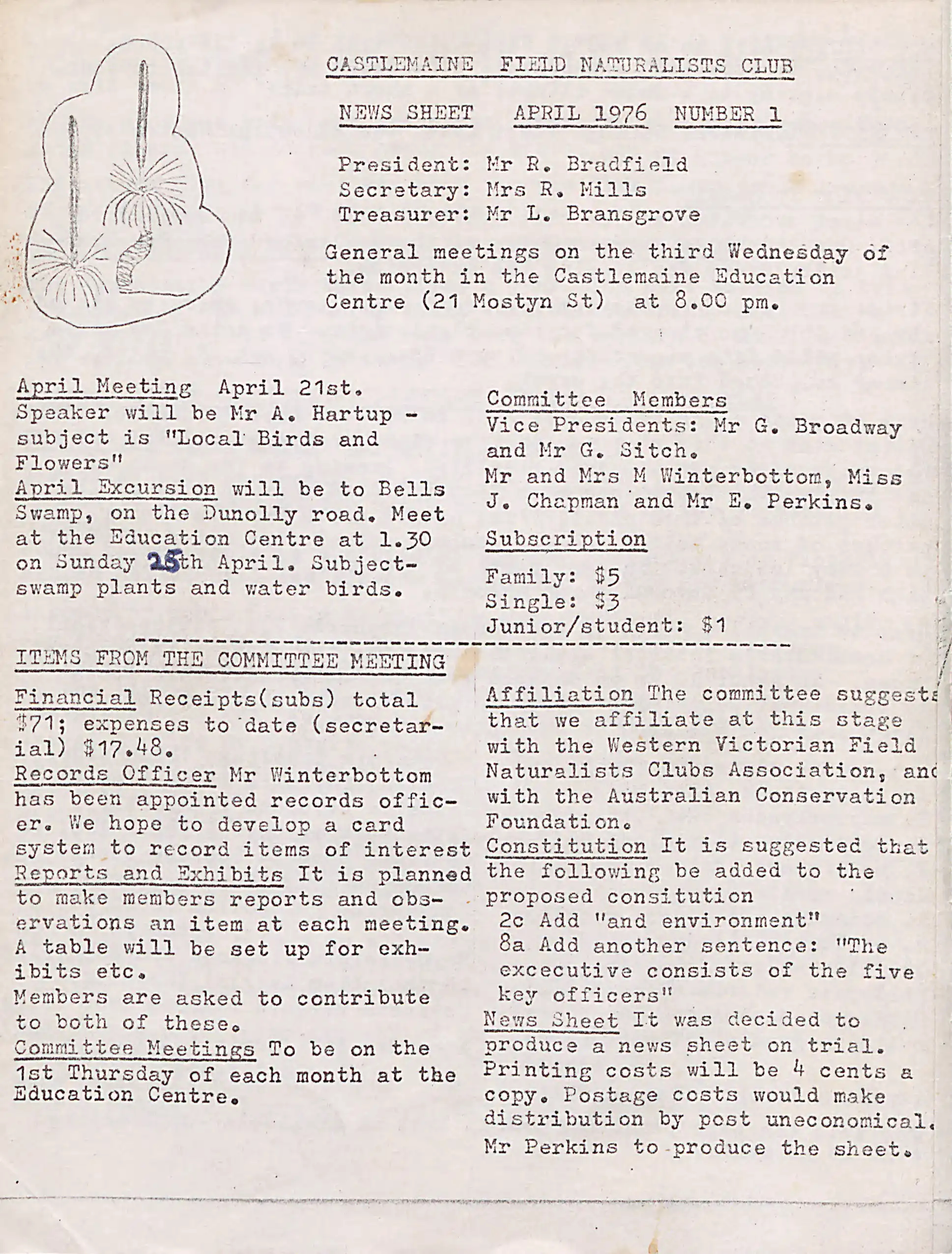
Page 1 of issue number 1 of the Castlemaine Field Naturalists Club’s newsletter, April 1976.
Fifty years later, the February 2026 issue, number 549, is a twelve-page, professionally designed, full-color newsletter, featuring thirty-six photographs. Most members now receive the Castlemaine Naturalist electronically, which has the advantage of allowing them to zoom in on the detail in the photographs.

Page 1 of issue number 549 of the Castlemaine Naturalist, February 2026.
The February 2026 issue illustrates the breadth and depth of the members’ engagement with nature and the Club’s vitality. The lead article profiles the launch of a new glossy brochure produced by Club members, Butterflies of the Mount Alexander Region. The brochure includes all known butterflies in the region, as well as information about endangered species, the differences between moths and butterflies, and tips on how to photograph butterflies.
Also included is an article about the Club’s participation in BirdLife Australia’s Annual Challenge Bird Count, Australia’s largest citizen science event, which resulted in sightings of 1,422 birds across 110 species. Over time, the newsletters also document other citizen science initiatives the Club has been involved in, including the Great Southern Bioblitz. In 2025, the Castlemaine Field Naturalists Club hosted the BioBlitz for the Castlemaine region for the fifth time, inviting participants to record as many species of flora, fauna and fungi as possible and contribute to science alongside communities across the Southern Hemisphere.
A regular feature of every issue of the Castlemaine Naturalist is the inclusion of members’ observations. This segment was introduced in the first newsletter and provides all members with an opportunity to contribute to meetings and the newsletters. Historically, these observations were published as sighting lists with dates and locations, creating a valuable scientific record. Today, many members also contribute their wildlife observations through iNaturalist, ensuring that local records feed into national and international biodiversity databases, including the Atlas of Living Australia (ALA) and the Global Biodiversity Information Facility (GBIF).
The fifty years of the Castlemaine Naturalist provide a record of observations and activities that have benefited both the local natural environment and the Club’s members, demonstrating the important citizen science contribution the Club has made since its establishment in 1976. Together, the newsletters document five decades of change in the Mount Alexander region’s biodiversity, recording shifts in species distributions, seasonal patterns, and conservation priorities. The Club is looking forward to updating this report when it celebrates its 100th anniversary in 2076!
The digitisation of the Castlemaine Naturalist newsletters and their inclusion in BHL was undertaken by BHL Australia as part of a wider project funded by a Public Record Office Victoria Local History Grant. To learn more, see Capturing the history of Victoria’s Field Naturalists Clubs.
From the Biodiversity Heritage Library
As we look ahead to the next chapter of BHL, we invite you to be part of it. If you value open access to biodiversity literature and the global collaboration behind it, your support will help ensure this work continues and grows.

Discover more from Biodiversity Heritage Library
Subscribe to get the latest posts sent to your email.

Leave a Comment