Biodiversity Heritage Library - Program news and collection highlights from BHL
  • Home
  • News
  • Featured Books
    • All Featured Books
    • Book of the Month Series
    • BHL at 20
  • User Stories
  • Campaigns
    • Fossil Stories
    • Garden Stories
    • Monsters Are Real
    • Page Frights
    • Her Natural History
    • Earth Optimism 2020
  • Tech Blog
  • Visit BHL
Home
News
Featured Books
    All Featured Books
    Book of the Month Series
    BHL at 20
User Stories
Campaigns
    Fossil Stories
    Garden Stories
    Monsters Are Real
    Page Frights
    Her Natural History
    Earth Optimism 2020
Tech Blog
Visit BHL
  • Home
  • News
  • Featured Books
    • All Featured Books
    • Book of the Month Series
    • BHL at 20
  • User Stories
  • Campaigns
    • Fossil Stories
    • Garden Stories
    • Monsters Are Real
    • Page Frights
    • Her Natural History
    • Earth Optimism 2020
  • Tech Blog
  • Visit BHL
Biodiversity Heritage Library - Program news and collection highlights from BHL
Blog Reel, Featured Books

Not Just Words on a Page: Tasmania’s History in the Papers and Proceedings

An historic illustration of plant and animal fossils

This post is part of BHL at 20: Treasures from the Biodiversity Heritage Library, a series contributed by members of the BHL community, highlighting remarkable works from across the collection in celebration of its 20th anniversary.

In 1849, the first volume of the Papers and Proceedings of the Royal Society of Van Diemen’s Land launched a tradition of advancing knowledge that continues to this day. Established in 1843, the Society is Australia’s oldest Royal Society, and for more than 180 years its prestigious journal of scientific and cultural history has captured the changing face of Tasmania, initially called Van Diemen’s Land by British colonists.

The yellowed cover of an historic journal, featuring text, a coat of arms, and a border.

Cover of the first volume of the Papers and Proceedings of the Royal Society of Van Diemen’s Land, 1849.

Window to colonial Tasmania

Volume One, published in three parts from 1849 to 1851, is a weighty mix of scientific papers, meeting reports and miscellaneous records. It sets the scene with a detailed analysis of the colony’s diverse population and weather, extending to nearly fifty pages of charts, tables and data. Papers on new building techniques, coal exploration, agriculture and manufacturing provide a fascinating snapshot of colonial enterprise as settlers sought to understand this new land and what it had to offer. In the natural sciences, contributions from a veritable ‘Who’s Who’, including John Edward Gray, John Gould and Frederick M’Coy, helped unravel the mysteries of ancient fossils and remarkable living creatures such as the platypus.

An historic illustration of fossil animals and plants

Plate XI from Frederick McCoy’s paper on fossil zoology and botany, V.1, Papers and Proceedings of the Royal Society of Van Diemen’s Land, 1849.

These early volumes document many of the human-driven changes that typically occur when new lands are seized and colonized. They also contain an invaluable timeline of just how quickly Tasmania’s Indigenous-managed landscape would change and it is the seemingly incidental reports presented at Society meetings that offer the richest insights.

In 1849, Mr Hull described a gigantic blue gum about six miles from Hobart Town, measuring 28 yards (25.6 metres) in circumference and estimated to be 330 feet (100.5 metres) high. Mr Champ donated a small spotted fish preserved in spirits that appeared to possess four legs with finger-like appendages, and Mr Milligan reported that two live thylacines sent to London the previous year had now arrived safely.

Specimens of the fungus known as ‘native bread‘ (Mylitta sp.), eaten by Tasmanian Aboriginal people, were presented for examination, with notes that, when grated and made into a pudding with milk, they were ‘very palatable’. A sample of white resin from the Oyster Bay pine was described as coming from a tree with an extremely restricted distribution, yet one highly suitable for local building and carpentry purposes. Today, the South Esk Pine Nature Reserve protects one of the few remaining stands of this endangered species.

Another insightful paper is by renowned naturalist Ronald Campbell Gunn, who explains how the ‘flying squirrel’ (the sugar glider) became naturalised in Tasmania after first being imported as a pet during the 1830s, quickly escaping and then establishing in the wild. Few at the time could have imagined that this pocket-sized pet would one day threaten Tasmania’s endangered swift parrot by preying on nesting females, eggs and chicks.

Perhaps read with the keenest interest was Captain Charles Stanley’s paper on the practicalities of introducing trout into Tasmania’s waterways. When live fish ova were eventually transported to the Salmon Ponds at New Norfolk and later released, Tasmania’s river systems would forever contain an introduced predator.

Beyond the science

Beyond the scientific papers, early journals also recorded the Society’s own activities: its office-bearers, donations, acquisitions and financial accounts — the administrative details most of us tend to ignore. Yet these records reveal the people who helped shape nineteenth-century Tasmania. The Society’s office-bearers were among the colony’s most influential figures, and meetings regularly attracted generous donations of books, artworks, natural and geological specimens, artefacts and more.

These gifts formed the foundation of collections that are today internationally recognised and housed in the Royal Tasmanian Botanical Gardens, the Tasmanian Museum and Art Gallery, and the Royal Society of Tasmania’s own Art and Library Collections. The journal documents not only the birth of these important institutions but also the determination, debate and politics involved in establishing them.

Within forty years of British settlement, Van Diemen’s Land was no longer merely a colonial outpost at the edge of the world. It had grown into an increasingly connected, resourceful and enterprising community pursuing scientific knowledge, economic opportunity and civic benefit. The Papers and Proceedings chronicle that remarkable transformation.

However, journals produced by colonial administrators inevitably reflect privilege and European perspectives and overlook Indigenous voices and other harsh injustices. It is often what is absent from the record, or now challenges contemporary values, that makes these volumes so compelling yet at times uncomfortable, to read.

An historic illustration of lerp and psyllids on eucalypt leaves.

Illustrations of Lerp and Psyllids associated with eucalypts, from Dobson’s paper, V.1, Papers and Proceedings of the Royal Society of Van Diemen’s Land, 1849.

Where to now?

Today’s Papers and Proceedings continue to focus on Tasmanian and Antarctic natural science but also encourage broader social and cultural themes. Recent volumes have contributed to truth-telling and historical accountability, including the publication of the Royal Society of Tasmania’s joint Apology to Tasmanian Aboriginal people in 2021 and papers arising from the Society’s annual Tasmanian Aboriginal Lecture.

Through the amazing Biodiversity Heritage Library’s open-access repository, researchers can apply computational tools to journals spanning more than 175 years, unlocking hidden insights that manual reading can miss. The complete digitised collection of thePapers and Proceedings of the Royal Society of Tasmania is freely available through BHL.

In an era increasingly dominated by artificial intelligence and social media, this journal remains as relevant as ever and is one of the Royal Society of Tasmania’s greatest legacies. More than simply words on a page, the Papers and Proceedings is a window into the environments, cultures and politics that continue to shape this unique island.

From the Biodiversity Heritage Library

For 20 years, BHL has made journals such as the Papers and Proceedings of the Royal Society of Tasmania freely accessible to researchers and readers around the world. With your support, we can continue preserving these irreplaceable records for generations to come.Orange button with a heart icon

July 28, 2026by nkearney
BHL News, Blog Reel

Connecting Biodiversity Knowledge: Senckenberg Joins the Biodiversity Heritage Library

An historic illustration of leaves and insects.

From biodiversity literature to connected biodiversity knowledge

In 1679, Maria Sibylla Merian published Der Raupen wunderbare Verwandelung, und sonderbare Blumennahrung, one of the earliest comprehensive studies of insect metamorphosis. Combining careful observation with detailed illustration, she documented insects and their host plants in ways that were remarkable for her time. Nearly 350 years later, her work remains part of the scientific record against which species descriptions and classifications can be traced, demonstrating how historical biodiversity literature continues to inform research today.

An illustrated title page of an historic book with ornate text surrounded by leafy vines and insects.

The beautifully illustrated title page of Der Raupen wunderbare Verwandelung, und sonderbare Blumennahrung by Maria Sibylla Merian. Published in 1679, the work is among the earliest comprehensive studies of insect metamorphosis, combining art and science to document insects alongside their host plants. An original edition is preserved in the Library of the Senckenberg German Entomological Institute (call number B 877:1). Image: Senckenberg German Entomological Institute Library.

The continued relevance of works such as Merian’s illustrates a simple reality: biodiversity knowledge builds over time. New observations depend on earlier descriptions, classifications, and published records. Access to this accumulated knowledge remains fundamental to biodiversity science – and increasingly important as research becomes more interconnected, data-driven, and global in scope.

This is one reason the Senckenberg Gesellschaft für Naturforschung joined the Biodiversity Heritage Library (BHL) in 2026. By contributing selected materials from its specialized libraries, Senckenberg helps connect historically developed collections to a global knowledge resource for biodiversity research. Among these materials is an original edition of Maria Sibylla Merian’s Der Raupen wunderbare Verwandelung (1679), preserved in the Library of the Senckenberg German Entomological Institute in Müncheberg. Born in Frankfurt, Merian provides a fitting historical link between Senckenberg’s headquarters and its commitment to making biodiversity knowledge accessible for future research.

An historic illustration of a butterfly and a caterpillar in the shape of a logo.

The Senckenberg logo featuring illustrations by Maria Sibylla Merian.

For me, this step also builds on a long-standing relationship with BHL. Since 2009, I have worked with BHL’s collections and community, both as a researcher and through my involvement in biodiversity information infrastructures. Over that time, I have seen BHL evolve from a pioneering digitization initiative into an essential component of the biodiversity knowledge ecosystem. Through my work as Vice President of the Consortium of European Taxonomic Facilities (CETAF), I also see how important access to biodiversity literature remains across the broader taxonomic community. Whether supporting integrative taxonomy, biodiversity knowledge systems, or emerging biodiversity and geobiodiversity data infrastructures, literature continues to provide the evidence base on which this work depends.

Much of that evidence is preserved in specialized research libraries closely linked to scientific collections. At Senckenberg – one of Germany’s largest natural history research institutions – the SGN Libraries reflect this relationship. Distributed across Dresden, Görlitz, Müncheberg, and Weimar, they represent distinct scientific and regional histories, including several sites shaped by long-established research institutions in eastern Germany. Together, they form a system of specialized research libraries covering zoology and entomology, botany, geology, and paleontology. In Müncheberg, the library of the Senckenberg German Entomological Institute is one of the largest entomological research libraries in Europe, holding an extensive corpus of literature that continues to support taxonomic and biodiversity research.

Senckenberg’s contribution to BHL is intentionally focused. BHL already provides remarkably comprehensive coverage of biodiversity literature. Institutions such as Senckenberg contribute specialized resources that complement existing holdings, help close remaining gaps, and strengthen the overall knowledge base. As I noted when announcing Senckenberg’s membership, the goal is not simply to increase the visibility of these collections. By connecting them to an international knowledge infrastructure, they become more systematically usable in a global research context – particularly for taxonomy, where access to historical publications remains essential for the description and classification of species.

Access to biodiversity literature is about more than preserving the past. Historical publications provide baselines that continue to anchor current research. This becomes particularly important in the context of biodiversity loss and environmental change, where researchers increasingly need to combine information across time, disciplines, and sources. When literature remains difficult to access, opportunities for comparison, synthesis, and reuse are lost. The real transformation begins when literature is no longer only read, but can also be connected, queried, and analyzed alongside collections, taxonomic names, and other biodiversity data.

An illustration of a butterfly specimen within a diagram showing the different types of data that can be generated from it.

AI-generated network visualization inspired by the plate of Papilio parnassius in Deutschlands Insecten (Parts 1–3) by Georg Wolfgang Franz Panzer. Generated with ChatGPT from the original illustration. Concept and prompt by J. Hoffmann.

Making literature available through BHL therefore supports more than access alone. It also allows publications to be connected across collections and used in ways that were difficult to imagine only a few years ago. Literature is becoming structured data – something that can be searched, analyzed, linked, and combined with other research resources. As biodiversity research becomes more data-driven, the availability of well-described and verifiable literature becomes more critical. It creates new opportunities for text mining, semantic enrichment, machine-assisted analysis, and the integration of knowledge across collections and disciplines.

Reliable literature also provides an important foundation for emerging AI applications by offering curated, citable, and scientifically validated sources. At the Information Center for Entomology at Senckenberg in Müncheberg, where biodiversity literature, archives, and collection information are brought together, this shift is already visible in practice. By connecting library, archive, and collection data and combining Linked Open Data approaches with text mining of legacy literature and archival material, historical resources become easier to discover, interpret, and reuse. What once existed primarily as individual publications increasingly becomes part of a broader, interconnected knowledge environment.

For Senckenberg, participation in BHL also supports the continued development of its decentralized library landscape. Engagement with shared standards and coordinated digitization efforts helps align historically developed systems and improves how materials can be discovered and used.

“Our libraries contain numerous specialized and historically developed collections of great relevance to international research. Their digitization and integration into BHL anchor them within a global research infrastructure and increase their visibility. At the same time, membership provides an important impulse for the strategic development of Senckenberg in the areas of digitization, networking, and international collaboration.”

– Dr. Lutz Kunzmann, Member of the Board of Directors, Senckenberg

Senckenberg’s participation also strengthens the contribution of German institutions within the BHL network by connecting specialized resources and expertise more closely to international efforts.

Works such as those of Maria Sibylla Merian remind us that biodiversity knowledge is cumulative. Preserved in literature, it remains part of an ongoing scientific dialogue that spans centuries. The value of BHL lies not only in preserving this record, but in making it discoverable, connected, and reusable. The closer we come to representing the breadth of biodiversity literature, the stronger the foundation becomes for taxonomy, biodiversity science, and the analytical approaches that increasingly shape future research.

For Senckenberg, joining BHL is therefore more than contributing digitized literature. It is a commitment to strengthening the global knowledge infrastructure on which biodiversity research depends. By connecting specialized collections and contributing to an open biodiversity knowledge infrastructure, we help ensure that biodiversity knowledge remains accessible – not only to today’s researchers, but also to the tools, technologies, and scientific questions of tomorrow.

July 22, 2026by nkearney
Blog Reel

Collaboration and Dedication: Digitizing Legacy Publications of the Asiatic Society

Illustration of Madhuca plant with blog title and BHL logo.

This post is part of BHL at 20: Treasures from the Biodiversity Heritage Library, a series contributed by members of the BHL community, highlighting remarkable works from across the collection in celebration of its 20th anniversary.

As the Digital Collections Manager for the Biodiversity Heritage Library, my take on the treasures of BHL’s collection is less about the content or significance of any particular title, and more about the work over many (many) years behind the scenes by the people within BHL partner institutions to bring these treasures from the shelves to the screen and make them accessible and discoverable for anyone with an internet connection. Building on a blog I posted in 2013, I would like to revisit the treasure that is the Journal of The Asiatic Society and its legacy publications in BHL.

The Asiatic Society

In 1784, the Asiatick Society was founded by Sir William Jones through British India’s highest court at the time, in Kolkata.1 The goal of the society was to study the “History, Civil and Natural, the Antiquities, Arts, Sciences, and Literature of Asia.”2 To this day, more than 240 years later, The Asiatic Society continues as a foundational society for learning in India and “the oldest surviving publishing house of the country.”3 Its publications span from 1788 to the present and cover a wide variety of research topics and interdisciplinary studies throughout the cultural and natural sciences, including literature and medicine. Its rich “legacy of […] promoting a comprehensive understanding of humanity’s intellectual and practical endeavors,” is evidenced by its status as an Institution of National Importance by the Indian government.3

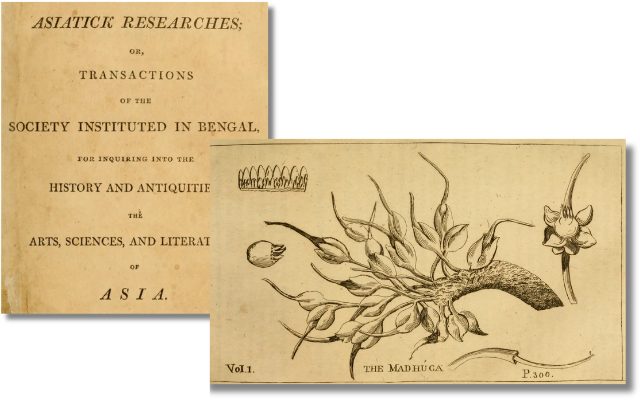
Pages from the Asiatic researches, or, Transactions of the Society instituted in Bengal v.1 (1806)

Pages from Asiatic Researches; or, Transactions of the Society Instituted in Bengal, v.1 (1806), title page and p.300

1 Journal, 9 Institutions, 11 Years

Back in June of 2010, the founding institutions of BHL began a major digitization project that would span the work of 11 years, 9 institutions, 19 people, 40 tickets within BHL’s issue tracking system, over 82 comments on those tickets, and countless hours of work. Was this part of a grant-funded project to facilitate the digitization and inclusion of millions of pages into BHL’s collection? No. This body of digitization and curation work revolves around the series of titles that are part of the Journal of The Asiatic Society. By June 2021, BHL was gratified to finally call the digitization of all public-domain volumes “complete” to the best of its ability.

With a variety of name changes over the years of its publication, BHL is pleased to provide open access to the following titles within the Journal’s history:

  • Asiatic Researches; or, Transactions of the Society Instituted in Bengal
  • Gleanings in Science
  • The Journal of the Asiatic Society of Bengal
  • Proceedings of the Asiatic Society of Bengal
  • Journal and Proceedings of the Asiatic Society of Bengal

In addition to the Journal, BHL also provides access to the Memoirs and a variety of other Asiatic Society publications.

Scanning Locally, Coordinating Globally

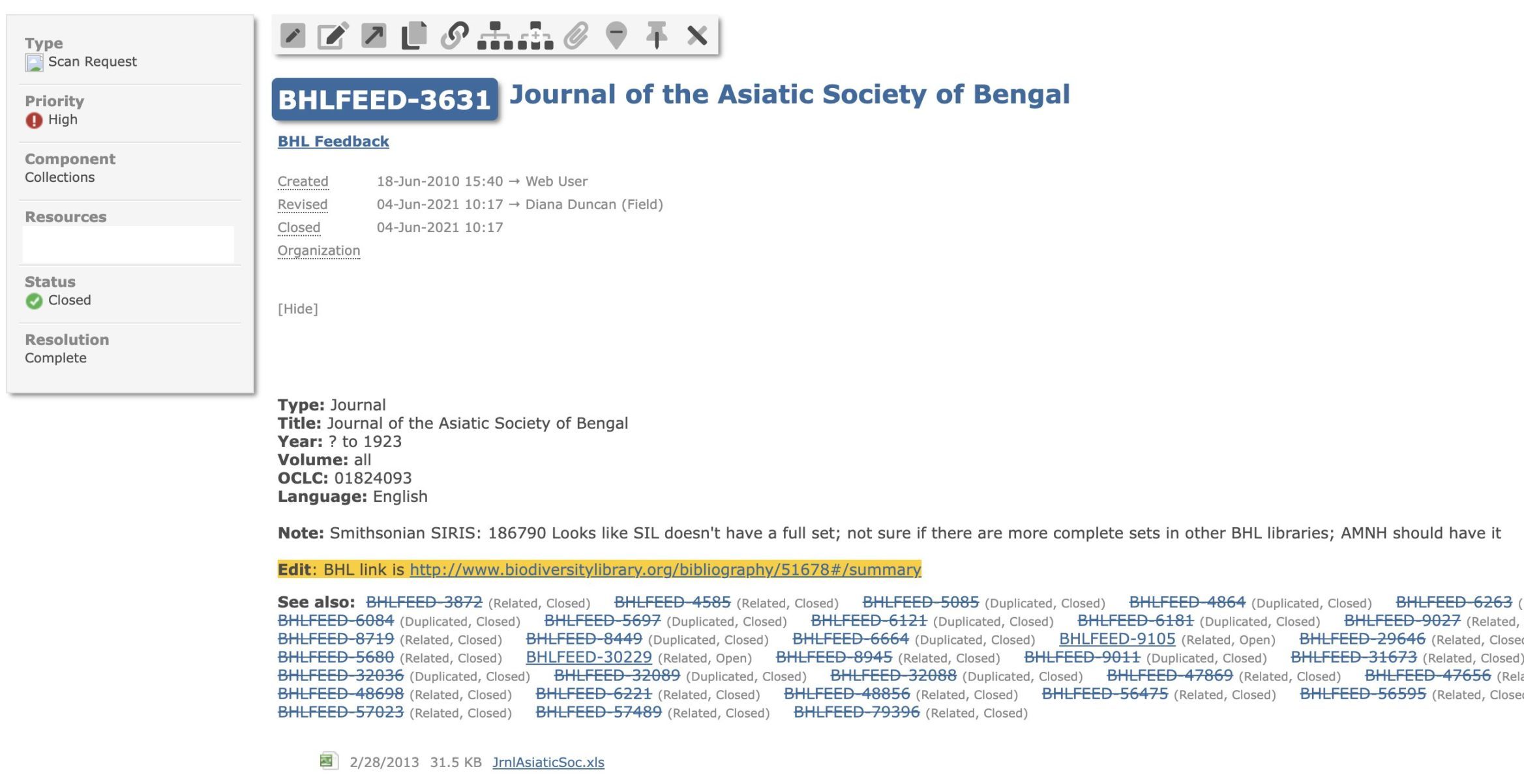
To help coordinate such efforts over so many people and so many years, BHL tracked the status of digitization, gap identification and fulfillment, cataloging needs, and curation tasks within its Gemini issue tracking system. This system has been in place for decades and is the source of truth on a variety of internal projects and tasks needed to run BHL’s website, increase and improve its collection, troubleshoot existing services, develop new features, etc.

Like many issue tracking systems, Gemini has myriad possibilities for configuring and customizing how tasks are categorized, organized, and managed. Almost too many for BHL’s use cases. It has taken years to learn how best to adapt the system to BHL’s needs and implement appropriate information architectures to keep projects organized. It is yet another system and login in a suite of web-based tools that are required to deliver BHL’s collection and services.

However, these internal communication tools are essential for managing the highly distributed and widely varied workforce that makes BHL’s collection and services possible. Managing the back-and-forth among 19 people over 11 years would not have been possible without an issue tracking system. It has become the backbone of BHL’s task management, providing a platform for candid, effective collaboration among consortium partner institutions.

screenshot of BHL scan request ticket within Gemini issue tracking system

Screenshot of BHL scan request ticket within the Gemini issue tracking system for the Journal of the Asiatic Society of Bengal, created 2010 June, closed 2021 June.

Why did it take so long?

Despite being the world’s largest open access digital library for biodiversity literature and archives, BHL does not have dedicated digitization or cataloging staff and lacks funding for digitization. Instead, each of BHL’s partners contribute what they can of their own staff and digitization resources to integrate and curate content in BHL’s collection. As an organization, BHL has recently gone through a significant transition, adopting a shared ownership model that is now more autonomous, globally distributed, and independent of any single institution. But the core work of its consortium partners continues as it has for the past 20 years: collaborating across institutional and international boundaries to make biodiversity literature and archives openly available. The skills and abilities to exercise this level of collaboration are cultivated through a network of communication channels, systems, and committees/working groups that prioritize commitment and buy-in.

Since the closure of BHL’s major grant funding through the MacArthur Foundation in 2013, consortium partners have seen digitization resources ebb and flow. The challenges of maintaining institutional support, securing personnel, achieving grant funding, etc. affect partners’ participation in BHL’s collaborative process. Other challenges with catalog records, the condition of the physical materials, digitization equipment, software bugs, and documentation and training also impact partners’ capacity to contribute content to the BHL collection. Developed organically over time, BHL’s distributed labor model allows partners to come as they are to the organization. Partners participate autonomously and collaboratively relationships when time and resources allow.

If BHL were fortunate enough to secure a major source of long-term funding, centralized resources could help support the processing, digitization, and integration of content across the collection. Please consider supporting the Biodiversity Heritage Library with a recurring donation or planned gift.

How can we make this process more efficient going forward?

The digitization of the Journal of The Asiatic Society legacy volumes is a testament to BHL’s persistence and dedication to increasing the access, usability, discovery, and breadth of its collection — the four priorities, in order of importance, as outlined in BHL’s collection development policy. Clearly, 11 years is a very long time and it would benefit everyone to make this process shorter and more efficient. As BHL’s new chapter is being drafted, our organization is building on its Guiding Principles for the Transition to develop new partnerships, new strategic goals, and a platform modernization plan. As Digital Collections Manager, I feel it’s imperative that BHL:

  • Continue to increase our global network of partners and more widely distribute BHL’s workforce, expertise, and content acquisition strategies.
  • Encourage contributors to provide public domain materials with appropriate metadata to the Internet Archive texts corpus and work with IA to source metadata for existing items.
  • Increase systems and support for BHL uploading workflows.
  • Develop and implement more efficient content ingestion methods alongside its more modern platform to come.
  • Help advocate for the importance of book digitization and funding support.
  • Harvest more open access biodiversity content at scale.

How BHL might achieve these goals remains to be seen, but as our new chapter brings greater autonomy and agility to our organization, I am more optimistic than ever before that BHL will find a way to sustain itself for the future. Sustainability means not simply keeping the website running, but maintaining and growing its unique collection of biodiversity literature and archives.

From the Biodiversity Heritage Library

BHL’s treasures are not just the books, journals, and archives we make freely available. They’re also the people whose collaboration, care, and persistence bring them to the world. For 20 years, BHL’s global community has worked across institutions and borders to digitize, preserve, and open biodiversity knowledge for everyone. With your support, we can continue this long-term work for BHL’s next chapter.

Orange button with a heart icon

Resources

  1. Wikipedia contributors. (2026, May 26). The Asiatic Society. Wikipedia. https://en.wikipedia.org/wiki/The_Asiatic_Society
  2. F, L. L. (1946). The bicentenary of the birth of Sir William Jones, F. R. S. , founder of the Royal Asiatic Society of Bengal. Notes and Records the Royal Society Journal of the History of Science, 4(1), 58–62. https://doi.org/10.1098/rsnr.1946.0012
  3. About us | Asiatic Society. (n.d.). https://asiaticsocietykolkata.org/publications/about-us
July 1, 2026by bcrowley

Help Support BHL

BHL's existence depends on the financial support of its patrons. Help us keep this free resource alive!

search

About BHL

The Biodiversity Heritage Library (BHL) is the world’s largest open access digital library for biodiversity literature and archives. BHL operates as a worldwide consortium of natural history, botanical, research, and national libraries working together to digitize the natural history literature held in their collections and make it freely available for open access as part of a global “biodiversity community.”

Join Our Mailing List

Sign up to receive the latest news, content highlights, and promotions.

Subscribe Now

Subscribe to Blog via Email

Enter your email address to subscribe to this blog and receive notifications of new posts by email.

Join 319 other subscribers

Subscribe to Blog Via RSS

Subscribe to the blog RSS feed to stay up-to-date on all the latest BHL posts.

Access RSS Feed

Inspiring Discovery through Free Access to Biodiversity Knowledge.

The Biodiversity Heritage Library makes it easier than ever for you to access the information you need to study and explore life on Earth…for free, anytime, anywhere.


64+ Million Pages of
Biodiversity Literature Online.

EXPLORE

Tools and Services
to Transform Research.

EXPLORE

300,000+
Illustrations on Flickr.

EXPLORE

ABOUT | HARMFUL CONTENT | PRIVACY | SITE MAP | TERMS OF USE