

Collaboration and Dedication: Digitizing Legacy Publications of the Asiatic Society
This post is part of BHL at 20: Treasures from the Biodiversity Heritage Library, a series contributed by members of the BHL community, highlighting remarkable works from across the collection in celebration of its 20th anniversary.
As the Digital Collections Manager for the Biodiversity Heritage Library, my take on the treasures of BHL’s collection is less about the content or significance of any particular title, and more about the work over many (many) years behind the scenes by the people within BHL partner institutions to bring these treasures from the shelves to the screen and make them accessible and discoverable for anyone with an internet connection. Building on a blog I posted in 2013, I would like to revisit the treasure that is the Journal of The Asiatic Society and its legacy publications in BHL.
The Asiatic Society
In 1784, the Asiatick Society was founded by Sir William Jones through British India’s highest court at the time, in Kolkata.1 The goal of the society was to study the “History, Civil and Natural, the Antiquities, Arts, Sciences, and Literature of Asia.”2 To this day, more than 240 years later, The Asiatic Society continues as a foundational society for learning in India and “the oldest surviving publishing house of the country.”3 Its publications span from 1788 to the present and cover a wide variety of research topics and interdisciplinary studies throughout the cultural and natural sciences, including literature and medicine. Its rich “legacy of […] promoting a comprehensive understanding of humanity’s intellectual and practical endeavors,” is evidenced by its status as an Institution of National Importance by the Indian government.3
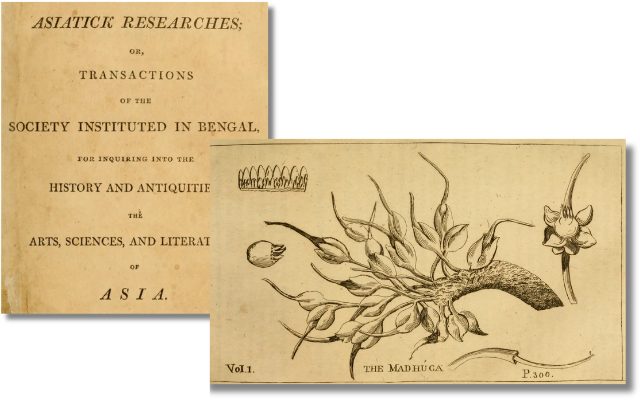
Pages from Asiatic Researches; or, Transactions of the Society Instituted in Bengal, v.1 (1806), title page and p.300
1 Journal, 9 Institutions, 11 Years
Back in June of 2010, the founding institutions of BHL began a major digitization project that would span the work of 11 years, 9 institutions, 19 people, 40 tickets within BHL’s issue tracking system, over 82 comments on those tickets, and countless hours of work. Was this part of a grant-funded project to facilitate the digitization and inclusion of millions of pages into BHL’s collection? No. This body of digitization and curation work revolves around the series of titles that are part of the Journal of The Asiatic Society. By June 2021, BHL was gratified to finally call the digitization of all public-domain volumes “complete” to the best of its ability.
With a variety of name changes over the years of its publication, BHL is pleased to provide open access to the following titles within the Journal’s history:
- Asiatic Researches; or, Transactions of the Society Instituted in Bengal
- Gleanings in Science
- The Journal of the Asiatic Society of Bengal
- Proceedings of the Asiatic Society of Bengal
- Journal and Proceedings of the Asiatic Society of Bengal
In addition to the Journal, BHL also provides access to the Memoirs and a variety of other Asiatic Society publications.
Scanning Locally, Coordinating Globally
To help coordinate such efforts over so many people and so many years, BHL tracked the status of digitization, gap identification and fulfillment, cataloging needs, and curation tasks within its Gemini issue tracking system. This system has been in place for decades and is the source of truth on a variety of internal projects and tasks needed to run BHL’s website, increase and improve its collection, troubleshoot existing services, develop new features, etc.
Like many issue tracking systems, Gemini has myriad possibilities for configuring and customizing how tasks are categorized, organized, and managed. Almost too many for BHL’s use cases. It has taken years to learn how best to adapt the system to BHL’s needs and implement appropriate information architectures to keep projects organized. It is yet another system and login in a suite of web-based tools that are required to deliver BHL’s collection and services.
However, these internal communication tools are essential for managing the highly distributed and widely varied workforce that makes BHL’s collection and services possible. Managing the back-and-forth among 19 people over 11 years would not have been possible without an issue tracking system. It has become the backbone of BHL’s task management, providing a platform for candid, effective collaboration among consortium partner institutions.
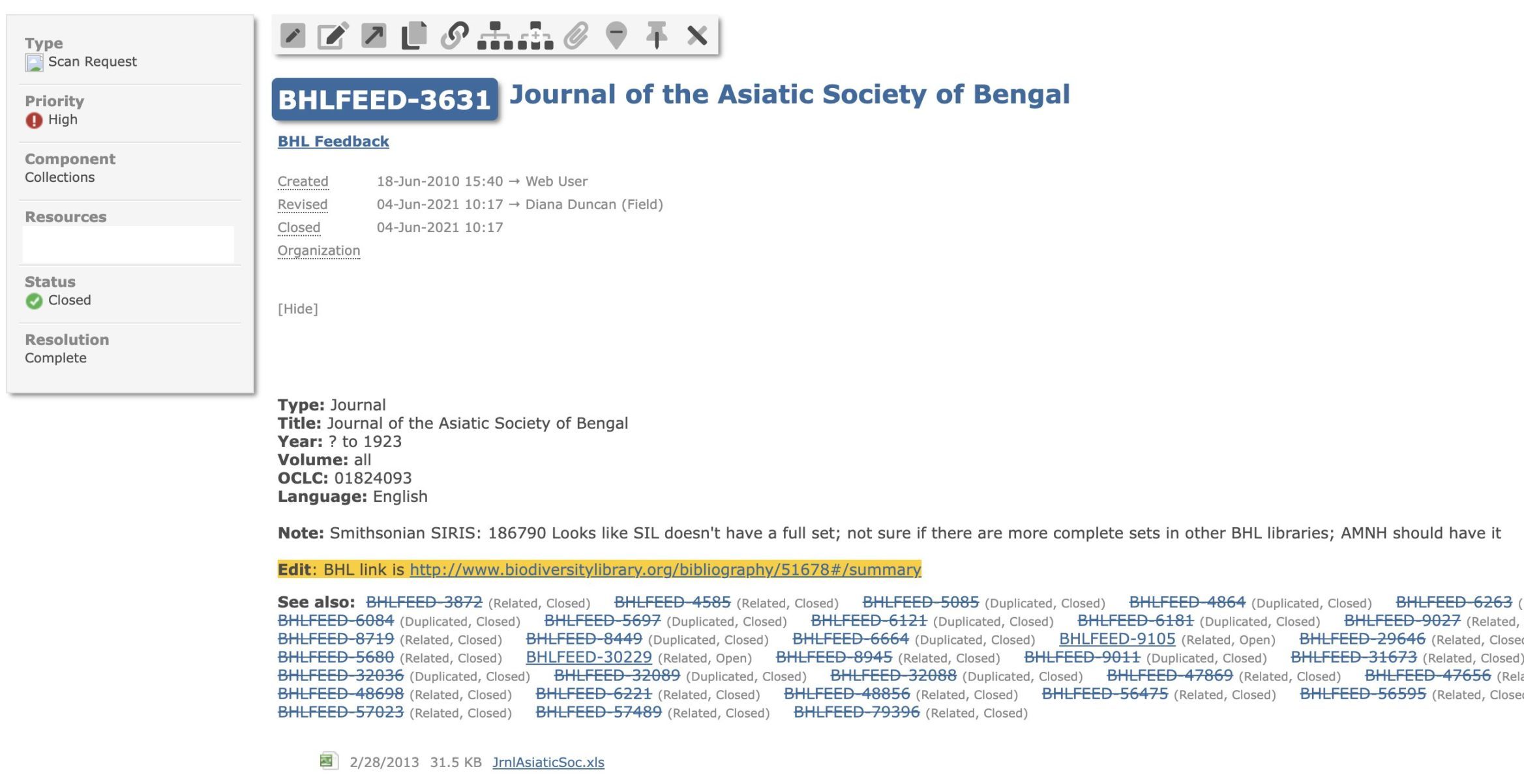
Screenshot of BHL scan request ticket within the Gemini issue tracking system for the Journal of the Asiatic Society of Bengal, created 2010 June, closed 2021 June.
Why did it take so long?
Despite being the world’s largest open access digital library for biodiversity literature and archives, BHL does not have dedicated digitization or cataloging staff and lacks funding for digitization. Instead, each of BHL’s partners contribute what they can of their own staff and digitization resources to integrate and curate content in BHL’s collection. As an organization, BHL has recently gone through a significant transition, adopting a shared ownership model that is now more autonomous, globally distributed, and independent of any single institution. But the core work of its consortium partners continues as it has for the past 20 years: collaborating across institutional and international boundaries to make biodiversity literature and archives openly available. The skills and abilities to exercise this level of collaboration are cultivated through a network of communication channels, systems, and committees/working groups that prioritize commitment and buy-in.
Since the closure of BHL’s major grant funding through the MacArthur Foundation in 2013, consortium partners have seen digitization resources ebb and flow. The challenges of maintaining institutional support, securing personnel, achieving grant funding, etc. affect partners’ participation in BHL’s collaborative process. Other challenges with catalog records, the condition of the physical materials, digitization equipment, software bugs, and documentation and training also impact partners’ capacity to contribute content to the BHL collection. Developed organically over time, BHL’s distributed labor model allows partners to come as they are to the organization. Partners participate autonomously and collaboratively relationships when time and resources allow.
If BHL were fortunate enough to secure a major source of long-term funding, centralized resources could help support the processing, digitization, and integration of content across the collection. Please consider supporting the Biodiversity Heritage Library with a recurring donation or planned gift.
How can we make this process more efficient going forward?
The digitization of the Journal of The Asiatic Society legacy volumes is a testament to BHL’s persistence and dedication to increasing the access, usability, discovery, and breadth of its collection — the four priorities, in order of importance, as outlined in BHL’s collection development policy. Clearly, 11 years is a very long time and it would benefit everyone to make this process shorter and more efficient. As BHL’s new chapter is being drafted, our organization is building on its Guiding Principles for the Transition to develop new partnerships, new strategic goals, and a platform modernization plan. As Digital Collections Manager, I feel it’s imperative that BHL:
- Continue to increase our global network of partners and more widely distribute BHL’s workforce, expertise, and content acquisition strategies.
- Encourage contributors to provide public domain materials with appropriate metadata to the Internet Archive texts corpus and work with IA to source metadata for existing items.
- Increase systems and support for BHL uploading workflows.
- Develop and implement more efficient content ingestion methods alongside its more modern platform to come.
- Help advocate for the importance of book digitization and funding support.
- Harvest more open access biodiversity content at scale.
How BHL might achieve these goals remains to be seen, but as our new chapter brings greater autonomy and agility to our organization, I am more optimistic than ever before that BHL will find a way to sustain itself for the future. Sustainability means not simply keeping the website running, but maintaining and growing its unique collection of biodiversity literature and archives.
From the Biodiversity Heritage Library
BHL’s treasures are not just the books, journals, and archives we make freely available. They’re also the people whose collaboration, care, and persistence bring them to the world. For 20 years, BHL’s global community has worked across institutions and borders to digitize, preserve, and open biodiversity knowledge for everyone. With your support, we can continue this long-term work for BHL’s next chapter.

Resources
- Wikipedia contributors. (2026, May 26). The Asiatic Society. Wikipedia. https://en.wikipedia.org/wiki/The_Asiatic_Society
- F, L. L. (1946). The bicentenary of the birth of Sir William Jones, F. R. S. , founder of the Royal Asiatic Society of Bengal. Notes and Records the Royal Society Journal of the History of Science, 4(1), 58–62. https://doi.org/10.1098/rsnr.1946.0012
- About us | Asiatic Society. (n.d.). https://asiaticsocietykolkata.org/publications/about-us
Discover more from Biodiversity Heritage Library
Subscribe to get the latest posts sent to your email.

As Digital Collections Manager, Bianca works at the intersection of collections, copyright, metadata, and community practice. She supports a global network of partners by providing training and documentation, and ensuring that BHL’s collection is as accessible, discoverable, usable, and comprehensive as possible.
Leave a Comment