Biodiversity Heritage Library - Program news and collection highlights from BHL
  • Home
  • News
  • Featured Books
    • All Featured Books
    • Book of the Month Series
    • BHL at 20
  • User Stories
  • Campaigns
    • Fossil Stories
    • Garden Stories
    • Monsters Are Real
    • Page Frights
    • Her Natural History
    • Earth Optimism 2020
  • Tech Blog
  • Visit BHL
Home
News
Featured Books
    All Featured Books
    Book of the Month Series
    BHL at 20
User Stories
Campaigns
    Fossil Stories
    Garden Stories
    Monsters Are Real
    Page Frights
    Her Natural History
    Earth Optimism 2020
Tech Blog
Visit BHL
  • Home
  • News
  • Featured Books
    • All Featured Books
    • Book of the Month Series
    • BHL at 20
  • User Stories
  • Campaigns
    • Fossil Stories
    • Garden Stories
    • Monsters Are Real
    • Page Frights
    • Her Natural History
    • Earth Optimism 2020
  • Tech Blog
  • Visit BHL
Biodiversity Heritage Library - Program news and collection highlights from BHL
Blog Reel

Collaboration and Dedication: Digitizing Legacy Publications of the Asiatic Society

Illustration of Madhuca plant with blog title and BHL logo.

This post is part of BHL at 20: Treasures from the Biodiversity Heritage Library, a series contributed by members of the BHL community, highlighting remarkable works from across the collection in celebration of its 20th anniversary.

As the Digital Collections Manager for the Biodiversity Heritage Library, my take on the treasures of BHL’s collection is less about the content or significance of any particular title, and more about the work over many (many) years behind the scenes by the people within BHL partner institutions to bring these treasures from the shelves to the screen and make them accessible and discoverable for anyone with an internet connection. Building on a blog I posted in 2013, I would like to revisit the treasure that is the Journal of The Asiatic Society and its legacy publications in BHL.

The Asiatic Society

In 1784, the Asiatick Society was founded by Sir William Jones through British India’s highest court at the time, in Kolkata.1 The goal of the society was to study the “History, Civil and Natural, the Antiquities, Arts, Sciences, and Literature of Asia.”2 To this day, more than 240 years later, The Asiatic Society continues as a foundational society for learning in India and “the oldest surviving publishing house of the country.”3 Its publications span from 1788 to the present and cover a wide variety of research topics and interdisciplinary studies throughout the cultural and natural sciences, including literature and medicine. Its rich “legacy of […] promoting a comprehensive understanding of humanity’s intellectual and practical endeavors,” is evidenced by its status as an Institution of National Importance by the Indian government.3
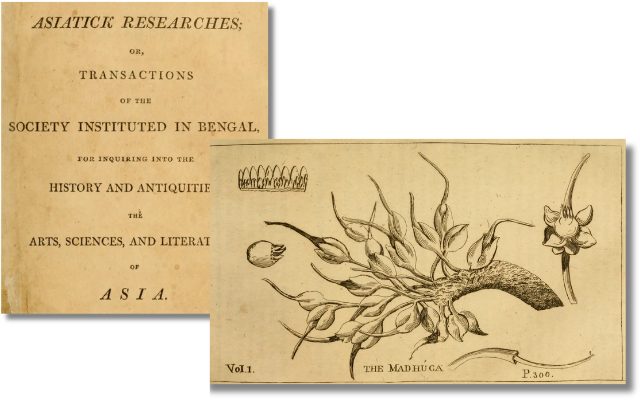
Pages from the Asiatic researches, or, Transactions of the Society instituted in Bengal v.1 (1806)

Pages from Asiatic Researches; or, Transactions of the Society Instituted in Bengal, v.1 (1806), title page and p.300

1 Journal, 9 Institutions, 11 Years

Back in June of 2010, the founding institutions of BHL began a major digitization project that would span the work of 11 years, 9 institutions, 19 people, 40 tickets within BHL’s issue tracking system, over 82 comments on those tickets, and countless hours of work. Was this part of a grant-funded project to facilitate the digitization and inclusion of millions of pages into BHL’s collection? No. This body of digitization and curation work revolves around the series of titles that are part of the Journal of The Asiatic Society. By June 2021, BHL was gratified to finally call the digitization of all public-domain volumes “complete” to the best of its ability.

With a variety of name changes over the years of its publication, BHL is pleased to provide open access to the following titles within the Journal’s history:

  • Asiatic Researches; or, Transactions of the Society Instituted in Bengal
  • Gleanings in Science
  • The Journal of the Asiatic Society of Bengal
  • Proceedings of the Asiatic Society of Bengal
  • Journal and Proceedings of the Asiatic Society of Bengal

In addition to the Journal, BHL also provides access to the Memoirs and a variety of other Asiatic Society publications.

Scanning Locally, Coordinating Globally

To help coordinate such efforts over so many people and so many years, BHL tracked the status of digitization, gap identification and fulfillment, cataloging needs, and curation tasks within its Gemini issue tracking system. This system has been in place for decades and is the source of truth on a variety of internal projects and tasks needed to run BHL’s website, increase and improve its collection, troubleshoot existing services, develop new features, etc.

Like many issue tracking systems, Gemini has myriad possibilities for configuring and customizing how tasks are categorized, organized, and managed. Almost too many for BHL’s use cases. It has taken years to learn how best to adapt the system to BHL’s needs and implement appropriate information architectures to keep projects organized. It is yet another system and login in a suite of web-based tools that are required to deliver BHL’s collection and services.

However, these internal communication tools are essential for managing the highly distributed and widely varied workforce that makes BHL’s collection and services possible. Managing the back-and-forth among 19 people over 11 years would not have been possible without an issue tracking system. It has become the backbone of BHL’s task management, providing a platform for candid, effective collaboration among consortium partner institutions.
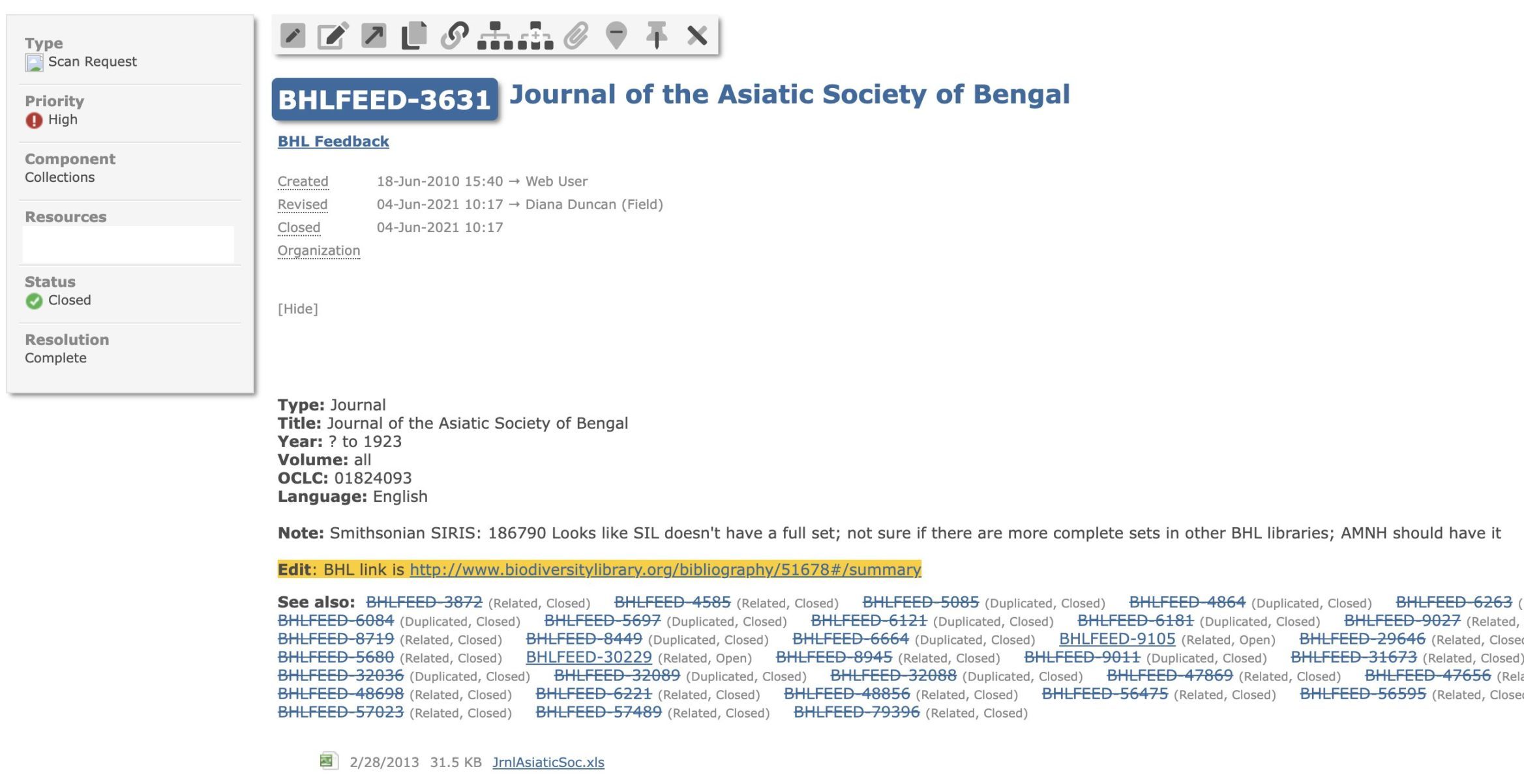
screenshot of BHL scan request ticket within Gemini issue tracking system

Screenshot of BHL scan request ticket within the Gemini issue tracking system for the Journal of the Asiatic Society of Bengal, created 2010 June, closed 2021 June.

Why did it take so long?

Despite being the world’s largest open access digital library for biodiversity literature and archives, BHL does not have dedicated digitization or cataloging staff and lacks funding for digitization. Instead, each of BHL’s partners contribute what they can of their own staff and digitization resources to integrate and curate content in BHL’s collection. As an organization, BHL has recently gone through a significant transition, adopting a shared ownership model that is now more autonomous, globally distributed, and independent of any single institution. But the core work of its consortium partners continues as it has for the past 20 years: collaborating across institutional and international boundaries to make biodiversity literature and archives openly available. The skills and abilities to exercise this level of collaboration are cultivated through a network of communication channels, systems, and committees/working groups that prioritize commitment and buy-in.

Since the closure of BHL’s major grant funding through the MacArthur Foundation in 2013, consortium partners have seen digitization resources ebb and flow. The challenges of maintaining institutional support, securing personnel, achieving grant funding, etc. affect partners’ participation in BHL’s collaborative process. Other challenges with catalog records, the condition of the physical materials, digitization equipment, software bugs, and documentation and training also impact partners’ capacity to contribute content to the BHL collection. Developed organically over time, BHL’s distributed labor model allows partners to come as they are to the organization. Partners participate autonomously and collaboratively relationships when time and resources allow.

If BHL were fortunate enough to secure a major source of long-term funding, centralized resources could help support the processing, digitization, and integration of content across the collection. Please consider supporting the Biodiversity Heritage Library with a recurring donation or planned gift.

How can we make this process more efficient going forward?

The digitization of the Journal of The Asiatic Society legacy volumes is a testament to BHL’s persistence and dedication to increasing the access, usability, discovery, and breadth of its collection — the four priorities, in order of importance, as outlined in BHL’s collection development policy. Clearly, 11 years is a very long time and it would benefit everyone to make this process shorter and more efficient. As BHL’s new chapter is being drafted, our organization is building on its Guiding Principles for the Transition to develop new partnerships, new strategic goals, and a platform modernization plan. As Digital Collections Manager, I feel it’s imperative that BHL:

  • Continue to increase our global network of partners and more widely distribute BHL’s workforce, expertise, and content acquisition strategies.
  • Encourage contributors to provide public domain materials with appropriate metadata to the Internet Archive texts corpus and work with IA to source metadata for existing items.
  • Increase systems and support for BHL uploading workflows.
  • Develop and implement more efficient content ingestion methods alongside its more modern platform to come.
  • Help advocate for the importance of book digitization and funding support.
  • Harvest more open access biodiversity content at scale.

How BHL might achieve these goals remains to be seen, but as our new chapter brings greater autonomy and agility to our organization, I am more optimistic than ever before that BHL will find a way to sustain itself for the future. Sustainability means not simply keeping the website running, but maintaining and growing its unique collection of biodiversity literature and archives.

From the Biodiversity Heritage Library

BHL’s treasures are not just the books, journals, and archives we make freely available. They’re also the people whose collaboration, care, and persistence bring them to the world. For 20 years, BHL’s global community has worked across institutions and borders to digitize, preserve, and open biodiversity knowledge for everyone. With your support, we can continue this long-term work for BHL’s next chapter.

Orange button with a heart icon

Resources

  1. Wikipedia contributors. (2026, May 26). The Asiatic Society. Wikipedia. https://en.wikipedia.org/wiki/The_Asiatic_Society
  2. F, L. L. (1946). The bicentenary of the birth of Sir William Jones, F. R. S. , founder of the Royal Asiatic Society of Bengal. Notes and Records the Royal Society Journal of the History of Science, 4(1), 58–62. https://doi.org/10.1098/rsnr.1946.0012
  3. About us | Asiatic Society. (n.d.). https://asiaticsocietykolkata.org/publications/about-us

July 1, 2026by bcrowley
BHL News, Blog Reel

Tis the season to be thankful!

View Full Size Image
BHL is a collaborative endeavor, no doubt about it; and it’s been thanks to these collaborations that we have the technical achievements we have. For many reasons, this is a good time to be thankful.

So as the BHL Technical Director, I would like to start by thanking my colleagues at the BHL Technical Group here in Missouri Botanical Garden (MBG) for taking the leading role in many of the pressing issues we’ve faced this year: our BHL Data Analyst and P.I. of the NEH-funded Art of Life project, Trish Rose-Sandler and our developer, Mike Lichtenberg, who’s been responsible for many of the new things you’ve seen in BHL and is always improving our Portal (check his Developer’s blog).

I’d also like to thank all the staff at the IT Division at MBG who have support our infrastructure this year and have been key to support our technical developments and enable the implementation of the required functionality; special thanks to Mike Westmoreland for supporting our installation of Macaw, our RefBank node at MBG, and our Solr infrastructure.

Thanks to our Technical Advisory Group (TAG) members who have supported our technical work all this past year by providing advice and leading several important tasks for the BHL community that started or concluded this year like Macaw (Joel Richards from Smithsonian), our Solr implementation for Full-text Search (Frances Webb from Cornell), the Partner Meta App implementation (Joe deVeer from Harvard) and represent BHL in technical meetings and hackathons (John Mignault from New York Botanical Garden, NYBG).  Our thanks also go to our folks at MBL, particularly to Anthony Goddard for the Cluster implementation and support throughout this past year.

View Full Size Image
Wild Turkey, male & female
Taken from: Wilson et al. American ornithology; or,
The natural history of the birds of the United States.v.3 pl.9
http://biodiversitylibrary.org/page/41423917

Particular thanks to the Secretariat and colleagues at Smithsonian, for leading and supporting BHL’s technical and operational activities.  Our gratitude also goes to the BHL Executive Committee, the BHL Members Committee, the BHL Collections Committee (lead by our Collections Manager, Bianca Crowley) and the BHL Staff group, comprised of dedicated individuals from each of the BHL Member and Affiliate Libraries, who contribute countless hours to scanning, paginating and cataloging to make the millions of pages in BHL available for free and open access.  Each of these groups also actively further our common objective by providing guidance, perspective and recommendations on technical topics.

This year, we also had some significant staff turn around.  This is no surprise as, unfortunately, it is part of any extensive collaborative endeavor such as BHL. Without taking any merit from all of our other former colleagues, we want to thank Grace Costantino and Gilbert Borrego for their enormous contributions to BHL: much of our current technical work wouldn’t be what it is without their lasting contributions.

We also would like to thank our partners at the NEH-funded Art of Life project, Indianapolis Museum of Arts, University of Colorado, Marine Biological Laboratory and a special mention to the Internet Archive technical team.  Our thanks go to our BHL partners, particularly to Harvard, Cornell and New York Botanical Garden colleagues in our IMLS-funded project to use Purposeful Gaming to help improve OCR text in BHL, starting next month.

Finally, we are particularly thankful to those we worked directly with, whom, I’m sure, represent a wider collaboration by themselves: Rod Page for BioStor, Rich Pyle and Rob Whitton for Zoobank, Nicky Nicholson from IPNI and Paul Kirk for Index Fungorum, Donat Agosti and Terry Catapano at Plazi,  Guido Sautter at the Karlsruhe Institute of Technology,  Lyubomir Penev, Jordan Biserkov and Theodore Georgiev at Pensoft and Dave Roberts for Vibrant and Dauvit King for Open University, the whole EOL team, particularly Jen Hammock, Cyndy Parr, Katja Schulz, Patrick Leary, Erick Mata and Bob Corrigan, Dmitry Mozzherin, David Shorthouse, and many, many others whose technical contributions keep making BHL what it is.

Our appreciation travels far to all our colleagues in BHL for their daily contributions, and translates into different languages for our international Global BHL Nodes collaborators for their invaluable support: Obrigado, Dankie, Danke, Dank, Gracias, Merci, Děkuji, 謝謝, شكرا

And most of all, our deepest thanks to all of the users of BHL who continuously inspire and challenge us to make BHL the best it can possibly be!

Thank you!

November 28, 2013by Joanne A. Schneider
Blog Reel

A Consortium that Scans Together, Bands Together

Portrait version of the Biodiversity Heritage Library logo.

Over the years, the BHL consortium has grown from its initial core of 10 members to now 15 member institutions across the United States and the United Kingdom.

While each institution contributes its own unique set of materials to the BHL collection, many of our collections share similar materials. Thank goodness we do because we rely on each other to help fill in gaps in the BHL corpus. But this is easier said than done. Have you ever tried to amass a complete set of 90+ year old objects into one place?!

The quick and dirty explanation of our digitization process is as follows — BHL consortium libraries:

  1. Work together to select books for scanning
  2. Do our best to make sure we don’t send the same materials for scanning, i.e. “de-duplication”
  3. Send the books from our shelves for scanning to various Internet Archive locations or to our own institutional scanning centers
  4. Send the bibliographic data from our library catalogs
  5. Render derivative files, such as the OCR (optical character recognition) text files
  6. Aggregate the data files and images for every page of every book scanned into our back-end database managed by the Missouri Botanical Garden
  7. Serve it all up via our website: http://biodiversitylibrary.org

And for those of us who prefer visuals:

BHL: Disseminating Content Beyond the Silo from Bianca Crowley and Grace Costantino

Steps 1 and 2 can get complicated. Fast. Which is why we need the tools to help us coordinate who’s scanning what, when. To manage our communications we use an issue tracking system, in our case Countersoft’s Gemini system. Whenever you submit feedback via our website, a new issue, or ticket, is created in our system which we route to the appropriate BHL Staff for follow up. Send us feedback telling us something’s missing from our collection and we’ll try to find the BHL library who can send it for scanning. Sounds easy enough, right?

Wrong. Enter an old journal series which over the course of decades, centuries even, can modify its scope, alter its publication title and alter it again (and again…). Combine this with the changing practices of the printing, bookbinding, and library industries over the course of history and you have quite the task to gather the various pieces of the puzzle and arrange them into the complete picture of a publication.

View Full Size Image
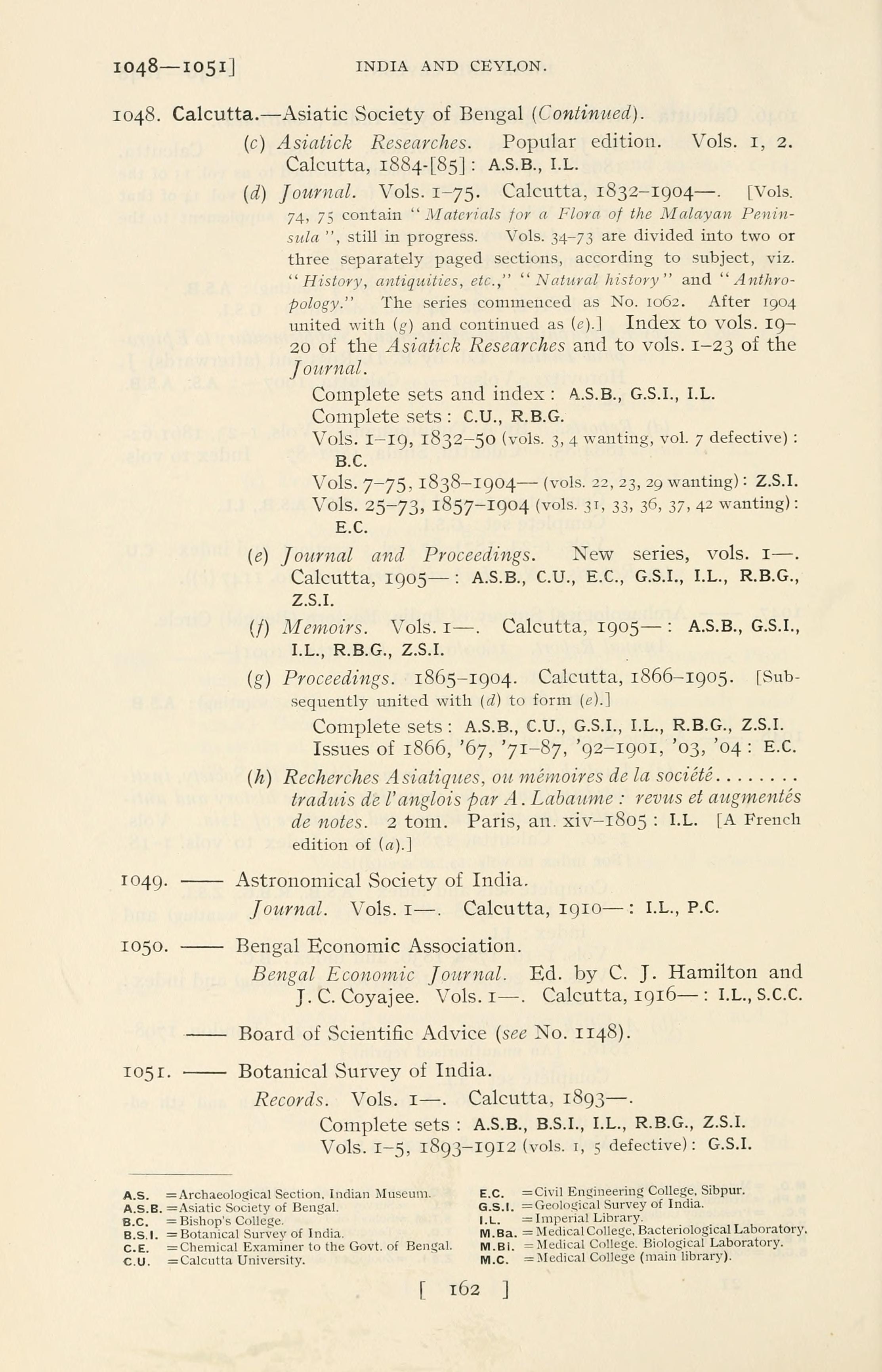
Bibliography of Asiatic Society publications,

The Journal of the Asiatic Society is one of my favorite examples of how the BHL member libraries work together to accomplish this task.  The Journal changed its title various times since the late 18th Century and we have 4 of them in the BHL starting with Asiatick Researches (1788-1849) to the Journal and the Proceedings of the Asiatic Society (1905-1934). Since we started digitizing books for the BHL in 2007, this series has called on 7 different libraries to send various volumes for scanning in an effort to complete the digital set. The work still continues today. With so many libraries involved, it is not uncommon for there to be 3 different ways the titles were cataloged and 5 different ways the volumes were bound, for example, making the work of selection and de-duplication rather tricky.

Without systems that allow us to communicate in detail about who’s scanning precisely what, when, we’d have no way to aggregate 15 different physical library collections into a single BHL collection online. Our issue tracking system is just one of many tools that we use to communicate across various aspects of our digitization workflow. However, the tools would not mean anything if it were not for the hard work and collaborative spirit of the librarians throughout our consortium.

March 15, 2013by [email protected]

Help Support BHL

BHL's existence depends on the financial support of its patrons. Help us keep this free resource alive!

search

About BHL

The Biodiversity Heritage Library (BHL) is the world’s largest open access digital library for biodiversity literature and archives. BHL operates as a worldwide consortium of natural history, botanical, research, and national libraries working together to digitize the natural history literature held in their collections and make it freely available for open access as part of a global “biodiversity community.”

Join Our Mailing List

Sign up to receive the latest news, content highlights, and promotions.

Subscribe Now

Subscribe to Blog via Email

Enter your email address to subscribe to this blog and receive notifications of new posts by email.

Join 319 other subscribers

Subscribe to Blog Via RSS

Subscribe to the blog RSS feed to stay up-to-date on all the latest BHL posts.

Access RSS Feed

Inspiring Discovery through Free Access to Biodiversity Knowledge.

The Biodiversity Heritage Library makes it easier than ever for you to access the information you need to study and explore life on Earth…for free, anytime, anywhere.


64+ Million Pages of
Biodiversity Literature Online.

EXPLORE

Tools and Services
to Transform Research.

EXPLORE

300,000+
Illustrations on Flickr.

EXPLORE

ABOUT | HARMFUL CONTENT | PRIVACY | SITE MAP | TERMS OF USE