

Extinct Species Descriptions: the most precious treasure in BHL
This post is part of BHL at 20: Treasures from the Biodiversity Heritage Library, a series contributed by members of the BHL community, highlighting remarkable works from across the collection in celebration of its 20th anniversary.
We are now exactly halfway through our 20th Anniversary blog post series. Coordinating this celebration of treasures chosen by our BHL community has been one of the most rewarding projects in my time as BHL’s Communications Director. It is an absolute honor to share mine now.
My favorite treasures in BHL are the very first scientific descriptions of new species. I like to think of these descriptions as a species’ international debut in the literature.
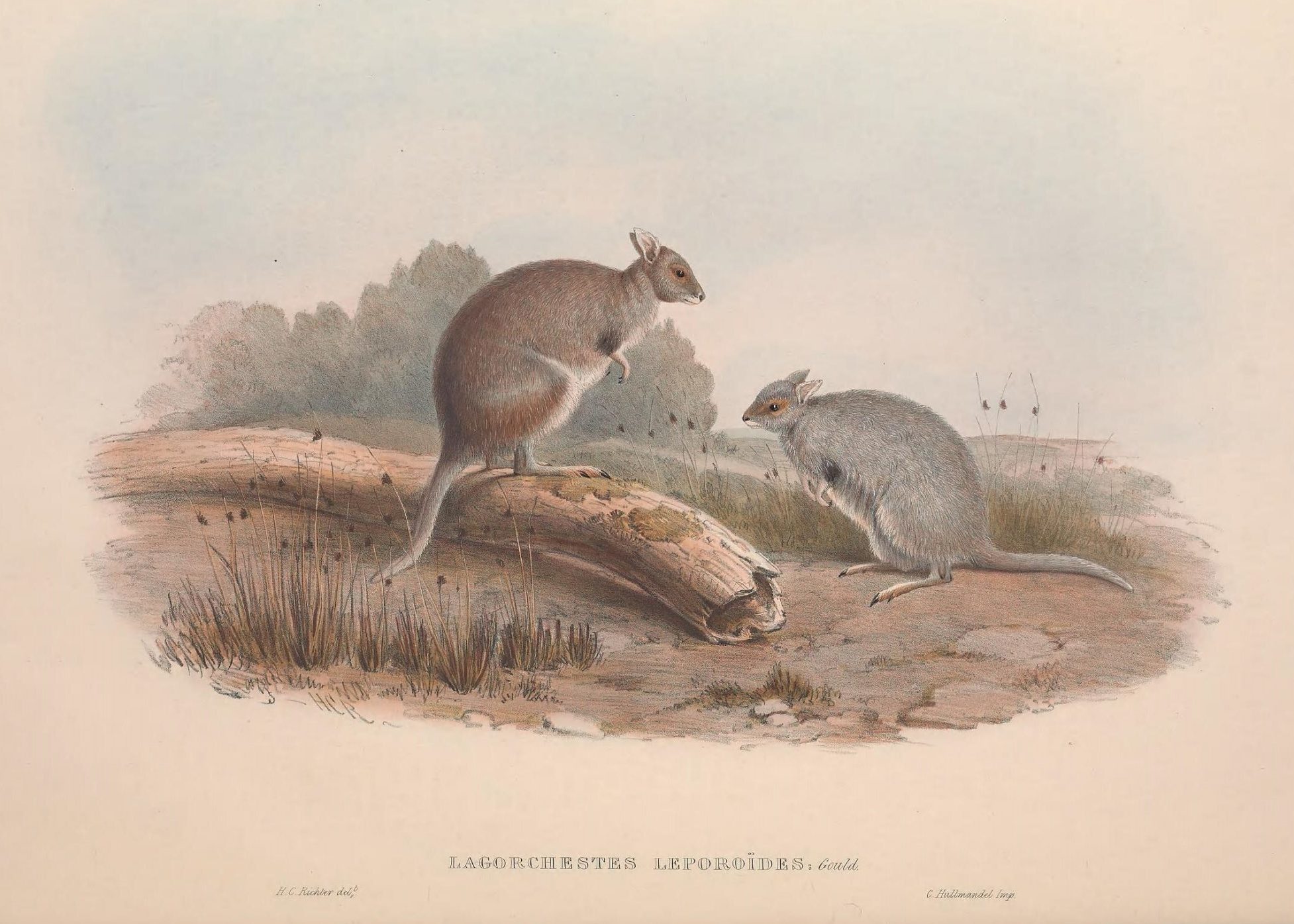
The now-extinct Eastern Hare-wallaby, (Lagorchestes leporides), illustrated by Henry Constantine Richter in John Gould’s A Monograph of the Macropodidae, or Family of Kangaroos (1841), Plate 12. Gould formally described the species earlier that year in the Proceedings of the Zoological Society of London.
As the Manager of BHL Australia, the descriptions I love the most are those of Australian species. Australia was one of the last continents to be encountered and documented by European naturalists. British colonization did not begin until 1788, but from the late eighteenth century onward, descriptions of Australia’s bizarre marsupials and monotremes began appearing in European literature thick and fast, accompanied by a buzz of excitement and wonder.
I find it fascinating to read the awe and curiosity of those early naturalists as they tried to fit Australia’s truly perplexing creatures into their existing understanding of the natural world. One of my absolute favorites is George Shaw’s 1799 description of the platypus: “Of all the Mammalia yet known,” he wrote, “it seems the most extraordinary…” I encourage you to read the full description. It’s wonderful.
But today – on Australia’s National Threatened Species Day – I want to talk about the most precious of these treasures: the descriptions of species that disappeared from the living world a devastatingly short time after making their debut in the scientific literature.
European colonization had devastating consequences for Australia’s native biodiversity. Australia’s long isolation as an island continent meant that many of its endemic animals were exceptionally vulnerable to the onslaught of introduced placental predators and competitors. The introduction of foxes and cats in particular, combined with the unprecedented destruction of the natural environment, has resulted in Australia having the highest rate of mammal extinctions in the world.
Tragically, many of Australia’s introduced species were deliberately released in attempts to make Australia more like Europe, a history I explored in an earlier BHL blog post, Exploring the Acclimatisation Society of Victoria’s Role in Australia’s Ecological History).
BHL: a treasure trove of lost species
While museum specimens may continue to reveal information about the anatomy, genetics and diet of extinct species, the literature preserves precious details from observations of living animals: their behavior, abundance, habitats, interactions, and how they were understood and perceived over time.
Scattered throughout BHL are descriptions, field observations, and illustrations of Australian species that have since disappeared: the Pig-footed Bandicoot, Lesser Bilby and Crescent Nail-tail Wallaby, and so many more. These depictions of once-living animals are now invaluable records of species that will never be observed again.
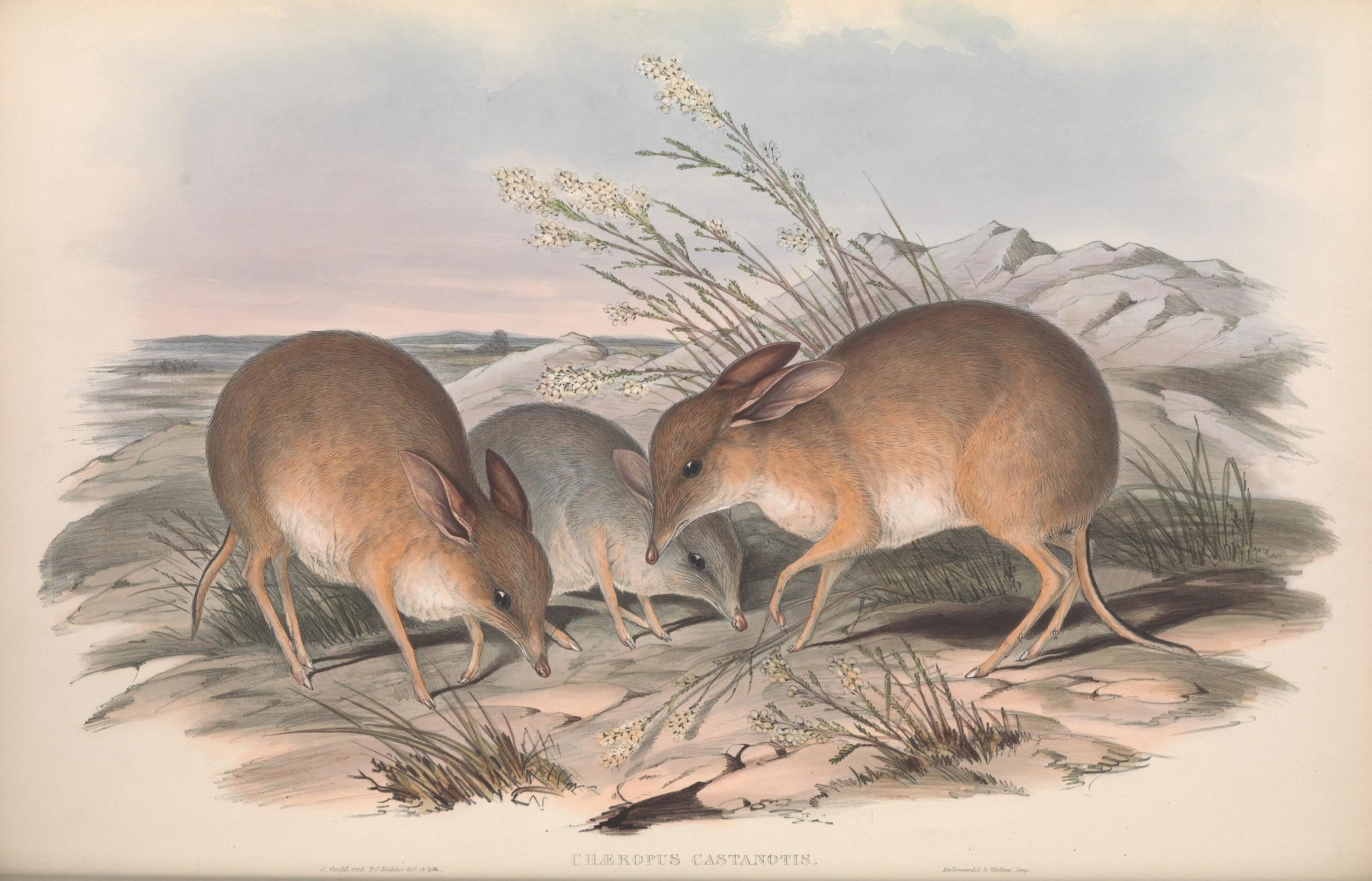
Henry Constantine Richter’s beautiful illustration of the now-extinct Pig-footed Bandicoot, from John Gould’s The Mammals of Australia 1863. Contributed by Smithsonian Libraries and Archives. View in BHL
It is our hope that by making this historic literature accessible and discoverable, we may learn from the past, and help prevent more species from becoming records of what has been lost.
The Thylacine: “an animal of the past”
Australia’s most well-known extinct species is the thylacine, or Tasmanian tiger. This dog-like marsupial carnivore was relentlessly persecuted as a threat to livestock, with private and government bounties placing a price on its head. Hunting and trapping, along with habitat destruction and fragmentation, drove it into rapid decline. The last known thylacine died in captivity at Beaumaris Zoo in Hobart on September 7, 1936. The species had been granted legal protection only two months earlier.
Australia’s National Threatened Species Day marks the anniversary of that tragic death: 90 years ago today.
BHL preserves a sobering scientific trail of the thylacine, documenting the brief period within which this beautiful species was observed, named, misunderstood, persecuted and, ultimately, lost. The first published scientific description and illustration of the thylacine appeared in the Transactions of the Linnean Society of London in 1808. Its author, George Prideaux Robert Harris, gave it the name Didelphis cynocephala (the “dog-headed opossum”). Harris wrote that its large black eyes gave it “a savage and malicious appearance” and compared it to the wolf or hyena.
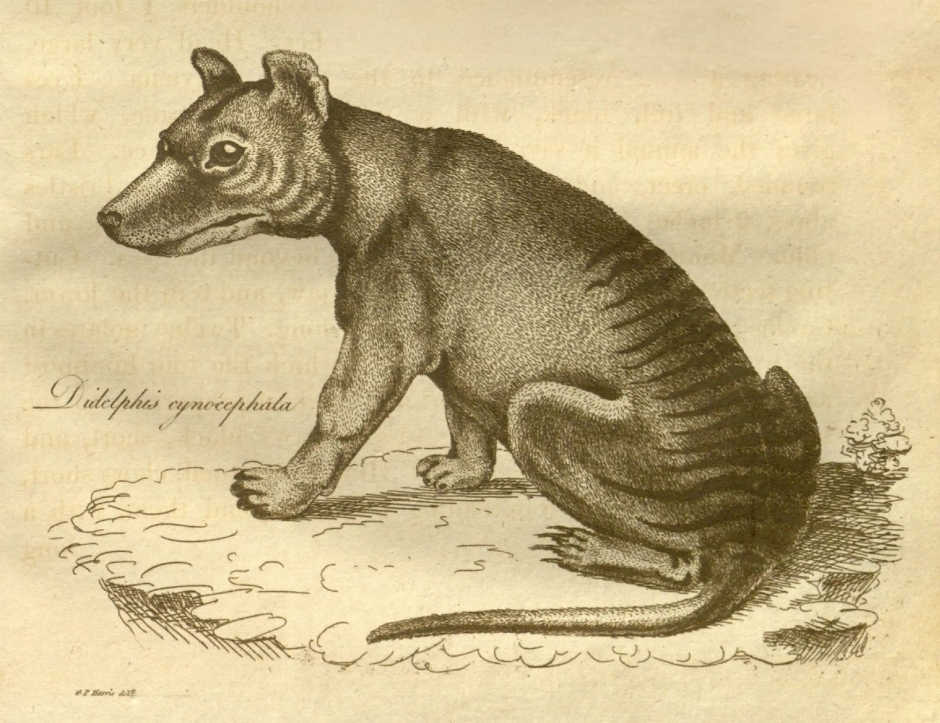
The first published illustration of the Thylacine, accompanying George Prideaux Robert Harris’s 1808 description in “Description of Two New Species of Didelphis from Van Diemen’s Land,” Transactions of the Linnean Society of London 9: 174–178. Contributed by Missouri Botanical Garden, Peter H. Raven Library. View in BHL
These negative words would echo through subsequent accounts. In 1838, Tasmanian naturalist Ronald Campbell Gunn reported that thylacines attacked sheep at night and were “so very large and powerful, that a number of dogs will not face one”. More than three decades later, Johan Ludwig Gerhard Krefft described the thylacine as “a dangerous creature” and “the largest and most ferocious of the whole Mammalian Fauna in Australia”. Modern research, however, suggests that the thylacine was probably poorly equipped to take down an adult sheep, making its reputation as a formidable livestock killer all the more tragic.
Yet, among these hostile accounts are warnings of the thylacine’s diminishing numbers. Joseph Wolf, one of the nineteenth century’s most celebrated zoological artists, depicted thylacines for the Proceedings of the Zoological Society of London (1850) and later for his magnificent Zoological Sketches (1861). His drawings were based on observations of a living pair of juvenile thylacines at London Zoo, the first thylacines ever to be exhibited in a zoological garden. In the accompanying text, zoologist Philip Lutley Sclater warned:
“The thylacine originally preyed on the Kangaroos and Bandicoots, but since the introduction of sheep into the colony, it has become more addicted to attack sheep folds. Perpetual war is therefore waged against it by the Tasmanian shepherds, whose determined persecution must eventually lead to its extinction.”
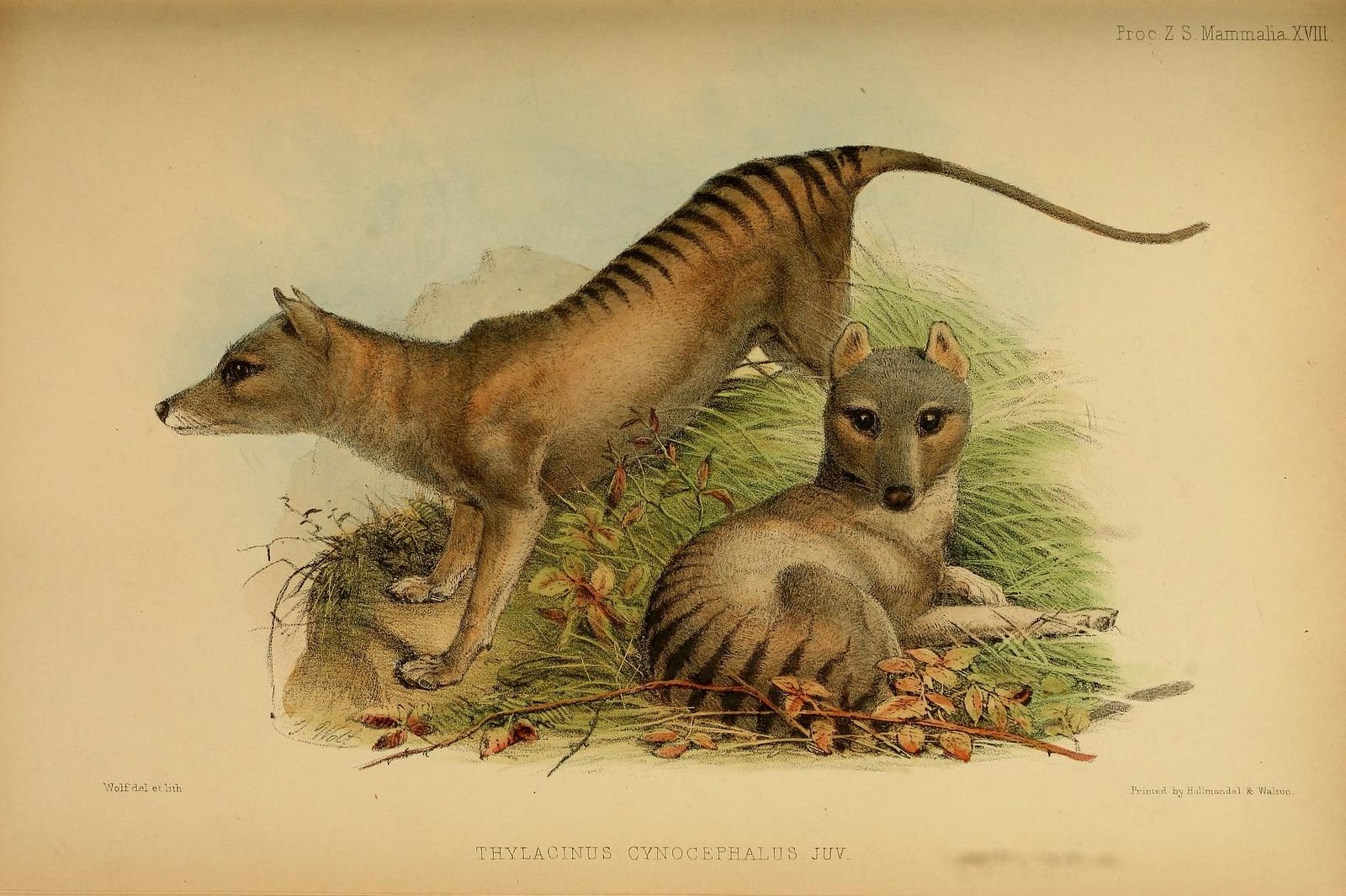
Joseph Wolf’s illustration of the two living thylacines on display at London Zoo, from the Proceedings of the Zoological Society of London (1850). Contributed by Harvard University, Museum of Comparative Zoology, Ernst Mayr Library. View in BHL
And then, in 1863, alongside one of the most famous illustrations of the thylacine, by Henry Constantine Richter for John Gould’s The Mammals of Australia, Gould gave an even more chilling prediction:
“When the comparatively small island of Tasmania becomes more densely populated, and its primitive forests are intersected with roads from the eastern to the western coast, the numbers of this singular animal will speedily diminish, extermination will have its full sway, and it will then, like the Wolf in England and Scotland, be recorded as an animal of the past: although this will be a source of much regret, neither the shepherd nor the farmer can be blamed for wishing to rid the island of so troublesome a creature. A price is already put upon the head of the native Tiger, as it is called; but the fastnesses of the Tasmanian rocky gullies, clothed with impenetrable forests, will, for the present, preserve it from destruction.”
John Gould was right: Tasmania’s gullies and forests protected the thylacine for the present – for his present. Seventy-three years later, the last known thylacine was dead.
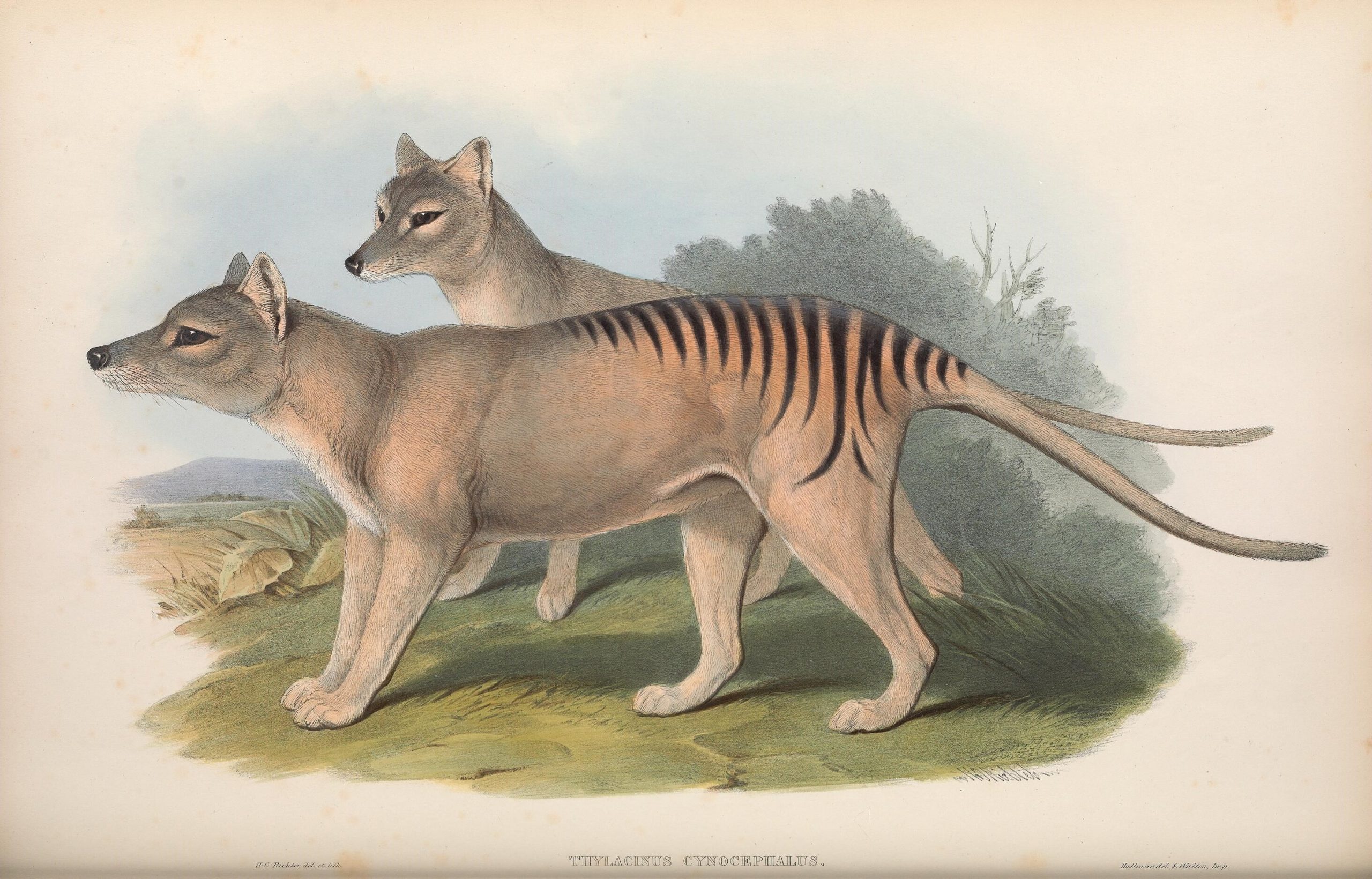
The thylacine, illustrated by Henry Constantine Richter, from John Gould’s “The mammals of Australia” (1863). Contributed by Smithsonian Libraries and Archives. View in BHL
Treasures lost, then found
Thankfully, not every story ends with extinction. One species in BHL is particularly close to my heart: the Leadbeater’s possum.
Also known as the fairy possum, the Leadbeater’s possum entered the scientific literature in 1867, when Frederick McCoy described it as both a new species and a new genus. McCoy was the first Director of the National Museum of Victoria, the institution now known as Museums Victoria, where I have worked for the past 23 years.
McCoy was renowned for spending substantial sums on books, an extravagance I will forever be grateful for. He ordered the latest scientific publications from Europe to be shipped to Australia at great expense, building what would become one of Australia’s largest and most significant natural history library collections. More than 150 years later, many of these nineteenth-century treasures are freely accessible on BHL, thanks to my wonderful team at BHL Australia.
McCoy named the new species Gymnobelideus leadbeateri, after John Leadbeater, the Museum’s first taxidermist. His original description includes a black-and-white illustration drawn from this specimen by Arthur Bartholomew. The image was later reworked by artist and lithographer Dr. John J. Wild, into the beautiful full-color plate that was published in McCoy’s Prodromus of the Zoology of Victoria (1885).
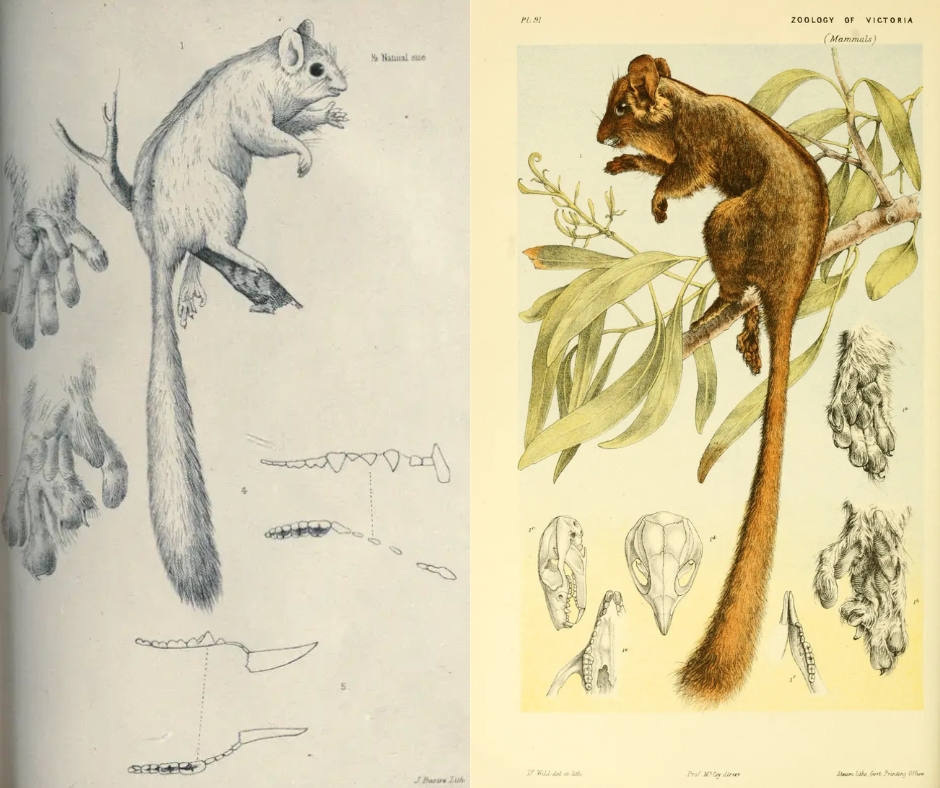
Left: Arthur Bartholomew’s original illustration of the Leadbeater’s possum, accompanying McCoy’s first published description, On a new genus of Phalanger (1867). Right: Plate 91 by Dr. John J. Wild for McCoy’s Prodromus of the Zoology of Victoria (1885).
Only a handful of Leadbeater’s possums were recorded over the next few decades, and when no sightings were made across a period of 50 years, the species was presumed extinct. Then, in 1961, a small colony was rediscovered near Marysville. In 1971, the Leadbeater’s possum was chosen as the faunal emblem of my home state of Victoria. Sadly, despite decades of conservation efforts, the future of our treasured fairy possum is far from secure. The species remains Critically Endangered, threatened by habitat loss and fragmentation, bushfires, climate change, and predation by feral cats.
Protecting our remaining treasures
When I first envisioned this 20th Anniversary series, I imagined it as a celebration of the rare books, exquisite artworks, and unique archives in BHL. Yet, the treasures I find most precious are the species themselves.
BHL provides a window into the point in history when each species entered the scientific record. It also preserves observations of animals that have since vanished: where they lived, how they behaved, how people perceived them, and, occasionally, the warnings that they were disappearing.
The thylacine reminds us what happens when those warnings are ignored. The Leadbeater’s possum is an urgent reminder that sometimes we have a second chance.
For 20 years, BHL has helped preserve the record of life on Earth and make it freely accessible to everyone. My greatest hope for the next 20 is that we use the knowledge preserved across our 64+ million pages not only to understand what we have lost, but to help protect what we still have.
From the Biodiversity Heritage Library
By supporting BHL, you help preserve the knowledge of species past and present and keep it freely available to researchers, conservationists, and policymakers around the world.

Discover more from Biodiversity Heritage Library
Subscribe to get the latest posts sent to your email.

Nicole Kearney is BHL’s Communications Director, Manager of BHL Australia, and Chair of BHL’s Persistent Identifier Working Group. She is passionate about open access, persistent identifiers, and Striped Possums.
Leave a Comment