

Discovering Carrie B. Aaron Through Projects and Partnerships
This post is part of BHL at 20: Treasures from the Biodiversity Heritage Library, a series contributed by members of the BHL community, highlighting remarkable works from across the collection in celebration of its 20th anniversary.
As the Cataloging and Digital Resources Librarian for the Academy of Natural Sciences (Academy) of Drexel University, I get to work with a lot of different materials including periodicals, rare books, archival manuscripts, and more. I recently had the joy of working with scientists’ handwritten notebooks and field journals while completing a project to have 83 of them digitized and transcribed for BHL.
One of the selected notebooks stood out to me: A notebook containing an entomological essay by Carrie Aaron, in part because it highlights a common problem encountered when researching women in the natural sciences. Before uploading the notebook to BHL, the original finding aid record described Carrie as “Mrs. Aaron” and did not provide any additional information about her. Thankfully, Academy Archivist Jessica Lydon noticed the issue and provided more details for me to add to the record, leading me to build a BHL Creator ID for Carrie Aaron that links to her Wikidata identifier. This might sound like a small detail only librarians would notice, but it’s a huge step in building recognition for an author.
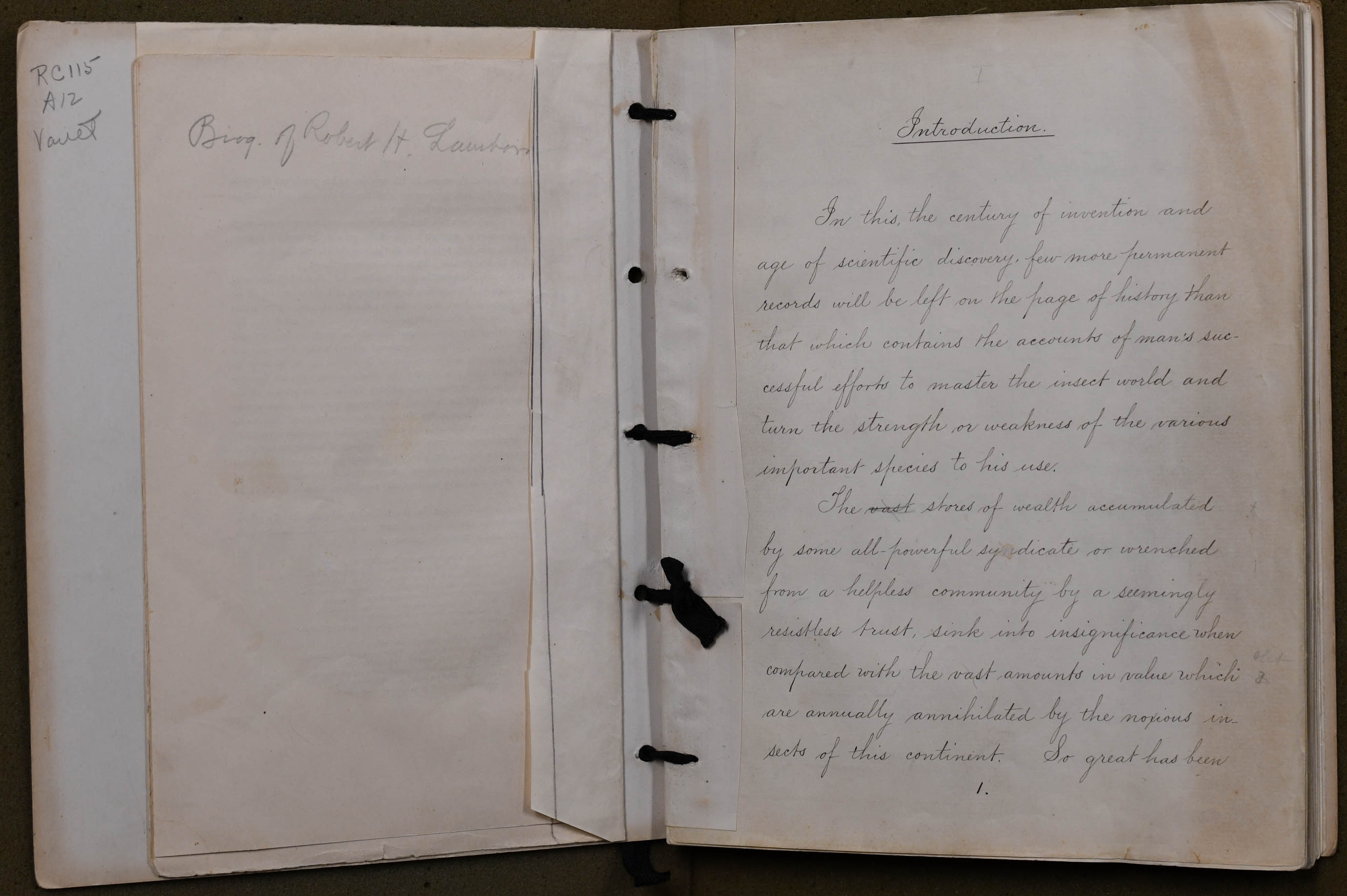
Page 1 of A notebook containing an entomological essay by Carrie Aaron, 1889, 1890, 1901, Small Collections and Individual Manuscripts Box 4, ANSP-Coll-0156, Carrie Baily Aaron Papers, Library and Archives, Academy of Natural Sciences of Drexel University, Philadelphia, Pennsylvania.
The updated catalog record provides more context around Aaron’s essay, which she submitted to a contest aimed at gathering information on how to eradicate mosquitoes. In Aaron’s written biographical notice about contest-holder Robert Henry Lamborn, she said, “While engaged in building the Lake Superior Railroad, Dr. Lamborn suffered so from the attacks of countless mosquitos, that he became interested in extermination of the insect, and later offered prizes for the three best essays on the subject.” I wonder if this was the motivation behind her essay submission.
With the help of dedicated Drexel University student digitization assistants, the Academy Library and Archives was happy to contribute the beautifully handwritten notebook to BHL, which showcases Aaron’s extensive entomological knowledge. Included are analyses of potential methods to reduce mosquito populations, including the use of dragonflies, which Aaron called “the hawks of the minuter insect world.”
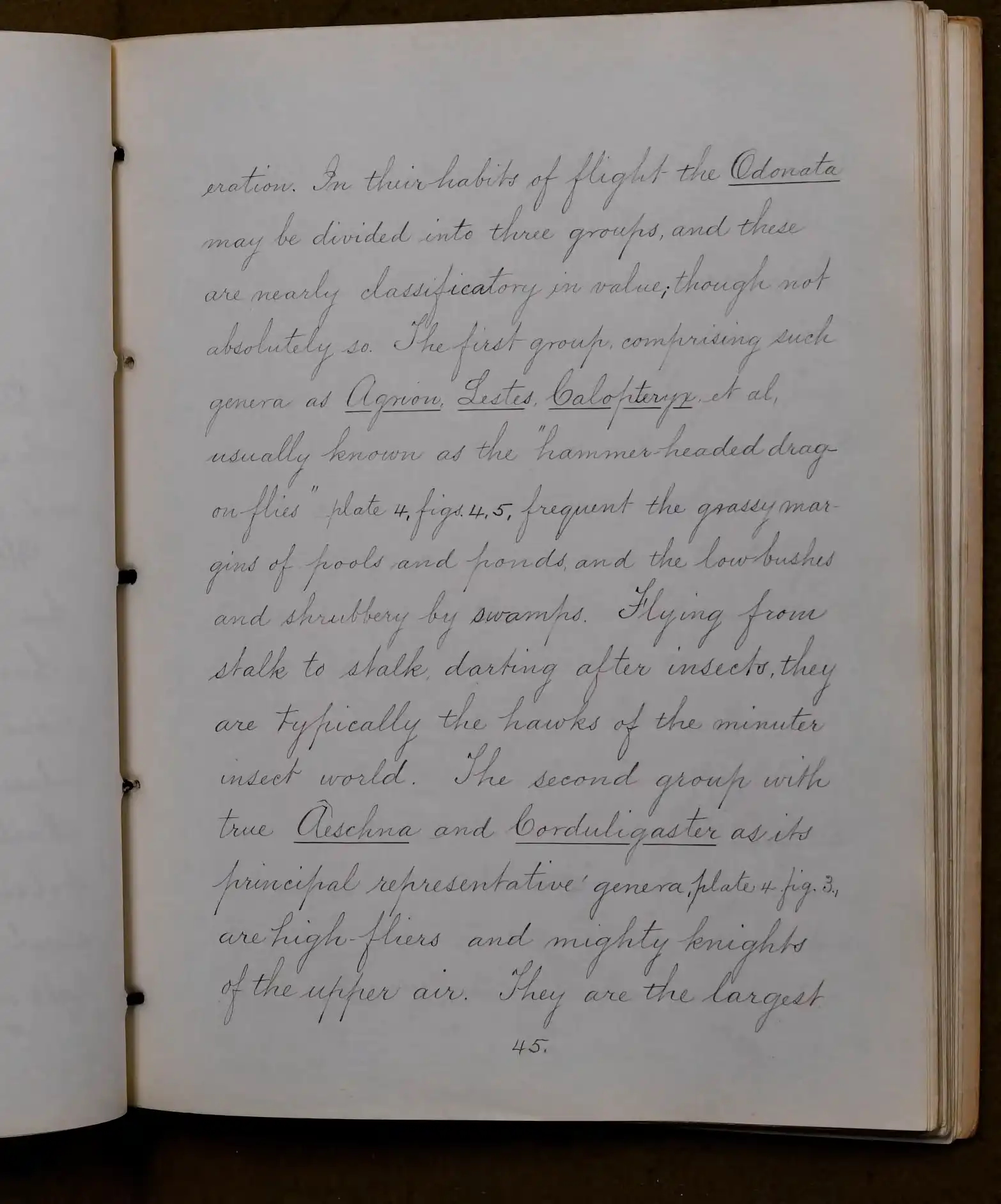
A page from Carrie Aaron’s notebook on BHL in which she refers to hammer-headed dragonflies as “the hawks of the minuter insect world”. (A notebook containing an entomological essay by Carrie Aaron, 1889, 1890, 1901, Small Collections and Individual Manuscripts Box 4, ANSP-Coll-0156, Carrie Baily Aaron Papers, Library and Archives, Academy of Natural Sciences of Drexel University, Philadelphia, Pennsylvania.)
Aaron and her researchers apparently even attempted to inoculate themselves with what was then described as poisonous droplets from mosquitoes, but the attempt was “not successful, owing probably to the inferiority of the needle as an injector, compared with the delicate hypopharynx.” The essay was later published with other submissions in Dragon Flies vs. Mosquitoes: Can the Mosquito Pest be Mitigated? under the title “The Dipterous Enemies of Man.”
In addition to the essay, Aaron’s notebook in the Academy’s collection contains a letter from Henry Skinner congratulating Aaron on her prize-winning essay and confirming that her entomological reputation would “now be well established.” Ten years after receiving the congratulatory letter, Aaron wrote to Skinner in 1900 asking that her name be removed from the list of associate members of the American Entomological Society: “During the ten years of my membership I have attended only two meetings; this has not been from lack of interest as much as from the fact that lady members are too greatly in the minority, and also that I care so little for the classification of insects.” This is not to say that Aaron was not grateful to Skinner for their “more than thirty year sympathetic friendship,” for which she thanked him in a letter she wrote in 1923.
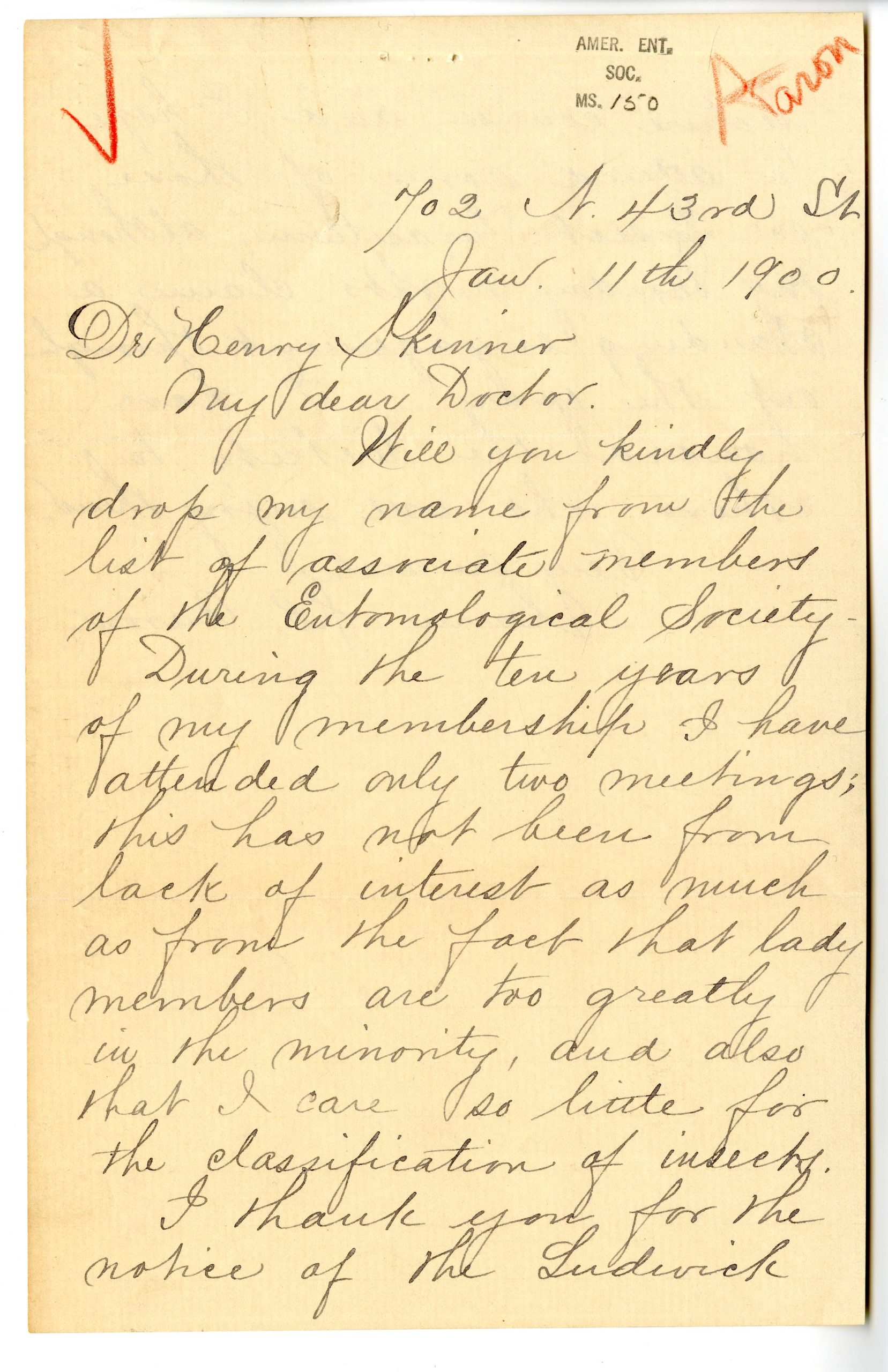
Carrie Aaron asking that her name be removed from the list of associate members of the American Entomological Society. (Carrie Aaron letter to Henry Skinner, January 11, 1900, Box 1, Folder 1, ANSP-Coll-0150, American Entomological Society correspondence, Library and Archives, Academy of Natural Sciences of Drexel University, Philadelphia, Pennsylvania.)
When given the opportunity to write a blog post in celebration of BHL’s 20th anniversary, it was an easy choice among the Academy Library and Archives staff to write about Carrie Aaron. The timing couldn’t have been better; shortly after choosing our blog post topic, we welcomed intern Will Le, who is currently digitizing our entire American Entomological Society (AES) correspondence collection, including letters written by Aaron, and uploading it to PA Photos and Documents. Funding for this project was generously provided by Dr. William Day and the American Entomological Society. Shout-out to Will Le, Jessica Lydon, Greg Cowper, and the American Entomological Society for making this happen!
Thanks to our intern and the AES digitization project, I was able to read Carrie Aaron’s letters on my laptop and learn about her travels in Santa Monica, a place she describes as “the land of perpetual bloom and uninterrupted sounds of birds and insects.” Later in this letter, Aaron describes a meaningful experience while visiting museums:
At Avalon we met the only woman curator of marine objects in the world and because she noticed how interested I was, also inquisitive, she shared a willingness to dissect and classify me; her museum contained many natural curiosities found in the waters of that locality. The most interesting museum I have ever seen is in Los Angeles, Exposition Park (of 130 acres) owned by the state, the resources and industries of California are shown in most attractive scenic effects. The exhibit of fossil remains of prehistoric animals really is wonderful, and made me regret not being healthy enough to make our Academy of Nat. Sci. a competitor in ownership of such a valuable contribution to scientific knowledge.
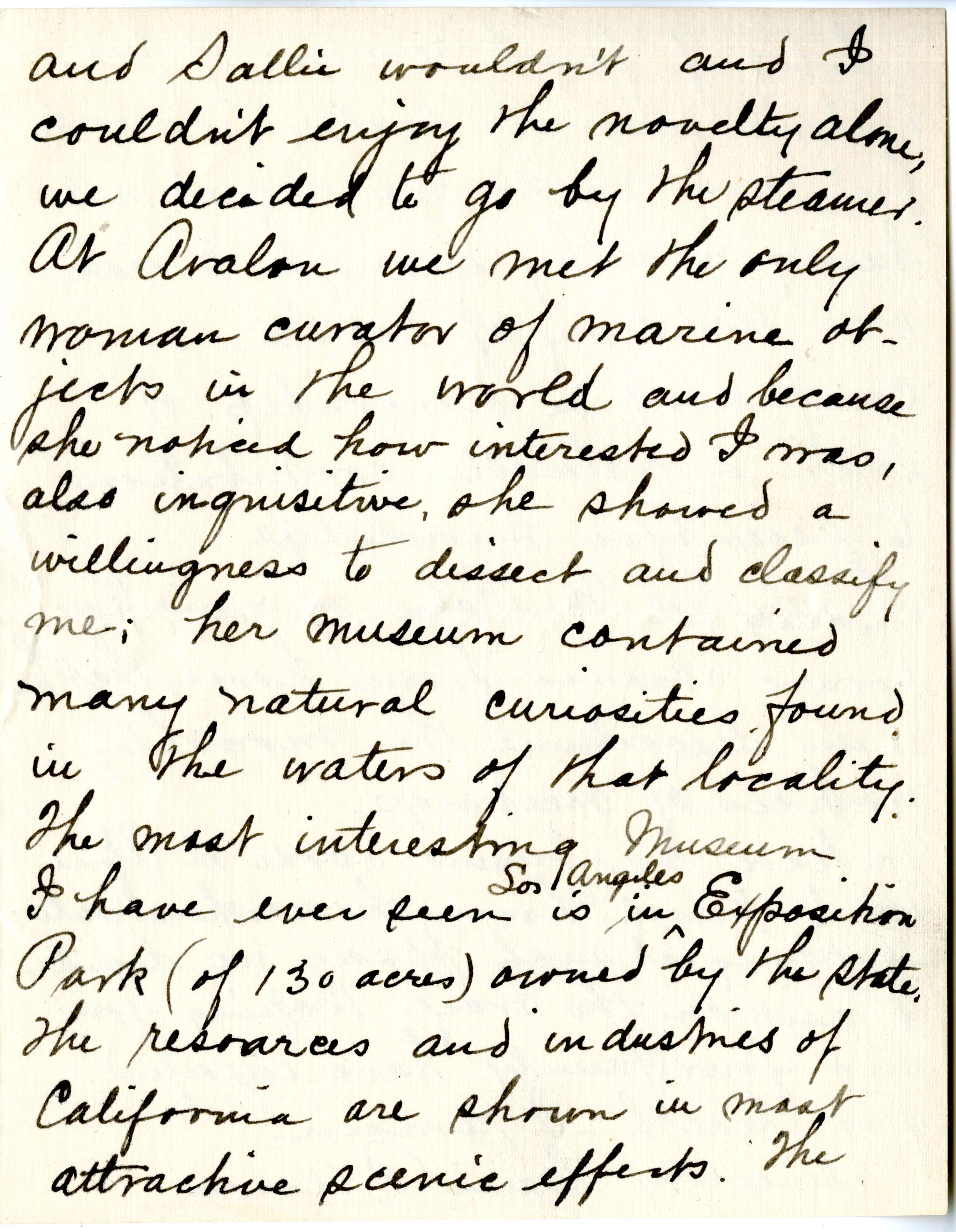
Aaron describes meeting “the only woman curator of marine objects in the world.” (Carrie Aaron letter to Henry Skinner, March 8, 1926, Box 1, Folder 1, ANSP-Coll-0150, American Entomological Society correspondence, Library and Archives, Academy of Natural Sciences of Drexel University, Philadelphia, Pennsylvania.)
Now I have a new research topic: who was the “only woman curator of marine objects in the world” Aaron was so excited to meet? To be continued!
After working with archival notebooks and reading Carrie Aaron’s letters, I’m thrilled to see how digitization and public access to collections spur research into lesser-known individuals and uncover more potential research subjects! I don’t consider myself a historian, but it’s difficult to resist historical research when presented with easily accessible primary sources and when given the tools to link subjects across different platforms. I hope to continue this energizing work at the Academy of Natural Sciences in collaboration with BHL for years to come.
From the Biodiversity Heritage Library
For 20 years, BHL has helped uncover the people and stories hidden within biodiversity literature and archives, making them freely available for new generations to discover. Your support helps us continue digitizing, connecting, and sharing collections like Carrie Aaron’s notebook—and ensures that more overlooked voices and histories can be found.

Discover more from Biodiversity Heritage Library
Subscribe to get the latest posts sent to your email.
Briana Giasullo is the Cataloging and Digital Resources Librarian at the Academy of Natural Sciences and serves on the Cataloging and Metadata Committee with BHL. She loves contributing to BHL and exploring new ways to interact with digital library and archives collections.
Leave a Comment