

Pioneers of Illinois Natural History: Stephen A. Forbes and Charles Robertson
This post is part of BHL at 20: Treasures from the Biodiversity Heritage Library, a series contributed by members of the BHL community, highlighting remarkable works from across the collection in celebration of its 20th anniversary.
Introduction
Stephen A. Forbes and Charles Robertson were pioneering scientists whose groundbreaking research continues to influence our understanding of the natural world. Forbes advanced the fields of biology and ecology, while Robertson explored bees and their relationships with flowers and other insects. Their careful observations and influential publications laid important foundations for modern biological and entomological research. Their enduring insights remain valuable to researchers, students, educators, and nature fans alike, connecting historical discoveries with contemporary scientific knowledge of biodiversity and ecological interactions. The University of Illinois Urbana-Champaign Library’s contributions of rare archival materials and publications by Forbes and Robertson are valuable additions to the Biodiversity Heritage Library (BHL), improving access to these records for scientists and historians alike.
Stephen A. Forbes
Stephen Alfred Forbes was born on 29 May 1844. He was a professor of zoology and entomology and a leader in the natural sciences at the University of Illinois Urbana-Champaign. His studies included insects, crustaceans, fishes, and birds – and their relationships to the environment. In 1886, he received the first-class medal of the Société d’Acclimation de France for scientific publications. He was appointed director of the Natural History Survey Division in 1917 and led the organization until his death on 13 March 1930 in Urbana, Illinois.

Portrait of Stephen A Forbes from the foreword to “Forbes Biological Station: the past and the promise,” in Illinois Natural History Survey special publication 10 (1989).
Among Forbes’ most influential works is The Fishes of Illinois, which documents over 150 fish species represented by more than 200,000 specimens collected from 102 Illinois counties. These fish are depicted in richly detailed color paintings by illustrators Lydia M. (Hart) Green and Charlotte M. Pinkerton. You can read more about the lives and work of these women in our previous blog post, written by Susan Braxton. The publication also includes detailed distribution maps, making it a valuable reference for aquatic biodiversity and fisheries research.
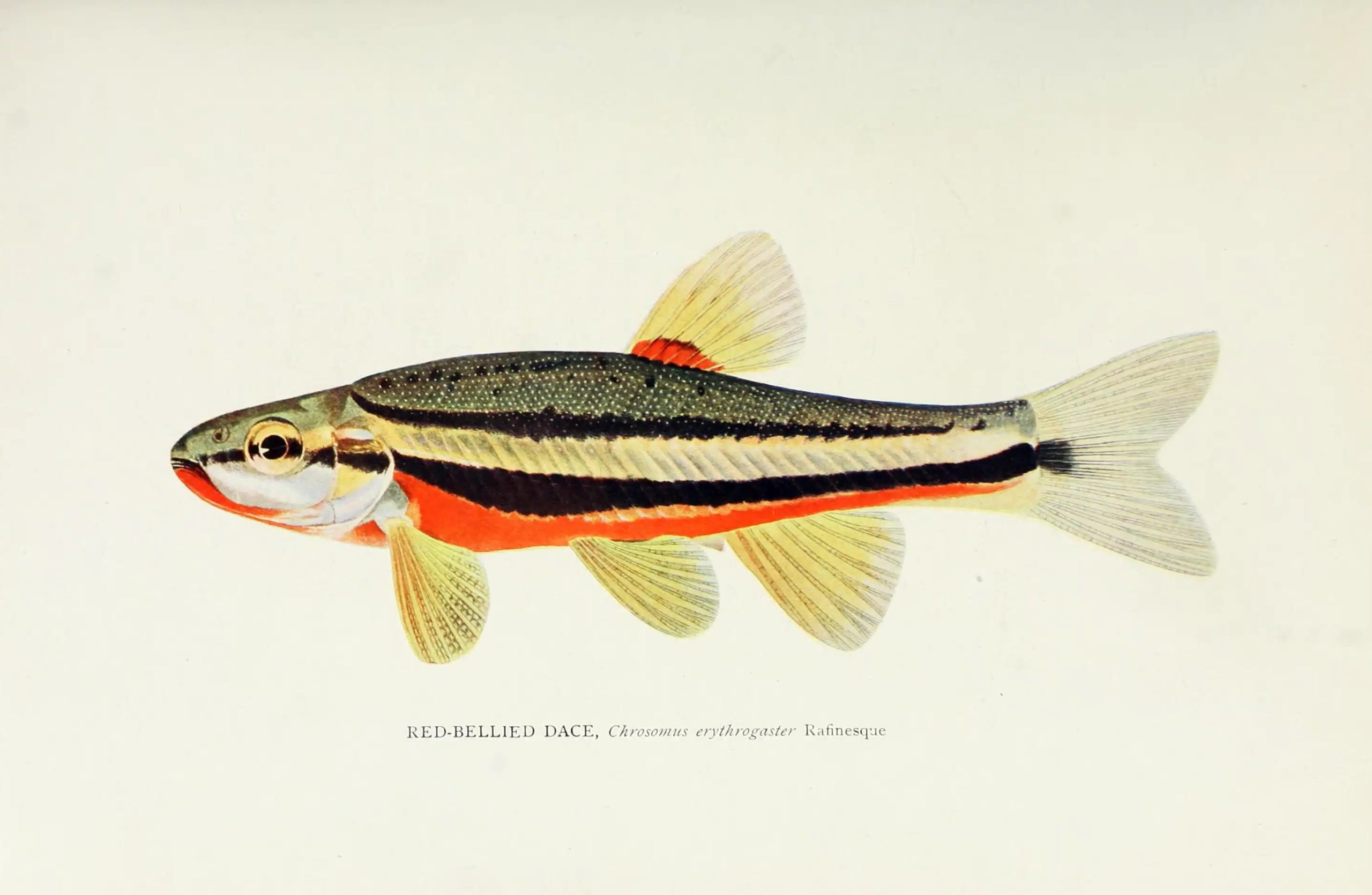
Illustration of Chrosomus featured in The Fishes of Illinois (1908).
In 1894, he established the Forbes Biological Station and, in 1896, directed the construction of a 48-foot floating biological laboratory at the site on the Illinois River in Havana, Illinois. The Station was specifically created to support continuous scientific investigation. It is no wonder that the Illinois Natural History Survey (INHS) celebrated the 150th anniversary of Forbes’ birth on 26 May 1994.

Image of a cabin boat from “Forbes Biological Station: the past and the promise”, in Illinois Natural History Survey Special Publication 10, p. 17 (1989).
Today, Forbes Station is used to advance science and policy in the Illinois River Valley and beyond. It houses the Frank C. Bellrose Waterfowl Research Center, whose research focuses on wetlands, waterfowl, and marsh birds. Today, the Illinois Natural History Survey operates six other field stations: Great Rivers Field Station, Illinois River Biological Station, Kaskaskia Biological Station, Lake Michigan Biological Station, Ridge Lake Biological Station, and Sam Parr Biological Station – all serving researchers from the University of Illinois Urbana-Champaign and across the state. BHL has an extensive collection of these and related publications, chronicling Forbes’ contributions to the understanding of ecology and the foundation of aquatic ecosystem science.
Forbes’ Memorial captures the impact he had on his contemporaries, the University of Illinois, and the state. The University Senate put forth a resolution acknowledging Forbes’ significant contributions:
The Senate knew him as Professor of Zoology and Entomology and Dean of the College of Science; it admired his sagacity and patience as chairman of its Committee on Educational Policy; its members loved him for his simplicity, sincerity and broad human interests. The University and the State are immeasurably indebted to him as one of their most useful and eminent laborers for the common good.
Charles Robertson
Charles Robertson was born on 12 June 1858 in Carlinville, Illinois. He began his academic education at Blackburn College in his hometown and continued his studies in botany and zoology at Harvard University. He returned to Blackburn College as a professor of biology and Greek. His research centered on investigating interactions of insects and flowering plants. Over more than 20 years, Robertson recorded visits by 1,429 pollinating insects (including flies, beetles, butterflies, and bees) to 456 plant species. He was collecting insects in Florida just a few months before his death on 1 June 1935 in Carlinville. His book, Flowers and Insects, published in 1928, presents an intensive study of flower-visiting insects from the city of Carlinville and remains one of the most comprehensive studies conducted in a single locality. Each insect he recorded was associated with the plant on which it was collected.

Portrait of Charles Robertson from History of Macoupin County, Illinois: Biographical and Pictorial, vol. 2 (1911), edited by Charles A. Walker. Image enhanced using Adobe Photoshop by T. C. McElrath. Source: Wikipedia
His personal life mirrored his work: he was born and died in the same small town, kept few but lasting friendships, and brought the same steady, unhurried patience to his acquaintances that he brought to a lifetime of observing flowers and their visitors.
Charles Robertson’s specimen collection logs document insect specimens and include information such as the specimen number, scientific name, sex, date and locality of collection, insect order, and scientific name of the host plant. His collections and correspondence have proved invaluable to researchers. His work was essential to an investigation of species decline in Carlinville, published in Ecology & Society and conducted by John Marlin, a research affiliate with the Illinois Sustainable Technology Center and INHS. A quantitative analysis published in July 2026 in the Data Science Journal highlights the wealth of knowledge contained in his correspondence and collection logs. The logs and most of Robertson’s papers from 1877 to 1935, including correspondence, reprints, five ledgers, and a data book on bee research, are preserved in the University Archives at the University of Illinois Urbana-Champaign. The seminal work Flowers and Insects, as well as his specimen collection logs, is readily available through BHL.
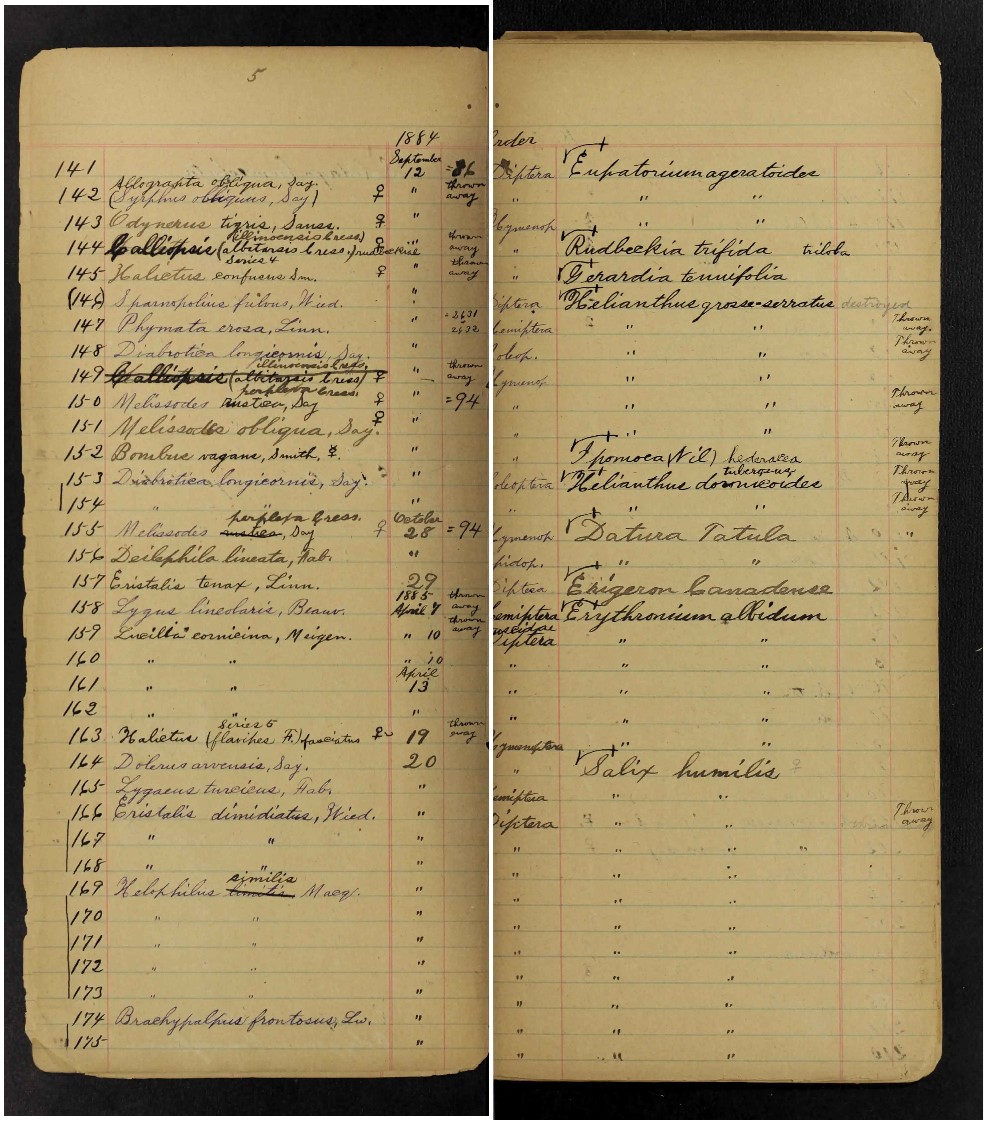
Side-by-side images of page 5 of the handwritten Specimen Collection Logs of Charles Robertson, vol. 1, 1884-1886. Images assembled by Kelli Trei.
Conclusion
These collections preserve the irreplaceable life’s work of two Illinois scientists. Forbes’ work remains important today. His holistic view of ecology, examining the relationships between organisms, the environment, and natural-resource industries, has helped shape our current understanding of applied ecology. Robertson’s correspondence and specimen logs represent an irreplaceable record of an ecosystem that can no longer be observed firsthand.
Archival documents such as these reveal the values, culture, and identity that shaped the Illinois Natural History Survey and science in Illinois. Being able to trace the legacy of scientific research and lives of those behind these discoveries provides richer context and understanding for future scientific research. BHL provides a unique juxtaposition between the human experience of doing science, revealed through archival documents, and the official scientific record preserved in books and journal articles. Together, these materials provide a fuller and more inclusive account of the history of science here in Illinois.
From the Biodiversity Heritage Library
For 20 years, BHL has helped preserve and share the scientific record, from landmark publications to the archival materials that illuminate the people, places, and observations behind them. With your support, we can keep treasures like these freely accessible, connecting past research with the scientists, historians, and communities who continue to learn from it today.

Discover more from Biodiversity Heritage Library
Subscribe to get the latest posts sent to your email.

Abubakari is a graduate assistant at Funk ACES and Veterinary Medicine Libraries, University of Illinois Urbana-Champaign. He earned his Bachelors in Library and Information Science from Makerere University in 2022 and is currently pursuing his MSLIS at University of Illinois. Before joining Illinois, Abu worked as a Graduate fellow at Busitema University (Uganda) for 2.9 years. He is interested in Academic Librarianship as a profession, especially information literacy, reference services, library instruction, and digital libraries.

Leave a Comment