

Collections as data: Transcribing the ornithological observations of Walter Faxon
Introduction
With the world facing the dual crisis of climate change and biodiversity loss, the emergence of the Biodiversity Heritage Library (BHL) 20 years ago was timely. Over that 20-year span, BHL has grown to become “the world’s largest open access digital library for biodiversity literature and archives”1 with a corpus of over 64 million pages. This vast corpus is also a repository of historical biodiversity data waiting to be extracted and used to inform a better understanding of anthropogenic effects on climate, the environment, and life on Earth.
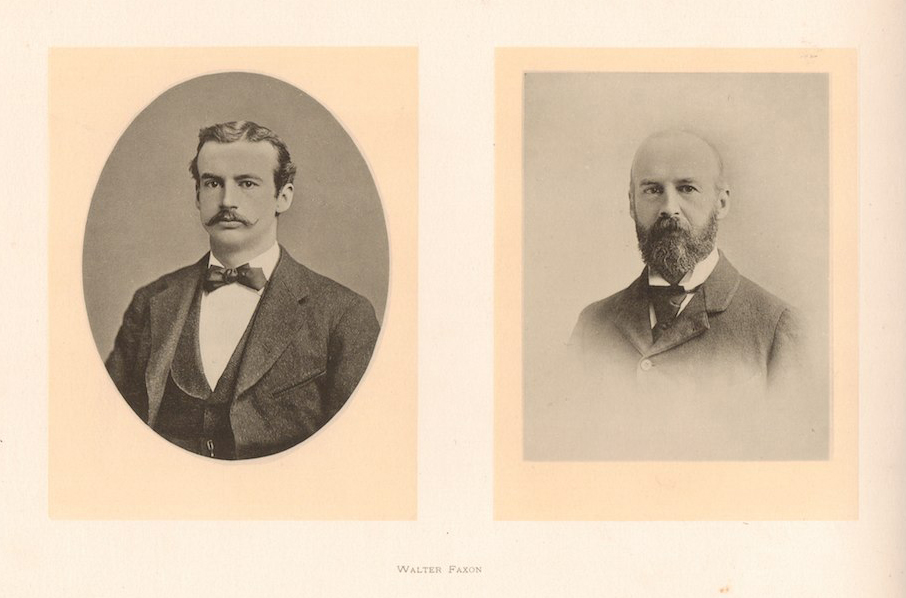
Portraits of Walter Faxon taken at graduation from Harvard (1871) and later in life (1896). Harvard College; Heliotype Printing Co.
Walter Faxon
One “dataset” recently added to BHL is the Ernst Mayr Library’s (EML) collection of Walter Faxon’s ornithological field journals, field notebooks and bird lists. Faxon (February 4, 1848 – August 10, 1920) was a native of Massachusetts. He was an Assistant Professor of Zoology at Harvard University from 1872 to 1886. Faxon specialized in the study of crustaceans and was Curator of the Invertebrate Department at Harvard’s Museum of Comparative Zoology (MCZ) for 46 years (1874–1920). He focused his work primarily on the Museum’s collections of Crustacea and Mollusca.
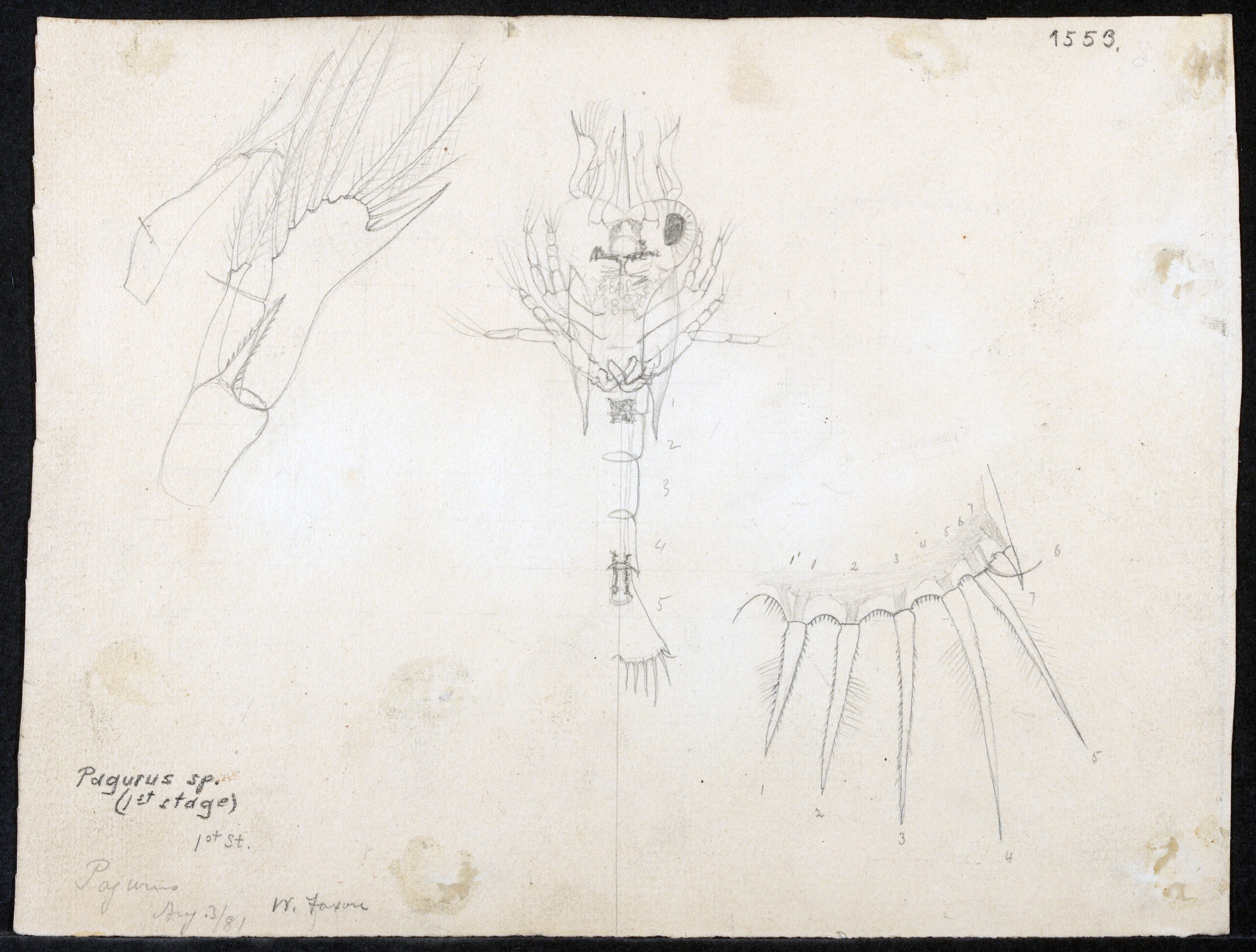
Pencil sketch of Pagurus sp. (hermit crab) first zoeal stage. Drawn by Walter Faxon on 3 August 1881. From the Ernst Mayr Library and Archives of the Museum of Comparative Zoology, Harvard University.
Ornithology was an avocation for Faxon, but he pursued it with the same level of professionalism with which he approached his curatorial work. He was a Fellow of the American Ornithologists’ Union from 1901–1904. “His long experience in the field [nearly 60 years] and his alertness of eye, ear and mind, as well as his scrupulous care to avoid error, combined to make him one of the best equipped and accurate of field ornithologists – the identification of a bird by him was never questioned.”2 This inspires confidence in the authenticity of the historical data Faxon left for us, now accessible via the BHL.
The Collection
The Faxon collection in the Ernst Mayr Library is relatively small, consisting of just over 2,200 pages of manuscript field journals, bird lists, field notebooks, correspondence, eight pencil drawings of Arthropoda and Crustacea, and some additional miscellaneous items. The EML also holds a large collection of William Brewster’s papers that include 145 letters to and from Faxon. Though not voluminous, Faxon’s field journals, bird lists and field notebooks (totaling 1,640 pages) record thousands of bird observations with species name, date, locality, number of individuals seen, and often additional information such as sex, life stage, and vocalization. These species occurrence data, compiled over 33 years (1886–1919), is arguably the greatest asset of Faxon’s collection. Aggregated with similar data from other sources around the world, the resulting dataset will help provide a clear picture of biodiversity change over time, informing efforts to mitigate accelerating species decline.
From the Archives to GBIF
BHL is well positioned to facilitate development of an aggregated global dataset. By providing the infrastructure and tools to host transcript files for manuscript materials, making the text searchable and scientific names discoverable, BHL promotes extraction of species occurrence data.
With the goal of including Faxon’s data with BHL exports to the Global Biodiversity Information Facility (GBIF), the EML has digitized and transcribed his ornithological observations. In 2025, the collection was digitized with the support of the Harvard Library Collections Digitization Program under the theme of Climate Change. In 2026, the EML was chosen to host a Pforzheimer Fellow to investigate the use of AI-powered tools to transcribe Faxon’s field journals, notebooks, and species lists.
Our Fellow, Mohit Mandal, a Harvard PhD candidate in Anthropology, worked on this project from June 1 to August 31, 2026. He began by evaluating ChatGPT and Google Gemini to determine which model would be best suited for the Faxon materials. Mohit found Gemini to have the edge in accuracy, but more constrained by file upload limits and not as user-friendly, as it works only with Google Workspace tools (e.g., no support for Microsoft Word). He found ChatGPT to be more flexible with follow-up prompting and had success retaining consistency by training the model according to his specifications. Based on this assessment he chose ChatGPT for the project. The initial transcripts were then verified using a different AI tool, Claude, to draw upon the two models’ complementary capabilities and improve overall accuracy.
Results
The screenshots below display page images alongside transcript text in the BHL book viewer. Overall, the results are impressive with pages reviewed thus far revealing relatively few errors. The goal of transcribing nearly 2,000 manuscript pages was achieved. The Pforzheimer Fellowship ended just one week before this writing, so we have not yet had time to calculate an accuracy metric. Some of the difficulties encountered are typical for transcription of handwritten material: notes written in pencil with smudges; marginal text written at an angle (poorly transcribed and, in some instances, not recognized by AI), etc.
One of the greatest challenges was training ChatGPT to capture tiny interlinear numbers and symbols that Faxon would place above the main lines of text (i.e., between lines). This interlinear text would record such things as the number of individual birds of a species seen on a given date, whether the birds were singing, and if they were in a flock. Mohit posits that the difficulty capturing this text may be a consequence of line-spacing constraints with word processors such as Microsoft Word and Google Docs. Ultimately, he was able to preserve the interlinear notations by formatting them as superscript text (Figures 3 and 4).
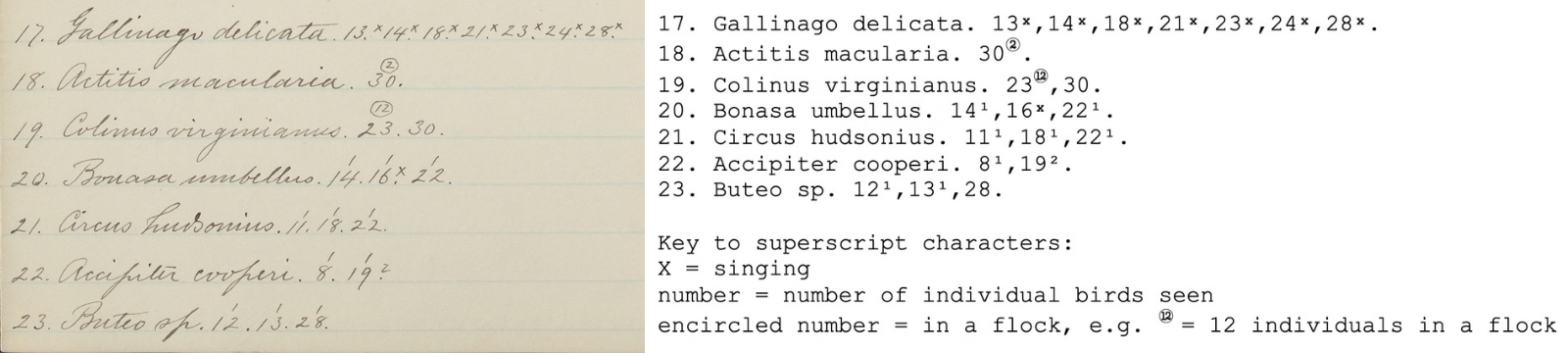
Left: Extract from Faxon’s April 1890 bird list highlighting his use of interlinear characters. Transcribed with ChatGPT-5.5 Thinking. From the Ernst Mayr Library and Archives of the Museum of Comparative Zoology, Harvard University. Right: Transcript of the extract with interlinear characters. ChatGPT would often miss these characters, especially on pages with difficult handwriting or on dates appended with more than one character. AI transcription of such characters requires further refinement.
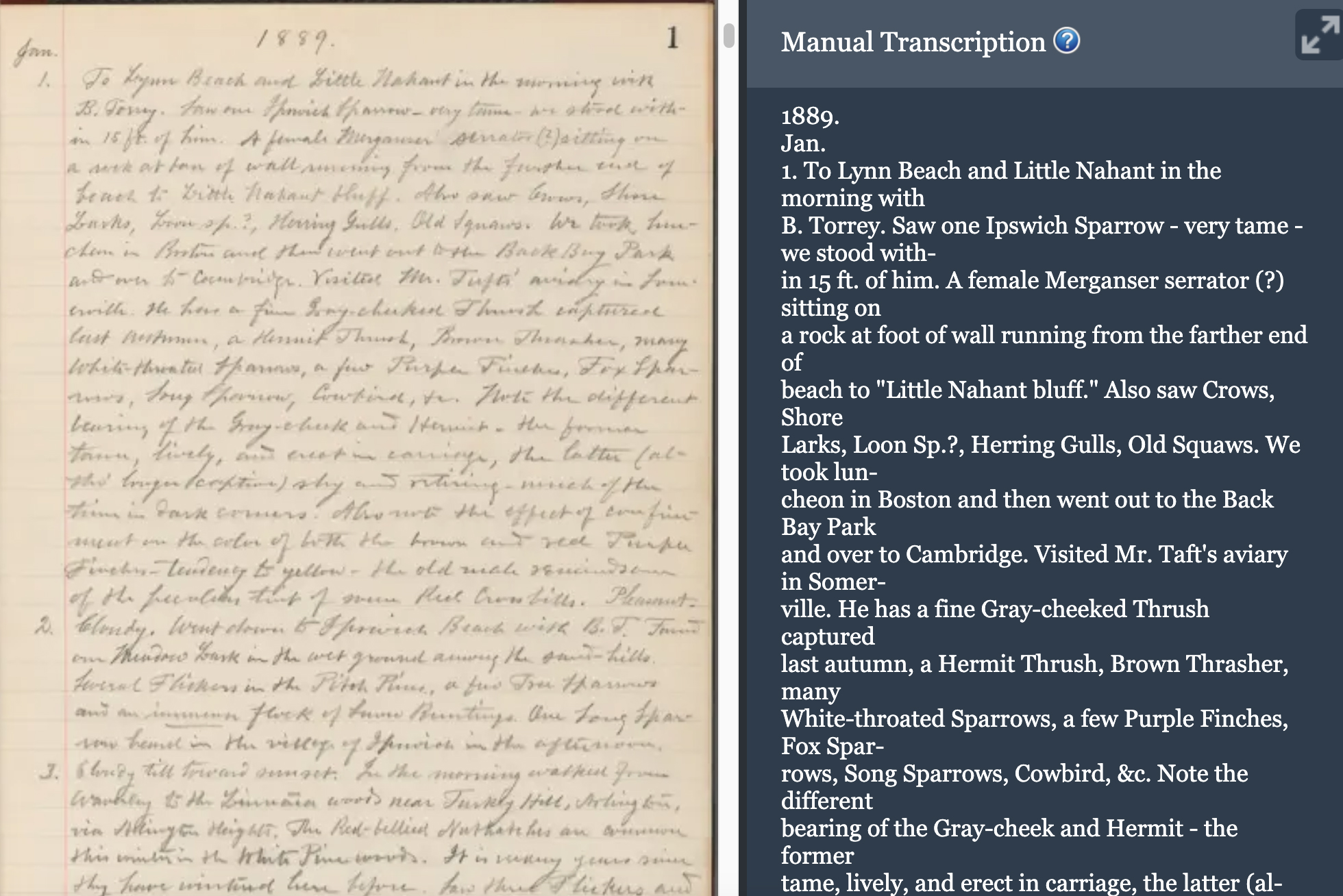
Page 1 of Faxon’s Field Journal, v.1 (1889–91), with transcript in BHL book viewer. Transcribed with ChatGPT-5.5 Pro. From the Ernst Mayr Library and Archives of the Museum of Comparative Zoology, Harvard University.
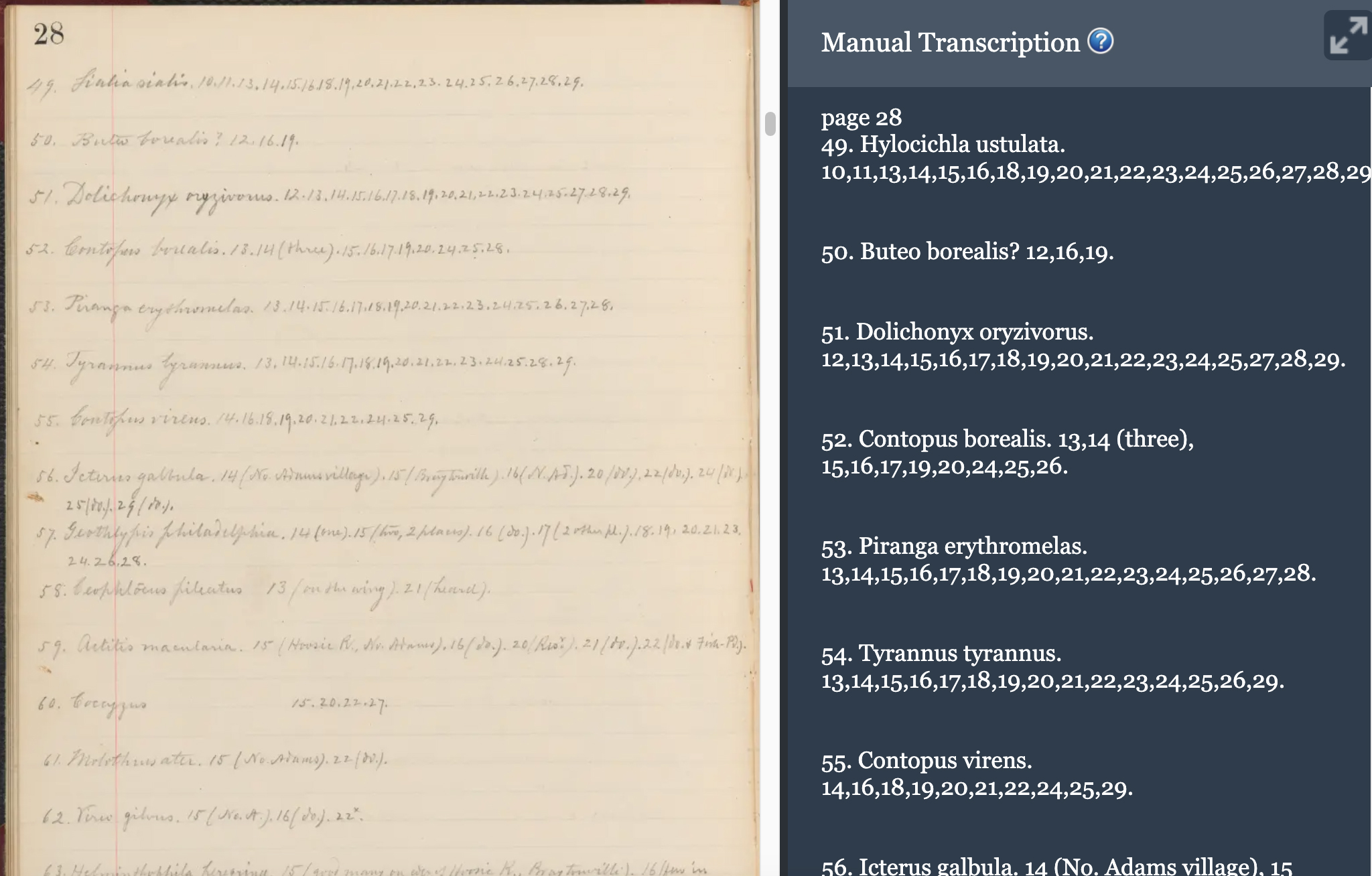
Species list in Faxon’s Field Journal, v.1 (1889–91), with transcript in BHL book viewer. In line 49, Sialia sialis is mis-transcribed as Hylocichla ustulata, an apparent hallucination. Transcribed with ChatGPT-5.5 Pro. From the Ernst Mayr Library and Archives of the Museum of Comparative Zoology, Harvard University.
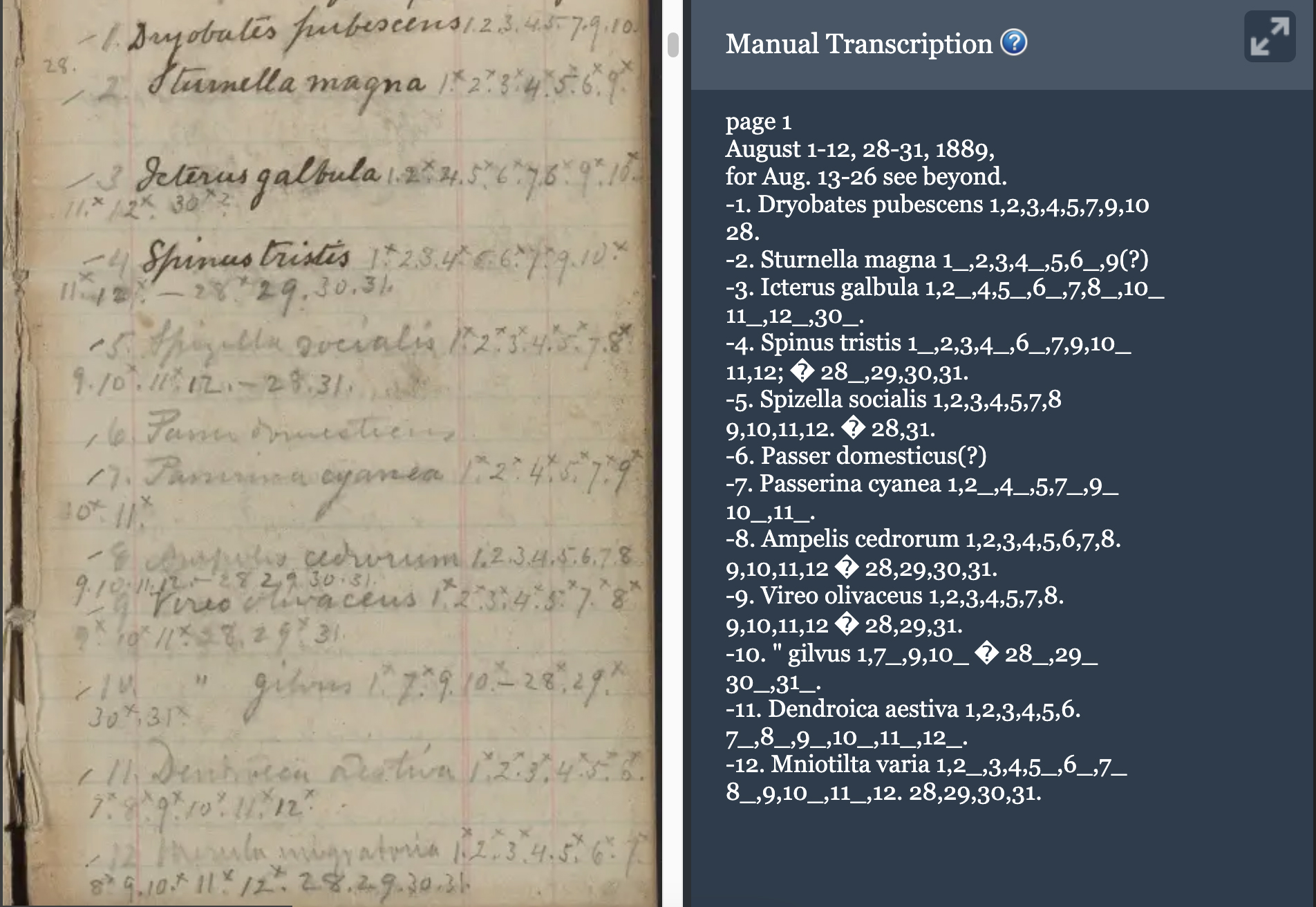
Species list in Faxon’s Field Notebook, v.1 (1889–91), with transcript in BHL book viewer. In line 12, Merula migratoria was mis-transcribed as Mniotilta varia, an apparent hallucination. Transcribed with ChatGPT-5.5 Thinking. From the Ernst Mayr Library and Archives of the Museum of Comparative Zoology, Harvard University.
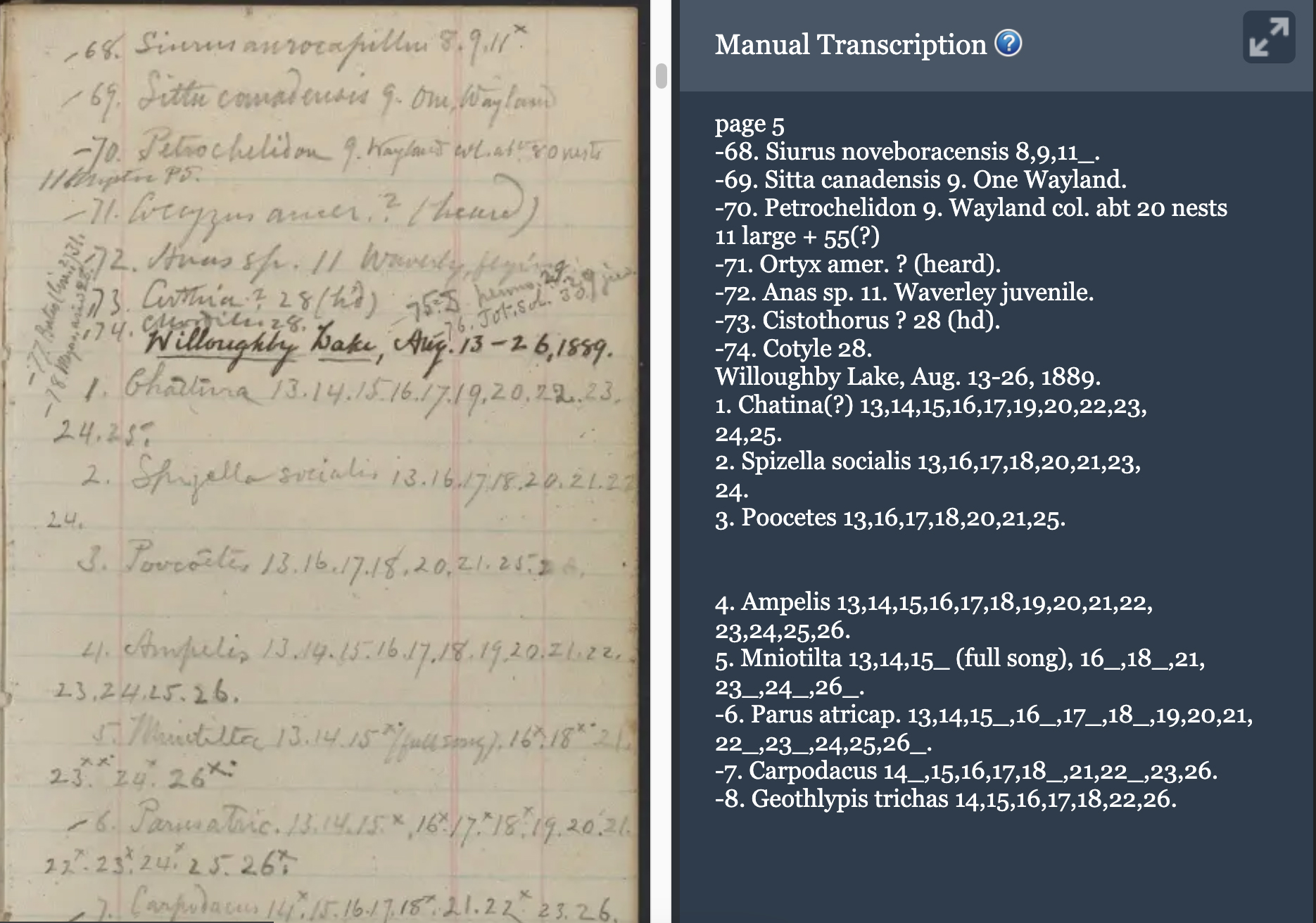
Species list in Faxon’s Field Notebook, v.1 (1889–91), with transcript in BHL book viewer. Note that lines 75–78, written at an angle, were not captured. Transcribed with ChatGPT-5.5 Thinking. From the Ernst Mayr Library and Archives of the Museum of Comparative Zoology, Harvard University.
Mohit’s major takeaway from this project was the realization “that the human element remains central to guide the goals and direction of the project, without which A.I. tools—at least at this stage of their development—often falter in accuracy, especially when handling complex page layouts and difficult handwriting.”3
With the rapid evolution of AI models, and the upcoming modernization of the BHL platform, we are moving closer to a sustainable means of extracting biodiversity data from handwritten field observations.
Acknowledgements
The author wishes to thank the Harvard Library for their support of this work via the Harvard Library Collections Digitization Program and the 2026 Pforzheimer Fellowships. Special thanks to our Fellow, Mohit Mandal, for his well-planned execution of this project.
References
- Biodiversity Heritage Library. “About the Biodiversity Heritage Library” (n.d.). https://about.biodiversitylibrary.org. Retrieved 5 Sep. 2026.
- Tyler, Winson M. (1921). “Notes and News” The Auk. 38 (1): 157–158. https://doi.org/10.2307/4074078. Retrieved 8 Aug. 2026.
- Mandal, Mohit. (2026). “[Pforzheimer Fellowship Report]”.
From the Biodiversity Heritage Library
For 20 years, BHL has made biodiversity knowledge freely accessible to the world. Your support helps us preserve treasures like Walter Faxon’s field journals and unlock the valuable biodiversity data they contain.

Discover more from Biodiversity Heritage Library
Subscribe to get the latest posts sent to your email.

Joe is a Co-Secretary of the BHL Executive Committee, and Digital Projects Manager at the Ernst Mayr Library (EML) at Harvard University where he has worked since 2006. The EML is a founding member of BHL, and Joe is honored to have worked with such a fantastic team of international colleagues over the past 20 years.
Leave a Comment