

Rejected to Accepted: E.A.W. Zimmermann’s Geographische Geschichte des Menschen, und der allgemein verbreiteten vierfüßigen Thiere
This post is part of BHL at 20: Treasures from the Biodiversity Heritage Library, a series contributed by members of the BHL community, highlighting remarkable works from across the collection in celebration of its 20th anniversary.
The Field Museum’s Marie Louise Rosenthal Library is fortunate to have a small fund dedicated to the purchase of rare books. As a result, Library staff are often on the lookout for titles that fall within our natural history collecting scope while also meeting the criteria of being both historically valuable and scientifically significant.
In March, I came across an interesting zoological title for sale: Geographische Geschichte des Menschen, und der allgemein verbreiteten vierfüßigen Thiere, nebst einer hieher gehörigen Zoologischen Weltcharte, a three-volume work on biogeography published between 1778 and 1783 by Eberhard August Wilhelm von Zimmermann, a German geographer, zoologist, and mathematician. The work also includes a fold-out map, Tabula Mundi Geographico Zoologica sistens Quadrupedes hucusque notos sedibus suis adscriptos edidit, which has been described as the first world map of zoological geography, illustrating late-eighteenth-century understandings of the global distribution of mammals.
Before purchasing a title for the rare book collection, I evaluate whether it fits the Library’s collecting scope, whether it is scientifically valuable, which institutions hold copies, and whether a digital version is already available in BHL. As I looked into Geographische Geschichte des Menschen und der allgemein verbreiteten vierfüßigen Thiere, I learned that Zimmermann had published an earlier edition in Latin in 1777 under a different title: Specimen zoologiae geographicae, quadrupedum domicilia et migrationes sistens, which is available in BHL.
A subsequent search led me to another BHL resource: Opinions and Declarations Rendered by the International Commission on Zoological Nomenclature (1954). In Opinion 257, the Commission rejected Specimen zoologiae geographicae, quadrupedum domicilia et migrationes sistens for “nomenclatorial purposes.” In short, the 1777 edition did not satisfy the requirements of Article 25 of the Règles internationales de la nomenclature zoologique, the predecessor of today’s International Code of Zoological Nomenclature. The work was consequently placed on the “Official Index of Rejected and Invalid Works in Zoological Nomenclature.”

The International Commission on Zoological Nomenclature’s 1954 opinion rejecting E.A.W. Zimmermann’s Specimen zoologiae geographicae, quadrupedum domicilia et migrationes sistens (1777) and accepting his later work Geographische Geschichte des Menschen, und der allgemein verbreiteten vierfüßigen Thiere, nebst einer hieher gehörigen Zoologischen Weltcharte (1778–1783).
Even more interestingly, further reading revealed that this opinion had a connection to the Field Museum. The Commission’s ruling stemmed in part from correspondence between Francis Hemming, Secretary of the Commission, and Wilfred H. Osgood of the Field Museum, who advocated for the recognition of Geographische Geschichte. Hemming also consulted Philip Hershkovitz, then Curator of Mammals at the Field Museum, who supported Osgood’s position. (This correspondence is summarized in the published statement of the case.)
Fortunately, the Commission confirmed that binomial nomenclature was applied in Zimmermann’s later publication, and therefore declared Geographische Geschichte des Menschen, und der allgemein verbreiteten vierfüßigen Thiere, nebst einer hieher gehörigen Zoologischen Weltcharte to be included on the “Official List of Works Approved as Available for Zoological Nomenclature.”
It is clear that Zimmermann greatly revised and improved his work in the German edition. Notably, Geographische Geschichte debuted several binomial names that are still attributed to Zimmermann, including Cervus muntjak, Lutra minima (known today as Chironectes minimus), and Canis zerda (known today as Vulpes zerda).

In his 1777 edition, Zimmermann failed to consistently apply binomial nomenclature, instead using a combination of generic or descriptive names. For example, in Specimen zoologiae geographicae, Zimmermann refers to a species of dormouse as Glis seu Rattus somnolentus (Left). However, in volume 2 (1780) of Geographische Geschichte, Zimmermann uses the binomial Myoxus glis (right). Today, the species is known as Glis glis.
In addition to the improved nomenclature, Geographische Geschichte also features an updated version of the Tabula mundi geographico zoologica, which incorporates new geographical information derived largely from recent travelers’ reports, including those from Captain James Cook and his crew. For example, the 1783 map reflects Cook’s “discovery” of the Sandwich Islands (Hawaii) and provides a more complete rendering of the western coast of North America. The Seychelles is also named east of mainland Africa, where the French established their colonial settlement just thirteen years prior.
On the fold-out map, names of quadrupeds are plotted directly onto their geographic ranges. Zimmermann’s use of nomenclature varies here. In some instances, he uses the genus alone; in others, the species epithet or full binomen; and, occasionally, a common name. Castor (beaver), for example, appears across northern North America, as does Bison; Tigris (tiger) can be found in Asia; and Kanguro (kangaroo) appears in New Holland (Australia), where the animal was first recorded for European science by Daniel Solander, a botanist aboard Cook’s ship, the HMS Endeavour.
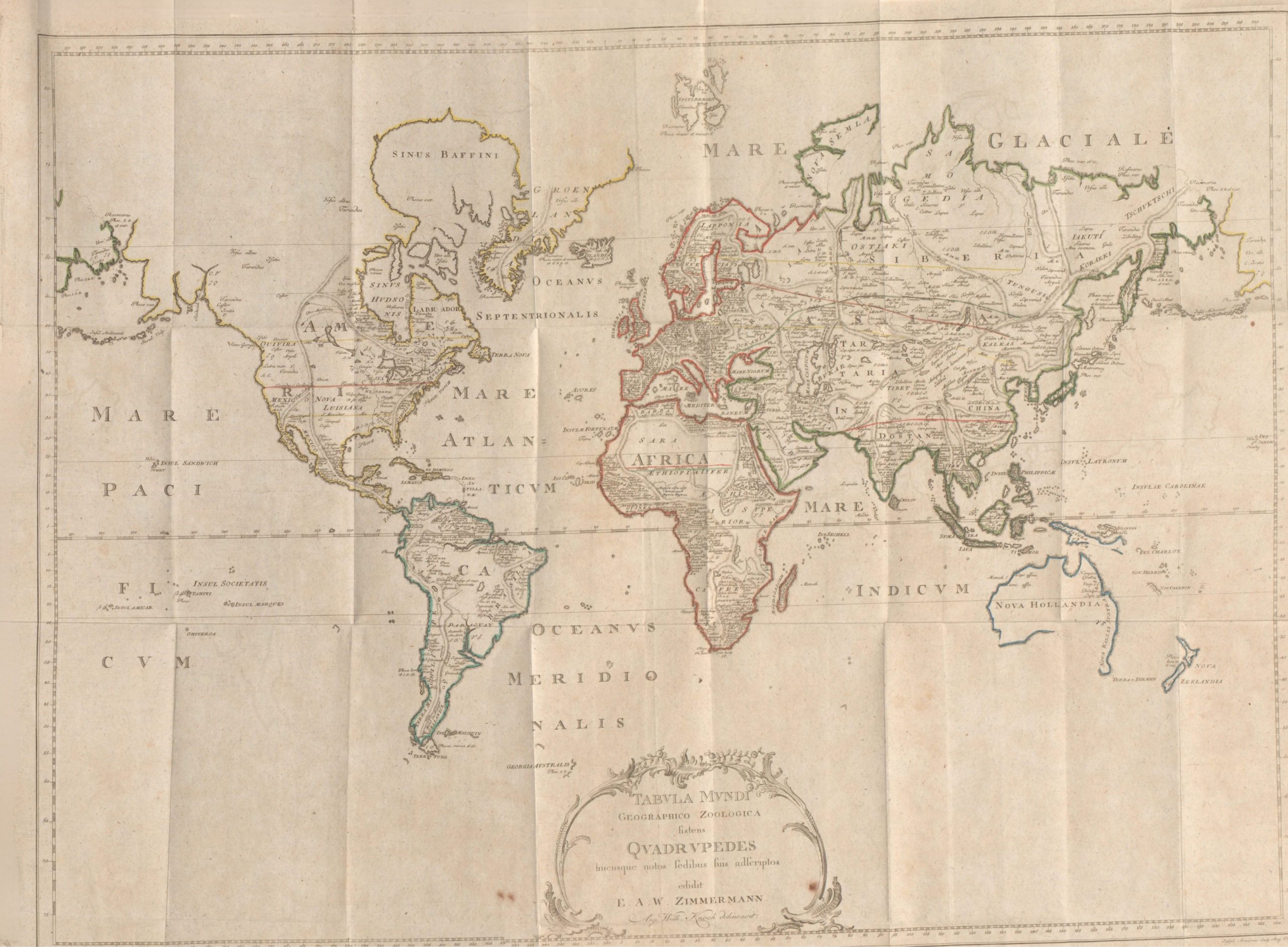
Tabula mundi geographico zoologica sistens quadrupedes(1783) from Zimmermann, Eberhard August Wilhelm von. 1778. Geographische Geschichte des Menschen, und der allgemein verbreiteten vierfüssigen Thiere : nebst einer hieher gehörigen zoologischen Weltcharte. Leipzig: In der Weygandschen Buchhandlung. https://www.biodiversitylibrary.org/bibliography/221536.
Finding the work to be historically important to mammalian biogeography, not widely held nor digitized in BHL, and connected to the Field Museum through its role in securing the work’s recognition for zoological nomenclature, I considered this acquisition an obvious choice.
I’m happy to report that Geographische Geschichte des Menschen, und der allgemein verbreiteten vierfüßigen Thiere, nebst einer hieher gehörigen Zoologischen Weltcharte is now available in BHL. Having access to both this three-volume edition and the rejected 1777 title, alongside the International Commission on Zoological Nomenclature’s ruling, provides a compelling case study in the development of zoological nomenclature, the changing standards by which scientific works are evaluated, and the ways in which new evidence can reshape our understanding of the natural world. As the 1954 ICZN opinion suggests, a work published in the 18th century can continue to have a life in the scientific record and be actively reassessed centuries later.
Further reading
In addition to the sources linked above, I also referred to the following:
Allen, J. A. (1902). Zimmermann’s ‘Zoologiae Geographicae’ and ‘Geographische Geschichte’ considered in relation to their zoological nomenclature. Bulletin of the American Museum of Natural History, 16, 13–22. https://digitallibrary.amnh.org/items/22a3b549-b2a3-4e28-b2aa-7758c85641fe
American Society of Mammalogists. (n.d.). Glis glis (Linnaeus, 1766): European fat dormouse. Mammal Diversity Database. https://www.mammaldiversity.org/taxon/1001506
Delaney, J. (2012). First X, then Y, now Z: Landmark thematic maps. Princeton University Library. https://static-prod.lib.princeton.edu/visual_materials/maps/websites/thematic-maps/contents.html
Lotzof, K. (n.d.). Endeavour 250: Natural history through colonial encounter. Natural History Museum. https://www.nhm.ac.uk/discover/hms-endeavour-250.html
From the Biodiversity Heritage Library
For 20 years, BHL has helped bring works like Zimmermann’s out of rare book collections and into the hands of researchers and readers around the world. With your support, we can continue to preserve, connect, and provide open access to the scientific record – including works whose significance is still being rediscovered centuries later.

Discover more from Biodiversity Heritage Library
Subscribe to get the latest posts sent to your email.

Elizabeth McKinley is the Library Director at the Field Museum in Chicago. She also co-chairs BHL’s Cataloging and Metadata Committee.

Leave a Comment