Biodiversity Heritage Library - Program news and collection highlights from BHL
  • Home
  • News
  • Featured Books
    • All Featured Books
    • Book of the Month Series
    • BHL at 20
  • User Stories
  • Campaigns
    • Fossil Stories
    • Garden Stories
    • Monsters Are Real
    • Page Frights
    • Her Natural History
    • Earth Optimism 2020
  • Tech Blog
  • Visit BHL
Home
News
Featured Books
    All Featured Books
    Book of the Month Series
    BHL at 20
User Stories
Campaigns
    Fossil Stories
    Garden Stories
    Monsters Are Real
    Page Frights
    Her Natural History
    Earth Optimism 2020
Tech Blog
Visit BHL
  • Home
  • News
  • Featured Books
    • All Featured Books
    • Book of the Month Series
    • BHL at 20
  • User Stories
  • Campaigns
    • Fossil Stories
    • Garden Stories
    • Monsters Are Real
    • Page Frights
    • Her Natural History
    • Earth Optimism 2020
  • Tech Blog
  • Visit BHL
Biodiversity Heritage Library - Program news and collection highlights from BHL
Blog Reel, Featured Books

Rejected to Accepted: E.A.W. Zimmermann’s Geographische Geschichte des Menschen, und der allgemein verbreiteten vierfüßigen Thiere

An historic map on yellowed paper

This post is part of BHL at 20: Treasures from the Biodiversity Heritage Library, a series contributed by members of the BHL community, highlighting remarkable works from across the collection in celebration of its 20th anniversary.

The Field Museum’s Marie Louise Rosenthal Library is fortunate to have a small fund dedicated to the purchase of rare books. As a result, Library staff are often on the lookout for titles that fall within our natural history collecting scope while also meeting the criteria of being both historically valuable and scientifically significant.

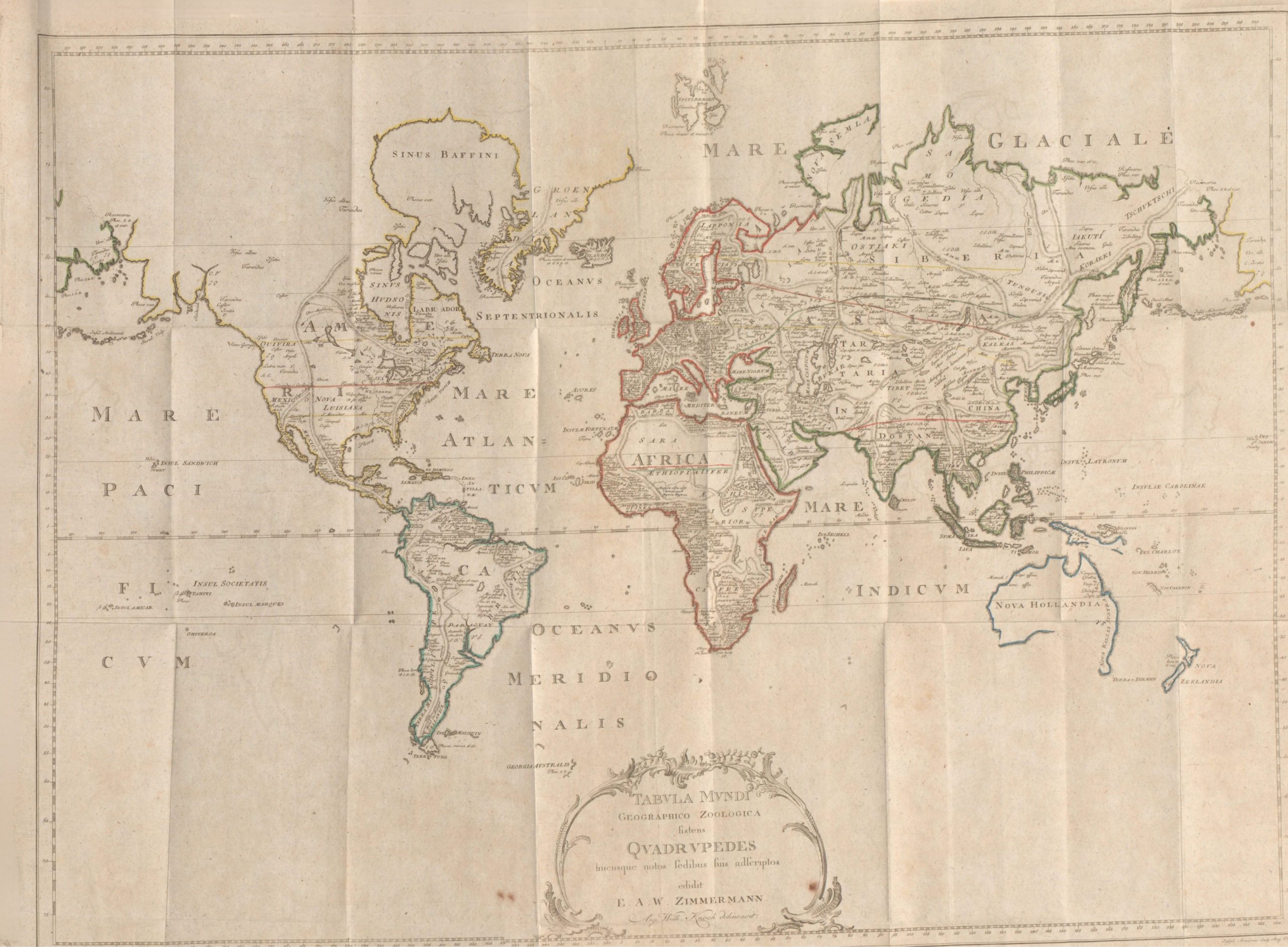
In March, I came across an interesting zoological title for sale: Geographische Geschichte des Menschen, und der allgemein verbreiteten vierfüßigen Thiere, nebst einer hieher gehörigen Zoologischen Weltcharte, a three-volume work on biogeography published between 1778 and 1783 by Eberhard August Wilhelm von Zimmermann, a German geographer, zoologist, and mathematician. The work also includes a fold-out map, Tabula Mundi Geographico Zoologica sistens Quadrupedes hucusque notos sedibus suis adscriptos edidit, which has been described as the first world map of zoological geography, illustrating late-eighteenth-century understandings of the global distribution of mammals.

Before purchasing a title for the rare book collection, I evaluate whether it fits the Library’s collecting scope, whether it is scientifically valuable, which institutions hold copies, and whether a digital version is already available in BHL. As I looked into Geographische Geschichte des Menschen und der allgemein verbreiteten vierfüßigen Thiere, I learned that Zimmermann had published an earlier edition in Latin in 1777 under a different title: Specimen zoologiae geographicae, quadrupedum domicilia et migrationes sistens, which is available in BHL.

A subsequent search led me to another BHL resource: Opinions and Declarations Rendered by the International Commission on Zoological Nomenclature (1954). In Opinion 257, the Commission rejected Specimen zoologiae geographicae, quadrupedum domicilia et migrationes sistens for “nomenclatorial purposes.” In short, the 1777 edition did not satisfy the requirements of Article 25 of the Règles internationales de la nomenclature zoologique, the predecessor of today’s International Code of Zoological Nomenclature. The work was consequently placed on the “Official Index of Rejected and Invalid Works in Zoological Nomenclature.”

The yellowed cover of an historic scientific publication with a black border and a library stamp.

The International Commission on Zoological Nomenclature’s 1954 opinion rejecting E.A.W. Zimmermann’s Specimen zoologiae geographicae, quadrupedum domicilia et migrationes sistens (1777) and accepting his later work Geographische Geschichte des Menschen, und der allgemein verbreiteten vierfüßigen Thiere, nebst einer hieher gehörigen Zoologischen Weltcharte (1778–1783).

Even more interestingly, further reading revealed that this opinion had a connection to the Field Museum. The Commission’s ruling stemmed in part from correspondence between Francis Hemming, Secretary of the Commission, and Wilfred H. Osgood of the Field Museum, who advocated for the recognition of Geographische Geschichte. Hemming also consulted Philip Hershkovitz, then Curator of Mammals at the Field Museum, who supported Osgood’s position. (This correspondence is summarized in the published statement of the case.)

Fortunately, the Commission confirmed that binomial nomenclature was applied in Zimmermann’s later publication, and therefore declared Geographische Geschichte des Menschen, und der allgemein verbreiteten vierfüßigen Thiere, nebst einer hieher gehörigen Zoologischen Weltcharte to be included on the “Official List of Works Approved as Available for Zoological Nomenclature.”

It is clear that Zimmermann greatly revised and improved his work in the German edition. Notably, Geographische Geschichte debuted several binomial names that are still attributed to Zimmermann, including Cervus muntjak, Lutra minima (known today as Chironectes minimus), and Canis zerda (known today as Vulpes zerda).

Two pages from historic scientific descriptions in Latin script

In his 1777 edition, Zimmermann failed to consistently apply binomial nomenclature, instead using a combination of generic or descriptive names. For example, in Specimen zoologiae geographicae, Zimmermann refers to a species of dormouse as Glis seu Rattus somnolentus (Left). However, in volume 2 (1780) of Geographische Geschichte, Zimmermann uses the binomial Myoxus glis (right). Today, the species is known as Glis glis.

In addition to the improved nomenclature, Geographische Geschichte also features an updated version of the Tabula mundi geographico zoologica, which incorporates new geographical information derived largely from recent travelers’ reports, including those from Captain James Cook and his crew. For example, the 1783 map reflects Cook’s “discovery” of the Sandwich Islands (Hawaii) and provides a more complete rendering of the western coast of North America. The Seychelles is also named east of mainland Africa, where the French established their colonial settlement just thirteen years prior.

On the fold-out map, names of quadrupeds are plotted directly onto their geographic ranges. Zimmermann’s use of nomenclature varies here. In some instances, he uses the genus alone; in others, the species epithet or full binomen; and, occasionally, a common name. Castor (beaver), for example, appears across northern North America, as does Bison; Tigris (tiger) can be found in Asia; and Kanguro (kangaroo) appears in New Holland (Australia), where the animal was first recorded for European science by Daniel Solander, a botanist aboard Cook’s ship, the HMS Endeavour.
An historic map on yellowed paper

Tabula mundi geographico zoologica sistens quadrupedes(1783) from Zimmermann, Eberhard August Wilhelm von. 1778. Geographische Geschichte des Menschen, und der allgemein verbreiteten vierfüssigen Thiere : nebst einer hieher gehörigen zoologischen Weltcharte. Leipzig: In der Weygandschen Buchhandlung. https://www.biodiversitylibrary.org/bibliography/221536.

Finding the work to be historically important to mammalian biogeography, not widely held nor digitized in BHL, and connected to the Field Museum through its role in securing the work’s recognition for zoological nomenclature, I considered this acquisition an obvious choice.

I’m happy to report that Geographische Geschichte des Menschen, und der allgemein verbreiteten vierfüßigen Thiere, nebst einer hieher gehörigen Zoologischen Weltcharte is now available in BHL. Having access to both this three-volume edition and the rejected 1777 title, alongside the International Commission on Zoological Nomenclature’s ruling, provides a compelling case study in the development of zoological nomenclature, the changing standards by which scientific works are evaluated, and the ways in which new evidence can reshape our understanding of the natural world. As the 1954 ICZN opinion suggests, a work published in the 18th century can continue to have a life in the scientific record and be actively reassessed centuries later.

Further reading

In addition to the sources linked above, I also referred to the following:

Allen, J. A. (1902). Zimmermann’s ‘Zoologiae Geographicae’ and ‘Geographische Geschichte’ considered in relation to their zoological nomenclature. Bulletin of the American Museum of Natural History, 16, 13–22. https://digitallibrary.amnh.org/items/22a3b549-b2a3-4e28-b2aa-7758c85641fe

American Society of Mammalogists. (n.d.). Glis glis (Linnaeus, 1766): European fat dormouse. Mammal Diversity Database. https://www.mammaldiversity.org/taxon/1001506

Delaney, J. (2012). First X, then Y, now Z: Landmark thematic maps. Princeton University Library. https://static-prod.lib.princeton.edu/visual_materials/maps/websites/thematic-maps/contents.html

Lotzof, K. (n.d.). Endeavour 250: Natural history through colonial encounter. Natural History Museum. https://www.nhm.ac.uk/discover/hms-endeavour-250.html

From the Biodiversity Heritage Library

For 20 years, BHL has helped bring works like Zimmermann’s out of rare book collections and into the hands of researchers and readers around the world. With your support, we can continue to preserve, connect, and provide open access to the scientific record – including works whose significance is still being rediscovered centuries later.

Orange button with a heart icon

August 18, 2026by nkearney
Blog Reel, User Stories

Exploring the People and Stories Behind the Names: BHL Empowers Research on Taxonomic History

white and green bird sitting atop a black and white sketch of a branch

In 1780, French naturalist François Le Vaillant traveled to the Cape of Good Hope and subsequently spent several years studying the region’s biodiversity. During his three journeys—the first around Cape Town and Saldanha Bay (April to August 1781), the second eastwards from the Cape (December 1781 to May 1783), and the third to the Orange River and into Great Namaqualand (June 1783 to c. May 1784)—Le Vaillant amassed a collection of thousands of specimens. Upon returning to Europe, he published accounts of his travels within Voyage dans l’intérieur de l’Afrique (1790, 2 vols.) and Second voyage dans l’intérieur de l’Afrique (1796, 3 vols.)—both of which were best sellers and were translated into several languages.

Within these narratives, Le Vaillant writes repeatedly of his Khoikhoi guide, whom he called Klaas (but whose name in Klaas’s own Khoe language seems to be unrecorded). Le Vaillant’s respect and affection for Klaas is evident. In the first volume of his Voyage dans l’intérieur de l’Afrique, Le Vaillant writes:

“…le bon Klaas fut déclaré mon égal, mon frère, le confident de tous mes plaisirs, de mes disgrâces, de toutes mes pensées ; il a plus d’une fois calmé mes ennuis, & ranimé mon courage abattu.” [“…the good Klaas is declared my equal, my brother, the confidant of all my pleasures, of my disgraces, of all my thoughts; he has more than once calmed my troubles, & revived my shattered courage.”]

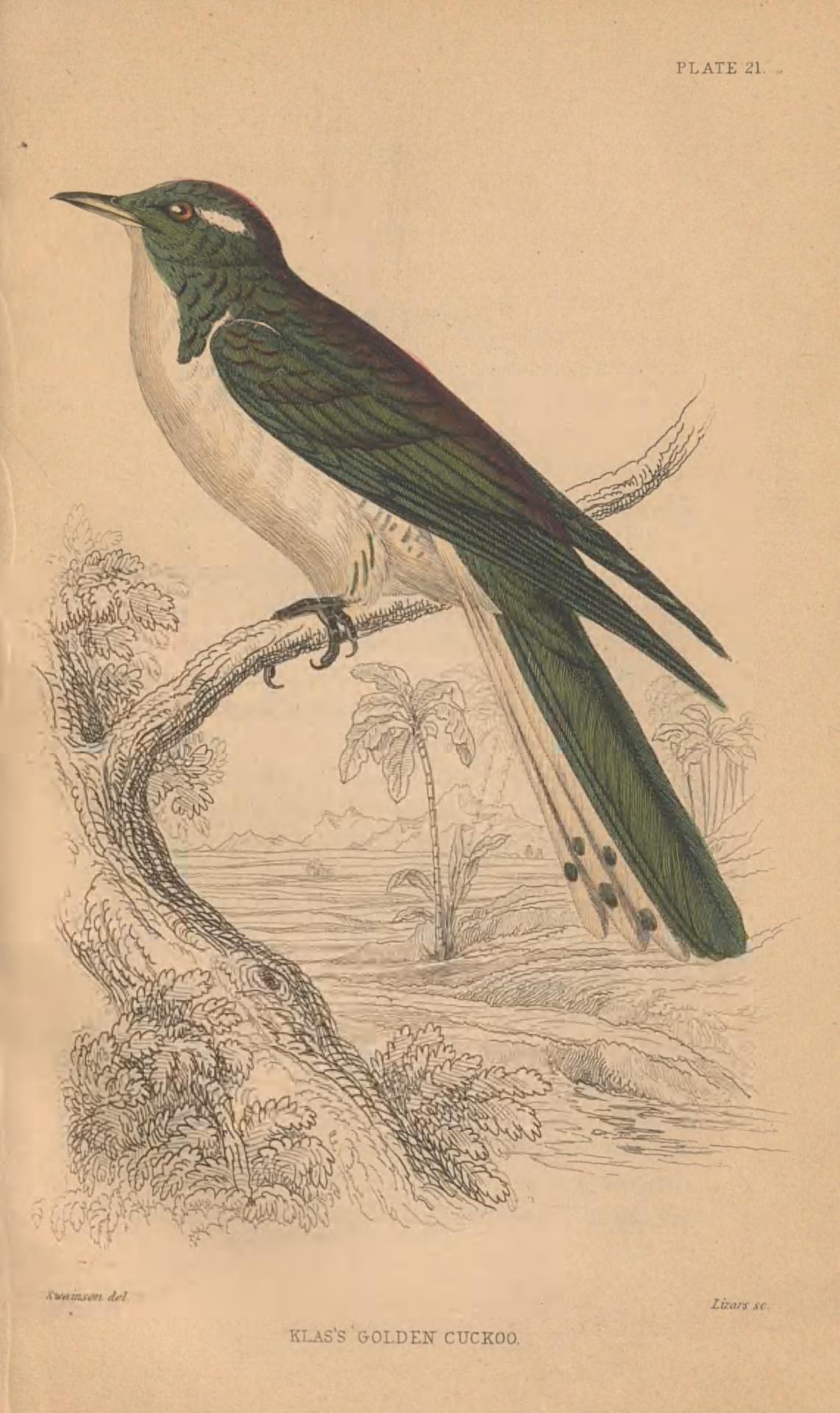
Klaas, of whom Le Vaillant wrote “by long practice [he] had become a naturalist”, also collected specimens for the French naturalist, which Le Vaillant later described within publications such as Histoire naturelle des oiseaux d’Afrique (1796–1808, 6 vols.). One such specimen was that of Klaas’s cuckoo, a species native to the wooded regions of sub-Saharan Africa. According to Le Vaillant, Klaas collected the specimen “près de la rivière Platte” (“near the Platte river”). It was the only individual of this species that the company encountered during their expedition.

When Le Vaillant published his account of the species within Histoire naturelle des oiseaux d’Afrique (v. 5, 1806), he named it “Le Coucou de Klaas” in honor of “mon ami Klaas”, writing:

“Puissent les naturalistes conserver à l’espèce que je vais décrire, le nom que je lui donne, et consacre ainsi les services que tu m’as rendus: ils me prouveront par là que mes travaux ont eu quelque prix à leurs yeux.” [“May naturalists preserve for the species I am going to describe, the name I give it, and thus consecrate the services you have rendered me: they will prove to me by this that my work has had some value in their eyes.”]

white and green bird sitting atop a black and white sketch of a branch

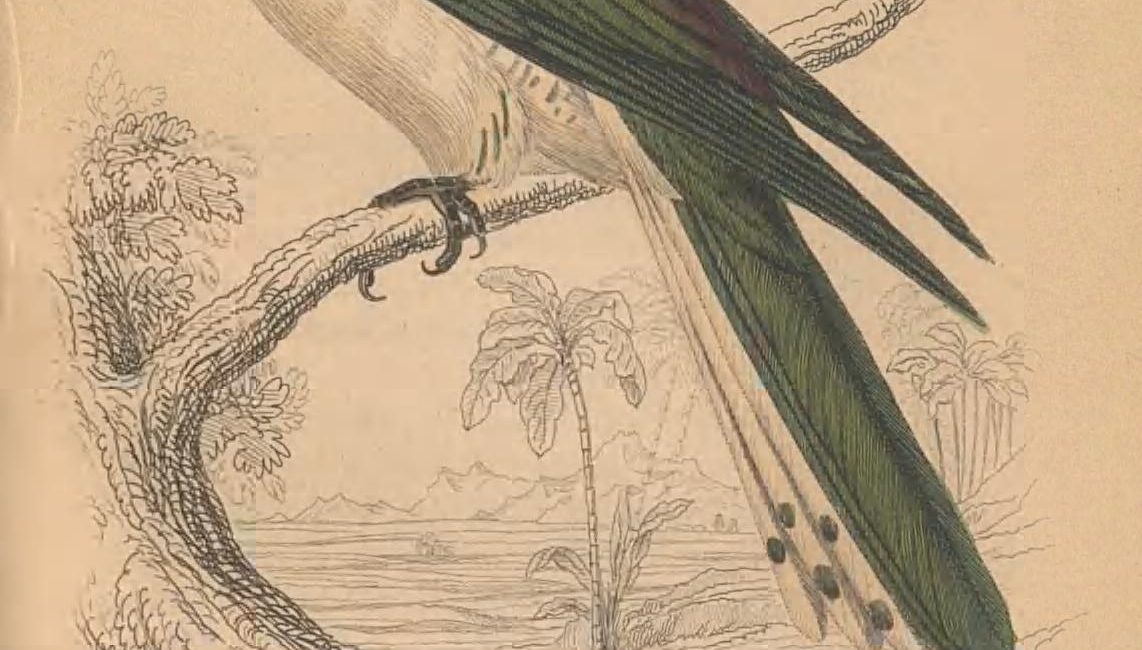
Klaas’s cuckoo (Chrysococcyx klaas). Engraving by William Lizars after William Swainson from Sir William Jardine’s Naturalist’s Library: Ornithology (v. 12, 1853 edition). Contributed in BHL from the Musée cantonal de zoologie, Lausanne.

While Le Vaillant, who opposed the Linnaean classification system, provided only French names to the species he described, future naturalists did fortunately honor Le Vaillant’s commemoration of Klaas. Some ten years after Le Vaillant’s description was published, English zoologist James Francis Stephens made a formal redescription of the species, designating it Cuculus klaas (now Chrysococcyx klaas).

Eponymous scientific naming, or the practice of naming a species after an individual, is the subject of Dr. Stephen B. Heard’s book, Charles Darwin’s Barnacle and David Bowie’s Spider (2020). Klaas’s cuckoo is the earliest example of a species being named after an Indigenous person that Heard has been able to trace. While researching the name for his book, Heard relied on the Biodiversity Heritage Library (BHL) to access Le Vaillant’s description of Klaas’s cuckoo and uncover more about the story behind the name.

“BHL is an incredibly rich resource,” lauds Heard. “These older names are often frustrating to puzzle out. In general, there’s no single index of name etymologies—you have to look for the paper that originally described the species and hope the name is explained. When I’m working on books or blog posts where I can explore my interests in the history of science, I use BHL every day.”

man in dark t-shirt with brown jacket standing in mossy landscape

Dr. Stephen B. Heard, pictured in the Wesman Islands of Iceland. Photo by: Kristie S. Heard.

Heard, an evolutionary ecologist, is a Professor of Biology at the University of New Brunswick in Canada. His “everyday” research concerns the ecology and evolution of plant-insect interactions, for which he relies on modern literature. However, some of his recent projects have taken a more historical turn—a turn that led him to BHL.

“My first book, The Scientist’s Guide to Writing, explores some of the history and social context of scientific writing,” shares Heard. “In trying to explain the evolution of what’s now a quite standardized writing form (the scientific paper), I dipped into writing as far back as the 1660s. BHL is a wonderful place to find that old literature.”

Heard found himself relying on BHL once again during his research on eponymous names for Charles Darwin’s Barnacle and David Bowie’s Spider.

“As I began work on Charles Darwin’s Barnacle and David Bowie’s Spider, I discovered that an enormous amount of taxonomic literature, in particular, is available online via BHL—and not just the obvious major journals,” says Heard. “The collection includes books, obscure memoirs of regional natural history societies, you name it. Most of that older and more obscure literature is not available through my university library, so BHL is a critical resource for me.”

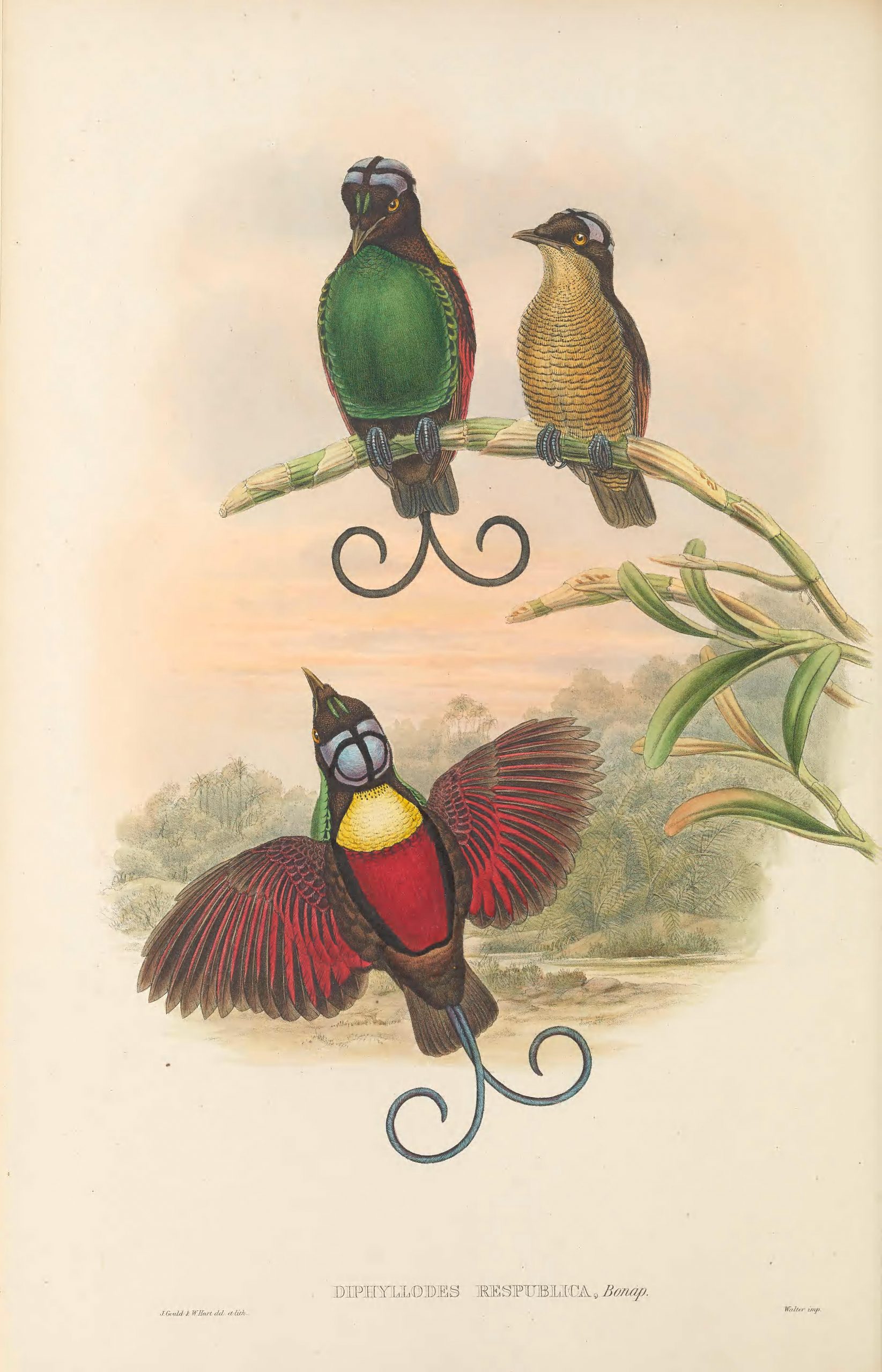
For Heard, one of the best things about eponymous scientific names is the insight they provide on the personality and humanity of scientists. Take, for example, French ornithologist Charles Lucien Bonaparte (nephew of Napoleon Bonaparte), who named over 200 bird species and over 250 bird genera. Heard was particularly struck by a paradox in two of Bonaparte’s namings: the bird of paradise Diphyllodes respublica and the imperial pigeon Ptilocolpa carola.

three birds, one red and in flights, one green, one yellow, the latter two seated on a branch

Bird of paradise (Diphyllodes respublica). Illustration by John Gould and William Matthew Hart from Gould’s The birds of New Guinea and the adjacent Papuan islands, v. 1 (1875-1888). Contributed in BHL from Smithsonian Libraries.

“Bonaparte named the bird of paradise as a statement of his republican ideals (perhaps a bit risky for a nephew of Napoleon), but he named the pigeon for his ‘daughter the countess Primoli, Charlotte, herself worthy of her illustrious name,’” explains Heard. “The inconsistency between Bonaparte’s republicanism and his mention of his daughter’s title and ‘illustrious name’ is fascinating—a good illustration of how scientific practice isn’t immune to the foibles and humanity of scientists themselves. As I worked on Charles Darwin’s Barnacle and David Bowie’s Spider, and spent more and more time with the writing of those who describe and (eponymously) name species, I was more and more struck by the creativity and humanity behind the act.”

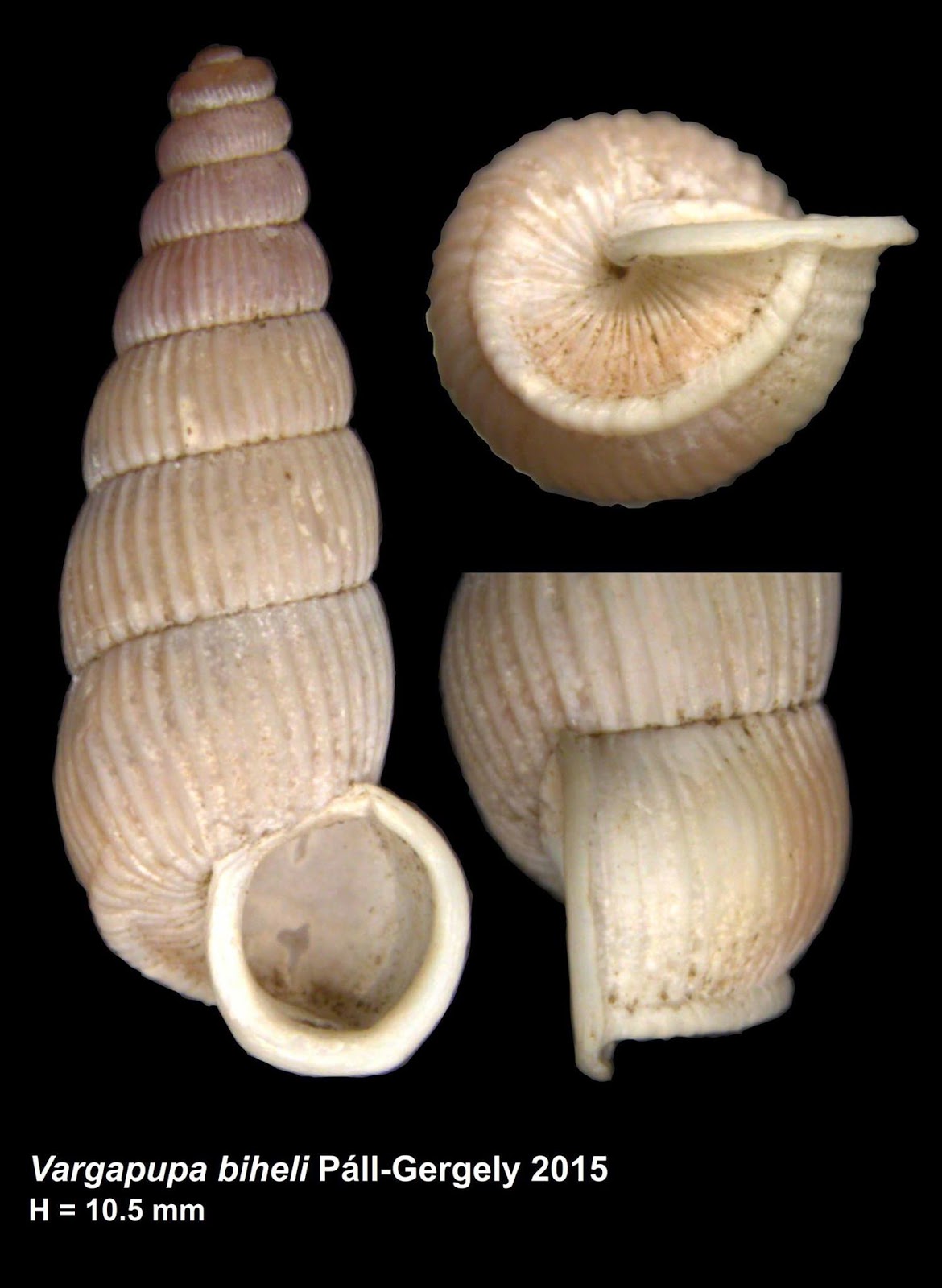
By providing free and open access to scientific literature, BHL is not only empowering modern taxonomic research, but also allowing researchers like Dr. Heard to learn more about the history of taxonomy and the people and stories behind the names. BHL’s impact on science has been recognized through modern-day eponymous naming. In 2015, a new land snail species from Laos—Vargapupa biheli Páll-Gergely, 2015—was named in honor of BHL. As author Dr. Barna Páll-Gergely wrote in the paper publishing the name:

“The new species is named after the Biodiversity Heritage Library (www.biodiversitylibrary.org) to thank the multitude of rare literature made available to us. The name ‘biheli’ is an acronym derived from the name BIodiversity HEritage Library.”

one full and two dissected shells, in a light cream color against a black background

Vargapupa biheli Páll-Gergely, 2015, named in honor of BHL. Photo by: Barna Páll-Gergely.

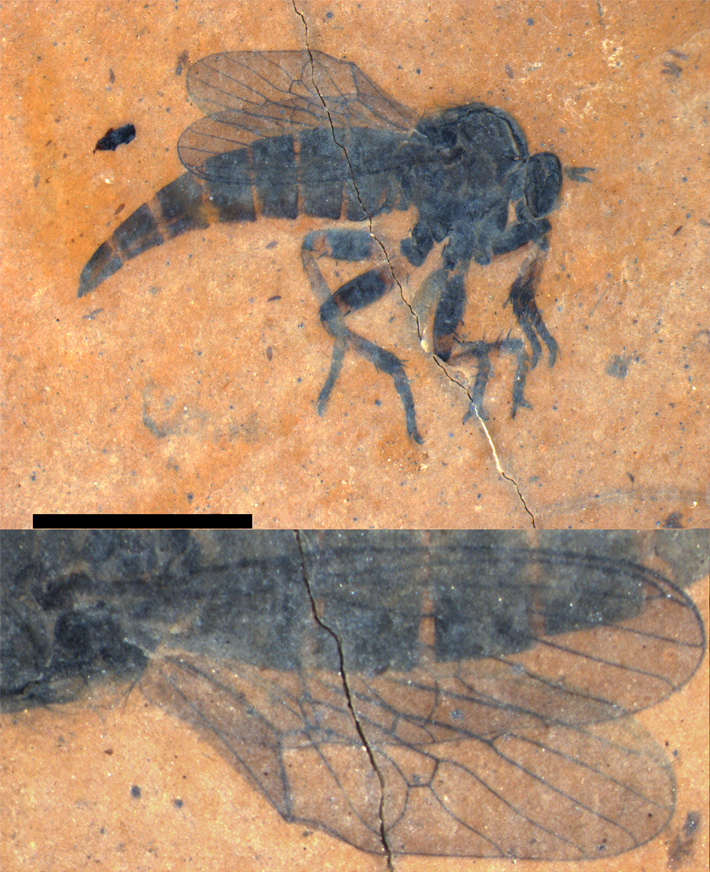
In 2019, a new species of fossil robber fly—Kishenehnoasilus bhl Dikow, 2019—was named in honor of BHL. On selecting this name, author Dr. Torsten Dikow shared:

“Taxonomic research involves not only the study of specimens, but also the review of often old literature. Having digital access to publications enhanced with tools such as scientific name recognition makes my research so much more efficient. The Biodiversity Heritage Library provides a lens into the literature published a long time ago. The same is true for this new species of robber fly, as it helps us to understand and document the past of biodiversity.”

a black fossilized fly preserved in orange amber.

Kishenehnoasilus bhl Dikow, 2019, named in honor of BHL. Photo by: Dale Greenwalt.

Whether it be as a vehicle to teach us more about an individual recognized in a species name, a window into the personalities and lives of the scientists naming species, or an opportunity to highlight the impact of policies like open access on global research, a species name is often a story waiting to be told—stories that BHL and its open access collections can help tell.

October 22, 2020by michelle.underhill

Help Support BHL

BHL's existence depends on the financial support of its patrons. Help us keep this free resource alive!

search

About BHL

The Biodiversity Heritage Library (BHL) is the world’s largest open access digital library for biodiversity literature and archives. BHL operates as a worldwide consortium of natural history, botanical, research, and national libraries working together to digitize the natural history literature held in their collections and make it freely available for open access as part of a global “biodiversity community.”

Join Our Mailing List

Sign up to receive the latest news, content highlights, and promotions.

Subscribe Now

Subscribe to Blog via Email

Enter your email address to subscribe to this blog and receive notifications of new posts by email.

Join 319 other subscribers

Subscribe to Blog Via RSS

Subscribe to the blog RSS feed to stay up-to-date on all the latest BHL posts.

Access RSS Feed

Inspiring Discovery through Free Access to Biodiversity Knowledge.

The Biodiversity Heritage Library makes it easier than ever for you to access the information you need to study and explore life on Earth…for free, anytime, anywhere.


ABOUT | HARMFUL CONTENT | PRIVACY | SITE MAP | TERMS OF USE