Biodiversity Heritage Library - Program news and collection highlights from BHL
  • Home
  • News
  • Featured Books
    • All Featured Books
    • Book of the Month Series
    • BHL at 20
  • User Stories
  • Campaigns
    • Fossil Stories
    • Garden Stories
    • Monsters Are Real
    • Page Frights
    • Her Natural History
    • Earth Optimism 2020
  • Tech Blog
  • Visit BHL
Home
News
Featured Books
    All Featured Books
    Book of the Month Series
    BHL at 20
User Stories
Campaigns
    Fossil Stories
    Garden Stories
    Monsters Are Real
    Page Frights
    Her Natural History
    Earth Optimism 2020
Tech Blog
Visit BHL
  • Home
  • News
  • Featured Books
    • All Featured Books
    • Book of the Month Series
    • BHL at 20
  • User Stories
  • Campaigns
    • Fossil Stories
    • Garden Stories
    • Monsters Are Real
    • Page Frights
    • Her Natural History
    • Earth Optimism 2020
  • Tech Blog
  • Visit BHL
Biodiversity Heritage Library - Program news and collection highlights from BHL
Blog Reel

Collaboration and Dedication: Digitizing Legacy Publications of the Asiatic Society

Illustration of Madhuca plant with blog title and BHL logo.

This post is part of BHL at 20: Treasures from the Biodiversity Heritage Library, a series contributed by members of the BHL community, highlighting remarkable works from across the collection in celebration of its 20th anniversary.

As the Digital Collections Manager for the Biodiversity Heritage Library, my take on the treasures of BHL’s collection is less about the content or significance of any particular title, and more about the work over many (many) years behind the scenes by the people within BHL partner institutions to bring these treasures from the shelves to the screen and make them accessible and discoverable for anyone with an internet connection. Building on a blog I posted in 2013, I would like to revisit the treasure that is the Journal of The Asiatic Society and its legacy publications in BHL.

The Asiatic Society

In 1784, the Asiatick Society was founded by Sir William Jones through British India’s highest court at the time, in Kolkata.1 The goal of the society was to study the “History, Civil and Natural, the Antiquities, Arts, Sciences, and Literature of Asia.”2 To this day, more than 240 years later, The Asiatic Society continues as a foundational society for learning in India and “the oldest surviving publishing house of the country.”3 Its publications span from 1788 to the present and cover a wide variety of research topics and interdisciplinary studies throughout the cultural and natural sciences, including literature and medicine. Its rich “legacy of […] promoting a comprehensive understanding of humanity’s intellectual and practical endeavors,” is evidenced by its status as an Institution of National Importance by the Indian government.3
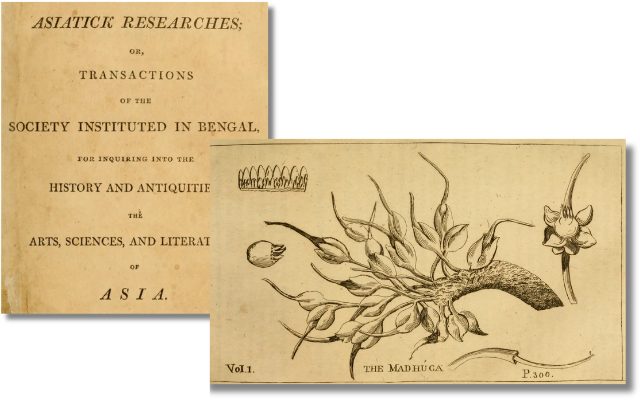
Pages from the Asiatic researches, or, Transactions of the Society instituted in Bengal v.1 (1806)

Pages from Asiatic Researches; or, Transactions of the Society Instituted in Bengal, v.1 (1806), title page and p.300

1 Journal, 9 Institutions, 11 Years

Back in June of 2010, the founding institutions of BHL began a major digitization project that would span the work of 11 years, 9 institutions, 19 people, 40 tickets within BHL’s issue tracking system, over 82 comments on those tickets, and countless hours of work. Was this part of a grant-funded project to facilitate the digitization and inclusion of millions of pages into BHL’s collection? No. This body of digitization and curation work revolves around the series of titles that are part of the Journal of The Asiatic Society. By June 2021, BHL was gratified to finally call the digitization of all public-domain volumes “complete” to the best of its ability.

With a variety of name changes over the years of its publication, BHL is pleased to provide open access to the following titles within the Journal’s history:

  • Asiatic Researches; or, Transactions of the Society Instituted in Bengal
  • Gleanings in Science
  • The Journal of the Asiatic Society of Bengal
  • Proceedings of the Asiatic Society of Bengal
  • Journal and Proceedings of the Asiatic Society of Bengal

In addition to the Journal, BHL also provides access to the Memoirs and a variety of other Asiatic Society publications.

Scanning Locally, Coordinating Globally

To help coordinate such efforts over so many people and so many years, BHL tracked the status of digitization, gap identification and fulfillment, cataloging needs, and curation tasks within its Gemini issue tracking system. This system has been in place for decades and is the source of truth on a variety of internal projects and tasks needed to run BHL’s website, increase and improve its collection, troubleshoot existing services, develop new features, etc.

Like many issue tracking systems, Gemini has myriad possibilities for configuring and customizing how tasks are categorized, organized, and managed. Almost too many for BHL’s use cases. It has taken years to learn how best to adapt the system to BHL’s needs and implement appropriate information architectures to keep projects organized. It is yet another system and login in a suite of web-based tools that are required to deliver BHL’s collection and services.

However, these internal communication tools are essential for managing the highly distributed and widely varied workforce that makes BHL’s collection and services possible. Managing the back-and-forth among 19 people over 11 years would not have been possible without an issue tracking system. It has become the backbone of BHL’s task management, providing a platform for candid, effective collaboration among consortium partner institutions.
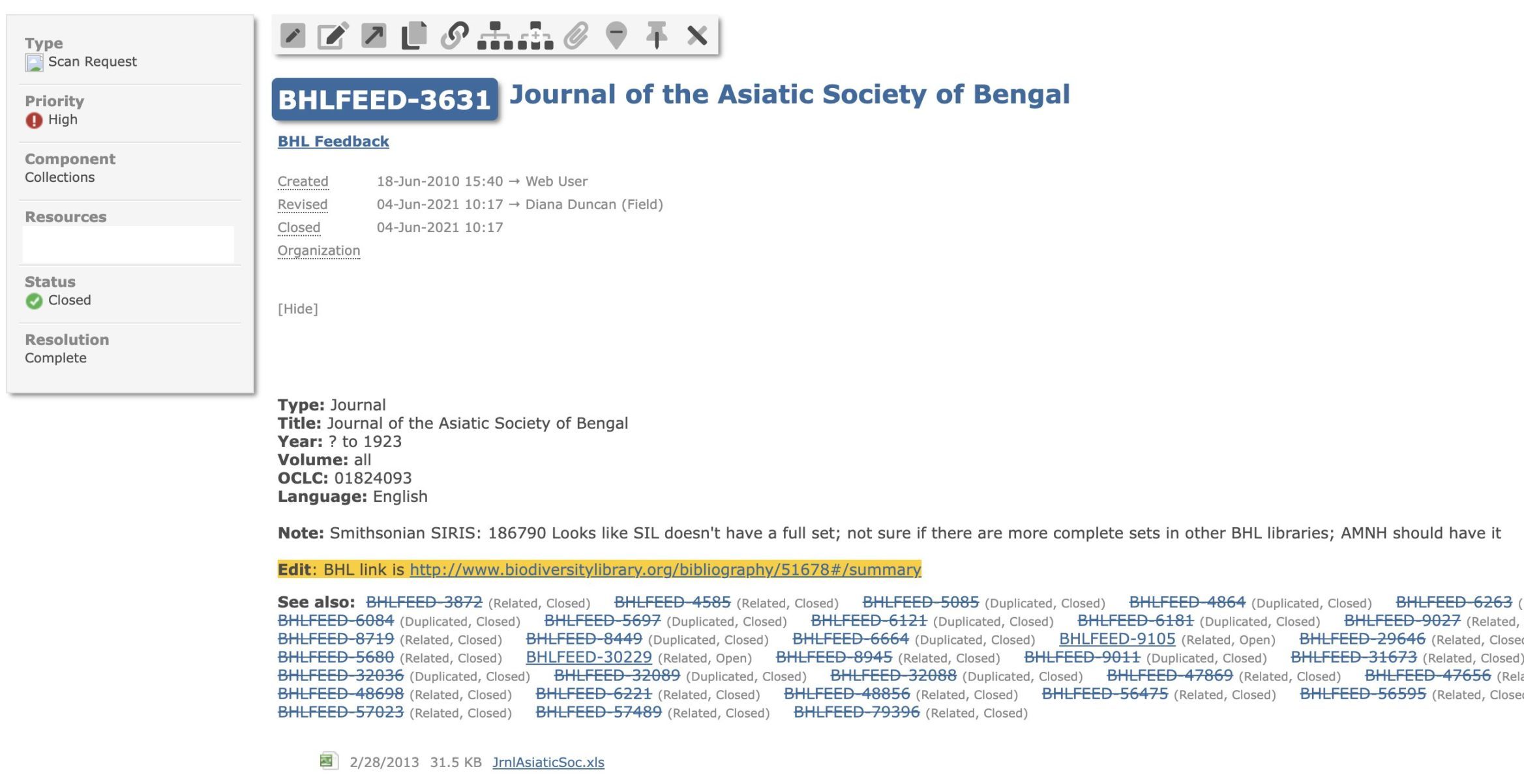
screenshot of BHL scan request ticket within Gemini issue tracking system

Screenshot of BHL scan request ticket within the Gemini issue tracking system for the Journal of the Asiatic Society of Bengal, created 2010 June, closed 2021 June.

Why did it take so long?

Despite being the world’s largest open access digital library for biodiversity literature and archives, BHL does not have dedicated digitization or cataloging staff and lacks funding for digitization. Instead, each of BHL’s partners contribute what they can of their own staff and digitization resources to integrate and curate content in BHL’s collection. As an organization, BHL has recently gone through a significant transition, adopting a shared ownership model that is now more autonomous, globally distributed, and independent of any single institution. But the core work of its consortium partners continues as it has for the past 20 years: collaborating across institutional and international boundaries to make biodiversity literature and archives openly available. The skills and abilities to exercise this level of collaboration are cultivated through a network of communication channels, systems, and committees/working groups that prioritize commitment and buy-in.

Since the closure of BHL’s major grant funding through the MacArthur Foundation in 2013, consortium partners have seen digitization resources ebb and flow. The challenges of maintaining institutional support, securing personnel, achieving grant funding, etc. affect partners’ participation in BHL’s collaborative process. Other challenges with catalog records, the condition of the physical materials, digitization equipment, software bugs, and documentation and training also impact partners’ capacity to contribute content to the BHL collection. Developed organically over time, BHL’s distributed labor model allows partners to come as they are to the organization. Partners participate autonomously and collaboratively relationships when time and resources allow.

If BHL were fortunate enough to secure a major source of long-term funding, centralized resources could help support the processing, digitization, and integration of content across the collection. Please consider supporting the Biodiversity Heritage Library with a recurring donation or planned gift.

How can we make this process more efficient going forward?

The digitization of the Journal of The Asiatic Society legacy volumes is a testament to BHL’s persistence and dedication to increasing the access, usability, discovery, and breadth of its collection — the four priorities, in order of importance, as outlined in BHL’s collection development policy. Clearly, 11 years is a very long time and it would benefit everyone to make this process shorter and more efficient. As BHL’s new chapter is being drafted, our organization is building on its Guiding Principles for the Transition to develop new partnerships, new strategic goals, and a platform modernization plan. As Digital Collections Manager, I feel it’s imperative that BHL:

  • Continue to increase our global network of partners and more widely distribute BHL’s workforce, expertise, and content acquisition strategies.
  • Encourage contributors to provide public domain materials with appropriate metadata to the Internet Archive texts corpus and work with IA to source metadata for existing items.
  • Increase systems and support for BHL uploading workflows.
  • Develop and implement more efficient content ingestion methods alongside its more modern platform to come.
  • Help advocate for the importance of book digitization and funding support.
  • Harvest more open access biodiversity content at scale.

How BHL might achieve these goals remains to be seen, but as our new chapter brings greater autonomy and agility to our organization, I am more optimistic than ever before that BHL will find a way to sustain itself for the future. Sustainability means not simply keeping the website running, but maintaining and growing its unique collection of biodiversity literature and archives.

From the Biodiversity Heritage Library

BHL’s treasures are not just the books, journals, and archives we make freely available. They’re also the people whose collaboration, care, and persistence bring them to the world. For 20 years, BHL’s global community has worked across institutions and borders to digitize, preserve, and open biodiversity knowledge for everyone. With your support, we can continue this long-term work for BHL’s next chapter.

Orange button with a heart icon

Resources

  1. Wikipedia contributors. (2026, May 26). The Asiatic Society. Wikipedia. https://en.wikipedia.org/wiki/The_Asiatic_Society
  2. F, L. L. (1946). The bicentenary of the birth of Sir William Jones, F. R. S. , founder of the Royal Asiatic Society of Bengal. Notes and Records the Royal Society Journal of the History of Science, 4(1), 58–62. https://doi.org/10.1098/rsnr.1946.0012
  3. About us | Asiatic Society. (n.d.). https://asiaticsocietykolkata.org/publications/about-us
July 1, 2026by bcrowley
Blog Reel

My Life as a BHL Staffer: Jacqueline Chapman

Have you ever spotted an error in the BHL? Have you ever experienced technical difficulties with downloading digital files from our website? Have you ever looked for an article, journal, or title in our collections and been disappointed to find that it wasn’t in BHL’s collections? Have you ever wanted to thank BHL staff for a particular article, feature, or service? Have you ever had an idea for how the BHL could improve?
If you have, I hope you have taken advantage of our Feedback system and sent your corrections, suggestions, and questions on to us!  And if you have done so recently, you may have heard from me.
View Full Size Image
My name is Jacqueline Chapman, and I have had the pleasure of responding to hundreds of messages from BHL users over the past few months as I’ve taken on the role of BHL’s virtual reference librarian. I work on the BHL as part of my duties as a Digital Collections Librarian at the Smithsonian Institution, where I participate in digital initiatives and coordinate with various staff members to digitize the collections of Smithsonian Libraries.
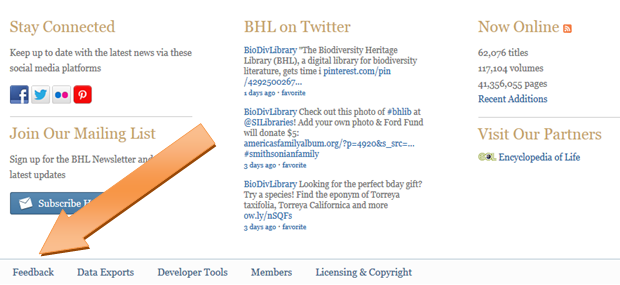
To submit feedback to the Biodiversity Heritage Library, simply scroll down to the bottom of our home page and click on Feedback.
View Full Size Image
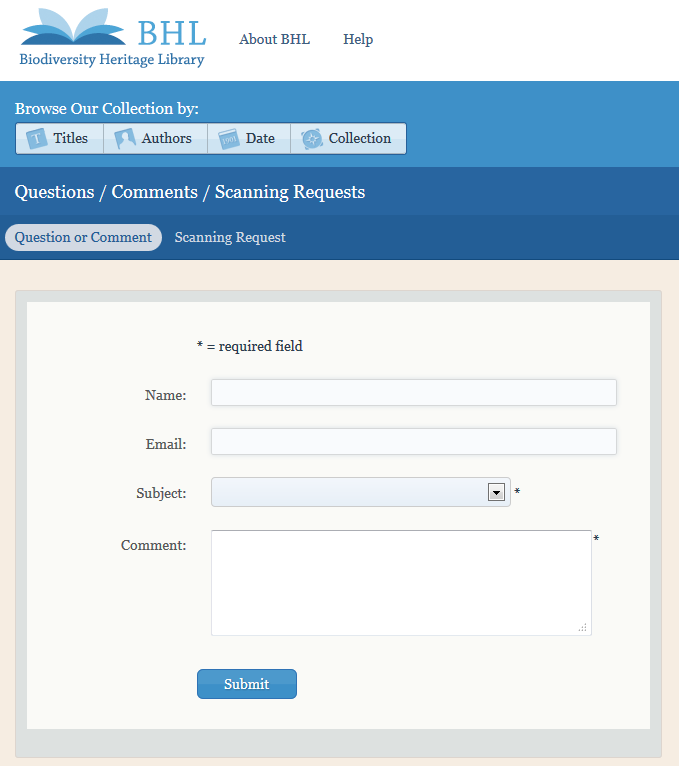
You will have the option to provide general feedback or to place a scanning request.  All submissions enter the same queue, in our back-end user feedback management system.  That’s where my work begins!
 
Questions and Comments
This section is a catch-all for user feedback that does not contain a scan request.  These may include image reuse requests, suggestions, error reporting, or technical questions.  Part of my job is to sort these submissions and determine what action is needed.
View Full Size Image
Through such user queries, I help with technical questions, investigate and fix quality issues, and answer more traditional reference questions.  I get to indulge in my enjoyment of detail-oriented intellectual tasks by merging rogue scans into their main entries, correcting metadata errors, re-sequencing volumes, merging duplicate author names, and delving into complex bibliographic mysteries. I especially enjoy sharing praise with the rest of the BHL staff!
 
Scan Requests
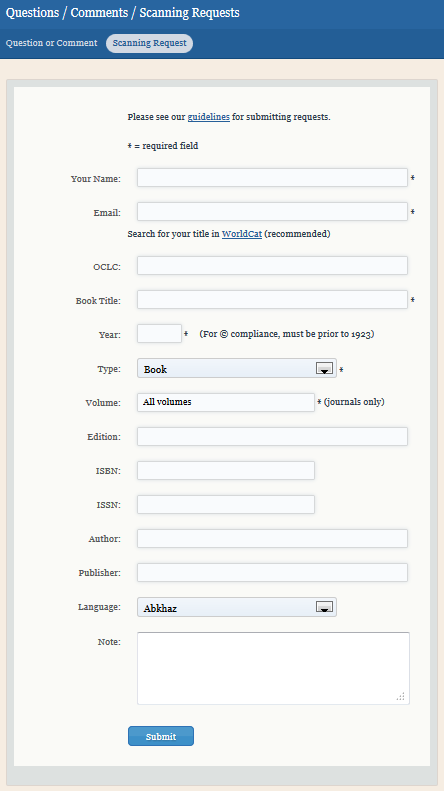
Members of the BHL user community are constantly helping our staff improve the quality of the BHL by requesting titles for inclusion and pointing out gaps in serials. A large portion of my duties consists of investigating these user submitted scan requests.
View Full Size Image
I begin by confirming that the requested item isn’t in BHL already.  Sometimes scan requests lead to the discovery of a mislabeled scan or to duplicate entries containing different volumes of the same title.  It’s great when I can satisfy a user request immediately by locating a difficult-to-find item in the BHL, and then make some changes so that it is more easily discovered by the next person.
If an item isn’t in the BHL, I check our queue to see if the item is already in progress.  We have over 1,000 issues open at any given moment, so it is not unusual for me to find that we are already hard at work on a particular scan request.
If the item is not already in progress, I will check to see if any of BHL’s member libraries holds the requested material and assign the scan accordingly.  An issue may be reassigned a number of times as institutions discover that their items are unable to be scanned, or that they lack specific volumes.  It is wonderful to see BHL collaboration in action as many partner libraries bring their collections together, digitally, in order to complete a series.
 
Submit Feedback!
I encourage you to take advantage of our feedback system. Our users make it possible for the Biodiversity Heritage Library to continually improve its offerings.  Our partners’ scanning priorities, our website’s design, the data export options that we offer, the goals we set for our project, and the social media platforms we embrace are all influenced though input from our users. We love to hear about how the BHL has aided the research of people around the world, and enjoy sharing some of the stories we hear in our BHL and Our Users feature.
Be part of the conversation!
August 21, 2013by Kathryn Stine
BHL News, Blog Reel

New Grant Helps The Field Museum Digitize Rare and Interesting Books!

View Full Size Image
Title Page Image, v. 3, Onze vogels in huis en tuin

One of the BHL partner institutions, The Field Museum Library, was recently awarded a small grant from the Consortium of Academic and Research Libraries in Illinois (CARLI) to contribute titles to the growing BHL corpus. The proposal entitled “Empowering Biodiversity Research,” allowed The Field Museum Library to contribute 34 new titles to the BHL.

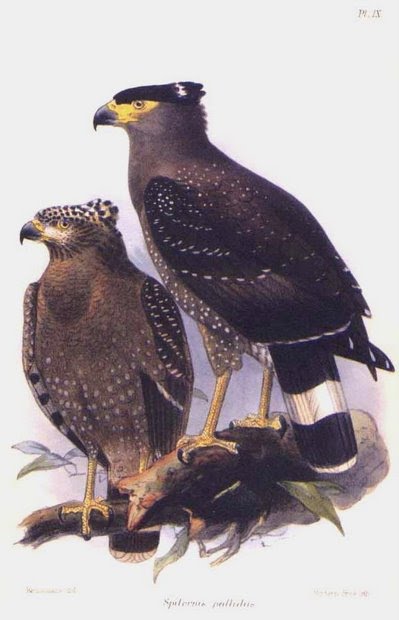
Several titles chosen for digitization came from the Library’s impressive Edward E. Ayer Ornithological Library, housed in the collections of the Mary W. Runnells Rare Book Room.

The titles were chosen for digitization via several means:

View Full Size Image
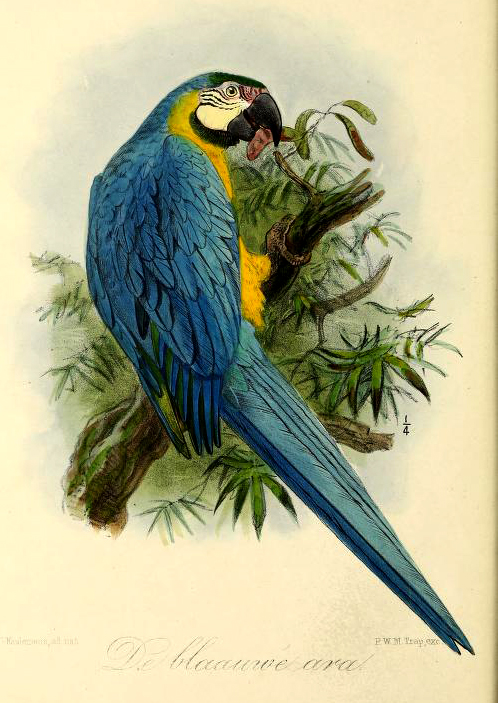
Blue Macaw. v. 3,

Onze vogels in huis en tuin

Requests received from users, which are processed via BHL’s issue tracking system, Gemini, allows us to fulfill user requests, complete series fill-in’s, and keep us organized! One item specifically requested was the famous work of Dutch illustrator John Gerard Keulemans (1842-1912), Onze vogels in huis en tuin (‘Our Birds in House and Garden’). Published in 3 volumes between 1869-1876, this collection of 200 lithographed plates were hand colored by the author. Noted for his beautiful and scientifically accurate work, Keulemans also provided illustrations for both Proceedings of the Zoological Society of London, The Ibis as well as numerous other monographs throughout the late 19th and early 20th centuries. With only 4 copies held in U.S. libraries, The Field Museum Library is the only BHL partner to own Onze vogels.


View Full Size Image
Neue Alpina, v. 1

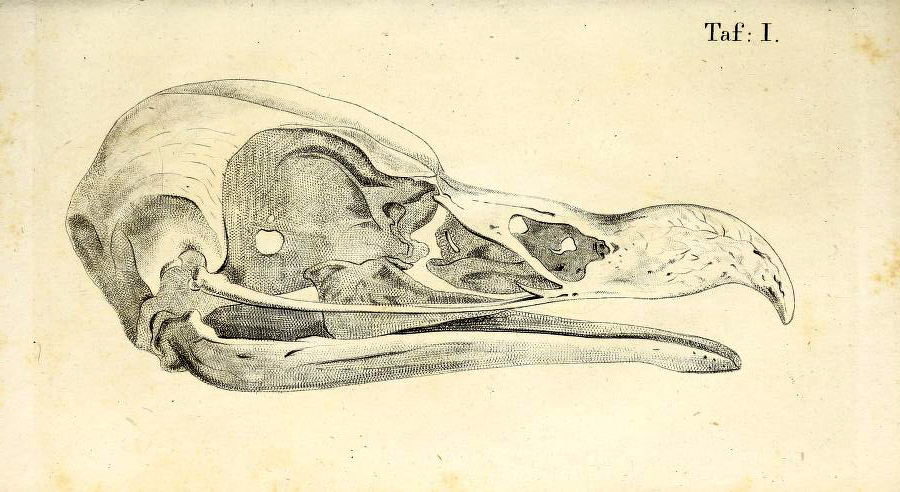
In-demand titles were also identified via the Library’s active Interlibrary Loan (ILL) program. This service allows institutions from all over the world to request loans of books or scans of articles from The Field Museum Library. Items that are out of copyright and related to biodiversity are flagged for potential digitization. The title, Neue Alpina, has been requested via ILL twice in the last six months. This periodical, complete in two volumes, was published 1821-1827 and is focused on the natural history of Switzerland. Also part of the Ayer Collection, The Field Museum Library is the only holder of this title in the U.S.

View Full Size Image
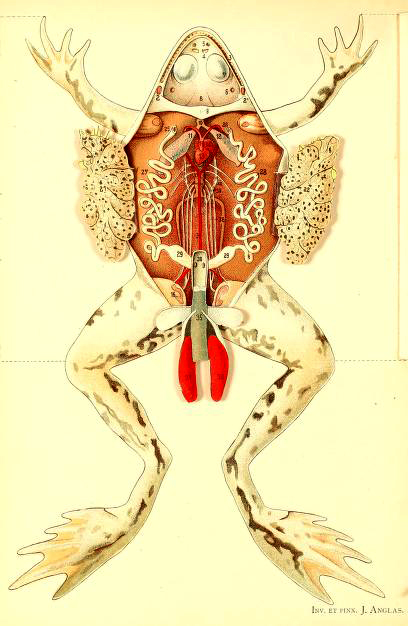
Dissected Frog. Les animaux de laboratoire

And finally, we often find pretty amazing items just by browsing the shelves! We came across an interesting item in our Herpetology Library from the collection of renowned herpetologist, Karl P. Schmidt. Les animaux de laboratoire: La grenouille (Anatomie et Dissection) is a short monograph about frog anatomy and a guide to dissection techniques. The amazing (and honestly, pretty fun) part of the book is the illustrations. The frog’s anatomy is dissected via multi-part anatomical flaps. The staff of the Internet Archive scanning center in Ft. Wayne, Indiana did a great job of capturing all of these flap elements during digitization.

Explore all items in the BHL contributed by The Field Museum Library here!

April 30, 2013by Kathryn Stine
Blog Reel, User Stories

BHL and Our Users: Mathew Louis & BHL Illustrations

View Full Size ImageThis week we feature one of our users that has taken a particular interest in BHL for the purpose of images, using BHL to strengthen the collection of scientific illustrations found on his website, http://sites.google.com/site/mmslouis/. As our users have long shown a specific interest in the images associated with BHL content, we expect that this post, and the work of our featured user, Mathew Louis, will prove to be particularly interesting to our user community.

Q: What is your title, institutional affiliation (or alternative place of employment), and area of interest?

A: Mine is a recreational interest in natural history studies and collection of image files from illustrations in natural history publications. I have a website which was originally begun as a collection of images by the illustrator John Gerrard Keulemans but has now expanded to include many other artists and natural history subjects: http://sites.google.com/site/mmslouis.

I also use the service (BHL) to review taxonomic information, such as the original citation or description of a name. For example, I have recently examined a synopsis of names relating to a genus of bats, Pteropus. BHL is useful in allowing me to trace resources which contain descriptions of more obscure names – information I could not have found elsewhere.

Q: How long have you been in your field of study?

A: The website was started in 2007, but I have always been an enthusiast of the subject in general.

Q: When did you first discover BHL?

A: About two-four years ago.

Q: What is your opinion of BHL and how has it impacted your research?

A: I could not have a better opinion of it and how it has been helpful. It is interesting to ask, because at the research library which I frequent, the staff made the decision, three years ago, to deselect and destroy all printed serial publications which were already available on the library catalogue’s database (and therefore unnecessary). The library’s database had a number of deficiencies: the quality of the images of illustrations, lack of indices/table of contents and other matter, incompleteness, and the database was inaccessible to me outside of the library. I was in the process of having scans made from one series in particular, and would have otherwise been out of luck if it were not for the same series being made available with this website, compared to a decade ago.

Q: How often do you use BHL?

A: I visit the library at the rate of once a week, and use BHL when I am using the computer. Thus, when I visit, I use it extensively.

Q: How do you usually use BHL (read the titles online/download whole PDFs/Downloading High Resolution Images/etc.)

A: I typically use BHL through Internet Archive. I use the online page view, which is excellent in how it allows for high resolution page view; this is an area where the Google Books service is deficient. I also download and save PDF files of texts.

Q: What are your favorite features/services on BHL?

A: The best aspects of the services are as follows: The ability to make requests to have scans of texts made; the efficiency of BHL when reporting problems or making queries; the high-resolution quality of the images of the pages.

Q: If you could change one thing about BHL, what would it be, or what developmental aspect would you like the BHL team to focus on next?

A: It would be helpful to receive email notification when a scan request has been carried through and the item becomes available online.

There are also some issues which might not actually apply to BHL, but rather to Internet Archive, which also provides texts from BHL. First, some of the texts are difficult to locate in a series. One example is Proceedings of the Zoological Society of London, where not all of the years (this series was not issued in numerated volumes) are clearly discernible on the list. Second, the format on Internet Archive for viewing texts was changed in the later part of 2010, and I think it would have been better to restore the previous format – it wasn’t broken. It would also be convenient if the scanned images of illustrations incorporated the entire plate, rather than in a number of cases where some have cropping.

Q: If you had to choose one title/item in BHL that has most impacted your research, or one item that you prefer above any other in BHL, what would it be and why?

A: I greatly appreciate the availability of The Ibis being made online.

Thank you, Mathew, for taking the time to share your experiences regarding BHL with us, and for sharing your website, which provides an invaluable presentation of many beautiful illustrations that might otherwise be difficult to locate.

In regards to your specific comment about providing email notification when scanning requests are completed, we hope to one day be able to provide this service. However, currently our resource limitations prevent the adoption of such a system. It may be helpful to subscribe to our rss feed of recent additions, which provides a list of all new inclusions to the BHL collection and is one method in which users can be provided with a notification of the completion of their scanning requests.

Visit Mathew Louis’ website here: http://sites.google.com/site/mmslouis.

April 26, 2011by ulib-libraryjobs
BHL News, Blog Reel

Sparking Conversations with Our Users: You Talk and We Listen

View Full Size ImageHere at BHL, we want to do a better job of connecting with our users. We want to interact with you, know what you think, what you would like to see, and have you contribute to the biodiversity conversation that shapes the development and progress of the Biodiversity Heritage Library. The recent debut of our new series on this blog, focusing on our users and how they use BHL for their work, is an example of our passion to get to know you, our users, more, and interact in new ways with you. However, the blog is not the only way we hope to accomplish this.

One method by which we converse and interact with our users is through our feedback form on BHL. This feedback form allows you, our user, to not only communicate with us about problems you’ve encountered or questions you might have, but, with the implementation of a specific request a title for scanning form last summer, 2010, it also allows our user community to actively participate in our collection development, ensuring that our resources are spent scanning the content our users truly need. Indeed, this feature has been a runaway success. Since the introduction of the request a title feature, BHL has received almost 900 requests for scanning. While our queue is long, and it will take a while to complete all of these requests, we are thrilled that our users are interacting with us in this way and helping us make sure that we focus our efforts and resources in the places that most need them.

We’ve increased our activity on Twitter and Facebook as well, striving to spark interesting dialogues about biodiversity, literature, and the brave new world (well, not quite so new anymore) of mass digitization. While we hope that this increased effort is useful and engaging for our users, from our perspective, it’s already paid off. Last week, we reached our goal of attaining 500 followers on Twitter (thanks, Ms. Brenner, for being our 500th follower!). For our next goal, we’re reaching high: 1000 followers. Pass this along to anyone you know who might be interested in conversing about the biodiversity literature field and assisting in our mission to serve up as much biodiversity literature as possible in an open access environment for the benefit of the world at large.

And if you have something to say about BHL, biodiversity, mass digitization, or any related topic, let us know. Comment on this blog, sent us a tweet to @BioDivLibrary, or post on our Facebook page. We’re listening, and we’re waiting!

February 22, 2011by michelle.underhill
Blog Reel, Featured Books

Book of the Week: BHL Requests

View Full Size ImageLast summer, 2010, we implemented a scanning request form by which our user community can request titles to be scanned and added to our ever-growing online collection. The feature was a runaway success, with 787 requests received to date. As we work to fulfill these requests, we thought it might be nice to highlight just a few of the rare item requests we’ve scanned thus far. So, without further ado:

La Galerie des Oiseaux (1834), T. 1 and T. 2

Die Orchideen (1915)

Symbolae ad Trematodum Evolutionis Historiam (1855)

Chronique Orchideenne (1897-1907), v. 1-2

Wild Life of the World: A Descriptive Survey of the Geographical Distribution of Animals (1916), v. 1, v. 2, v. 3

And remember, if you have any titles that you’ve been wanting to see in BHL, fill out our request form and, provided condition, availability and subject matter are appropriate, we’ll gladly add it to our request queue for scanning.

January 14, 2011by michelle.underhill
BHL News, Blog Reel, Tech Updates

New Feature: User-Submitted Requests for Scanning!

Portrait version of the Biodiversity Heritage Library logo.

So, many of you participated in our BHL User Survey 2010, and we greatly appreciate your contributions! One of the most prevalent themes throughout the range of responses that we received was that our users want to be able to submit requests for scanning. So, you spoke; we listened.

Introducing the new scanning request form on BHL!

View Full Size Image

You as a user can now submit requests for items to be scanned and added to the BHL collection, free of charge to you, no less! The process is easy, too. Simply access the “Feedback” form on the BHL website (located in the upper right hand corner of the header through the “Feedback” link, or at the title and item level in BHL by clicking on the “Report an Error” link on the right hand side of the title screen or above the scan images in the book viewer) and choose the option “Scanning Request.” You can then fill out and submit the form indicating your request for scanning.

We do ask that you keep a few things in mind. First, due to copyright restrictions, requests for scanning are limited to items published before 1923. Secondly, our ability to scan a request is limited both to the collections of our BHL member institutions and the condition of the volumes they might hold. If we don’t have it, we can’t scan it. If it’s falling apart, we probably won’t be able to scan it. Finally, we scan requests in the order they are received, and depending on certain circumstances, such as the rarity or fragility of the item in question, it may take longer to scan certain requests. Nevertheless, we are excited about this new feature and the opportunity it gives you, the user, to contribute to the building of our ever-increasing digital collection. So, pull out those lists of items you wished BHL had and start submitting your requests! We’re waiting…

June 22, 2010by ulib-libraryjobs

Help Support BHL

BHL's existence depends on the financial support of its patrons. Help us keep this free resource alive!

search

About BHL

The Biodiversity Heritage Library (BHL) is the world’s largest open access digital library for biodiversity literature and archives. BHL operates as a worldwide consortium of natural history, botanical, research, and national libraries working together to digitize the natural history literature held in their collections and make it freely available for open access as part of a global “biodiversity community.”

Join Our Mailing List

Sign up to receive the latest news, content highlights, and promotions.

Subscribe Now

Subscribe to Blog via Email

Enter your email address to subscribe to this blog and receive notifications of new posts by email.

Join 319 other subscribers

Subscribe to Blog Via RSS

Subscribe to the blog RSS feed to stay up-to-date on all the latest BHL posts.

Access RSS Feed

Inspiring Discovery through Free Access to Biodiversity Knowledge.

The Biodiversity Heritage Library makes it easier than ever for you to access the information you need to study and explore life on Earth…for free, anytime, anywhere.


64+ Million Pages of
Biodiversity Literature Online.

EXPLORE

Tools and Services
to Transform Research.

EXPLORE

300,000+
Illustrations on Flickr.

EXPLORE

ABOUT | HARMFUL CONTENT | PRIVACY | SITE MAP | TERMS OF USE