Biodiversity Heritage Library - Program news and collection highlights from BHL
  • Home
  • News
  • Featured Books
    • All Featured Books
    • Book of the Month Series
    • BHL at 20
  • User Stories
  • Campaigns
    • Fossil Stories
    • Garden Stories
    • Monsters Are Real
    • Page Frights
    • Her Natural History
    • Earth Optimism 2020
  • Tech Blog
  • Visit BHL
Home
News
Featured Books
    All Featured Books
    Book of the Month Series
    BHL at 20
User Stories
Campaigns
    Fossil Stories
    Garden Stories
    Monsters Are Real
    Page Frights
    Her Natural History
    Earth Optimism 2020
Tech Blog
Visit BHL
  • Home
  • News
  • Featured Books
    • All Featured Books
    • Book of the Month Series
    • BHL at 20
  • User Stories
  • Campaigns
    • Fossil Stories
    • Garden Stories
    • Monsters Are Real
    • Page Frights
    • Her Natural History
    • Earth Optimism 2020
  • Tech Blog
  • Visit BHL
Biodiversity Heritage Library - Program news and collection highlights from BHL
Blog Reel

Collaboration and Dedication: Digitizing Legacy Publications of the Asiatic Society

Illustration of Madhuca plant with blog title and BHL logo.

This post is part of BHL at 20: Treasures from the Biodiversity Heritage Library, a series contributed by members of the BHL community, highlighting remarkable works from across the collection in celebration of its 20th anniversary.

As the Digital Collections Manager for the Biodiversity Heritage Library, my take on the treasures of BHL’s collection is less about the content or significance of any particular title, and more about the work over many (many) years behind the scenes by the people within BHL partner institutions to bring these treasures from the shelves to the screen and make them accessible and discoverable for anyone with an internet connection. Building on a blog I posted in 2013, I would like to revisit the treasure that is the Journal of The Asiatic Society and its legacy publications in BHL.

The Asiatic Society

In 1784, the Asiatick Society was founded by Sir William Jones through British India’s highest court at the time, in Kolkata.1 The goal of the society was to study the “History, Civil and Natural, the Antiquities, Arts, Sciences, and Literature of Asia.”2 To this day, more than 240 years later, The Asiatic Society continues as a foundational society for learning in India and “the oldest surviving publishing house of the country.”3 Its publications span from 1788 to the present and cover a wide variety of research topics and interdisciplinary studies throughout the cultural and natural sciences, including literature and medicine. Its rich “legacy of […] promoting a comprehensive understanding of humanity’s intellectual and practical endeavors,” is evidenced by its status as an Institution of National Importance by the Indian government.3
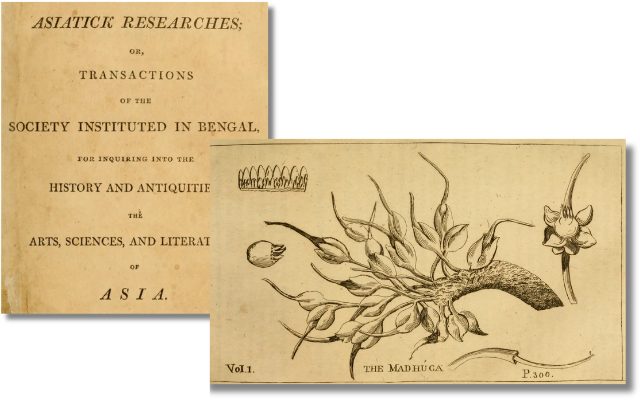
Pages from the Asiatic researches, or, Transactions of the Society instituted in Bengal v.1 (1806)

Pages from Asiatic Researches; or, Transactions of the Society Instituted in Bengal, v.1 (1806), title page and p.300

1 Journal, 9 Institutions, 11 Years

Back in June of 2010, the founding institutions of BHL began a major digitization project that would span the work of 11 years, 9 institutions, 19 people, 40 tickets within BHL’s issue tracking system, over 82 comments on those tickets, and countless hours of work. Was this part of a grant-funded project to facilitate the digitization and inclusion of millions of pages into BHL’s collection? No. This body of digitization and curation work revolves around the series of titles that are part of the Journal of The Asiatic Society. By June 2021, BHL was gratified to finally call the digitization of all public-domain volumes “complete” to the best of its ability.

With a variety of name changes over the years of its publication, BHL is pleased to provide open access to the following titles within the Journal’s history:

  • Asiatic Researches; or, Transactions of the Society Instituted in Bengal
  • Gleanings in Science
  • The Journal of the Asiatic Society of Bengal
  • Proceedings of the Asiatic Society of Bengal
  • Journal and Proceedings of the Asiatic Society of Bengal

In addition to the Journal, BHL also provides access to the Memoirs and a variety of other Asiatic Society publications.

Scanning Locally, Coordinating Globally

To help coordinate such efforts over so many people and so many years, BHL tracked the status of digitization, gap identification and fulfillment, cataloging needs, and curation tasks within its Gemini issue tracking system. This system has been in place for decades and is the source of truth on a variety of internal projects and tasks needed to run BHL’s website, increase and improve its collection, troubleshoot existing services, develop new features, etc.

Like many issue tracking systems, Gemini has myriad possibilities for configuring and customizing how tasks are categorized, organized, and managed. Almost too many for BHL’s use cases. It has taken years to learn how best to adapt the system to BHL’s needs and implement appropriate information architectures to keep projects organized. It is yet another system and login in a suite of web-based tools that are required to deliver BHL’s collection and services.

However, these internal communication tools are essential for managing the highly distributed and widely varied workforce that makes BHL’s collection and services possible. Managing the back-and-forth among 19 people over 11 years would not have been possible without an issue tracking system. It has become the backbone of BHL’s task management, providing a platform for candid, effective collaboration among consortium partner institutions.
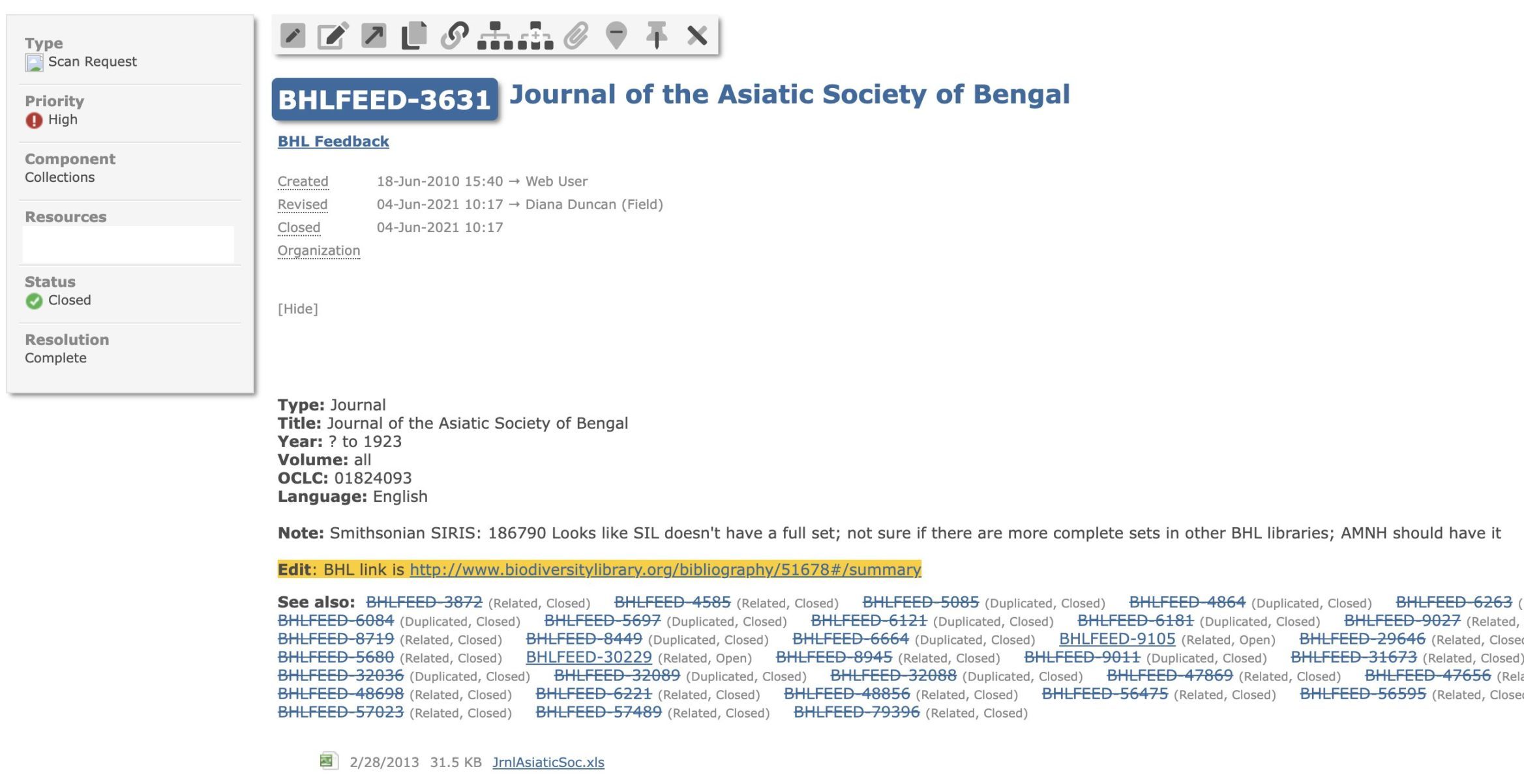
screenshot of BHL scan request ticket within Gemini issue tracking system

Screenshot of BHL scan request ticket within the Gemini issue tracking system for the Journal of the Asiatic Society of Bengal, created 2010 June, closed 2021 June.

Why did it take so long?

Despite being the world’s largest open access digital library for biodiversity literature and archives, BHL does not have dedicated digitization or cataloging staff and lacks funding for digitization. Instead, each of BHL’s partners contribute what they can of their own staff and digitization resources to integrate and curate content in BHL’s collection. As an organization, BHL has recently gone through a significant transition, adopting a shared ownership model that is now more autonomous, globally distributed, and independent of any single institution. But the core work of its consortium partners continues as it has for the past 20 years: collaborating across institutional and international boundaries to make biodiversity literature and archives openly available. The skills and abilities to exercise this level of collaboration are cultivated through a network of communication channels, systems, and committees/working groups that prioritize commitment and buy-in.

Since the closure of BHL’s major grant funding through the MacArthur Foundation in 2013, consortium partners have seen digitization resources ebb and flow. The challenges of maintaining institutional support, securing personnel, achieving grant funding, etc. affect partners’ participation in BHL’s collaborative process. Other challenges with catalog records, the condition of the physical materials, digitization equipment, software bugs, and documentation and training also impact partners’ capacity to contribute content to the BHL collection. Developed organically over time, BHL’s distributed labor model allows partners to come as they are to the organization. Partners participate autonomously and collaboratively relationships when time and resources allow.

If BHL were fortunate enough to secure a major source of long-term funding, centralized resources could help support the processing, digitization, and integration of content across the collection. Please consider supporting the Biodiversity Heritage Library with a recurring donation or planned gift.

How can we make this process more efficient going forward?

The digitization of the Journal of The Asiatic Society legacy volumes is a testament to BHL’s persistence and dedication to increasing the access, usability, discovery, and breadth of its collection — the four priorities, in order of importance, as outlined in BHL’s collection development policy. Clearly, 11 years is a very long time and it would benefit everyone to make this process shorter and more efficient. As BHL’s new chapter is being drafted, our organization is building on its Guiding Principles for the Transition to develop new partnerships, new strategic goals, and a platform modernization plan. As Digital Collections Manager, I feel it’s imperative that BHL:

  • Continue to increase our global network of partners and more widely distribute BHL’s workforce, expertise, and content acquisition strategies.
  • Encourage contributors to provide public domain materials with appropriate metadata to the Internet Archive texts corpus and work with IA to source metadata for existing items.
  • Increase systems and support for BHL uploading workflows.
  • Develop and implement more efficient content ingestion methods alongside its more modern platform to come.
  • Help advocate for the importance of book digitization and funding support.
  • Harvest more open access biodiversity content at scale.

How BHL might achieve these goals remains to be seen, but as our new chapter brings greater autonomy and agility to our organization, I am more optimistic than ever before that BHL will find a way to sustain itself for the future. Sustainability means not simply keeping the website running, but maintaining and growing its unique collection of biodiversity literature and archives.

From the Biodiversity Heritage Library

BHL’s treasures are not just the books, journals, and archives we make freely available. They’re also the people whose collaboration, care, and persistence bring them to the world. For 20 years, BHL’s global community has worked across institutions and borders to digitize, preserve, and open biodiversity knowledge for everyone. With your support, we can continue this long-term work for BHL’s next chapter.

Orange button with a heart icon

Resources

  1. Wikipedia contributors. (2026, May 26). The Asiatic Society. Wikipedia. https://en.wikipedia.org/wiki/The_Asiatic_Society
  2. F, L. L. (1946). The bicentenary of the birth of Sir William Jones, F. R. S. , founder of the Royal Asiatic Society of Bengal. Notes and Records the Royal Society Journal of the History of Science, 4(1), 58–62. https://doi.org/10.1098/rsnr.1946.0012
  3. About us | Asiatic Society. (n.d.). https://asiaticsocietykolkata.org/publications/about-us
July 1, 2026by bcrowley
BHL News, Blog Reel

New Collection Development Policy

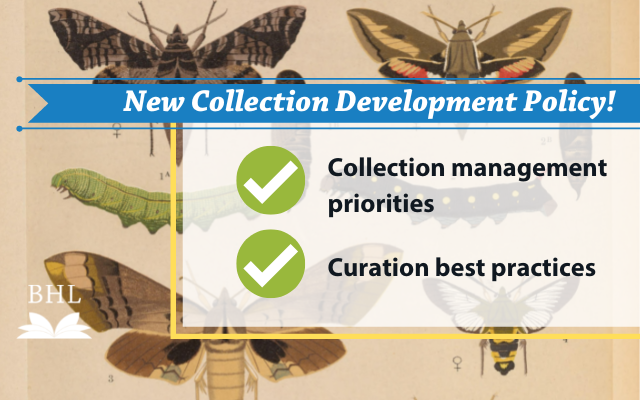
Image of moths behind text announcing new collection development policy

The BHL Collections Committee has completed a comprehensive review and revision of BHL’s collection development policy. The new policy is written to provide recommendations and serve the collection management needs of BHL Partners. As a key objective of BHL’s Strategic Plan 2020-2025, the new policy is a significant revision to the original policy written in 2010. In learning together as a collaborative community of practice since then, our understanding of BHL collection management has been expanded and refined to:

  • clarify collection management priorities;
  • articulate our responsibility to pursue more diverse perspectives;
  • outline BHL Partner expectations;
  • better define our scope;
  • describe BHL-specific curation best practices; and
  • provide transparency by posting the complete policy via BHL’s About Site.

Going forward, the collection development policy will be reviewed on a yearly basis for minor updates.

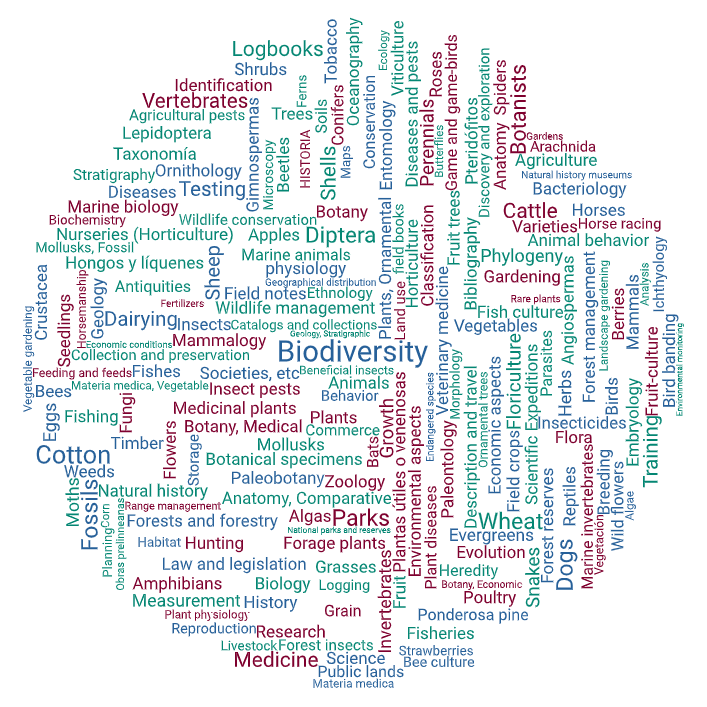
Visual representation of selected biodiversity relevant subject terms

A snapshot of BHL relevant subject keywords as derived from its collection. September 2022

With over 40 BHL Partners across the globe, the Biodiversity Heritage Library collection is the one place where these disparate materials can come together. BHL’s shared vision, to inspire discovery through free access to biodiversity knowledge, is the basis upon which staff at partner institutions contribute their time and expertise to crafting policies and best practices such as BHL’s collection development policy. It is with special thanks to the BHL Collections Committee, our Partners, and especially the late Connie Rinaldo, that we are proud to announce its release.

November 17, 2022by bcrowley
BHL News, Blog Reel

Acknowledging Harm, Rethinking Collections

BHL Acknowledgment of Harmful Content

The Biodiversity Heritage Library has released an Acknowledgment of Harmful Content to recognize deep prejudices within some of the pages of its collection. As a digital library of natural science publications and archival materials, BHL is a free and open access online resource that primarily reflects the print collections of its contributors. Some of the content in BHL is harmful because it reflects ableist, classist, colonialist, eurocentrist, racist, sexist, xenophobic, and other biased views, especially in descriptions of peoples, lands, and species. The long and, at times, painful history of the scientific record has privileged hegemonic perspectives with the right to print while stifling the voices of the powerless.

Acknowledgment of Harmful Content

The Biodiversity Heritage Library acknowledges the existence of harmful content in many biodiversity science publications and original materials included in its collection. We are reckoning with the, at times, painful heritage of our collection and seeking to address its impact on science and culture today. As a curated digital collection aggregating content from hundreds of providers into a single platform, BHL is a reflection of the historical collection development decisions of those providers as well as the publishing practices and historical colonial processes that have shaped the scholarly record of biodiversity science. Scientific understanding evolves over time, through critical analysis of new information and scrutiny of its mistakes. We recognize that as a free and open access digital library, we simultaneously increase and promote access to materials, some of which espouse deep prejudices that are counterproductive to the advancement of scientific knowledge and overshadow the contributions of marginalized peoples across the globe. At best these views are outdated; at worst, the legacy of natural sciences is unjust and inhumane. The harmful content in BHL’s collection goes against the values of the Biodiversity Heritage Library. It is provided for access as part of the historical record.

BHL joins recent global outcries against racial and environmental injustice. We are assessing our role as a digital library and the responsibility we have to question our neutrality and address harm without reducing access. We are deeply concerned about the continuing crisis of global species loss and the inequitable divisions within our own species. Reflecting on ourselves, we see an organization grappling with inclusion and the acute consequences that these harmful views have on the world and its people today.

Heritage institutions such as the AfricaMuseum, Digital Public Library of America, Royal Botanic Gardens Kew, Trove, and others are also addressing these issues. In general the museum and cultural heritage community is reckoning with our organizations’ past and present, as well as the ways in which our collections, publications, public exhibitions and strategic goals impact society.

Over the course of 2020, BHL rethought the implementation of our strategic plan with the goal to challenge ourselves towards more equitable collection management, technical development, outreach, partnership development, and mission enabling practices. With regard to our collection management objectives going forward, we will be:

  • publishing a collaborative research bibliography to inform new collection management strategies that focus on global challenges including biodiversity loss, systematic racism, and the effects of a worldwide pandemic on scholarly research,
  • identifying and filling gaps in the collection to achieve more complete and inclusive representation of the available knowledge of and perspectives on biodiversity, e.g. including indigenous knowledge,
  • and conducting a comprehensive review and revision of our collection development policy.

If “knowing the past is critical to reforming the present” as Dr. David Silverman suggests [1] then publicly acknowledging the biases in our collection is a first step towards making our collection more inclusive. As a global consortium with a variety of social, cultural, epistemological, and political factors at play, we are unified in our commitment to advancing equity in the global biodiversity community while also maintaining access to the historical record.

Sincere thanks to the Biodiversity Heritage Library Collections Committee for participating in many challenging discussions and writing BHL’s Acknowledgment. In addition, we would like to thank BHL’s Executive Committee, Secretariat, as well as BHL Staff and Partners for their careful consideration and feedback. The Acknowledgment would not have been possible without the thoughtful input of our reviewers including: Lidia Ponce de la Vega, Smithsonian Libraries and Archives Diversity Equity Accessibility and Inclusion (DEAI) Committee, as well as colleagues within our professional networks especially Cornell University Library, MBLWHOI Library and the Woods Hole Diversity Advisory Committee, Muséum national d’Histoire naturelle, and Royal Botanic Gardens Kew.

[1] Silverman, D. (2019, November 18). [This Land Is Their Land] | C-SPAN.org. https://www.c-span.org/video/?466094-1/this-land-land

October 13, 2021by SheilaC7108
Blog Reel

Meredith Wray: BHL Digital Content Intern, Summer 2019

My name is Meredith Wray, and I had the wonderful opportunity to serve as a Biodiversity Heritage Library digital content intern this summer.

First off, a little bit about myself. I am from Richmond, VA and obtained my undergraduate degree in American Studies from William & Mary. I am working to achieve my master’s in library and information science from Rutgers University, with a concentration in archives and preservation. I am extremely interested in the work of digital libraries and archives. My program is remote, so I was very excited to find a learning opportunity like the BHL internship in which I could expand my librarian skill set and apply my coursework to the goals of the Biodiversity Heritage Library. The remote nature of the internship allowed for a flexible work schedule on my part as I balance coursework and my job.

Picture of Meredith Wray

Meredith Wray, digital content intern at the Biodiversity Heritage Library for summer 2019;.

The Biodiversity Heritage Library is an open access digital library for biodiversity literature and archives that aims to improve research methodology by facilitating collaboration between biodiversity facilities. I quickly grew to appreciate the mission of BHL as a means to inspire biodiversity discovery through free access. I was able to work with and learn from my supervisor, Bianca Crowley, Digital Collections Manager for BHL. I had weekly video conference calls with Bianca and worked the rest of the week remotely to achieve progress on assigned projects, tracking assignments through digitization workflow tools.

The goals of the internship are to focus on metadata creation, cataloging, and gain experience with digitization workflows. I was taking a cataloging and classification course over the summer, so it was very rewarding to apply my coursework learning about MARC records and cataloging principles in a digital library environment like BHL. My day-to-day consisted of assigning MARC records to items, often finding them in OCLC; uploading items to BHL’s digitization workflow management tool, Macaw; and filling out item-level metadata, such as the sponsoring institution, author, or volume information, before passing them along to be uploaded to Internet Archive.

Picture1.png

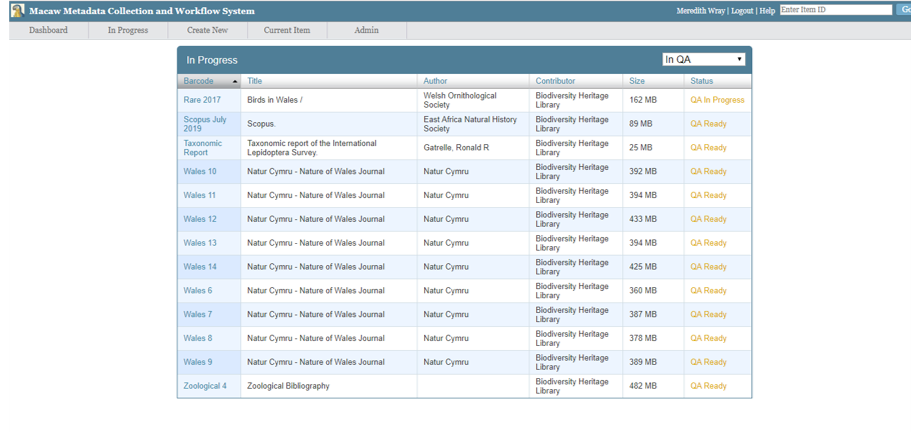
Here you can see a screenshot of what Macaw (BHL’s digitization workflow management tool) looks like when I’m working on several items — these are the items currently in QA.

I would usually have several issues going at once — either uploading or assigning metadata to digitized items. Once uploaded, I would go through each item to assign page level metadata — page numbers, page sides, volume and year information. I would also assign page types to each, taking note of any tables, text, photographs, illustrations, and front or back matter (title page, cover, table of contents, or bibliography). This was to help researchers and users of BHL scan the item to see what its contents may hold.

My conversations with Bianca challenged me to think about the items from the perspective of a researcher — what information would be most helpful, as well as really taking and describing the item as-is and not attempting to make judgements on any of the items. This principle was emphasized in my cataloging class, but it was rewarding to apply in an online library environment. Although most of my day-to-day work consisted of cataloging and metadata creation, I was lucky enough to develop a better understanding of copyright issues and moving walls through my training and ongoing discussions with Bianca, who explained the ongoing partnerships and communications needed to obtain legal and physical access to materials for BHL.

The items I worked on ranged from International Congress of Entomology proceedings to nature journals focused on the biodiversity heritage of Wales. The most time-intensive and at times challenging items were compiling abstracts and conference proceedings from the International Congress of Entomology. Several of the items were several thousand pages long and required some patience uploading, but I was able to gain experience digitally stitching PDFs together and preparing them for upload.

My favorite item to work with was probably several of the Nature in Wales journals. These journals have a variety of content types and covered the biodiversity of the Welsh region with interesting articles, photographs, and illustrations, so assigning page-level metadata to these items was always interesting.

Picture2.png

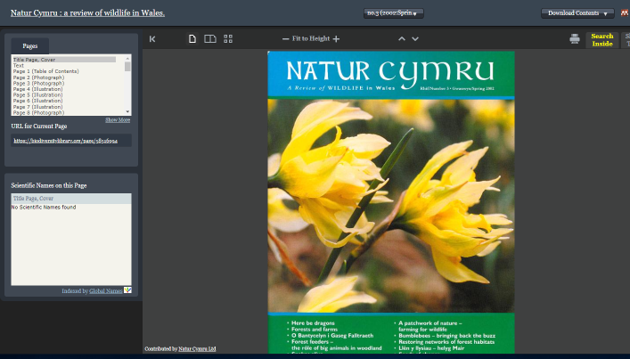
Uploaded volume of Natur Cymru : a review of wildlife in Wales.

In the end, I contributed 28 items and 16,053 pages to BHL. The variety of materials and content was really exciting to work with, and I am honored to have contributed  several items to BHL for potential use by researchers and students. I am thrilled to have had the opportunity to work on BHL projects and appreciate the learning experience as it relates to my master’s degree and professional goals.

September 10, 2019by Joel Richard

Help Support BHL

BHL's existence depends on the financial support of its patrons. Help us keep this free resource alive!

search

About BHL

The Biodiversity Heritage Library (BHL) is the world’s largest open access digital library for biodiversity literature and archives. BHL operates as a worldwide consortium of natural history, botanical, research, and national libraries working together to digitize the natural history literature held in their collections and make it freely available for open access as part of a global “biodiversity community.”

Join Our Mailing List

Sign up to receive the latest news, content highlights, and promotions.

Subscribe Now

Subscribe to Blog via Email

Enter your email address to subscribe to this blog and receive notifications of new posts by email.

Join 319 other subscribers

Subscribe to Blog Via RSS

Subscribe to the blog RSS feed to stay up-to-date on all the latest BHL posts.

Access RSS Feed

Inspiring Discovery through Free Access to Biodiversity Knowledge.

The Biodiversity Heritage Library makes it easier than ever for you to access the information you need to study and explore life on Earth…for free, anytime, anywhere.


64+ Million Pages of
Biodiversity Literature Online.

EXPLORE

Tools and Services
to Transform Research.

EXPLORE

300,000+
Illustrations on Flickr.

EXPLORE

ABOUT | HARMFUL CONTENT | PRIVACY | SITE MAP | TERMS OF USE