Biodiversity Heritage Library - Program news and collection highlights from BHL
  • Home
  • News
  • Featured Books
    • All Featured Books
    • Book of the Month Series
    • BHL at 20
  • User Stories
  • Campaigns
    • Fossil Stories
    • Garden Stories
    • Monsters Are Real
    • Page Frights
    • Her Natural History
    • Earth Optimism 2020
  • Tech Blog
  • Visit BHL
Home
News
Featured Books
    All Featured Books
    Book of the Month Series
    BHL at 20
User Stories
Campaigns
    Fossil Stories
    Garden Stories
    Monsters Are Real
    Page Frights
    Her Natural History
    Earth Optimism 2020
Tech Blog
Visit BHL
  • Home
  • News
  • Featured Books
    • All Featured Books
    • Book of the Month Series
    • BHL at 20
  • User Stories
  • Campaigns
    • Fossil Stories
    • Garden Stories
    • Monsters Are Real
    • Page Frights
    • Her Natural History
    • Earth Optimism 2020
  • Tech Blog
  • Visit BHL
Biodiversity Heritage Library - Program news and collection highlights from BHL
Blog Reel

Collaboration and Dedication: Digitizing Legacy Publications of the Asiatic Society

Illustration of Madhuca plant with blog title and BHL logo.

This post is part of BHL at 20: Treasures from the Biodiversity Heritage Library, a series contributed by members of the BHL community, highlighting remarkable works from across the collection in celebration of its 20th anniversary.

As the Digital Collections Manager for the Biodiversity Heritage Library, my take on the treasures of BHL’s collection is less about the content or significance of any particular title, and more about the work over many (many) years behind the scenes by the people within BHL partner institutions to bring these treasures from the shelves to the screen and make them accessible and discoverable for anyone with an internet connection. Building on a blog I posted in 2013, I would like to revisit the treasure that is the Journal of The Asiatic Society and its legacy publications in BHL.

The Asiatic Society

In 1784, the Asiatick Society was founded by Sir William Jones through British India’s highest court at the time, in Kolkata.1 The goal of the society was to study the “History, Civil and Natural, the Antiquities, Arts, Sciences, and Literature of Asia.”2 To this day, more than 240 years later, The Asiatic Society continues as a foundational society for learning in India and “the oldest surviving publishing house of the country.”3 Its publications span from 1788 to the present and cover a wide variety of research topics and interdisciplinary studies throughout the cultural and natural sciences, including literature and medicine. Its rich “legacy of […] promoting a comprehensive understanding of humanity’s intellectual and practical endeavors,” is evidenced by its status as an Institution of National Importance by the Indian government.3
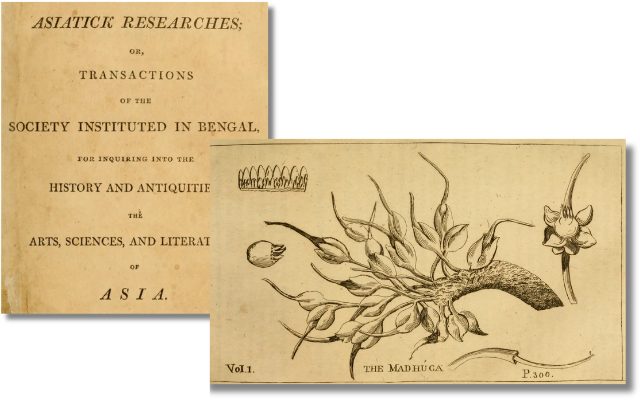
Pages from the Asiatic researches, or, Transactions of the Society instituted in Bengal v.1 (1806)

Pages from Asiatic Researches; or, Transactions of the Society Instituted in Bengal, v.1 (1806), title page and p.300

1 Journal, 9 Institutions, 11 Years

Back in June of 2010, the founding institutions of BHL began a major digitization project that would span the work of 11 years, 9 institutions, 19 people, 40 tickets within BHL’s issue tracking system, over 82 comments on those tickets, and countless hours of work. Was this part of a grant-funded project to facilitate the digitization and inclusion of millions of pages into BHL’s collection? No. This body of digitization and curation work revolves around the series of titles that are part of the Journal of The Asiatic Society. By June 2021, BHL was gratified to finally call the digitization of all public-domain volumes “complete” to the best of its ability.

With a variety of name changes over the years of its publication, BHL is pleased to provide open access to the following titles within the Journal’s history:

  • Asiatic Researches; or, Transactions of the Society Instituted in Bengal
  • Gleanings in Science
  • The Journal of the Asiatic Society of Bengal
  • Proceedings of the Asiatic Society of Bengal
  • Journal and Proceedings of the Asiatic Society of Bengal

In addition to the Journal, BHL also provides access to the Memoirs and a variety of other Asiatic Society publications.

Scanning Locally, Coordinating Globally

To help coordinate such efforts over so many people and so many years, BHL tracked the status of digitization, gap identification and fulfillment, cataloging needs, and curation tasks within its Gemini issue tracking system. This system has been in place for decades and is the source of truth on a variety of internal projects and tasks needed to run BHL’s website, increase and improve its collection, troubleshoot existing services, develop new features, etc.

Like many issue tracking systems, Gemini has myriad possibilities for configuring and customizing how tasks are categorized, organized, and managed. Almost too many for BHL’s use cases. It has taken years to learn how best to adapt the system to BHL’s needs and implement appropriate information architectures to keep projects organized. It is yet another system and login in a suite of web-based tools that are required to deliver BHL’s collection and services.

However, these internal communication tools are essential for managing the highly distributed and widely varied workforce that makes BHL’s collection and services possible. Managing the back-and-forth among 19 people over 11 years would not have been possible without an issue tracking system. It has become the backbone of BHL’s task management, providing a platform for candid, effective collaboration among consortium partner institutions.
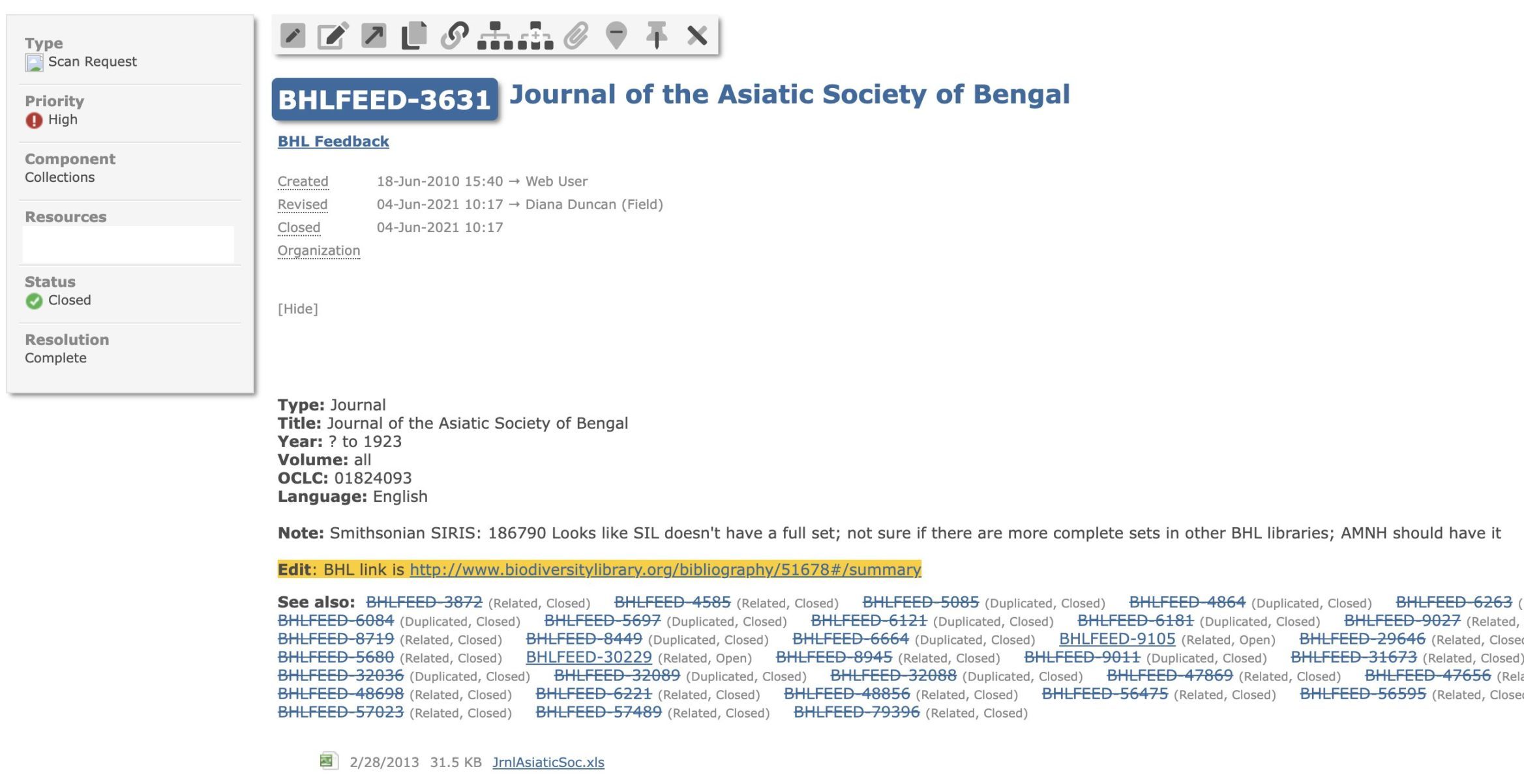
screenshot of BHL scan request ticket within Gemini issue tracking system

Screenshot of BHL scan request ticket within the Gemini issue tracking system for the Journal of the Asiatic Society of Bengal, created 2010 June, closed 2021 June.

Why did it take so long?

Despite being the world’s largest open access digital library for biodiversity literature and archives, BHL does not have dedicated digitization or cataloging staff and lacks funding for digitization. Instead, each of BHL’s partners contribute what they can of their own staff and digitization resources to integrate and curate content in BHL’s collection. As an organization, BHL has recently gone through a significant transition, adopting a shared ownership model that is now more autonomous, globally distributed, and independent of any single institution. But the core work of its consortium partners continues as it has for the past 20 years: collaborating across institutional and international boundaries to make biodiversity literature and archives openly available. The skills and abilities to exercise this level of collaboration are cultivated through a network of communication channels, systems, and committees/working groups that prioritize commitment and buy-in.

Since the closure of BHL’s major grant funding through the MacArthur Foundation in 2013, consortium partners have seen digitization resources ebb and flow. The challenges of maintaining institutional support, securing personnel, achieving grant funding, etc. affect partners’ participation in BHL’s collaborative process. Other challenges with catalog records, the condition of the physical materials, digitization equipment, software bugs, and documentation and training also impact partners’ capacity to contribute content to the BHL collection. Developed organically over time, BHL’s distributed labor model allows partners to come as they are to the organization. Partners participate autonomously and collaboratively relationships when time and resources allow.

If BHL were fortunate enough to secure a major source of long-term funding, centralized resources could help support the processing, digitization, and integration of content across the collection. Please consider supporting the Biodiversity Heritage Library with a recurring donation or planned gift.

How can we make this process more efficient going forward?

The digitization of the Journal of The Asiatic Society legacy volumes is a testament to BHL’s persistence and dedication to increasing the access, usability, discovery, and breadth of its collection — the four priorities, in order of importance, as outlined in BHL’s collection development policy. Clearly, 11 years is a very long time and it would benefit everyone to make this process shorter and more efficient. As BHL’s new chapter is being drafted, our organization is building on its Guiding Principles for the Transition to develop new partnerships, new strategic goals, and a platform modernization plan. As Digital Collections Manager, I feel it’s imperative that BHL:

  • Continue to increase our global network of partners and more widely distribute BHL’s workforce, expertise, and content acquisition strategies.
  • Encourage contributors to provide public domain materials with appropriate metadata to the Internet Archive texts corpus and work with IA to source metadata for existing items.
  • Increase systems and support for BHL uploading workflows.
  • Develop and implement more efficient content ingestion methods alongside its more modern platform to come.
  • Help advocate for the importance of book digitization and funding support.
  • Harvest more open access biodiversity content at scale.

How BHL might achieve these goals remains to be seen, but as our new chapter brings greater autonomy and agility to our organization, I am more optimistic than ever before that BHL will find a way to sustain itself for the future. Sustainability means not simply keeping the website running, but maintaining and growing its unique collection of biodiversity literature and archives.

From the Biodiversity Heritage Library

BHL’s treasures are not just the books, journals, and archives we make freely available. They’re also the people whose collaboration, care, and persistence bring them to the world. For 20 years, BHL’s global community has worked across institutions and borders to digitize, preserve, and open biodiversity knowledge for everyone. With your support, we can continue this long-term work for BHL’s next chapter.

Orange button with a heart icon

Resources

  1. Wikipedia contributors. (2026, May 26). The Asiatic Society. Wikipedia. https://en.wikipedia.org/wiki/The_Asiatic_Society
  2. F, L. L. (1946). The bicentenary of the birth of Sir William Jones, F. R. S. , founder of the Royal Asiatic Society of Bengal. Notes and Records the Royal Society Journal of the History of Science, 4(1), 58–62. https://doi.org/10.1098/rsnr.1946.0012
  3. About us | Asiatic Society. (n.d.). https://asiaticsocietykolkata.org/publications/about-us
July 1, 2026by Bianca Crowley
BHL News, Blog Reel

BHL Transition Update #3: Gaining Momentum

Image of HMS Challenger with BHL logo

Image of 19th Century sailing ship, HMS Challenger with BHL logoSince the release of our official Call for Support on 11 June 2025, the global response has been inspiring and heartwarming. Institutions and individuals from across the biodiversity, library, and research communities have reached out with offers of support, ideas, and encouragement.

The #BHLTransition is making headway

We’re charting the course to a strong and sustainable future for the Biodiversity Heritage Library. Behind the scenes, many exciting conversations are underway, including offers of technical hosting, funding support, and staffing partnerships. While we’re not yet able to share full details, we’re confident these discussions will translate into confirmed commitments.

Reimagining BHL

This is a rare and powerful opportunity to think boldly about what BHL could become. The Call for Support outlines BHL’s existing roles and services – but not its limits.

As we transition from Smithsonian hosting, we’re seeking ambitious ideas for BHL’s future. 

We welcome proposals that explore: 

  • Alternative staffing models, including distributed teams or new hires.
  • Aspiring visions for BHL’s technical architecture, including new tools or platforms.
  • Shared infrastructure or services hosted across institutions.
  • Pioneering approaches to how BHL serves global biodiversity knowledge.

Whether your institution can host a current role, contribute infrastructure, support a new function, or propose a radical new approach – we want to hear from you. 

What’s Underway (and Ahead)?

  • We’re continuing to meet with potential hosts and supporters across the globe.
  • Our fiscal sponsorship agreement is in its final stages. Once confirmed, it will provide the administrative foundation for BHL’s next phase.
  • We’re working closely with Smithsonian leadership to coordinate a smooth transition of administrative and technical functions.
  • We’re exploring new development opportunities to reimagine BHL’s technical infrastructure.
  • We’re collaborating with partners on new grant applications to help fuel the transition and future innovation. 
  • We continue to support our Partners in growing and enhancing BHL content: June saw the addition of 108,584 pages and 6,143 articles to the BHL collection.

Initial expressions of interest to the Call for Support are encouraged by 31 August 2025, but we will continue to welcome offers after this date on a rolling basis.

How You Can Help

📢 Keep sharing the Call for Support: If you haven’t already, please share the Call for Support with your institutions and networks. Every connection helps. 

💬 Get in touch: Have an idea, contact, or offer of support? We’d love to hear from you. Contact: [email protected] 

💚 Show your support: Use the hashtag #ILoveBHL on social media to spread the word.

Thank you to everyone who has shared encouragement, advice, and support. The global BHL community is the heart of this effort. Your energy and vision are helping us navigate a new course for the Biodiversity Heritage Library, ensuring a bright, innovative and sustainable future. 

Stay tuned for more updates.


July 11, 2025by Bianca Crowley
BHL News, Blog Reel, Featured Books

Ukrainian Українська Collection

Ukrainian Українська Collection with BHL and USDA National Agricultural Library logos

Through ongoing collaborative collection building and digitization, the United States Department of Agriculture’s National Agricultural Library (NAL) is partnering with the Biodiversity Heritage Library to support biodiversity and scientific research in Ukraine with the release of the Ukrainian Українська Collection. BHL and NAL stand with the people of Ukraine and echo the support of its consortium partner institutions in their condemnation of the Russian Federation’s invasion.

Ukrainian Українська Collection with BHL and USDA National Agricultural Library logosThe threat to Ukraine’s cultural heritage materials remains substantial during the wartime humanitarian crisis. Many libraries and cultural heritage institutions throughout Ukraine have been severely damaged or destroyed, resulting in the permanent loss of culturally and scientifically significant content. Through the digitization of historic materials related to biodiversity research in Ukraine, this project will help support Ukraine’s scientific community by providing access to these important resources.

Significance of the Material

The Ukrainian Українська Collection includes rare and unique titles covering biodiversity research in Ukraine over the past two centuries, including previously uncataloged material. These items have been selected for their cultural and scientific significance to the biodiversity research community, and include an array of topics from wheat production, agricultural economics, soil management, animal breeding, and rural electrification, to arbovirus ecology. Geographically, the material covers a range of areas, including the historic Bukovina and Bessarabia regions.

This collection will contribute to and expand the cumulative digitization and preservation efforts of Ukrainian cultural heritage material across the globe, including the Saving Ukrainian Cultural Heritage Online (SUCHO) initiative, and the Smithsonian Cultural Rescue Initiative (SCRI).

Increasing Discoverability through Collaborative Transcription

In addition to providing enduring access to these valuable items, a major goal of the project is to facilitate increased discoverability through transcription and translation. NAL welcomes volunteers with Ukrainian and Russian language expertise to assist in interpreting these important cultural materials. Join us on FromThePage or reach out to NAL’s Transcription Program Manager, at [email protected] for more information.

Going Forward

BHL will work with its Partners to continue to add to the Ukrainian Українська Collection. Beyond the work of identifying eligible open access materials within their holdings, Partners are encouraged to pursue cataloging, digitization, and transcription projects to support the collection. Particular attention will be paid to Ukrainian Українська Collection materials as part of BHL curation efforts, such as enhancing descriptive metadata and improving access to article information where possible.

In organizing this collection of materials, BHL is adding to the efforts of many cultural and natural heritage organizations to preserve pieces of Ukraine’s invaluable history and culture. Bit by bit, as librarians, technologists, researchers, people, BHL offers its support to the monumental global challenge to save cultural and natural heritage from the destruction of war and humanitarian crises, regardless of borders.

April 4, 2023by Bianca Crowley
BHL News, Blog Reel

BHL Bi-annual Newsletter (November 2022) Now Available!

Preview of newsletter header with image of reptiles on rocks

Preview of newsletter header with image of reptiles on rocks

Our latest bi-annual newsletter is now available! From saving pirated research journals to releasing our new Collection Development Policy, don’t miss the latest news from the BHL community.

View our November 2022 Bi-annual Newsletter.

November 29, 2022by Bianca Crowley
BHL News, Blog Reel

New Collection Development Policy

Image of moths behind text announcing new collection development policy

The BHL Collections Committee has completed a comprehensive review and revision of BHL’s collection development policy. The new policy is written to provide recommendations and serve the collection management needs of BHL Partners. As a key objective of BHL’s Strategic Plan 2020-2025, the new policy is a significant revision to the original policy written in 2010. In learning together as a collaborative community of practice since then, our understanding of BHL collection management has been expanded and refined to:

  • clarify collection management priorities;
  • articulate our responsibility to pursue more diverse perspectives;
  • outline BHL Partner expectations;
  • better define our scope;
  • describe BHL-specific curation best practices; and
  • provide transparency by posting the complete policy via BHL’s About Site.

Going forward, the collection development policy will be reviewed on a yearly basis for minor updates.

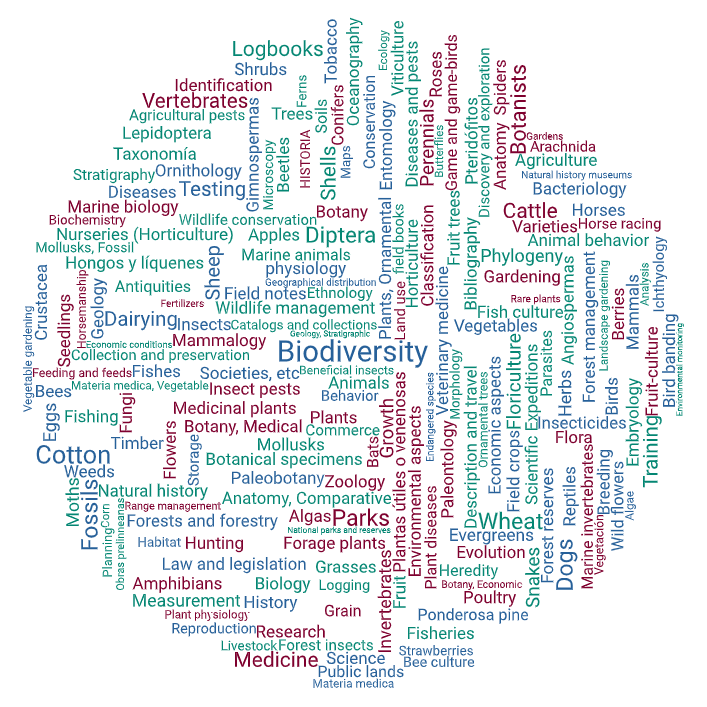
Visual representation of selected biodiversity relevant subject terms

A snapshot of BHL relevant subject keywords as derived from its collection. September 2022

With over 40 BHL Partners across the globe, the Biodiversity Heritage Library collection is the one place where these disparate materials can come together. BHL’s shared vision, to inspire discovery through free access to biodiversity knowledge, is the basis upon which staff at partner institutions contribute their time and expertise to crafting policies and best practices such as BHL’s collection development policy. It is with special thanks to the BHL Collections Committee, our Partners, and especially the late Connie Rinaldo, that we are proud to announce its release.

November 17, 2022by Bianca Crowley

Help Support BHL

BHL's existence depends on the financial support of its patrons. Help us keep this free resource alive!

search

About BHL

The Biodiversity Heritage Library (BHL) is the world’s largest open access digital library for biodiversity literature and archives. BHL operates as a worldwide consortium of natural history, botanical, research, and national libraries working together to digitize the natural history literature held in their collections and make it freely available for open access as part of a global “biodiversity community.”

Join Our Mailing List

Sign up to receive the latest news, content highlights, and promotions.

Subscribe Now

Subscribe to Blog via Email

Enter your email address to subscribe to this blog and receive notifications of new posts by email.

Join 319 other subscribers

Subscribe to Blog Via RSS

Subscribe to the blog RSS feed to stay up-to-date on all the latest BHL posts.

Access RSS Feed

Inspiring Discovery through Free Access to Biodiversity Knowledge.

The Biodiversity Heritage Library makes it easier than ever for you to access the information you need to study and explore life on Earth…for free, anytime, anywhere.


64+ Million Pages of
Biodiversity Literature Online.

EXPLORE

Tools and Services
to Transform Research.

EXPLORE

300,000+
Illustrations on Flickr.

EXPLORE

ABOUT | HARMFUL CONTENT | PRIVACY | SITE MAP | TERMS OF USE