Biodiversity Heritage Library - Program news and collection highlights from BHL
  • Home
  • News
  • Featured Books
    • All Featured Books
    • Book of the Month Series
    • BHL at 20
  • User Stories
  • Campaigns
    • Fossil Stories
    • Garden Stories
    • Monsters Are Real
    • Page Frights
    • Her Natural History
    • Earth Optimism 2020
  • Tech Blog
  • Visit BHL
Home
News
Featured Books
    All Featured Books
    Book of the Month Series
    BHL at 20
User Stories
Campaigns
    Fossil Stories
    Garden Stories
    Monsters Are Real
    Page Frights
    Her Natural History
    Earth Optimism 2020
Tech Blog
Visit BHL
  • Home
  • News
  • Featured Books
    • All Featured Books
    • Book of the Month Series
    • BHL at 20
  • User Stories
  • Campaigns
    • Fossil Stories
    • Garden Stories
    • Monsters Are Real
    • Page Frights
    • Her Natural History
    • Earth Optimism 2020
  • Tech Blog
  • Visit BHL
Biodiversity Heritage Library - Program news and collection highlights from BHL
Blog Reel, Campaigns, Her Natural History

Dorothea Eliza Smith: Resilient Botanical Illustrator

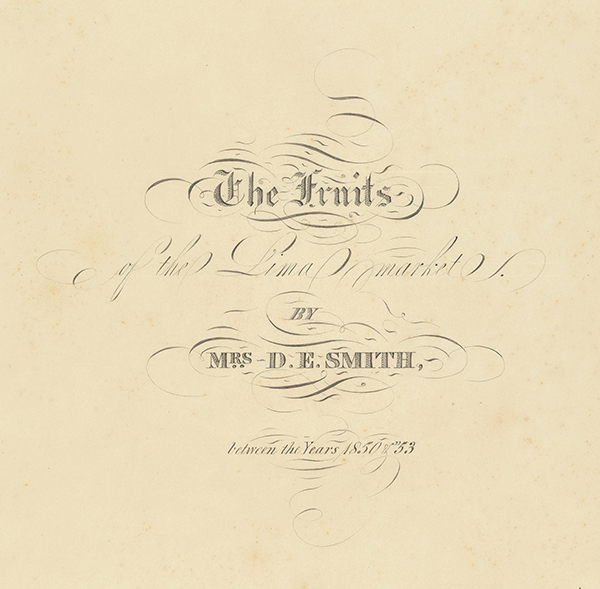
Title page of The Fruits of the Lima Market, a collection of manuscript illustrations by Dorothea Eliza Smith.

As we celebrate the role women have played in the natural history sciences, we can find many examples of successful women who have been under-appreciated for the meaningful work they did during their lives. Women like Maria Sibylla Merian, Mary Margaret Smith, and Evelyn Cheesman significantly advanced a variety of sciences, even if they have only recently been gaining attention for doing so. But historic relegation of women has also meant that countless people throughout history were denied the tools to achieve success in these fields. How many women could have been published artists or scientists, if it weren’t for societal expectations that never gave them the chance?

Within the collections of rare botanical texts and seldom seen manuscripts housed at the Oak Spring Garden Foundation is a beautiful work by a largely unknown artist, Dorothea Eliza Smith. Her Fruits of the Lima Market – a collection of watercolors that she completed between 1850 and 1853 – stands out as an exemplary creation made even more impressive by her relative obscurity and the sparse details of her life.
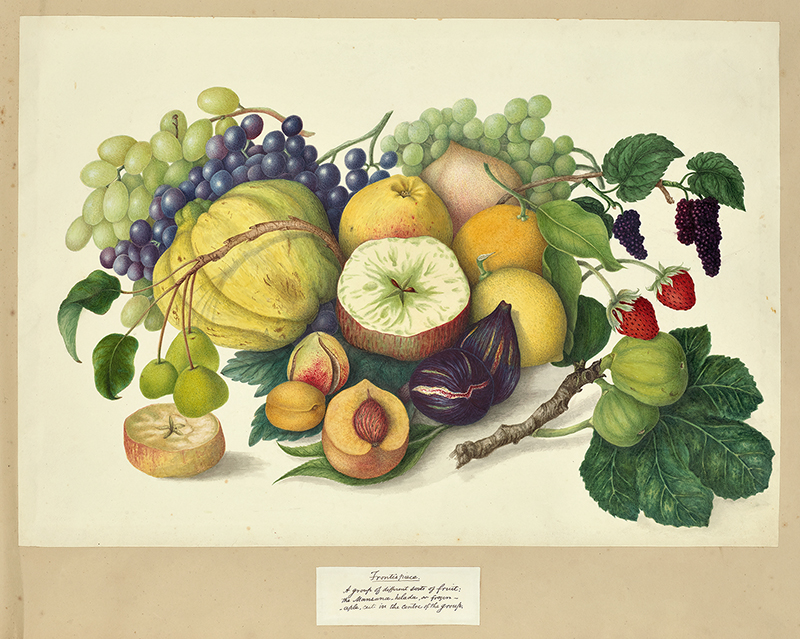
Frontispiece of The Fruits of the Lima Market. These illustrations were never published and would likely have vanished into complete obscurity had the artist’s husband not worked to preserve them in the family collection.

Dorothea was born to Joseph and Dorothy Peers on January 29, 1804, in Wales – the third child and first girl born to the couple. In 1828, when she was twenty-four, she married William Kerr who was a merchant trading primarily out of Caracas, Venezuela, but their marriage was cut short as Kerr seems to have died sometime before 1840. That year, Dorothea married Dr. Archibald Smith, who also had extensive experience living and working in South America.

Smith was born in 1797 in Scotland, received his medical degree from the University of Glasgow in 1820, and moved to Peru five years later. Once there, he was employed by a British mining company to help its workers adjust to the high altitudes at which they worked, but the company’s bankruptcy in 1827 meant that Smith needed to find new work. To this effect, he rented some land and began to grow sugar cane, but by 1830 he had moved to Lima and the next year took a job overseeing the health of British and American sailors stationed in and around the Peruvian capital. (Peru became an independent country in 1824, so the sailors were not part of an occupying force.) At some point during this time he must have become acquainted with Dorothea as they married in Scotland in 1840 where they continued to live for the next few years.
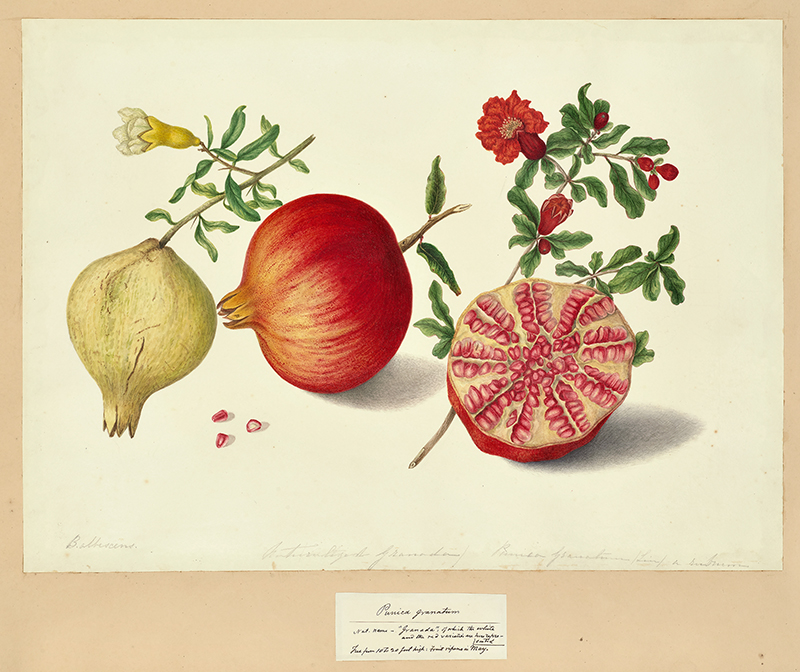
Punica granatum (Pomegranate) by Dorothea Eliza Smith. The folio contains 30 watercolors and eventually made its way to Crewe Hall library, where they were purchased by Rachel and Paul Mellon in 1957.

While their marriage appears to have been strong, they both faced an enormous loss when Archibald and the couple’s daughter Dorothy – who was eight – were shipwrecked off the Peruvian coast, and Dorothy drowned. Dorothea wrote from Liverpool to her husband shortly after the loss in 1849 that “we are all improving in strength not withstanding our recent trial” and would soon join her husband in Peru with their other children – Sophia, Isabella, and John. Interestingly, Dorothea and the children decided to sail around Cape Horn on their journey to South America rather that land in Panama, walk across the isthmus, and catch another ship to Peru. Both trips took similar amounts of time, but supposedly with three children, Dorothea would have rather not tried to keep track of them on an overland trek. The details of the Smiths’ time in Peru are sparse, other than that Dorothea worked on her watercolors of the fruits of the Lima market from 1850 to 1853, and at any rate they all seemed to have returned to the United Kingdom by 1855. Dorothea would die about nine years later, in 1864, and her husband would join her in 1868, both in Edinburgh, Scotland.
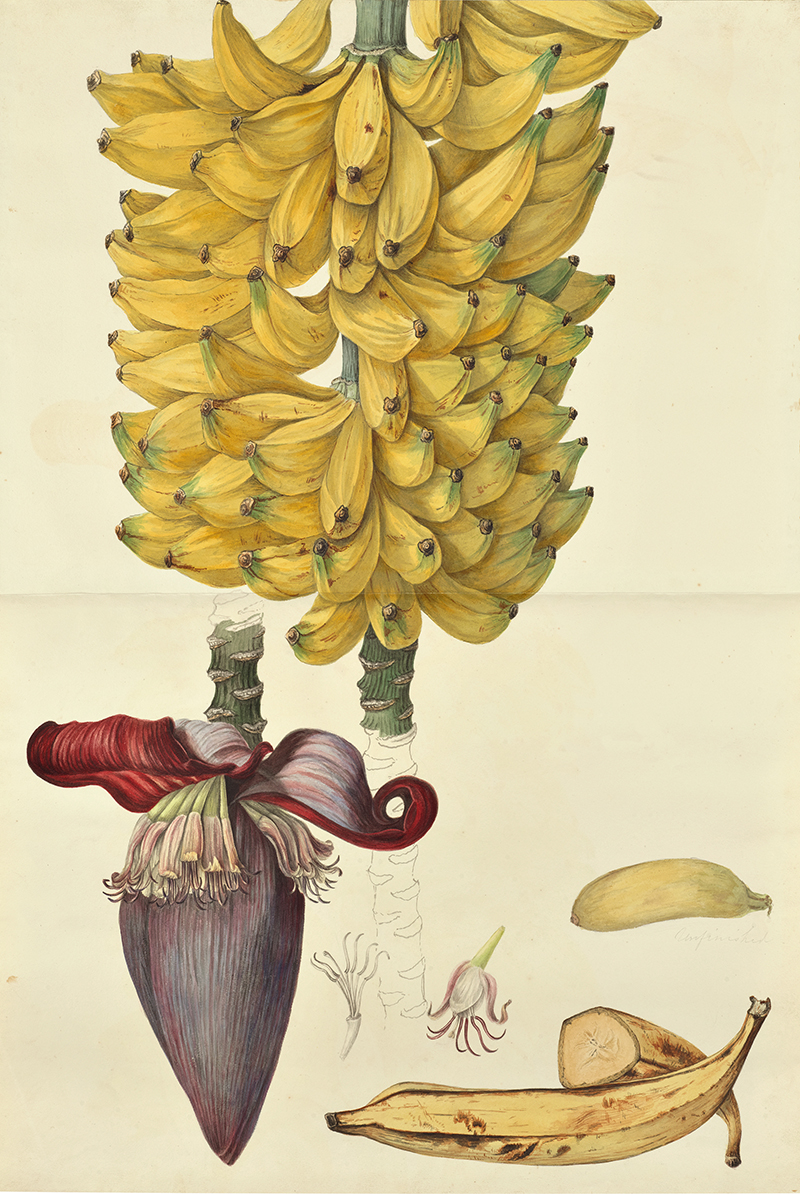
Bananas by Dorothea Eliza Smith. The watercolors are remarkably detailed and include botanical details like cross-sections and seed pods. These details underly observations on the artist’s behalf that go beyond a casual or purely aesthetic purpose.

Dorothea Smith’s The Fruits of the Lima Market are significant and worthy of study both for their quality and for their commentary on botanical science and British economic reach. To begin, Dorothea’s watercolors are impressive in that they are thoughtfully detailed in their depiction and with regards to their associated scientific information (Each painting includes notes on its fruit’s scientific name, local name, height, and fruiting months), and in that they have a refined artistic sensibility to them as pertains to the ways in which Smith plays with the juxtaposition of the different colors of the fruits. Smith also provided drawings of cross-sections of the fruits and their seeds. It is further interesting that Smith chose to draw the fruits of the Lima market as opposed to other flora from the Peruvian countryside. Her choice seems to be wrapped up both in her assumedly easy access to such fruits and in her life as spouse to first a merchant then a medical doctor and one-time farmer who both left Britain for opportunities in South America. Even her trip to arrive in Peru followed established trade and tourist routes from Europe to the western South American coast. Her watercolors work on two levels then – the first as an expression of her high scientific and artistic acumen and secondly as a reflection of her proximity to British commercial interests throughout the world. Smith’s manuscript was maintained by her husband after her death as he worked to make it known to knowledgeable scientists (even citing her in his own work), and as such kept it from disappearing into complete obscurity. Thus, the remarkable work of Dorothea Eliza Smith remains and whose story, though very much incomplete, understates the significant contributions of so many unknown female scientists and illustrators to the collected advancement of Western science.

References

Vega, Fernando, Kimberly Fisher, and Tony Willis. “Dorothea Eliza Smith, artist of ‘The Fruits of the Lima Market’” Archives of Natural History 41.2 (October 2014): 223-229.
March 26, 2019by Chris Byrd
Blog Reel, Campaigns, Her Natural History

The Life and Works of Margaret Meen

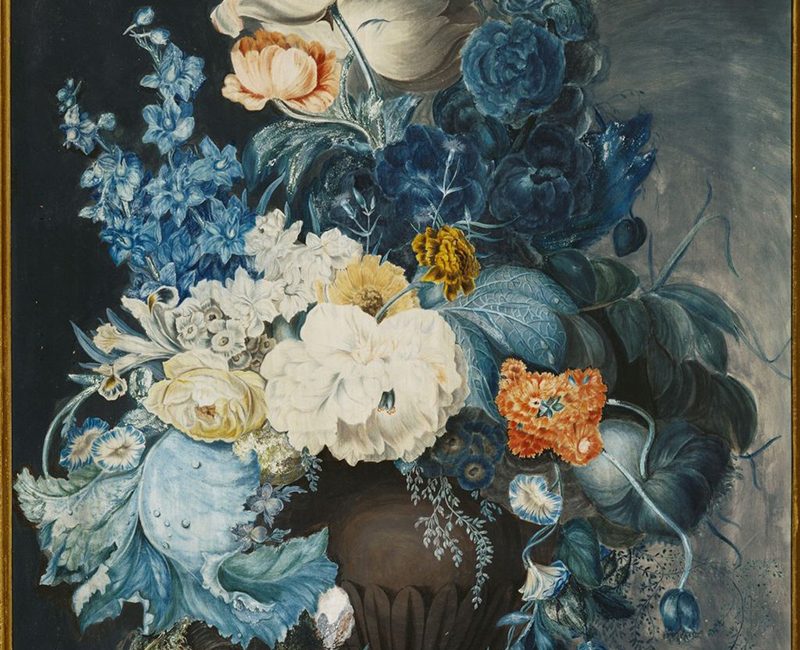
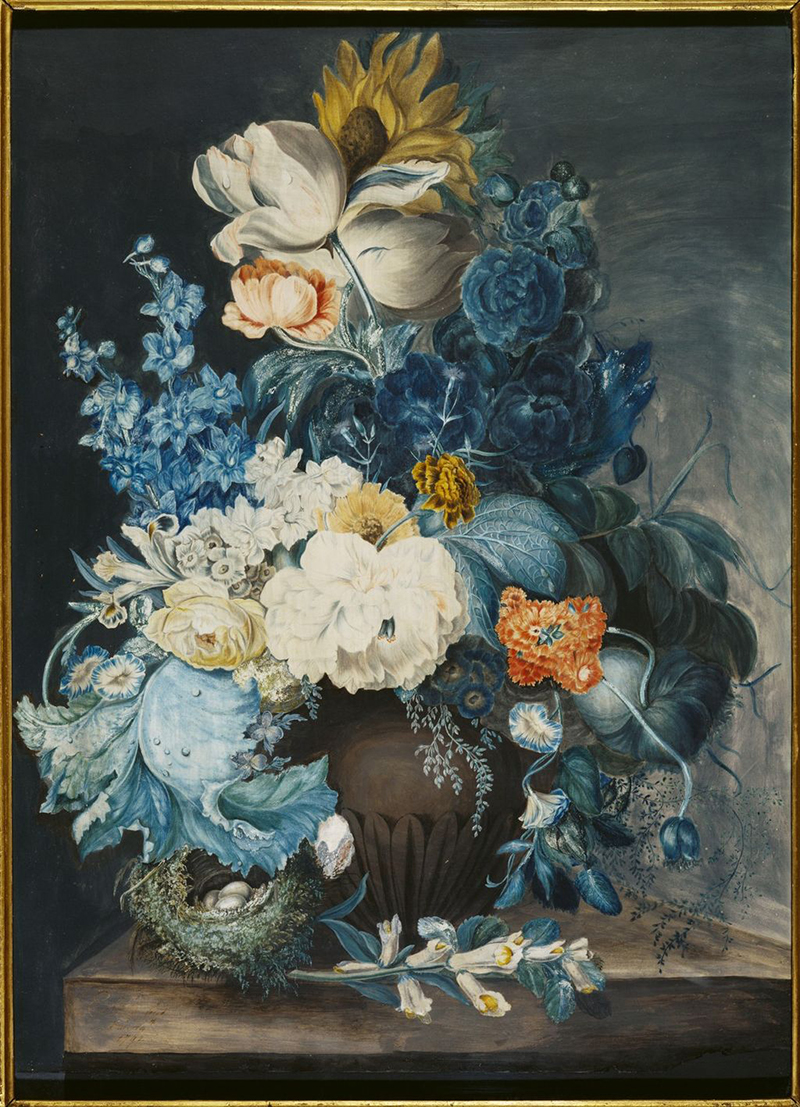
“A group of flowers in a jar and a bird’s nest,” by Princess Elizabeth after Margaret Meen. Now in the Victoria and Albert Museum, London. Public domain, retrieved from Wikimedia Commons.

As you may have seen in BHL’s blog yesterday, The Royal Botanic Gardens, Kew, has been partnering with the Oak Spring Garden Foundation to digitize works by women botanical artists held in Kew’s archives. One of these talented but largely unknown artists is Margaret Meen – whose botanicals graced the walls of royal palaces and scientific academies. In fact, though little remembered or written about today, Meen’s botanicals and her prowess as an instructor of fledgling artists left a lasting impression on British botanical illustration.

Margaret Meen was born sometime around 1751 in the English county of Suffolk, but lived most of her life in London in order to better sustain herself as a working artist and teacher.  Though it is not known where or how Meen developed her skill as an artist, her brother Henry was Prebend of Twyford and also taught at St. Paul’s, indicating that Margaret most likely came from a family of some wealth and standing and thus would have had access to an education in the arts.  Certainly Henry’s status in London allowed Margaret to come into contact with the upper echelon of British aristocracy, and Meen’s talent as an artist was soon recognized by the royals.

One of her most celebrated patrons, in fact, was Queen Charlotte—wife of George III—who wrote in her diary in 1789 that she “drew with Miss Mean [sic] from 10 till one,” and who most likely purchased a painting of flowers that now hangs at the Victoria and Albert Museum in London.

Additionally, the queen’s daughter, Princess Elizabeth, was quite the budding artist herself, and her notable painting “Flower piece with bird’s nest” (1792) is modeled after Meen’s work purchased by the queen.  The princess even maintained a friendly correspondence with Meen as late as 1822.

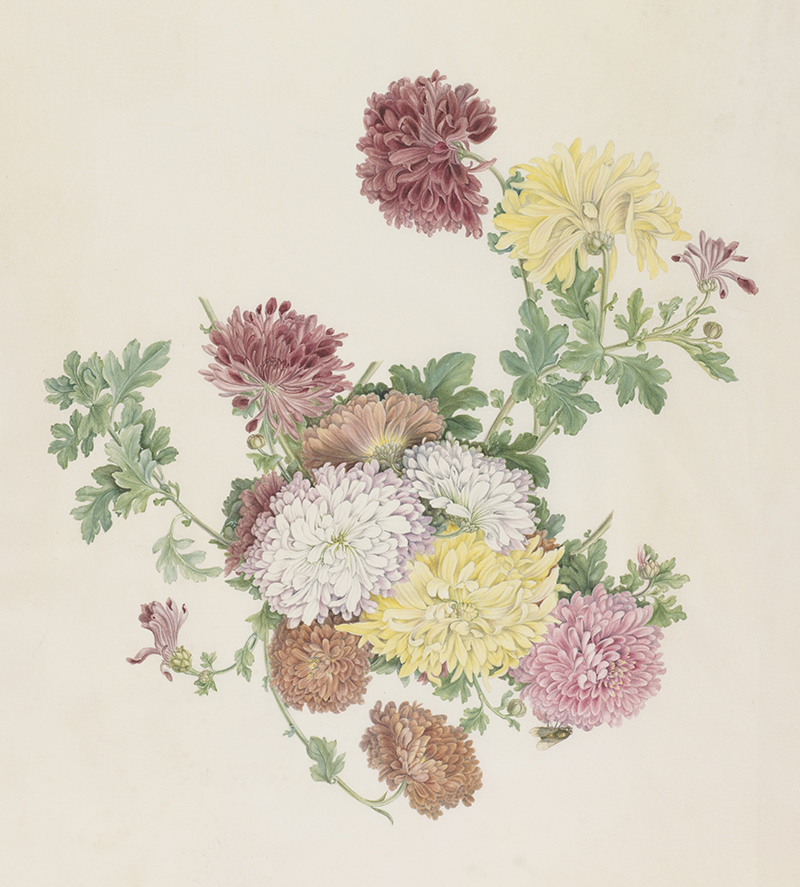
Chrysanthemums and a fly. Reproduced with permission from the Board of Trustees of the Royal Botanic Gardens, Kew, digitized with support from the Oak Spring Garden Foundation.

Aside from being the occasional tutor to artistically-inclined members of the royal family, Meen was a member of and exhibited her work at the Royal Academy from 1775 to 1785 and also with the Associated Artist in 1810. She was also employed to document the many new plants being grown in the Royal Gardens at Kew in the late 18th and early 19th centuries, using William Aiton’s Hortus Kewensis to name the species she illustrated. At this time, the Gardens at Kew were unrivaled in Britain for their botanical collection.

Her work, though largely unheralded, has been highly praised on the occasions that it is critiqued with special notice of Meen’s prodigious output and effective illustrative techniques.  Also, usually mentioned with Meen’s name is her founding of the periodical Exotic Plants from the Royal Gardens at Kew (1790), which she dedicated to Queen Charlotte but which only lasted for two issues.

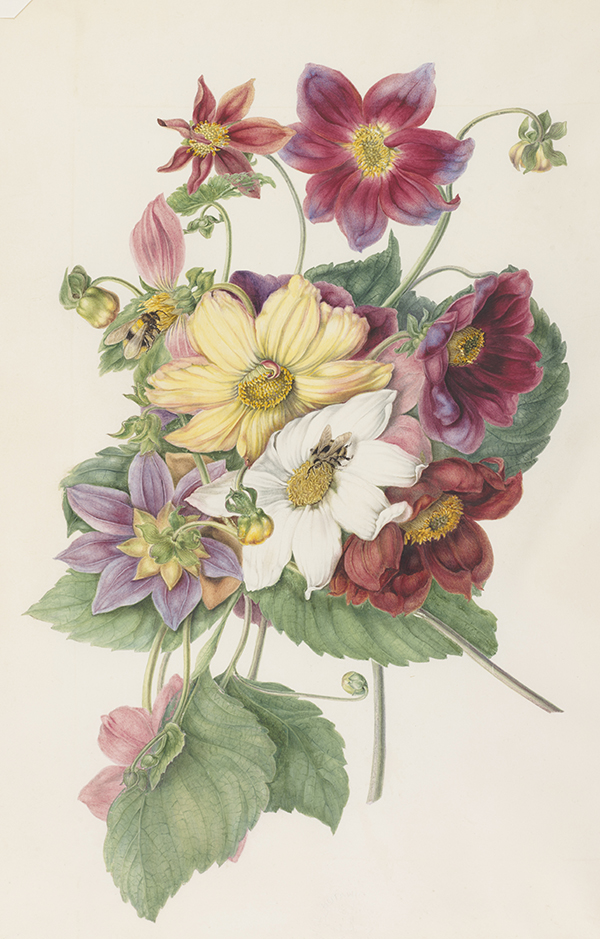
Watercolor of various flowers and bees. Reproduced with permission from the Board of Trustees of the Royal Botanic Gardens, Kew, digitized with support from the Oak Spring Garden Foundation.

Finally, Meen spent a large part of her later years as a drawing tutor for families with the means to provide their children with one and as an instructor for larger groups of students at a school in Notting Hill, London.  Among Meen’s pupils was the future Lady Northampton and Emma Smith, the future wife of Jane Austen’s nephew and biographer. Meen kept up her teaching until late in her life and as she never married or had children of her own, was especially determined to impart her artist lessons on to young minds in whom she saw latent talent.

Margaret Meen’s career as a botanical artist took her from the halls of Buckingham Palace to chambers of the Royal Academy and the schoolrooms of London. Over her long life she not only contributed to the furtherance of scientific knowledge through her botanical prints but also to the development of young artists from the most privileged to those who simply attended her classes in Notting Hill. Her artwork was appreciated by everyone from the Queen of England to its most revered scientists and its precocious young scholars. Though little remembered today, Margaret Meen’s art and legacy thus stands as an important part of late 18th and early 19th century British botanical history and deserves to be better celebrated today.

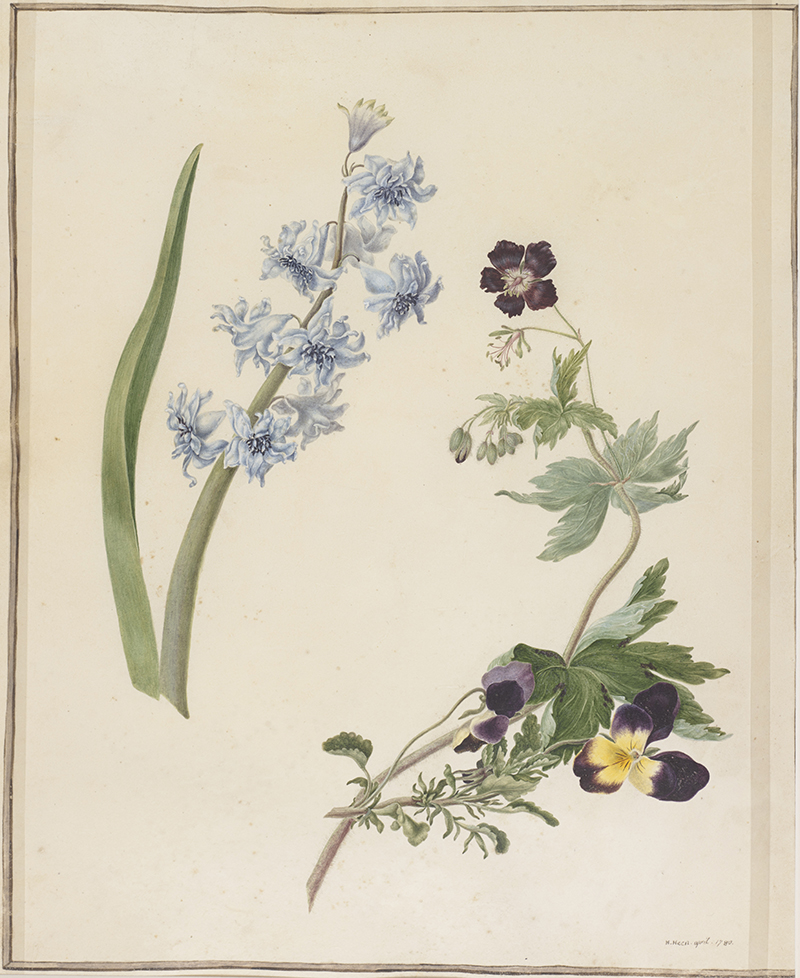
Watercolor of pansy and unknown flower. Reproduced with permission from the Board of Trustees of the Royal Botanic Gardens, Kew, digitized with support from the Oak Spring Garden Foundation.

This post was updated on 22 February 2021 to correct birth and death dates for Meen and a typo in quoted materials from Queen Charlotte’s diary.

References

Blunt, Wilfrid and William T. Stearn. The Art of Botanical Illustration. New York: Antique Collectors Club Press, 1993. Originally published in 1950.

Mabey, Richard. The Flowering of Kew. London, UK: Ebury Press, 1988.

McDonald, Kelly M. “Margaret Meen: A Life in Four Letters.” Academia.edu.

Royal Academy. “Anderson’s Notes on the 1775 Exhibits of James Lambert, William Laranson, P.J. Loutherbourg, William Martin, J. Mauris, Jeremiah Meyer, Margaret Meen and Mary Moser.”

Royal Collection Trust. “Description of ‘Flower piece with bird’s nest.’”

March 14, 2019by Chris Byrd

Help Support BHL

BHL's existence depends on the financial support of its patrons. Help us keep this free resource alive!

search

About BHL

The Biodiversity Heritage Library (BHL) is the world’s largest open access digital library for biodiversity literature and archives. BHL operates as a worldwide consortium of natural history, botanical, research, and national libraries working together to digitize the natural history literature held in their collections and make it freely available for open access as part of a global “biodiversity community.”

Join Our Mailing List

Sign up to receive the latest news, content highlights, and promotions.

Subscribe Now

Subscribe to Blog via Email

Enter your email address to subscribe to this blog and receive notifications of new posts by email.

Join 319 other subscribers

Subscribe to Blog Via RSS

Subscribe to the blog RSS feed to stay up-to-date on all the latest BHL posts.

Access RSS Feed

Inspiring Discovery through Free Access to Biodiversity Knowledge.

The Biodiversity Heritage Library makes it easier than ever for you to access the information you need to study and explore life on Earth…for free, anytime, anywhere.


64+ Million Pages of
Biodiversity Literature Online.

EXPLORE

Tools and Services
to Transform Research.

EXPLORE

300,000+
Illustrations on Flickr.

EXPLORE

ABOUT | HARMFUL CONTENT | PRIVACY | SITE MAP | TERMS OF USE