Biodiversity Heritage Library - Program news and collection highlights from BHL
  • Home
  • News
  • Featured Books
    • All Featured Books
    • Book of the Month Series
    • BHL at 20
  • User Stories
  • Campaigns
    • Fossil Stories
    • Garden Stories
    • Monsters Are Real
    • Page Frights
    • Her Natural History
    • Earth Optimism 2020
  • Tech Blog
  • Visit BHL
Home
News
Featured Books
    All Featured Books
    Book of the Month Series
    BHL at 20
User Stories
Campaigns
    Fossil Stories
    Garden Stories
    Monsters Are Real
    Page Frights
    Her Natural History
    Earth Optimism 2020
Tech Blog
Visit BHL
  • Home
  • News
  • Featured Books
    • All Featured Books
    • Book of the Month Series
    • BHL at 20
  • User Stories
  • Campaigns
    • Fossil Stories
    • Garden Stories
    • Monsters Are Real
    • Page Frights
    • Her Natural History
    • Earth Optimism 2020
  • Tech Blog
  • Visit BHL
Biodiversity Heritage Library - Program news and collection highlights from BHL
Blog Reel, Featured Books

From Canada’s National Capital to “the Rock” — The Tale of a Traveling Book by Philip Henry Gosse

dragonflies

The Island of Newfoundland was nicknamed “The Rock” because of its rocky terrain and high cliffs.

I’m Elizabeth Smith, and I work at the Canadian Museum of Nature’s Library & Archives as Acquisitions and Cataloguing Officer. In this capacity, I have the privilege of caring for a rare book collection consisting of approximately 4,000 pre-20th century monographs, manuscripts and periodicals, including a special unpublished manuscript, Entomologia Terrae Novae by Philip Henry Gosse — which I had the privilege of hand couriering to St John’s Newfoundland for a short exhibit and panel talk at Memorial University’s QEII Library this past September.

photo of a version with dark hair and green sweater holding a manuscript with illustrations of butterflies

Elizabeth Smith is an acquisitions and cataloguing officer with the Canadian Museum of Nature in Ottawa. Here she holds Philip Henry Gosse’s unpublished manuscript, Entomologia Terrae Novae. (Francesa Swan/CBC). Source.

This special manuscript has been digitized by the Museum’s Library & Archives on BHL.

On arrival in St John’s, I was greeted by the managing editor for Boulder Books and whisked over to the CBC Radio station to do an interview for On-The Go with Ted Blades. Months prior, Boulder reached out to our library to inquire about borrowing the manuscript to be shown in tandem with the launch of their newest field guide, Stouts, Millers & Forky-Tails: Insects of Newfoundland & Labrador, which drew inspiration from Gosse’s work. I was ultimately invited to speak alongside Dr. Tom Chapman, head of the Department of Biology at Memorial University and co-author of that field guide, at an engagement and advocacy event held by Memorial’s QEII Library in the Centre for Newfoundland Studies (CNS). The event was fittingly called A Bug’s Life: Tales of the N.L. Insect (1833-2019).

black and white photo of a man looking into a microscope

Philip Henry Gosse, 1863. Source: Canadian Museum of Nature Blog.

Entomologia Terrae Novae, authored by Philip Henry Gosse in 1833, was the first attempt to classify and illustrate the insect fauna of Newfoundland. About 250 magnificent illustrations adorn its pages — many of which are of the Lycaenidae family, which is the second-largest family of butterflies.

butterflies

(Below) The common blue butterfly (Polyommatus icarus) of the Lycaenidae family along with (above) the black swallowtail (Papilio polyxenes). Gosse, Philip Henry. Entomologia terrae novae. 1833. Contributed in BHL from the Canadian Museum of Nature Library / Bibliothèque du Musée canadien de la nature.

I pondered with my entomologist colleague, Dr. Bob Anderson, as to why that might be. Perhaps it was the metamorphosis process that fascinated Gosse? We reflected on the fact that much of the world’s life forms were only starting to be explored, and that exploration and illustration was a hobby in this (almost) Victorian Era. Dr. Anderson also taught me of the value in capturing the host plants in scientific illustrations, as it can inform research scientists of various things. There are several examples of this throughout the book.

butterflies and caterpillars on plants

Gosse captured the metamorphosis process and host plants in his drawings. Gosse, Philip Henry. Entomologia terrae novae. 1833. Contributed in BHL from the Canadian Museum of Nature Library / Bibliothèque du Musée canadien de la nature.

Philip Henry Gosse was the son of Thomas Gosse and Hannah (née Best). He was sent from England to Carbonear at age 17 to work as a clerk. Gosse’s father, Thomas, was a miniature portrait artist himself, but it was Gosse’s aunt (Susan Bell) who first taught him to draw. He did so exquisitely, sometimes with the help of a microscope. Throughout the manuscript, readers can see examples of insects which Gosse carefully represented in their actual size and enlarged to a magnified proportion to show more detail.

illustration of a bee at scale and magnified

Example from Gosse’s manuscript of an insect drawn to scale and magnified. Gosse, Philip Henry. Entomologia terrae novae. 1833. Contributed in BHL from the Canadian Museum of Nature Library / Bibliothèque du Musée canadien de la nature.

Meticulously hand drawn insects like these are nothing short of impressive. If you take a closer look, you will also notice annotations and even … a dolphin sketch! Gosse went on to illustrate other forms of life, some for which he was more famous (for example, he’s known for inaugurating the word “aquarium” and making these glass enclosures popular with the publication of his 1854 monograph dedicated to the subject).

dolphins

Dolphins, an unexpected inclusion in Gosse’s manuscript. Gosse, Philip Henry. Entomologia terrae novae. 1833. Contributed in BHL from the Canadian Museum of Nature Library / Bibliothèque du Musée canadien de la nature.

Gosse moved on from Newfoundland to Quebec and other locations, taking the manuscript with him and eventually passing it along to his son, Edmund Gosse. It was passed down through the Gosse family until it was donated to the Canadian Museum of Nature in the 1950s.

This singular manuscript holds many treasures and a few surprises. We were excited to bring this work back to Newfoundland for the first time since its creation in the 1830s to be showcased as part of this special event with the Memorial University’s QEII Library. While it is a phenomenal experience to view the manuscript in person and appreciate the almost 3D quality of the drawings, the digitized copy in the Biodiversity Heritage Library ensures that everyone can enjoy this unique item and the important milestone it represents for the history of entomological studies in Newfoundland.

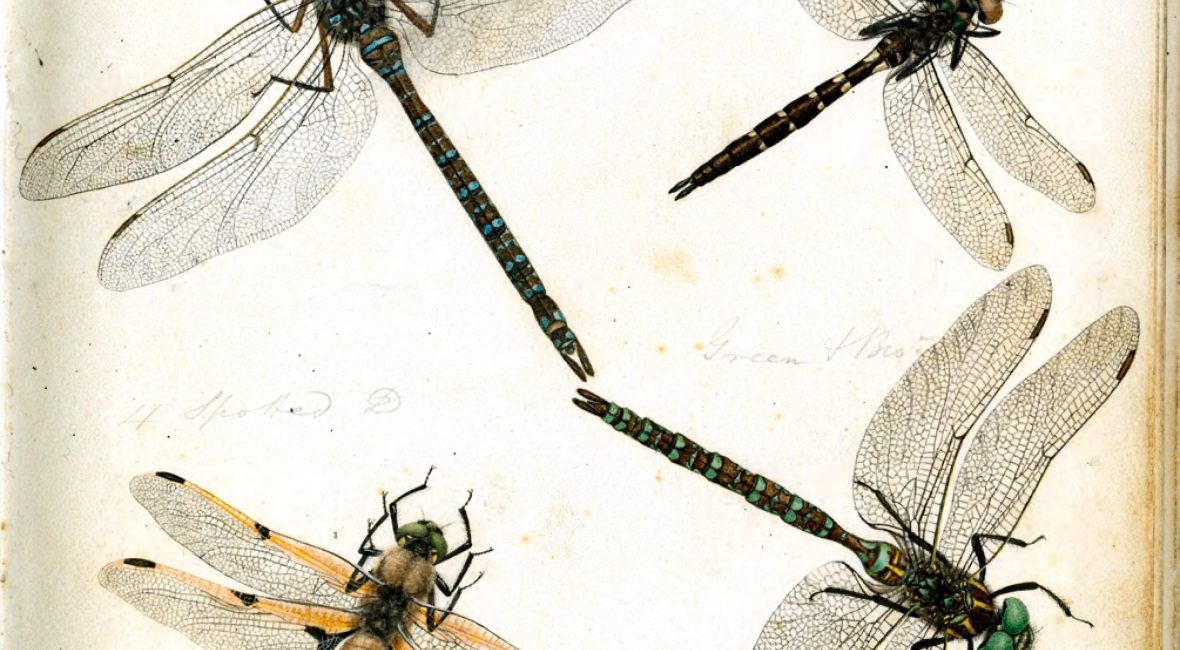
dragonflies

Dragonflies of Newfoundland. Gosse, Philip Henry. Entomologia terrae novae. 1833. Contributed in BHL from the Canadian Museum of Nature Library / Bibliothèque du Musée canadien de la nature.

November 22, 2019by Elizabeth Smith
Blog Reel, Featured Books

Exploring the Birds of Canada

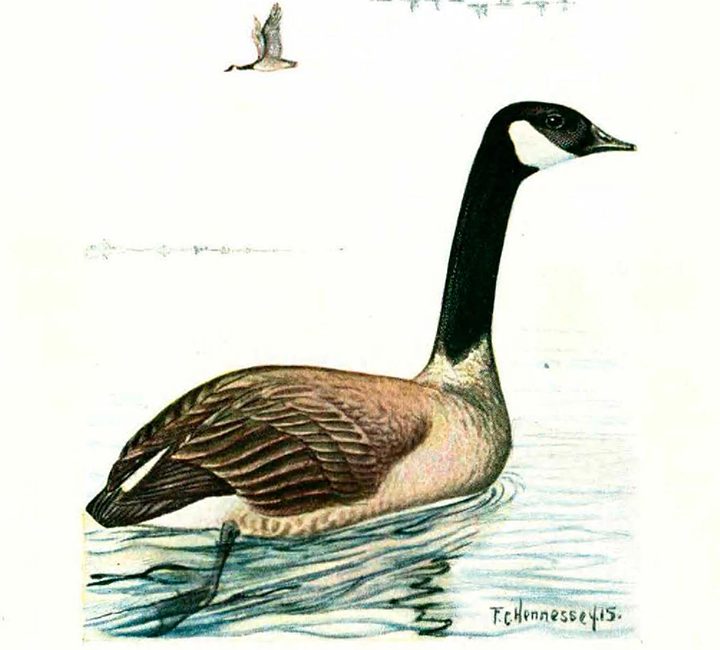
illustration of a goose in water
illustration of a goose
Canada Goose (Branta canadensis). Illustration by F.C. Hennessey. Birds of Canada (1934) by Percy Algernon Taverner. Digitized in BHL by Canadian Museum of Nature Library.

Did someone say Spring?!

In Ottawa, we start to see the Canada Geese returning to their summer nesting grounds around this time of year. Large flocks of them fly overhead in the same v-shaped formations we saw months ago when they left in the late fall.​

drawings of various geese varieties
Various subspecies of the Canada Goose (Branta canadensis). Birds of Canada (1934) by Percy Algernon Taverner. Digitized in BHL by Canadian Museum of Nature Library.

Aren’t migratory birds fascinating? Along with so many other Canadian bird species.

Birds of Canada by Percy Algernon Taverner remains one of the best accounts of the kinds of birds that occur in Canada. And the first thirty-six pages holds just the right amount of information to open the science of ornithology to bird lovers, yet still enough information to satisfy research needs.​

illustration of pine grosbeaks
The pine grosbeak (Pinicola enucleator). Illustration by Allan Brooks. Birds of Canada (1934) by Percy Algernon Taverner. Digitized in BHL by Canadian Museum of Nature Library.

Further on, the book is beautifully illustrated with the works of Allan Brooks, a distinguished bird artist, and there is an abundance of illustrations imbedded throughout, contributing visual explanations. A well-illustrated book was still a rarer occurrence in 1934 when this title was published. This was undoubtedly a key factor in its popularity at the time.​

illustration of upland plover
The upland plover or sandpiper (Bartramia longicauda). Illustration by Allan Brooks. Birds of Canada (1934) by Percy Algernon Taverner. Digitized in BHL by Canadian Museum of Nature Library.

Percy Algernon Taverner compiled over 330 publications about birds, but Birds of Canada was amongst his three best-sellers. Thanks to the Canadian Museum of Nature Library, you can read a copy of Birds of Canada on BHL.​

illustration of rufous hummingbird
The rufous hummingbird (Selasphorus rufus). Illustration by Allan Brooks. Birds of Canada (1934) by Percy Algernon Taverner. Digitized in BHL by Canadian Museum of Nature Library.

Taverner built from scratch the Ornithology department of the National Museum of Canada (now Canadian Museum of Nature). Fast forward from then to now (1911 to 2018), a public Bird Gallery at the Canadian Museum of Nature’s Victoria Memorial Museum Building in downtown Ottawa is the largest and most modern bird gallery in Canada with nearly 500 specimens of Canadian birds.​

photo of a man smoking a pipe outside
Percy Algernon Taverner.

In 2015, Percy Taverner Park was named in his honour. This park is at Woodbine Place, in Ottawa Ontario, where three imaginative bike racks border the entrance to the park. They are stylized Northern Cardinals and reputed to be Percy Taverner’s favourite birds.​

photo of bike racks shaped by cardinals
Bike racks stylized as Northern Cardinals at the entrance to Percy Taverner Park. Image source: Old Ottawa South Community Association.​
sketch of a cardinal alongside text
Northern Cardinal (Cardinalis cardinalis). Birds of Canada (1934) by Percy Algernon Taverner. Digitized in BHL by Canadian Museum of Nature Library.

For a thoughtfully and nicely written biography, A Life with Birds: Percy A. Taverner, Canadian Ornithologist, 1875-1947 by John L. Cranmer-Byng, a special issue of the Canadian Field-Naturalist, 1996, volume 110, number 1, is also available to read on BHL.

illustration of two woodpeckers
The hairy woodpecker (Picoides villosus or Leuconotopicus villosus). Taxonomy varies by taxonomic authority. Illustration by Allan Brooks. Birds of Canada (1934) by Percy Algernon Taverner. Digitized in BHL by Canadian Museum of Nature Library.

In the words of Taverner himself, “ornithology is one of the problems of nature that may be successfully attacked from so many points of view and in so many ways that there is interesting and valuable work for all to accomplish according to individual taste or opportunity”.​

text on a page
Quote from the introduction of Birds of Canada (1934) by Percy Algernon Taverner. Digitized in BHL by Canadian Museum of Nature Library.
illustration of two owls
The eastern screech owl (Megascops asio). Illustration by Allan Brooks. Birds of Canada (1934) by Percy Algernon Taverner. Digitized in BHL by Canadian Museum of Nature Library.
March 22, 2018by Elizabeth Smith

Help Support BHL

BHL's existence depends on the financial support of its patrons. Help us keep this free resource alive!

search

About BHL

The Biodiversity Heritage Library (BHL) is the world’s largest open access digital library for biodiversity literature and archives. BHL operates as a worldwide consortium of natural history, botanical, research, and national libraries working together to digitize the natural history literature held in their collections and make it freely available for open access as part of a global “biodiversity community.”

Join Our Mailing List

Sign up to receive the latest news, content highlights, and promotions.

Subscribe Now

Subscribe to Blog via Email

Enter your email address to subscribe to this blog and receive notifications of new posts by email.

Join 319 other subscribers

Subscribe to Blog Via RSS

Subscribe to the blog RSS feed to stay up-to-date on all the latest BHL posts.

Access RSS Feed

Inspiring Discovery through Free Access to Biodiversity Knowledge.

The Biodiversity Heritage Library makes it easier than ever for you to access the information you need to study and explore life on Earth…for free, anytime, anywhere.


64+ Million Pages of
Biodiversity Literature Online.

EXPLORE

Tools and Services
to Transform Research.

EXPLORE

300,000+
Illustrations on Flickr.

EXPLORE

ABOUT | HARMFUL CONTENT | PRIVACY | SITE MAP | TERMS OF USE