
Biodiversity Heritage Library - Program news and collection highlights from BHL
  • Home
  • News
  • Featured Books
    • All Featured Books
    • Book of the Month Series
    • BHL at 20
  • User Stories
  • Campaigns
    • Fossil Stories
    • Garden Stories
    • Monsters Are Real
    • Page Frights
    • Her Natural History
    • Earth Optimism 2020
  • Tech Blog
  • Visit BHL
Home
News
Featured Books
    All Featured Books
    Book of the Month Series
    BHL at 20
User Stories
Campaigns
    Fossil Stories
    Garden Stories
    Monsters Are Real
    Page Frights
    Her Natural History
    Earth Optimism 2020
Tech Blog
Visit BHL
  • Home
  • News
  • Featured Books
    • All Featured Books
    • Book of the Month Series
    • BHL at 20
  • User Stories
  • Campaigns
    • Fossil Stories
    • Garden Stories
    • Monsters Are Real
    • Page Frights
    • Her Natural History
    • Earth Optimism 2020
  • Tech Blog
  • Visit BHL
Biodiversity Heritage Library - Program news and collection highlights from BHL
Blog Reel, Featured Books

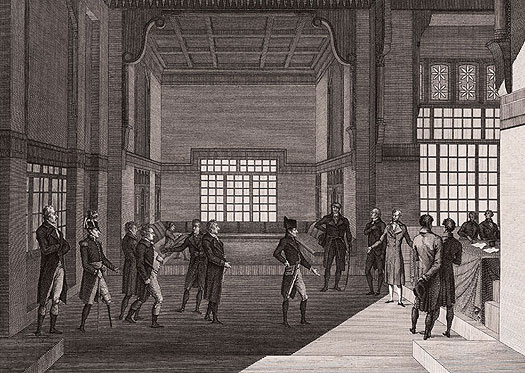
The Description de l’Égypte: The Savants of Napoleon’s Egyptian Campaign

View Full Size Image
by Jean-Constantin Protain (courtesy of Linda Hall library)

The Expedition

Where were they going? That is what the majority of the 44,000 soldiers and sailors on 400 French ships must have been thinking up until they landed near Alexandria on July 2, 1798. They had just annexed Malta and had recently invaded Italy and set out immediately for their next conquest…Egypt. The extra hush-hush invasion of Egypt had begun and Napoleon could not have been more excited. He fashioned himself the next Alexander the Great and invading Egypt would be following right in his footsteps. The invasion had many political and economic reasons for taking place such as protecting French trade interests and attempting to get the upper hand on Britain who were also interested in establishing colonies across Africa. The invasion was doomed to fail from the beginning as the population resisted the French and the British sunk the French ships effectively stranding them. Sickness and disease also ravaged the French troops. Napoleon himself went back to France within a year, trying to take advantage of a political opening for him to enact a coup.  In 1801, after an unsteady three years, the French were defeated by the Ottomans and British and the French were forced to head back home in defeat.

While the defeat was costly and embarrassing to the French, it did provide another positive aspect that has been celebrated even since. As part of the invasion, Napoleon and the French government commissioned a group of scientists from diverse scientific fields of study to accompany the soldiers. Whether it was due to the idea of Enlightenment or simply propaganda, more than 150 engineers, astronomers, physicists, chemists, doctors, botanists, naturalists, and artists made the arduous journey to Egypt, even though most of them had no idea where they were going! These French savants, more comfortable in a laboratory or classroom, dropped everything for a chance to be part of an historic journey promising a scholarly cornucopia (they hoped) and maybe a little adventure. Most had no interest in the invasion or the colonization of Egypt. Theirs was a mission of science.

Their mission wasn’t easy. The French troops didn’t want them there.  A ship carrying their scientific equipment ran aground and sank. Many became sick and some even died. However, they withstood the hardships, founded the Institut d’Egypte with the idea to disseminate the values of Enlightenment in Egypt, and in doing so produced a masterpiece of scholarship… the Description de l’Egypte.


Description de l’Égypte, ou, Recueil des observations et des recherches qui ont été faites en Égypte pendant l’expédition de l’armée françaisewas the result of the herculean efforts made by the savants. They compiled an impressive amount of data and specimens from all facets of Egyptian life and its environment covering the areas of natural history, archaeology, chemistry, geography, and medicine just to name a few.

When the French army left Egypt in defeat, the collections of specimens and materials the savants had collected were almost lost due to the terms of surrender to England. Fortunately, the French zoologist, Étienne Geoffroy Saint-Hilaire, was actually able to persuade the British that only the savants alone could read and interpret all their notes, records and other materials. Luckily, a large amount of the scientific material was allowed to go to France although other specimens, such as the all-important Rosetta Stone ended up in the British Museum where it is still on display today.

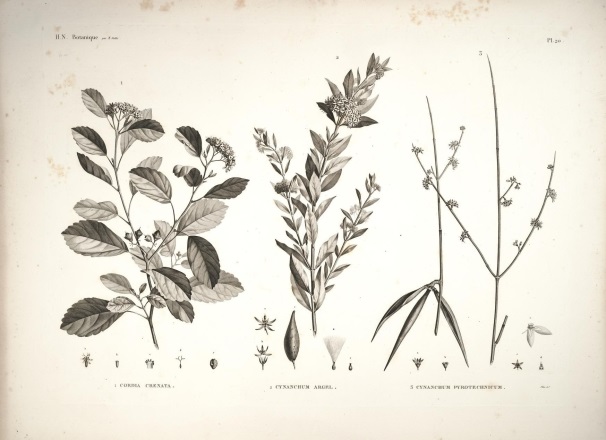
The savants returned to France in 1801 and immediately organized their materials to meet an edict of Napoleon’s ordering the publication of all the material. Finally, in 1809, the first volumes were published and new volumes were continually published through 1828 equaling at least 20 folios (depending on the edition). The set includes over 800 plates and thousands of illustrations. The atlases are large and beautifully engraved. We are featuring some of the plates from these atlases dealing with the natural history of Egypt here.

This beautiful collection was an enormous success, even with a hefty price tag, exposing Europeans to the largely unknown land and history of Egypt. So, while France’s Egyptian campaign was an utter failure, the publication of the Descriptionwas an academic success and led to the birth of the field of Egyptology in Europe.

Some of the Naturalists/Savants

BHL also has other works dealing with natural history by some of the savants that were part of the creation of the Description de l’Egypte.
View Full Size Image

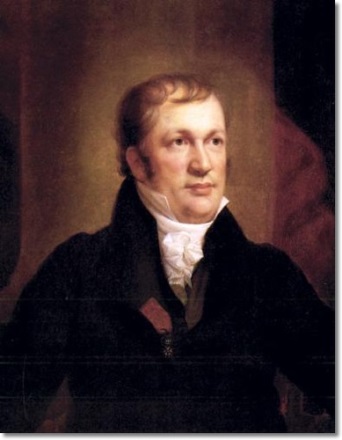
Étienne Geoffroy Saint-Hilaire was a French naturalist who studied the animals and fish of Egypt. He was a senior director for the Egyptian scientific campaign. He was precise with his observations and attention to detail. He wasn’t an illustrator but provided multiple specimens to be illustrated later by artists like Henri-Joseph Redouté. Geoffroy was one of the savants responsible for convincing the English that the French scientists should retain many of the records and specimens collected by him and his colleagues. He became best known for his theory on the “unity of composition” and earned many awards and honors throughout his life for his work.
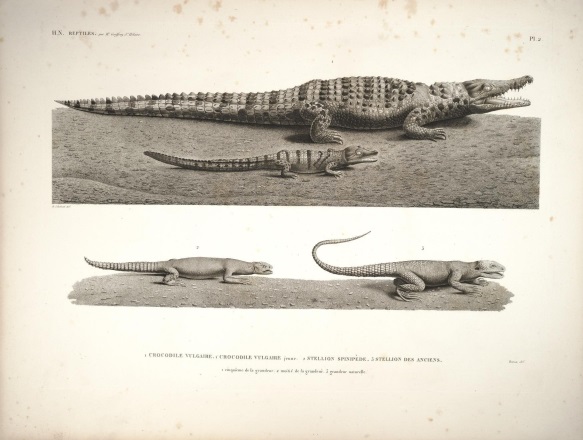
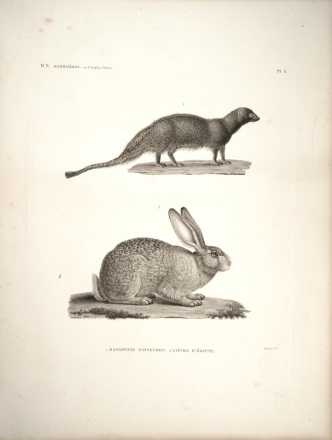
View Full Size ImageView Full Size Image
View Full Size ImageAlire Raffeneau Delile was a physician and French botanist. He collected and described numerous types of algae, as well as papyrus (Cyperus papyrus) and the sacred lotus (Nymphaea lotus). He was also one of the scientists whosuccessfully convinced the British to let him keep the plant specimens that the French had collected in Egypt. He later moved to the United States as French vice consul and as a physician. He later returned to France becoming director of the botanic garden in Montpellier.
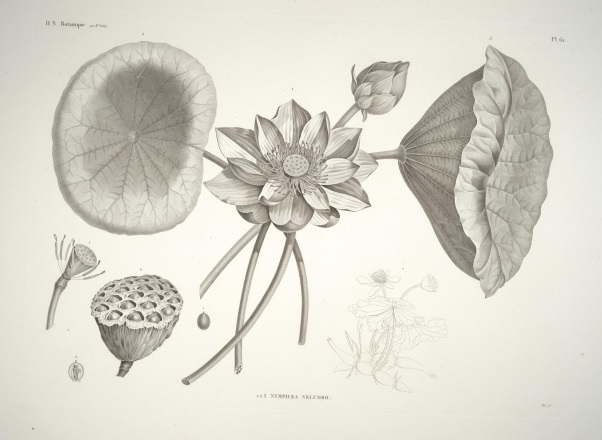
View Full Size Image

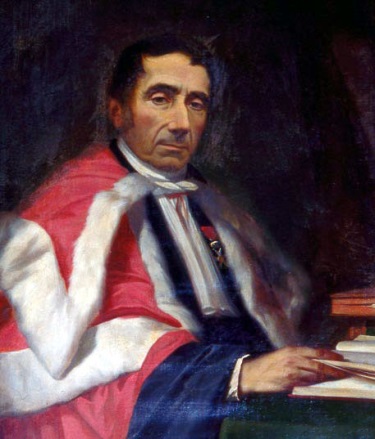
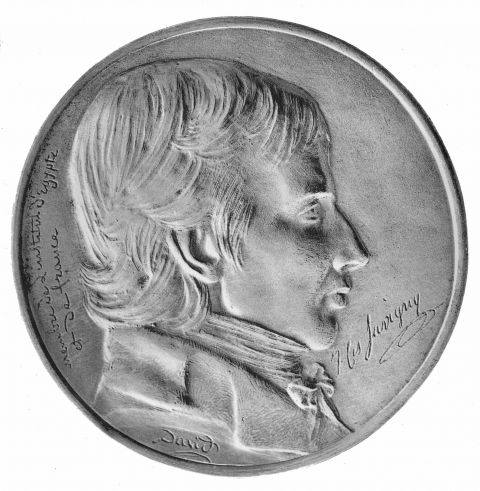
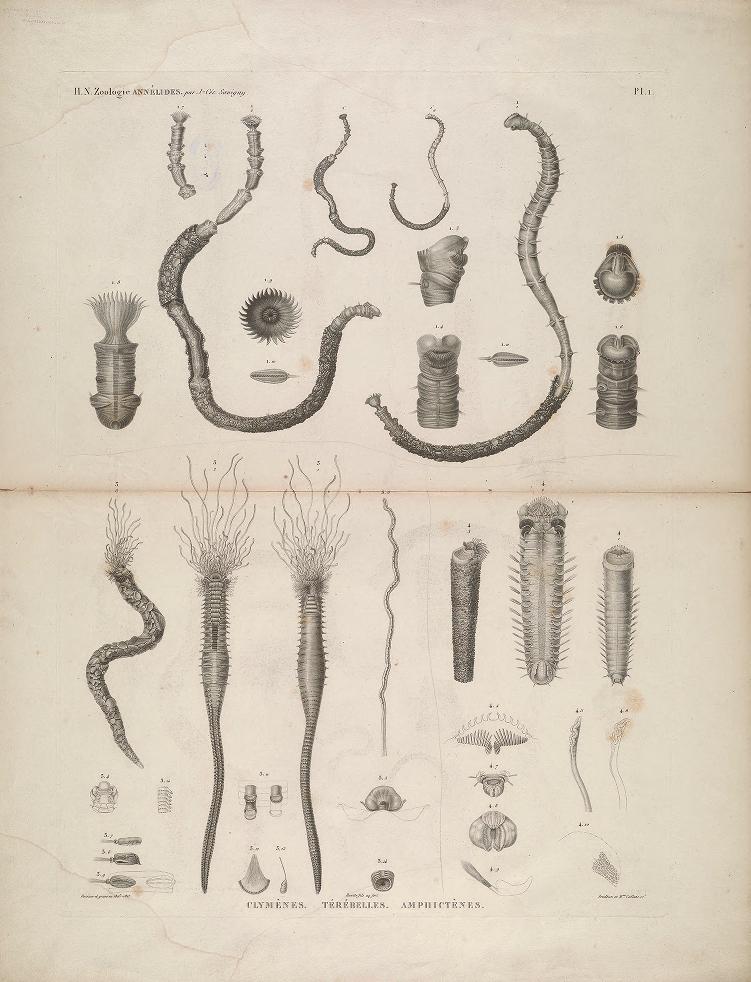
Marie Jules César Lelorgne de Savigny was a French zoologist who was responsible for studying the invertebrates encountered in Egypt while Geoffroy studied the vertebrates. Savigny also contributed all of the ornithology sections and supplemented other sections on vertebrates for the Description de l’Egypte. Georges Cuvier himself suggested to Napoleon that Savigny take part in the campaign. Even while suffering deteriorating eyesight, he completed Mémoires sur les animaux sans vertèbre.
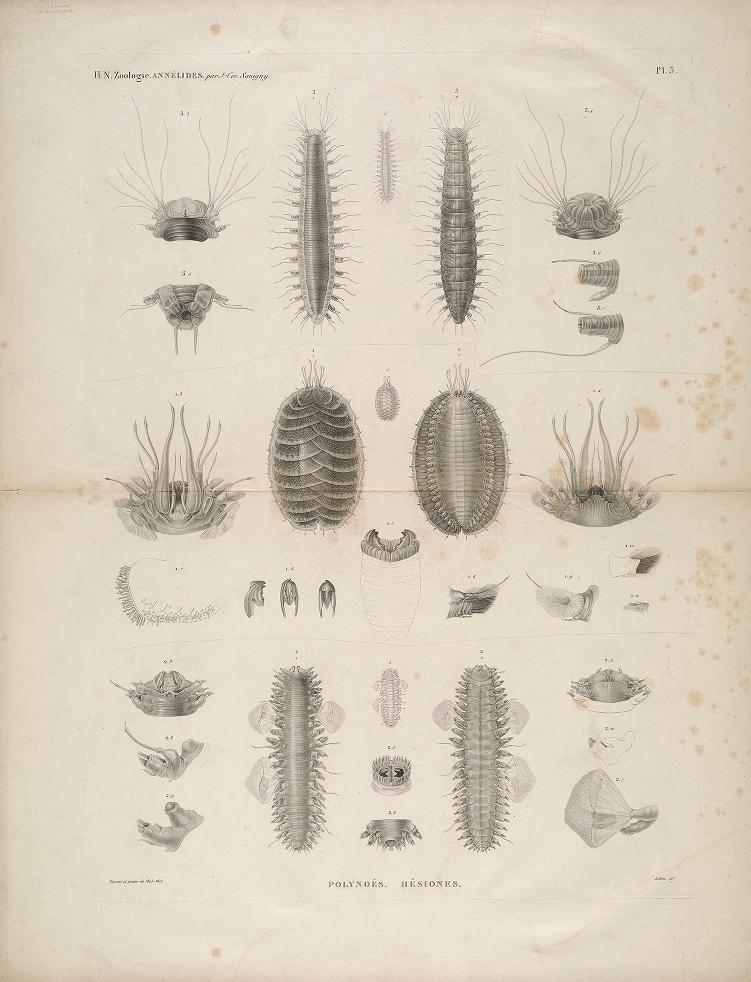
View Full Size ImageView Full Size Image

Additional Sources

BHL Collection

Flickr Collection

Description de l’Egypte by Bibliotheca Alexandrina in collaboration with the l’Institut d’Egypte

Mirage: Napoleon’s Scientists and the Unveiling of Egypt by Nina Burleigh

Napoleon and the Scientific Expedition to Egypt

We hope you enjoyed this post. Interested in guest-blogging for BHL? We’d love that! Natural history, biodiversity and conservation topics are especially welcomed. Email us your ideas at [email protected].
August 1, 2013by jjdipasquale
Blog Reel, Featured Books

Bone Wars: Book of the Week

Building on the previous BHL Blog post by Clare Flemming, on the controversial and vitriol-laced “Bone Wars” between well respected paleontologists Edward Drinker Cope and Othniel Charles Marsh, the Book of the Week this week actually focuses on two items. To be more exact, two versions of the same item.

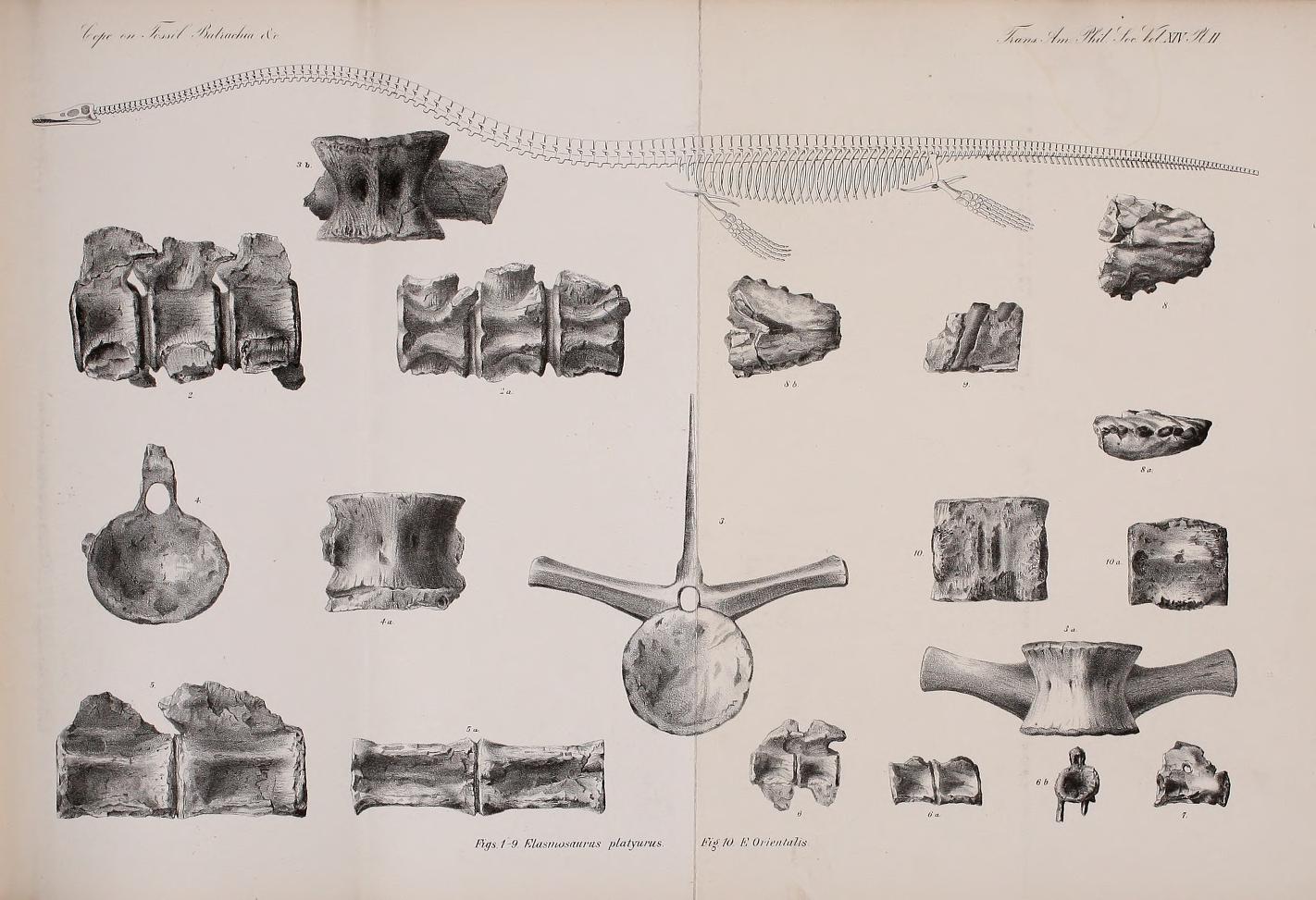
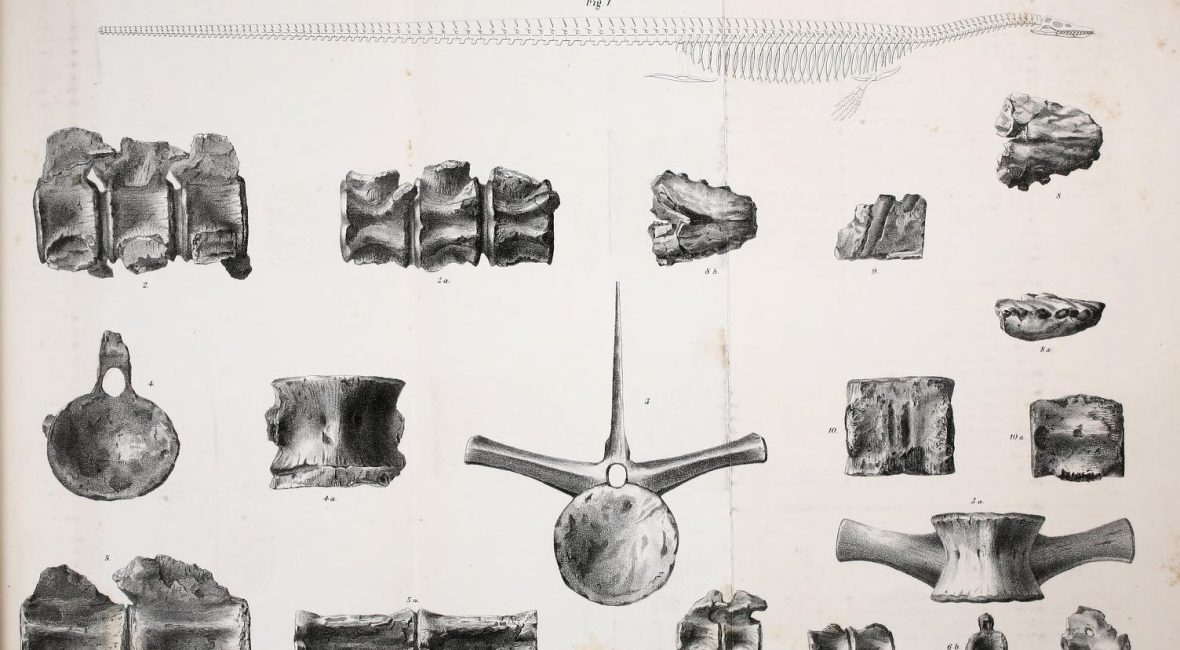
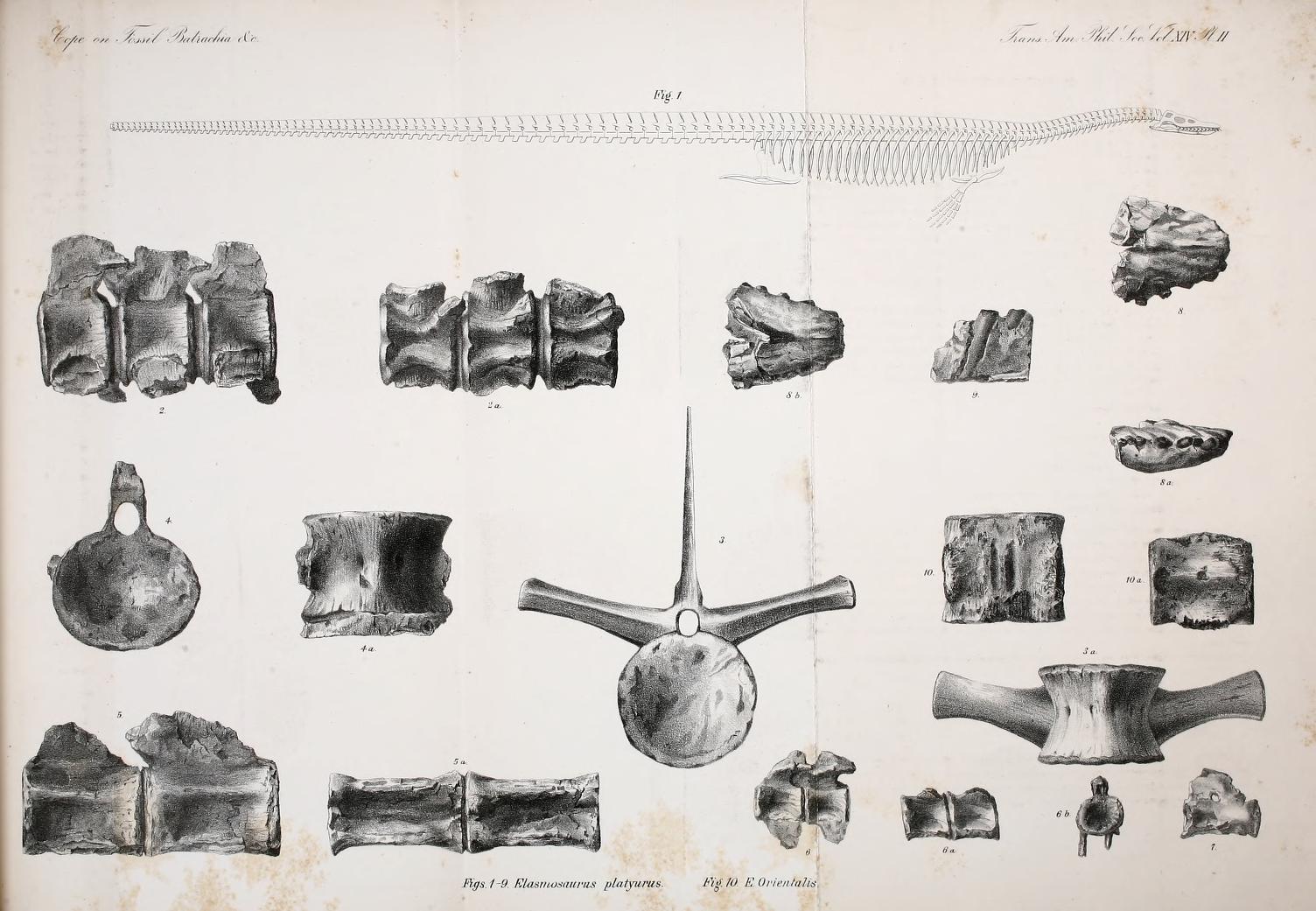
Synopsis of the Extinct Batrachia, Reptilia and Aves of North America by Edward Cope, published in Volume 14 of the Transactions of the American Philosophical Society, is arguably the most famous item either paleontologist published, not due to its academic qualities but because it exemplifies and magnifies how the competition between the two men and the rush to publish led to major errors by both. Here is how Plate II from the Synopsis of the Extinct Batrachia… was first printed:

View Full Size Image
http://biodiversitylibrary.org/item/123123#page/113/mode/1up

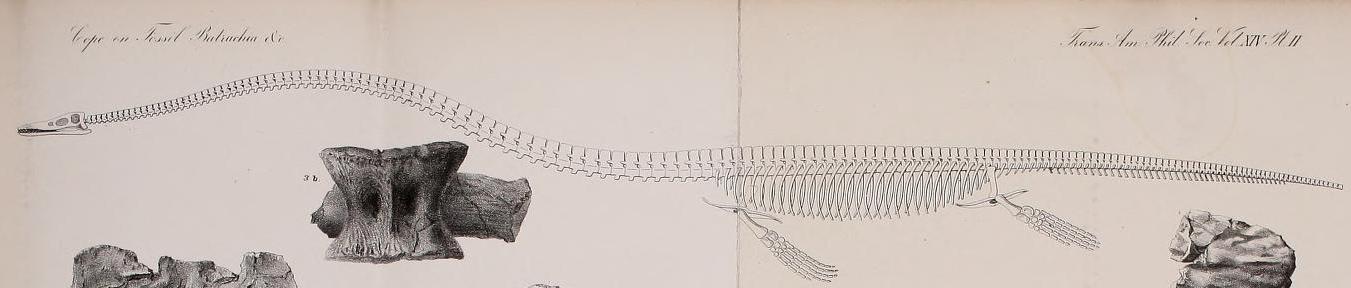
This is how it was re-printed after an error was discovered:
View Full Size Image
http://biodiversitylibrary.org/item/123170#page/117/mode/1up

Do you see the difference?

How about now?

View Full Size Image
View Full Size Image 

That’s right, Cope’s reconstruction of the plesiosaur Elasmosaurus has the head on the wrong end of the dinosaur! Marsh pointed out the error soon after Cope had (too quickly) published his results. Cope and Marsh, in order to settle their argument asked, Joseph Leidy, the Father of American Vertebrate Paleontology himself, to examine the fossils and he declared that Marsh was most likely correct that Elasmosaurus has a long neck and a short tail, not the other way around as Cope had proposed. Cope was so utterly humiliated that he attempted to purchase every copy of the journal he could hunt down with the incorrect illustration and to release an updated version with the correct head placement. However, he couldn’t get his hands on all of the original erred copies (Marsh, of course, had his own copy) and the error was publicized, surely to the great satisfaction of Marsh.

Thus, the Bone Wars had begun as the rivalry between the two men continued to intensify and only ended after the death of Cope in 1897.

The rivalry between the two men showed both sides of the academic coin in the field of paleontology at that time. While both men succeeded in advancing the field of paleontology, they also produced a negative reputation in the eye of the public that witnessed the ugly rivalry unfold in the pages of newspapers and scientific journals across the country.

Check out the images from the first copy of Synopsis of the Extinct Batrachia, Reptilia and Aves of North America at BHL Flickr. Also, take a look at all the items available at BHL authored or coauthored by Cope or Marsh in the BHL Bone Wars Collection and a select collection of books by Marsh and Cope at the new Bone Wars iTunes U Collection!

We hope you enjoyed this post. Interested in guest-blogging for BHL? We’d love that! Natural history, biodiversity and conservation topics are especially welcomed. Email us your ideas at [email protected].
November 15, 2012by jjdipasquale
Blog Reel

My Life as a BHL Staffer: Gilbert Borrego

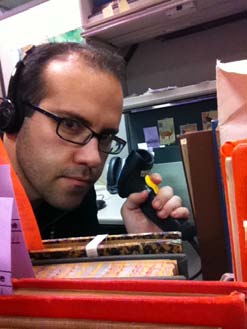
View Full Size ImageTo kick off the new year, we here at BHL are starting a new monthly series titled “My Life as a BHL Staffer.” Each month, we will showcase a different BHL staff member and give an overview of what tasks and duties that person performs. We kick off the series with me, Gilbert Borrego, BHL staff member from the Smithsonian Institution. While I have a lot of different duties to perform for BHL, I can group them into three main areas: Social Media (which includes Flickr and Facebook), the pagination of BHL materials, and lastly, the pulling and returning of the physical items that will be scanned and eventually show up on BHL. I’ll start with the fan favorite:

BHL Flickr:

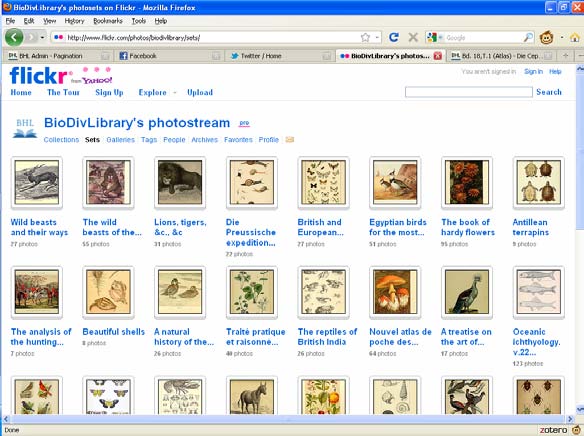
The goal of having a BHL Flickr page (http://www.flickr.com/photos/biodivlibrary/sets/) is to have a means to showcase BHL content in a new and fun way. We want to supply a pool of image content for dissemination through multiple social media sites like Facebook and Twitter, and for other potential BHL projects. We also use it to provide BHL content to the Encyclopedia of Life (http://eol.org) as part of their practice to automatically pull images from Flickr to include on EOL taxon pages. Lastly, we want to use it a way to connect with you, the BHL and Flickr communities!

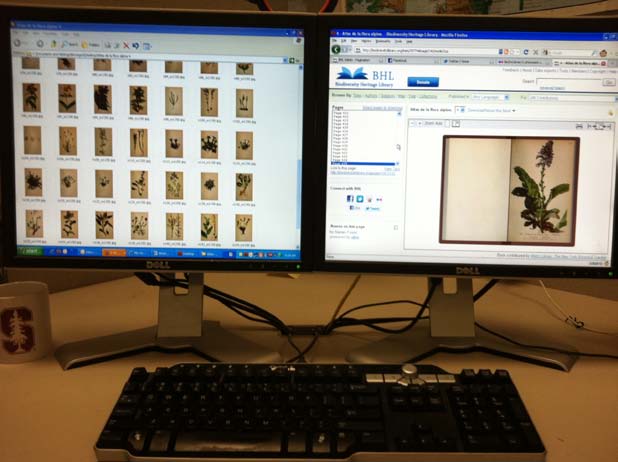
We started making a real concerted effort to populate and utilize Flickr in July 2011 and it just took off! I usually choose the items that I want to post on Flickr based on what items come across my desk, looking at items on the BHL recent addition feed (http://biodiversitylibrary.org/Recent.aspx), or doing keyword searches on BHL (http://biodiversitylibrary.org/). I look for the most visually stunning, interesting or intricate plates that I can find. I download all the images from an item, one image at a time.

View Full Size Image

Believe me, the two monitor set up is necessary!

I then upload them into Adobe Bridge which enables me to attach the all important metadata to all of the images. The metadata includes the filename, the creator, the source, descriptive information, keywords, credits, and copyright information. After that, I upload the whole batch to the BHL Flickr page and assign it to various categories including the contributing institution, the classification of the animals or plants pictured, and whether the item was used as a Book of the Week for this blog.

View Full Size Image
Beautiful, huh? 🙂

We also provide BHL content to the Encyclopedia of Life (http://eol.org). Images from our Flickr page are added to EOL when tagged with the proper machine tags with scientific names. You can learn more about machine tags here:
http://www.flickr.com/groups/encyclopedia_of_life/rules/
And guess what? YOU can add machine tags to our images too! In fact, we would love for some assistance in getting even more of our images into EOL! Learn how to do it with this snazzy tutorial:
http://www.slideshare.net/eoleducation/eol-flickr-tutorial

We currently have over 22,000 images on Flickr and will continue to keep adding more and more! If you know of any items in BHL with images that are screaming to be added to Flickr, please let us know via FlickrMail or leave us some feedback ([email protected]).

I also post everyday on Facebook: https://www.facebook.com/pages/Biodiversity-Heritage-Library/63547246565 We typically provide news and information that would be of potential interest to our Facebook followers. We try to change up the look of our page when we can, which means changing the profile picture often. Most importantly, we try to engage our users by being as interactive as we can. We love replying to comments and questions, so please be active and participate on our quizzes and make plenty of comments about anything we post!

Pulling and Returning Items:

SIL’s scanning process begins with the selection of material to scan. Material is selected for scanning based on three key areas: content identified by the systematic scanning of a biodiversity discipline topic (i.e. Entomology, Ornithology, Botany, etc.), institutional publications, and content identified through BHL’s issue tracking system, called Gemini, which includes user-submitted feedback. You can submit a scan request (or any other type of question or feedback here:

http://biodiversitylibrary.org/Feedback.aspx

Staff members work to resolve this feedback by assigning them to various BHL institutions to address. We also have a system in place that helps to help make sure different institutions do not scan the same items. Once items have been selected for scanning, I will retrieve the items from the appropriate library branch which are located throughout the Smithsonian Natural History Museum building.

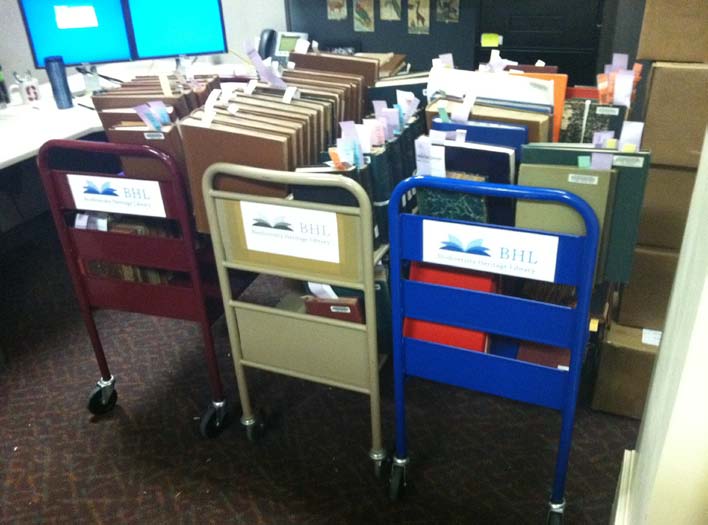
Once the items have been scanned and the books are sent back to us, I review the quality of the scans by performing a statistical sampling of books from the shipment or scanning batch. The process of quality assessment can be time consuming as it involves clicking through the scanned page images while turning the physical pages of the book at the same time. However, it is very important that we provide high quality scans that are not missing pages or that have pages that are cut off. After the assessment, the items are checked back in and reshelved.

View Full Size Image

Yikes, that is a lot of books!

Pagination:

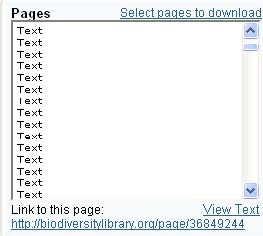
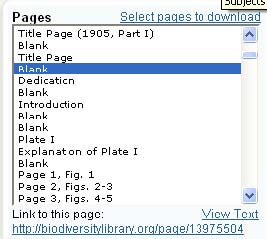
Pagination is the process of dividing our content into discrete pages in order to more easily find the information researchers need to help them do their work in a timely manner without having to search for information page by page. Basically, pagination includes indicating things such as page numbers, volume and issue numbers, tables of content, indices, identifying plates and figures and anything else to make searching through online items easy and quick. My position requires me to do quite a bit of pagination as it is an important component to using BHL for research. In the end, I want to make something that looks like this…
View Full Size Image

…to look a little more like this.

View Full Size Image

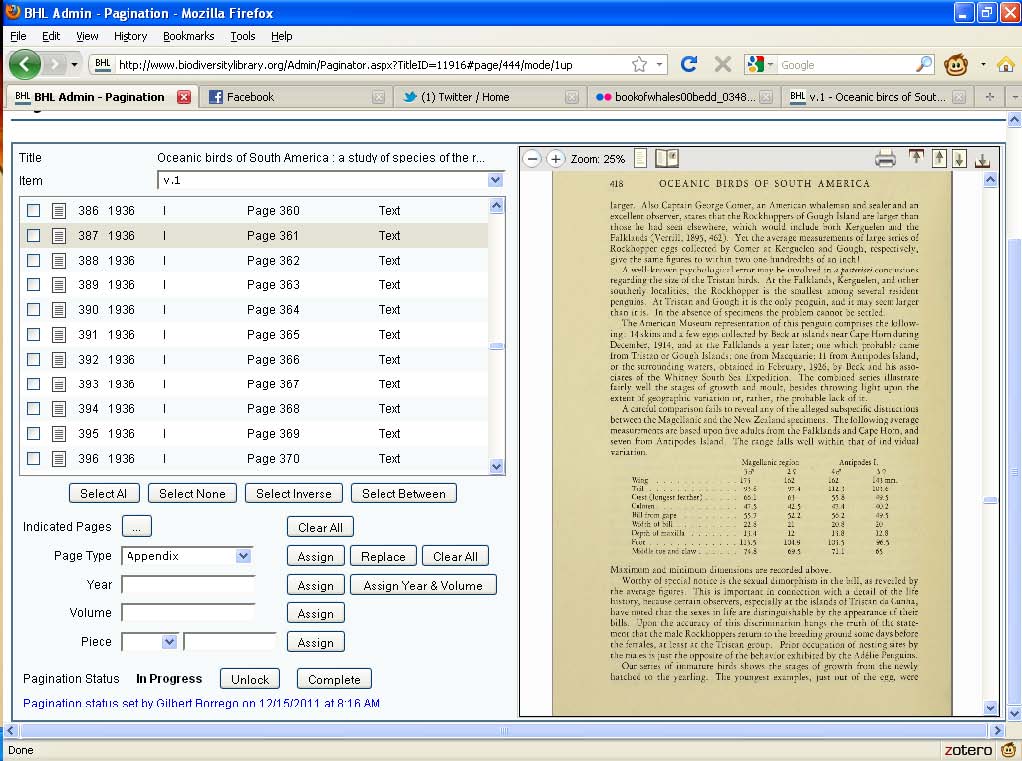
My pagination work screen looks like this:
View Full Size Image

I can manipulate multiple items at one time by checking the appropriate boxes, (for example, finding and checkmarking all the plates and have them numbering sequentially). If this looks like it takes a long time, it does! I have to look at every single page to verify what it is and give it the correct information. An item may take anywhere from 30 minutes to several hours, and certain series may take WEEKS, so be patient with us! 🙂

Seriously, we are looking at various ways to make the pagination process more automated, but for now, we have to manually manipulate each page. We prioritize pagination based on requests from users and we try to finish them up as soon as we can. So, if you know of an item in BHL that you would like paginated, please let us know (http://biodiversitylibrary.org/Feedback.aspx). We will be happy to do it, just give us a little time to get it done.

Well, that is a very brief and simplified description of what I do for BHL. Hopefully it was both interesting and informative! You would not believe how hardworking and committed every BHL staffer is and how committed everybody is to this ambitious project and I am still amazed that I get to play a role in it! Be sure to look out for our next BHL member profile next month and learn more about us!

January 9, 2012by jjdipasquale
BHL News, Blog Reel, Tech Updates

New and Improved Social Media Interactions

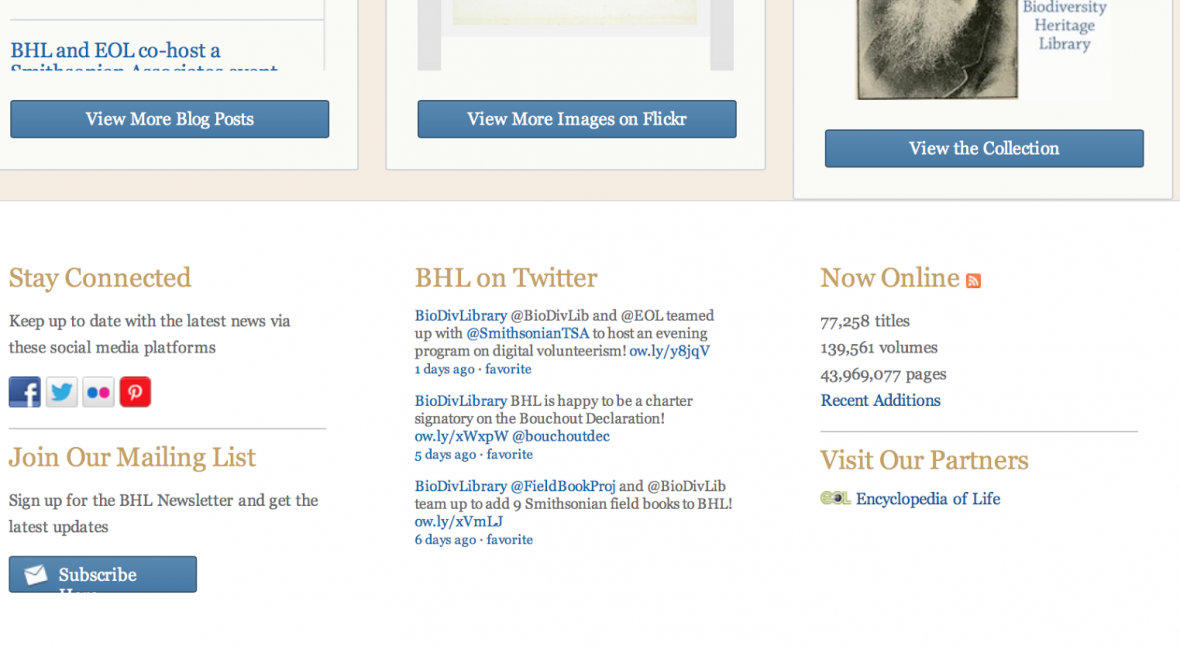
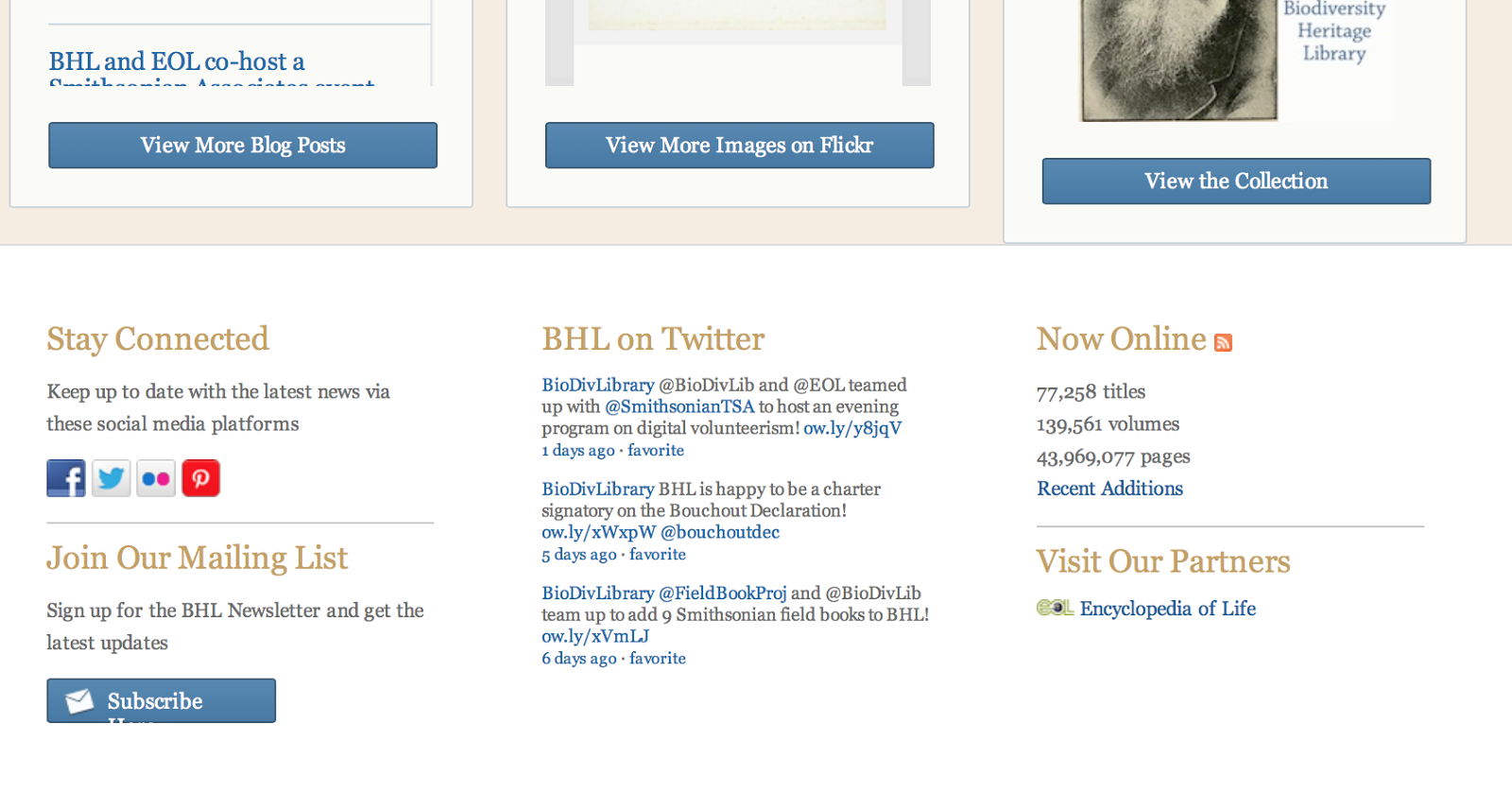
If you’re active in social media, chances are you’ve already discovered our presence on a variety of platforms, including Facebook, Flickr, Pinterest and Twitter (for a list of all of our social media accounts, visit our public wiki). You can now also see linked icons to each of our social media platforms on the lower left-hand side of BHL’s home page.

View Full Size Image
Stay connected with BHL via our social media buttons on the homepage.

We love the way social media has allowed us to connect and interact with users in a way we couldn’t before, including sharing thousands of beautiful images with you, conducting daily trivia contests, and hearing from you about what you like about BHL and what you’d like to see improved or added to our site or collection. As great as this has been, we think we can do more. So, our technical development team has been busy providing you with even more ways to socially interact with BHL content.

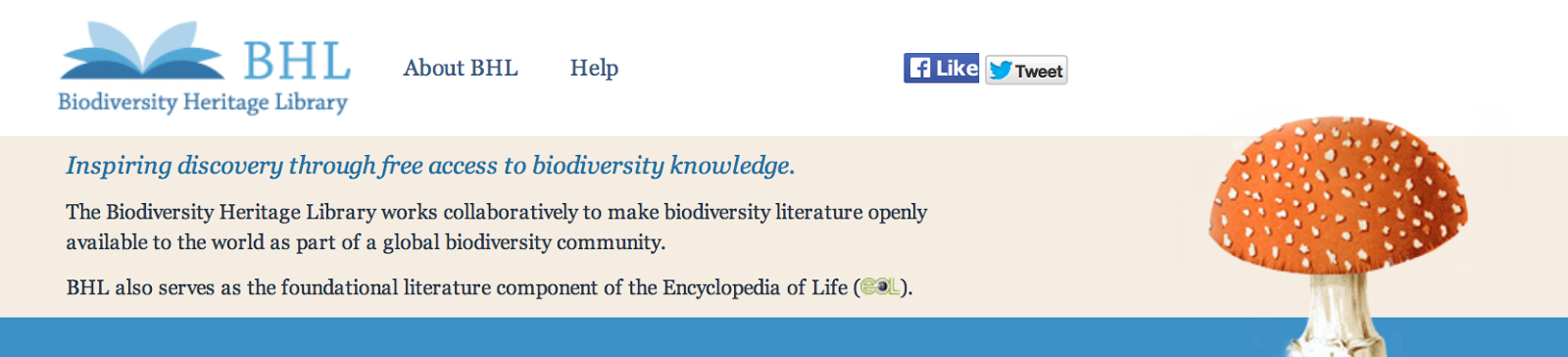
Cue the social media icons. As we mentioned before, on the lower left-hand side of the BHL page, you now see icons for our social media outlets. But in the BHL website header you will also see Facebook “Like” and Twitter “Tweet” buttons.

View Full Size Image
Tell your friends that you like BHL via Twitter or Facebook by clicking the “Like” or “Tweet” buttons in the header while on the BHL homepage.

What do these buttons do? They allow you to share aspects of BHL that you like with your friends and followers with a single click. If you’re on the BHL homepage and you click the Facebook “Like” button, your profile will indicate that you “like” BHL. Similarly, if you click on the “Tweet” button, you can tweet the BHL link to your followers.

But perhaps this isn’t enough. Say you want to “like” or share a specific title, volume, or page with your friends and followers. All you have to do is find the content that you want to “Like” or “Tweet” and click on the Facebook “Like” or Twitter “Tweet” button while on that page in BHL to send a title, volume, or page specific tweet or page post.

View Full Size Image
Find a specific title or volume in BHL and click on the “Like” or “Tweet” button in the BHL header to send a tweet or FB page post linking directly to that title or volume.
View Full Size Image
Go to a specific page in BHL and click the “Like” or “Tweet” button in the BHL header to send a tweet or FB page post linking directly to that page.

We think that’s pretty cool, and we hope it will allow you to share your serendipitous moments of awesome biodiversity literature discovery with the world!

If you have any thoughts or comments about these developments, or other ideas that you’d like to see implemented, don’t hesitate to send us some feedback or, better yet, tell us via Facebook or Twitter!

September 7, 2011by jjdipasquale

Help Support BHL

BHL's existence depends on the financial support of its patrons. Help us keep this free resource alive!

search

About BHL

The Biodiversity Heritage Library (BHL) is the world’s largest open access digital library for biodiversity literature and archives. BHL operates as a worldwide consortium of natural history, botanical, research, and national libraries working together to digitize the natural history literature held in their collections and make it freely available for open access as part of a global “biodiversity community.”

Join Our Mailing List

Sign up to receive the latest news, content highlights, and promotions.

Subscribe Now

Subscribe to Blog via Email

Enter your email address to subscribe to this blog and receive notifications of new posts by email.

Join 319 other subscribers

Subscribe to Blog Via RSS

Subscribe to the blog RSS feed to stay up-to-date on all the latest BHL posts.

Access RSS Feed

Inspiring Discovery through Free Access to Biodiversity Knowledge.

The Biodiversity Heritage Library makes it easier than ever for you to access the information you need to study and explore life on Earth…for free, anytime, anywhere.


64+ Million Pages of
Biodiversity Literature Online.

EXPLORE

Tools and Services
to Transform Research.

EXPLORE

300,000+
Illustrations on Flickr.

EXPLORE

ABOUT | HARMFUL CONTENT | PRIVACY | SITE MAP | TERMS OF USE