Biodiversity Heritage Library - Program news and collection highlights from BHL
  • Home
  • News
  • Featured Books
    • All Featured Books
    • Book of the Month Series
    • BHL at 20
  • User Stories
  • Campaigns
    • Fossil Stories
    • Garden Stories
    • Monsters Are Real
    • Page Frights
    • Her Natural History
    • Earth Optimism 2020
  • Tech Blog
  • Visit BHL
Home
News
Featured Books
    All Featured Books
    Book of the Month Series
    BHL at 20
User Stories
Campaigns
    Fossil Stories
    Garden Stories
    Monsters Are Real
    Page Frights
    Her Natural History
    Earth Optimism 2020
Tech Blog
Visit BHL
  • Home
  • News
  • Featured Books
    • All Featured Books
    • Book of the Month Series
    • BHL at 20
  • User Stories
  • Campaigns
    • Fossil Stories
    • Garden Stories
    • Monsters Are Real
    • Page Frights
    • Her Natural History
    • Earth Optimism 2020
  • Tech Blog
  • Visit BHL
Biodiversity Heritage Library - Program news and collection highlights from BHL
BHL News, Blog Reel

The Field Book Project: Increasing Access to Researchers’ Fieldbooks

American Archives Month celebrates the importance of archives and the work of archivists as they seek to collect, organize, and make accessible unique materials from our nation’s history. The Smithsonian Field Book Project is an exciting example of such work, an effort across SI departments and divisions to increase accessibility to field book content. Field books are important because they are the primary source records of flora, fauna, and ecosystem biodiversity research. They hold the first observations, thoughts, and reflections of scientific researchers when they venture out to observe, document, and collect specimens of the natural world.

A field book can contain everything from grass specimens to weather observations to recipes for native foods, and at the Smithsonian, document almost 200 years of history, going back to 1815! Field books not only provide invaluable access to species and habitat data, but also contain surprising insights and observations into the history of science and history in general – see Edward Chapin’s mention of the Panama Disease in banana plantations in Jamaica in 1941, for example, or Leonard Shultz’s observations during the Bikini Atoll nuclear tests in 1952, or Devra Kleiman’s notes on how financial instability in Brazil in 1990 was affecting her project to save the Golden Lion Tamarin from extinction (she was successful!).

View Full Size Image
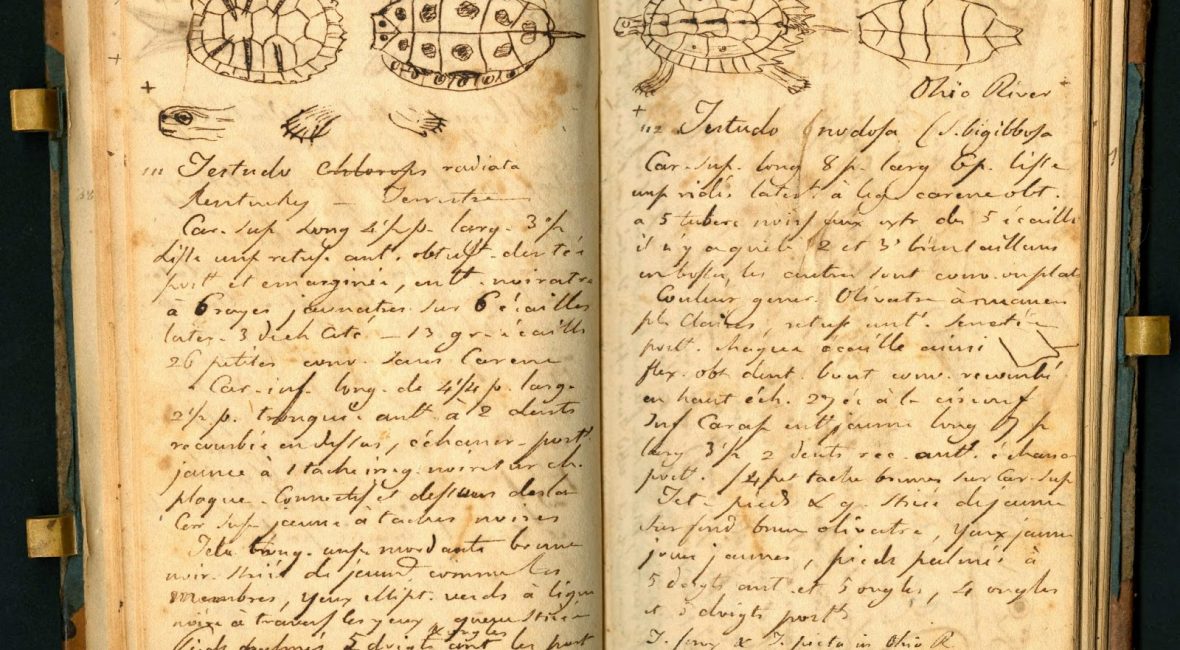
Rafinesque, C. S. Notebook kept by Rafinesque on a trip from Philadelphia to Kentucky, 1818. http://biodiversitylibrary.org/page/45995976

The first part of the Field Book Project focused on discovering, documenting, and preserving these invaluable records, using customized cataloging and description standards to better suit materials that are not just historical, but that also function as museum and library reference materials for present-day researchers. Catalog records for the field books have been created and made available on several public, online platforms (such as Smithsonian Collections Search Center) in order to engage with as wide an audience as possible. Thus, field books that might have been previously scattered, stored amidst other materials, and unknown to any but those in their department can now be found and used by researchers across and beyond the Smithsonian Institution.

The next phase of the Project will focus on continuing to discover, catalog, and preserve Smithsonian field books, while expanding the goal of digitization and online availability. A selection of field books (2600) will be digitized using dedicated scanning equipment, and the fully digitized records will be published to both the Smithsonian Collections Search Center website and to the Biodiversity Heritage Library web portal. The renewed focus on not just discovery, but also digitization stems from the potential for connection that these field books represent. In many cases, we’ve found that our field books relate to field books and specimen collections of other museums and research institutions across the country, and even internationally!

View Full Size Image
Moynihan, Martin. Gull Notes, 1955-56. Fieldbook from The Field Book Project in the Smithsonian Transcription Center. https://transcription.si.edu/project/6829

We’ve seen new and expanded uses of our digitized field books that make us excited to provide more opportunities to the community of researchers. The Project has contributed many of the digitized field books to the Smithsonian Transcription Center. These resources have inspired the interest of our “volunpeers” who have not only described content for machine-readability and full-text searching, but have also discovered new information in the field books that the project team can use to enrich the catalog records. Now, we are even using the documentation and guidelines from this project to help support the creation and ongoing work of similar projects at Smithsonian and Biodiversity Heritage Library partner institutions.

The more field books and similar collections we can help make discoverable, the more we can connect the content to related research, and the more we contribute to ongoing projects in both the scientific and humanities fields. The Smithsonian Field Book Project is an exciting and ongoing example of how archivists help to find, preserve, and make available fascinating historical materials that still retain great importance for present-day scientific and historical research.

View Full Size Image
Silberglied, Robert E. Field notes, Mexico, July-August, 1965. http://biodiversitylibrary.org/page/46042458

If you are interested in learning more about the project or in reading some of the transcribed content – or even in transcribing some yourself! – please visit the project website or our collection in the Smithsonian Transcription Center and see what you can do to help make field books, unique and invaluable archival, library, and museum resources, increasingly available and discoverable to the wider public.

Julia Blase
Project Manager, The Field Book Project 

October 21, 2014by Julia Blase
Blog Reel, Featured Books

Down the rabbit (Lepus curpaeums) hole: Edward A. Chapin

Last week, with the arrival of many more of the field books to the Biodiversity Heritage Library web portal, I had the chance to dive deeply into the field books of Edward Chapin, entomologist and Curator of Insects at the Smithsonian Institution from 1934 to 1954. I spent the most time in his field book covering a set of travels to Cuba and Jamaica, though mostly Jamaica, in 1937 and 1941. It was a fascinating adventure “down the rabbit hole” into another era of history!

The beetles, bad weather, and endless driving

View Full Size Image
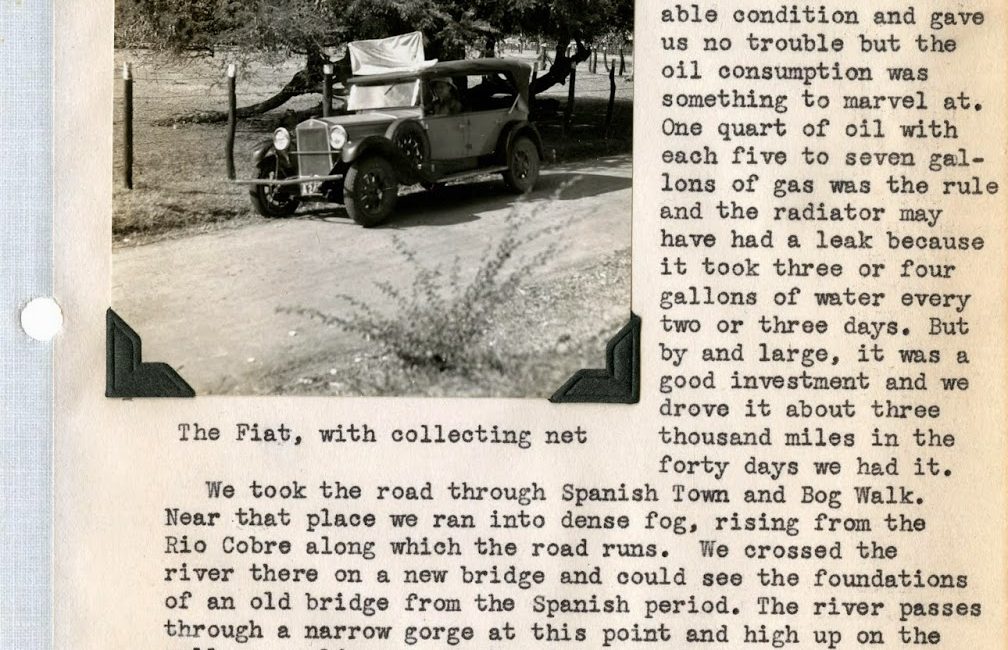
Entry from Edward A. Chapin’s “Field notebook, Cube and Jamaica, 1937, 1941, [1947].” Smithsonian Institution Archives. SIA Acc. 11-085, Box 1, Folder 1.

Several things struck me almost as soon as I began reading, the first of which was how closely Chapin’s descriptions of the insect life of the islands were wrapped with his observations of the weather, travel conditions, car problems, dinner menus, host families and housing arrangements, and even clothing purchases. A set of observations on insect collecting might be as short as a sentence or as long as a page, depending on what caught his attention that day. The second item that struck me was how frustrating these kinds of expeditions could be! Not only Chapin deal with the usual traveler’s woes of lost luggage and poor weather, but he also faced challenges unique to the scientist – the difficulty in finding many types of insects, or one insect in many life stages, or in finding relevant insects at all. It seemed that Chapin sometimes spent days driving from one end of the island to the other, looking for abandoned homes, downed trees, fence posts and post holes, and such beetle- and termite-friendly places to explore, and often finding nothing. However, on other days he was so overwhelmed with his findings that the problem became locating additional jars to hold them all!

Sugar factories, banana plantations, and Panama Disease

I also went further down the field book “rabbit hole” with items that Chapin mentioned seemingly offhand. For instance, in one of his entries, he described his visit to a sugar factory and detailed the process by which cane became sucrose and molasses, which I found fascinating. He followed that entry with one describing the tour of the banana plantations on the island, and how the banana carriers (those who took bunches from the rows of plants to spots along the road where they would be loaded into trucks) received only “three shillings a hundred bunches. The work is hard as it means tramping through mud six or eight inches deep for fifty yards or so with about 150 lbs balanced on the head.” I immediately looked online for a recording of Harry Belafonte’s “Day-O” and began to read about its history as a Jamaican folk song – the song seems so lighthearted, compared to the work it describes. I can hardly imagine the kind of daily labor that the banana carriers endured.

Chapin even made a brief mention of Panama Disease affecting the banana plants on the island – I did a bit of research and discovered that another strain of Panama Disease is the current cause of problems with the Cavendish banana that we all enjoy at our local grocery stores. “Race 1” of the disease was the cause of the epidemic in the 1950’s that wiped out the previously farmed Gros Michel banana. Chapin’s 1941 journal was recording the disease almost 10 years before it became a widespread problem!

New Seville and Christopher Columbus

I fell into more research when Chapin mentioned a visit to Seville, which was

“now a large coconut walk but originally the site of the first Roman Catholic cathedral (1505). The foundations have been cleared and in the center of the floor there is a hole about six feet across and ten feet deep, carefully walled with brick, from which a passage leads away to the west. In this passage we found a dozen pieces of very beautifully carved stone, probably the remains of the altar. One piece has the coat-of-arms of the Bishop of Seville, the others are mostly angels and cherubims.”

I did a quick search for “Seville, Jamaica” and found a UNESCO world heritage website for “New Seville,” which hosted Christopher Columbus in the late 1490s and did indeed feature a Roman Catholic church of “Peter Martyr, the first abbot of Jamaica, having begun in 1525.” Someone’s dates are off…I’m inclined to think that Chapin was misled in thinking the church was from 1505, but who knows? At least I learned more about the history of Columbus’ voyages in the new world, and just in time for Columbus Day (October 13th).

WWII Internment Camps

View Full Size Image
Entry from Edward A. Chapin’s “Field notebook, Cube and Jamaica, 1937, 1941, [1947].” Smithsonian Institution Archives. SIA Acc. 11-085, Box 1, Folder 1.

One more historical mention led me to another fifteen minutes or so of research – Chapin’s off-hand mention that the husband in one of the families he met on the island was “at present serving at the internment camp as a guard.” The history I knew of U.S. internment camps during WWII only covered the Japanese-American internment camps in the West. I had no idea that there were internment camps in Jamaica. Who did they hold? A quick search revealed that not only were there internment camps on the islands, but that they held both plantation owners who were of German descent and thus “possibly” sympathizers, as well as the German POW’s from U-boats taken in the Atlantic (see also the one-sentence mention of the German POW barracks in Up Park Camp on this page).

The mongoose and the dolphins

And finally, there were two mentions of animals that I found fascinating. The first was a mention of the mongoose, an invasive species introduced to the islands to prey on the rats that destroyed large amounts of sugar cane. As in many other places, the non-native species proved far more destructive than imagined and became more of a problem than the rats themselves even in 1941. The mongoose lives on the islands to this day, and has contributed to the possible extinction of at least four native species. And second, a mention by Chapin of his journey home, where he was off the coast of Cape Hatteras and recorded being

“in the midst of the herd of bottlenosed dolphins headed north on their annual migration. As far as one can see, in every direction, there are thousands of dolphins moving steadily northward. On either side of the bow, our boat is convoyed by groups of from three to ten animals…we first sighted them at four in the afternoon and they were still with us at dark.”

Today herds of dolphins are recorded as numbering only in the hundreds during their winter migration – nevertheless, what a lovely image with which to conclude my research adventures in the field notebooks of Edward A. Chapin, entomologist, traveler, and recorder of both scientific and humanist history.

For more information

For more information about Edward Chapin, and to see the full records for his field books held at the Smithsonian Institution, please see his records in the Smithsonian Collections Search Center.

As of this blog post, three field books by Edward Chapin have been fully digitized and are available on the Biodiversity Heritage Library site.

Each of the three field books in BHL has been fully transcribed by volunteers with the Smithsonian Transcription Center. You can find them at the following three links: Cuba and Jamaica, Colombia, Chile.

View Full Size Image
Letter from Edward A. Chapin’s “Field notebook, Cube and Jamaica, 1937, 1941, [1947].” Smithsonian Institution Archives. SIA Acc. 11-085, Box 1, Folder 1.
October 13, 2014by Julia Blase

Help Support BHL

BHL's existence depends on the financial support of its patrons. Help us keep this free resource alive!

search

About BHL

The Biodiversity Heritage Library (BHL) is the world’s largest open access digital library for biodiversity literature and archives. BHL operates as a worldwide consortium of natural history, botanical, research, and national libraries working together to digitize the natural history literature held in their collections and make it freely available for open access as part of a global “biodiversity community.”

Join Our Mailing List

Sign up to receive the latest news, content highlights, and promotions.

Subscribe Now

Subscribe to Blog via Email

Enter your email address to subscribe to this blog and receive notifications of new posts by email.

Join 319 other subscribers

Subscribe to Blog Via RSS

Subscribe to the blog RSS feed to stay up-to-date on all the latest BHL posts.

Access RSS Feed

Inspiring Discovery through Free Access to Biodiversity Knowledge.

The Biodiversity Heritage Library makes it easier than ever for you to access the information you need to study and explore life on Earth…for free, anytime, anywhere.


64+ Million Pages of
Biodiversity Literature Online.

EXPLORE

Tools and Services
to Transform Research.

EXPLORE

300,000+
Illustrations on Flickr.

EXPLORE

ABOUT | HARMFUL CONTENT | PRIVACY | SITE MAP | TERMS OF USE