Biodiversity Heritage Library - Program news and collection highlights from BHL
  • Home
  • News
  • Featured Books
    • All Featured Books
    • Book of the Month Series
    • BHL at 20
  • User Stories
  • Campaigns
    • Fossil Stories
    • Garden Stories
    • Monsters Are Real
    • Page Frights
    • Her Natural History
    • Earth Optimism 2020
  • Tech Blog
  • Visit BHL
Home
News
Featured Books
    All Featured Books
    Book of the Month Series
    BHL at 20
User Stories
Campaigns
    Fossil Stories
    Garden Stories
    Monsters Are Real
    Page Frights
    Her Natural History
    Earth Optimism 2020
Tech Blog
Visit BHL
  • Home
  • News
  • Featured Books
    • All Featured Books
    • Book of the Month Series
    • BHL at 20
  • User Stories
  • Campaigns
    • Fossil Stories
    • Garden Stories
    • Monsters Are Real
    • Page Frights
    • Her Natural History
    • Earth Optimism 2020
  • Tech Blog
  • Visit BHL
Biodiversity Heritage Library - Program news and collection highlights from BHL
Blog Reel, Campaigns, Featured Books

The Rhododendrons of Sikkim-Himalaya

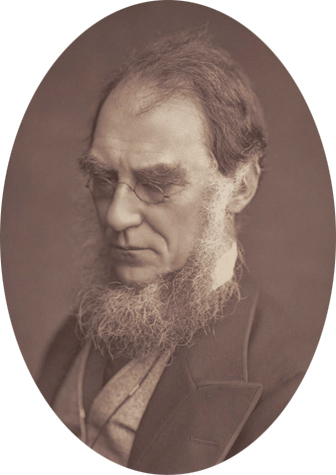
Joseph Hooker, born 200 years ago this year, may have been the greatest botanist of the nineteenth century, professionalizing practice of the discipline and establishing the system of botanical classification used almost universally until the advent of genetics-based systems. He was certainly one of the most pivotal Directors in the history of the Royal Botanic Gardens, Kew, defending its role as a scientific institution rather than a pleasure park and expanding its infrastructure and collections. However, to horticulturalists, he is perhaps best known for his introduction of new species of Rhododendron to Europe in the mid 19th century.

View Full Size Image
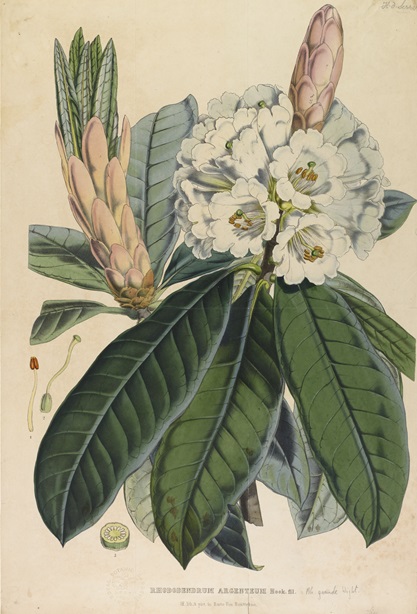
Rhododendron argenteum one of Hooker’s new species published in The Rhododendrons of Sikkim-Himalaya. http://s.si.edu/2tkRKAP. Drawing by Joseph Dalton Hooker. Lithographed by Walter Hood Fitch. Digitized by the Missouri Botanical Garden.

It was whilst on a plant collecting expedition in India and the Himalayas (1847-1851) that Hooker became the first European to be granted permission to explore what was then the autonomous kingdom of Sikkim, now a northern state of India, which had previously been closed to foreign explorers. In this unspoilt mountain kingdom, he gathered over 25 species of Rhododendron that would prove to be unknown to science and to European horticulturalists.

Spectacular illustrations of these Rhododendrons were published in the lavish book The Rhododendrons of Sikkim-Himalaya. At Kew, we love that these are available to view online at the Biodiversity Heritage Library for ease of access along with many other landmark publications by Hooker. You can also browse the superb illustrations on Flickr.

View Full Size Image
Illustrations from Hooker’s Rhododendrons of Sikkim-Himalaya made available through Flickr by our partners at BHL.

Hooker braved the monsoon rains to ensure that he could collect seeds of these new botanical beauties. His letters from the expedition, recently digitized by the archives of Kew Gardens, describe the discomforts of the endeavor: frozen fingers, the shin tearing Rhododendron scrub, prolific leeches, the danger from overflowing rivers, snow blindness, rock falls and the added suffering of altitude sickness to name a few.

“Worst of all is the depressing effect of being often baffled: you go at up a gully, take a probable branch, are turned at the top,: down you go, every step lost & try another, & so on, 4, 5, & 6 times perhaps; till, utterly fagged, you slope at night-fall down to camp, wet bruised & dissatisfied.” (Source)

Hooker was sometimes demoralized but not deterred and was determined to collect as much as he could:

“These explorations are very hard work, but I get such lots of plants that they are always abundantly profitable”. (Source)

More tales of Hooker’s collecting trials in his own words are available online through Kew’s Joseph Hooker correspondence project and in his published Journal available on BHL. Some of my personal favorites include imprisonment by the Rajah and a close shave with an avalanche in which his collecting companion, a dog named Kinchin, lost his whiskers.

View Full Size Image
Victorian photograph of the Rhodoedndron Dell at The Royal Botanic Gardens, Kew. Reproduced by the Permission of the Trustees of The Royal Botanic Gardens, Kew.

The Kew Gardens Annual Report of 1850 records the receipt of ’21 baskets of Indian orchids and new species of Rhododendron’ from Hooker. The Rhododendrons were planted in Kew’s hollow walk, to become known as the Rhododendron dell, and shared with nurseries and gardeners across Europe, starting a craze for the plants and a legacy of their profusion across the gardens of stately homes in particular.

View Full Size Image
Field sketch of Rhododendron falconeri by Joseph Hooker, c.1850. Reproduced by the Permission of the Trustees of The Royal Botanic Gardens, Kew.

The additional annotated field sketches, dried plants and descriptions that Hooker sent home allowed the great botanical artist Walter Hood Fitch and Joseph Hooker’s father, botanist William Jackson Hooker, to publish The Rhododendrons of Sikkim Himalaya before Joseph had even returned home. To mark the bicentenary of Hooker’s birth this year, Kew has reproduced a facsimile edition of the publication from the first edition held in its library collection.

June 30, 2017by Virginia Mills
Blog Reel, Campaigns, Featured Books

Celebrating Sir Joseph Dalton Hooker at 200

View Full Size Image

On the 30th June 1817, Joseph Dalton Hooker was born in Halesworth, Suffolk. The second child of William Jackson Hooker, Joseph would, during the course of his life, become a ‘botanical trailblazer’ – traveling across the globe to collect plants and theorizing on plant species diversity and geography. Joseph Hooker would also become Kew Gardens’ second and most illustrious Director, overseeing the establishment of the first dedicated botanical Laboratory at Kew, the Marianne North Gallery and the expansion of the Gardens’ herbarium and economic botany collections.

To celebrate the bicentenary of his birth this year, BHL is joining the Royal Botanic Gardens, Kew to highlight Hooker’s works and contributions to science. Follow #JDHooker2017 on social media this week (26-30 June) to learn more about J.D. Hooker and explore his publications and archival materials. You can browse his publications in the BHL book collection and see related artworks from those publications in our Flickr collection. Learn more about the BHL content here.

A special aspect of the campaign is Hooker’s archival material, which is being made available online thanks to Kew Gardens. Hooker was a prolific correspondent – writing to family, friends and colleagues up until his death in 1911. We are fortunate at Kew to hold an extensive archival collection reflecting both his personal papers – such as his letters to his family during his travels in India – and those created during his tenure as Assistant Director and then Director of Kew.

View Full Size Image

The Joseph Hooker Correspondence Project is currently working on digitizing and transcribing a large selection of Joseph Hooker’s correspondence, and we are delighted to announce that over 1,000 of his letters are now available to view online. This portal allows visitors to search the letters and, where available, read the summaries and transcripts of the letters. We also plan to release further letters and data in the coming months – so watch this space.

View Full Size Image
Joseph Dalton Hooker’s correspondence online.

Highlights of the current online collection are the letters written by Hooker to Charles Darwin, a long-time friend and confidant, as well as those to his family during his adventures in Antarctica and India. These letters provide wonderful insights into the hardships of botanical collecting and the trials of travel during the first half of the nineteenth century.

2017 is an important year for Kew as it marks the 200th Anniversary of Joseph Hooker’s birth. Not only is the correspondence project continuing to scan, transcribe and make publicly available the previously unpublished letters written by Joseph Hooker, but we are also working with colleagues from across the gardens and beyond with our partners such as BHL to further raise awareness of Hooker and his important work.

View Full Size Image

Kew will be hosting a conference celebrating the ongoing impact Joseph Hooker has had on modern botanical science. The ‘Joseph Dalton Hooker Bicentenary Meeting: The Making of Modern Botany’ will be held on the 30th June at the Royal Botanic Gardens, Kew and will bring together experts on subjects such as botanical illustration, Antarctic flora and botanical classification.

In addition to this conference, currently on display at the Shirley Sherwood gallery is the exhibition ‘Joseph Hooker: Putting plants in their place’, which brings together archival, three dimensional and illustrative material from the Kew collections to explore Joseph Hooker’s life and work. The exhibition will be open until the 17th September 2017 and various tours and talks are also being held.

View Full Size Image
Selection of material on display on the Wolfson Reading Room at the Royal Botanic Gardens, Kew.

The Library, Art & Archives department has also prepared a display in the Wolfson Reading Room in the Herbarium, Library, Art & Archives building, which has just opened and is free to view. Drop in Monday-Friday 10am-4pm to see more material from our Historic Joseph Hooker collections, including material relating to his (entirely scientific!) interest in opium.

View Full Size Image
One of a series of illustrations depicting the cultivation and manufacture of opium. Collected by Joseph Hooker during his visit to the Patna opium manufactory in India in 1848.

In the gardens, the Kew volunteer guides will be providing walking tours, allowing visitors to find out how instrumental Joseph Hooker was in shaping botany and the landscape at Kew. On the weekend of the 1st and 2nd of July, the gardens will host a Joseph Hooker Bicentenary celebration with family activities, explorer’s camp and talks. The Shirley Sherwood Gallery will also be hosting a ‘Kew After Hours’ event on the evening of the 29th June. Further details of these events and others related to Joseph Hooker can be found on the main Kew website.

Further afield, the Botanic Survey of India has been hosting an exhibition on Joseph Hooker’s legacy in Indian botany. The exhibit is curated jointly with Kew staff and will shortly go on tour to other locations in India.

Visit the BHL website to learn more about the #JDHooker2017 campaign, and follow the hashtag all this week for more great highlights.

Related Links

Joseph Hooker Correspondence Project
View the Joseph Hooker letters online
Joseph Dalton Hooker Bicentenary Meeting: The Making of Modern Botany
Joseph Hooker: Putting plants in their place 
Walking tours around the gardens

June 26, 2017by Virginia Mills

Help Support BHL

BHL's existence depends on the financial support of its patrons. Help us keep this free resource alive!

search

About BHL

The Biodiversity Heritage Library (BHL) is the world’s largest open access digital library for biodiversity literature and archives. BHL operates as a worldwide consortium of natural history, botanical, research, and national libraries working together to digitize the natural history literature held in their collections and make it freely available for open access as part of a global “biodiversity community.”

Join Our Mailing List

Sign up to receive the latest news, content highlights, and promotions.

Subscribe Now

Subscribe to Blog via Email

Enter your email address to subscribe to this blog and receive notifications of new posts by email.

Join 319 other subscribers

Subscribe to Blog Via RSS

Subscribe to the blog RSS feed to stay up-to-date on all the latest BHL posts.

Access RSS Feed

Inspiring Discovery through Free Access to Biodiversity Knowledge.

The Biodiversity Heritage Library makes it easier than ever for you to access the information you need to study and explore life on Earth…for free, anytime, anywhere.


64+ Million Pages of
Biodiversity Literature Online.

EXPLORE

Tools and Services
to Transform Research.

EXPLORE

300,000+
Illustrations on Flickr.

EXPLORE

ABOUT | HARMFUL CONTENT | PRIVACY | SITE MAP | TERMS OF USE