Biodiversity Heritage Library - Program news and collection highlights from BHL
  • Home
  • News
  • Featured Books
    • All Featured Books
    • Book of the Month Series
    • BHL at 20
  • User Stories
  • Campaigns
    • Fossil Stories
    • Garden Stories
    • Monsters Are Real
    • Page Frights
    • Her Natural History
    • Earth Optimism 2020
  • Tech Blog
  • Visit BHL
Home
News
Featured Books
    All Featured Books
    Book of the Month Series
    BHL at 20
User Stories
Campaigns
    Fossil Stories
    Garden Stories
    Monsters Are Real
    Page Frights
    Her Natural History
    Earth Optimism 2020
Tech Blog
Visit BHL
  • Home
  • News
  • Featured Books
    • All Featured Books
    • Book of the Month Series
    • BHL at 20
  • User Stories
  • Campaigns
    • Fossil Stories
    • Garden Stories
    • Monsters Are Real
    • Page Frights
    • Her Natural History
    • Earth Optimism 2020
  • Tech Blog
  • Visit BHL
Biodiversity Heritage Library - Program news and collection highlights from BHL
Blog Reel, Featured Books

The Herefordshire Pomona

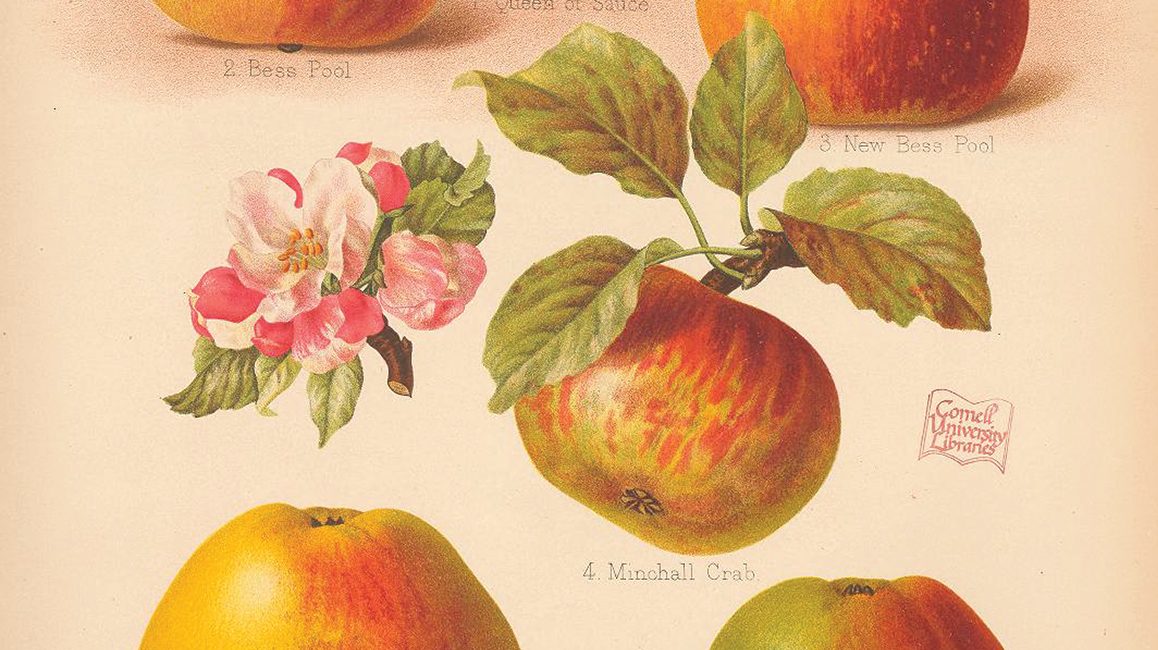
Illustration of various apple cultivars

The Herefordshire Pomona. v. 2 (1876-1885). Art by Edith E. Bull. Digitized by Cornell University Library, Mann Library. https://biodiversitylibrary.org/page/55785827.

It is a glimpse into a lush diversity of the past….and into possibilities for a resilient future. The Herefordshire Pomona is a classic in the science and practice of pomology. Compiled and edited by the eminent 19th century horticulturalist Robert Hogg and the physician Henry Graves Bull, who moonlighted as an enthusiastic amateur naturalist, the Pomona was an outgrowth of efforts by the Woolhope Naturalists’ Field Club to record and showcase the different varieties of apples and pears found in the orchards of Herefordshire, a county in the West Midlands region of England.

For centuries, Herefordshire was known as the center of English apple cider production, a reputation that it continues to enjoy today. And yet, already in the mid-1800s there was growing concern among English horticulturalists and naturalists that many of the region’s orchards were falling into disuse, the fruits of their trees being passed over and forgotten in favor of more popular imports from other parts of the country and world.

Illustration of a variety of apple cultivars

The Herefordshire Pomona. v. 2 (1876-1885). Art by Edith E. Bull. Digitized by Cornell University Library, Mann Library. https://biodiversitylibrary.org/page/55785532.

To counter this erosion of agricultural heritage, each year the Woolhope Club staged exhibitions of locally grown apples, inviting renowned experts, including Dr. Hogg, to judge the quality of the featured fruits, and to help identify any fruits not already clearly recognized. To fully capture the insights gained from these explorations, Hogg and Bull enlisted the help of artists Alice Blanche Ellis and Edith Elizabeth Bull (thought to be Dr. Bull’s daughter), who drew their pomological subjects as they saw them— glorious hues, unsightly warts, odd-lot shapes, fluky speckles and all. The resulting work was issued in seven parts between the years 1876 and 1885, purchased on subscription basis by English town and country gentry willing to pay a tidy sum for this comprehensive and gorgeously illustrated work.

HerefordshirePomona_List of Cider Apples Perry Pears_Small.jpg

List of cider apples and perry pears recommended for planting by the Woolhope Club. List of cider apples and perry pears recommended for planting by the Woolhope Club. The Herefordshire Pomona. v. 2 (1876-1885). Digitized by Cornell University Library, Mann Library. https://biodiversitylibrary.org/page/55785887.

While the Pomona may thus have been born as the ultimate coffee table book for upper class households, it performed an invaluable service by documenting the presence of over 400 apple and pear varieties in 19th century England. Its indexes alone, featuring variety names like Garter Apple, Foxwhelp, Cocc-a-gee, Monstrous Pippin, Jolly Beggar, Bess Pool, Kentish Fill-basket, Peasgood’s Nonesuch, Queen of Sauce, Friar, Gipsy King, Schoolmaster, American Mother, Hoary Morning, and Bastard Rough Coat, read like a playful ode to the hidden stories—from lyrically sweet and archly comic to the darkly dramatic—of old English country life. Descriptions for each variety—drawn from Fruit Manual, a significant earlier work by Hogg—are instructive, not just for information about horticultural best practices of the time, but also for their guidance about important qualities of each variety, such as flavor, optimal timing for harvest, and shelf life in storage. And, as the Pomona notes, when it comes to cider apples, one should not be fooled by the size and the often-bitter taste of their varieties, for the smaller the fruit, the better the beverage.

Illustration of a variety of apple cultivars

The Herefordshire Pomona. v. 2 (1876-1885). Art by Alice B. Ellis and Edith E. Bull. Digitized by Cornell University Library, Mann Library. https://biodiversitylibrary.org/page/55785803.

In 1885, six hundred copies of the Herefordshire Pomona’s seven published parts were bound and issued as a two-volume set. Mann Library is fortunate to hold one of these extremely rare sets in the Library’s special collections. Over the past several months, we have digitized both volumes.  Now part of the growing online collection of legacy life sciences literature in the Biodiversity Heritage Library, this digitized copy in the BHL collection makes an invaluable record of English horticultural history widely available to today’s scientists and breeders. As current interest in finding lost cultivars, securing genetic diversity, and developing new varieties with appropriate qualities for a re-emergent cider industry grows, the Herefordshire Pomona will help ensure that insights preserved from our past continue to advance both the discovery and conservation needed for a healthier world tomorrow.

Illustration of a variety of apple cultivars

The Herefordshire Pomona. v. 2 (1876-1885). Art by Alice B. Ellis and Edith E. Bull. Digitized by Cornell University Library, Mann Library. https://biodiversitylibrary.org/page/55785583.

The week of 4 June 2018, BHL is celebrating cider-making and apples with Cornell University Library and Mann Library. Follow #CornellCider on social media for a sweet dose of apple delight and visit the Pomology: Apples and Cider collection on BHL to explore more great books like Herefordshire Pomona.

Sources:

Arbury, Jim. “Pomonas and Pomology,” The Herefordshire Pomona. Ed. Robert Hogg and Henry Graves Bull. 1876. The Folio Society, 2014

Bunyard, Edward A. Guide to the Literature of Pomology. By E.A. Bunyard … [s.n.], 1915, www.biodiversitylibrary.org//bibliography/33776.

Monbiot, George. “Fallen fruit,” The Guardian, 30 October 30, 1994. www.theguardian.com/lifeandstyle/2004/oct/30/foodanddrink.weekend

Nissen, Claus. Die Botanische Buchillustration: Ihre Geschichte Und Bibliographie. 2. Aufl., durchgesehener und verb., A. Hiersemann, 1966.

Roach, F. A., The Cultivated Fruits of Britain: Their Origin and History.  B. Blackwell, 1985

June 7, 2018by Joel Richard
Blog Reel, Featured Books

Seeds in the Stacks: A Closer Look at Two Seedsmen from the Golden Age

The National Agricultural Library (NAL), Special Collections has one of the world’s largest collections of nursery and seed trade catalogs totaling over 200,000 from American as well as international companies. This collection, representing businesses located in all states plus over 50 countries, was named after its long-time curator, Henry G. Gilbert. The earliest catalog is from William R. Prince & Company dated 1771. NAL continues to collect modern-day catalogs.

The collection was begun by Percy Ricker, U.S. Department of Agriculture’s first economic botanist. Through the course of his work, he traveled to many plant nurseries throughout the country and collected duplicate copies of their catalogs. When he retired in the 1940s, he had amassed over 70,000 catalogs, and the collection grew from there.

NAL has been systematically digitizing its seed trade catalogs with over 41,000 catalogs available online through the Biodiversity Heritage Library (BHL) as well as Internet Archive. The bulk of the holdings begin in the late 1800s, which is considered the golden age of mail order catalogs.

James Vick and Peter Henderson are two men who epitomized that golden age.

James Vick and Sons

James Vick (1818-1882) started in the seed business in 1860. Born in England, he immigrated with his family to New York in 1833 and would go on to influence the nursery and seed trade catalog business with beautiful color illustrations and much more.

vicksfloralguide1889jame_00061.jpg

James Vick and Sons Charles, James, and Frank. Vick’s Floral Guide, 1889. Digitized by the U.S. Department of Agriculture, National Agricultural Library.

Prior to getting into the seed business, Vick was a printer for newspapers, experience which helped make his Floral Guides eye-catching. The first one was published in 1862. Vick used chromolithography in several of the guides, creating beautiful horticultural images. In fact, he was a pioneer in mass-producing color illustrations in mass-market catalogs as demonstrated by his 1864 catalog that contained a full-page chromolithograph of double zinnias. His images became so popular that he produced a set of large prints that were either sold separately or given with large orders.

vicksgardenflora1898jame_00411.jpg

Vick’s Garden and Floral Guide, 1898. Digitized by the U.S. Department of Agriculture, National Agricultural Library.

In addition to being a skilled printer, Vick was a successful writer, editor, publisher, and owner of several well-known horticultural publications, so he knew how to connect with people. He developed a personal, chatty style of communication. In addition to information on seeds and plants, his guides shared gossip, correspondence, gardening advice, and a special children’s section as well as space for a complaints forum (for example, the high price of postage).

vicksillustrated1873jame_0003.jpg

Vick’s Illustrated Floral Guide, 1873. Digitized by the U.S. Department of Agriculture, National Agricultural Library.

Throughout Vick’s life, he was constantly trying to improve his business. In the mid-19th century, the best seeds came from Europe. American seeds had an inferior reputation at the time. He wanted to grow high-quality seeds in America and went to Europe to study the methods of the Old World (in particular the effects of climate). In the 1873 Vick’s Illustrated Floral Guide, he shared the results of his studies with readers.

vicksflowerveget00vick_0184.jpg

Vick’s Flower and Vegetable Garden, 1878. Digitized by Smithsonian Libraries.

In addition to his guides, he published a book titled Vick’s Flower and Vegetable Garden and Vick’s Illustrated Monthly magazine. He followed a pattern with lovely etchings, essays, conversation, and beautiful color plates.

vicksfloralguide1881jame_0014.jpg

Vick’s Seed House, 1880. Vick’s Floral Guide, 1881. Digitized by the U.S. Department of Agriculture, National Agricultural Library.

James Vick and Sons was extremely successful, growing the business to include flower farms and a five-story seed house that included a printing office, bindery, box-making establishment, and artists’ and engravers’ rooms. It was a self-contained business and was one of the largest and most well-run seed houses of its time. It had 300 orders and 3,000 letters a day, and its publications reached an annual circulation of 250,000. While its products were excellent, much of its success was due to James Vick and his understanding of the power of connecting and engaging with the customer. His sons carried on that tradition until the early 20th century when the company was sold to Burpee Seed Company.

Peter Henderson

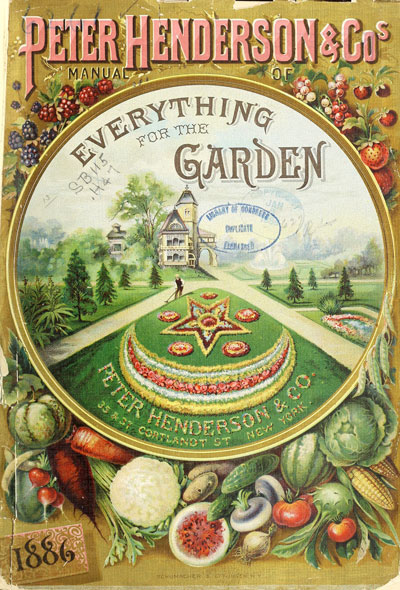
Another nurseryman whose catalogs enjoyed widespread distribution during the “Golden Age” of the mail order catalog business was Peter Henderson (1822-1890). One of the leading authorities on commercial floriculture of the time, he simplified and improved methods of handling plants for commercial purposes. He was head of Peter Henderson & Company, a seed and supply business. The company’s thick catalogs reflected Henderson’s sales concept of “Everything for the Garden” and offered seeds, bulbs, fertilizers, insecticides, and gardening and lawn tools. A prolific writer, Henderson gained popularity through his willingness to share horticultural techniques in his descriptive catalogs, books, articles, and letters.

Bailey_Cyclopedia_Horticulturists_Henderson.jpg

Peter Henderson, Bailey’s Standard Cyclopedia of Agriculture, 1881.

peterhendersonco1886frontpete_27_0003.jpg

Peter Henderson & Co.’s Manual of Everything for the Garden, 1886. Digitized by the U.S. Department of Agriculture, National Agricultural Library.

Born in Scotland in 1822, Henderson showed an early aptitude for handling plants. Perhaps his talent was inherited from his maternal grandfather who was a nurseryman and florist. Beginning at age 16, he apprenticed to head gardener George Sterling at Melville Castle. The following year, Henderson won a gold medal for the best herbarium of native and exotic plants submitted to the Royal Botanical Society of Edinburgh for a competition throughout Great Britain.

buistsprizemedal1894robe_0003.jpg

Scottish nurseryman Robert Buist’s property. Buist’s Garden Seeds, 1894. Digitized by the U.S. Department of Agriculture, National Agricultural Library.

In 1843, he immigrated to the United States and obtained employment as a gardener for several other Scottish nurserymen, including George Thorburn and Robert Buist. He remodeled Charles F. Spang’s greenhouses and grounds. In 1847, Peter and his brother James began a business growing vegetables in New Jersey and marketing them in nearby New York City.

Several years later, the brothers parted ways. Peter began growing and selling ornamental plants from his Jersey City property. In 1871, he founded Peter Henderson & Company and established a seed house and store in New York on Cortlandt Street. In 1880, from his property in nearby South Bergen, he erected state-of-the-art greenhouses with innovative heating and ventilation systems. The location of these greenhouses in the Jersey City area meant that his inventory could be transported conveniently across the country by means of rail and water ways.

peterhendersonco1886back.jpg

Peter Henderson & Co. located at 35-37 Cortlandt Street, New York City. Peter Henderson & Co.’s Manual of Everything for the Garden, 1886. Digitized by the U.S. Department of Agriculture, National Agricultural Library.

peterhendersonco18pete_26_0148_1885back.jpg

Peter Henderson & Co. greenhouses. Peter Henderson & Co.’s Manual of Everything for the Garden, 1885. Digitized by the U.S. Department of Agriculture, National Agricultural Library.

Henderson was willing to share his knowledge on gardening topics with the public, even though it meant letting his competitors know about his research. He contributed articles to magazines such as Hovey’s Magazine of Horticulture, The Horticulturist, Gardener’s Monthly, The Country Gentleman, and Moore’s Rural New-Yorker. His son Alfred wrote in Henderson’s biography that the American Agriculturist desired all his writings so they “…paid him a price per column that has been considered perhaps the largest rate ever paid an American writer.”

Henderson_Gardening-for-Profit.jpg

Gardening for Profit, revised in 1874. Copy in BHL digitized by the Library of Congress.

The U.S. Department of Agriculture asked him to write an article on market gardening for the Report of the Commissioner of Agriculture for the Year 1865. The public’s interest in the subject led to Henderson writing his first book, Gardening for Profit (1866), the first of its kind about commercial marketing of vegetables. He went on to author four more books, including Practical Floriculture (1868), Gardening for Pleasure (1875), Garden and Farm Topics (1884), and Henderson’s Hand Book of Plants (1881). He co-authored How the Farm Pays (1884) with William Crozier, one of the most successful farmers in the United States.

“““““““““““

“To supply a population of a million inhabitants daily, throughout the year, with fresh vegetables would, it might be supposed, require an immense tract of land. Such, however, is not the case.”

Peter Henderson, “Market Gardening in the Vicinity of New York.” Report of the Commissioner of Agriculture for the Year 1865. (Page 243)

“““““““““““`

everythingforgar1909_0190.jpg

Peter Henderson & Co.’s Manual of Everything for the Garden, 1909. Digitized by the U.S. Department of Agriculture, National Agricultural Library.

Henderson’s popular articles and books attracted customers for his plant and seed business. He wrote his own plant descriptions for his catalogs until 1890. He created clever and original advertisements. In fact, he was the first to use a heavy black border around his advertisements. Another reason for his popularity was his prompt and detailed response to correspondence. According to son Alfred in 1890, “…in the last thirty five years he wrote or dictated at least one hundred and seventy-five thousand letters.” He replied to correspondents the same day he received their letters, no matter how tired he was from the rigors of outdoor work and running a business.

peterhenderson1892bulbsplantss0082.jpg

An illustration of a gardener frequently appears in Henderson’s catalogs. Perhaps this figure represents Henderson. Bulbs, Plants, Seeds for Autumn Planting, Peter Henderson & Co., 1892. Digitized by the U.S. Department of Agriculture, National Agricultural Library.

Henderson even traveled long distances to give advice to entrepreneurs on such topics as land suitability, best plants to raise on the property, and greenhouse construction. It was the willingness of this leading florist, seed merchant, and horticultural writer to share knowledge that advanced horticulture from an art form to a science.

James Vick and Peter Henderson were shrewd businessmen who had great influence on the nursery and seed trade business through their catalogs, innovation, and personal styles. They became like friends to their readers and Vick’s seeds or Henderson’s opinions were often sought after. But, these were men who cared about horticulture both as art and science as well as business. They believed that gardening was an uplifting, healthy pursuit and wanted to promote the beauty of horticulture in addition to running successful businesses.

Bibliography

Bailey, Liberty Hyde. The Standard Cyclopedia of Horticulture. Volume III -F.-K. Page 1579. New York: The MacMillan Company, 1915.

Becker, Robert F. “Peter Henderson: Plant Pioneer.” American Horticulturist, 74, no. 12 (December 1995): 24-30.

Christopher, Thomas. “Heirloom Seed Catalogs.” Horticulture 63, no. 12 (December 1985): 24-27.

Henderson, Alfred. Peter Henderson, Gardener-Author-Merchant: A Memoir. New York: McIlroy and Emmet. 1890. Accessed on March 19, 2018. https://archive.org/details/peterhendersonga01hend.

Henderson, Peter. “Market Gardening in the Vicinity of New York.” Report of the Commissioner of Agriculture for the Year 1865. Washington, D.C.: Government Printing Office, 1866.

McIntosh, W.H. History of Monroe County, New York: With Illustrations, Descriptive of its Scenery, Palatial Residences, Public Buildings, Fine Blocks, and Important Manufactories 1788-1877. Philadelphia: Everts, Ensign and Events, 1877.

“Peter Henderson and Company – Peter Henderson and James Henderson.” Jersey City Past and Present. Accessed on March 12, 2018. http://www.njcu.edu/programs/jchistory/Pages/H_Pages/Henderson_Peter.htm.

Ricker, Percy L. and Magdalene R. Newman. The Nursery and Seed Trade Catalog Collection of the United States Department of Agriculture. Washington, 1945. Accessed on April 17, 2018. http://archive.org/details/CAT31064290.

Van Ravenswaay, Charles. A Nineteenth-Century Garden. New York: Universe Books, 1977.

“Vick, James (1818-1882).” n.d. Accessed March 13, 2018. http://www.sil.si.edu/SILPublications/seeds/vickjames.html.

May 24, 2018by Joel Richard
Blog Reel, Featured Books

Animal Keepers’ Forum Comes to BHL

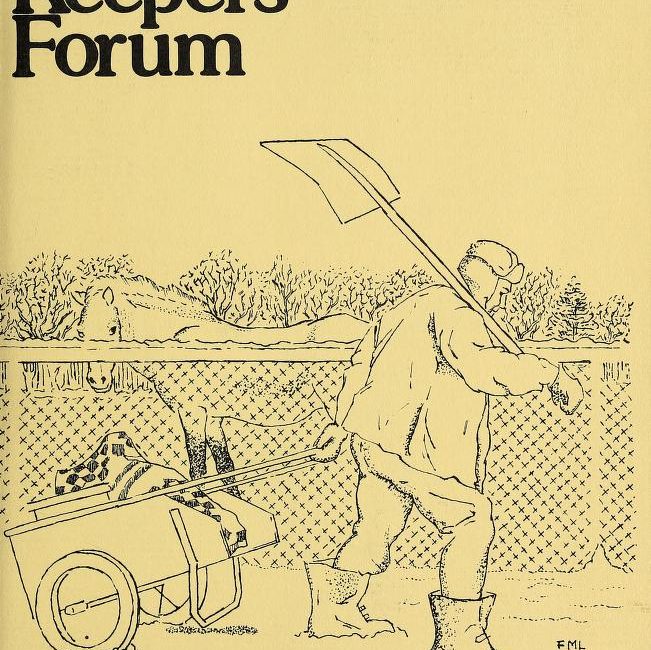
animalkeepersfor51978amer_0007.jpg

Image of a cover of Animal Keepers’ Forum, featuring a simple line drawing of a person pulling a wheelbarrow and carrying a shovel over one shoulder, in front of an enclosure with a horse. Text reads: “Animal Keepers’ Forum”, “Dedicated to Professional Animal Care.” Animal Keepers’ Forum. 1978. Digitized in BHL by Smithsonian Libraries.

Animal Keepers’ Forum, first published by the American Association of Zookeepers in 1974, set out to solve a problem: animal care and conservation requires specialized knowledge, but institutions were limited in their ability to share experience with each other. Animal Keepers’ Forum has connected animal care professionals for the past 44 years, and serves as both a current resource for husbandry best practices and a historical record of conservation efforts.

Now it’s openly accessible on the Biodiversity Heritage Library as part of the Expanding Access to Biodiversity Literature project, funded by the Institute of Museum and Library Services. Thanks to permission from the American Association of Zookeepers, Smithsonian Libraries has digitized the complete run of volumes from 1974 through the present, with a 2-year embargo period.

The 2015 special issue on prosimians gives a great sample of the publication’s scope: Duke University’s Lemur Center details their husbandry practices for mouse lemurs, with specifics from housing and diet to breeding and animal biometrics; St. Louis Zoo explains how they sustainably grow and harvest browse for their Coquerel’s Sifakas; and the Lemur Conservation Foundation shares how the AKO Project uses storytelling through picture books helps engage kids in wildlife conservation.

lemur_picturebooks.jpg

An image of two children’s picture-book covers featuring paintings of lemurs, and a photograph of children posing with picture books and smiling. Animal Keepers’ Forum. 2015. Digitized in BHL by Smithsonian Libraries.

animalkeepers42102015amer_0020.jpg

Photo of four chicks perched in a line. The chicks are black and white with yellow beaks. Article title: ‘Hand-reading White-crested Laughing Thrushes (Garrulax leucolophus) as a Method of Increasing Captive Population Sustainability’. Animal Keepers’ Forum. 2015. Digitized in BHL by Smithsonian Libraries.

The mission of the American Association of Zookeepers (AAZK) is “to advance excellence in the animal keeping profession, foster effective communication beneficial to animal care, support deserving conservation projects, and promote the preservation of our natural resources and animal life,” according to its website. The AAZK was founded in 1967 in San Diego, CA. Its first publication was an unofficial newsletter called The Ruptured Rhino (1968-1969), which is also coming to BHL along with the AAZK Bulletin. Eventually, The Rupture Rhino led to Animal Keepers’ Forum, which became the association’s official publication in 1975.

animalkeepersfo111974amer_0001.jpg

Image of the first page of Animal Keepers’ Forum, v. 1 no.1. Transcription from ‘Editorial Comment’ by Dave Ruhter: “Among zoo keepers, as with very few other professions, there exists a void in intraprofessional communications. If you are fortunate enough to have access to zoo magazines or occasionally obtain an AAZPA newsletter, you can find out what’s going on in the zoo world. But what’s happening among keepers at Denver or Brookfield? When was the last time you heard of new programs at Tulsa or Los Angeles? As problems come up, have you ever wondered what your fellow professionals are doing in similar situations? This is what Animal Keepers’ Forum is all about. We are offering to you a vehicle of communication with topics that concern and interest keepers… the more knowledgeable you are, the more valuable you are to your animals and to your zoo.” Animal Keepers’ Forum. 1974. Digitized in BHL by Smithsonian Libraries.

animalkeepersf4212015amer_0016.jpg

Photograph of an ocelot, a small, spotted wild cat, in profile. Article title: Overnight Behavioral Study on 1.1 Brazilian Ocelots (Leopardus pardalis). Animal Keepers’ Forum. 2015. Digitized in BHL by Smithsonian Libraries.

Until its digitization, accessibility to Animal Keepers’ Forum was fairly limited without a subscription. Jacqueline Chapman (Digital Collections Librarian) and Kristen Bullard (former Branch Librarian, National Zoological Park & Conservation Biology Institute and current Science Researcher Services Librarian, Natural & Physical Sciences Department) of Smithsonian Libraries authored a paper and presented at the 2017 AAZK National Conference to address the significance of making this resource available digitally and for free (‘Connecting Keepers to Collective Knowledge: The Digitization of Animal Keepers’ Forum and the Promise of Open Access to Zoological Scholarly Communication’).

They share that a search of the global online library catalogue WorldCat found only 30 libraries with Animal Keepers’ Forum, and that Smithsonian Libraries was the only institution listed as having a complete set of the periodical. As a result, it has been one of the most frequently requested titles from the Smithsonian’s Zoological Park and Conservation Biology Institute library branch through interlibrary loan. (While it is likely available at libraries that don’t participate in WorldCat, the WorldCat search result does indicate that it was relatively difficult to access for those without the resources to subscribe.)

“Some species are so unique that information about their care is hard to find and [Animal Keepers’ Forum] might be one of the only sources for this material,” Chapman and Bullard write. “The knowledge within [Animal Keepers’ Forum] is now available to anyone, allowing the best practices and lessons learned, this collective knowledge of zoo keepers, to be accessed without barrier to anyone. This will hopefully support capacity and knowledge building in institutions that have suffered from limited resources over time.”

animalkeepersf3422007amer_0001.jpg

Image of a cover of Animal Keepers’ Forum, featuring a simple black and white illustration of a California Condor chick being fed by a puppet resembling the head of an adult condor. The image is by Mary Deckert, a docent at the Los Angeles Zoo, which participates in a recovery program for this critically endangered species. Animal Keepers’ Forum. 2007. Digitized in BHL by Smithsonian Libraries.

Many thanks to: the American Association of Zookeepers for contributing this resource; the Institute of Museum and Library Services for funding the Expanding Access to Biodiversity Literature project; Smithsonian Libraries for digitization; and Jacqueline Chapman and Kristen Bullard for sharing their insights!

References:

‘About Us’ (aazk.org)
‘Animal Keepers’ Forum’ (aazk.org)
‘Connecting Keepers to Collective Knowledge: The Digitization of Animal Keepers’ Forum and the Promise of Open Access to Zoological Scholarly Communication’ (Chapman & Bullard, 2017)

May 17, 2018by michelle.underhill
Blog Reel, Featured Books

28,000 Pages about the Sea: Challenges and Solutions for Digitizing the Fowler Collection

Workflow Meets Deluge

Henry Weed Fowler must have loved fish.

Ichthyology dominated his entire career. He started as a museum assistant at the Academy of Natural Sciences of Philadelphia in 1903. Other experts in his field soon recognized his prolific skill. In 1918, an assistant curator at the Smithsonian, Barton A. Bean, reached out to Fowler (then still an assistant) for help identifying fishes collected by the United States Exploring Expedition. Fowler dove into the work. He delivered a lengthy 750-page manuscript in two years, helping to discover 18 new species of fish in the process.[1]

For reference, the average field book here at the Smithsonian Institution Archives is 110 pages.

In 1925, Bean again sought out Fowler (then an associate curator) to identify fish from a 1907-1910 expedition by the steamer Albatross in the Philippines. Over the next several years, the pair published three manuscripts together (one | two | three), after which Fowler published three more of his own (one | two | three). Then, Fowler additionally completed six massive manuscripts – thousands of pages of independently written material – that were never published. Fowler passed away in 1965 after becoming a Curator of Fishes in 1940.[2] His unpublished manuscripts were transferred to the Smithsonian Institution Archives in 1975.[3]

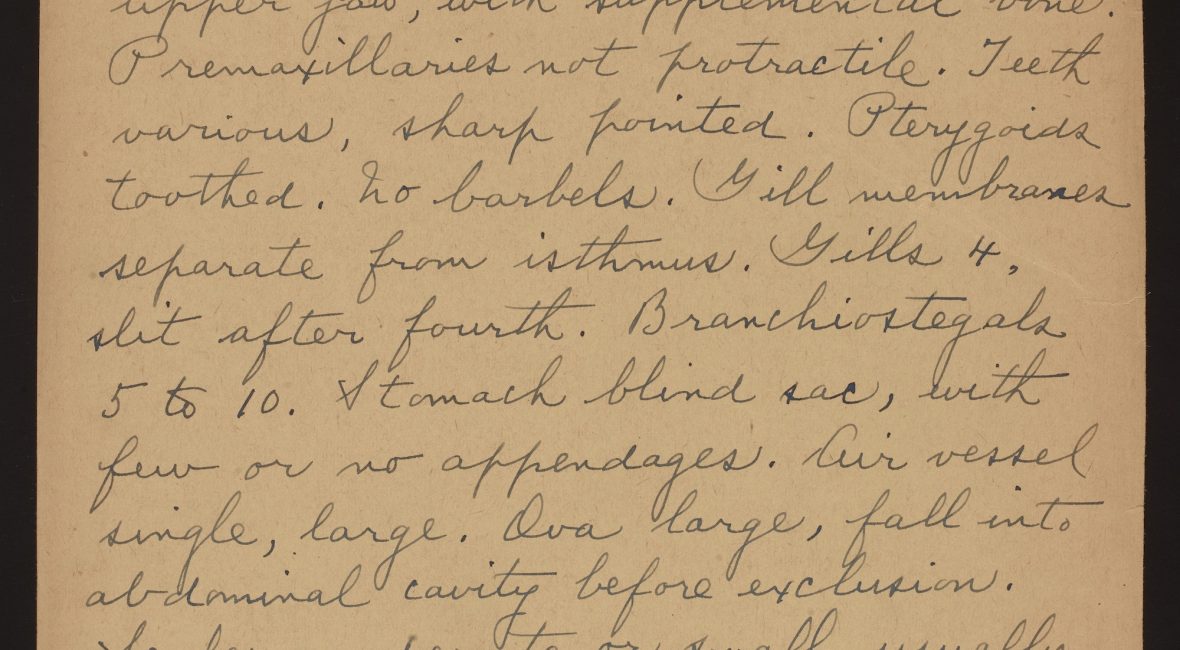
Fowler, Henry Weed. Manuscript of Henry Weed Fowler on the fishes of the Philippines, unpublished, circa 1930-1941. Families Argentinidae and Serpidae. Digitized in BHL by Smithsonian Institution Archives.

Fowler, Henry Weed. Manuscript of Henry Weed Fowler on the fishes of the Philippines, unpublished, circa 1930-1941. Families Argentinidae and Serpidae. Digitized in BHL by Smithsonian Institution Archives. https://biodiversitylibrary.org/page/55806651.

As a part of the BHL Field Notes Project, Smithsonian Institution Archives is digitizing one-of-a-kind field notes and manuscripts so they may be accessed online by researchers who may otherwise not be able to access the material. Logistically, each field book is assigned a unique identifier in the Archive’s Field Book Registry which we use to help track the item throughout the digitization process. On average, one unique identifier means one 110-page field book. We can normally digitize and deliver at least 30 field books per week.

Here’s where it got tricky: Fowler’s six unpublished manuscripts were grouped under a single identifier, MODSI6368. One 28,000-page item, 254-times larger than normal, and estimated 2.5 TB worth of images. One field book to outweigh them all.

Fowler’s unpublished manuscripts in the digital imaging lab, with imaging tech Charles Zange for scale. Photo by Mignonette D. Johnson. Smithsonian Institution Archives.

Fowler’s unpublished manuscripts in the digital imaging lab, with imaging tech Charles Zange for scale. Photo by Mignonette D. Johnson. Smithsonian Institution Archives.

The eight-Hollinger-box, 153-folder field book arrived in Staging in late February. Our team held a meeting. We needed a new approach.

Logistics of a Tidal Wave

Proceeding as normal would irreversibly skew project deliverables. Loading a 28,000 page manuscript in the BHL portal wouldn’t be the most useful approach for researchers. After detailed discussion, we settled on a plan: break out the manuscript into sub-elements at the folder level instead of the title level, photograph at ~650ppi so we wouldn’t have to adjust the camera during the day, and bulk scan smaller items that required a higher resolution.

This new approach offered several advantages. Adjusting the camera several times a day adds up and slows down imaging; removing the need to adjust constantly would save us time and make imaging the manuscript more efficient. Treating each folder as a separate sub-element would mean creating smaller, more manageable digital objects closer to the average 110 pages we usually work with. This would shorten descriptive metadata per image in our Collections Management System (CMS) records; otherwise we would be embedding page-long collection notes into each image. It would also allow us to take advantage of how BHL manages multi-volume titles. This in particular is a method already successfully implemented by our fellow Field Notes Project partners at the Missouri Botanical Garden on their George Engelmann material, so we knew it could be a user-friendly way to present the extensive Fowler manuscript.

We had a plan. Now we had to see if it would work.

Fowler, Henry Weed. Manuscript of Henry Weed Fowler on the fishes of the Philippines, unpublished, circa 1930-1941. Order Synbranchii. Digitized in BHL by Smithsonian Institution Archives. https://biodiversitylibrary.org/page/55811117

Fowler, Henry Weed. Manuscript of Henry Weed Fowler on the fishes of the Philippines, unpublished, circa 1930-1941. Order Synbranchii. Digitized in BHL by Smithsonian Institution Archives. https://biodiversitylibrary.org/page/55811117.

Results after the Storm

The first Fowler image came through the camera on March 14, 2018. Our team finished photography on April 17th. Delivery to the Biodiversity Heritage Library is ongoing (stay tuned!). Here are a few statistics from the Fowler photography project:

  • Final page count: 28,735
    • 153 folders, average 187.8 pages/folder (1.7 times larger than average field books)
  • 24 days of imaging and metadata processing
    • Average 1197.29 images/day
  • Highest one-day count of photography: 2,415 pages
    • 345 pages/hour (5.75 pages/minute) for 7 hours by one technician
  • 2.59 TB storage footprint
  • Widespread sense of accomplishment

Spread the Word across the Seas!

Fowler has started to make his way online. As the team moves to another collection (Edmund Heller), check out some of the other worldwide journeys by Smithsonian researchers at the Smithsonian Transcription Center and the Smithsonian Field Books Collection. Thank you to our many volunteers, both online and here in the lab, for your passion and dedication in support of this project!

The BHL Field Notes Project is funded by the Council on Library and Information Resources (CLIR).

Citations

[1] “Fowler, Henry Weed, 1878-1965,” Smithsonian Institution Archives

[2] Ibid.

[3] “Henry Weed Fowler Papers,” Record Unit 007180, Collections Management System, Smithsonian Institution Archives 

May 3, 2018by Joel Richard
Blog Reel, Featured Books

“Abnormal apples” and “proliferous potatoes” – Uncovering the stories behind Kew’s Museum of Economic Botany Collection.

What is Economic botany?

Economic botany can, in a nutshell (excuse the pun), be described as the use of plants by people. This relationship spans thousands of years and includes both individuals and cultures – making this subject a rich and fascinating link between botany and anthropology. Economic botany collections can essentially be described using the term biocultural.

Kew’s Museum of Economic Botany.

The Economic Botany Collection at the Royal Botanic Gardens, Kew holds around 100,000 objects from around the globe. Established as the Museum of Economic Botany by Kew’s first official Director, Sir William Jackson Hooker, in 1847, it was cited as a public repository for ‘all kinds of useful and curious Vegetable Products, which neither the living plants of the Garden nor the specimens in the Herbarium could exhibit’.

Raw materials are housed in the Collection, alongside objects ranging from jewellery, musical instruments and an array of dyes and medicines. Many of these items were acquired by Kew during the peak of colonial expansion, with the majority dating from around 1847 to 1930. Kew staff are currently working with indigenous cultures and partner institutions to ensure that traditional crafts, such as the use and manufacture of Tapa (Pacific barkcloth), are being kept alive and in some cases revived in the communities where they first originated.

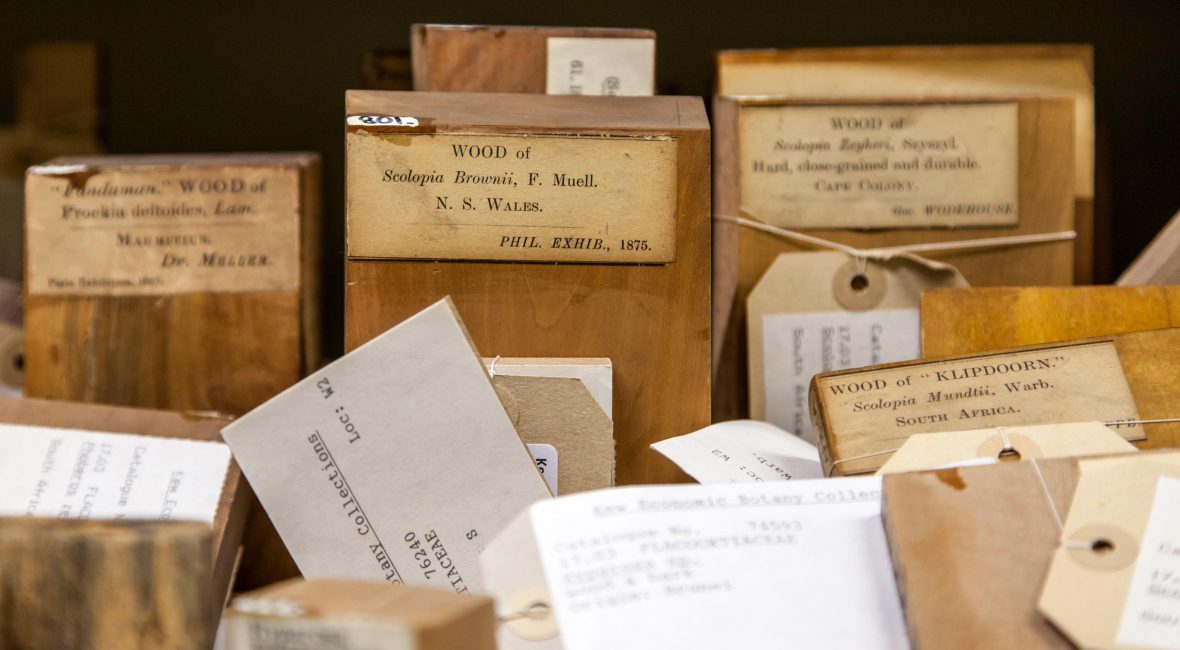
EcBotWoodColln_IMG_5764_hero_web.jpg

Economic botany wood collection samples

The Mobile Museum Project.

In parallel with this research and outreach, Kew’s Museum of Economic Botany has recently embarked on a project called The Mobile Museum: Economic Botany in Circulation. This is, in effect, where the Royal Botanic Gardens Kew, Library, Art & Archives and Biodiversity Heritage Library comes in.

As part of the Mobile Museum project, Kew is digitising and making available online through BHL the Collection’s “Entry and Exit books”. These huge tomes each consist of thousands of entries made by Kew staff over the years, listing every specimen either sent out from or sent in to the Museum of Economic Botany from 1847 right up to the present day. Each book is in the process of being scanned and uploaded to BHL, and the project team, including a number of dedicated volunteers, are working hard to transcribe each page so that there will be both a physical and digital record of these unique and invaluable logbooks. This data transcription is initially being entered into searchable Excel spreadsheets, which will then be transferred into an Access database and raw data files from this will be available to download from the project website.

The existing Kew Economic Botany Database will also be enhanced, with all objects located in other institutions being added. This will mean that interested parties will soon be able to search not just for objects currently in the collection, but also objects that were once at Kew and are now housed elsewhere.

The first of these books, which is now freely available on BHL, is entitled “Specimens Distributed” and spans from 1881 to 1901. It is a fascinating continuous record of specimens, materials and artefacts that were sent from Kew to over 1000 institutions worldwide, including other botanic gardens, schools and universities and local museums.

SpecimensDistributed1881-1901_0057.jpg

The first page of records for Specimens Distributed, which includes entries for “fossil leaves” and “petrified woods”

Specimens distributed.

The first thing that I noticed when researching this blog, as I skimmed through the hundreds of pages of handwritten entries, was just how many plant parts the Museum of Economic Botany held. On first thought, you may think of a few important parts of a plant that could be held in this sort of collection – bark, petals, seeds, stems or similar. But what struck me was the sheer scope of plants and all their various facets that were collected – resins, gums, fibers, bulbs, fruits, roots, pods, pulps, rubbers, even galls (a kind of benign growth on the external tissue of some plants, usually a reaction to parasites or bacteria).

As I browsed the book, I became engrossed in 6 pages in particular entitled November 14th 1887 – Sir James Paget, Royal College of Surgeons – A large collection of specimens of vegetable morphology.

SpecimensDistributed1881-1901_0203.jpg

Page 147 of Specimens Distributed, showing the beginning of the distribution list for Sir James Paget at the Royal College of Surgeons

Sir James Paget.

As I looked over these pages, I noticed that words such as “undeveloped”, “abnormal” and “malformation” were preceding plant names or plant parts. It occurred to me that the plants being described had possibly been collected due to their interesting morphological or biological anomalies – and they were being sent out, maybe for further investigation, to Sir James Paget at the Royal College of Surgeons. This name rang a vague bell, so I did a little research.

Sir James Paget is considered one of the most outstanding medical researchers of the 19th century and is known as the father of British pathology. He described diseases including Paget’s disease of the bone and Paget’s disease of the nipple, and throughout his career he stressed how vital science research was for medical practise.

Interestingly, Paget was a close friend of Charles Darwin, who helped his medical research by sharing thoughts and musings. Darwin also sent Paget books, including a book that he wrote on earthworms, prompting this response from Paget: “It seems to me the best that ever you have written in showing the splendid and great truths that may be found in common things”.

Sir-James-Paget.jpg

Sir James Paget, the father of British pathology (Credit: The Paget’s Association)

The next chapter.

As part of the Mobile Museum Project, Kew are also in the process of digitising the Museum of Economic Botany’s “School Letter Books”. These are logbooks containing hundreds of letters of correspondence between the Museum of Economic Botany and schools across the UK – the first book spanning from 1877 – 1894. These letters are mainly requests from teachers and lecturers who asked Kew for educational objects and samples, either to use as teaching aids or to help establish their own small collections.

The Economic Botany Collection at Kew has a rich and varied history that spans over three centuries. By making these unique books available online through BHL, we hope that more people can make use of the fascinating information held within them that has been so meticulously recorded throughout the years.


April 26, 2018by Joel Richard
Blog Reel, Featured Books

American Daffodil Society Expands Access through BHL and ‘DaffLibrary’

1_daff.jpg

Illustration of a large, yellow flower with green stem and leaves. American Daffodil Society. The Daffodil Journal. Volume 1. 1961. Digitized in BHL by American Daffodil Society.

For Mary Lou Gripshover, daffodils started as an easy entry into horticulture, but led her to the unexpected, too.

“Half a century ago, when I was a young housewife, I belonged to a garden club which in turn participated in an area-wide flower show,” she explains. “Everyone had to enter. At that point I wasn’t much good at flower arrangements, and entering daffodils in the Horticulture Section was easy. Just cut a bloom and put it in the vase provided. And the stems didn’t bend, like tulips did. So then of course I had to get more daffodils so I could enter all the classes for the various divisions… and it just grew from there. Who knew 50 years ago that I’d make friends the world over, just because of a little yellow flower?”

2_daff.jpg

A delicate painting of a single daffodil flower with a green stem and leaf. Curtis, William. The Botanical magazine, or, Flower-garden displayed. 1790. Digitized in BHL by Missouri Botanical Garden, Peter H. Raven Library.

Gripshover serves as a librarian / digitizer for the American Daffodil Society (ADS), a group with international membership that has connected daffodil enthusiasts since its founding in 1954. In the spirit of National Gardening Month, we’re highlighting the ADS’ publication, The Daffodil Journal, which comes to BHL as part of the Expanding Access to Biodiversity Literature project. Early volumes of this quarterly journal from 1964-1968 are currently available on BHL, with more volumes on the way.

4_daff.jpg

A page from a seed catalog with descriptions of varieties of Daffodil for sale, and two black and white illustrations; one a close-up of a flower variety called Empress, the other a mix of many flowers. Griffith and Turner Co. Bulbs and seeds.  1900. Digitized in BHL by U.S. Department of Agriculture, National Agricultural Library.

According to the ADS website, ‘daffodil’ is the common name for all members of the genus Narcissus. There are somewhere between 40 and 200 different species/subspecies/varieties (depending on who you ask), and more than 25,000 registered cultivars (named hybrids).

The first mission of the ADS was to create a publication, starting with a small bulletin and yearbook. After its first decade, the society released its quarterly publication, The Daffodil Journal, to share information on “all aspects of daffodil culture, breeding, and exhibition.” Now the ADS has its own digitization project, DaffLibrary, where more than 3,000 resources on daffodils are available as downloadable PDFs or as links to other websites. The Daffodil Journal through the year 2012 is available on DaffLibrary, so you can view more recent issues of the publication there until more are added to BHL.

5_daff.jpg

Colorful painting from the cover of a bulb magazine, including white and yellow daffodils and other yellow, white and pink flowers. Thorburn, J.M. & Co. Annual descriptive catalogue of flower seeds. 1903. Digitized in BHL by New York Botanical Garden, LuEsther T. Mertz Library.

“The ADS has had a ‘paper library’ almost from the beginning,” Gripshover says. But because the society has no permanent headquarters, the physical collection had to move several times, and didn’t get much use. “Occasionally a list of available titles would be published in the Journal, and maybe there’d be a little action then, but interest didn’t last. Eventually, it was decided that we should at least get back issues of the Journal scanned, so in 2004 we had 40 years’ worth of the Journal professionally scanned. Several years later, someone suggested that we should think about scanning some of the other materials we had. I foolishly said that I could do some scanning… and it’s turned into a permanent job! But it’s one I enjoy.”

6_daff.jpg

A painting of yellow flowers with a darker yellow background. Ferry, D.M. & Co. Bulbs and seeds. 1913. Digitized in BHL by U.S. Department of Agriculture, National Agricultural Library.

DaffLibrary is now the most-viewed of the ADS’ websites, and gets much more use than the physical collection did: in just the first 3 months of 2018, it connected close to 15,700 visitors to nearly 55,000 pages. Popular resources included book, historic, and scientific references; plant show handouts/material; casual-reading books and articles; biography information; and information about growing daffodils using different methods.

Many thanks to the American Daffodil Society for contributing The Daffodil Journal to BHL, and to Mary Lou Gripshover for sharing her story with us and dedicating years of work to support open access information!

7_daff.jpg

A bold stencil-style image of yellow daffodils with green leaves and stems. Boddington, Arthur T.  Boddington’s quality bulbs, seeds and plants. 1911. Digitized on BHL by New York Botanical Garden, LuEsther T. Mertz Library.

References

American Daffodil Society

‘About’ DaffLibrary

April 19, 2018by Joel Richard
Blog Reel, Featured Books

From ‘Shotgun Ornithology’ to Nature Conservation: Scientific Stories and Data from the Field Notes of William Brewster

handwritten text on a page with a drawing of a moose

William Brewster (1851-1919) was a renowned American amateur ornithologist, serving as a co-founder of the American Ornithologists’ Union, the first president of the Massachusetts Audubon Society, and a curator at Harvard’s Museum of Comparative Zoology (MCZ). As a part of the CLIR-funded BHL Field Notes Project, MCZ has been digitizing Brewster’s journals, diaries, letters, and photographic prints, which are held in Special Collections at the MCZ’s Ernst Mayr Library.

Most of Brewster’s observations are based in New England, where he split his time between two homes in Cambridge and Concord, Massachusetts. Brewster would stay in a cabin by the Concord River to study nature and escape city life in Cambridge. He also took notes when travelling: his notebooks document trips to the southern USA, the Caribbean, and Europe.

black and white photo of a man sitting in front of a cabin in the woods.

A black and white photograph of Brewster sitting on the front doorstep of his cabin in Concord, Ma. The small, one-story log cabin is set in a hillside and surrounded by small trees and shrubs. The back of the photograph has the note: “Concord, Mass. May 20, 1892.” (Ernst Mayr Library Special Collections, call no. bBr97.70.7.)

Brewster’s writings contain a wealth of information, from data on temperature and weather conditions to descriptions of animal behavior and personal musings. Some of the extensive Brewster collection is already available to view on BHL – here’s a sampling of the kinds of information you’ll find.

In the warmer months, Brewster often camped at Lake Umbagog (north of the White Mountain National Forest, straddling Maine – New Hampshire border), where he spent his days tracking the progress of bird nests around the lake and making other general observations. Here’s a typical example of one of Brewster’s bird lists, recorded at Lake Umbagog in 1907. The larger numbers are dates, with superscripts indicating the number of individuals counted that day. Asterisks tell us that the bird was heard vocalizing. Some additional details are also penned in (for example, he notes that Dendroica pensylvanica, the Chestnut-sided Warbler, was in an apple tree). [1]

handwritten page from a journal

An image of a page from a journal. Two smaller papers with handwritten, numbered lists are attached to a larger page. The heading reads: “Lake Umbagog, 1907. July and August.” The lists have scientific names of bird species, followed by dates, numbers of birds observed, and some additional notes. (1907. Journals of William Brewster, 1871-1919 (inclusive). Find this journal on BHL.)

Beginning in the 1890s, Brewster’s journals document a transition of focus from mainly specimen-collecting to photography and documenting behaviors. (His journals reveal an interesting story about his increasing ethical conflict and desire to study wildlife without contributing to its decline. You can read more about this in a previous BHL blog post found here.) Earlier in Brewster’s career, his journals list and provide details on species collected – data that is similarly useful to the list above in that it gives an indication of species distribution and abundance. It also corresponds with existing specimens and documents the impact made by scientific collectors of the era.

The kinds of data in these journals diversifies as Brewster started devoting more time to documenting animal behaviors. In many ways, this work seems to have been harder than getting a good shot at a bird. Even with today’s apps and audio libraries, figuring out bird calls can be a challenge. Equipped with just pencil, paper, field glasses and ears, studying bird vocalizations is much trickier, as shown by Brewster’s notes below from 1902. [2] Today, we can represent bird vocalizations visually using spectrograms. In order to translate sounds to text, Brewster listened diligently to invent mnemonics, describe patterns, and make comparisons to other more familiar sounds.

handwritten text on a page

An image from one of Brewster’s journals showing his written renditions of an unknown bird’s vocalizations. He writes: “The voice was much louder than that of any Blackbird and was also more penetrating. The cry lasted from ½ to ¾ of a second (timed with a stop watch) and I noted the following variations: Kèt – kèt – kèt – ă – ă – ă – ă – ă (the a sounded as ah) [etc.]” https://s.si.edu/2q6rKGa.

It’s worth mentioning that Brewster’s animal observations weren’t limited to birds, and that a lot of his animal encounters made for interesting stories. Below is a sketch of a moose from Lake Umbagog, observed in August 1869. [3] His impression: “He seemed like some long-forgotten antedeluvian creature which, arousing from a sleep of thousands of years, was wandering aimlessly about in a land so changed that it no longer had any place for such strange monsters.”

handwritten text on a page with a drawing of a moose

A simple ink-sketched outline of a female moose with head held low and ears lying flat back. The sketch is embedded in a paragraph handwritten in cursive script on lined paper. https://s.si.edu/2GD0beA.

As though telling the story to a friend, he recounts following the moose through the wetland in his canoe – sometimes ending up way too close for comfort. After talking to a local guide, he learned that the moose that he’d seen was a mid-sized female, and concluded, “If she was not really a very large one I have no wish to be equally near to a big bull!”

Because he returned to Lake Umbagog year after year, Brewster was able to notice longer-term changes in familiar ecosystems. Increasingly, these changes were man-made disturbances: the clearing of woods, the creation of new roads, and other urbanizing changes. He also recorded how local communities of animals and plants responded after these disturbances. The following passages from Brewster’s field notes document some changes that he saw in the Maine woods as a consequence of logging for paper mills, and include some of his own predictions.

“Where the road passes through the woods … the roadworkers last May cut away the mountain maples, cornels and other shrubs and low trees that made such a beautiful border to the forest clearing in their places a broad belt of bare rocks half covered with the fallen brush wood. This deed of vandalism was performed while I was here and at the time I feared that years must elapse before Nature, with all her diligence, could repair the injury.

“I underrated her powers for already this thicket of road is, if anything, more beautiful than ever. Fire weed, Eupatorium, Impatiens, Asters, Golden rod and several other tall and rank flowering plants have shot up through and almost perfectly concealed the unsightly brush and stone heaps and I have rarely seen a more brilliant or attractive display of wild flowers. The fire weed is especially tall and fine and the jewel weed grows in solid beds yards in extent. Of course the Humming birds had not overlooked such a feeding ground. There were at least three of them there at once including an adult male with blazing ruby throat at which I fired an ineffectual shot.” [4]

In this instance, Brewster noticed that one year was enough time to see plant growth after the woods had been cleared, that the colonizing plants were different from the ones that characterized the location before, and that they had impacted animal life. He penned these observations on ecological succession just a few years before the first scientific paper on this concept was published (“An Ecological Study of the Sand Dune Flora of Northern Indiana”, Henry Chandler Cowles, 1898.). [5]

illustration of two hummingbirds

A painting of Ruby-throated hummingbirds. Two male birds with red throats are hovering face-to-face with their beaks nearly touching. A female sits below in a branch with white flowers. All the birds are green above with white undersides and have long, narrow beaks. Below the painting is the text: “RUBY-THROATED HUMMING Order – MACROCHIRES Family – TROCHILUS Genus – ARCHILOCUS Species – COLUBRIS National Association of Audubon Societies.” (Portraits and habits of our birds. v.2. New York city: National association of Audubon societies,1920. (See on BHL.)

The following year, he wrote:

“The Lake shore has been sadly marred … by the lumbermen who last winter cut all the spruces and many of the fine, tall white pines all the way from this landing to the deep cove near the Tidswell place. […] Lumbering is a very different business now from what it was twenty years ago. Then only the larger trees were taken; now the pulp mills devour everything and nothing is spared thicker at the base than five inches! […] These changes in the character of the forests must make speedy & considerable changes in the bird fauna. The shore near Crocker’s camp, for instance, has been one of the chief breeding grounds for the Bay breasted Warbler. They will breed there no longer, now that all the spruces are gone.” [6]

Knowing now that local extirpations and even total extinction can occur (this was the decade when the passenger pigeon disappeared from the wild), he would have penned this prediction with heavy heart. To help preserve an area he cared about – his familiar stomping grounds along the Concord River in Concord, Mass. – over time, Brewster purchased 300 acres of the riverfront. His ‘October Farm,’ across the river from Great Meadows National Wildlife Refuge, is now protected land with trails recently opened to the public – while his writings, notes and photographs preserve the region for us as he knew it in the 19th and early 20th centuries.

(If you’re interested in learning more, I write an ongoing series of blog posts on the Brewster collection on the Ernst Mayr Library blog. You might like to see archival and modern photos of October Farm, Brewster’s property in Concord.)

References

[1] July and August 1907. Journals of William Brewster, 1871-1919 (inclusive). Find this journal on BHL.

[2] June 1, 1902. Journals of William Brewster, 1871-1919 (inclusive). Find this journal on BHL.

[3] August 27, 1896. Journals of William Brewster, 1871-1919 (inclusive). Find this journal on BHL.

[4] August 15, 1896. Journals of William Brewster, 1871-1919 (inclusive). Find this journal on BHL.

[5] ‘Henry C. Cowles’. The University of Chicago Centennial Catalogues. Web accessed: https://www.lib.uchicago.edu/projects/centcat/fac/facch14_01.html

[6] May 15, 1897. Journals of William Brewster, 1871-1919 (inclusive). Find this journal on BHL.

April 5, 2018by kmichaelis
Page 12 of 62« First...10«11121314»203040...Last »

Help Support BHL

BHL's existence depends on the financial support of its patrons. Help us keep this free resource alive!

search

About BHL

The Biodiversity Heritage Library (BHL) is the world’s largest open access digital library for biodiversity literature and archives. BHL operates as a worldwide consortium of natural history, botanical, research, and national libraries working together to digitize the natural history literature held in their collections and make it freely available for open access as part of a global “biodiversity community.”

Join Our Mailing List

Sign up to receive the latest news, content highlights, and promotions.

Subscribe Now

Subscribe to Blog via Email

Enter your email address to subscribe to this blog and receive notifications of new posts by email.

Join 319 other subscribers

Subscribe to Blog Via RSS

Subscribe to the blog RSS feed to stay up-to-date on all the latest BHL posts.

Access RSS Feed

Inspiring Discovery through Free Access to Biodiversity Knowledge.

The Biodiversity Heritage Library makes it easier than ever for you to access the information you need to study and explore life on Earth…for free, anytime, anywhere.


64+ Million Pages of
Biodiversity Literature Online.

EXPLORE

Tools and Services
to Transform Research.

EXPLORE

300,000+
Illustrations on Flickr.

EXPLORE

ABOUT | HARMFUL CONTENT | PRIVACY | SITE MAP | TERMS OF USE