Biodiversity Heritage Library - Program news and collection highlights from BHL
  • Home
  • News
  • Featured Books
    • All Featured Books
    • Book of the Month Series
    • BHL at 20
  • User Stories
  • Campaigns
    • Fossil Stories
    • Garden Stories
    • Monsters Are Real
    • Page Frights
    • Her Natural History
    • Earth Optimism 2020
  • Tech Blog
  • Visit BHL
Home
News
Featured Books
    All Featured Books
    Book of the Month Series
    BHL at 20
User Stories
Campaigns
    Fossil Stories
    Garden Stories
    Monsters Are Real
    Page Frights
    Her Natural History
    Earth Optimism 2020
Tech Blog
Visit BHL
  • Home
  • News
  • Featured Books
    • All Featured Books
    • Book of the Month Series
    • BHL at 20
  • User Stories
  • Campaigns
    • Fossil Stories
    • Garden Stories
    • Monsters Are Real
    • Page Frights
    • Her Natural History
    • Earth Optimism 2020
  • Tech Blog
  • Visit BHL
Biodiversity Heritage Library - Program news and collection highlights from BHL
BHL News, Blog Reel

BHL Recognized for Award at the DLF Forum

View Full Size Image
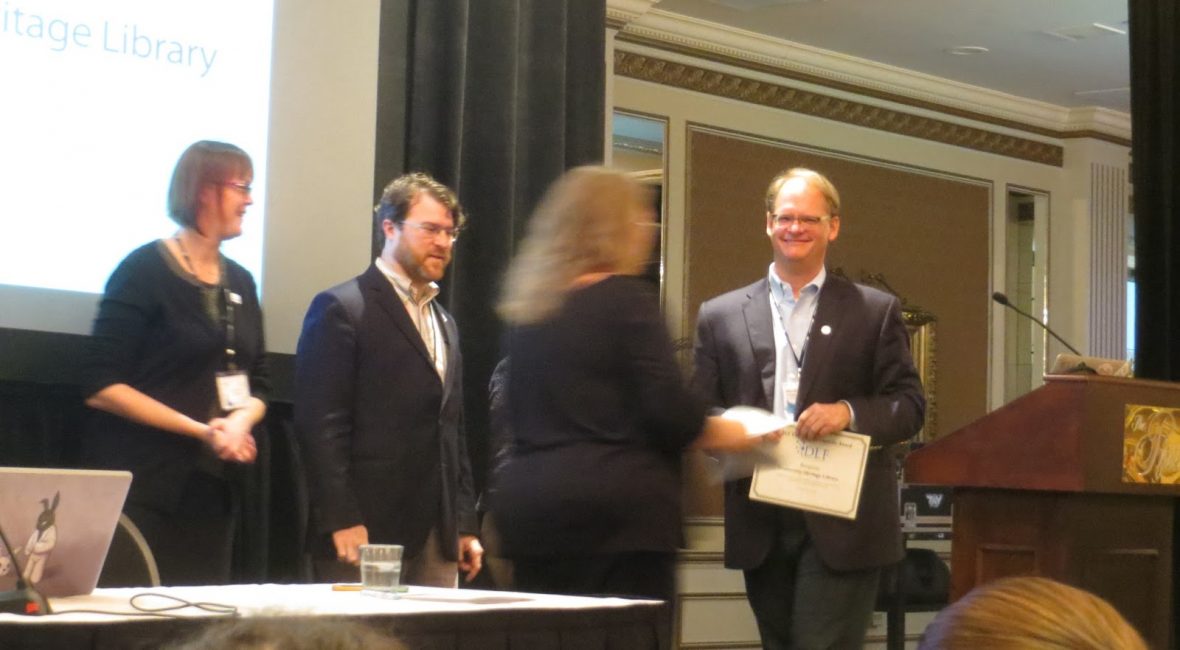
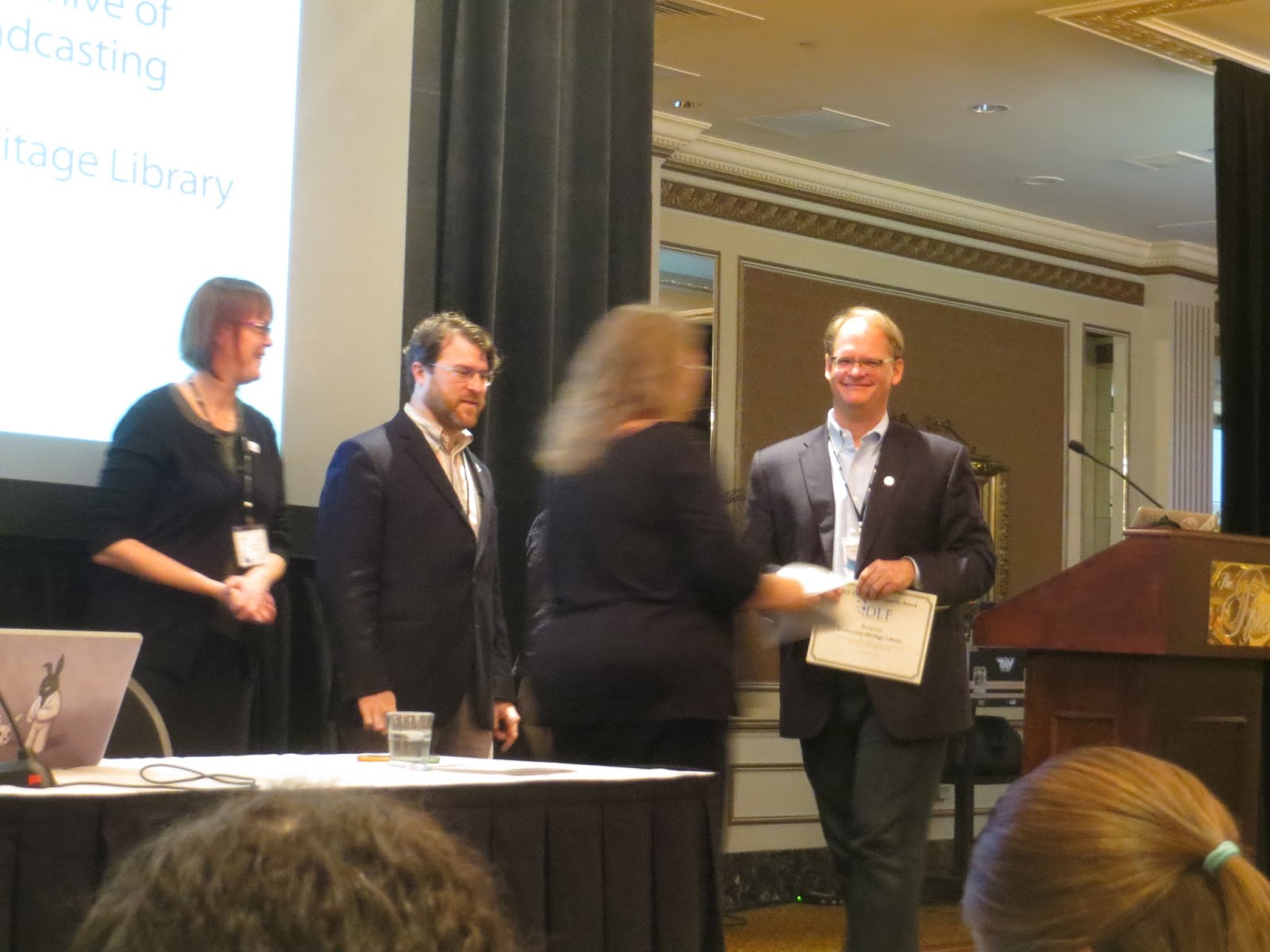
BHL Program Director Martin R. Kalfatovic accepts the Community/Capacity Award on behalf of the BHL consortium at the 2016 DLF Forum in Milwaukee, Wisconsin.

During an award ceremony at the Digital Library Federation (DLF) Forum in Milwaukee, Wisconsin on November 7, the Biodiversity Heritage Library was recognized as a co-recipient of the inaugural DLF Community/Capacity award, along with the American Archive of Public Broadcasting.

The Community/Capacity Award honors cross-institutional collaboration and constructive, community-minded capacity building in digital libraries, archives, and museums. During the month of June, DLF member organizations voted on an impressive list of 16 nominees to determine the award winner. In a tie-vote, the DLF community selected BHL and AAPB as the first-ever winners of the Community/Capacity Award.

The Biodiversity Heritage Library collaborates to build and maximize capacity across its international consortium of over 30 institutions in order to provide free and open online access to library collections from around the world. This highly collaborative approach serves BHL’s users with a constantly growing collection of open access biodiversity literature, including materials often physically available in limited locations throughout the world.

The DLF Community/Capacity Award celebrates BHL’s commitment to collaboration, openness, and community spirit, which has transformed the way researchers around the world access biodiversity information. As former Smithsonian Secretary G. Wayne Clough stated in Best of Both Worlds, BHL is “an impressive example of what can be accomplished by digitization of library resources through a collaborative approach.”

Joining BHL Program Director Martin R. Kalfatovic on stage to accept the award from DLF Director Bethany Nowviskie were BHL Member representative Kelli Trei (University of Illinois, Urbana-Champaign), and Jacqueline Chapman and Joel Richard from Smithsonian Libraries. Additional representatives from BHL included Anne Kenney (University Librarian, Cornell University Library), Keri Thompson (Smithsonian Libraries), and Karl Blumenthal (Internet Archive).

Congrats to the @BioDivLibrary! Unlocking knowledge in Special libraries to share with the world. #DLFforum pic.twitter.com/UKmkqTlr6e

— talytr (@tltroup) November 7, 2016

We are honored to have received this award along with the American Archive of Public Broadcasting. We would like to thank the DLF community for selecting BHL as a co-recipient of the award and to especially recognize the contributions of each and every one of our consortium partners whose dedication, support, and unwavering commitment make BHL a reality.

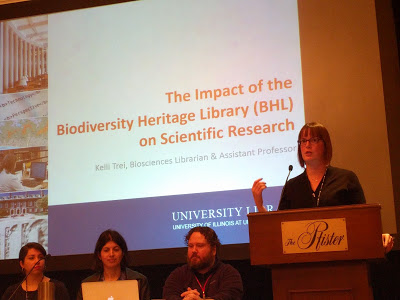
The 2016 DLF Forum also included a presentation by Trei, “The Impact of the Biodiversity Heritage Library on Scientific Research.” The presentation details a study evaluating the scientific impact of the digital Biodiversity Heritage Library (BHL) through topic modeling and analysis of a series of interviews with scientific researchers featured in a BHL blog.
View Full Size Image
Kelli Trei, BHL Member representative, University of Illinois, Urbana-Champaign, presenting at the 2016 DLF Forum on “The Impact of the Biodiversity Heritage Library on Scientific Research.”


November 9, 2016by michelle.underhill
BHL News, Blog Reel

Your Next Purchase Could Help Save Biodiversity and Support Research Worldwide

We live in the midst of a major extinction crisis and widespread climate change. Documenting Earth’s species and understanding the complexities of swiftly-changing ecosystems is more important than ever before. To do this, scientists need something that no single library can provide – access to the world’s collective knowledge about biodiversity.

View Full Size Image

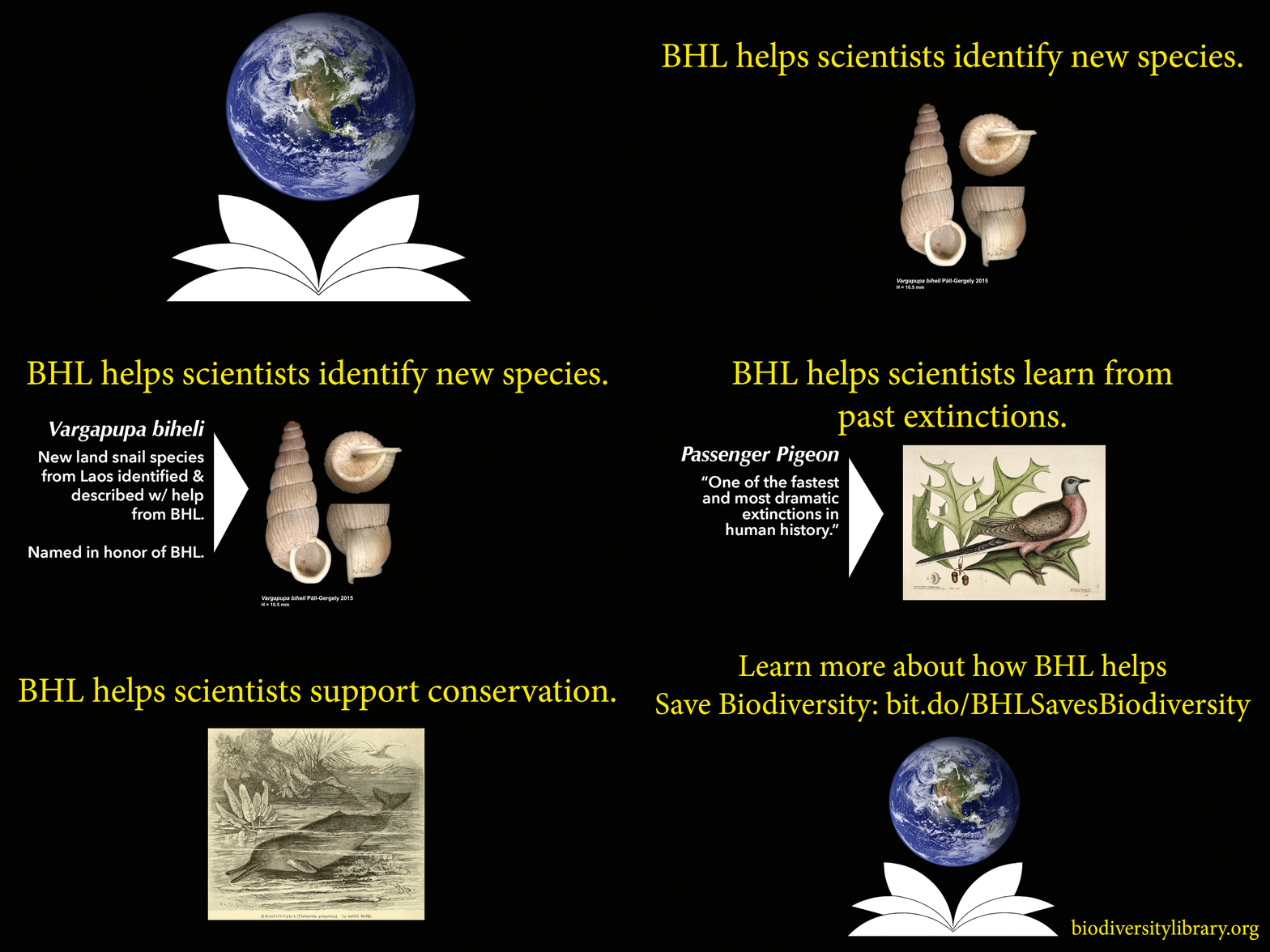
Fortunately, the Biodiversity Heritage Library is revolutionizing scientific research by providing free and open access to the collections of natural history and botanical libraries around the world. Since it was founded in 2006, BHL has become the largest open access digital library for biodiversity literature, allowing everyone, everywhere to freely access collections from across global and providing scientists with the information they need to study and save biodiversity. Learn more about how BHL helps save biodiversity and read testimonials from real users about BHL’s impact on global science.

View Full Size Image

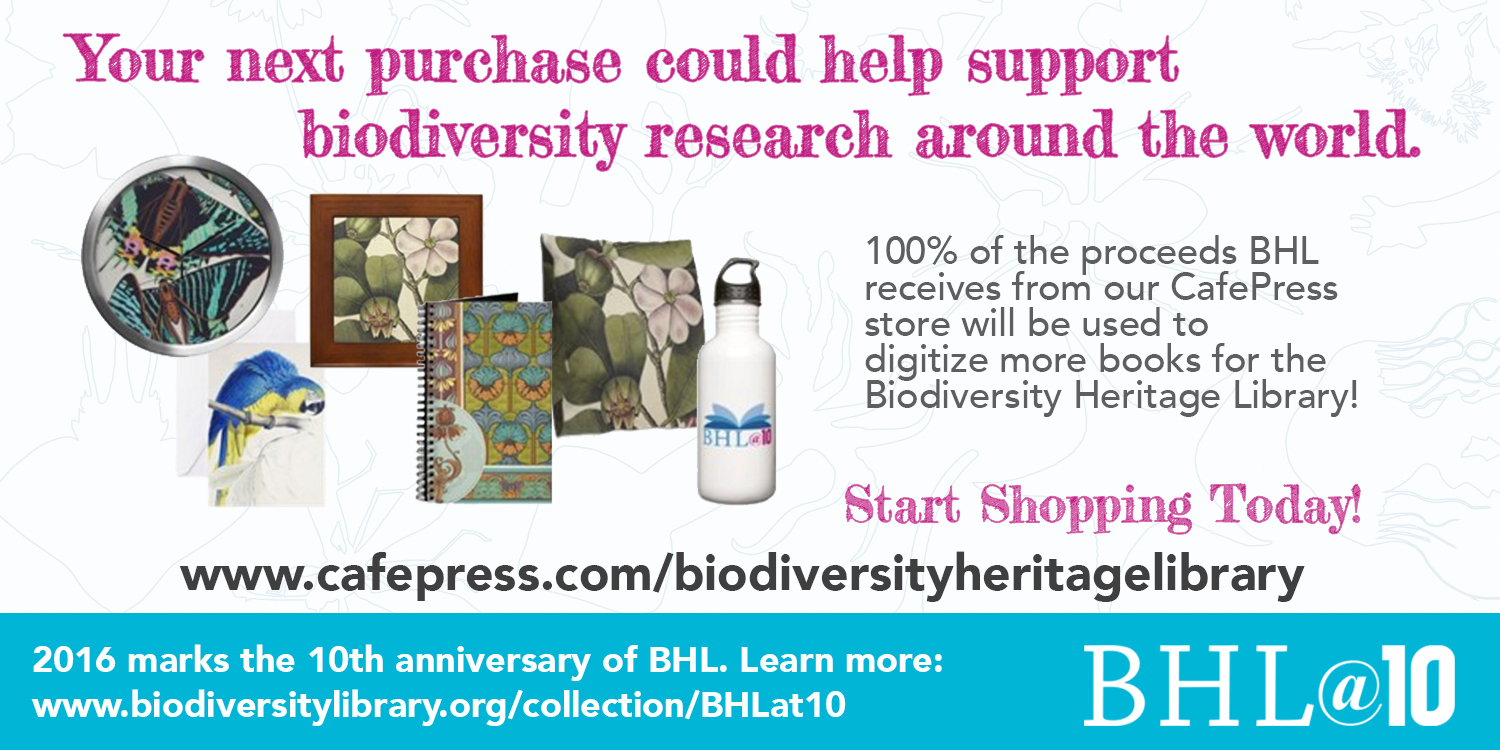
The existence of BHL depends on support from our users. As part of our 10th anniversary celebration, we’ve launched a CafePress store with products featuring our #BHLat10 theme and images from our collection. We’re launching the store with a small selection of images from BHL, but we’ll be expanding this selection in the future as we continue to develop our store. 100% of the proceeds that BHL receives from the sale of these products will be used to digitize more books for BHL. Start shopping today and help give scientists around the world the resources they need to study and save biodiversity.

And if merchandise isn’t your thing, but you want to help support BHL’s future, consider making a tax-deductible gift to help us continue to support science and research around the world.

Follow #BHLat10 all this week (11-15 April 2016) to join our 10th anniversary celebrations.  The campaign celebrates BHL’s impact on the global science community, our history and growth, and our collections. Content is being published on our blog, Twitter, Facebook, Flickr, Pinterest, and BHL. Learn more: http://www.biodiversitylibrary.org/collection/BHLat10

We also have programming all week tying into our #BHLat10 themes. Learn more.

Finally, don’t forget to sign our birthday card and tell us what BHL means to you!

April 12, 2016by ulib-libraryjobs
BHL News, Blog Reel, Campaigns

Happy 10th Anniversary, BHL!

2016 marks the 10th anniversary of the Biodiversity Heritage Library (BHL, www.biodiversitylibrary.org)!

View Full Size Image
Since 2006, the Biodiversity Heritage Library has transformed the way scientists, researchers, and librarians around the world access knowledge about and study life on Earth. In order to document Earth’s species and understand the complexities of swiftly-changing ecosystems in the midst of a major extinction crisis and widespread climate change, scientists need something that no single library can provide – access to the world’s collective knowledge about biodiversity. Beyond the scientific realm, such information also allows scholars to answer complex research questions related to human exploration, culture, and the history of science. Through a worldwide partnership of natural history and botanical libraries, BHL has become the largest open access digital library for biodiversity literature, allowing everyone, everywhere to freely access library collections from across global and empowering research like never before.

We’re celebrating our anniversary with our #BHLat10 campaign this week, 11-15 April 2016. The campaign highlights BHL’s impact on the global science community; our history, growth, and Member and Affiliate contributions; and collections that highlight our 10th anniversary theme. Content will be published through our blog, Twitter, and Facebook. We also have a Flickr collection made up of the most-viewed albums from our Members and Affiliates,  and a Pinterest board with selections from those albums. Finally, check out the most-downloaded books from each of our Members and Affiliates in our BHL book collection. Learn more about our campaign here: http://www.biodiversitylibrary.org/collection/BHLat10

We’ll also have programming throughout the week that celebrates our 10th anniversary and highlights our #BHLat10 themes. Check out our full list of programs below:

From Shelf to Screen

In the past 10 years, BHL’s collections have grown to over 48 million pages! Find out how a book goes from a library’s shelves to BHL by going behind-the-scenes at the Smithsonian Libraries’ Conservation and Digitization Annex!
When? 10am EDT/3pm BST, 11 April 2016
Where? www.periscope.tv/biodivlibrary

BHL Day at the Natural History Museum, London

A programme highlighting BHL’s impact on the global science community and featuring speakers from biodiversity-related disciplines.
When? 8am-1pm EDT/1-6pm BST, 12 April 2016
Where? Follow #BHLDay on Twitter to join the live tweeting of this event.

Let’s Talk Impact: An Interview with Rod Page at the Royal Botanic Gardens, Kew

Join us for a live interview at the Royal Botanic Gardens, Kew, with Martin R. Kalfatovic (@UDCMRK), BHL Program Director, and Rod Page (@rdmpage), creator of BioStor (@biostor_org), for a discussion about BHL’s impact on science and possibilities for the future.
When? 11am EDT/4pm BST, 13 April 2016
Where? Google Hangouts: http://bit.do/BHLLetsTalkImpact

Behind the Scenes at Tring

BHL’s partner libraries are full of amazing treasures. Join us for a behind-the-scenes look at selections from the Ornithology and Rothschild Libraries’ incredible collections at the Natural History Museum at Tring.
When? 6am EDT/11am BST, 15 April 2016
Where? www.periscope.tv/biodivlibrary

It’s a great week to celebrate our 10th anniversary because it’s also the American Library Association’s National Library Week. This year’s NLW theme is #LibrariesTransform. BHL has been transforming scientific research for 10 years, helping scientists identify, describe, and save Earth’s biodiversity. Explore interviews with actual users to see how BHL supports science and education (and even humanities research in history and art!). Visit our website to learn more about the tools, services, and citizen science initiatives that BHL provides and supports to help further transform biodiversity research around the world.

View Full Size Image

To help ensure that BHL continues to transform biodiversity research for decades to come, we’ve launched a CafePress store with products celebrating our 10th anniversary and featuring images from our collection. We’ve launched the store with a small selection of images from BHL, but we’ll be expanding this selection in the future as we continue to develop our store. 100% of the proceeds that BHL receives from the sale of these products will be used to digitize more books for BHL. Check out the store today!

View Full Size Image

And if merchandise isn’t your thing, but you want to help support BHL’s future, consider making a tax-deductible gift to help us continue to support science and research around the world.

We hope you’ll join us in celebrating our 10th anniversary this week and all year long! Follow #BHLat10 on social media to catch all of our great content and tell us how BHL has impacted your work by posting with the hashtag or leaving a comment on this blog. And don’t forget to sign our birthday card and tell us what BHL means to you!

Happy Birthday, BHL!

April 11, 2016by michelle.underhill
Blog Reel, User Stories

Basionyms, Synonyms, Authorities: Tracking the Names of Macro- and Micro Algae Through Time

Portrait version of the Biodiversity Heritage Library logo.

As part of our BHL & Our Users series, we recently caught up with Dr. Roberta Cowan, a specialist in Phycology (taxonomy) and information management. Over the last 19 years, Dr. Cowan has been actively involved in nomenclatural work, notably for Australian algal species.  Dr. Cowan was kind enough to provide some background on her work and the role BHL has played in making that work both quicker and easier over the years.

Roberta Cowan, PhD 

View Full Size Image
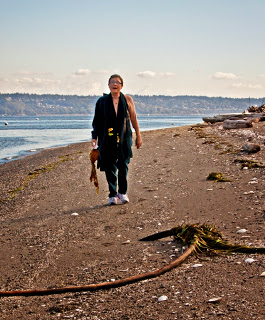
Dr. Cowan collecting on Whidbey Island,
Washington State 

In the 1980s a number of countries had nomenclatural plant databases. There was the famous Index Kewensis from Royal Botanic Gardens, Kew  and the Gray Cards from the Harvard University Herbaria. In Australia the Australian Plant Name Index (APNI) was being prepared. In the early 1990s proposals were put forward to the Australian Government to create a database for the marine macroalgae (Australian Marine Algal Name Index, AMANI) and the freshwater algae. Later the marine microalgae were included in AMANI. All of this information is now being updated and transferred to the Atlas of Living Australia (ALA).

I began work on AMANI in 1994. At that time, in order to check the accuracy of information regarding binomials cited in literature about Australian algae the original literature had to be sourced via the inter-library loan system. By definition much of the literature was contained in monographs and journal runs that were considered rare by the lending library. This invariably meant that the item was not available for photo-copying. Often the full bibliographic details for original literature was not entirely clear and so a ‘catch 22’ situation occurred in that an item may well be sourced to a particular library but could not be copied until the full bibliographic detail was supplied. The detail could only be supplied by accessing the item. Access to the item therefore had to wait until I could travel to the lending library. This meant waiting until travel to the libraries on the other side of Australia–or the other side of the planet–could be afforded.

In 2007, with the founding of the Biodiversity Heritage Library the problems of access and the problems of confirming bibliographic details became increasingly rare. My work changed from submitting inter-library loan forms and waiting for weeks for a requested item to arrive to searching BHL, selecting the item for download, filling in the information: title, author, keywords and waiting a very short time for the pdf to appear via a link in an email.

I am presently editing the algal data relevant to the nomenclature of all names cited in Australian taxonomic literature and all taxonomic literature citing Australian algal names for the Atlas of Living Australia. BHL is one of my most important tools.

December 17, 2013by sayeedmd
Blog Reel

My Life as a BHL Staffer: Jacqueline Chapman

Have you ever spotted an error in the BHL? Have you ever experienced technical difficulties with downloading digital files from our website? Have you ever looked for an article, journal, or title in our collections and been disappointed to find that it wasn’t in BHL’s collections? Have you ever wanted to thank BHL staff for a particular article, feature, or service? Have you ever had an idea for how the BHL could improve?
If you have, I hope you have taken advantage of our Feedback system and sent your corrections, suggestions, and questions on to us!  And if you have done so recently, you may have heard from me.
View Full Size Image
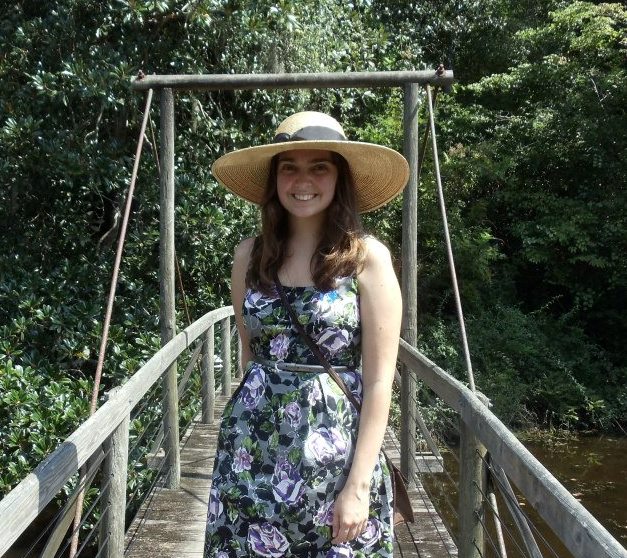
My name is Jacqueline Chapman, and I have had the pleasure of responding to hundreds of messages from BHL users over the past few months as I’ve taken on the role of BHL’s virtual reference librarian. I work on the BHL as part of my duties as a Digital Collections Librarian at the Smithsonian Institution, where I participate in digital initiatives and coordinate with various staff members to digitize the collections of Smithsonian Libraries.
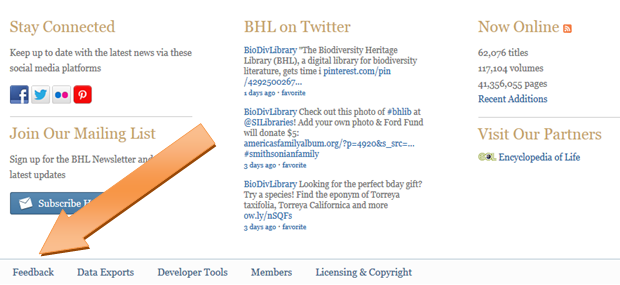
To submit feedback to the Biodiversity Heritage Library, simply scroll down to the bottom of our home page and click on Feedback.
View Full Size Image
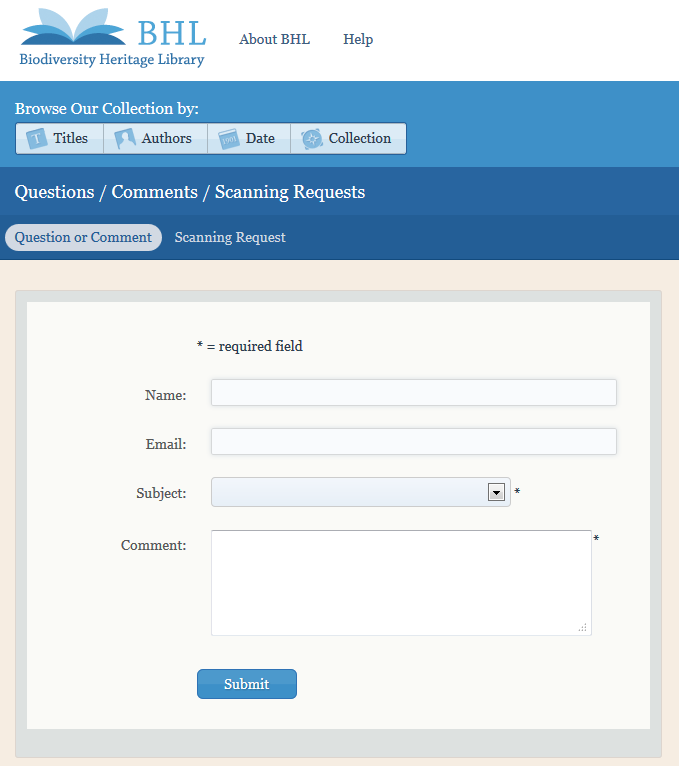
You will have the option to provide general feedback or to place a scanning request.  All submissions enter the same queue, in our back-end user feedback management system.  That’s where my work begins!
 
Questions and Comments
This section is a catch-all for user feedback that does not contain a scan request.  These may include image reuse requests, suggestions, error reporting, or technical questions.  Part of my job is to sort these submissions and determine what action is needed.
View Full Size Image
Through such user queries, I help with technical questions, investigate and fix quality issues, and answer more traditional reference questions.  I get to indulge in my enjoyment of detail-oriented intellectual tasks by merging rogue scans into their main entries, correcting metadata errors, re-sequencing volumes, merging duplicate author names, and delving into complex bibliographic mysteries. I especially enjoy sharing praise with the rest of the BHL staff!
 
Scan Requests
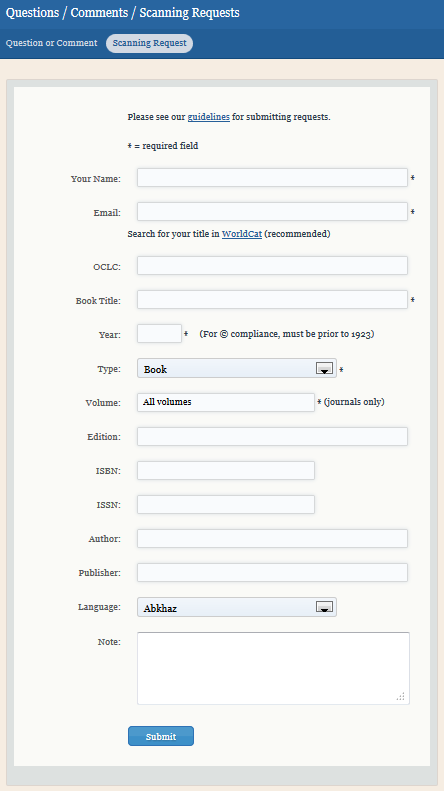
Members of the BHL user community are constantly helping our staff improve the quality of the BHL by requesting titles for inclusion and pointing out gaps in serials. A large portion of my duties consists of investigating these user submitted scan requests.
View Full Size Image
I begin by confirming that the requested item isn’t in BHL already.  Sometimes scan requests lead to the discovery of a mislabeled scan or to duplicate entries containing different volumes of the same title.  It’s great when I can satisfy a user request immediately by locating a difficult-to-find item in the BHL, and then make some changes so that it is more easily discovered by the next person.
If an item isn’t in the BHL, I check our queue to see if the item is already in progress.  We have over 1,000 issues open at any given moment, so it is not unusual for me to find that we are already hard at work on a particular scan request.
If the item is not already in progress, I will check to see if any of BHL’s member libraries holds the requested material and assign the scan accordingly.  An issue may be reassigned a number of times as institutions discover that their items are unable to be scanned, or that they lack specific volumes.  It is wonderful to see BHL collaboration in action as many partner libraries bring their collections together, digitally, in order to complete a series.
 
Submit Feedback!
I encourage you to take advantage of our feedback system. Our users make it possible for the Biodiversity Heritage Library to continually improve its offerings.  Our partners’ scanning priorities, our website’s design, the data export options that we offer, the goals we set for our project, and the social media platforms we embrace are all influenced though input from our users. We love to hear about how the BHL has aided the research of people around the world, and enjoy sharing some of the stories we hear in our BHL and Our Users feature.
Be part of the conversation!
August 21, 2013by Kathryn Stine
Blog Reel, Featured Books

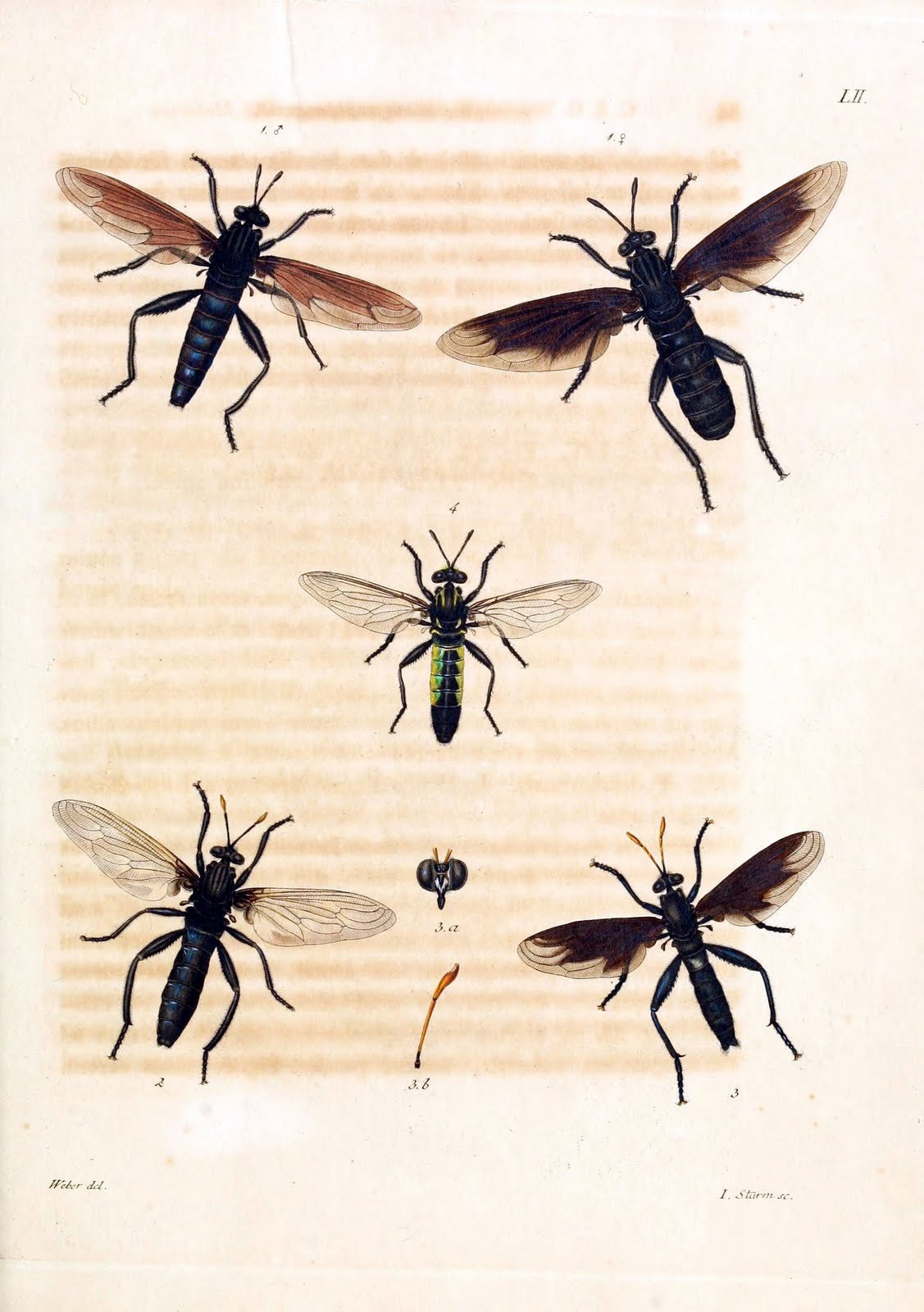
Book of the Week: A Study in Flies

View Full Size Image

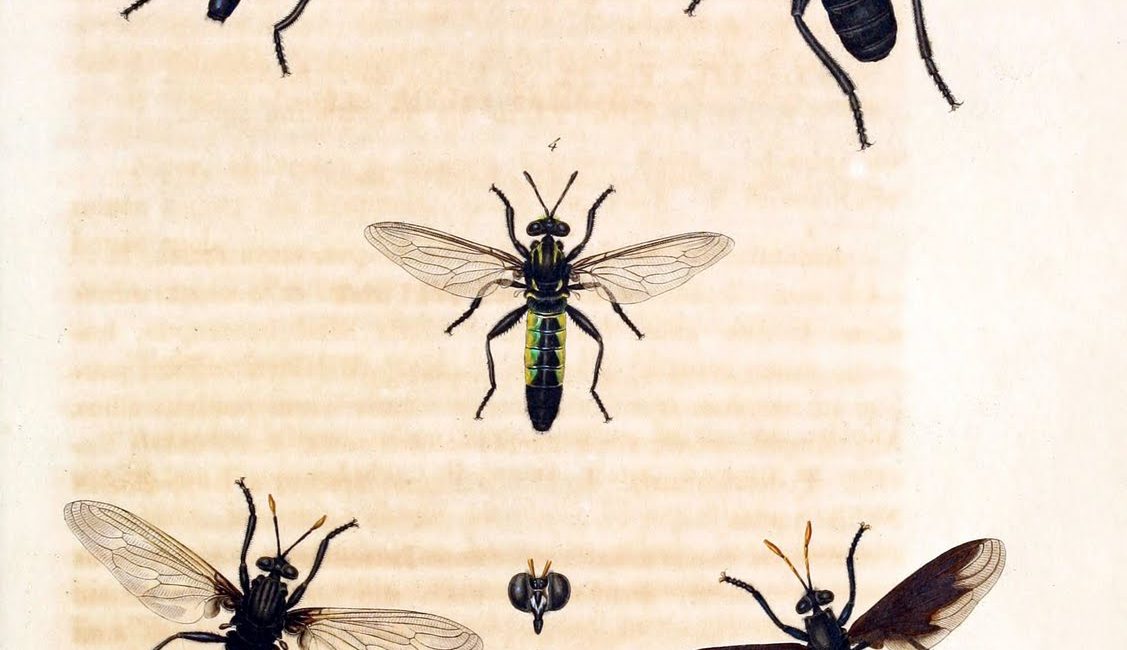
This week, we featured one of our BHL users, Dr. Torsten Dikow, in our regular blog series, BHL and our Users. With a focus on flies in his research, Dr. Dikow identified his favorite book in BHL, which we’re highlighting today as our book of the week. As Dr. Dikow stated when asked about his favorite item in BHL,

“Well, there are so many beautiful and scientifically important items on the BHL, but I would probably go with a study on flies from 1831: Monographia Generis Midarum by C.R.W. Wiedemann. Just look at the beautiful color drawings of these flies, including some of the largest known flies from South America. Only very few scientists would have access to this rare book and would be able to admire these color illustrations if it had not been digitized by BHL.”

To give you a little background on the author, Christian Rudolph Wilhelm Wiedemann, a German physician, historian, naturalist, and entomologist, is best known for his studies of world Diptera. The author of the first monographs on “exotic” or non-European Diptera, his descriptions of the species portray many advances over others working in his field, including “a brief Latin diagnosis, a fuller detailed description in German, the sex of the specimen, locality details, a reference to the collection in which the specimen was to be found and, sometimes, the name of the collector.” His work with Johann Christian Ludwig Hellwig and Johann Karl Wilhelm Illiger set “new standards for descriptions (uniform terminology for structures and colour) and for nomenclature, especially in regard to the avoidance of synonyms by proper research of pre-existing literature.” Of course, we can’t help but wonder how much easier their research would have been had BHL been around ;-).

Wiedemann’s collection of Diptera and Hymenoptera can now be found at the Natural History Museum (Vienna), Senckenberg Museum (Frankfurt), and the Zoological Museum at the University of Copenhagen. The portion of the collection at the University of Copenhagen is detailed online.

Our book of the week describes flies of the family Mydidae, which includes large flies, one of which is the largest known fly in the world, Gauromydas heros. Found mostly in arid regions, little is known of Mydidae biology as they are not often encountered due to the brevity of their adult life span. Recent classification changes in the family resulted in the inclusion of genera formerly in the family Apioceridae.

Thank you, Dr. Dikow, for highlighting this book. It truly is a masterpiece worthy of note! We encourage our users to take some time to view the beautiful illustrations of the rare Diptera found within Monographia Generis Midarum.

This week’s book of the week, Monographia Generis Midarum (1831), by Christian Rudolph Wilhelm Wiedemann, was contributed by the Smithsonian Institution.

May 12, 2011by michelle.underhill
Page 2 of 2«12

Help Support BHL

BHL's existence depends on the financial support of its patrons. Help us keep this free resource alive!

search

About BHL

The Biodiversity Heritage Library (BHL) is the world’s largest open access digital library for biodiversity literature and archives. BHL operates as a worldwide consortium of natural history, botanical, research, and national libraries working together to digitize the natural history literature held in their collections and make it freely available for open access as part of a global “biodiversity community.”

Join Our Mailing List

Sign up to receive the latest news, content highlights, and promotions.

Subscribe Now

Subscribe to Blog via Email

Enter your email address to subscribe to this blog and receive notifications of new posts by email.

Join 319 other subscribers

Subscribe to Blog Via RSS

Subscribe to the blog RSS feed to stay up-to-date on all the latest BHL posts.

Access RSS Feed

Inspiring Discovery through Free Access to Biodiversity Knowledge.

The Biodiversity Heritage Library makes it easier than ever for you to access the information you need to study and explore life on Earth…for free, anytime, anywhere.


64+ Million Pages of
Biodiversity Literature Online.

EXPLORE

Tools and Services
to Transform Research.

EXPLORE

300,000+
Illustrations on Flickr.

EXPLORE

ABOUT | HARMFUL CONTENT | PRIVACY | SITE MAP | TERMS OF USE